Sorry, There is No Snooze Button

Matthew 24: 36-44

36“But about that day and hour no one knows, neither the angels of heaven, nor the Son, but only the Father. 37For as the days of Noah were, so will be the coming of the Son of Man. 38For as in those days before the flood they were eating and drinking, marrying and giving in marriage, until the day Noah entered the ark, 39and they knew nothing until the flood came and swept them all away, so too will be the coming of the Son of Man. 40Then two will be in the field; one will be taken and one will be left. 41Two women will be grinding meal together; one will be taken and one will be left. 42Keep awake therefore, for you do not know on what day your Lord is coming. 43But understand this: if the owner of the house had known in what part of the night the thief was coming, he would have stayed awake and would not have let his house be broken into. 44Therefore you also must be ready, for the Son of Man is coming at an unexpected hour.

You know that moment in the darkness of the early morning when the first light begins to peak in over the horizon and make its way through your bedroom window?  You know better than to look at it, knowing it will surely sting your eyes that are groggy from hours of being closed off to the world.  So you look away, trying to let your eyes get used to it.  And slowly, very slowly the new morning begins to come into focus.  At that point you don’t know what the day holds-you don’t know what will go as planned and what will not.  You do not know what you will learn or what you will lose or what you will gain.  But, no matter what, you have to get up.  WAKE UP!

Today we find ourselves about halfway through this Advent season, halfway through our waiting, our preparing, our looking at ourselves in a new way, our listening, our remembering, our looking forward….zzzzzzz…..WAKE UP!  It’s time to wake up. And sorry, there is no snooze button.

Theologian William Long equates Advent to an “echo chamber” that heightens our senses, that makes us realize that those small sounds of salvation that we hear are all around us.  I think it holds the sounds of the past and the future that reverberate in our present and reminds us that salvation is not something “out there” or, even worse, “up there”.  Whatever you may think that heaven or whatever is next is, it is not way up ahead.  It is not shielded from view.  It is all around us.  The air is thick with God’s presence.  Barbara Brown Taylor says that “Earth is so thick with divine possibility that it is a wonder we can walk anywhere without cracking our shins on altars.” The only reason it is veiled is that we have too much clouding our view and we’re not yet prepared to see.

The vision is ever and ever closer.  We cannot be lulled into a comfortable, sleepy complacency.  Think about this.  Years ago, a Lutheran preacher, Edmund Steimle, preached a Christmas Eve sermon entitled “The Eye of the Storm”.  He compared that serene view of Christmas Eve, the stuff that is depicted as we sing “Silent Night” and light our candles, to the eye of a hurricane.  We’re familiar with that.  The winds swirl and the rains come until we almost cannot bear it.  And then they stop.  And the calm descends upon us.  But, lest we get too comfortable, we are reminded that they will come again, seemingly unwinding themselves from where they were before.  We just have to stay awake because God is in it all, both darkness and light.  Robert Benson has a book entitled “Punching Holes in the Dark”.  In it, he speaks of our faith journey as being one where we are called to continually punch holes in the darkness so that more and more of the light will be able to enter.  But we have to be awake to do that.  And being awake, being ready, is not something to be feared.  It is a gift.  It is us at our fullest self.

A legend tells how, at the beginning of time, God resolved to hide within the Creation that God had made.  As God was wondering how best to do this, the angels gathered around.  “I want to hide myself somewhere in Creation,” God told them.  “I need to find a place that is not too easily discovered, for it is in their search for me that my creations will grow in spirit and in understanding.”  “Why don’t you hide yourself deep in their earth?” the first angel suggested.  God pondered this idea for a while, then replied, “No, it will not be long before they mine the earth and discover the treasures that it contains.  They will discover me too quickly, and they will not have had enough time to do their growing.”  “Why don’t you hide yourself in their moon?” a second angel suggested.  God thought about this idea for a while, and then replied, “No, it will take a little longer, but before long they will learn to fly through space and will find their way there and know its secrets.  They will discover me too soon, before they have grown enough.”  The angels were at a loss to know what hiding places to suggest.  There was a long silence.  “I know,” piped up one angel, finally.  “Why don’t you hide yourself within their own hearts?  They will never think of looking there!”  “That’s it!”, said God, delighted to have found the perfect hiding place.  And so it is that God hides secretly deep within the heart and soul of every one of God’s creatures, until that creature has grown enough in spirit and in understanding to risk the great journey into the secret core of its own being.  And there, awakened, the creature discovers its creator, and is rejoined to God for all eternity.” (From “One Hundred Wisdom Stories From Around the World,” by Margaret Silf, p. 32-33)

So, Advent comes and disrupts our comfortable lives.  And we are called to wake up to God breaking through the darkness into our lives—2,000 years ago, in the promised future, and even today if we will only awaken to the dawn.   Ralph Waldo Emerson once said that “people only see what they are prepared to see.”  That’s what we’ve been doing—preparing to see.

The curtain is rising.  Jesus is not waiting in the wings somewhere until the play is done; rather, Jesus is standing on the stage itself, inviting us in. “Come, awaken, wait with me.  You do not know when the Glory will come but this waiting is a holy place.  Stay awake so that you won’t miss the inbreaking of the Divine itself, the dawn of the fullness of the Kingdom of God.”  The reason we read this passage that begins at the end is because it is the same as the beginning.  God is the Alpha and the Omega.  Birth and death are all wrapped up together, needing each other to give life.  Awaken now so that you do not miss one thing.  Open your eyes.  We’re halfway there!  The baby is coming!  The extraordinary miracle of what is about to happen is matched only by the moment before it does—this moment, this time.  The world awaits!  Awaken that you do not miss the story!

So, are you awake?  When God is ready, God will come.  Watch…for you know not when or where God comes.  Watch, that you might be found whenever, wherever God comes. WAKE UP! so you don’t miss one glorious thing.

We may ignore, but we can nowhere evade, the presence of God. The world is crowded with [God]. God walks everywhere incognito. And the incognito is not always easy to penetrate. The real labor is to remember to attend. In fact to come awake. Still more to remain awake. (C.S. Lewis)

Grace and Peace,

Shelli

Shoots and Branches

“Peaceable Kingdom”, John Swanson, 1994

Isaiah 11: 1-6 (7-8) 9-10

A shoot shall come out from the stump of Jesse, and a branch shall grow out of his roots. 2The spirit of the Lord shall rest on him, the spirit of wisdom and understanding, the spirit of counsel and might, the spirit of knowledge and the fear of the Lord. 3His delight shall be in the fear of the Lord. He shall not judge by what his eyes see, or decide by what his ears hear; 4but with righteousness he shall judge the poor, and decide with equity for the meek of the earth; he shall strike the earth with the rod of his mouth, and with the breath of his lips he shall kill the wicked. 5Righteousness shall be the belt around his waist, and faithfulness the belt around his loins. 6The wolf shall live with the lamb, the leopard shall lie down with the kid, the calf and the lion and the fatling together, and a little child shall lead them… 9They will not hurt or destroy on all my holy mountain; for the earth will be full of the knowledge of the Lord as the waters cover the sea.  10On that day the root of Jesse shall stand as a signal to the peoples; the nations shall inquire of him, and his dwelling shall be glorious.

So, once again we read yet another passage about that future vision that God holds for us—you know, the one that we’re walking toward, the one that we are supposed to be a part of bringing to be, the one that God promised us.  We are given a vision of a shoot, a new shoot that will come out of the dead and decaying stump of the past, a branch that will come out of the original roots of our faith and our lives. It doesn’t replace the old; it just continues growing.

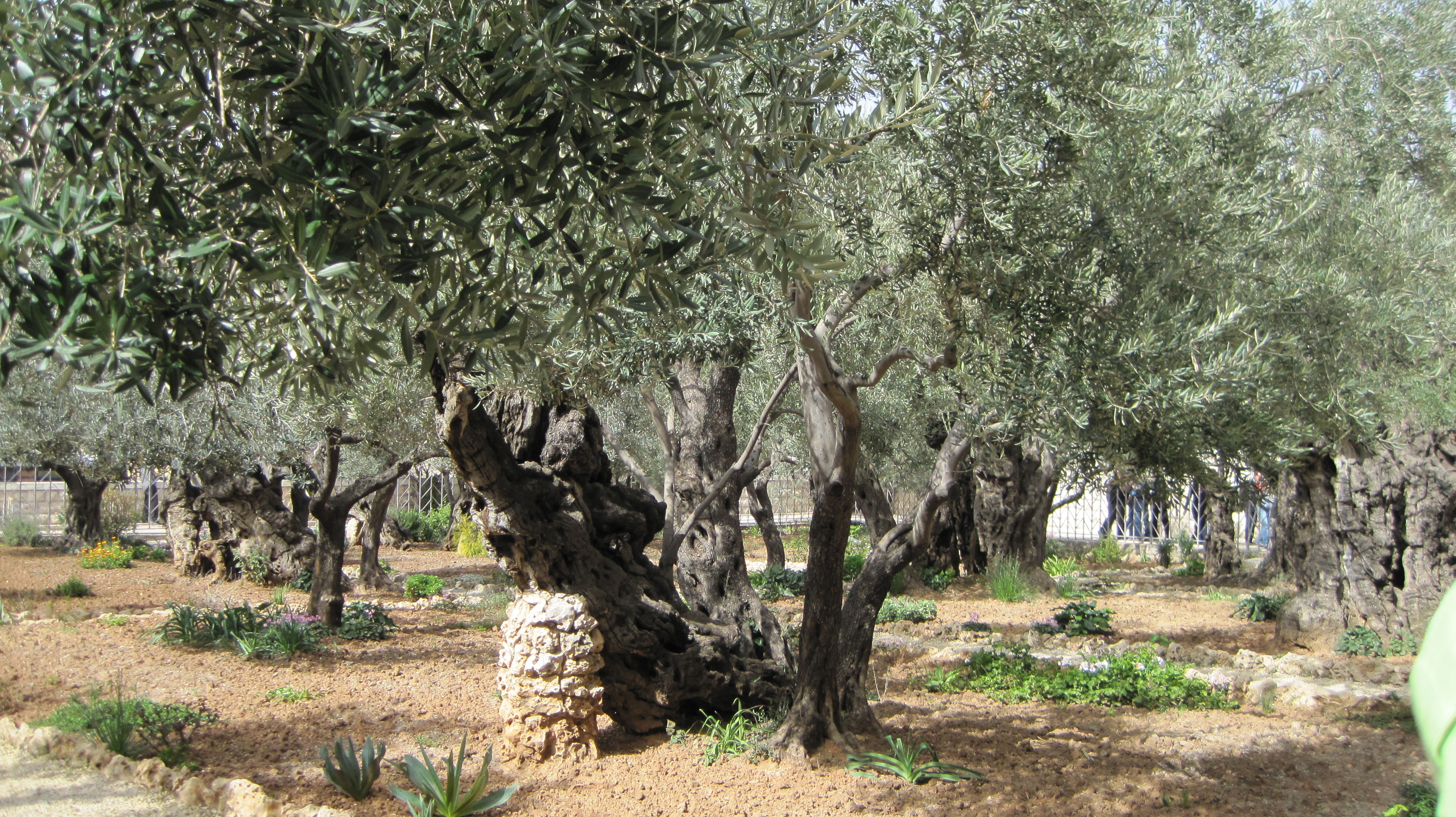
Garden of Gethsemane, Jerusalem, Israel

I have a picture of an olive tree that I took in the Garden of Gethsemane.  Olive trees will actually live for centuries, sprouting new life over and over again.  If you look at this picture, the thing on the left side that looks like a dead and decaying stump (because, well, that’s essentially what it is) is what is left of a tree that was probably in that place 2,000 years ago.  Imagine…that is what is left of a tree that might have been there that night before the Crucifixion as Jesus prayed and submitted his own life to God.  And from that stump came another shoot, that grew into a tree that is probably about 1,000 years old.  And to the right of it is yet another stump that may be 200 years old or so.  And from that is a newer shoot, a live, growing tree that is just a few years old.  It is a picture of new shoots, new creations that God is always creating and always nurturing into being.  But they exist together, sprouting from each other’s strengths into new life.

So, how do we live as new shoots?  How do we embrace that vision we’ve been given and make it part of us?  The message that Advent brings is that God loves us enough to keep showing up—in a vision laid out for us to embrace, in Emmanuel, God-With-Us, and over and over again as God walks with us through our own becoming a new creation.  Maybe the question is whether or not we are holding on to what we know or are we new shoots, giving the old new life?  This is not just a rehash of the same old thing.  William Sloane Coffin once said that “believers know that while our values are embodied in tradition, our hopes are always located in change.”  But change is often uncomfortable.  Change is unpredictable.  Change is hard.  Maybe we can just get through this busy season and then change. 

A couple of years ago, the Today Show had a feature story about some young Panda bears who had been brought up in captivity.  But the plan was to eventually return them to their natural habitat.  So, in order to prepare them for what was to come, their caretakers thought that it would be better if they had no human contact.  So to care for them, the people dressed up like panda bears.  In order to show them how to be pandas, they became them.

I think that’s been done before!  In its simplest form, the Incarnation is God’s mingling of God with humanity.  It is God becoming human and breathing a piece of the Divine into humanity.  It is the mystery of life that always was coming into all life yet to be.  God became human and lived here.  God became us that we might change the world.   God became like us to show us what it meant for us to be like God envisioned (not to be God, not even to be “Godly”, but to be just like God envisioned we could be) in the world.  God didn’t walk this earth to teach us to be divine; God came to show us what it means to be human–caring, loving humans that envision that the world could be different.  The miracle of the birth of the Christ child is that God now comes through us.  We ARE the new shoots of transformation.

So perhaps the reason that the earth is not yet filled with the knowledge of the Lord, that the Reign of God has not come into its fullness, that poverty and homelessness and injustice and war still exists is because we do not dare to imagine it any other way.  This is not some vision of an inaccessible utopian paradise; this is the vision of God.  The passage says that a shoot shall come out of the stump and a branch shall grow out of the roots.  In other words, life shall spring from that which is dead and discarded.  Because in God’s eyes, even death has the foundation, the roots of life.  Even death will not have the last word.  We just have to imagine it into being.  So, imagine beyond all your imaginings; envision a world beyond all you dare to see; and hope for a life greater than anything that is possible.  Imagine what it means to become a new shoot and prepare yourself to be just that. And then you’ll start to be.

Only those who live beyond themselves ever become fully themselves. (Joan Chittister)

Grace and Peace,

Shelli

Preparing for What Is Next

Malachi 3: 1-3

See, I am sending my messenger to prepare the way before me, and the Lord whom you seek will suddenly come to his temple. The messenger of the covenant in whom you delight—indeed, he is coming, says the Lord of hosts. 2But who can endure the day of his coming, and who can stand when he appears? For he is like a refiner’s fire and like fullers’ soap; 3he will sit as a refiner and purifier of silver, and he will purify the descendants of Levi and refine them like gold and silver, until they present offerings to the Lord in righteousness.

We all know that Advent is the Season of Preparation.  And each of us is all too aware how much preparation that really entails and what we have to do over the next 19 days (Ahem…19 days!).  But, sadly, most of us are kind of missing the point.  Advent is not just meant to be a 4-week lead up to the big day.  It’s really it’s own thing.  And in this time, we are called to prepare ourselves by allowing God to guide us down a new pathway so we really will be ready for what is next.  But we have to be open to change.  We have to be open to BEING changed.  It’s not easy.  It was never promised that it would be easy.  This season is about more than preparing or getting ready for Jesus’ coming.  It is also about preparing ourselves, opening our hearts to the change that comes with that.

The passage from Malachi echoes that same thing.  Malachi literally means “messenger”.  We don’t know if that was someone’s name or what.  But the messenger carries a promise of God’s coming, a promise we’ve heard before.  But this time it is compared to a refiner’s fire or fuller’s soap that will reform the society in preparation for the day of the Lord’s coming. 

But we’re probably a bit uncomfortable with the whole fire thing.  Fire is destructive.  Fire burns.  But it also purifies.  It purifies by burning away the ore so that the precious metal inside is revealed.  It is intense.  But the point is that one has to get close enough to the fire to work with the metal for that to happen.  It is risky.  It might even be painful.  But it is the only way for all the impurities to be gone.  We have to endure our own impurities, our own shortcomings, being burned away until we are made new.  Part of it is up to us.

I’ve used this before but there is a wonderful illustration from an unknown author that tells the story of a woman watching a silversmith at work.  “But Sir,” she said, “do you sit while the work of refining is going on?” “Oh, yes madam, “replied the silversmith, “I must sit with my eye steadily fixed on the furnace, for if the time necessary for refining be exceeded in the slightest degree, the silver will be injured.” So as the lady was leaving the shop, the silversmith  called her back, and said he had still further to mention, that he only knows when the process of purifying was complete, by seeing his own image reflected in the silver.

That’s what God is doing for us—refining our lives, preparing them, burning away the impurities until God’s own image in which we are made is finally revealed.  John Wesley would have called the journey of sanctification, or going onto perfection in Christ.  And then this image of the fuller’s soap may be lost on us who are more accustomed to throwing Tide pods in a washing machine.  When the weaving of a fabric is complete, it is sent to a fuller, who cleans it and gets rid of the loose threads and makes it more tightly bound together.  The process means that the fabric becomes “full”, just as our lives do on this journey toward the Divine.

But we tend to concentrate on the easy and enjoyable part of God’s coming, focusing solely on a God who will make our lives better.  In that way, we are no different than those that looked for the Messiah the first time.  The truth is, as Dietrich Bonhoeffer said in a 1928 Advent sermon, “We [become] indifferent to the message, taking only the pleasant and agreeable out of it and forgetting the serious aspect, that the God of the world draws near to the people of our little earth and lays claim to us.”  Lays claim…asks us to change…asks us to become something new…asks us to let go of all those things that we hold, of all that we are so trying to control in our lives and travel down the pathway that God has laid.  Prepare the way?  Yeah…it’s not talking about your Christmas decorations; It’s talking about YOU.  It’s talking about preparing yourself for what is next.

Make many acts of love, for they set the soul on fire and make it gentle.  (Mother Teresa)

Grace and Peace,

Shelli

Shhh…You’re Supposed to Be Listening

There were some problems with this post, so I apologize if you’re getting this a second time!

Psalm 29: 3-9

3The voice of the Lord is over the waters; the God of glory thunders, the Lord, over mighty waters. 4The voice of the Lord is powerful; the voice of the Lord is full of majesty. 5The voice of the Lord breaks the cedars; the Lord breaks the cedars of Lebanon. 6He makes Lebanon skip like a calf, and Sirion like a young wild ox. 7The voice of the Lord flashes forth flames of fire. 8The voice of the Lord shakes the wilderness; the Lord shakes the wilderness of Kadesh. 9The voice of the Lord causes the oaks to whirl, and strips the forest bare; and in his temple all say, “Glory!”

The voice of the Lord…God’s voice…listen…

Most humans don’t listen that well.  We like talking, filling our lives with our own thoughts and our own opinions and, at times, our own bloviations.  And think what we miss!  Is it possible that in our call to wait during this season, we are also being reminded to listen, to listen for God’s voice?  You know, when you read the Old Testament, there are lots of places where people are convinced that they hear God’s voice, that they hear God calling to them.  And God tells them to go from where they are or follow a star or climb a mountain or cross a sea or listen to a burning bush. So, did God quit talking?  Or did we quit listening?

God’s voice comes to us in a myriad of ways—nature, animals, others, our own conscience, our own thoughts (if we listen to them rather than feeling like we need to spit them out into the world before they’re fully formed), and music of all kinds.  I often hear God in music.  I think it’s because music breaks in and seeps into us.  It quiets us.  It teaches us to LISTEN, to listen to something other than our own voice.  Joan Chittister said that “music is the only sound of heaven we’ve ever been given…music is where the soul goes to put into notes what cannot be said in words.”  That’s why music crosses languages.  I listen to lots of music for which I can’t understand the words and, yet, I do understand them. 

That’s the way we need to learn to listen—not to know what words are being used but to learn to let what we hear penetrate deep into our souls.  We will hear God’s voice but it may not be in the words or the language to which we are accustomed.  It may be a song we’ve never heard.   This is the season when we stop and learn to listen for God’s voice.  It’s there.  But we have to listen. 

So, I found this video.  It’s a little different but I think it says a lot.  It teaches us to listen…and to sing.  It teaches us to respond to the music we hear.  (I WOULD turn the sound down a bit if you’re next to your dog.)

Down in the forest 
We'll sing a chorus  
One that everybody knows 
Hands held higher  
We'll be on fire  
Singing songs that nobody wrote (Wolf Conservation Center)

But ask the animals, and they will teach you… (Job 12:7)

In this our Season of Waiting, we are learning to listen, to listen to God’s voice.  It’s there.  It’s everywhere. It surrounds us, goes before us, follows us, and seeps into us. It’s leading us to that for which we are waiting.  But we have to stop.  And we have to listen.  It happens in the silence, the holy silence, the spaces between our words.  It happens in OUR silence.  See, Creation is full of songs of all types.  It never stops.  It never sleeps.  It is always there.  We don’t have to know the words.  We just have to listen.  When we are silent, we will hear the music around us.  And it will become a part of us.  And we will recognize it when it does.  Because we’ve heard it before.  It is God’s gift.  It is God’s voice.  Shhhhh….You’re supposed to be listening.

I just couldn’t help myself. The gates were open and the hills were beckoning…I can’t seem to stop singing wherever I am. (Maria, from…”The Sound of Music”)

Grace and Peace,

Shelli

Shhh…You’re Supposed to Be Listening

Psalm 29: 3-9

3The voice of the Lord is over the waters; the God of glory thunders, the Lord, over mighty waters. 4The voice of the Lord is powerful; the voice of the Lord is full of majesty. 5The voice of the Lord breaks the cedars; the Lord breaks the cedars of Lebanon. 6He makes Lebanon skip like a calf, and Sirion like a young wild ox. 7The voice of the Lord flashes forth flames of fire. 8The voice of the Lord shakes the wilderness; the Lord shakes the wilderness of Kadesh. 9The voice of the Lord causes the oaks to whirl, and strips the forest bare; and in his temple all say, “Glory!”

The voice of the Lord…God’s voice…listen…

Most humans don’t listen that well.  We like talking, filling our lives with our own thoughts and our own opinions and, at times, our own bloviations.  And think what we miss!  Is it possible that in our call to wait during this season, we are also being reminded to listen, to listen for God’s voice?  You know, when you read the Old Testament, there are lots of places where people are convinced that they hear God’s voice, that they hear God calling to them.  And God tells them to go from where they are or follow a star or climb a mountain or cross a sea or listen to a burning bush. So, did God quit talking?  Or did we quit listening?

God’s voice comes to us in a myriad of ways—nature, animals, others, our own conscience, our own thoughts (if we listen to them rather than feeling like we need to spit them out into the world before they’re fully formed), and music of all kinds.  I often hear God in music.  I think it’s because music breaks in and seeps into us.  It quiets us.  It teaches us to LISTEN, to listen to something other than our own voice.  Joan Chittister said that “music is the only sound of heaven we’ve ever been given…music is where the soul goes to put into notes what cannot be said in words.”  That’s why music crosses languages.  I listen to lots of music for which I can’t understand the words and, yet, I do understand them. 

That’s the way we need to learn to listen—not to know what words are being used but to learn to let what we hear penetrate deep into our souls.  We will hear God’s voice but it may not be in the words or the language to which we are accustomed.  It may be a song we’ve never heard.   This is the season when we stop and learn to listen for God’s voice.  It’s there.  But we have to listen. 

So, I found this video.  It’s a little different but I think it says a lot.  It teaches us to listen…and to sing.  It teaches us to respond to the music we hear.  (I WOULD turn the sound down a bit if you’re next to your dog.)

Down in the forest 
We'll sing a chorus  
One that everybody knows 
Hands held higher  
We'll be on fire  
Singing songs that nobody wrote (Wolf Conservation Center)

But ask the animals, and they will teach you… (Job 12:7)

In this our Season of Waiting, we are learning to listen, to listen to God’s voice.  It’s there.  It’s everywhere. It surrounds us, goes before us, follows us, and seeps into us. It’s leading us to that for which we are waiting.  But we have to stop.  And we have to listen.  It happens in the silence, the holy silence, the spaces between our words.  It happens in OUR silence.  See, Creation is full of songs of all types.  It never stops.  It never sleeps.  It is always there.  We don’t have to know the words.  We just have to listen.  When we are silent, we will hear the music around us.  And it will become a part of us.  And we will recognize it when it does.  Because we’ve heard it before.  It is God’s gift.  It is God’s voice.  Shhhhh….You’re supposed to be listening.

I just couldn’t help myself. The gates were open and the hills were beckoning…I can’t seem to stop singing wherever I am. (Maria, from…”The Sound of Music”)

Grace and Peace,

Shelli

An Active Imagination

“Peaceable Kingdom”, John August Swanson, 1994

Amos 9: 13-15

13The time is surely coming, says the Lord, when the one who plows shall overtake the one who reaps, and the treader of grapes the one who sows the seed; the mountains shall drip sweet wine, and all the hills shall flow with it. 14I will restore the fortunes of my people Israel, and they shall rebuild the ruined cities and inhabit them; they shall plant vineyards and drink their wine, and they shall make gardens and eat their fruit. 15I will plant them upon their land, and they shall never again be plucked up out of the land that I have given them, says the Lord your God.

So, out here in the wilderness, what are we supposed to do while we wait for things to get better?  I mean, faith is about waiting, yes.  But faith is also about doing. Faith is supposed to be active, right?  So what are we supposed to be DOING during this wilderness time?  And how can we find out more about when this will actually resolve?

We 21st century journeyers struggle with the unknown, with just leaving things to chance, with admitting that perhaps there are those aspects of our journey that are not for us to know now. That is what Advent does for us…it points us toward mystery. Some would equate that to nothingness or, perhaps, even to darkness–unknown, foreboding, maybe even a little dangerous. But God came and comes over and over again. I think that God’s coming does not, much to some of our chagrin, bring with it the surety that we might like. In fact, knowing everything that’s ahead, being so absolutely sure of how everything is going to turn out, is surely the death of our faith.  Because if you are so sure of everything, why would you need faith at all?  God doesn’t give us surety; God instead instills faith in us to lead us through the darkness.

It is our faith that opens the door to our imagination.  And it is our imagination that strengthens our faith.   God says…walk with me awhile my child and look…look far beyond where you can see…listen far beyond where you can hear…journey far beyond where you think you belong…and there, there I will be, and there will be the Creation that I have created for you. You can’t see it right now.  But you can imagine it. 

Imagination is not some remnant of our childhood that we were supposed to lose as we matured.  It is part of us and it matures with us.  A mature imagination has no limits to what it can envision; it has no boundaries to what it can do.  A mature imagination steps beyond reason and intellect, not leaving them behind, but sweeping them into a new image, a vision of a New Creation.  A mature imagination is fueled by faith.  Our imagination takes us to the place to which God leads us.  Our imagination gives us a glimpse of the mystery that God has promised, the promise of new life.

Advent is about imagining.  Think of those that came more than 2,000 years before us.  They were imagining what the coming of the Messiah would mean.  Now they more than likely got it wrong.  But that’s not the point.  They were imagining a new Creation, a new way of being.  They were imagining that their lives would be better, that peace and justice would rule, that hunger and poverty would be no more.  They were imagining that they would find there way home.  And their faith walked them in that direction.  So, in this Advent so many years later, just imagine…

Your imagination is your preview of life’s coming attractions. (Albert Einstein)

Grace and Peace,

Shelli

Do This


jesus-in-the-garden-of-gethsemane-16-12-203Jesus, knowing that the Father had given all things into his hands, and that he had come from God and was going to God, 4got up from the table, took off his outer robe, and tied a towel around himself. 5Then he poured water into a basin and began to wash the disciples’ feet and to wipe them with the towel that was tied around him. 6He came to Simon Peter, who said to him, “Lord, are you going to wash my feet?” 7Jesus answered, “You do not know now what I am doing, but later you will understand.” 8Peter said to him, “You will never wash my feet.” Jesus answered, “Unless I wash you, you have no share with me.” 9Simon Peter said to him, “Lord, not my feet only but also my hands and my head!” 10Jesus said to him, “One who has bathed does not need to wash, except for the feet, but is entirely clean. And you are clean, though not all of you.” 11For he knew who was to betray him; for this reason he said, “Not all of you are clean.” 12After he had washed their feet, had put on his robe, and had returned to the table, he said to them, “Do you know what I have done to you? 13You call me Teacher and Lord—and you are right, for that is what I am. 14So if I, your Lord and Teacher, have washed your feet, you also ought to wash one another’s feet. 15For I have set you an example, that you also should do as I have done to you.16Very truly, I tell you, servants are not greater than their master, nor are messengers greater than the one who sent them. 17If you know these things, you are blessed if you do them. (John 13: 3-17)

I thought of that last night that we were together.  It was wonderful.  It was a cool evening and the breeze was blowing into the room through the open windows.  All of our family was there and all of Jesus’ friends were all together at a table near the door.  It was the Passover festival and we so enjoyed ourselves.  Jesus sat next to me.  He had been unusually pensive, almost as if he were grieving.  Several times he looked around the room with a faraway look in his eyes.  He put his hand on my shoulder and then he got up and went over and joined his friends.  They had all been through so much and they finally seemed to be enjoying themselves.  I turned back to the table to talk to the family and when I looked again, Jesus was kneeling down and washing the disciples’ feet.

I couldn’t take my eyes off of him.  Most had seen him as a leader of those men that could at times be almost over-zealous.  But the one I knew was kneeling there—compassionate, loving, almost a servant.  I realize now that he was showing us who we should be.  He was showing us how to love one another, how to put others first, how to see God in others’ eyes.  I feel so blessed to be able to say how much I learned from him.  Many parents cannot say that.  I learned to love; I learned to be gentle and compassionate; I learned to serve.  I am certain that future generations will picture this night and see only Jesus and his disciples.  But it was Passover.  We were all there.  We were all watching, although we were careful not to disturb the certain intimacy that was in that moment.  We did not understand in the moment what the next day would hold but we knew that this was a special time and a special place.

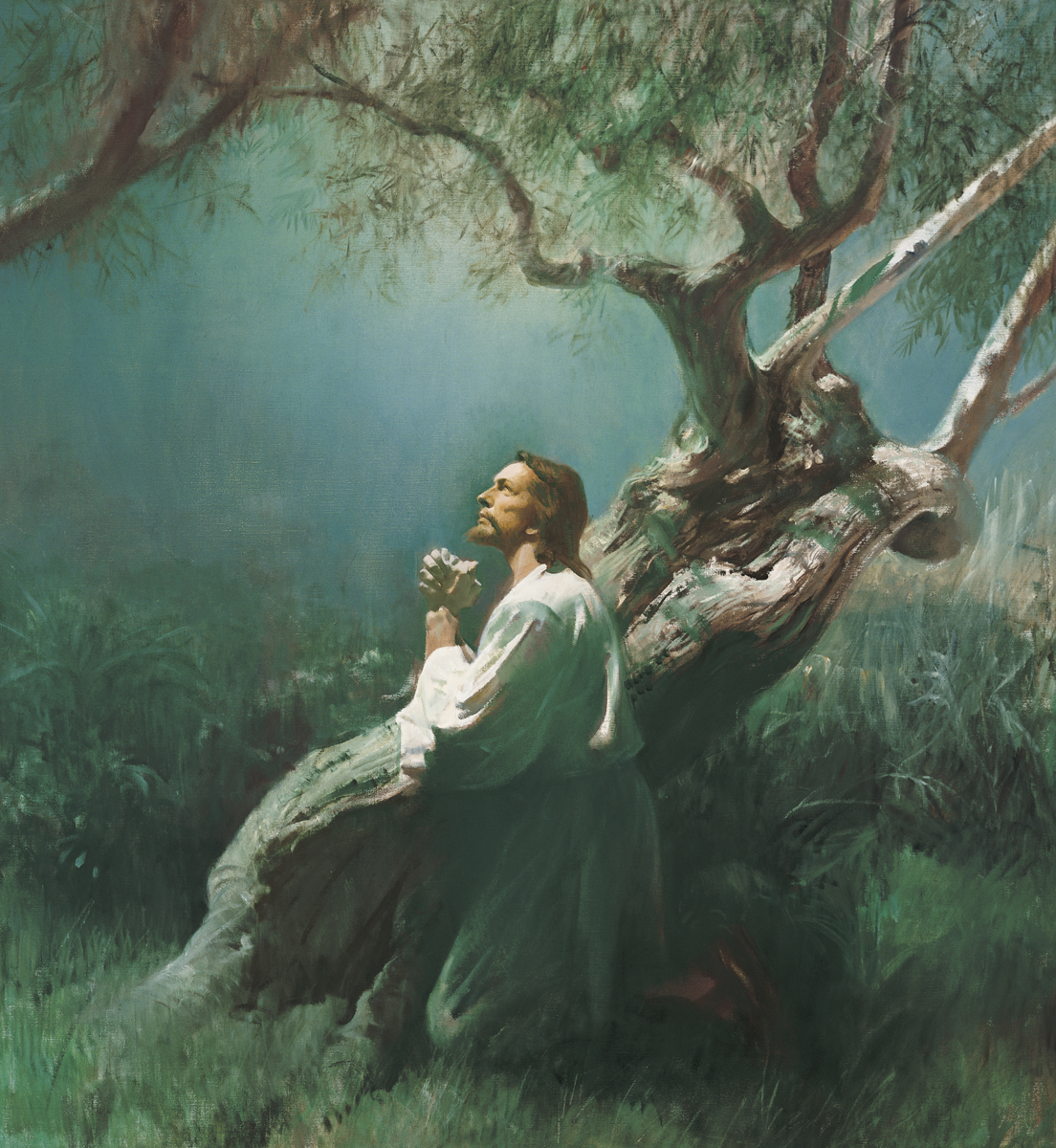
I didn’t go with them when they left and walked down to the Garden.  I wish I had.  I know that I couldn’t have done anything, but maybe I could have comforted him or something.  There in the garden, Jesus was arrested.  It was said that one of the disciples had betrayed him, pointing him out to the guards.  I didn’t concentrate too much on that.  All I know is that they took him away that night and I would never be able to hold him again.  Now I know that what happened that evening would spark the change in the world.  What happened that evening to that baby that I held, the baby that I lifted out of that hay-filled stall so many years ago, would begin a sequence of events that I know now was God’s way of leading us all through the story, leading us all home.

In that Garden, Jesus surrendered not his innocence but his control.  And only in surrendering will we know what God intends for our life.  I see now that if Joseph and I had not surrendered so long ago, giving ourselves to whatever it was God had in store, that I would not have been blessed with this life that I’ve known.  But, more importantly, the story would have been different.  Each of us has a chance not to write our own chapter but to be a part of a story that is already beautifully written.  What Jesus taught me was that each of us has to do this.  God did not create us as robotic characters following the one in front of us.  Instead, God placed a tiny piece of the Godself in each of us.  It’s called free will.  God created us to choose.  And then on our journey of faith, we are asked to choose to surrender it back to God so that we will finally understand what it means to be loved by God.

It’s not what you do for God; it’s what God does for you.  Instead of trying to love God, just let God love you. (Richard Rohr)

FOR TODAY:  What is God asking you to surrender so that you can be a part of the story?

Peace to you in this often-hectic week,

Shelli