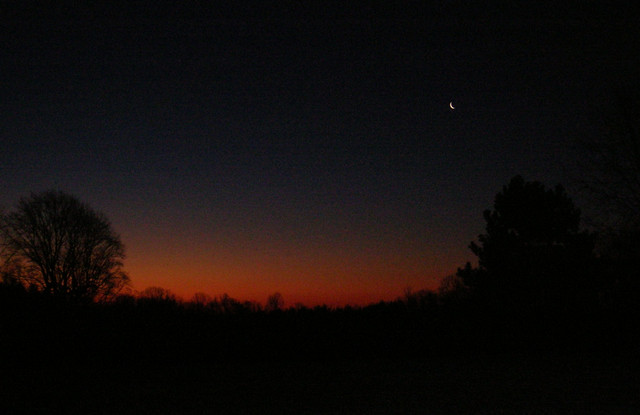
First Light

Scripture Passage:  Genesis 1: 1-5

In the beginning when God created the heavens and the earth, 2the earth was a formless void and darkness covered the face of the deep, while a wind from God swept over the face of the waters.  Then God said, “Let there be light”; and there was light. 4And God saw that the light was good; and God separated the light from the darkness. 5God called the light Day, and the darkness he called Night. And there was evening and there was morning, the first day.

Today is the winter solstice in the Northern Hemisphere, the shortest day (and the longest night) of the year.  This night that just ended in the wee hours of the morning was about 14 hours long in the southern part of the United States. If you live farther north, you had an even longer night.  In fact, the northernmost parts of Canada and Alaska had less than 3 hours of light.  (And winter has begun, so Happy Winter!)  The word “solstice” is derived from the Latin “solstitium”, from two words meanings “sun” and “stand still”.  Technically, this comes from the fact that during the days surrounding the solstice, the sun appears at its lowest point in the sky and then seems to have the same noontime elevation for several days in a row.  To early astronomers, the sun appeared to hang in the sky, suspended, paralyzed, as if waiting for some word to move on.

So today we read the passage that speaks of the first light, the first time that the light was spoken into being.  I think some people have this notion that nothing existed prior to that.  But it did.  God was there.  God was there in the midst of what is described as a formless, disordered void, as darkness that covered and consumed everything as winds swept over the waters.  There wasn’t “nothing”; there was a seemingly dark, chaotic, noisy something.  And then God, in God’s infinite wisdom, spoke the light into being.  And the light pushed its way into the darkness, parting the grasp on everything that the darkness had held.  Now note that this isn’t the sun.  (That came later.)  Sometimes we make the mistake of reading this passage and we tend to think of the sun as the source of all light.  But go back and read beyond the passage I showed.  The sun doesn’t come into play until the “fourth day” of the passage so there must have been eons of time between when light came to be and the creation of this sphere of hot plasma that reflects it.  The First Light was something different.  The First Light was a new creation, parting and intersecting the darkness, weakening its grasp on everything, and shining into what was ahead.  The First Light is what God created to lead the way to everything else.

It’s hard for us to get a sense of the profound sight of light dispelling utter darkness. We are seldom, if ever, in utter darkness.  We have the benefit of moonlight and stars and streetlights and car lights and the glow of cities that never really sleep.  Years ago I stepped into a small boat and floated through a glowworm cave at Doubtful Sound in Southwest New Zealand. (How odd, you say!) The cave was lit with artificial light that helped us maneuver our way to the deepest part of the cave.  And then they shut the lights off.  I have never been in darkness like that.  It was the kind of darkness that almost hurt your eyes as your brain’s memories of light bounced off of it and back.  There were no shadows, no rainbow-type rings around dim lights.  There were no forms of anything (huh…it was “formless”, to refer back to the Scripture passage!).  There was just darkness.  My three friends and I were in this boat with two Japanese tourists and two German tourists.  None of us spoke the other languages.  When the lights went off and the darkness consumed us, our initial response was to reach for each other and hold hands.  So, as I floated through this darkness in complete silence with only the sound of the water lapping at the boat, holding hands with my friend Debby and an older Japanese man that I had just met,  As the boat turned down another tunnel, we got our first glimpse.  It was only two or three or first but as we continued on, there were eventually millions of glowworms shining into the darkness.  We could see the cave, the boat, each other.  We sort of sheepishly dropped hands at that point as if we were somehow intruding into each other’s light.  But what I realized is that you can only see the First Light when you’re in the darkness.

Sometimes the darkness is just too overwhelming for words.  Even though this is a joyous season, the world is still hurting.  There is still violence and tragedy.  And for many of us in our personal lives, there is still pain of loss or hurt.  Some of us are grieving someone that is not here this Christmas.  Some of us are struggling with job loss or frustration or changes that we’re just not really ready to handle.  And we are all living in this almost surreal time created by a pandemic that is scary and all-consuming.  The promise of this season is not that there will be no darkness any more than the promise of this life is that there will never be sadness or grief or disappointment or depression or despair.  Life is full of shadows and longest nights.  Life is full of those times when we cannot see the light.  Life is full of roads on which we cannot see where to go to return from exile.  Life is full of poverty and destruction and terror.  And life is full of those times when we’re so afraid, we just want to hold hands in the darkness. 

But in the midst of the darkness, God dwells, unknown and mysterious, the Word that created and dwelled in the darkness even before light came to be.  And even in our darkest places, the first light begins to break through.  That, my friends, is indeed the message of the season.  God tiptoes into the night and gently, very gently, hands us hope for our world, peace for our souls, and light for our longest nights in the form of a baby who shows us the way to walk through the darkness so that everyone might begin to see the world through a new light.  When we are standing in the light, and we look at the darkness, we don’t see darkness.  Light does that—it teaches us to see even through the darkness. 

Maybe the reason we celebrate Christmas in the darkest week of the year is because for generations our ancestors have known that it is in the darkest darkness that we recognize the light of hope.  So in the midst of a season of darkness and endings, we choose to celebrate birth and beginnings.  Ralph Waldo Emerson once said that “when it is dark enough, [we] see the stars.” There is a Maori Proverb that says to turn your face to the [light] and the shadows will fall behind you.  Look, my friends…the Light is beginning to break, dispelling the darkness around us.  It is the First Light that shows us the beauty and leads us to everything else.  And it is very, very good.

Too many of us panic in the dark.  We don’t understand that it’s a holy dark and that the idea is to surrender to it and journey through to real light. (Sue Monk Kidd)

Grace and Peace,

Shelli

Magnificat

“The Magnificat, Therese Quinn, rsj, Sisters of St. Joseph of the Sacred Heart

Advent 4B Psalter:  Luke 1: 46-55

46And Mary said, “My soul magnifies the Lord, 47and my spirit rejoices in God my Savior, 48for he has looked with favor on the lowliness of his servant. Surely, from now on all generations will call me blessed; 49for the Mighty One has done great things for me, and holy is his name. 50His mercy is for those who fear him from generation to generation. 51He has shown strength with his arm; he has scattered the proud in the thoughts of their hearts. 52He has brought down the powerful from their thrones, and lifted up the lowly; 53he has filled the hungry with good things, and sent the rich away empty. 54He has helped his servant Israel, in remembrance of his mercy, 55according to the promise he made to our ancestors, to Abraham and to his descendants forever.” 

We love this passage.  It is Mary’s Song, the poetic rendering of her realization that she has truly been blessed, that she has been called to do what no one else has done, what no one else will do.  She has been called to give birth to God in this world, to deliver the promise that her people have always known.  But don’t get too lost in the poetry and the familiarity. American Methodist missionary E. Stanley Jones called The Magnificat “the most revolutionary document in the world”.  It is said that The Magnificat terrified the Russian Czars so much that they tried to dispel its reading.  More recently, it was banned in Argentina when the mothers of the disappeared used it to call for non-violent resistance.  In the 1980’s, the government of Guatemala banned its recitation.  It is an out and out call to revolution.  Less subversive language has started wars.  Edward F. Marquart depicts it as God’s “magna carta”.  It is the beginning of a new society, the preamble to a Constitution that most of us are not ready to embrace.  We’d rather chalk it up to the poetry of an innocent young woman and keep getting ready for Christmas.  But we can’t do that.  It’s something much, much more.

See, this is God’s vision for the world. It is not a world where the best and the brightest and the richest and the most powerful come out on top. It is not a world that we can control. It is not a world where we can earn what we have and deserve who we are. It is rather a world where God’s presence and God’s blessings are poured onto all. But it comes with a price. Those who have, those who are, those whose lives are filled with plenty are called to change, to open their lives to God and to others. Because God will scatter the proud, those who think they have it figured out, those who are so sure of their rightness and their righteousness.  In other words, those of us who think that we have it all nailed down will be shaken to our core.  The powerful–those with money, those with status, those with some false sense of who they are above others–will be brought down from their high places.  The poor and the disenfranchised, those who we think are not good enough or righteous enough, will be raised up. They will become the leaders, the powerful, the ones that we follow.  The hungry will feel pangs no more and those who have everything–the hoarders, the affluent, those are the ones whose coffers will be emptied to feed and house the world. 

God is about to turn the world upside-down.  Look around you.  This is not it; this is not what God had in mind.  And God started it all not by choosing a religious leader or a political dynamo or even a charismatic young preacher but a girl, a poor underage girl from a third-world country with dark skin and dark eyes whose family was apparently so questionable that they are not even mentioned and whose marital status seemed to teeter on the edge of acceptable society.  God picked the lowliest of the lowly to turn the world upside down.

But this is not some isolated poem in the middle of Mary’s story.  These words are the Gospel. Let me say that again.  These words ARE the Gospel.  If you were to put the Gospel into its Cliff Notes version, I would think you could take the words of The Magnificat, Matthew 22: 37-39 (love God, love neighbor), and Matthew 28:20b (“I am with you always until the end of the age.”) and have a pretty good idea of what Jesus was trying to say—love God, love each other, know that I am there, and let my vision be your world. 

There are those who will read this and dismiss it as some utopian socialist notion, something that flies in the face of our capitalistic society. I don’t think it’s either. God’s vision does not align with any form of government on this earth but is instead ordered with love and grace and abundant mercy. It is not a vision where everyone is treated the same; it is a vision where everyone is loved. So we are called to turn the world upside down, to be part of making a world where everyone is loved.

And when you’re turned upside down, things tend to spill. No longer can we hold onto what we know. No longer can we rest on the laurels of our past. If we’re going to be part of God’s vision of the world, we have to give up those things that are not part of it. We have to change, learn to live a new way, look upon the world and others not as competition, not as threats, but as the very vision of God pouring into the world. So, THIS Advent, what are you willing to let go of so that you will have room to offer a place for God? How willing are you to turn your world upside down? How are you being called to give birth to Christ in this world?

Into this world, this demented inn, in which there is absolutely no room for him at all, Christ has come uninvited. But because he cannot be at home in it, because he is out of place in it, and yet he must be in it, his place is with those others who do not belong, who are rejected by power, because they are regarded as weak, those who are discredited, who are denied the status of persons, tortured, exterminated. With those for whom there is no room, Christ is present in this world. (Thomas Merton)

God help us to change, To change ourselves and to change our world
To know the need of it. To deal with the pain of it
To feel the joy of it, To undertake the journey without undertaking the destination, The art of gentle revolution
—Michael Leunig

Grace and Peace,

Shelli

Let It Be

Advent 4B Lectionary Text:  Luke 1: 26-38

26In the sixth month the angel Gabriel was sent by God to a town in Galilee called Nazareth, 27to a virgin engaged to a man whose name was Joseph, of the house of David. The virgin’s name was Mary. 28And he came to her and said, “Greetings, favored one! The Lord is with you.” 29But she was much perplexed by his words and pondered what sort of greeting this might be. 30The angel said to her, “Do not be afraid, Mary, for you have found favor with God. 31And now, you will conceive in your womb and bear a son, and you will name him Jesus. 32He will be great, and will be called the Son of the Most High, and the Lord God will give to him the throne of his ancestor David. 33He will reign over the house of Jacob forever, and of his kingdom there will be no end.” 34Mary said to the angel, “How can this be, since I am a virgin?” 35The angel said to her, “The Holy Spirit will come upon you, and the power of the Most High will overshadow you; therefore the child to be born will be holy; he will be called Son of God. 36And now, your relative Elizabeth in her old age has also conceived a son; and this is the sixth month for her who was said to be barren. 37For nothing will be impossible with God.” 38Then Mary said, “Here am I, the servant of the Lord; let it be with me according to your word.” Then the angel departed from her.

Annunciation literally means “the announcement”.  The word by itself probably holds no real mystery.  But it is the beginning of the central tenet of our entire Christian faith—The Annunciation, The Incarnation, The Transfiguration, The Resurrection.  For us, whether we realize it or not, it begins the mystery of Christ Jesus.  For us, the fog lifts and there before us is the bridge between the human and the Divine.

The text says that Mary was much perplexed.  The truth is, this young girl was so confused at first. Well, of course she was confused!  And on top of that, she was terrified.  You see, to put it into the context in which Mary lived, there is a folktale that is told in the Apocryphal Book of Tobit that tells of a jealous angel who would appear on a bride’s wedding night each time she married and kill her bridegroom. This story, of course, was part of the culture in which Mary lived.  She had grown up hearing that story. And remember, that even though Mary and Joseph had yet to be formally married, they were betrothed.  This is more than just being engaged.  The commitment had already been made.  There had already been a dowry given. So Mary could have thought that this angel was coming to kill her bridegroom.  Not only would she lose her intended spouse but she would be left with nothing.  As one who was already betrothed, she would essentially be relegated to the class of widow with no resources.  Then the angel tells her not to be afraid.  Don’t be afraid? Good grief…she was terrified!

I think Mary’s initial response (as its translated in our Scriptures) is one of the most profound phrases ever: “How can this be?” How can this happen when it doesn’t make sense?  Why me?  Why of all the people in the world that you could have chosen, why choose me?  In other words, you have got to be kidding me!  We identify with this.  Even when we intend to obey God, we struggle when it is so far out of the parameters of the life we have that is makes no sense.  It is the question of faith. It is what we all ask about our lives.  Because, surely, in this moment, Mary saw her world toppling down.  And the world waited.  God waited.  How can this be?  Because, you see, it CAN’T be–not without God and, interestingly enough, not EVEN without Mary.

The passage tells us that Mary pondered these things.  I love that image of pondering.  So, what does it mean to ponder?  If you read this Scripture, it does not mean thinking something through until you understand it or until you “get it”.   Nowhere does it say that Mary was ever completely sure about what was going to happen.  Nowhere does it say that she ever stopped asking questions, that she ever stopped pondering what this would mean for her life.  It really doesn’t even tell us that she actually stopped being afraid.  Nowhere does it say that she expected this turn of events. 

And then this angel shows up.  What if Mary had said no?  What if her fear or her plans had gotten the best of her?  What if she was just too busy planning for whatever was going to happen next in her life?  What if she really didn’t have time to do any pondering today? Now, as much as we’d like to think that we have the whole story of God neatly constructed between the covers of our Bible or on that nifty little Bible app that you have on your iPhone, you and I both know that there is lots of God’s work that is missing.  We really just sort of get the highlights (or at least what the writers think are highlights).  Who knows?  Maybe Mary wasn’t the first one that God asked to do this.  Maybe she was the second, or the tenth, or the 386th.  After all, this is a pretty big deal.  I mean, this pretty much shoots that whole long-term life plan thing out of the water. 

But, you see, this story is not about Mary; it’s about God.  And through her willingness to ponder, her willingness to let go of the life that she had planned, her willingness to open herself to God’s entrance into her life and, indeed, into her womb, this young, dark-haired, dark-skinned girl from the wrong side of the tracks was suddenly thrust into God’s redemption of the world.  It is in this moment that all those years of envisioning what would be, all those visions that we’ve talked about, all of the waiting, all of the preparing, it is here, in this moment, that they begin to be.  This is the moment.  Just let it be.

That’s what this whole Advent journey has been about:  Preparing us to respond, to respond not to the gifts that we think God will bring, not to what we have experienced before, but to what God offers us in this moment. We are no different from Mary.  God is waiting on our response; waiting to hear whether or not we, too, will say “yes” to birthing the Christ Child in our own lives.

So God waits patiently for Mary to respond. The world stops, hangs suspended if only for a time, its very salvation teetering on the brink of its demise. Oh, sure, if Mary said no, God could have gone to someone else. Surely God could have found SOMEONE to birth the salvation of the world. But it wouldn’t have been the same. After all, the Divine did not just plunk a far-removed piece of the Godself into a womb. Our understanding is that, yes, the Christ was fully Divine; but Jesus was “born of a woman”, fully human and, as a human, Jesus carried Mary’s unique and specific DNA with him. Mary was not just a container through which God came into this little world. Mary’s DNA, Mary’s response, Mary’s “how can this be?”, Mary’s “yes” is written all through the salvation of the world. In this moment, this moment for which the world has waited, the moment for which we have prepared…in this moment, the history of the world begins to turn.  The Light begins to come into focus and the heavens begin winging their way toward us, full of expectancy, full of hope.  Mary said “yes” and the Divine began to spill in to the womb of the world. Salvation has begun.  The world is with child.

“What is the good if Mary gave birth to the Son of God 2,000 years ago, if I do not give birth to God today?”  He says that “We are all Mothers of God, for God is always needing to be born.” (Meister Eckhart)

Grace and Peace,

Shelli

The Other Side of the Manger

The Annunciation of Joseph, St. Joseph’s Church, Nazareth, Israel

Matthew 1: 18-25

18 Now the birth of Jesus the Messiah* took place in this way. When his mother Mary had been engaged to Joseph, but before they lived together, she was found to be with child from the Holy Spirit. 19Her husband Joseph, being a righteous man and unwilling to expose her to public disgrace, planned to dismiss her quietly. 20But just when he had resolved to do this, an angel of the Lord appeared to him in a dream and said, ‘Joseph, son of David, do not be afraid to take Mary as your wife, for the child conceived in her is from the Holy Spirit. 21She will bear a son, and you are to name him Jesus, for he will save his people from their sins.’ 22All this took place to fulfil what had been spoken by the Lord through the prophet:  23 ‘Look, the virgin shall conceive and bear a son, and they shall name him Emmanuel’, which means, ‘God is with us.’ 24When Joseph awoke from sleep, he did as the angel of the Lord commanded him; he took her as his wife, 25but had no marital relations with her until she had borne a son;* and he named him Jesus.

Ahhh…those words…”Now the birth of Jesus the Messiah took place in this way.”  After weeks of reading about John the Baptist and the Assyrians and people in exile and stories of years upon years of people waiting and waiting, we FINALLY get to one of “the stories”. Doesn’t it sort of stop you in your tracks?  This is it.  This is that for which we’ve waited, that for which we’ve prepared, that for which we’ve hoped.  This is the beginning of the story that we love. Now I know what you’re thinking.  This is about Joseph.  Where is Mary?  Where is that Annunciation story to which we’re more accustomed?  [Advertisement:  That is tomorrow!]  So, today, we’re going to look at the other side of the manger.

Poor Joseph! He really doesn’t get much of the spotlight.  In fact, the lectionary only has us read this passage once every three years, and, technically, this is not one of those years.  In the Gospels, the writer known as Matthew is the only one that even talks about him.  So Joseph is usually relegated to supporting cast status and we often just skip him.  It’s easy to do because he doesn’t even have a speaking role.  There’s no “how can this be?”, no offering of his opinion, no shaking his fist in utter disbelief.  He’s actually almost rendered speechless.  So we really know very little about him. We know he was from Nazareth, a sort of no-name town in Galilee.  We can surmise that he was a carpenter because Jesus is described as the son of a carpenter several times in Scripture.  And we know that he was engaged, or actually betrothed. to Mary.  Now understand that this is not like our notion of an engagement.  This was a marital contract.  It just wasn’t consummated.  They were not just dating.  They were really pretty much considered husband and wife.  And you know what?  Joseph had plans.  He had some idea laid out of how his life would go. 

You know, when you think about it, Joseph had to be hurt, probably even angry at Mary.  But he had apparently already decided what he was going to do (a plan that it should be noted in the face of the tradition was EXTREMELY merciful and compassionate).  He was going to quietly dismiss her and, I suppose, Joseph would have faded into the pages of the story.  Maybe Mary could have gotten help from her cousins.  Maybe Jesus and John would have grown up like brothers.  It could have all worked out.  And then came the dream.

It was apparently a wild fit of a dream.  I mean, the Lord came.  That cannot have been a comfortable situation.  And, true to form, God tells him not to be afraid.  “Oh, no,” Joseph thought, “I have read this before.  When the Lord tells you not to be afraid, things tend to happen–things like the floor of your world on which your standing giving way and you falling uncontrollably into something that you never imagined and for which you certainly could never have planned.  Hold on!”  And the Lord hands him a story that doesn’t even make sense.  Joseph is being asked to step back into the story.  And oh what a story it has become!  Joseph is being asked to raise the child that IS the Messiah.  Joseph is being asked to love him and guide him and discipline him (Good grief, how do you discipline a Messiah?  I mean, does he get like some sort of Divine time out?)  Joseph is even told what to name the child—Emmanuel, “God With Us”.

Well, I’m betting that Joseph’s first thought when he awoke was that he had eaten some bad lamb or something.  He probably laid there for a few minutes processing it all.  I mean, remember, we know from the verses before the ones we read that Joseph was descended from a long line of dreamers.  In fact, old Grandpa Jacob (like 34 “greats” ago) had fought back, wrestling until the break of day!  Remember that?  And then Joseph got up and moved out of the way and followed.  He had plans.  He had a reputation to think of.  He had a face that he had to present to the temple.  He had a life.  But Joseph moved aside and fell speechless.  And then, and then God gave him his voice.

The name “Joseph” means “God will add” or “God will increase”.  God called Mary as the God-bearer; but God called Joseph to also respond, to add to the meaning of the story.  After all, it is the Joseph side of the story that once again upsets the social and religious expectation apple cart, so to speak.  It is Joseph that must break the ranks of laws and righteousness and instead become human.  This beautiful nativity story is both wondrous and scandalous at the same time.  We tend to relegate it to a star-lit evening.  Mary had made a choice that would change her life forever.  And so, somehow Joseph had to trust this strange news that he, too, was being drawn into the story.  Somehow Joseph had to get on board with God turning his whole life upside down.

So, are you ready?  Are you ready for what comes next?  I’m not talking about whether or not you’ve cooked everything, or finished your shopping, or wrapped the gifts, or finished trimming the tree.  Are you ready for what comes next?  Are you ready to birth the Christ into your life?  Are you ready to add to the story?  Are you ready for the unexpected, for your plans to be shattered and your world turned upside down?  Are you ready for the floor of what you know to give way?  Are you ready for the night when the angel comes?  So what will you do?  Most of us don’t go running through the darkness to Bethlehem.  We hold back or we wait or we cower in the darkness hoping that someone else will do it.  But heading into the darkness, into the unknown, is the only way to see the Light of the World.  And if you pay attention, you will have a night when an angel comes and asks you to turn your world upside down.  And if you let yourself fall into it, THAT will be the beginning of everything that God has in store for you.

We must be willing to let go of the life we have planned so as to have the life that is waiting for us. Joseph Campbell

Grace and Peace,

Shelli

Doxology

Advent 4B Lectionary Text: Romans 16: 25-27

25Now to God who is able to strengthen you according to my gospel and the proclamation of Jesus Christ, according to the revelation of the mystery that was kept secret for long ages 26but is now disclosed, and through the prophetic writings is made known to all the Gentiles, according to the command of the eternal God, to bring about the obedience of faith— 27to the only wise God, through Jesus Christ, to whom be the glory forever! Amen.

This passage that our lectionary assigns us for the fourth Sunday of Advent is a doxology.  It comes at the end of Paul’s Letter to the Romans.  Interestingly, though, it’s not found in every translation of the letter and in some it appears in a different place (like after Chapter 14 or something).  So, truthfully, we’re not sure what it is. Scholars think that it is quite possible that Paul did not write these verses but that they were attached to the end of the letter perhaps AS a doxology, a statement of praise and proclamation.  But regardless of who wrote it, this is a statement of response.  It is, to use Paul’s words, an “obedience of faith.”  The Incarnation of God in Jesus Christ invokes our response; otherwise it is virtually meaningless.  German theologian Helmut Thielicke said that, “faith can be described only as a movement of flight, flight away from myself and toward the great possibilities of God.”  The whole Scripture in its fullness is about our response, about our movement, our journey.  It is our faith that moves it and opens up the possibilities that God envisioned.

We read this doxology alongside the veritable imminence of Jesus’ birth, the story of Mary as God-bearer, as the one who responded to God’s call to birth the Savior into the world.  The story is truly beginning to unfold.  And, yet, the story has been there all along.  As Christians, we come into a story that is already there.  God has been calling and people have been responding for thousands of years before Jesus.   It’s not new; it’s continuing.  (Maybe instead of “Old Testament” and “New Testament”, we ought to call it “The Story of God” and “The Continuing Story of God”.  I like that!)  The Letter to the Romans is the Apostle Paul’s understanding of that story.  (It’s really incredible.  You should read it “cover to cover”, so to speak, if you haven’t already.  It is truly a masterpiece.)  And at the end, either Paul or someone who read Paul’s letter and then wrote a response of praise, added this doxology.  It was the writer’s praise to God for the unveiling of something for them that had been around from the very beginning.

So why are we reading a doxology?  Doesn’t that come at the end of something?  Isn’t that the point where we pick up our purse or put our jacket back on set to music?  Isn’t that the point where we put our bulletin away and get ready to get out of there first so we can go eat?  Well, here’s the deal.  We are one week away from Christmas Eve, one week away from the end of all our looking and waiting and preparing for the coming of God yet again.  And part of our preparing is thinking about what comes next, what we’re going to do with all this preparing, all this waiting, all this changing that we’re doing to ready ourselves for God.  See, if you’re not thinking about what you’re going to do with it, what actual response you’re going to make, then the preparation is worthless.  The call means nothing without a response and the proclamation is empty without the doxology.

Advent is not just the “pre-Christmas” season.  These days leading up to Christmas Eve call us to envision what God envisions and then move toward it.  I think it’s a season that teaches us to see through the shadows of the world.  Because this world often seems random and meaningless, full of pain and despair, sickness and loneliness, and even death.  But into this world that is often callous and lacking in compassion, directionless and confused; into our lives that many times are wrought with grief and a sense that it is all for naught; into all of it is born a baby that holds the hope of the world for the taking.  We just have to be ready, open, and willing to take it—and respond.  The great illustrator and writer, Tasha Tudor said, “the gloom of the world is but a shadow.  Behind it, yet within our reach, is joy.  Take joy!”  This is what this doxology says:  All of this that has been laid out for you, all of this that has been created; all of this that has for so long been moving toward your life…take it.  Take joy!  And, as part of your Advent preparation, listen for how you are called to respond. 

The Advent mystery is the beginning of the end in all of us that is not yet Christ.  Thomas Merton

Grace and Peace,

Shelli

God Is Now Here

Zephaniah 3: 14-20

14Sing aloud, O daughter Zion; shout, O Israel! Rejoice and exult with all your heart, O daughter Jerusalem! 15The Lord has taken away the judgments against you, he has turned away your enemies. The king of Israel, the Lord, is in your midst; you shall fear disaster no more. 16On that day it shall be said to Jerusalem: Do not fear, O Zion; do not let your hands grow weak. 17The Lord, your God, is in your midst, a warrior who gives victory; he will rejoice over you with gladness, he will renew you in his love; he will exult over you with loud singing 18as on a day of festival. I will remove disaster from you, so that you will not bear reproach for it. 19I will deal with all your oppressors at that time. And I will save the lame and gather the outcast, and I will change their shame into praise and renown in all the earth. 20At that time I will bring you home, at the time when I gather you; for I will make you renowned and praised among all the peoples of the earth, when I restore your fortunes before your eyes, says the Lord.

So, here we are in this short book of Zephaniah, which sets itself in about the seventh century BCE during the reign of King Josiah of Judah.  Josiah is many times characterized as the last great king, whose only equal would have been King David.  The identity of this prophet is not really very clear.  His father’s name is Cushi, which could mean that he was of Ethiopian heritage (Cush being the name for what we call Ethiopia).  This short book is primarily a book of judgment oracles that proclaim and invoke the coming Day of the Lord.  The prophet announces what is essentially cosmic destruction and demise and then at the end, the part that we read, unfolds a ninth oracle of salvation and renewal, a promise of some sort of final resolution of judgment and an assurance that the world will finally stop shaking and moving in what oftentimes seems to be an unnatural and even unbearable way.  And the Lord, no longer a seemingly inaccessible and unapproachable mover of Creation, is actually with us.  The Scripture, using the present tense (rather than the future), says, “The Lord, your God, is in your midst.”  In other words, in the midst of all your worrying, all your bemoaning of lost opportunities of the past, all your despair, is God.  God is there, right there with you.

In this Season of Advent, we spend a lot of time looking forward to God’s coming, both to the “big day” when we remember Jesus’ birth as well as the final culmination of Creation, whatever and whenever that will be.  But then this…God is in our midst.  God is here, now.  There is no waiting for God’s Presence.  God is in our midst.  Yes, it is true that we live in what could be described as an “in-between” time.  The world is now but it is not yet what it should be.  There is still poverty, homelessness, and war.  There is still a veritable shaking of the earth as it groans toward its completeness.  But God is here—right here with us, in the midst of the poverty, in the midst of the homelessness, in the midst of the war, in the midst of the shaking.  God is in our midst.

So what does that mean?  When I was little I used to lay in bed and try to imagine God looking at me. I didn’t really understand what that meant, but I had been told in Sunday School that God was with us. It was odd to me. So I shut my eyes tight and opened them really fast to try to actually catch God peeking from behind some cotton-candy cloud, I suppose. (Apparently God was faster than I was!)  I wondered, though, did God have time to watch me sleep? Did God watch me take a bath? I mean, really, doesn’t God have better things to do than to watch me all the time? So somewhere along the way, we convince ourselves that God is out there or up there or somewhere down that road on which we’re traveling and that our mission is to “find God” (as if God is the one that is lost!). After all, why would God spend a bunch of time in the muck of this messed-up world?  But then we read that “the Lord is in our midst.”—not out there away from us, not up there over us, not down that road patiently waiting for us to catch up. God is in our midst. God is here…among us….with us.

Well, here we were desperately searching for God in our life and this little unsung hero of a book wedged in between all those Minor Prophets had it there all along. God is with US. No wonder we couldn’t find God! We weren’t looking in the right place! So all this time that we’ve been waiting for the Lord, God’s been here, waiting for US to notice. All this time that we’ve spent trying to figure God out and figure out what God wants and figure out how we can get to God when we should have been rejoicing. And the passage says that the Lord has taken away our judgments, just smoothed them right over, I suppose. (Actually, I think that’s called forgiveness.) The Hebrew Tanakh translation talks about it as God “soothing us with love”.   I love that, the thought of being soothed with love.  I mean, I guess it would be uncomfortable for God to hang around with us and continue to pick us apart at the same time and why would God hang around at all if it wasn’t for love?

So, try something with me.  Look at these letters:  G-O-D-I-S-N-O-W-H-E-R-E…What do they say?  Well, it depends on your perspective.  If one is cynical, mired down with despair, buried in what “was” or what “might have been”, one might read these letters as “God is Nowhere.”  Sadly, so many in the world do read it that way!  But if one is open to faith, open to the promise of new life to come, open to the assurance that things ARE going to change, one might alternatively read the letters as “God is Now Here.”  This season of Advent is one that shows us how to relate to the notion that God is indeed now here, that God is not only with us, but has been with us all along, that God is walking with us through the darkness and leading us to the Light.

So, in the midst of a world that sometimes makes no sense, in the midst of a life that is sometimes riddled with questions and heartache, in the midst of the way we hurt each other and judge each other and divide ourselves into camps, in this time straddled between a pandemic that carries death and despair and the hope-filled sight of planes being loaded with a vaccine, God comes.  God comes right there into our midst. You see, God didn’t wait for the world to be right. God didn’t wait for us to stop fighting with each other or arguing over who belongs here with us. God didn’t wait for terrorists to quit attacking innocents. God didn’t wait for us so-called innocents to quit attacking those who we think MIGHT be terrorists. God didn’t wait for us to feed the hungry or shelter the homeless. God didn’t wait for us to figure out what it means to be made in the image of God. God just came. God just showed up, really sort of uninvited because frankly sometimes we forget to do that. I don’t think that matters to God. God is not waiting for us to invite God to show up. God is waiting for us to notice that God is already here.

That’s what Christ was trying to show us.  No, things are not the way they should be and they are not the way they will be.  But God is in our midst.  The Season of Advent is not just for us to prepare for God’s coming.  It is to prepare ourselves to see with new eyes the Kingdom of God that is everywhere.  The Kingdom of God is here, already spilled into our midst and as we wait for the coming of its full completion, as we wait and “look for that day when justice shall roll down like waters and righteousness like an ever-flowing stream, when nation shall not lift up sword against nation, neither shall they learn war anymore”, as we wait we are called to become the people that God envisions we can be.  And “at that time I will bring you home, at that time when I gather you; for I will make you renowned and praised among [and with] all the peoples of the earth, when I restore your fortunes before your eyes, says the Lord.”  Look!  God is in our midst.  God is now here.    

Bidden or unbidden, God is present. (Desiderius Erasmus, 1466-1536; also attributed to Carl Jung, who supposedly posted these words above the door at his house in Switzerland)

Grace and Peace,

Shelli

Memories and Dreams

Advent 3B Lectionary Psalter:  Psalm 126

1When the Lord restored the fortunes of Zion, we were like those who dream. 2Then our mouth was filled with laughter, and our tongue with shouts of joy; then it was said among the nations, “The Lord has done great things for them.” 3The Lord has done great things for us, and we rejoiced. 4Restore our fortunes, O Lord, like the watercourses in the Negeb. 5May those who sow in tears reap with shouts of joy. 6Those who go out weeping, bearing the seed for sowing, shall come home with shouts of joy, carrying their sheaves.

This Psalm is one of fifteen Psalms known as the Songs of Ascent or, literally, “Songs of Going Up”.  In The Mishnah, the “Oral Torah”, the first major work of rabbinic literature, these fifteen Psalms coincide with the fifteen steps to the Temple.  They are, literally, songs of going up to meet God. It is a psalm of both preparation and anticipation.  It is a reminder of what the Lord has done and a promise that God will do it yet again. This Psalm came from people that had no voice.  They lived in an empire that was not theirs and whose leaders barely knew they existed. And they knew that they needed to be restored, that they needed to go home.  It is a calling to wait with hopeful expectation. It is a calling to dare to dream of what will be.

We’ve said it over and over but we have to admit that we do not wait well.  We are accustomed to instant gratification for the most part.  We’re used to doing pretty much what we want when we want.  That’s why the world of today that has seemed to slow to a crawl because of the Covid pandemic is so hard for us.  We miss what we used to do.  We miss where we used to go.  We miss who we used to be.  We’ll miss that full, bustling sanctuary on Christmas Eve.  Some of us will miss holiday family get-togethers.  We even miss the crowded, joyous shopping trip.  But we can remember…and we can dream of next year.

Have you thought, though, that maybe this “new” way of living into which we’ve been forced is a way of slowing us down? Think about it.  When the Israelites to whom this song was sung found themselves in these low times, those times filled with despair, those times when hopelessness could have run rampant if not checked, they drew on their memories, their institutional memories.   They remembered what God had done.  It wasn’t things that happened in their personal lives; it was the memories of a people, those stories that were so much a part of them.  And they remembered that God had restored them.  And, through that memory, they had faith that God would do it again.

Advent calls us, too, to remember.  It’s hard for us.  We normally move so fast through life, always stretching toward the next moment, always focused on our present and our future.  But it’s our past, our memory, that holds the foundations for our faith.  The Greek word for it is anamnesis.  Interestingly, it’s used in the medical discipline to talk about medical history, that history that stretches back into blood relatives that came before us, perhaps those that we have never met.  We Christians use it to talk about the Eucharist, when we remember what God has done—not to us as individuals but to us as children of God.  We remember God’s never-ending presence over thousands of years of human history.  It is OUR history; those are OUR memories. And, then, like the Psalm, we look forward to the promise of life ahead.  But that life would make no sense standing alone.  Our understanding of it comes from our institutional memory.  

Memories and dreams go hand in hand.  Memories provide our pathway, our innate knowledge of where to travel, much like a river does.  Like the Negeb in the Psalm, each season it is filled after the winter rains and, rejuvenated, it knows where to go.  It knows where to flow.  It knows the direction to move.  Seeds, too, have a memory, a sort of “code” that was implanted in them from the beginning of time, that tells them what to do, tells them what they will become.  We are not that different.  Our memory reminds us who we are; our dreams show us who we will be.  They are interconnected, inseparable.  So in this somewhat strange Advent season we’re in, remember the songs, those “songs of going up” and pay attention to your dreams. Our faith is made of memories and dreams, past and future, that teaches us to walk and gives us the notes to sing “O Come, O Come Emmanuel”.   Next year…always next year…but it would mean nothing if we didn’t remember.

A dreamer is one who can find [his or her] way in the moonlight, and [whose] punishment is that [he or she] sees the dawn before the rest of the world.  (Oscar Wilde)

Grace and Peace,

Shelli