Armor of Light

Waiting is all about timing.  It is about knowing when to wait, when to awake, and when to start moving forward.  So, Paul tells us to lay the works of darkness aside and put on the armor of light and, well, start moving.  I actually find that a rather odd notion—an armor of light.  What exactly is that?  After all, an armor is solid, deflecting, a protective shield against that which comes against it.  Honestly, sometimes I find the military language a bit off putting, as if we are somehow taking those wonders of faith and pulling them down into our secular language, the language of empire.

But, remember, this was written right in the middle of an empire to people who lived in and were subjects of that empire.  It was what they understood.  Think about it.  You know all those military soldiers that you see so often, the ones that are marching for the emperor through the streets of Rome and its subject cities?  Think about the armor they wear.  And don an armor that is different.  Because God’s entry into the world in the form of Jesus Christ did not affirm and ratify the empire.  In fact, it was inherently ANTI-earthly empire.  The coming of Christ was the beginning of the end of the earthly empires. 

In its place, we were given a vision of a New Kingdom, a Kingdom where peace reigns, where poverty is filled, where the excluded are welcomed, and where we all stand together.  It’s not a pipe dream.  It’s that armor of light that Paul told us to don.  But it’s not an armor that protects us or hides us; it’s an armor that we become.  And that is what we are called to do now, even in the midst of this earthly empire—to become light, to reflect light.

Imagine looking into a dark sky away from the city lights, a sky filled with stars.  But they’re not covering the sky.  Darkness is still there, still prevalent.  But the stars peek through as if someone punched pinholes into the sky mass—just enough for the light to get through.  And that is where we come in, we, the armor-wearing reflectors of the light of God shining into the world as we imagine God continuing to punch those pinholes into the darkness. 

But if you remember your astronomy lessons, some of that light has taken hundreds of thousands of years to get to us.  The Light has already shined into our midst.  But sometimes it takes us awhile to see it.  But it’s as near as what we see.  Yes, waiting is about timing.  We are waiting for us to catch up to the Light.  So, this is the moment when we must awake from sleep and start looking toward the light.  The Kingdom of God is coming to be.  It is happening as fast we can see.  So, open your eyes.  It’s there.

Lyrics:  “We Shall Be Free” (Garth Brooks)

This ain’t comin’ from no prophet
Just an ordinary man
When I close my eyes
The way this world shall be
When we all walk hand in hand

When the last child cries for a crust of bread
When the last man dies for just words that he said
When there’s shelter over the poorest head
Then we shall be free, yeah

When the last thing we notice is the color of skin
And the first thing we look for is the beauty within
When the skies and the oceans are clean again
Then we shall be free

We shall be free, we shall be free
Stand straight and walk proud
‘Cause we shall be free

When we’re free to love anyone we choose
When this world’s big enough for all different views
When we all can worship from our own kind of pew
Then we shall be free, yeah (oh, oh, oh)

We shall be free, we shall be free
Have a little faith, hold out
‘Cause we shall be free

And when money talks for the very last time
And nobody walks a step behind
When there’s only one race
And that’s mankind, then we shall be free

We shall be free, we shall be free
Stand straight (walk proud)
Have a little faith (hold out)
We shall be free (oh, oh, oh)
We shall be free, we shall be free
(Stand straight) stand straight
(Have a little faith) walk proud
‘Cause we shall be free (oh, oh, oh)

We shall be free, we shall be free
Stand straight, walk proud
‘Cause we shall be free (oh, oh, oh)
(We shall be free)

Source: LyricFind

Songwriters: Stephanie Davis / Troyal Brooks

We Shall Be Free lyrics © Sony/ATV Music Publishing LLC

Grace and Peace,

Shelli

Waiting on the World to Change

And, so, we begin again.  Today is the first day of Advent and the first day of our Christian year.  We’ve arrived back at the beginning.  And, yes, I know sometimes it feels like we don’t really get anywhere but as we traverse through our faith journey season after season, there really ARE differences.  Perhaps the light seems a bit brighter.  Maybe we are catching on just a little bit more quickly.  But, as the Scripture says, we STILL don’t know what will happen when.  And that, my friends, is what faith is all about.

But this Scripture is always a weird start to the season for me.  This can’t be right!  What happened to Mary?  Where are those angels announcing the coming birth?  And why are we reading about Noah’s ark? That’s just odd.  Come on, we need something joyful and festive to think about.  After all, life is hard right now.  Our world seems to have so many problems. It would be really, really great if some things would change. But why in the world are we beginning at what feels like the end of the story?  We start there because, as we know, the end is always the beginning.

The reference to Noah reminds us that life goes on.  Life is always going on.  The seasons come and go and come again (and, yes, some are filled with wind and torrents and crowds).  And, hopefully, somewhere in there, we become a little wiser and a little closer to God.  Hopefully, we’ll be able to recognize the rainbow when it comes.  But it calls for us to wake up a little and realize that we are even as we sit here being gathered into the arms of God.

Yes, there are those that would take this passage and understand it as predicting our being temporarily or permanently removed from this world.  Some even will try to hold it over peoples’ heads as a way to scare people into believing.  I don’t think that’s what it’s about, though.  Faith is not about doing the right thing or living the right way or being scared into a place that does not feel welcoming and grace-filled.  God doesn’t want us to come to faith kicking and screaming.  God desires a relationship with us and wants us to desire a relationship with God.  And God has enough faith in us to do that. 

So, the writer of Matthew’s Gospel writes about this relationship.  Those who are “taken” refers to being gathered into the Kingdom community at the end of what we know, just as some were gathered into the ark, redeemed in a way that they never thought possible.  So, being a believer means to stay awake so that we will be a part of it even now, awake to the surprises that are to come.  Because, imagine, what if the surprise turns out to be that Jesus was here all along, that ahead of time itself, he has been calling and gathering and enlightening and sanctifying all along?  What if we really ARE called to be the hands of Christ?  What if rather than waiting on the world to change, we are called to make those changes, to BE those changes? What if rather than dozing off or lulling ourselves into a sort of sleepwalking life as we tend to do, we have been called to be awake to everything that God continues to do?  So, are you awake?

So, Advent arrives, abruptly disrupting our comfortable lives.  And we are called to wake up to God breaking through the darkness into our lives—2,000 years ago, in the promised future, and even today if we will only awaken to the dawn.   Ralph Waldo Emerson once said that “people only see what they are prepared to see.”  So, now is the time to prepare.

The curtain on the Advent is now rising.  Jesus is not waiting in the wings somewhere until the play is done; rather, Jesus is standing on the stage itself, inviting us in. “Come, awaken, wait with me.  You do not know when the Glory will come but this waiting is a holy place.  Stay awake so that you won’t miss the inbreaking of the Divine itself, the dawn of the fullness of the Kingdom of God.”  The reason that we begin at the end is because it is the same as the beginning.  God is the Alpha and the Omega.  Birth and death are all wrapped up together, needing each other to give life.  Awaken now so that you do not miss one thing.  Open your eyes.  The baby is coming!  The extraordinary miracle of what is about to happen is matched only by the moment before it does—this moment, this time.  The world awaits!  Awaken that you do not miss the story!  Yes, I know you’re waiting on the world to change.  So, what are you going to do?

Lyrics:  “Somewhere to Begin”

People say to me, “Oh, you gotta be crazy!
How can you sing in times like these?
Don’t you read the news? Don’t you know the score?
How can you sing when so many others grieve?”
People say to me, “What kind of fool believes
That a song will make a difference in the end?”

By way of a reply, I say a fool such as I
Who sees a song as somewhere to begin
A song is somewhere to begin
The search for something worth believing in
If changes are to come there are things that must be done
And a song is somewhere to begin

Additional verses: 2) Dream… 3) Love…


© T. R. Ritchie, Whitebark Music/BMI

Grace and Peace,

Shelli

Calm

This passage is actually from the first Sunday of Advent for Year A.  (See, to write every day, I usually have to add Scriptures.)  It is familiar, perhaps one of your favorites.  Filled with beautiful imagery, it provides a promise of a reconciliation of God’s people as they stream together to one place, a great gathering with echoes of peace and unity. It’s a hard read in this time of turmoil and war.  That image seems to have slipped farther away than ever.  What can we do?  How are we supposed to be a part of this peaceable kingdom when we’re so afraid and so divided and, yes, so incredibly angry at one another?

The meaning of this season of Advent, like most of our church seasons, is not easily condensed into a pithy phrase.  It’s complicated and nuanced.  See, part of it is remembrance of the past, of the people that wandered for centuries as they waited for a Savior.  That’s why we read Isaiah so much that we might in some way finally know the story of exile and redemption.  Advent is also about our own preparation.  Are our hearts ready for what is next?  Are we prepared to perhaps not just welcome the Christ child in some sort of annual re-creation but to actually change the way we walk from that place?  And, finally, this season is one that beckons us to look ahead to that peaceable kingdom, to the time of peace and unity and that imagined great gathering of God’s people.  But here’s the crux.  This season of preparation is not just about getting your house ready or getting all the gift-buying done or even preparing your heart for Christmas Eve.  That’s only part of it.  We are being asked to do something else.  We are being asked to be a part of calming this world that it might awake to what it is called to be.  We are called to be catalysts of change and instruments of peace.  Rather than merely decorating our trees, we are actually called to do some manger-lining, to prepare for the birth of Christ and the birth of the Kingdom.  Our waiting is not passive.  We are called to be part of it.

What in the world does that mean?  I’m so bothered by our world right now.  I pray for peace.  But I don’t think that’s enough.  See, I’d like to be a pacifist.  I think it is the way of Christ.  I think it is the way to be human.  But my pacifism flew out the window when I walked into Auschwitz.  When you step across the train tracks that brought humans in cattle cars to their demise, when you walk across the noisy sharp rocks that still remain on the floor of the camp, and when you enter the barracks with scratches in the walls where someone tried to maintain their sanity and dignity, you begin to realize that peace is not merely an absence of war. 

Auschwitz has piles of things that were unearthed when the camp was freed and all of these belongings are there to help us remember.  I was drawn to a suitcase, a suitcase with the name Anna Kraus on it.  My grandmother’s maiden name was Krause, so the name caught my eye.  I’ve thought a lot about her over the years and, particularly, over the last few months.  In recent years, there have been great strides in completing the database of the victims of Auschwitz and other concentration camps.  Now I know.  She was born May 19, 1898.  Her last residence was the district of Seegasse in Vienna.  She was transported from Vienna to Terezin and then from Terezin to Auschwitz on October 23, 1944 with 1,713 other deportees.  Of those 1,517 were murdered.  Anna was one of those.  Now I know.

Now we know.  What now?  What part do we have in lining the manger for the birth of that Kingdom?  This season of Advent is the one that calls us to do that.  As I said, I’d like to be a pacifist but maybe I don’t have the stomach for it.  I believe that the people of Israel have a right to defend themselves.  I believe that for Anna.  I also believe that the people of Palestine have a right to safety and dignity and, yes, a place to live, a place to thrive. I believe that we have to speak out against anti-Semitism and anti-Muslim rhetoric.  I believe that we should always speak out against any notion of certain races or certain ethnicities or certain ways of life or certain ways of worship being better or more deserving than the next.  I believe in that great gathering with all of us streaming into the Peaceable Kingdom.  I believe that each of us has our own part in lining that manger for the birth, a part in beating all the swords into plows.  Peace is not merely an absence of war.  In Hebrew, Shalom is more about wholeness or completeness.  If people do not have dignity and freedom, if they are not whole or complete, peace is not present.  I think peace is perhaps more of a calming of rhetoric, a calming of anger, a calming of violence, a calming of the world we know that it might become what God envisions it to be.  God will bring the Peaceable Kingdom to be.  But perhaps we are called to line the manger with a world that is calm enough to know that.  Because now we know.

There is a Muslim prayer for peace that prays, “In the name of Allah, the beneficent, the merciful.  Praise be to the Lord of the Universe, who has created us and made us into tribes and nations, that we may know each other, not that we may despise each other.”

Shalom to you as you do your part in the manger-lining.  May this Advent be a season of Peace.

Grace and Peace,

Shelli

Lament

I’m backtracking a little and going back and picking up some of the Scriptures from yesterday’s lectionary.  And, yes, this passage assigned to us as the Old Testament reading for the first week of Advent seems a little dark and dreary.  I know.  You’re ready for some twinkling lights and perhaps a star and some signs of hope.  But we get a lament.  How does a lament fit in with this season?

The truth is that our culture, particularly in this country, doesn’t handle laments well.  I don’t know if we’re too shaped by our English Puritan roots or what.  But somewhere along the way, we became convinced that all of those things that go wrong, all those things that are uncomfortable, all of those things that involve grief and such, should be pushed down, or bottled up, or hidden away in the junk drawer of our lives.  So, when we lose those we love, when health issues don’t seem to cooperate with the life that we envisioned for ourselves, when things just do not go according to our plans, we tend to hide them away.  We are taught to be strong, even stoic at times.  And we are convinced that there is a proper way to grieve and an expected and timely way to move on.

So, consequently, reading laments is an odd, if not uncomfortable, practice for us.  Take this one, for instance.  The Israelites have returned home after years in exile.  But home was not the same.  It would never be the same.  The Temple (the place where they knew God was) had been destroyed.  And in their search for God, for a God that seemed elusive or even hidden, they began to look at their own lives and name their grief and pray a prayer of lament.  But how does that fit into Advent?

Well, see, we’re often told to move on.  Do we really move on?  Do we really put those things away or do they just continue to gnaw at the comfortable parts of our lives?  Is that really the best way to handle our grief and our losses and our failed expectations?  Maybe we should take a lesson from our brothers and sisters who are immigrants or refugees or part of the African, Middle Eastern, or African American traditions.  They openly wail their grief and pound their chests in atonement.  Their lament is tangible.  It can be felt.  It can be heard.  It can be shared. It can be named.  And in that naming, it is claimed.  And in its midst, God enters.

I have lived most of my life with little loss.  That changed over the last seven years or so.  In those years, I have lost people I love, a beloved dog, as well as my own well-being and security.  I have lost what I expected to be.  I remember when my wonderful friend Suzy died of ovarian cancer, I tried to be strong, to “move on” the way that everyone expects you to do (particularly as a pastor—for some reason people don’t want their pastor to grieve uncontrollably).  I did fine for several months and then at Annual Conference that year, where Suzy and I usually sat together and ate together and caught up with our lives, I heard her name read in worship and I collapsed into sobs.  I was pretty much given the impression from one of the other clergy that that probably wasn’t acceptable.  I didn’t care.  It was cleansing.  It was prayerful.  It was lament.

Re-read the lament.  Or write your own.  No, we don’t “move on”.  That’s a farce.  What we do is we walk the journey of lament.  We name our grief or our loss and we claim it.  And into our grief and our despair and our loss, God comes.  God comes not as a magic Band Aid that fixes our problems but as a Master Creator that re-orders them.  We do not move on.  We are never rid of them; instead, they are redeemed and recreated.

In this season of Advent, we are sometimes tempted to put our best face on, to work to make the season one of joy and memories.  But the season calls us to be fully ourselves, to be the ones into whose lives God enters.  Maybe a few laments wouldn’t be all that bad. Maybe some good old-fashioned wailing will make us realize what God offers us.  Maybe sharing with others will lead to transformation for all of us.  God doesn’t wait to enter until everything is perfect.  That was never the deal. God enters when transformation is at hand.  God enters when God is needed the most.  So, maybe go ahead and clean out that junk drawer!

Grace and Peace,

Shelli

Flashes of Light

Lectionary Scripture Text: Luke 21:25-36

25“There will be signs in the sun, the moon, and the stars, and on the earth distress among nations confused by the roaring of the sea and the waves. 26People will faint from fear and foreboding of what is coming upon the world, for the powers of the heavens will be shaken. 27Then they will see ‘the Son of Man coming in a cloud’ with power and great glory. 28Now when these things begin to take place, stand up and raise your heads, because your redemption is drawing near.”

29Then he told them a parable: “Look at the fig tree and all the trees; 30as soon as they sprout leaves you can see for yourselves and know that summer is already near. 31So also, when you see these things taking place, you know that the kingdom of God is near. 32Truly I tell you, this generation will not pass away until all things have taken place. 33Heaven and earth will pass away, but my words will not pass away. 34“Be on guard so that your hearts are not weighed down with dissipation and drunkenness and the worries of this life, and that day catch you unexpectedly, 35like a trap. For it will come upon all who live on the face of the whole earth. 36Be alert at all times, praying that you may have the strength to escape all these things that will take place, and to stand before the Son of Man.”

We begin again.  The Christian calendar cycles around and starts again today and Advent begins.  And we wait.  We wait for what will come.  We wait for the promise to be fulfilled.  We wait for the Light.  And we look for the signs.  You see, there are always signs.  Even here in the darkness, before the birth, before the manger, before the coming of God into our world, there are signs.  Even in this unsettling time when confusion prevails, when divisions escalate, when the world topples a little as it spins, there are signs.  You know the ones.  They are flashes of light in the darkness that come when we don’t expect them, that appear when we’re not ready to see them, perhaps when our eyes are not adjusted enough to encounter them.  And so, they hurt.  And we push them away.  And we wait in darkness.

This is not new.  The Hebrew Scriptures are often inherently dark in timbre.  They carry stories of a people waiting for God to come, sometimes hurting, sometimes wanting, always hopeful.  But in the midst of the darkness, over and over and over again, there are flashes of light, flashes of a great light to be seen by those who walk in darkness.  But the light can only be seen by those who are looking for it, who are prepared, who do not push it way as a nuisance for which they’re not ready.  That is the lesson of Advent—not just that we must wait, not only that we must not “jump the gun” before the season of Light comes, but that we must learn how to wait.  Advent waiting is anything but passive.  It is instead a season of preparation.  It is a time of preparing oneself to see the Light.  And the signs and flashes help us know where to walk—if we will only pay attention.

This Advent is different for me.  My dad passed away in September.  Those “high days” are always hard at first after losing someone.  But, for me, THIS is the day I was dreading.  For many of the last couple of years, I have tried to post daily to this blog during Advent and Lent.  I thought about not doing it this year because I knew it would be a little painful.  See, my dad was probably my most engaged reader.  He would read it every morning and often he would text or email me or we would talk about it.  He would engage with the writing and with me.  Last winter and early spring, I had to spend some time “camping out” at their house after what I have chosen to call the “great flood of 2021” after the Great Texas Freeze froze my pumps in the house in which I was living.  Each morning when I was there, while I was still in that groggy state of morning sleep, I would often hear the song that I had included with the blog as I often have done.  It was coming from my dad’s iPad.  At that moment each morning he became part of what I had written.  And as I remembered that, I took it as a sign…

Advent is a lot like that.  We enter it a little a groggy.  After all, it’s hard to wait.  It’s hard to know what life holds.  It would be easier to push it away, to wait until we are ready.  But there are flashes of light and carefully-placed soundbites that draw us in, that remind us that the waiting is not for naught.  They are signs that invite us to engage.  That’s what Advent calls us to do—to engage, to be alert.  Those signs of light that we see along the way are not for us to smile and pass by.  They are drawing us in, inviting us to become a part of them, to live with them not as sign of what’s to come but as chapters of the story itself. This is the way we walk toward the Light.

So, this Advent, remember to stay alert to those signs.  They are for you.  Engage with them in the way that you are called to do.  Do not wait passively.  Do not put off encountering them for later when you think the time is right.  This season is not “pre-Christmas”.  It is, rather, the season of holy waiting.  I hope what I write will be helpful.  I hope in some small way it will hold flashes of light for you.

God did not wait till the world was ready, till nations were at peace. God came when the Heavens were unsteady and prisoners cried out for release. God did not wait for the perfect time.  God came when the need was deep and great. In the mystery of the Word made flesh the maker of the Stars was born. We cannot wait till the world is sane to raise our songs with joyful voice, or to share our grief, to touch our pain.  God came with Love.  Rejoice!  Rejoice! And go into the Light of God. (Madeleine L’Engle) 

Grace and Peace,

 Shelli

Walking Each Other Home

Scripture Passage:  Matthew 1: 1-17

An account of the genealogy* of Jesus the Messiah,* the son of David, the son of Abraham. 2 Abraham was the father of Isaac, and Isaac the father of Jacob, and Jacob the father of Judah and his brothers, 3and Judah the father of Perez and Zerah by Tamar, and Perez the father of Hezron, and Hezron the father of Aram, 4and Aram the father of Aminadab, and Aminadab the father of Nahshon, and Nahshon the father of Salmon, 5and Salmon the father of Boaz by Rahab, and Boaz the father of Obed by Ruth, and Obed the father of Jesse, 6and Jesse the father of King David. And David was the father of Solomon by the wife of Uriah, 7and Solomon the father of Rehoboam, and Rehoboam the father of Abijah, and Abijah the father of Asaph,* 8and Asaph* the father of Jehoshaphat, and Jehoshaphat the father of Joram, and Joram the father of Uzziah, 9and Uzziah the father of Jotham, and Jotham the father of Ahaz, and Ahaz the father of Hezekiah, 10and Hezekiah the father of Manasseh, and Manasseh the father of Amos,* and Amos* the father of Josiah, 11and Josiah the father of Jechoniah and his brothers, at the time of the deportation to Babylon. 12 And after the deportation to Babylon: Jechoniah was the father of Salathiel, and Salathiel the father of Zerubbabel, 13and Zerubbabel the father of Abiud, and Abiud the father of Eliakim, and Eliakim the father of Azor, 14and Azor the father of Zadok, and Zadok the father of Achim, and Achim the father of Eliud, 15and Eliud the father of Eleazar, and Eleazar the father of Matthan, and Matthan the father of Jacob, 16and Jacob the father of Joseph the husband of Mary, of whom Jesus was born, who is called the Messiah.*  17 So all the generations from Abraham to David are fourteen generations; and from David to the deportation to Babylon, fourteen generations; and from the deportation to Babylon to the Messiah,* fourteen generations.

I know what you’re thinking.  What an odd scripture to use on the day before Christmas Eve, the day when we are almost there, almost ready to emerge from the darkness into the glorious Light.  The truth is, we usually skip over these verses.  I mean, they’re full of hard-to-pronounce words that none of us want to have to read from the lectern and, frankly, they’re kind of boring.  Am I right?  In fact, these verses are NEVER included in the Lectionary, regardless of what year you use.  So….why?  Why are we reading them?  Because the story itself is buried in the details…

I suppose God could come into the world with no help from us, with no help from all those faithful ones who came before us.  But what would it mean?  Why bother?  After all, the name of the Christ child is “God With US”.  Doesn’t that mean something?  God did not just drop the baby out of the sky like some sort of Divine UPS package.  The story is incomplete without those that came before. And it is incomplete without us.  Because without us, without every one of us, without EACH of us, God never would have come at all.  God came as Emmanuel, “God with US”, and calls us into the story.

And what a story it is!  It is a story of those that were called and those that ran away, a story of some who were exiled and some who wrestled, a story of scared and wandering people sent to new places and new lives with new names. The story includes prophets and poets, priests and kings.  It is a story of movement between darkness and light and, always, a hope for a Savior.  This line of David shown by the writer known as Matthew is 42 generations of God’s people, six sets of seven generations that lived and questioned and prayed and worshipped and wondered and sometimes shook their fists at God and then handed it off to the children that followed them.  Now you might remember that the number 7 is one of those numbers that connotes perfection or completeness, the hallowed finishing.  So, six completed ages of the history of God’s people waiting and watching and walking the journey brings us to the seventh, the New Creation, the beginning of what is next.

The Incarnation is the mingling of God with humanity.  There’s no way out.  The Divine is even now pouring into our midst and we are changed forever.  But we have to birth the Godchild into our lives.  Knowing that we could never become Divine, the Divine became us.  The world is turned upside down.  And so God stayed around to show us how to live in this new world.  The writer of Matthew is right.  All this DID take place to fulfill what has been spoken by the Lord through the prophets.  The Light is just beyond our sight, ready to dawn, ready to call us into it that we might continue the story.  We are all walking together.  As Ram Dass said, “we’re all just walking each other home”.

Open your eyes.  The Light is about to dawn.

God did not wait till the world was ready, till nations were at peace. God came when the Heavens were unsteady and prisoners cried out for release. God did not wait for the perfect time.  God came when the need was deep and great. In the mystery of the Word made flesh the maker of the Stars was born. We cannot wait till the world is sane to raise our songs with joyful voice, or to share our grief, to touch our pain.  God came with Love.  Rejoice!  Rejoice! And go into the Light of God. (Madeleine L’Engle)

Grace and Peace,

Shelli

The People Who Walk in Darkness

Scripture Passage:  Isaiah 9: 2-7

2The people who walked in darkness have seen a great light; those who lived in a land of deep darkness— on them light has shined. 3You have multiplied the nation, you have increased its joy; they rejoice before you as with joy at the harvest, as people exult when dividing plunder. 4For the yoke of their burden, and the bar across their shoulders, the rod of their oppressor, you have broken as on the day of Midian. 5For all the boots of the tramping warriors and all the garments rolled in blood shall be burned as fuel for the fire. 6For a child has been born for us, a son given to us; authority rests upon his shoulders; and he is named Wonderful Counselor, Mighty God, Everlasting Father, Prince of Peace. 7His authority shall grow continually, and there shall be endless peace for the throne of David and his kingdom. He will establish and uphold it with justice and with righteousness from this time onward and forevermore. The zeal of the Lord of hosts will do this.

In a national survey this past week, The Washington Post found that the top three words that people use to describe 2020 are “exhausting”, “lost”, and “chaotic”.  We can probably identify.  We’ve spent this season of waiting looking for something, looking for a light in the darkness, a hand in the shadows, an order to the chaos.  Well, the darkness is beginning to fade as the light has begun to make its way into our lives.  The thing is that we have to be prepared to see it.  Are we?  After this long season of preparation in a longer year of chaos, have we done all our preparing?  Are our eyes adjusted?  Or will we again need turn away and look toward the darkness because we are so unprepared to see the light?

The people who walked in darkness have seen a great light; those who lived in a land of deep darkness— on them light has shined. 

These verses begin by speaking of past events.  Darkness is a metaphor for despair and death and the light symbolizes joy and life.  What probably began with a joyous mood over the deliverance from a particular oppressor (perhaps the Assyrians) becomes a vision of perpetual peace and joy.  Then midway through the passage, the writing changes to present tense.  Taken together, it is a reminder of what God has done and the proclamation that God is indeed doing it again, this turning darkness into light.  This announcement of a joyous and hopeful birth, the fulfillment of the promise of a son of David’s house, was written probably eight centuries before the birth of Jesus.  They were probably uttered about the birth of a specific king in Judah.  The words became part of the lives and the faith of the people and were handed down as a glorious reminder for generations that followed. So when the early writers of the Gospel began to write what had occurred with the incredible birth of Christ, they drew on these words, affirming that God has acted graciously and fulfilled promises before and that God continues to do that.  They are powerful words—that God’s will for justice, righteousness, and peace is made flesh in the smallest and weakest of human creatures, a baby in a manger, a light that shines on those in the darkness.

The people who walked in darkness have seen a great light; those who lived in a land of deep darkness— on them light has shined. 

But we are a people that tends to run from the darkness.  We don’t do well with it.  We don’t do well with the unknown, with not being able to see (and maybe even control or clean up) our pathway.  And yet so much of our faith journey is made in darkness.  In fact, so much of our faith journey actually begins in darkness.  Creation begins in darkness.  Seeds sprout in darkness.  Birth begins in darkness.  Even light begins in darkness. But we try our best to dispel the darkness, to light our lives with whatever artificial light we can find.  And we fill our lives with enough light so that we will never experience the darkness.  And because our lives are so full, there is no place to begin.  There is no room for light. 

The people who walked in darkness have seen a great light; those who lived in a land of deep darkness— on them light has shined. 

In my old neighborhood, there was an old French colonial house with wonderful verandas lining both floors of the house.  For years, the house would outline the verandas with twinkling Christmas lights.  It was beautiful.  Then, for some reason I’ve never completely understood, they began to add more and more lights.  They started by stringing lights across the verandas three, five, seven, fifteen times.  Then the next year, they did the same to the house.  They must have had 50,000 lights!  I would describe it as a veritable blob of holiday lights—so many lights, in fact, that you could no longer see the lines of the house itself.  The house had been overtaken by light.  And, let me tell you, it was no longer beautiful.  Light is not pretty or comforting or even helpful alone.  In fact, it’s blinding.  Light is at its best when it illuminates the darkness and creates shadows and contrasts so that we can truly look at the light.

The people who walked in darkness have seen a great light; those who lived in a land of deep darkness— on them light has shined. 

Part of our Advent journey is traveled in darkness.  Part of our lives are traveled in darkness.  It is a darkness where we wait for what is to come, not really knowing how or when God will come, but knowing that the light is just up ahead as we journey down this Holy pathway, never alone.  Traveling in darkness means that we must look to the One that guides us.  And, here, in the darkness, we will be able to see the light as it dawns on our world.  Do not run from the darkness, do not try to make it go away before its time, do not attempt to dispel it from your life because that is where the Light will shine.

The people who walked in darkness have seen a great light; those who lived in a land of deep darkness— on them light has shined. 

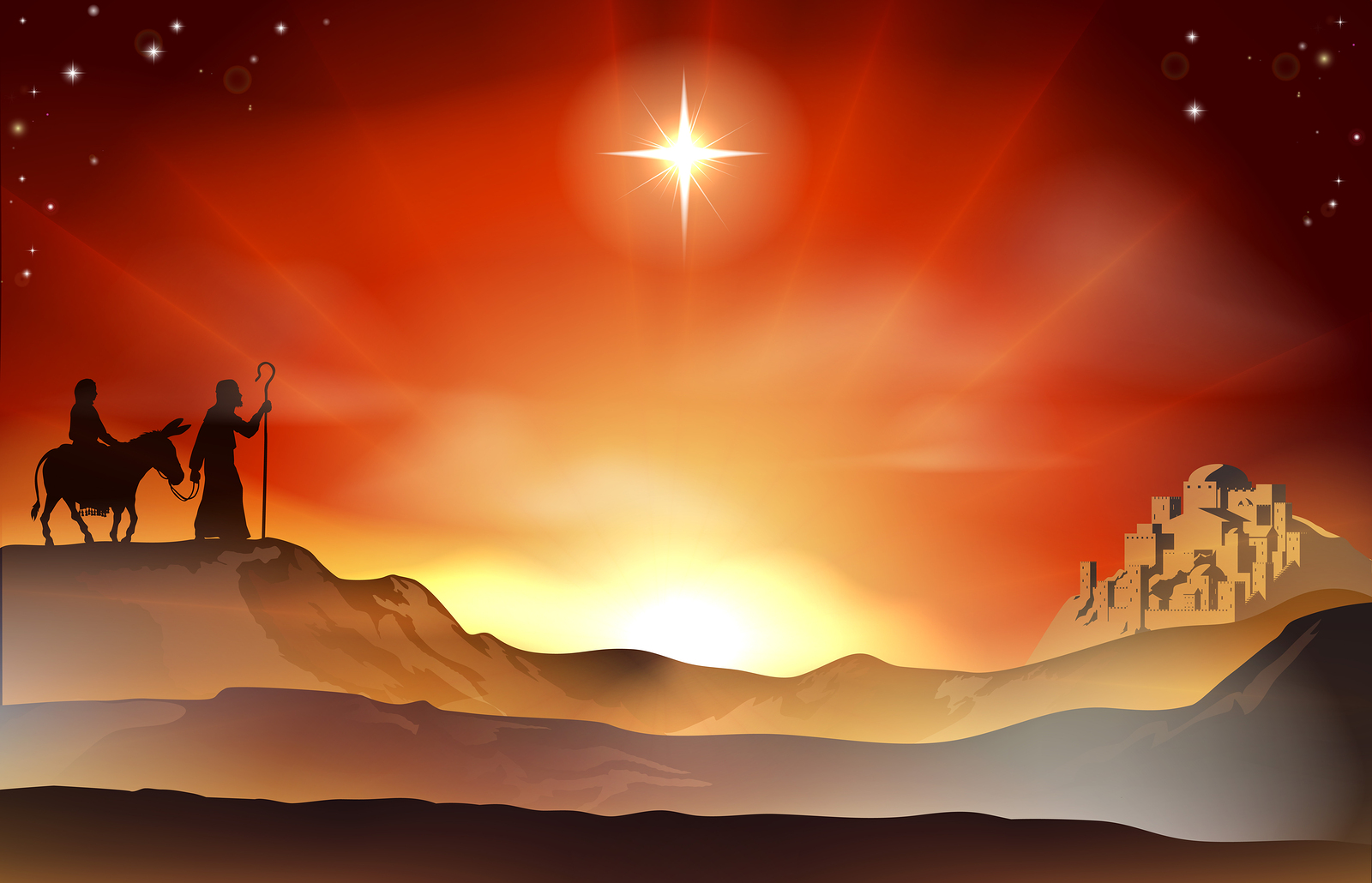
This journey of waiting is nearing its end.  The Light will soon again pierce the darkness.  Think about that first journey.  Mary and Joseph were not wealthy, prominent citizens of the capital city of Jerusalem.  They were poor working class citizens of a no-name town in what was essentially a third-world country.  Remember the Scriptures:  nothing good comes from Nazareth.  There was nothing there.  And we tend to romanticize their trip to Bethlehem, making it into some sort of painting of a starlit camping trip with a lovely dark blue backdrop and a beaming star above.  That wasn’t exactly the way it was.  If they did indeed have to make that journey as the writer of the Gospel According to Luke claims, it’s about an 80 mile trip, a 4-day journey under the best of circumstances.  But, as we know, the teen-age Mary was pregnant and at that time, they would probably want to avoid Samaria (which was not the friendliest of territories to the Israelites), which means they probably would have circled through what is now modern-day Jordan, making it an even longer trip.  And, remember, the whole reason that they were traveling at all was for the tax census, imposed by a foreign government to pay for foreign rulers that ruled their lives.  These were not the best of times.  They traveled in darkness.  But that part of the story often falls away.  We need to remember that the darkness is part of the story, part of every story of God.

The people who walked in darkness have seen a great light; those who lived in a land of deep darkness— on them light has shined. 

In every beginning, there is darkness.  The darkness of chaos seems eternal, Yet form emerges: light dawns, and life is born.  (New Union Prayerbook.)

Grace and Peace,

Shelli