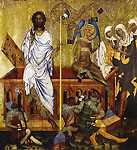
Flesh and Blood, Literally…

Lectionary Passage:  John 6: 51-58
To read this passage online, go to http://bible.oremus.org/?passage=John+6:51-58&vnum=yes&version=nrsv.

Yes, more about bread!  But we can’t help but read this passage and think of our own Eucharistic language.  That is probably intentional.  Commentators think that this sixth chapter of the version of the Gospel story by the writer that we call John might have actually been composed over time and that the implications to the Eucharist might have been added later.  It, like our participation in Holy Communion, is an opening of oneself to a life in Christ.  The bread and the cup are lenses through which we can see things differently.  When taken literally–the notion of eating flesh and drinking blood–, they are downright shocking to the ears of this world.  So, if not literal, then are they merely symbols?

The truth is that this idea of “living bread” is something more.  It is more than just an over-spiritualized connection to the idea of God.  Rather, it is meant as a real, even a physical, maybe EVEN a literal, connection to the real God that is ever-present in our life.  This is hard for us.  We tend to be a little more Puritanical than most of us would care to admit.  We tend to try to separate the spiritual from the physical, perhaps trying to hold off at bay that physical self that is sometimes so raw, so vulnerable and exposed, perhaps even so dirty from that seemingly pristine image of God that we hold so dear.  But is that what Jesus intended here?  Listen:  “Those who eat my flesh and drink my blood abide in me, and I in them.”

So what would it mean to connect to God, to literally abide in God, in every aspect of our being?  What would it mean to actually become the living, breathing image of God Incarnate?  We all wear skin.  We all live and breathe and walk around in this absolutely incredible physical body that is not disconnected from our soul or from our spiritual selves but actually part of it.  What does it mean to realize and affirm that God loves all of us–our souls AND our bodies?  And what, then, in turn, would it mean to love God in the same way?

The last things that Jesus did had nothing to do with making sure that the Disciples had all the Scriptures memorized or that they believed the right way or worshipped appropriately.  Jesus did not leave them instructions on how to be righteous or right.  Rather, in those last hours, he fed them bread and wine, things they could see, smell, and taste.  And then he touched their feet, caressing them lovingly, pouring cool water over them and wiping them with a towel.  And, lastly, he said the words that they needed to hear:  “Do this–not BELIEVE this or UNDERSTAND this or SPOUT this to the masses–but DO this.  Do this in remembrance of me.”

Stanley Hauerwas claims that “Christianity is not a set of beliefs or doctrines one believes in order to be a Christian, but rather Christianity is to have one’s body shaped, one’s habits determined, in such a way that the worship of God is unavoidable.”  Our faith is not limited to the spiritual.  It really is literal; it really does have to do with the flesh and the blood and sometimes even those funny looking, flat-bottomed things with the not-so-pretty toes at the end of our legs.  God created all of us.  God loves every molecule of our being.  And with every thing we are, we are called to love God, to become one with God, to live in full Communion with nothing left behind.

And, when you think about it, those senses, those very literal expressions of our bodies, are the ways that we connect to each other.  So, stop, and see, hear, smell, taste, and touch and do this in remembrance of me.  Eat this bread and drink this wine–together.  And kneel and wash and serve–together.

The day of my spiritual awakening was the day I saw–and knew I saw–all things in God and God in all things. (Mechtild of Magdeburg, 13th century mystic)

Grace and Peace,

Shelli

As God in Christ…

Ruins of Coventry Cathedral

Lectionary Passage: Ephesians 4: 25-5:2To read this passage online, go to http://bible.oremus.org/?passage=Ephesians+4:25+-+5:2&vnum=yes&version=nrsv

I’m not usually a big Ephesians fan.  I mean, first of all, it probably wasn’t even written by Paul but rather by a seemingly zealous (and sometimes over-zealous) disciple of his.  There are problems with it–mainly for women!  But this passage speaks something hauntingly real, something with which we can identify regardless of our gender or our place, regardless of where we are in life.  We are called to discard our old nature and don a new one.  Well, there you go!  How easy is that?  We are called to see that we are part of one another, that not speaking the truth to others is the same as not speaking the truth to ourselves.

But lest you think that this is some sort of sappy morality check where we all stand and sing “Kum-ba-yah”, think again!  It is not a vision of good or right behavior.  It is not a call to all be the same so that we can all just get along.  It is the call to be something different, to leave our old selves behind and see ourselves anew.  No longer can we dismiss our shortcomings as “only human”.  Rather, we are called to see ourselves as fully human, fully living imitations of Christ, and immersing ourselves in the Truth that is God, in the Truth that is who we are called to be.

OK, full confessions….I got mad at someone today.  No, let me elaborate:  I got REALLY mad at someone today.  I felt violated, taken advantage of…you name it.  You’ve been there.  I thought I had it all figured out.  And then, I began working on the notes for this week’s lectionary passages.   And, there, as if our Sovereign Creator saw fit to provide some sort of show of colossal sacred humor, there it was:  “Be kind to one another, tenderhearted, forgiving one another, as God in Christ has forgiven you.”  Are you kidding me?  NOW?  You throw this at me NOW when I’m so incredibly justified????  So, in my own show of incredible restraint, I slammed the book shut and headed off to the sanctuary.  (Now, see, that’s the good part of no longer working in oil and gas.  Their sanctuaries did not hold near the draw that ours does.) And I sat there in the darkened sanctuary, struggling to be at peace.  And I saw something that I’d never seen before.  I looked at Jesus in the Gethsemane Window.  I’ve always assumed that he carried a look of resolve, a look of incredible peace.  But, today, I saw a look of ire.  Spilling out of him was an anger so immense, so intense, that it consumed him.  What were they doing asleep?  Don’t they know how hard I tried?  Don’t they know what this means?  And then…take this cup, take it from me, so that I can be who you call me to be.

I’m sure it’s wrong, wrong to saddle Jesus with so much humanity.  But isn’t that why we’re all here?  Because Jesus was human, fully human.  Third-century theologian, Athanasius, is attributed with the words, “Christ became human that we might become divine.”  To expect yourself to be perfect is not even spiritual, much less realistic.  I mean, if you were perfect, why would you need Christ, why would you need God?

The first time that I ever encountered this passage with any real intent was on a choir trip.  (Because, in my previous oil and gas life, I actually sang!)  Our choir was invited to be part of a national music festival in Coventry Cathedral in England.  Now you have to know that Coventry Cathedral, a beautiful middle-age cathedral, was destroyed by bombing during World War II.  Everything that they knew was gone, burned, ashes….And, so, in 1940, their provost ordered the words inscribed on the altar that was left:  “Father, forgive.”  Today there stands a brand new cathedral next to the ruins of the old one dedicated to the work of reconciliation.  And where the altar stands, engraved with those words, are two statues, gifts from two countries celebrating the work of reconciliation that the cathedral had proclaimed.  The countries who gave the statues are Germany and Japan, the very destroyers of what was.

And so, that year that we were there, the festival commissioned a musical arrangement of their own creed, if you will.  It is called their Litany of Reconcilation.  It recognizes who we are and affirms what we can become:
 
All have sinned and fallen short of the glory of God.
The hatred which divides nation from nation, race from race, class from class,
Father Forgive.

The covetous desires of people and nations to possess what is not their own,

Father Forgive.

The greed which exploits the work of human hands and lays waste the earth,
Father Forgive.

Our envy of the welfare and happiness of others,

Father Forgive.

Our indifference to the plight of the imprisoned, the homeless, the refugee,

Father Forgive.

The lust which dishonours the bodies of men, women and children,

Father Forgive.

The pride which leads us to trust in ourselves and not in God,
Father Forgive.

Modern Coventry Cathedral

The litany ends with this:

Be kind to one another, tenderhearted, forgiving one another, as God in Christ has forgiven you.

Grace and Peace,

Shelli

Mirror, Mirror

Lectionary Passage: 2 Samuel 11: 26-12: 13a
To read this passage online, go to http://bible.oremus.org/?passage=2+Samuel+11:26+-+12:15&vnum=yes&version=nrsv

Do you remember the story of Snow White?  The fantasy begins with a magic mirror.  And every morning, the hopelessly vain evil queen rises, dresses, coifs her hair, applies her make-up, and then admires herself in the mirror.  But as we know, it’s not an ordinary mirror.  This mirror can carry on a conversation.  Better than that, this mirror tells her exactly what she wants to hear.  Every morning the evil queen looks into the mirror and says, “Mirror, mirror, on the wall, who’s the fairest of them all?”  And the dutiful mirror, perfectly rehearsed, answers, “You, my queen, you are the fairest of them all.”
But even brainwashed mirrors can go rogue now and then and one morning when the queen looked into the mirror with the familiar question, “Mirror , mirror, on the wall, who’s the fairest of them all?”, the mirror replied, “Snow White, my queen, Snow White is the fairest of them all.”  You know, the truth hurts, doesn’t it?  Sometimes we would rather just live our lives with a magic mirror affirming that everything we do is the right thing, one that would somehow allow us to hide in a fairy tale.  But life is not a fairy tale.
Our Old Testament passage is the continuing story from last week.  Remember that David, home alone while his armies were out fighting battles, had spied the fair Bathsheeba and, in what can only be described as a colossal failure of leadership and an implausible abuse of  power and authority, had sent for her, slept with her, impregnated her, and then in an attempt to cover up the deed, lied, schemed, and finally murdered her husband Uriah the Hittite.  So, Uriah is now dead and Bathsheeba mourns.  With Uriah dead, David then is free to take Bathsheeba as his wife, bringing legitimacy to their son.   Well, as you know, there are a variety of ways that this story is told.  Some will shift the blame to Bathsheeba, depicting her as some sort of harlot or something that wooed David into the affair.  But that, of course, ignores the fact that it was David that had all the power here.  Others will somehow characterize it as God’s work, as if God would call David to cheat, lie, scheme, and murder to further the building of the Kingdom of God.  Sorry, I don’t really think that’s quite what God had in mind.
So today we have the story of Nathan.  I love Nathan.  He confronts the problem head-on.  And he does it in quite a remarkable way.  He tells a parable.  (Where have we heard that style of teaching before?)  He tells the story of a rich man who possessed many flocks and herds—so many, in fact, that he didn’t even really know them all–and a poor man who possessed one lowly little lamb who the poor man actually had grown to love.   Yet when a traveler appeared, the rich man, replete with livestock, actually took the one lamb from the poor man to feed his guest.  Well, David was incensed.  After all, what a horrible man!  Someone should do something!  That is not justice!  That man should be punished!  That man doesn’t deserve to live!
You know, John Westerhoff once said that “if a parable doesn’t make you a bit uncomfortable, [doesn’t make you squirm a little in your seat], you probably have not gotten it.”  So, obviously, David didn’t get it.  Obviously, it was much easier to hand out judgment for someone else’s acts than to recognize his own failures and shortcomings.  So Nathan, courageously speaking the truth in love, essentially, holds up the mirror.  “David,” he said, “You are the man!”
He then explains in detail what David has done, all the time holding a mirror, forcing David to look at himself, to look at his own actions, to realize that his actions have consequences, that they cannot be hidden from God.  And, maybe even more painful, they cannot be hidden from himself.  David has to face what he has done, look at the consequences, look at the pain and the suffering that he has caused.  And David finally admits his wrong.  He confesses.  It’s a hard thing.  It’s a hard thing to admit when you’ve done something wrong.  It’s a hard thing to be forced to take a good hard look in that mirror and see the reflection not of that image of God in which you were created but rather someone that you’d rather not be around.
Yeah, sin is a hard thing to talk about.  It’s a hard thing to look at, particularly, when that mirror is showing us someone that we don’t really want to be.  Where did we go wrong?  And what will everyone else think?   And, after all, we’re good Methodists.  We don’t need to talk about sin.  We have grace.  Really?  I think Rev. Barbara Brown Taylor has possibly written the most incredible book on sin that I have ever read.  I highly recommend it.  In her book entitled “Speaking of Sin:  The Lost Language of Salvation,” she depicts sin as our only hope.  Well that’s a new spin on it!  After all, aren’t we trying to avoid it?  She says that “sin is our only hope, because the recognition that something is wrong is the first step toward setting it right again.” (pg. 59)  In other words, no longer can we just sweep something under the rug hoping that it will go away, hoping that our good Methodist upbringing will shower us with grace and keep our sins closeted away where they need to be.  It’s a phenomenal way to think about it, to realize that in some way, holding the mirror up for ourselves or, if we can’t do that, hoping that someone in our life will be grace-filled enough to do it for us, can actually bring us closer to God, actually put us on the road to beginning again.
We often talk about sin as that which separates us from God.  Traditional Christianity loves to take it all the way back to Adam and Eve, as if the first couple’s transgression somehow changed the path for us all.  Do you think that’s a way of trying to cover it up?  (OK, I must admit, I’m not really an “Original Sin” type of person!)  Do you think that’s our way of trying to shift the blame from us a bit, a way to somehow transfer over to someone else’s mirror?  Well, I think we may need some sort of holy spurt of Windex or something.  Because tucking it away or covering it up or shifting blame does us no good at all.  It’s still there, still separating us, still standing in the way of the grace-filled relationship that God offers each of us. 
Truth is, the opposite of sin is not innocence.  I don’t even think it’s righteousness.  The opposite of sin is choosing God, choosing to look ourselves in the mirror and finally see that image of God in each of us. We don’t live in a fairy tale.  God did not create a bunch of robotic, perfect creatures and claim them as children.  God created us—sometimes cheating, sometimes lying, sometimes sinful, always wanting to do better, always wanting to find our way, always searching and wondering what it is God desires for us.  I don’t think God wants or expects us to remain innocent.  If God had wanted that, we wouldn’t be here at all.  We would have no reason to be.  Faith would be non-existent.  Innocence has no reason to choose God.  Innocence does not need faith.  Maybe we need a Nathan in our life unless we can somehow learn to look into the mirrors that God provides for us along the way, to truly see ourselves, where we fall short, where we choose darkness over light, where we choose or just acquiesce to those systemic sins that we see (hunger and homelessness over shared resources,  prejudice over acceptance, classism over equality, nationalism over patriotism ) and, most of all, to see that image of God that is always part of us somehow slip through and reveals itself in the most miraculous ways.
We are not innocent; we are forgiven.  But that’s not an eraser on the giant chalkboard of life.  God’s forgiveness comes when we don’t deserve it, when we haven’t earned it.  It comes in the darkness; it comes at our lowest point; it comes when sin is our only hope.  It is grace.  “Mirror, mirror on the wall, who’s the fairest one of all?”  It is that you that is staring back—doubtful and assured, sinful and forgiven, speaking the truth in love with a tiny piece of God in you—only an image, a faint glimmer that holds your whole life in its hands.  That’s all that God needs to create beauty, to create wonder, to create life.  You see, God has done this before—many, many times.  It is the very mirror that shows us the image of God, that shows us who we are really called to be.
Grace and Peace,
 
Shelli


CALLING: Choosing to See Abundance

For many years now, I’ve been sort of fascinated with the whole idea of calling and what the notion of that means.  I thought maybe I’d start writing some of these thoughts on the blog every now and then.  I would love to hear your own thoughts, your own stories or notions of calling.

Yes, we claim that we are all called–each and every one of us.  I don’t know about you, but I probably put that in almost every sermon or lesson that I put together.  But do we truly believe that God has called us?  What does that mean?  Does it give us permission to just, then, continue down the road we’re on, thinking that that is where God plunked us down so surely that is where God called us to be?  And here’s one for you:  Is it a calling simply because God envisions it?  In other words, what happens to a calling that, for want of a better word, falls on deaf ears?  Is it still a calling?  What happens to that vision that God has for us if we never stop and open ourselves enough to see exactly what it is?  What happens to God’s calling for me if I’ve already figured out what my life is about?  What am I supposed to be?

I think all of us ask ourselves those questions.  But, do you think there is something that you’re “supposed” to be?  Well, I suppose it would be easier if God had simply set us on the right road and just told us to walk down the line in the middle, never veering, never turning, perhaps just stopping for rest every seven days or so.  Then we could all walk forward, perfectly aligned, like a bunch of good little Stepford soldiers marching to wherever God led us.  OK, so all we’d have to do is stay on the line, right?  Just keep moving.  Really?  I know there are those who claim that kind of “right and wrong”, “righteous and evil” theology but I personally don’t think that’s exactly how it works. 

After all,  remember what the all-powerful God did in creating us.  This all-powerful being gave away part of the Godself, relinquished part of what made God omnipotent.  God made a world and filled it with abundance.  And then God made us, images, however shadowy, of the very Godself that created us.  And God took a piece of the power that God held and gave it away.  It’s called free will.  All of a sudden, this great Creator was no longer omnipotent.  God can do everything–everything, that is, except make us choose.  And, really, if you were God (or, for that matter, even if you were you), wouldn’t you rather someone choose to love you, choose to be with you, choose to be who you envisioned them to be? 

So, I guess that straight line down the middle of the road has sort of faded away (or maybe it was never there in the first place!).   Maybe that was the whole idea.  Maybe we weren’t called to see the road at all but rather to see the abundance through which it takes us. Maybe that is the way we choose to love, choose to be with God, choose to love God.

And back to the other question:  Is it a calling if we do nothing?  Or does God’s calling to us come to be in our response?  First and foremost, God calls us into holiness, into that sacred mystery that is God.  God calls us to know the Godself, to know the very image of God in which we were created, to know the very best self that we can be.  But, more specifically, God calls each of us in unique ways.  God calls us to use our gifts, our talents, our individual circumstances, the persons in our life, to live that calling and become who God calls us to be.  God can do all things–all things, that is, except respond.  Look around.  Look at the incredible abundance that God has poured into your life.  What is your response?

Vocation does not come from willfulness. It comes from listening.  I must listen to my life and try to understand what it is truly about—quite apart from what I would like it to be about—or my life will never represent anything real in the world, no matter how earnest my intentions…Vocation does not mean a goal that I pursue.  It means a calling that I hear.  (Parker Palmer, in Let Your Life Speak:  Listening for the Voice of Vocation, 4.)   

Grace and Peace,

Shelli

Dancing in the Rain

Image from “Singing in the Rain” (1952)
(with Gene Kelly)

Lectionary Passage:  John 6: 1-21
To read this passage online, go to http://bible.oremus.org/?passage=John+6:1-21&vnum=yes&version=nrsv

We love this story.  (And they must have loved it in the first century because the writers of all four gospels chose to include it their unique account of the Good News of Jesus Christ.) Yes, we like the notion of Jesus providing everything we need, bursting in just when we are at the end of our ropes, just when we need help the most, and fixing the ails of our life (or at least feeding us lunch!).

But notice (don’t you hate that…yes, I’m about to ruin your image of super-hero Jesus pulling lunch out of a hat or whatever we thought he did!) that the story never says that the boy’s lunch was the ONLY food there.  Perhaps there were some people holding back what they had brought, afraid to offer it for community consumption because, after all, what if they ran out?  What if they needed it tomorrow or the next day or after they retire?  So, perhaps the miracle lies not in some sort of image of Jesus creating something from nothing but rather in the little boy himself.  He was first, freely offering what he had to Jesus and the Disciples to do whatever they needed to do with it.  Now, note what was in the little boy’s lunch–barley bread and fish.  Barley is a very inexpensive and somewhat “unglamourous” grain and fish were plentiful.  After all, they were right next to this huge lake.  (Just to get it in your head, the “Sea” of Galilee is actually a huge lake.)  In other words, this was the lunch of the poor.  The little boy was more than likely not from a family of means.  Perhaps his mom had lovingly packed all they had into his lunch so that her son could have this experience of seeing this great man Jesus of whom they had only heard.  But before that ever happened, the little boy stood and offered everything he had.

And, then, well you know how it goes.  The person next to him saw what he had done, thinking that no longer could he now with a clear conscience keep what he had brought tucked away.  And then the person next to that person saw him offer what he had.  It went on and on, a veritable Spirit moving through the crowd.  The message is right.  It WAS a miracle!  And when they had finished eating, they realized that it wasn’t that there was enough for all.  There was more!  There were leftovers that were then gathered into baskets.  Maybe they were for later.  Maybe they were for those who needed it.  Or maybe they were offered as holy doggie bags to remind us that God always gives us way more than we really need. 

So what about those of us who feel that we need to be prepared for the next storm that is coming around the bend?  Well, keep reading.  The passage goes on to say that the disciples started across the lake in the darkness.  And, sure enough, the storm began to rage–blowing winds, crashing waves, beating sheets of rain bearing down upon them.  Wouldn’t you know?  See, this is what we were afraid of!  But, there is Jesus.  “Do not be afraid.  Do not be afraid.”  What is interesting is that the account never says that Jesus calmed the storm.  Jesus calmed the disciples.  Jesus reminded the disciples that no matter what, no matter how hungry or unprepared they are, no matter what storms come up unexpectedly, they are not alone.  It is truly a story of extraordinary abundance.

I was going to write today on the David and Bathsheeba story but I got up early this morning to get a drink of water.  And standing at the window in my kitchen, I saw the words on a plaque I have on the window sill:  “Life isn’t about waiting for the storm to pass.  It’s about learning to dance in the rain.”  (I looked it up and the quote is attributed to Vivian Green.)  It’s a great thought.  Jesus is not a super hero that performs unexplainable miracles or plucks us out of the storms of life.  Jesus is much more.  When the storms come, when the winds rage, and when we just think we just don’t have enough for what’s coming, God invites us to dance, holding us until we find the rhythm that is deep within us and know the steps ourselves.

So, keep dancing!

Grace and Peace,

Shelli

For those of you who are reading this through the St. Paul’s ESPACE link, welcome!  And for those who get this as a “blog” email, yes, I’m finally back!  I’m going to try to maybe do this 2-3 times a week.  Keep on me!  🙂  Shelli

We Have Risen! We Have Risen Indeed!

To read today’s Gospel passage, click on
http://bible.oremus.org/?ql=200846939

THE LORD IS RISEN!

THE LORD IS RISEN INDEED!

“The Resurrection of Christ”
Vyssi Brod Hohenfurth, c. 1350

Christ, the Lord, is risen today, Alleluia!
Sons of men and angels say, Alleluia!
Raise your joys and triumphs high, Alleluia!
Sing, ye heavens, and earth, reply, Alleluia!

Love’s redeeming work is done, Alleluia!
Fought the fight, the battle won, Alleluia!
Lo! the Sun’s eclipse is over, Alleluia!
Lo! He sets in blood no more, Alleluia!

Vain the stone, the watch, the seal, Alleluia!
Christ hath burst the gates of hell, Alleluia!
Death in vain forbids His rise, Alleluia!
Christ hath opened paradise, Alleluia!

Lives again our glorious King, Alleluia!
Where, O death, is now thy sting? Alleluia!
Once He died our souls to save, Alleluia!
Where thy victory, O grave? Alleluia!

Soar we now where Christ hath led, Alleluia!  Following our exalted Head, Alleluia!
Made like Him, like Him we rise, Alleluia!  Ours the cross, the grave, the skies, Alleluia!

Hail, the Lord of earth and Heaven, Alleluia!  Praise to Thee by both be given, Alleluia!
Thee we greet triumphant now, Alleluia!  Hail, the resurrection, thou, Alleluia!

King of glory, Soul of bliss, Alleluia!  Everlasting life is this, Alleluia!
Thee to know, Thy power to prove, Alleluia!  Thus to sing and thus to love, Alleluia!

(Charles Wesley, 1739)

The day has arrived!  After all this time of anunciation and birth, of baptism and ministry, of teaching and healing, of calling and response, of temptation and darkness, of dying and crucifixion, this Day of Resurrection has dawned.  Christ has risen!  Christ has risen indeed!

But lest we lapse into thinking of this day as a commemoration of The Resurrection of Christ, as a mere remembrance of what happened on that third day so long ago, we need to realize that this day is not just about Jesus’ Resurrection; it is also about our own.  We who carried our cross, we who died to self, are this day given new life.  God has recreated us into who God calls us to be.  And, in a way, that is almost more scary than the dying.  There is no going back.  The self that we knew before is no more.  We are a new creation.  We have risen!  We have risen indeed!

You see, Jesus did not die and magically come back to life.  God did not undo what had been done.  There was still a bloody cross standing on an unknown hill called Golgotha.  Rather, God created something new–a new way of seeing and a new way of being.  Do you remember the first time God did that?

In the beginning when God created the heavens and the earth,the earth was a formless void and darkness covered the face of the deep, while a wind from God swept over the face of the waters. Then God said, ‘Let there be light’; and there was light. And God saw that the light was good; and God separated the light from the darkness. God called the light Day, and the darkness he called Night. And there was evening and there was morning, the first day. (Genesis 1: 1-5)

From the void, from the darkness, God created Light and Life.  Truthfully, if you look at it from a literal view, nothing has really changed.  Jesus, sadly, is still dead.  But through eyes that have been resurrected, nothing will ever be the same again.  Maybe resurrection comes not in raising one above life, but in raising life to where it is supposed to be.  Jesus was the first to cross that threshold between–between death and life, between the world and the sacred, between seeing with the eyes of the world and seeing with the eyes of the Divine.  Resurrection is not about being transplanted to a new world but rather being called to live in this one with a new way of seeing.  It means being recreated into the one that God envisions you to be.  It means being given a new way of seeing where love is stronger than death, where hope abides, and where life has no end.  It means being capable of glimpsing the Holy and the Sacred, the promise of Life, even in this life, even now.  This day of Easter is now only about Jesus’ Resurrection; it is about ours!  So, what do you plan to do with your new life?

The end of all our exploring…will be to arrive where we started…and know the place for the first time. (T.S. Eliot)

King of glory, Soul of bliss, Alleluia! Everlasting life is this, Alleluia!
Thee to know, Thy power to prove, Alleluia! Thus to sing and thus to love, Alleluia!

Everlasting life is truly this!

Grace and Peace,

Shelli

Thank you for joining with me on this Lenten journey!  I have been so blessed by all the comments and the reflections that you have shared.  We will do this again.  In the meantime, I’m going to take a little “blogging sabbatical” and return on April 25th with posts two or three times a week.  I will do the “every day” thing again later!  Let me know if you or others that you know want to join the Google group and get emails each time I post.  And comment!  Let’s start a discussion!   You can email me at swilliams@stpaulshouston.org.  Let me hear from you! 

The Day Between

What do we do with this day, this Holy Saturday?  We are still grieving.  The reality of it all is beginning to sink in, beginning to be real.  Jesus is gone, dying alone on some hill that we don’t even know.  So, what do we do today?  How do we pick up the pieces in the midst of our pain and despair and just go on with our lives?  Oh, we 21st century believers know how the story ends.  We’ve already jumped ahead and read the next chapter many, many times.  (Don’t tell those that don’t read ahead, but it all works out in the end.)

And yet, we do ourselves no favors if we jump ahead to tomorrow.  After all, the Scriptures tell us that Jesus rose on the third day, the THIRD day, as in one-two-three.  The third day doesn’t happen without today.  It must be important, right?  But, oh, it’s just so painfully quiet.  The sanctuary is dark, awaiting to be redressed for its coronation.  The bells are quiet, hanging expectantly for tomorrow.  And we still sit here draped in black with our Easter brights hanging there ready for us to don.  What are we supposed to do today?

Tradition (and the older version of the Apostles’ Creed) holds that Jesus died, was buried, and descended into hell.  So is that what this day is?  Descent?  Good grief, wasn’t the Cross low enough?  The well-disputed claim is that Jesus descended into death, descended into hell, perhaps descended into Gehenna (Greek, Hebrew–Gehinnom, Rabbinical Hebrew–גהנום/גהנם), the State of ungodly souls.  Why?  Why after suffering the worst imaginable earthly death would Jesus descend into hell?  Well, the disputed part is that Jesus, before being raised himself, descended to the depths of suffering and despair and redeemed it, recreated it.  The sixth century hymnwriter, Venantius Fortunatus claimed that “hell today is vanquished, Heaven is won today.” Why is that so out of bounds of what God can do?  Don’t we believe that God is God of all?  Or does it give us some sense of comfort to know that we are not the worst of the bunch, that there are always Judas’ and Brutus’ that have messed up a whole lot worse than any of us and so are destined to spend eternity on the lowest rungs of hell?  But, oh, think about the power and grace and amazing love of a God who before the Divine Ascent into glory, descended into the depths of humanity and redeemed us all, perhaps wiped out the hell of each of our lives rung, by rung? 

And, yet, again, we cannot leave it all to Christ to do.  Just as we were called to pick up our cross yesterday, we are called to descend down into the depths, plunging into the unknown darkness, so that God can pick us up again, set us right, and show us a new journey.  And so this day, we stand between, between death and life, between hell and heaven, between a world that does not understand and a God who even in the silence of this day has begun the redeeming work.  In some ways, this is the holiest day of the week.  How often do we stand with a full and honest view of the world and a glimpse of the holy and the sacred that is always and forever part of our lives?  How often do we stand together and see ourselves as both betrayers and beloved children of God?  How often do we stand in the depths of our human state and yet know that God will raise us up.  This is a pure state of liminality, a state, as the Old English would say, “betwixt and between.”  It is where we are called to be.  It is the place of the fullness of humanity as it claims both human and divine.  In the silence of this day, we stand with God.  And we wait, we wait expectantly for resurrection, we wait for God to say us once again.  It is where we should always be.  We won’t though.  We won’t be there. (Remember, we’ve had this problem before.)  And maybe on some level, it’s too much for us to always be there, always be waiting expectantly for God.  But at least we can remember what this day feels like as we stand between who we were and what we will be. 

So, for today, keep expectant vigil.  Do not jump ahead.  We can only understand the glory of God when we see it behind the shadow of death.  But, remember, shadows only exist because of Light. 

“Welcome, happy morning!” age to age shall say:
“Hell today is vanquished, Heav’n is won today!”
Lo! the dead is living, God forevermore!
Him, their true Creator, all His works adore!

Refrain
“Welcome, happy morning!”
Age to age shall say.

Earth her joy confesses, clothing her for spring,
All fresh gifts returned with her returning King:
Bloom in every meadow, leaves on every bough,
Speak His sorrow ended, hail His triumph now.

Refrain

Months in due succession, days of lengthening light,
Hours and passing moments praise Thee in their flight.
Brightness of the morning, sky and fields and sea,
Vanquisher of darkness, bring their praise to Thee.

Refrain

Maker and Redeemer, life and health of all,
Thou from heaven beholding human nature’s fall,
Of the Father’s Godhead true and only Son,
Mankind to deliver, manhood didst put on.

Refrain

Thou, of life the Author, death didst undergo,
Tread the path of darkness, saving strength to show;
Come, then True and Faithful, now fulfill Thy Word;
’Tis Thine own third morning; rise, O buried Lord!

Refrain

Loose the souls long prisoned, bound with Satan’s chain;
All that now is fallen raise to life again;
Show Thy face in brightness, bid the nations see;
Bring again our daylight: day returns with Thee!

Refrain
Just wait…
Grace and Peace,
Shelli