After

Wise MenLectionary Scripture Passage for Reflection:  Matthew 2: 1-12

In the time of King Herod, after Jesus was born in Bethlehem of Judea, wise men from the East came to Jerusalem, asking, “Where is the child who has been born king of the Jews? For we observed his star at its rising, and have come to pay him homage.” When King Herod heard this, he was frightened, and all Jerusalem with him; and calling together all the chief priests and scribes of the people, he inquired of them where the Messiah was to be born. They told him, “In Bethlehem of Judea; for so it has been written by the prophet: ‘And you, Bethlehem, in the land of Judah, are by no means least among the rulers of Judah; for from you shall come a ruler who is to shepherd my people Israel.’” Then Herod secretly called for the wise men and learned from them the exact time when the star had appeared. Then he sent them to Bethlehem, saying, “Go and search diligently for the child; and when you have found him, bring me word so that I may also go and pay him homage.”  When they had heard the king, they set out; and there, ahead of them, went the star that they had seen at its rising, until it stopped over the place where the child was. When they saw that the star had stopped, they were overwhelmed with joy. On entering the house, they saw the child with Mary his mother; and they knelt down and paid him homage. Then, opening their treasure chests, they offered him gifts of gold, frankincense, and myrrh. And having been warned in a dream not to return to Herod, they left for their own country by another road.

Happy New Year!  It’s almost over—this season of readying and wrapping, of decking the halls and visiting with friends and family, of over-running and over-eating and over-spending.   If you’re like me, you love all there is about Advent and Christmas but when it’s time for it to be over, you’re ready.  You’re ready to go back to normalcy, back to your usual schedule.  You’re ready to go back to your life.

When I was little, we had a manger scene that sat on the entry table of our home during the Advent and Christmas season.  I think that it was probably my favorite decoration.  Putting it out meant that Christmas was here.  And during the season, my brother and I would continually move it around and change the story a bit.  Sometimes the Mary and Joseph were in the stable and other times they were carefully but precariously placed on the roof.  Sometimes the Shepherds were herding the camel and the Wisemen were traveling with a sheep or an angel.  And sometimes the baby was in the manger and other times the character would show up in various other places throughout the house.  But, always, at the end of the season, it was sad to me to put the manger scene away, to rewrap all the characters in their tissue paper that they wore for most of the year, put away the baby, and close the box.  It was over.  It was time to go back.  Now is the time.  What now?  What do we do after it all ends?  The truth is, “after” is when it begins, “after” is when it becomes real, and “after” is the whole reason we do this at all.

In the Gospel text for this Sunday, we find the last (and maybe the main!) question of Advent.  It comes not at Christmas Eve in the midst of the candlelight and carols but after.  And, believe it or not, it’s not asked by those who had been waiting and hoping for it to happen.  It is asked by some who knew nothing of its happening before.  All they knew was what followed, what came after.  But they believe that the star (or, for some, an unusual conjunction of heavenly bodies that produces an especially bright light) marks the birth of a special child destined to be a king.  They ask, “Where is the child who has been born king of the Jews?

We all know the story of the Wise Ones from the East (Wisemen, or Magi, or Kings, or Zoroastrian followers, or whoever they were numbered in three or however many tradition holds).  They came at the request of King Herod.  They came supposedly to “pay homage”, but we know that that was not the case.  The truth is, Herod had heard that there was a new king in town and for him that was one king too many.  So, “paying homage” was only a precursory mission leading up to the demise of this new competing ruler.  We are told that they brought gifts, gifts fit for a king.  And then the passage tells us that, heeding a warning in a dream, these wise and learned (and probably powerful) members of the court of Herod, left Bethlehem and returned to their own country, a long and difficult journey through the Middle Eastern desert.  Rather than returning to their comfortable lives and their secure and powerful places in the court of Herod, they left and went a different way.  They knew they had to go back to life.  But it didn’t have to be the same.  So they slip away into the night.  Herod is furious.  He has been duped.  So he issues an order that all the children two years old and younger in and around Bethlehem should be killed.  The truth is that Jesus comes into the world as it actually is, not as we wish it to be.  Evil and greed are real and the ways of the world can and do crush life.

This passage moves the story beyond the quiet safety of the manger.  We realize that the manger is actually placed in the midst of real life, with sometimes dark and foreboding forces and those who sometimes get it wrong.   The primary characters are, of course, God and these visitors, these foreign Gentiles who did not even worship in the ways of the Jewish faith.  They were powerful, intelligent, wealthy, and were accustomed to using their intellect and their logic to understand things.  You know, they were a lot like us.  But they found that the presence of the Divine in one’s life is not understood in the way that we understand a math equation.  It is understood by becoming it.

Maybe that’s the point about Christmas that we’ve missed.  Maybe it’s not just about the nativity scene.  Maybe it’s more about what comes after.  We often profess that Jesus came to change the world.  But that really didn’t happen.  Does that mean that this whole Holy Birth was a failure, just some sort of pretty, romantic story in the midst of our sometimes chaotic life?  Maybe Jesus didn’t intend to change the world at all; maybe Jesus, Emmanuel, God with Us, came into this world to change us.  Maybe, then, there IS a new normal.  It has to do with what we do after.  It has to do with how we choose to go back to our lives.  Do we just pick up where we left off?  Or do we, like those wise men choose to go home by another way?   The point of the story is actually what comes after.  And that, my friend, is where you come in.
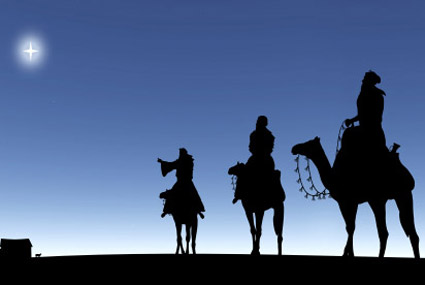
epiphany-germanySo, the baby cannot just be put away in the manger scene box.  The Incarnation of God happens over and over and over again.  Christmas day happens each and every time that we see God in each other, that we see the sacred in this world, and that we see that we have the Divine all over us.  We cannot go back to life as it was.  It doesn’t exist.  There is indeed a new normal that comes after all of the celebrations and after all of the birthing.  So, in these days after Christmas as you put the decorations away for another year, look around at your new normal.  Look around at what comes after.  What are you called to do?  How have you changed?  What other way will you travel home?

When the star in the sky is gone, When the Kings and Princes are home,

When the shepherds are back with their flocks, The Work of Christmas begins:

            To find the lost, To heal the broken,  To feed the hungry, To release the prisoner,

            To teach the nations, To bring Christ to all, To make music in the heart.

(Howard Thurman, “The Work of Christmas”)

Happy After!

Grace and Peace,

Shelli
Gate

Garden Gate-2


The future enters into us, in order to transform itself in us, long before it happens.  (Rainer Maria Rilke)


Scripture Passage for Reflection:  Isaiah 62: 10

Go through, go through the gates, prepare the way for the people; build up, build up the highway, clear it of stones, lift up an ensign over the peoples.


I heard today that “selfie” is the word of the year for 2013.  Amazing, really, that the most prevalent part of our lives as a people and as a culture has to do with taking a picture of oneself; in other words, the thing that we have elevated to the most descriptive part of who we are is a focus on our selves.  But look, look up ahead!  There is so much out there.  There is beauty that we’ve never seen and things that we’ve never experienced.  There are those that can teach us, those that can lead us, and those that can walk with us.  There is more to us than our selves that we have fabricated, the selves that we think are “photo-ready” for the world.

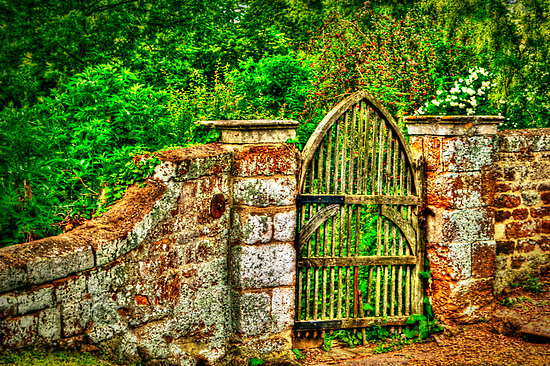
Once again, we find ourselves standing at the gate of a new year.  We’ve done this before.  We’ve made resolutions and with every part of our being have meant to change our course, to do things differently, or to make our lives better or more fulfilling.  Perhaps our problem is that as we enter the gate each year, we enter something new but we somehow manage to drag our own baggage with us.  We step through the threshold still harboring regrets of past failures or fears for what may lie ahead.  We don’t really want to let go of those selves that we have worked so hard to show to the world.  Our eyes are still inwardly focused.

This gate is a place of liminality, where our eyes are opened to both the past and the future.  It is the place where we connect to both.  Now I don’t think that we can possibly separate one time from the next, nor do we want to.  God has placed us in a world that was here long before any of us came to be and one that will more than likely be here long after any of us are gone.  We do not exist in a vacuum.  Each of our years builds upon the ones before and our lives build upon lives that came before us, some of which we never knew.  Each of us are called to be builders, one brick at a time, to build this road that God lays before us.  So which brick is yours to place?  What part is yours to build?  And what parts do you have to set down and leave behind so that your hands will be free to build?

In her book, There Is a Season, Sr. Joan Chittister tells a story that goes: Once upon a time some disciples asked their rabbi, “In the book of Elijah we read: ‘Everyone in Israel is duty bound to say, “When will my work approach the works of my ancestors, Abraham, Isaac, and Jacob?”’ But how are we to understand this?  How could we in our time ever venture to think that we could do what they could?”  The rabbi explained:  “Just as our ancestors invented new ways of serving, each a new service according to their own character—one the service of love, the other that of stern justice, the third that of beauty—so each one of us in our own way must devise something new in the light of the teachings and of service and do what has not yet been done.”

Devising something new…no pressure there!  But maybe it’s not a “thing”.  Maybe it’s just a new way of looking at one’s life, a way of looking at the world and one’s place in it.  It means oh so much more than a selfie!  (Which I guess is no longer put into quotes since it is apparently an actual word!)  This gate is the place where we embrace what we’ve been handed from those that came before us as well as the self of our past.  This gate is the place where we can peer into the unknown.  The gate is the place where we begin our new selves.

I stand at the gate of this new year.  I do not know what the other side will show me or what the road will hold.  I know that there are things that I love, things that I think  in this moment that I cannot live without, that I will leave behind and people and things that I do not know that will become part of me.  I know that I will feel joy and grief.  I know that there is beauty that I have not seen and lessons that I have not learned.  I know that there are things that I will discover, things that I will write, and things that I will make my own.  I know that there are new dances to dance.  I know that there are those things that will bring me closer to God.  But, above all, I know that the other side of the gate holds God’s vision for me, the vision of the self that I am supposed to become.

Sacred Mystery,  Waiting on the threshold of this New Year, you open the gates and beckon to me:  “Come! Come! Be not wary of what awaits you as you enter the unknown terrain, be not doubtful of your ability to grow from its joys and sorrows.  For I am with you.  I will be your Guide.  I will be your Protector.  You will never be alone.”

Guardian of the New Year,  I set aside my fears, worries, concerns.  I open my life to mystery, to beauty, to hospitality, to questions, to the endless opportunity of discovering you in my relationships, and to all the silent wisps of wonder that will draw me to your heart.

I welcome your unfailing Presence and walk with hope into this New Year.  Amen.

(Joyce Rupp,  Out of the Ordinary:  Prayers, Poems, and Reflections for Every Season)


Have a wonderful and blessed New Year!

Grace and Peace,

Shelli

Word

Star over BethlehemScripture Passage for Reflection:  John 1: 1-5

In the beginning was the Word, and the Word was with God, and the Word was God. He was in the beginning with God. All things came into being through him, and without him not one thing came into being. What has come into being in him was life, and the life was the light of all people. The light shines in the darkness, and the darkness did not overcome it.

The day has dawned.  The Light has flooded in illuminating everything in its path.  It happened before long ago.  Remember…remember back to the beginning when with a Word, God spoke everything into being.  With just a Word, what was dark and without form became waters that parted revealing a new earth.  And then God called Light and Light came, not to push out the darkness but to illuminate its meaning and the two would become forever entwined like twins that know each other’s thoughts.  And then God separated the waters and made sky and then gathered them all together to raise a new land.  God filled the earth with plants and streams and crawling creatures and swimming serpents and flying fantastical feather beings and animals that would walk on four legs, animals that would push us to our wildest limits of fear and trepidations and others that we would tame and love and be loved by in return.  God made the sun and the moon and the stars and gave us time and space and ways to measure both.  And then with yet another Word God spoke us into being and gave us life.  And God then seemed to fall silent if only for awhile, with a faint vision of what the future would hold.  And God proclaimed it good.

And now from the silence, God speaks again as the Word made Flesh.  Once again time and space part and God beckons Light forward.  But this time rather than creating a separate world, God pours the Divine into Creation.  This time rather than speaking water and sky and creatures into being, God speaks the very Godself into earth.  This day all of earth is new again, recreated from the inside out this time.  God is here, God in our midst, Emmanuel.  And God proclaimed it good.

On this day, all power and prestige and prepared plans are laid at the feet of a baby.  God has spoken yet again with a Word that was there even in the beginning, but a Word that God was saving for this moment in time.  God speaks and shepherds hear, drawn to the child.  God speaks and Gentiles from the east begin their journey to lay their gifts at the feet of the Christ.  God speaks this day and each of us must listen and follow.  Creation was not missing anything before.  It was good.  It was the way it was supposed to be.  But through the years, we forgot how to see, forgot how to listen, and started worshipping a silent God.  But God is never silent.  If we see, if we hear, God is always speaking.  God came, Emmanuel, God With Us, that we might finally hear the Word, the Word, this time, made flesh.

Have a wonderful Christmas!

Grace and Peace,

Shelli

A little programming news…Thank you for joining me on this daily Advent journey.  Now I’m going to rest for a little while.  I’ll write more often starting in Epiphany.  I’ll try for once or twice a week.  Then join me in Lent and we’ll do our daily journey together again!  In the meantime, keep “dancing to God”!  Shelli 

Flesh


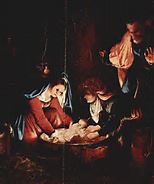
"The Nativity", Lorenzo Lotto, 1527-1528
“The Nativity”, Lorenzo Lotto, 1527-1528

Scripture Passages for Reflection:

When Joseph awoke from sleep, he did as the angel of the Lord commanded him; he took her as his wife, but had no marital relations with her until she had borne a son; and he named him Jesus. (Matthew 1:24-25)

And she gave birth to her firstborn son and wrapped him in bands of cloth, and laid him in a manger, because there was no place for them in the inn. (Luke 2:7)

And the Word became flesh and lived among us, and we have seen his glory, the glory as of a father’s only son, full of grace and truth. (John 1:14)

The Gospel writers all seemed to struggle a bit to fully convey the wonder, the unfathomable glory, of this night.  In fact, the writer that we know as Mark didn’t even really try.  He or she just jumped right in proclaiming the Good News, seemingly in a tremendous hurry to get the word out.  For the writer of Matthew’s Gospel, he seemed to only be able to state it with some proof of what it was not.  (In other words, this is no ordinary birth.)  And the writer that we call Luke seemed very focused on the physical place of Jesus’ birth and the realization that there really was no room.  But years later, the writer of John’s Gospel, conveyed a notion with which we still struggle:  that God in God’s wisdom after centuries upon centuries of trying to deal with humanity, after years of drawing us toward the Divine, of showing us a vision that God has for each of us, became flesh, one of us.  On this night, God is born human, fully human, into a world that was never really ready, never really prepared (and probably still isn’t).  And, yet, God must have loved the world, even THIS world, more than life itself, to come into it as one of us.  God became human and lived with us.  Incredible thought, isn’t it?

The Incarnation is God’s unveiling, God’s coming out of the darkness and the shadows and the clouds and showing us for the first time what we could not see before. Emmanuel, God With Us, this day walks into our ordinariness.  God has traversed time and space and all things Divine to enter our every day world.  Pierre Teilhard de Chardin said that “by virtue of the creation, and still more of the incarnation, nothing here below is profane for those who know how to see.”  Perhaps God came into this ordinary world to show us the holiness that had been created, the sacredness that in our worldliness, we were somehow missing. God steps into our lives to show us the depths to which we have not allowed ourselves to dig.   No longer can flesh and humanity be deemed “bad”; God came as flesh, came as human, came as one of us.  It would be easy to dismiss the whole thing as something that “seemed” like one of us because, after all, this is God.  And what would God be doing fooling around with the squalor and feebleness of this world?  You see, it is not that God lowered the Godself to our standard but that God’s coming raised us toward the Divine.  And notice in the Christmas stories how they emphasize the lowliness of the surroundings and the danger to the child as much as the miraculous glory of the event.  By entering human existence, even God faces down the power of evil, sin, and death.  In love, God elects to be no more immune than we are from the dangers to love and life.

Thomas Merton once said that “the Advent mystery is the beginning of the end in all of us that is not yet Christ.”  It is all this waiting, all this preparing that we have done that has put us in this place.  It is the place that humbles and amazes at once.  Who would have ever thought?  Who would have ever written the story such that a baby’s birth on a cold desert night in the midst of social turmoil would be the in-breaking of the Godself into our world, Emmanuel, God With Us.  After all this time, all this waiting for God, this hoping against hope that God would show up and pull us out of the mire of humanity, God comes full on into it, not pretending to be like us but becoming one of us.  God came to show us how to be who we are, who we are called to be, and to show us that, once again, it is very, very good.  So, on this night of nights, as the Light begins to dawn and we realize that God has come bursting into our lives and into our world, let us open our eyes and rub the sleep out of them and finally see this thing that has happened.
Reflection:  On this night of nights, what does God in our midst mean for you?  How can this year be different?
Merry Christmas!
Shelli

Threshold

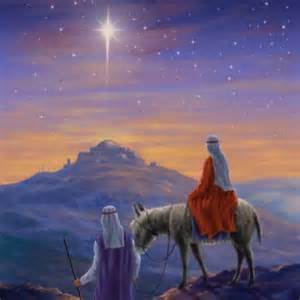
Journey to Bethlehem-colorScripture Passage for Reflection:  Luke 2: 1-5

In those days a decree went out from Emperor Augustus that all the world should be registered. This was the first registration and was taken while Quirinius was governor of Syria. All went to their own towns to be registered. Joseph also went from the town of Nazareth in Galilee to Judea, to the city of David called Bethlehem, because he was descended from the house and family of David. He went to be registered with Mary, to whom he was engaged and who was expecting a child. 

There is a word that we do not use much called “liminality”.  It is from the Latin word for threshold and is used to describe a state of being “betwixt and between”a point of being suspended between what has happened and what will be.  It is likened to being on an airplane flying over the ocean between two continents.  For a few hours, it is as if you are suspended between times, cultures, and nations.  It is as if you are nowhere and everywhere at the same time.  It is a place of enlarged vision, enlarged perspective and no real place to put down roots.  Liminality is a place that our souls crave, a place where our spiritual sense is somehow heightened, a place where se can see both who we are and who we will become.  On this eve of the Great Eve, we find ourselves a little “betwixt and between”.

Think of this day so long ago.  Bethlehem was in reach for this scared young couple who were so unsure of exactly what the world held for them.  They were rounding the final peaks of their journey.  But this day they found themselves no longer a part of their old lives and yet they didn’t really know what tomorrow would hold. But now, now they were traveling through a foreign land.  It was the land of Joseph’s family.  He had been there often as a child.  But the place was different somehow, full of those who followed this emperor, nothing like he really remembered.  The road was packed with travelers returning to the place of their ancestors to make their presence known to the government.  Joseph felt like he should know these people and, yet, they were all strangers to him.  Mary and Joseph did not feel like they were part of this new world and yet their old world did not exist.  There didn’t seem to be any room for them at all.

We are indeed standing on the edge of a brave new world.  Oh sure, we do this once a year whether we’re ready or not. Once a year, the night of nights comes and we sing Silent Night and we light our candle and once again welcome the Christ Child into our lives.  Why is this year any different?  Because, in this moment, standing on this edge between who we are and who we will be has the possibility of changing everything.  This is the moment when we decide whether or not to turn toward Bethlehem or to turn and go back.  Standing in this place of “betwixt and between”, we see both, fully in our view.

We are not that different from that scared young couple.  We find ourselves pulled between the life we’ve so carefully created and the life we’ve been promised.  It is hard to not hold so tightly to those structures that give us power and prestige and security.  And yet, God doesn’t call us to leave our lives behind but to live all that we are and all that we have within that vision that God holds for us.  And it is in this moment, standing here between the two that allows us to see how to do that, that allows us to see our lives the way that God sees them and journey on.  It is in this moment that God gives us new eyes and asks us to follow the star.  And if we do that, this year WILL be different.  We are standing in the threshold between a waiting world and one in which the Divine has already poured into our midst.  We live in the already and the not yet.  But for those who see with new eyes, the road ahead is the only one that makes sense anymore.  Because that is the way to Bethlehem.  Let us go and see this thing that has happened.  There’s a world about to be born.

This text speaks of the birth of a child, not the revolutionary deed of a strong man, or the breath-taking discovery of a sage, or the pious deed of a saint.  It truly boggles the mind:  The birth of a child is to bring about the great transformation of all things, is to bring salvation and redemption to all of humanity.

As if to shame the most powerful human efforts and achievements, a child is placed in the center of world history.  A child born of humans, a son given by God.  This is the mystery of the redemption of the world; all that is past and all that is to come.

All who at the manger finally lay down all power and honor, all prestige, all vanity, all arrogance and self-will; all who take their place among the lowly and let God alone be high; all who see the glory of God in the lowliness of the child in the manger:  these are the ones who will truly celebrate Christmas. (From Christmas With Dietrich Bonhoeffer, ed. By Manfred Weber)

Reflection:  On this eve of Eve’s, name those things that are holding you back from THIS year being different.

Grace and Peace,

Shelli

Behold, A Mystery!

Mystery ForestScripture Passage for Reflection: 1 Corinthians 15:51

Listen, I will tell you a mystery! We will not all die, but we will all be changed.

This Season of Advent is ripe with mystery.  I guess it’s conventional and comfortable to take all the stories as they are written, to make sure that Jesus was born the way we assume him to be born, to make sure that there was nothing that might be in question.  And so we spend the season praying over and over to God that God will somehow get our perspectives straight; in other words, that God will swoop in and finally clear it all up for us once and for all.  But mystery still remains!  There are oh so many questions.  Why this way?  Why Mary?  Why that time? (I mean the world wasn’t any more ready for it than it is now!)  Why NOT now?  Why THIS man?  Why THIS place?  Was it in a manger or a grotto or the back room attached to the house that was built for the animals in that century?  And why didn’t they have room?  I mean, really, if God was coming into the world, why didn’t God at least make reservations for the occasion?  So much of this doesn’t make sense at all.  Wouldn’t it have been more efficient of God’s coming into the world was better documented, perhaps well-explained so that we’d have something with which to work?  It would definitely be oh so much easier.

The truth is, surety and doubt, belief and questions are all a part of our faith.  They are all a part of the story.  They are the way the story unfolds. When I was in seminary, Perkins arranged for students to participate in a small question and answer type discussion with noted author and screenwriter, John Irving.  One of the questions that someone asked him was how he went about constructing his stories.  The question was, of course, not surprising.  The answer, though, might have been to some.  Irving said that when he sat down to write, he always wrote the ending first and then backed through the story, creating characters, plot, and theme.  The point of the story is, after all, that with which we are left.  Regardless of where it’s located in the work, the point is usually realized at the end.  I think that’s what God has done.  God wrote the ending first, the recreation of all there is, the Kingdom of God in its fullest, and then began to back through the story.  So this coming of the Godself into our midst becomes the turning point that leads us that Way.

Eternal life was already there for us written into the deepest part of our being, the very image of God within us.  But the way to that life is murky at best.  So God came not as one wielding weath and power and the things of this world but as one holding nothing, a tiny baby with nothing but the love of two people who had promised to show him the Way.  God never intended that this way would be one of certitude.  The journey is one of seeking, of questioning, of wrestling, until one finds his or her way to God.  Having all the answers would have shut us down long ago.  It is the mystery that invites us to journey.  Another noted author, Andrew Greeley, once wrote, “Life is prodigious,  overwhelming. In that there is mystery, hint, and perhaps sacrament…The excessiveness of life is the best sacrament we could ask for, a hint of how powerful, how determined, and how excessive You are.”  Maybe God’s plan was not to bring the Divine down to our understanding but to give us something to journey toward.  Mary’s part was a journey into the unknown.  So was Joseph’s.  So is ours.  But it is only unknown until we embrace it as Home.

God…leads us step by step, from event to event.  Only afterwards, as we look back over the way we have come and reconsider certain important moments in our lives in the light of all that has followed them, or when we survey the whole progress of our lives, do we experience the feeling of having been led without knowing it, the feeling that God has mysteriously guided us. (Paul Tournier)

Reflection:  What part of this mystery is the hardest for you?  Where do you need to journey?

Grace and Peace,

Shelli

Lighted Windows

Candle in the WindowScripture Passage for Reflection:  John 1:5

The light shines in the darkness, and the darkness did not overcome it.

There are bumps in every road–even the road to Bethlehem.  There are things that we plan, that we need, that somehow do not go the way we envisioned.  For me, one of my favorite services is the Service of the Longest Night, the service of light where we remember that even in the midst of those bumps in the road, even in the darkest darkness, is God, walking with us, bumping along just like we are.  And then Wednesday night, I got sick.  Now I don’t do sick well.  It’s hard to admit that I’m sick.  But Thursday was just not going to happen for me so I missed the Service of the Longest Night.  I missed the service that I probably needed to help me get through some bumps in the road because of a bump in the road.  Go figure!

I actually don’t think that original journey to Bethlehem was without its bumps.  Life is like that.  The little caravan with the pregnant couple whose world had been turned upside down probably encountered lots of things.  They probably couldn’t drive straight through.  There were places that they had to avoid, places that were filled with danger from thieves or wild animals or parts of the road that were all but impassable.  And the weather was totally unpredictable.  Who knew that it would be this cold at night?  But they knew that this was something that they had to walk and they knew that they were not alone.  But it was so incredibly dark!

We are told that this is the season of light.  We are usually made to believe that this season should be a joyous one of celebration.  We are made to feel that we should put aside our worries and our cares and enjoy ourselves; we are told to embrace the celebrations and be happy; we are told to look toward the light, the birth of the Christ child.  And yet, tonight, here we sit in darkness. This is the winter solstice, the longest night of the year–fourteen hours of darkness.  The word “solstice” is derived from the Latin “solstitium”, from two words meanings “sun” and “stand still”.  Technically, this comes from the fact that during the days surrounding the solstice, the sun appears at its lowest point in the sky and then seems to have the same noontime elevation for several days in a row.  To early astronomers, the sun appeared to hang in the sky, suspended, paralyzed, as if waiting for some word to move on.

So it seems that on this night of darkness, it is appropriate to acknowledge those parts of our lives that do not seem to “fit” with the joyous season—our frustrations, our fears and anxieties, our anger, our depression, our loneliness, our despair, our grief.  These are not things that we can just leave at the door to the season and then pick them up later.  They are part of us.  And just as we bear them, God takes them and holds them and in what can only be attributed to the mystery of God, somehow manages to put a light in the window in the midst of our darkest night.

That’s exactly what happened that first Christmas.  Think about it.  Things were far from completely right with the world.  The young couple Mary and Joseph were not wealthy, prominent citizens of the capital city of Jerusalem.  They were poor working class citizens of a no-name town in what was essentially a third-world country.  Remember the Scriptures:  nothing good comes from Nazareth.  There was nothing there.  And we tend to romanticize their trip to Bethlehem, making it into some sort of painting of a starlit camping trip with a lovely dark blue backdrop and a beaming star above.  That wasn’t exactly the way it was.  If they did indeed have to make that journey as the writer of the Gospel According to Luke claims, it’s about an 80 mile trip, a 4-day journey under the best of circumstances.  But, as we know, the teen-age Mary was pregnant and at that time, they would probably want to avoid Samaria (which was not the friendliest of territories to the Israelites), which means they probably would have circled through what is now modern-day Jordan, making it an even longer trip.  And, remember, the whole reason that they were traveling at all was for the tax census, imposed by a foreign government to pay for foreign rulers that ruled their lives.  These were not the best of times.  They traveled in darkness.  But that part of the story somehow falls away when it is illumined by the light in the window.  God came, Immanuel, God with us.  “The light shines in the darkness and the darkness did not overcome it.”

You know, since humanity began, light has been important.  But for those of us who live in the city, where profound physical darkness almost never comes, we may have lost that sense of what light really means.  It’s about more than just lighting our way or giving us a pathway so that we can see where we are going.  Think about those who lived before there was electricity and streetlights every 500 feet or so.  When the sun went down, they were plunged into darkness, save for a few strategically-placed stars.  Until, that is, they lit a candle.  And cultures all over the world and throughout history have had traditions of putting a candle in the window.

The Irish tradition of putting a candle in a window is a symbol of hospitality.  Reminiscent of the first Christmas, it was seen as a gesture to ancient travelers who could find no shelter that there was room for them.  During those times in Irish history when Catholicism was abolished, a candle in the window designated a safe place for Catholic members and clergy.  And we’ve all seen movies and depictions of people trudging through a dark and foreboding snowy night only to be saved by seeing a light in a window.  So, lighted windows are much, much more than something that provides us light to see.  They are places of hospitality, of welcome.  They signify shelter and protection.  A candle in the window draws us in from the darkness.  It brings us home.

So, maybe we who live always surrounded by light don’t really have an appreciation for what lighted windows really mean—until, that is, we find ourselves surrounded by darkness, until we find ourselves encountering a bump in the road.  And in those times, there is the light—a place of welcome, of shelter, of safety.  It draws us home.  The promise of the season is not that there will be no darkness but that it will not overcome the light, that it will not overcome us.

Reflection:  What bumps in the road have you encountered this Advent?  Where have the lights in the window been for you?

Grace and Peace,

Shelli