(part of the “Waiting on the World to Change” Advent Series)
Isaiah 40: 1-5, 27-31
Comfort, O comfort my people, says your God. 2Speak tenderly to Jerusalem, and cry to her that she has served her term, that her penalty is paid, that she has received from the Lord’s hand double for all her sins.
3A voice cries out: “In the wilderness prepare the way of the Lord, make straight in the desert a highway for our God. 4Every valley shall be lifted up, and every mountain and hill be made low; the uneven ground shall become level, and the rough places a plain. 5Then the glory of the Lord shall be revealed, and all people shall see it together, for the mouth of the Lord has spoken.”
27Why do you say, O Jacob, and speak, O Israel, “My way is hidden from the Lord, and my right is disregarded by my God”? 28Have you not known? Have you not heard? The Lord is the everlasting God, the Creator of the ends of the earth. He does not faint or grow weary; his understanding is unsearchable. 29He gives power to the faint, and strengthens the powerless. 30Even youths will faint and be weary, and the young will fall exhausted; 31but those who wait for the Lord shall renew their strength, they shall mount up with wings like eagles, they shall run and not be weary, they shall walk and not faint.
Today is the winter solstice in the northern hemisphere. It is the moment when the north pole (for the northern hemisphere) is tilted the farthest away on its axis from the sun. I think it actually occurs at 9:03 a.m. this morning if you want to put it on your calendar. Today is the day of the year when the light hours are the shortest and the dark hours are the longest. It’s always been interesting to me that our celebration of Jesus’ birth is placed just after the solstice. (Because, honestly, we’re not sure when it ACTUALLY happened. That day was just sort of assigned.)
This passage from Isaiah is the beginning of what most scholars call “Second Isaiah”. It was probably written toward the end of the Babylonian exile and is directed to those that had been forcibly removed from their home in Jerusalem several years before. Now, this was not what we typically know of as “slavery”. Most of the Israelites were allowed to have their own homes and come and go as they please. They were even allowed to work for a living. But it was a different culture and a different homeland. Everything that they had known before was gone. The society was different. The culture was different. They weren’t really sure how to maneuver in this new way of living and life around them was surely one of darkness. It would be easy for them to assume that God had deserted them, that somehow God had left them in a place to which they were unaccustomed and had just left them to fend for themselves. At the very least, their image of God probably had to be recast.
But around 539 BCE, Cyrus, the ruler of Persia, conquered the Babylonians and so many of those exiled were given the chance to return home. So, the exiles are filled with a message of trust and confident hope that God will completely end this time of despair and hardship. Speaking to a city and a way of life that is all but destroyed, the exclamation is made that the exile is indeed about to end. God is coming to lead the exiles home, bringing redemption and restoration. In essence, God is coming to show them a new and different way to live, a new and different to look at life even in the midst of darkness.
In this writing, there is no prophet even mentioned. Instead, here, it is God who is speaking. It is God who is promising a new start for the city and a people whose lives today lie in ruins. Out of the void, out of the ruins, it is God’s voice that we hear. Out of the darkness, a new day is dawning. “Comfort, O comfort my people…Remember, that every valley shall be lifted up, and every mountain and hill made low, the uneven ground shall become level, and the rough places a plain. Then my full and final glory will be revealed.”
Now notice here that God does not promise to put things back the way they were before. God is not limited to simply rebuilding what was taken away. No, God is recreating, making new, lifting valleys, lowering mountains, and ultimately, when all is said and done, revealing a glory that we’ve never seen before in what is essentially a brand new Creation, a brand new “in the beginning…”. “See, I am making all things new.” “Comfort” here is not just solace or consolation; it is transformation. “The light shines in the darkness and the darkness did not overcome it.”
As I noted yesterday, we live in an “in-between” time. Old English would refer to it as “betwixt and between”. It is that time of liminality. We live in an overlap of time. The light is shining into the darkness but we are experiencing these long hours of darkness. I’ve been reading some of the Psalms and Scriptures of lament lately. It is those writings of grief for the world. It is those writings of grief for us. It is those times when we just want to shake our fists and scream at what is going on. It is those times when we are waiting for the world to change. We modern-day Christians struggle with that. Somewhere along the way we were told that we were supposed to be well-behaved around God. But I think God can take anything we dish out. And, to be honest, God is not a casual acquaintance. I would like to think that I am close enough to God to get angry sometimes.
This passage from Isaiah is an answer to those laments. It’s not saying that bad things won’t happen; it’s not saying that the world will be perfect. It’s saying that things are going to get better, that God is recreating us and the world even as we shake our fists and shout into the abyss. Living as a Christian means that we are constantly pulled and stretched between the poles of longing and lament, of hope and despair, of grief and resurrection. It is all part of our faith. We do not live in some naïve state of being with the belief that God will somehow remove us from the reality of the present. No, we are asked to be here, living in faith. We are truly people of joy and hope. That’s why the woes of the world hurt us so badly. That’s why we grieve. That’s why we lament, a holy practice of lament. That’s why sometimes we shake our fists and scream into the lamentable abyss. And God comes and sits with us, Emmanuel, God-with-us, and offers comfort and renewal, restoration and hope.
“With This Bright Voice”

By Amanda Gorman (for 2025 UNICEF campaign)

With this bright voice
We speak—
Audacious and audible.

What yesterday we might have called obstacles
Today rise as opportunities
That make us unstoppable.

We respond
In every strife
In every struggle
God did not wait till the world was ready, till nations were at peace. God came when the Heavens were unsteady and prisoners cried out for release. God did not wait for the perfect time. God came when the need was deep and great. In the mystery of the Word made flesh the maker of the Stars was born. We cannot wait till the world is sane to raise our songs with joyful voice, or to share our grief, to touch our pain. God came with Love. Rejoice! Rejoice! And go into the Light of God. (Madeleine L’Engle)
Lyrics:
[Verse 1] I’ve seen more than I, I wanna see The people I love turnin’ on me But I know, I know, I know, I know there’s a A better day comin’ I’ve been dreamin’ that one fine day All my trouble gonna fade away And I know, I know, I know, I know there’s a A better day comin’
[Chorus] Woah-oh, woah-oh A better day comin’ Woah-oh, woah-oh A better day comin’
[Verse 2] And it’s harder holdin’ on to forgiveness To lay those ghosts to rest Oh, but the sun can rise out of the darkest night No anger, no bitterness Can fill the hole inside my chest Too long, too long, too long, too long have I Have I been runnin’ Ooh, that blue horizon ain’t far away I hear it callin’ out my name And I know, I know, I know, I know There’s a better day comin’ The sun’s gonna rise out of the darkest night It’s gonna change everything, woah-oh
(part of the “Waiting on the World to Change” Advent Series)
Psalm 80: 1-7, 17-19 (Advent 4A)
1Give ear, O Shepherd of Israel, you who lead Joseph like a flock! You who are enthroned upon the cherubim, shine forth
2before Ephraim and Benjamin and Manasseh. Stir up your might, and come to save us!
3Restore us, O God; let your face shine, that we may be saved.
4O Lord God of hosts, how long will you be angry with your people’s prayers?
5You have fed them with the bread of tears, and given them tears to drink in full measure.
6You make us the scorn of our neighbors; our enemies laugh among themselves.
7Restore us, O God of hosts; let your face shine, that we may be saved.
17But let your hand be upon the one at your right hand, the one whom you made strong for yourself.
18Then we will never turn back from you; give us life, and we will call on your name.
19Restore us, O Lord God of hosts; let your face shine, that we may be saved.
This season of Advent is about learning to hope. It is about waiting, waiting on the restoration for which we pray and journey and that we believe God has promised us. So, what does restoration mean to you? In the days from which this Psalm came, the people had wandered in the wilderness, a wilderness that was not just hard to navigate but was downright inhospitable. Danger lurked everywhere so the people prayed to God to restore them. Restoration meant safety. Restoration meant finally having a home. They had been delivered but restoration is something more.
Thomas Merton once said that “the Advent mystery is the beginning of the end in all of us that is not yet Christ.” And so, we pray for that to happen. We pray for God to restore us. Again, what does that mean? In our world, “restoration” means to put something back, to return it to its former condition. Is that what it means? I mean, why would God do all this and call us into the fray to go back to something that “was”. One of the Perkins seminary professors once called that the “Kindergarten of Eden”. Think about it. We’re not trying to get back to some prehistoric utopian garden. That notion was talking about the beginning, the time when we humans began. It was a way of placing us into a history that was and still is and will always be.
But time is not linear. Advent teaches us that. We are waiting for the coming of a God who has come, who is here. We wait for a vision of the world to come to be that is here now. We just have to see it; we just have to become it. We just have to let go of our expectations that it will be what we already know. Richard Rohr says that “people don’t see things as they are; we see things as WE are.” That’s our problem. We are hoping for a restoration of what we imagine rather than the final restoration of a vision of God that is beyond anything we can fathom. The restoration for which we hope and pray is not a return to what was; it is a coming to the vision of what will be. The restoration for which we pray is not a return; it is a becoming. It is all things becoming, as Merton said, the Christ. It is hope and love and mercy and grace finally embracing a world that is wrought with despair and lostness and hopelessness.
We live in between times. The coming of God is already and not yet. The reign of Christ is already and not yet. We are being restored little by little, as if it is seeping into our bones and marrow even as we feel despair. Remember, Paul’s description of Creation groaning with labor pains? (Romans 8:22) Yes, we are waiting on the world to change. It is a world that is already and not yet.
Not only is another world possible, she is on her way. On a quiet day, I can hear her breathing. (Suzanna Arundhati Roy)
Lyrics
The answer’s been here all along We just need to hold each other ’til the hurt is gone Oh, to belong, still a dream
Look what we’ve imagined with pain Make believing we aren’t the same But you and I know the truth Imagine what we could do If we imagined with love
Wild where the energy flows The window’s wide open All we see is the door that’s closed Sad how it goes So it goes, ’til it goes
Look what we’ve imagined with pain Make believing we aren’t the same But you and I know the truth Imagine what we could do If we imagined with love
Time for all of us to wake up out of this hypnotic state Instead of dreaming fast asleep, we should be dreaming wide awake
Look what we’ve imagined with pain Make believing we aren’t the same But you and I know the truth Imagine what, we could do, if we choose Yeah, what do we have to lose If we imagined with love?
(part of the “Waiting on the World to Change” Advent Series)
Matthew 1: 18-25 (Advent 4A)
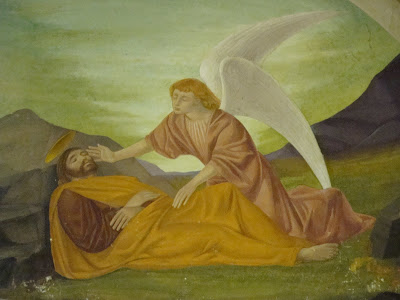
18 Now the birth of Jesus the Messiah* took place in this way. When his mother Mary had been engaged to Joseph, but before they lived together, she was found to be with child from the Holy Spirit. 19Her husband Joseph, being a righteous man and unwilling to expose her to public disgrace, planned to dismiss her quietly. 20But just when he had resolved to do this, an angel of the Lord appeared to him in a dream and said, ‘Joseph, son of David, do not be afraid to take Mary as your wife, for the child conceived in her is from the Holy Spirit. 21She will bear a son, and you are to name him Jesus, for he will save his people from their sins.’ 22All this took place to fulfil what had been spoken by the Lord through the prophet: 23 ‘Look, the virgin shall conceive and bear a son, and they shall name him Emmanuel’, which means, ‘God is with us.’ 24When Joseph awoke from sleep, he did as the angel of the Lord commanded him; he took her as his wife, 25but had no marital relations with her until she had borne a son; and he named him Jesus.
So, here, we get the story of the annunciation. Wait, didn’t we talk about the annunciation yesterday? No, this is the OTHER one. This is the other side of the story. We’re guilty of skipping over it, this calling of Joseph. I suppose it’s pretty easy. After all, he doesn’t even talk. We really know very little about him. We know he was from Nazareth, a sort of no-name town in Galilee. We can surmise that he was a carpenter because Jesus is described as the son of a carpenter several times in Scripture. And we know that he was engaged, or actually betrothed to Mary. This is not like our engagement. This was a marital contract. It just wasn’t consummated. They were not just dating. But you know what? Joseph had plans. He had some idea laid out of how his life would go. And, when you think about it, Joseph had to be hurt, probably even angry at Mary. And then came the dream. (What is it about Josephs and dreams?)
The writer known as Matthew is the only one that gives Joseph his moment. But, interestingly enough, he doesn’t even get a chance to ask a question (like, “How can this be?”) or voice his opinion or perhaps shake his fist in utter disbelief. I don’t know if it’s the moment or the Scripture, but Joseph is somehow rendered speechless. He’s not even given a small speaking role. Instead, Joseph, who had apparently already decided what he was going to do (a plan that it should be noted in the face of the tradition was merciful and compassionate). He was going to quietly dismiss her. And, I suppose, Joseph would have faded into the pages of the story with no other mention. Perhaps Mary could have gotten help from her cousins. They probably would have put her up. And Jesus and John would have grown up like brothers. It could have all worked out, but a better story was waiting. Because in this moment, Joseph is handed a dream.
It was apparently a wild fit of a dream. I mean, the Lord came. That cannot have been a comfortable situation. And, true to form, God tells him not to be afraid. “Oh, no,” Joseph thought, “I have read this before. When the Lord tells you not to be afraid, things tend to happen–things like the floor of your world on which your standing giving way and you falling uncontrollably into something that you never imagined and for which you certainly could never have planned. Hold on!” And the Lord hands him a story that doesn’t even make sense. Joseph is being asked to step back into the story. And oh, what a story it has become. Joseph is being asked to raise the child that IS the Messiah. Joseph is being asked to love him and guide him and discipline him (Good grief, how do you discipline a Messiah? I mean, does he get like some sort of Divine time out?) Joseph is even told what to name the child—Emmanuel, “God With Us”.
Well, I’m betting that Joseph’s first thought when he awoke was that he had eaten some bad lamb or something. He probably laid there for a few minutes processing it all. I mean, remember, the verses before the ones we read remind us that Joseph was descended from a long line of dreamers. In fact, old Grandpa Jacob (like 34 “greats” ago) had fought back, wrestling until the break of day! Remember that? And then Joseph got up and moved out of the way and followed. He had plans. He had a reputation to think of. He had a face that he had to present to the temple. He had a life. But Joseph moved aside and fell speechless. And then, and then God gave him his voice.
The 20th century theologian Dietrich Bonhoeffer who died for speaking out about the Nazi regime, once said that “We have become so accustomed to the idea of divine love and of God’s coming at Christmas that we no longer feel the shiver of fear that God’s coming should arouse in us. We are indifferent to the message, taking only the pleasant and agreeable out of it and forgetting the serious aspect, that the God of the world draws near to the people of our little earth and lays claim to us. The coming of God is truly not only glad tidings, but first of all frightening news for everyone who has a conscience.”[i]
Lays claim to us…This Scripture makes us realize that God’s coming into the world did not just involve God, an angel, and Mary. Joseph was there too, as were all of those who came before and all of those (including us) who came after. God’s coming is not just the birth of a baby in a pretty nativity story; God’s coming is the way that God lays claim on us. God’s coming is the way that God turns all of our lives upside down. God’s coming is the way that the story changes.
The truth is, there was a story. And Joseph had written some of his chapters in not realizing that they didn’t lead to the vision that God had in mind. When I was in seminary, I was privileged to be a part of a small group of students (there were maybe thirty of us) that had a wonderful conversation with John Irving (the author of “A Prayer for Owen Meany”, “The Cider House Rules”, and “The World According to Garp”). Someone asked what was probably an expected question: How do you craft your stories? The answer was probably not as expected. John Irving said that he always writes the end of the story first and then fleshes out the plot and the characters and the themes to get to that ending.
Don’t you think that’s what God has done? God has this vision for what the world should be. And along the way, God calls and comforts and cajoles to coax us toward that ending. The early chapters are not written. That’s up to us. But the ending is the very vision of God. So, God called Joseph. Joseph had a story. He was writing it. And when he was called, he changed it. What about us? We are waiting on the world to change. What if that vision has already been written? What if the way we get there, the way the world changes, is us? What if the change is not the ending but the way the story plays out? What if our calling is to write a better story?
Home is where your story begins. (Anne Danielson)
Grace and Peace,
Shelli
[i] From “The Coming of Jesus in our Midst”, by Dietrich Bonhoeffer, in Watch for the Light: Readings for Advent and Christmas, December 21
(part of the “Waiting on the World to Change” Advent Series)
Luke 1:26-38
26In the sixth month the angel Gabriel was sent by God to a town in Galilee called Nazareth, 27to a virgin engaged to a man whose name was Joseph, of the house of David. The virgin’s name was Mary. 28And he came to her and said, “Greetings, favored one! The Lord is with you.” 29But she was much perplexed by his words and pondered what sort of greeting this might be. 30The angel said to her, “Do not be afraid, Mary, for you have found favor with God. 31And now, you will conceive in your womb and bear a son, and you will name him Jesus. 32He will be great, and will be called the Son of the Most High, and the Lord God will give to him the throne of his ancestor David. 33He will reign over the house of Jacob forever, and of his kingdom there will be no end.” 34Mary said to the angel, “How can this be, since I am a virgin?” 35The angel said to her, “The Holy Spirit will come upon you, and the power of the Most High will overshadow you; therefore the child to be born will be holy; he will be called Son of God. 36And now, your relative Elizabeth in her old age has also conceived a son; and this is the sixth month for her who was said to be barren. 37For nothing will be impossible with God.” 38Then Mary said, “Here am I, the servant of the Lord; let it be with me according to your word.” Then the angel departed from her.
The text says that Mary was much perplexed. I’ll bet she was! The truth is, this young girl was so confused at first. Well, of course she was confused! And on top of that, she was terrified. You see, to put it into the context in which Mary lived, there is a folktale that is told in the Apocryphal Book of Tobit that tells of a jealous angel who would appear on a bride’s wedding night each time she married and kill her bridegroom. This story, of course, was part of the culture in which Mary lived. She had grown up hearing that story. And remember, that even though Mary and Joseph had yet to be formally married, they were betrothed. This is more than just being engaged. The commitment had already been made. There had already been a dowry paid. So, Mary could have thought that this angel was coming to kill her bridegroom. Not only would she lose her intended spouse but she would be left with nothing. As one who was already betrothed, she would essentially be relegated to the class of widow with no resources. Then the angel tells her not to be afraid. Don’t be afraid? Good grief…she was terrified!
I think Mary’s initial response (as its translated in our Scriptures) is one of the most profound phrases ever: “How can this be?” How can this happen when it doesn’t make sense? Why me? Why of all the people in the world that you could have chosen, why choose me? In other words, you have got to be kidding me! We identify with this. Even when we intend to obey God, we struggle when it is so far out of the parameters of the life we have or the life that we have planned that is makes no sense. It is the question of faith. It is what we all ask about our lives. Because, surely, in this moment, Mary saw her world toppling down. And the world waited. God waited. How can this be? Because, you see, it CAN’T be–not without God and, interestingly enough, not EVEN without Mary.
The passage tells us that Mary pondered these things. I love that image of pondering. So, what does it mean to ponder? If you read this Scripture, it does not mean thinking something through until you understand it or until you “get it”. Nowhere does it say that Mary was ever completely sure about what was going to happen. Nowhere does it say that she ever stopped asking questions, that she ever stopped pondering what this would mean for her life. It really doesn’t even tell us that she actually stopped being afraid. Nowhere does it say that she expected this turn of events.
And then this angel shows up. What if Mary had said no? What if her fear or her plans had gotten the best of her? What if she was just too busy planning for whatever was going to happen next in her life? What if she was waiting for the world to change before she committed to something that would so drastically change her life? What if she really didn’t have time to do any pondering today? Now, as much as we’d like to think that we have the whole story of God neatly constructed between the covers of our Bible or on that nifty little Bible app that you have on your iPhone, you and I both know that there is lots of God’s work that is missing. We really just sort of get the highlights (or at least what the writers think are highlights). Who knows? Maybe Mary wasn’t the first one that God asked to do this. Maybe she was the second, or the tenth, or the 386th. After all, this is a pretty big deal. I mean, this pretty much shoots that whole long-term life plan thing out of the water.
But, you see, this story is not just about Mary; it’s also about God. And through her willingness to ponder, her willingness to let go of the life that she had planned, her willingness to open herself to God’s entrance into her life and, indeed, into her womb, this young, dark-haired, dark-skinned girl from the wrong side of the tracks was suddenly thrust into God’s redemption of the world. We don’t really know her. We’re not given a resume’. We don’t know her family (except for the one cousin that would birth the one known as John the Baptizer). Who are her people? Maybe that’s the point. Because it is in this moment that all those years of envisioning what would be, all those visions that we’ve talked about, all of the waiting, all of the preparing, all of the journeying and planting that the people of God have done, it is here, in this moment, that they begin to be. This is the moment. Just let it be.
That’s what this whole Advent journey has been about: Preparing us to respond, to respond not to the gifts that we think God will bring, not to what we have experienced before, but to what God offers us in this moment. We are no different from Mary. God is waiting on our response; waiting to hear whether or not we, too, will say “yes” to birthing the Christ Child in our own lives.
What do we miss as we wait for the changes we so desperately want in our world today? What do we miss when we are unwilling to put ourselves out there, to risk that our lives might dramatically change? What do we miss when God calls us and we make excuses or turn and look away? We miss what could be. We miss the world changing, if only a little bit. We miss becoming who God sees we can be. We miss the new kind of beautiful God has waiting for us. When the world begins to change, even in small ways, have we situated ourselves to see it? When the world begins to change, where are we? When the world begins to change, are we so grieving our losses and our sadness and our regrets over the past that we let the beauty that begins to be slip through our fingers?
So, God waits patiently for Mary to respond. The world stops, hangs suspended if only for a time, its very salvation teetering on the brink of its demise. This is a world that is wrought with injustice and poverty, with corrupt leaders and wars, with economic peril. This is a world like ours. Oh, sure, if Mary had said no, God could have gone to someone else. Surely God could have found SOMEONE to birth the salvation of the world. But it wouldn’t have been the same. After all, the Divine did not just plunk a far-removed piece of the Godself into a womb. Our understanding is that, yes, the Christ was fully Divine; but Jesus was “born of a woman”, fully human and, as a human, Jesus carried Mary’s unique and specific DNA with him. Mary was not just a container through which God came into this little world. Mary’s DNA, Mary’s response, Mary’s “how can this be?”, Mary’s “yes” is written all through the salvation of the world. In this moment, this moment for which the world has waited, the moment for which we have prepared…in this moment, the history of the world begins to turn. The Light begins to come into focus and the heavens begin winging their way toward us, full of expectancy, full of hope. Mary said “yes” and the Divine began to spill in to the womb of the world. Salvation has begun. The world is with child. The world is beginning to change.
“What is the good if Mary gave birth to the Son of God 2,000 years ago, if I do not give birth to God today?” He says that “We are all Mothers of God, for God is always needing to be born.” (Meister Eckhart)
Lyrics
… Told my troubled heart don’t worry Hope is here The tides are turning
… I can see I can see A new light shining down on me A new way A new road Oh to a new kind of beautiful A new kind of beautiful Not like it was before It’s a new kind of beautiful
… Take my hand The worst is over Weight is lifting off our shoulders
… I can see I can see A new light shining down on me A new way A new road Oh to a new kind of beautiful A new kind of beautiful Not like it was before It’s a new kind of beautiful
… Oh, ohhh Whoa A new kind of beautiful Oh, ohhh Whoa
… I can see I can see A new light shining down on me A new way A new road Oh to a new kind of beautiful
(part of the “Waiting on the World to Change” Advent Series)
Romans 1: 1-7 (Advent 4A)
Paul, a servant of Jesus Christ, called to be an apostle, set apart for the gospel of God, 2which he promised beforehand through his prophets in the holy scriptures, 3the gospel concerning his Son, who was descended from David according to the flesh 4and was declared to be Son of God with power according to the spirit of holiness by resurrection from the dead, Jesus Christ our Lord, 5through whom we have received grace and apostleship to bring about the obedience of faith among all the Gentiles for the sake of his name, 6including yourselves who are called to belong to Jesus Christ, 7To all God’s beloved in Rome, who are called to be saints: Grace to you and peace from God our Father and the Lord Jesus Christ.
First of all, and I realize that this is totally irrelevant, but does anyone else notice that this passage is just one sentence? Perhaps Paul was not one for taking lots of breaths. Or was he almost in a panic-state trying to get the words out? It was as if his audience was somehow drifting away, heading down a road that he did not think was good, leaving Paul behind in a sense. So, Paul, seemingly breathless and with more words than a sentence should hold, went chasing after them. Whatever it is, Paul is reminding his hearers to whom they belong. Maybe it was his way of trying to call them away from the lure of the world, from what Paul saw as an almost competing society, a competing way of living and being. See, these people probably had no problem seeing themselves as belonging to Christ, as part of Christ’s kingdom. I mean, they were new believers. They were excited. They were still pumped up from that first evangelical moment that they had experienced. And yet, there was the Roman Empire looming large around them. It was hard to refuse. Who are we kidding? It was dangerous to refuse. One could quickly lose everything.
Now I don’t think Paul really wanted them to leave it all behind. After all, his own identity as a Jew in the Roman Empire was important to him. He just wanted them to see something different. He wanted them to see something bigger, something beyond where they were. He wanted them to realize that it was not that the Roman Empire was where they belonged now and the Kingdom of God was where they were going; but rather, the two existed together. He wanted people to understand that the Kingdom of God was not the “other way”, not the veritable opposite of the way they were living but rather the “Thing” that encompassed the “thing”. And maybe they belonged to both things. (I mean, in our own context, patriotism is not anti-God; it just has the possibility of developing into sort of a misplaced devotion that competes with our spiritual selves.) All that we are and all that we have and all to which we belong belongs to God. It is the way God lays claim on us, bursting into our lives as we know them, pouring the very Godself into each and every crevice of our lives until all (yes, ALL) is recreated in the Name of Christ. We are called not to choose between Christ and the world but to bring Christ to the world.
I once baptized a young child that was eating a Ritz cracker through the whole thing. Now, we don’t usually pass out hor’dourves with the Sacraments, but, really, did that change God’s Presence in that moment? For that matter, who’s to say that it didn’t make that Presence more real? (OK, so maybe I’m not as much of a sacramental purist as you thought!) God’s presence and God’s promise comes wherever one is. Our calling is to respond to that presence in the midst of the lives we lead. But that entails learning to see and listen in a way that many of us do not. We need to appreciate how God calls others into being so that we might be able to better discern our own unique way that God is entering our lives. And the Ritz? Well, who hasn’t eaten a Ritz? (And, for me, a little peanut butter) It is not part of the “other” way of living. All that we have and all that we are belongs to God. And, you know, that little bit of water that I sprinkled onto that child’s head does not exist in a vacuum. The choice is not to choose the water or the Ritz. The choice is not to choose God or empire. The choice is to follow God through all that is and all that we encounter, to open oneself to becoming new not instead of the old but as even it is made new.
So, here we are one week from Christmas Eve. I don’t know about you but this whole waiting on the world to change thing is, well, it’s exhausting! Our world is exhausting. Sometimes it seems like the “empire”–the power-hungry, money-hungry, allegiance-hungry, affirmation-begging ones that have put themselves in charge—just doesn’t leave a lot of room for the change we so desperately need. And so, we stay mired in global wars and national gun violence, in acceptance of prejudice and homophobia and racism, in our refusal to allow others into our society. Journalist and writer Tina Brown (in her Substack Letter “Fresh Hell”) says that we’ve been “liberated to be our worst selves”. Don’t you think that’s the way Paul felt sometimes? Don’t you think there were those in that group of first hearers of his Letter to the Roman that felt the same way we do? I think so. I want to feel differently than I do. I want to see and feel that “peace that passeth understanding”. But, for now, we’re here. And so is God. God calls us to be who God calls us to be even in the midst of the empire, even in the midst of our worst selves.
I think that’s the point of Advent—not to lift us out of where we are but to remind us that there is another way to be where we are, that we are not destined to be mired in this, that we are destined to lift it up with us as we journey beyond the muck and the mire. Maybe God’s Presence is not some big, flashy extravaganza like we’ve been expecting. Maybe it’s been there all along, sort of like a little bit of water and a Ritz cracker, or maybe more like a baby born into a world that was not ready, that was never ready, a world that couldn’t move over and make room. Advent is not only about welcoming a King; Advent is about making room for a God who comes into our ordinary lives as an ordinary person into an ordinary (and, yes, very flawed) place and makes it all extraordinary. Advent is a lot like eating a Ritz cracker through a Holy Sacrament or a run-on sentence that only makes sense when you figure out the context.
There must be always remaining in every one’s life some place for the singing of angels, some place for that which in itself is breathlessly beautiful and, by an inherent prerogative, throws all the rest of life into a new and creative relatedness, something that gathers up in itself all the freshets of experience from drab to commonplace areas of living and glows in on bright white light of penetrating beauty and meaning —then passes.”(Howard Thurman)
(part of the “Waiting on the World to Change” Advent Series)
2 Samuel 7: 1-16
Now when the king was settled in his house, and the Lord had given him rest from all his enemies around him, 2the king said to the prophet Nathan, “See now, I am living in a house of cedar, but the ark of God stays in a tent.” 3Nathan said to the king, “Go, do all that you have in mind; for the Lord is with you.”
4But that same night the word of the Lord came to Nathan: 5Go and tell my servant David: Thus says the Lord: Are you the one to build me a house to live in? 6I have not lived in a house since the day I brought up the people of Israel from Egypt to this day, but I have been moving about in a tent and a tabernacle. 7Wherever I have moved about among all the people of Israel, did I ever speak a word with any of the tribal leaders of Israel, whom I commanded to shepherd my people Israel, saying, “Why have you not built me a house of cedar?” 8Now therefore thus you shall say to my servant David: Thus says the Lord of hosts: I took you from the pasture, from following the sheep to be prince over my people Israel; 9and I have been with you wherever you went, and have cut off all your enemies from before you; and I will make for you a great name, like the name of the great ones of the earth. 10And I will appoint a place for my people Israel and will plant them, so that they may live in their own place, and be disturbed no more; and evildoers shall afflict them no more, as formerly, 11from the time that I appointed judges over my people Israel; and I will give you rest from all your enemies. Moreover the Lord declares to you that the Lord will make you a house. 12When your days are fulfilled and you lie down with your ancestors, I will raise up your offspring after you, who shall come forth from your body, and I will establish his kingdom. 13He shall build a house for my name, and I will establish the throne of his kingdom forever. 14I will be a father to him, and he shall be a son to me. When he commits iniquity, I will punish him with a rod such as mortals use, with blows inflicted by human beings. 15But I will not take my steadfast love from him, as I took it from Saul, whom I put away from before you. 16Your house and your kingdom shall be made sure forever before me; your throne shall be established forever.
The Bible is a story of a journey, a movement from one place to another, one time to another, one way of being to another. It is full of stories of going beyond and coming home. And woven through those stories are stories of us building and constructing and attempting to wall off our understanding of God. (And it’s often also the story of us destroying what is built.) Throughout the Scriptures, God sends us forth, we begin to walk, and then we build something, then God sends us forth, we begin to walk, and then we wall something off, on…and…on…It has continued for thousands of years and continues today. See, we understand the notion of God being everywhere, of God not being limited to what we build and what we wall off. But most of us still find ourselves in the midst of building projects throughout our lives. Some of those projects are for houses, some are for churches or grand cathedrals, and some are for ourselves, our traditions, our ideals, and our own lives. Does it make it seem better? Does it bring God closer? Or does it just make us a little more comfortable?
This poor Scripture doesn’t get a whole lot of Advent attention because it shares the fourth week of Advent in Lectionary Year B with Mary’s story and, not surprisingly, most people would not choose Nathan and David over Mary and the angel in the middle of Advent. I’ve never preached it. I’ve barely written on it. But it’s still a great story and reminder for the season. And it’s important. Dr. Walter Brueggemann once made the claim that this chapter was the most important chapter in the Samuel saga and was one of the pivotal chapters in the entire Old Testament. Think about it. It seals the Davidic dynasty and it turns the entire human story toward God’s vision of it.
The text we read sort of wraps up the promise that God made to Abram in the twelfth chapter of Genesis. The people have a home and they can live in peace. And David’s reign as king has been pretty much legitimized. Things seem to be going well. (Well, for the most part. I mean, it’s David, right?) And so, David envisions now a more permanent structure to house the ark of the Lord. In other words, David now desires to build a temple in Jerusalem. I don’t know if he feels a little guilty that HE has a house and God doesn’t (as if God isn’t IN the house of cedar already and as if the moveable tent that had “housed” God for so long as the Ark of the Covenant moved from place to place was somehow no longer sufficient.). Maybe he really felt that God needed to be given God’s due, that a grand and glorious structure would show honor to God (as well as perhaps raise David’s reputation). In a shamefully cynical view, perhaps David wanted to just know EXACTLY where God was, as if he could once again wall God off into a limited space, thereby protecting God or maybe even himself. In other words, he wanted to know that there was a place where he could go where he KNEW God would be.
But that night the Lord intervenes by way of Nathan with a promise not necessarily of a permanent “house” but, rather a permanent dynasty, an everlasting house of the line of David. David has risen from shepherd boy to king and has apparently felt God’s presence through it all. He now sits in his comfortable palace and compares his “house” to the tent that “houses God” in his mind. God, through the prophet Nathan, responds by asking, in a sense, “Hey! Did you hear me complaining about living in a tent? No, I prefer being mobile, flexible, responsive, free to move about, not fixed in one place.” God then turns the tables on David and says, “You think you’re going to build me a house? No, no, no, no. I’M going to build YOU a house. I’ll build you a house that will last much longer and be much greater than anything you could build yourself with either wood or stone. I’ll build you a house that will shelter the hopes and dreams of your people long after ‘you lie down with your ancestors.’” And God promises to establish David and his line forever.
The truth is, we all desire permanence; we want something on which we can stand, that we can touch, that we can “sink our teeth into”, so to speak. We want to know the plan so that we can fit our lives around it. Well, if this was going to make it easier to understand God, go ahead. But Franciscan Fr. Richard Rohr warns us that “God is always bigger than the boxes we build for God, so do not waste too much time protecting your boxes.” (from Everything Belongs) (That’s actually one of my favorite quotes!) The truth is, this is a wandering God of wandering people. This is not a God who desires to or can be shut up in a temple or a church or a closed mind. This is not a God who desires to be (or can be) “figured out.” This God is palatial; this God is unlimited; this God will show up in places that we did not build. (and sometimes in places that we really wouldn’t go!) This God does not live in a house; this God dwells with us—wherever we are. This God comes as a traveler, a journeyer, a moveable feast. And this God shows up where we least expect God to be—such as in a god-forsaken place on the outskirts of acceptable society to a couple of scared people that had other plans for their lives. This God will be where God will be. And it IS a permanent home.
So, here’s the problem with David’s thinking. God has made and stood by lots of promises. But God’s promise of a home, God’s promise of permanence, God’s promise of a “place” that the people of God can call their own came with another directive. With that promise of home, was the exhortation to “go”, to leave this place with which your familiar and go to the place to which you’ve been called. It doesn’t mean we’re homeless; it means that we’re journeying with God. I think part of the reason God never really told anyone to build a “house” (sorry, David) is that when we start DOING for God, when we start building and hammering and making noise, things have a tendency to get out of control. The “house” becomes about us and we forget why we built it in the first place. So, God doesn’t call for a permanent house; God calls for one that exists within us, a place where God can sit with us, and eat with us, and make plans for the future. It’s the place where we make room for God.
So, returning to our ongoing theme of “waiting on the world to change”, I’m going to ask a hard question. Are we waiting for the world to become what God wants us to be, to become that holy vision about which we’ve talked and dreamed? Or are we just really mad right now that people seemed to have come into our house—the house that WE built—and moved the furniture around? It’s hard. I’m not sure I like the answer. Because, remember, when God promises us a place, God also tells us to “go”. I guess this Advent waiting is a way of beginning to move, starting to follow the journey, the Way of God.
Advent both makes us aware of a God who is beyond our reach and opens us up to a God who is present and immanent among us, to the God who desires to dwell within us. The mystery of God is that One who cannot be contained in the largest of cathedrals, One who is beyond our reach, beyond our knowing, beyond our understanding, comes to us as one of us, as a baby, in a seemingly godforsaken place for which the world had no room or on a cross on the outskirts of town. God indeed makes a home for us. Sometimes it’s in a packed cathedral with a candle pointing us beyond what we know. And sometimes God comes to us when we are alone, perhaps when we wish we could be somewhere else, perhaps when there is no room, and makes a home in us. That is the mystery of God. But you have to make room. Transcendence is sometimes hard to attain but immanence, the notion of God dwelling with you, dwelling within you, is even harder. I think God DOES want a sanctuary. But it doesn’t look a temple or church. This Advent, make room for the God within you. While you’re waiting on the world to change, God’s vision of the world is waiting for you to go out into it. Don’t worry about the furniture. You can fix it later.
If indeed we love the Lord with all our hearts, minds, and strength, we are going to have to stretch our hearts, open our minds, and strengthen our souls, whether our years are three score and ten or not yet twenty. God cannot lodge in a narrow mind. God cannot lodge in a small heart. To accommodate God, they must be palatial. (William Sloane Coffin)
(part of the “Waiting on the World to Change” Advent Series)
Isaiah 7: 10-17
10Again the Lord spoke to Ahaz, saying, 11Ask a sign of the Lord your God; let it be deep as Sheol or high as heaven. 12But Ahaz said, I will not ask, and I will not put the Lord to the test. 13Then Isaiah said: “Hear then, O house of David! Is it too little for you to weary mortals, that you weary my God also? 14Therefore the Lord himself will give you a sign. Look, the young woman is with child and shall bear a son, and shall name him Immanuel. 15He shall eat curds and honey by the time he knows how to refuse the evil and choose the good. 16For before the child knows how to refuse the evil and choose the good, the land before whose two kings you are in dread will be deserted.
17The Lord will bring on you and on your people and on your ancestral house such days as have not come since the day that Ephraim departed from Judah—the king of Assyria.”
During each season of Advent, we read texts that get louder and louder with prophetic messages of what is to come. This is the thing of which Christmas’s are made. And now we read of the signs and wonders that were shown to the House of David. “Here, listen people, there is a young woman with child. She shall bear a son and the world will change.” That’s essentially what it says. But wait a minute! We always read this as a prophetic sign of what will come, a prophet’s vision of the coming of Christ, Immanuel. But, read it again. This is in the present tense. The young woman IS with child. (as in already) So, which is it? Is it a child born immediately after this writing or are we talking about the birth of Jesus? After all, the writer known as Matthew depicted it differently. Is it then or is it later? Yes. Really, does it really matter. Because it’s all of the above.
The sign is a child. The child’s name, Immanuel (or “God with us”) reinforces the divine promise to deliver the people from sure demise. The child is born of a young woman, the Hebrew “almah”, which means a young woman of marriageable age. Many scholars think that the young woman may have been Ahaz’s wife and her son the future king Hezekiah. If the author had wanted to depict the woman as a virgin, the word “betulah” would have been used. But in the Greek translation of the Old Testament, the word was translated as “parthenos” or “virgin”. So the writer of The Gospel According to Matthew understood the verse as a prediction of the birth of Jesus. And then all those translators that came after that capitalized on that notion, perhaps in an effort to explain the unexplainable, to rid the text of the ambiguities that were probably meant to be there in the first place.
So, which is it? Is it a virgin or a young woman? Is it talking about Hezekiah or Jesus? Is it what the writer known as Isaiah probably wrote or what the writer known as Matthew assumed or what the later redactors translated? Yes. All of the above. The text and, indeed, the whole Bible is ambiguous at best. Who are we kidding? Faith is ambiguous. Faith is everything. I mean, maybe the ambiguity was actually a sign of what was coming. Faith encompasses surety and doubt, light and darkness, life and death. I don’t really get wrapped up in what “really” happened. It doesn’t bother me if this is actually talking about Hezekiah. But it was part of the Matthean writer’s tradition. It meant something to him. Somewhere in the words, in the text of his faith, he saw God. He felt God. To him, it means Immanuel. And what better way to depict the first century nativity story that we love? The coming of God WAS foretold–over and over and over again–through sacred stories told and shared by a waiting people. It continues to be told, the story of God who breathed Creation into being, who entered the very Creation that held the God-breath, and who comes into each of our lives toward the glorious fulfillment of all that was meant to be.
Signs…are we missing them? Are we looking for some that aren’t there or dismissing some that are perhaps too obvious to us. I don’t think that God ever intended to lay it all out for us like some sort of lesson for us to memorize. God doesn’t call us to have it all figured out but rather to live it, to open our eyes to all the sign and wonders of the world, to all the ways that God walks with us, to all the ways that God calls us to follow, to become. All of the above, the obvious and the ambiguous, are part of the Truth that God reveals (whether or not our human minds can fathom it as “true”). We are about to begin our journey to Bethlehem. It is a road that is filled with ambiguities–loss and finding, sorrow and joy, fear and assurance, doubts and fears, a manger and a cross. But along the way are signs of the God who is always with us, Immanuel, who carries us from moment to moment and from eon to eon with the promise of new life. Let us go and see this thing that the Lord has made known–you know, all of the above. It is this for which we were made.
Yes, we’re waiting on the world to change. Are there signs? Are we missing them? Are we not paying attention? Perhaps we think we have everything so figured out that we’re not open to what is. Signs are not always overly obvious. They are not always accompanied by flashing lights and sirens. They sometimes come to us quietly, faintly. Sometimes we might miss them. And sometimes they’re just not what we want to see. Maybe as your waiting on the world to change, there are signs that its actually happening.
If God’s incomprehensibility does not grip us in a word, if it does not draw us into [God’s] superluminous darkness, if it does not call us out of the little house of our homely close-hugged truths…we have misunderstood the words of Christianity. (Karl Rahner)





 Dancing to God