Reclaimed in the Wildeness

Fork in the desert roadScripture Text:  Genesis 21: 14

14So Abraham rose early in the morning, and took bread and a skin of water, and gave it to Hagar, putting it on her shoulder, along with the child, and sent her away. And she departed, and wandered about in the wilderness of Beer-sheba.

Well our heroes from yesterday are not shining examples of humanity in this story. After God promised Abraham a son with his wife Sarah, they laughed in disbelief. But they waited…and waited…and waited. They got impatient, as we all do at times, and took matters into their own hands. (Don’t we all do that at times?)  So Sarah devised a plan where Abraham would father a child with her slave Hagar. After all, in her mind that would fulfill the promise that Abraham would become the “father of a nation” so maybe this was what God meant all along. But, of course, things did not come out completely rosy. Predictably, Hagar’s pregnancy provoked Sarah’s jealousy and bitterness, and so she drove Hagar into the wilderness. But, true to character, God found her there and welcomed her back, in effect reclaiming her as part of the story. He told her that her child that was to be born would be called Ishmael, which means “God hears”. He said that her descendants would be “too numerous to count”. (This is starting to sound vaguely familiar!)

In the passage for today, it is probably some fifteen years later. It is the occasion of the weaning of Isaac, which probably means that he’s about three years old. Once again, those old wounds and jealousies surface for Sarah and, once again, she drives Hagar, this time with the child Ishmael, into the wilderness. Hagar gives up, toying with just leaving Ishmael to die so the whole sordid thing would end. But then, once again, God hears. And then God makes what is really an extraordinary promise to Hagar that is almost identical to the promise made to Abraham. “I will make him into a great nation…God was with the boy.”

This is a little bit different wilderness story.  Hagar was not “driven” to the wilderness; she didn’t go there for solace or renewal; she wasn’t wandering through it on the way to the Promised Land.  Hagar was sent away, forced into the wilderness mainly by Sarah’s jealousy and resentment and Abraham’s fear and remorse.  And there God again reclaims her, giving her a new story, a new promise of life to come.  The story is a reminder that God is God, once and for all, and that God, with infinite compassion and abounding grace will reclaim us even from ourselves, even from what we humans do to each other.  One by one, in the deepest wilderness of our lives, God reclaims us as children of God.

God’s focus becomes a focus on the future.  Five chapters before this when Hagar had run into the wilderness to avoid Sarah’s wrath, God came.  Sent into the wilderness as forsaken, Hagar encounters God.  In fact, God draws her into conversation.  Hagar becomes the first person in Genesis to encounter an angel of God and the first woman to be given promises (the first woman, ever!).  She becomes the only person in the Old Testament to actually name God.  Hagar, sent into the wilderness so that she would not be part of the story, is reclaimed by God and given a story all her own. In his book, Peculiar Treasures, Frederick Buechner says of this story that it tells “how in the midst of the whole unseemly affair the Lord, half tipsy with compassion, went around making marvelous promises, and loving everybody, and creating great nations, like the last of the big-time spenders handing out hundred dollar bills.”

Both children are recognized as belonging to Abraham but also to a particular future that will be worked out in the future. God announces that it is through Isaac that descendants will be named for Abraham, referring to the covenantal line. But Abraham can be assured that God will care for the future of Ishmael as well, making of him a great nation, making him of the great story that God is continually writing.

In this season of Lent, we do wander in the wilderness.  Some of our wildernesses are self-imposed; some are gifts given from God for renewal and recreation; and some wildernesses are so deep that God must pluck us out of the undergrowth and hold us, setting us upright, so that we begin a new journey.  Lent teaches us that the story is always more than we planned, more than we can see, more than the road that we are on now.  In this wilderness season, the story begins to move beyond ourselves.  We just have to learn to pay attention and allow ourselves to be reclaimed by a story we did not fully know.

Grace fills empty spaces, but it can only enter where there is a void to receive it, and it is grace itself which makes this void. (Simone Weil)

FOR TODAY:  What is your story?  What chapter is God calling you to include?  How is God reclaiming you from the wilderness in which you wander?

Grace and Peace,

Shelli

Falling Down Laughing

Falling down laughingScripture Text:  Genesis 17: 4-8

4“As for me, this is my covenant with you: You shall be the ancestor of a multitude of nations. 5No longer shall your name be Abram, but your name shall be Abraham; for I have made you the ancestor of a multitude of nations. 6I will make you exceedingly fruitful; and I will make nations of you, and kings shall come from you.  7I will establish my covenant between me and you, and your offspring after you throughout their generations, for an everlasting covenant, to be God to you and to your offspring after you. 8And I will give to you, and to your offspring after you, the land where you are now an alien, all the land of Canaan, for a perpetual holding; and I will be their God.”

You know the story.  Abram and Sarai have longed for a child, an offspring, a descendent.  But it had never happened.  And now, with more years behind them than ahead, they have resolved that the longing will never come to be.  The first ones to hear this story were more than likely in the midst of exile, living in the wilderness of darkness and looking at the bare remains of a city and temple that once was.  The story comes as a reminder of who they are as the people of God.  It is a reminder that God does not always act within the limits that we have established and the plans that we have formulated in our small minds; rather, God continually jaunts out into the wilderness, into what cannot be, and creates.  It’s ludicrous; it’s incredulous; it’s enough to make you fall down laughing.  But God’s promise remains true.

First, God appears to Abram and announces God’s presence.  Abram falls on his face, downright shocked at who is actually speaking to him.  And with the covenant, Abram becomes Abraham and Sarai becomes Sarah.  The covenant signifies a shift in who they are.  God promises that Abram will have descendents.  And they laughed.  Well, of course they laughed.  It was ridiculous.  Abram and Sarai were old–really, really, really old.  All logic told them that their childbearing years were not just running out but were way behind them.  It just didn’t make sense.  But surprisingly, God often doesn’t make sense in this world that we have figured out.  God continually tends to sort of blow the boundaries and the limits that we have drawn out of the water.

Our lectionary (even the full passage that I didn’t put up at the front of this) doesn’t really include the part where Abram fell down laughing.  Perhaps those who put the lectionary together thought that a bit too irreverent of the mighty God.  After all, would you dare laugh at God?  Well, good grief, don’t you think God is laughing at us sometimes?  Perhaps laughter is what brings perspective.

Abraham laughed.  Sarah laughed.  And I’m betting God laughed.  (You can just imagine the inside joke between the three:  “This is going to be good.  No one will ever believe this could happen.  We’ll just shake them up a bit.”)  Maybe laughter is our grace-filled way of getting out of our self and realizing that, as ludicrous and unbelievable as it may be, God’s promise holds.  Maybe it’s our way of admitting once and for all that we don’t have it all figured out, that, in all honesty, we don’t even have ourselves figured out, that there’s a whole new identity just waiting for us to claim.  In this Season of Lent, we are called to get out of our self, to open ourselves to possibilities and ways of being that we cannot even fathom. Go ahead and laugh.  It is only the beginning.  The promise holds.

You know, I don’t think God really expects us to stay buttoned-up and well-behaved.  God doesn’t want anything that we are not.  God doesn’t want us on our best behavior; God wants us real; God wants us to just flat fall down laughing sometimes at the ludicrousness of it all.  If sometimes tells you not to cry, if someone tells you not to laugh, they are telling you not to be you.  God gave you those expressions of emotion as a wonderful, wonderful gift to get you through it all.  Don’t you think God enjoys a good joke once in a awhile?  After all, this is the God that promised offspring to someone not just past their prime, but downright looking at the tail end of life!  And THEN came through with the promise.  Pretty funny…pretty sneaky…pretty amazing.

I hope that at my funeral, there will be both tears and laughter because then I will know that I have lived the fullness of life.  And then I hope that everyone will leave the church and go dancing because then I will know that they have joy.  The wilderness is known for tears but sometimes you just have to laugh at the ludicrousness of it all.  I don’t know if we laugh our way through the wilderness or out of it, but Abram embraced it and became someone else.  Abraham and Sarah never got to the Promised Land.  It was enough to live with God’s Promise of what it held; it was enough for it to make one fall down laughing in praise to the God who chooses not to live within our rules, who chooses instead to love our laughter and feel our tears and offer grace through it all.

Humor is the beginning of faith and laughter is the beginning of prayer. (Reinhold Niebuhr)

FOR TODAY:  Laugh…laugh…laugh…laugh enough that you fall down in prayer.

Grace and Peace,

Shelli


Roundabout Way of the Wilderness

Moses in the WildernessScripture Text:  Exodus 13: 17-22

17When Pharaoh let the people go, God did not lead them by way of the land of the Philistines, although that was nearer; for God thought, “If the people face war, they may change their minds and return to Egypt.” 18So God led the people by the roundabout way of the wilderness toward the Red Sea. The Israelites went up out of the land of Egypt prepared for battle. 19And Moses took with him the bones of Joseph who had required a solemn oath of the Israelites, saying, “God will surely take notice of you, and then you must carry my bones with you from here.” 20They set out from Succoth, and camped at Etham, on the edge of the wilderness. 21The Lord went in front of them in a pillar of cloud by day, to lead them along the way, and in a pillar of fire by night, to give them light, so that they might travel by day and by night. 22Neither the pillar of cloud by day nor the pillar of fire by night left its place in front of the people.

The Season of Lent is the wilderness season.  It begins in the wilderness and ends in another wilderness until Easter bursts forth.  And in between those wildernesses are the stories of the way of the wilderness.  Lent is about fasting from what we know and feasting on what we find in our roundabout way through the wilderness.  There are, of course, many mentions of wildernesses in the Scriptures.  The NRSV touts 287 times that the word “wilderness” shows up.  Well, there seems to be a recurring theme here.  Maybe it’s not that wilderness just keeps cropping up in our Scriptures; maybe the Scriptures are rather about the wilderness, or, more specifically, a rhythm of going and return, forsakenness and deliverance, hopelessness and redemption.  The Scriptures begin in the wilderness.  Genesis 1 doesn’t specifically mention the word.  But in its place is a depiction of it as a formless void filled with darkness.  It is where we begin and then God recreates it into order and light.  Pilgrimage, or journeying, is a way of life.  And all of us struggle along the way.  The wilderness is part of our story.  It is part of us.  It is the way we grow in our faith.

When you read the Exodus passage above, we are told that God sort of “redirected” the people through the wilderness to avoid the land of the Philistines.  And there they wandered for forty years, through a wilderness with no real “roadmap”, through shifting sands and places devoid of landmarks.  They journeyed through hopelessness and forsakenness, continually asking questions and doubting that God was there at all.  But they grew.  They grew to know God, grew to know themselves.  What they found in the wilderness was their identity.  The sometimes harsh lessons of the desert transformed the people into God’s people.  Led by a cloud through the desert, the people became people of faith.

We are no different.  This season may sometimes seem to be a roundabout way through the wilderness.  We encounter the dangers of hopelessness and forsakenness; we experience the dangers of questions and doubt; and somewhere in there, if we give ourselves the chance, we are recreated and transformed into newness and life.  During this season, we keep hearing over and over to empty ourselves before God and open ourselves to what God is showing us.  It is our season of unmasking, peeling off all of the layers that do not belong to us, that make us someone who we are not. Leo Tolstoy once said that “there are many reasons for the failure to comprehend Christ’s teaching…but the chief cause which has engendered all these misconceptions is this: that Christ’s teaching is considered to be such that it cannot be accepted, or even not accepted, without changing one’s life.” The wilderness is what changes us, what changes our life.

In the spiritual tradition, wilderness is the place where we leave the world behind and place ourselves at God’s disposal. (Daniel Wolpert)

FOR TODAY:  Embrace your journey through the wilderness.  Make it your story.  This is your beginning.  Place yourself at God’s disposal and change your life.

Grace and Peace,

Shelli

Lessons From the Desert Fathers


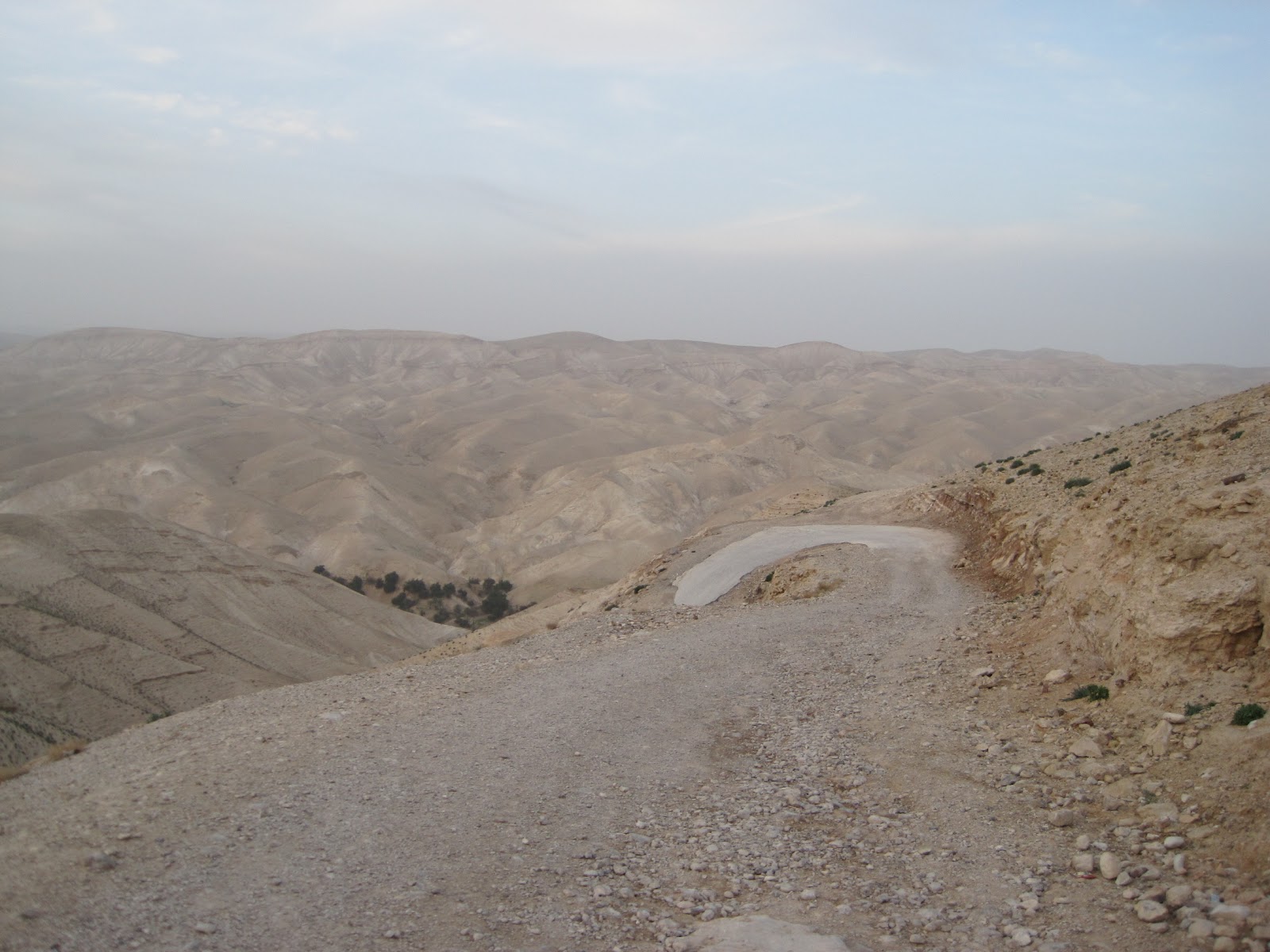
The Judean Wilderness, February, 2010

Scripture Text:  Mark 1: 10-13

10And just as he was coming up out of the water, he saw the heavens torn apart and the Spirit descending like a dove on him. 11And a voice came from heaven, “You are my Son, the Beloved; with you I am well pleased.” 12And the Spirit immediately drove him out into the wilderness. 13He was in the wilderness forty days, tempted by Satan; and he was with the wild beasts; and the angels waited on him.

Jesus was baptized by John and then the version of the Gospel by the writer we know as Mark has immediately being driven into the wilderness.  Still wet with the waters of life, Jesus began his 40-day quest filled with danger, temptation, and probably questions about his own identity and the ministry that would come.  We struggle with this.  We often get hung up on the whole temptation thing, trying to come up with reasons why Jesus, of all people, would have been tempted.  But the writer of this version of the account doesn’t offer more than a mere mention of that.  Instead, we have Jesus being driven out into the wilderness and then the story picks up a few sentences later.  You see, no one followed Jesus out in the desert to get the first hand account.  He was on his own, alone in the wilderness.

We’re not big fans of wildernesses.  In fact, we try to do everything we can to avoid them, or at least find one that has cellular reception and free WIFI available.  And yet, Jesus was driven into the wilderness, as if he had no choice.  Jesus was forced to spend 40 days in what is essentially a wasteland.  The wilderness was waiting for him, offering something that the crowds and the towns and even the synagogue could not.  The wilderness, the place that no one owns, the place that no one has tamed, the place that no one really wants to beat, the place that will never become something that it is not offers just that–itself.  Jesus is not the first to wander in the wilderness and he was not the last.  A few centuries after this, orders of monks in Northern Africa began to make their way into the desert, into the wilderness to experience God’s Presence unhindered by what humans have attempted to create, unhindered by expectations and schedules.  It was the place where they went to renew their prayer life, to begin again.  There were those, like Jesus, that returned to their lives but with new eyes and new hearts.  There were also though that chose to stay , even though they would remain visitors in a place that was not theirs.  In the wilderness, nothing exists but you and God, and, uninterrupted and unhindered, God can create you yet again.

Our wildernesses come in all forms.  Some are self-imposed and others are those to which we are driven at a time that we have no control over where we are going.  The wilderness is hard and dangerous and uncomfortable.  Some are filled with grief and despair.  Others are wrought with a feeling that we will never get out.  Sometimes the wilderness seems unforgiving, as if it’s only focus is to push us into vulnerability, to push us into temptation.  But the lesson that we learn from the wilderness is that, when everything else is gone, when the clouds make us unable to see the way out, when we feel that it will never end, God is there.  And we have become someone new.

Most of us will not drop out of society and make our way to the wilderness.  Even Jesus returned to Galilee, proclaiming the Gospel.  But in this season that remembers Jesus’ time in the wilderness, we can learn what it means to awaken to God’s Presence, to be mindful of this Presence that is always and forever with us, to, day by day, strip those things away that have our attention.  We can learn what it means to enter an intentional wilderness, a place and a time where God is all we have. These forty days are our emptying time—the time when we strip all of our preconceptions away and meet God where God is—right there with us.  We do not walk this road alone.  God is always there.  And when we are tempted to once again take control, God will still be there.  Lent is the time when we allow God to work on us that we might burst forth on Easter morning in radiant bloom.

We need the tonic of wildness, to wade sometimes in marshes where the bittern and the meadow-hen lurk, and hear the booming of the snipe; to smell the whispering sedge where only the wilder and more solitary fowl builds her nest, and the mink crawls with its belly close to the ground.  We can never have enough of nature.  We must be refreshed by the sight of inexhaustible vigor, vast and titanic features, the sea-coast with its wrecks, the wilderness with its living and its decaying trees, the thunder cloud, and the rain which lasts weeks and produces freshets. We need to witness our own limits transgressed, and some life pasturing freely where we never wander. (Henry David Thoreau)

FOR TODAY:  Think of what it would mean to enter an intentional wilderness this Lent, to, day by day strip all those things away that have your attention until all that is left is God, who is recreating you even now.

Grace and Peace,

Shelli


Return to the Waters

man under waterfallScripture Text:  1 Peter 3: 18-22

18For Christ also suffered for sins once for all, the righteous for the unrighteous, in order to bring you to God. He was put to death in the flesh, but made alive in the spirit, 19in which also he went and made a proclamation to the spirits in prison, 20who in former times did not obey, when God waited patiently in the days of Noah, during the building of the ark, in which a few, that is, eight persons, were saved through water.

21And baptism, which this prefigured, now saves you—not as a removal of dirt from the body, but as an appeal to God for a good conscience, through the resurrection of Jesus Christ, 22who has gone into heaven and is at the right hand of God, with angels, authorities, and powers made subject to him.

In this season of returning, here the writer of this general letter known as First Peter dispenses with any talk of being “saved” as it relates to salvation.  Instead, the promise lies in our re-creation, our renewal, our resurrection (the “little r” one), our being made into a new Creation.  It is a reminder that in our baptism, in that moment when the waters covered our body, or covered our head, or when drops of the stuff clinging to another’s hand somehow, some way, landed on our head and brushed our forehead and became the sign of a cross, in THAT moment, we were made new.  It wasn’t just washing away of sin and it certainly wasn’t some sort of something that made us sin no more (although, let me tell you, that would have made this life thing a little easier!)  In that moment as the waters touched us, we were made new, suddenly swept into a new way of being, and our life in Christ began.

Now baptism is not some sort of magic potion that makes everything perfect.  After all, we are not robotic churchy beings.  We are human–messed up, sometimes sinful, sometimes without hope, sometimes without direction, sometimes overwhelmed, but always, always, Beloved children of God.  For those to whom this was written, the words were a reminder that whatever chaos and peril life now holds, it is not permanent, that beyond what we know, beyond what we can imagine, the God of all Creation is working on us even now, creating molecule after molecule, so that when the flood waters of life finally subside, we will remember who and whose we are, a Beloved Child of God with whom God is well pleased.  And no matter what we do, no matter how much we mess up this life that we’ve been given, no matter how much the world’s chaos swirls around us beyond our control, the promise is true.  God is always there beckoning us to return to the waters, to return to where we began and begin again.

This season of Lent is not a season that merely calls us to clean up the mire and muck of our lives.  It is not a season to finally become good and obedient boys and girls.  It is not a season that promises to get your life together (or organize yourself or lose weight or some other thing you think you need to do disguised as a Lenten discipline).  Lent is a season that calls us to return–to who we are called to be, to what gives us life, to God.  It is a season to return to the waters of your baptism, not just for 40 days, but forever.

Do you remember the old version of the Apostles’ Creed, where we proclaim that Jesus descended into hell?  Well, this is the passage from which that notion may have started.  It claims that Jesus proclaimed to those imprisoned spirits; in other words, Jesus entered hell and blew the gates off.  See, you can always begin again.  You can always return to the waters. You just have to be willing to try out some newness.

One cannot step twice in the same river, for fresh waters are forever flowing around us.  (Hereclitus of Ephesus, 535-475 BCE)

FOR TODAY:  Remember your baptism. Now begin again.

Grace and Peace,

Shelli

Return to Grace

Rainbow

Scripture Text:  Genesis 9:12-17

12God said, “This is the sign of the covenant that I make between me and you and every living creature that is with you, for all future generations: 13I have set my bow in the clouds, and it shall be a sign of the covenant between me and the earth. 14When I bring clouds over the earth and the bow is seen in the clouds, 15I will remember my covenant that is between me and you and every living creature of all flesh; and the waters shall never again become a flood to destroy all flesh. 16When the bow is in the clouds, I will see it and remember the everlasting covenant between God and every living creature of all flesh that is on the earth.” 17God said to Noah, “This is the sign of the covenant that I have established between me and all flesh that is on the earth.”

This is actually the tale-end of the story of Noah and the famous ark filled to the brim with the remnants of Creation.  And here…after all this time of pounding rains, all this time cooped up with animals of all kinds, all this time rocking and swaying with the boat…here, God speaks.  The familiar bow of color is set in the clouds as a sign of the promise that God has made.  We usually take it as a sign that God will take care of us, that God will right the wrongs of the world and order them yet again, that God will somehow assuage our pain and grief and put things back the way they were.  Really?  THAT’S not what that says.

Now we can either look at this story as a sort of children’s story, complete with rainbows and pairs of elephants and zebras and orangutans or we can look at this story as one depicting a deity who was so angered by the rebellion of the Creation that God wiped it off the face of the earth. Truthfully, neither one works. Indeed, this is a story about rebellion and human sinfulness. (And to be honest, what story is NOT?) But the whole point is that no matter how far the human creation wandered from the Creator, there was a calling back, a return, an offering of love and forgiveness and a chance to begin again. Now, that’s hard for us to fathom too, possibly because we are not good at offering each other “do-overs”. We are not good at understanding a God who would dispense with all means of justified destruction and just offer Presence and Grace and a future filled with hope. It is hard for us to imagine that no matter what we do, no matter what we screw up or blow up or make up, God is offering a chance to return, a chance to be recreated into something that only God can imagine.

You see, the Celtic tradition would look upon the rainbow not as a promise that God would “fix” the world or “fix” us, but as a threshold, a point between what is and what will be.  So, the promise is not that God will fix everything, but that, always, there is a chance to begin again.  We always and forever, no matter what we’ve done or thought or how many times we’ve flaked out in life, have the chance to return to the beginning. God does not wipe what has happened.  God does not forget what we have done.  Rather God, knowing and remembering full well what the creatures have done in Creation, STILL God offers a threshold through which we can return to Grace–if we will only step through.

The grace of God means something like:  Here is your life.  You might never have been, but you are because the party wouldn’t have been complete without you.  Here is the world.  Beautiful and terrible things will happen.  Don’t be afraid.  I am with you.  Nothing can ever separate us…There’s only one catch.  Like any other gift, the gift of grace can be yours only if you’ll reach out and take it.  Maybe being able to reach out and take it is a gift too.  (Frederick Buechner)

FOR TODAY:  What does it mean to return to grace?  What does it mean not to forget what has happened, not to forget what you have done, but to allow yourself to step through the threshold that God has opened wide, to allow yourself to begin again?

Grace and Peace,

Shelli

Return to Dust

Return to DustScripture Text:  Psalm 51: 10-12

10Create in me a clean heart, O God, and put a new and right spirit within me.  11Do not cast me away from your presence, and do not take your holy spirit from me. 12Restore to me the joy of your salvation, and sustain in me a willing spirit.

Scripture Text:  Genesis 2: 7

7then the Lord God formed man from the dust of the ground, and breathed into his nostrils the breath of life; and the man became a living being.

This is the day.  The pancakes are gone.  The Mardi Gras beads lay strewn across the road as the wind blows them toward the gutter.  Whatever you did yesterday is gone.  The bingeing stops. And now, now we return to dust.  What an odd lot we are.  We eat and drink ourselves silly early this week so that we can approach the altar today and have ashes wiped on our foreheads.  We party and binge and then mark ourselves as sinners, repentant once again.  I used to think that this day was somewhat overly morose.  It never made sense to me.  Why are we carefree partyers one day and then sullen pious ones the next?  And then, we are warned against being overly pious, overly “showy” of our faith disciplines.  So make up your mind, already!

Dust…dirty, yucky, dust…the leftovers, that which remains, that which stays behind clinging to that on which it lands.  We try to wash it away or wipe it down or use some product named Lemon Pledge to give it a fresh scent and perhaps prolong its return.  But, no matter what, it ALWAYS returns.  But on this day, we return to it.  And then we pray to God that we might somehow get a clean heart, a fresh start, a new beginning. And yet, the second Creation story says that God created humans from the dust of the ground, from the dirty, yucky dust that blew uncontrollably across the land.  The dust moved freely from one place to another carrying the beginnings of life whether or not it knew it.  And then God breathed life into it and it became something new, a new Creation made in the very image of God.

And so this day, we return.  We return to our beginnings.  Rather than expecting God to “wipe us clean”, this day calls us to expect God to create us yet again.  We return to dust so that God can take us, breathe life into us once again, creating in us a clean heart and a new and right Spirit.  Today we become dust once again, moving freely and then clinging to God yet again.  I think, given that image of the dust, I am tempted to become a little “Peterish” (oh no, not just my forehead, but ALL of me…Create ALL of me.) But in that speck of dust shaped in the form of a cross, God begins me again.

Lent is not just a time for squaring conscious accounts but for realizing what we perhaps had not seen before.  (Thomas Merton)

FOR TODAY:  Become dust.  Become free to be created yet again.  Open yourself to God breathing life into you yet again.

Grace and Peace,

Shelli