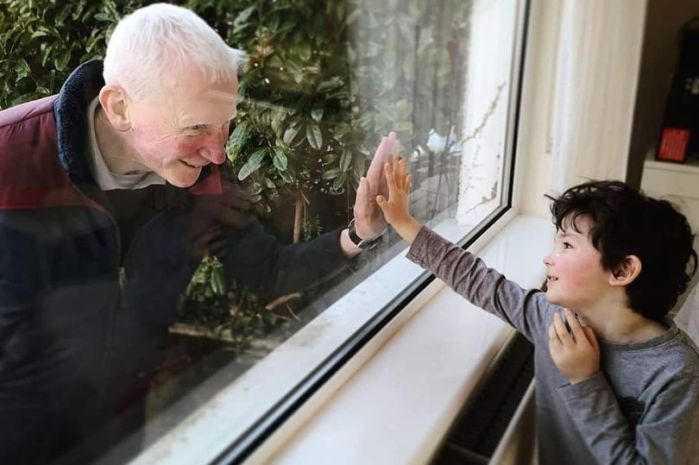
Don’t Touch

0_Jody-Mallon

John 12: 1-11

Six days before the Passover Jesus came to Bethany, the home of Lazarus, whom he had raised from the dead. There they gave a dinner for him. Martha served, and Lazarus was one of those at the table with him. Mary took a pound of costly perfume made of pure nard, anointed Jesus’ feet, and wiped them with her hair. The house was filled with the fragrance of the perfume. But Judas Iscariot, one of his disciples (the one who was about to betray him), said, “Why was this perfume not sold for three hundred denarii and the money given to the poor?” (He said this not because he cared about the poor, but because he was a thief; he kept the common purse and used to steal what was put into it.) Jesus said, “Leave her alone. She bought it so that she might keep it for the day of my burial. You always have the poor with you, but you do not always have me.” When the great crowd of the Jews learned that he was there, they came not only because of Jesus but also to see Lazarus, whom he had raised from the dead. So the chief priests planned to put Lazarus to death as well, since it was on account of him that many of the Jews were deserting and were believing in Jesus.

She took, poured, and wiped.  It’s more than just touching.  It’s visceral, part of us in the very depth of our being.  Took, poured, and wiped.  It’s what we do.  It’s the Eucharist of our lives.  We lift the wine, we pour it into the chalice, we wipe the small drops of wine that escaped from the line of pouring.  And then we share.

You can imagine the others standing around stunned at the very spectacle of this woman touching Jesus in such an intimate way.  I like to think that there was a part of each of them that wished for that connection, that wanted desperately to touch Jesus, to get close enough to breathe him in.  After all, they were just beginning to understand what was coming and, I’m guessing, they wanted to hold on.

You know that they all smelled it–that strong scent of the oils that had been poured out.  It was wafting from Mary’s touch, seeping into the walls, and forever penetrating the senses of all of those who surrounded her.  They judged her with their words, probably putting on more of a show for each other than for her.  But the scent was overwhelming.  And they would remember.  You know how scent is.  I have a lot of my grandmother’s belongings.  And once in awhile, especially on a very humid day, I’ll open a book or the box of recipes or move what used to be her kitchen chair, or open the secretary on which she used to do her homework when she was little, and I smell it.  It’s the smell of her house, the smell of her life.  It’s the smell I remember from my childhood.  It never goes away.  They would remember.  They would always remember that smell.  And when they were fortunate enough, on a very humid day, to smell it again, it would come back.  And they would remember the way that Mary touched him–not in a sexual way or a predatory way–but in a way that connects us all.  It was an intimacy for which we all crave, an intimacy that seals our hearts and souls to each other.

And, yet, here we are.  Don’t touch.  Don’t stand too close.  I saw a video today.  It was a nurse that used paint to show how, even wearing gloves, our touch spreads, whether we realize it or not.  We don’t even know when it happens.  We touch our face or our cell phone or a head of lettuce in the grocery store and we leave a part of ourselves behind and take whatever is there with us.  I wish it didn’t have to do with viral bacteria because it’s a wonderful image.  Our touch is left behind.  When we hold, when we embrace, when we anoint, we leave a part of ourselves behind and we take the memory of what we touched with us.

So, for now, we don’t touch. Because, right now, we’re, literally, viral.  (And not in a good way!) But when we can’t touch, we remember.  We remember what it felt like to embrace and that memory sustains us.  We remember the scent of that moment.  I think that’s why God gave us these senses–because they remember even when we don’t.  Those gathered in that small stuffy room that was overwhelmed with expensive perfumed oil will always remember.  Because their senses were there.  We can’t touch right now and, yet, we remember.  We remember the things that connected us once and, for now, when we don’t touch, that’s enough. And, in the meantime, there’s a connection between us all that is beyond us.  That’s what faith is.  It’s not merely trust or belief.  It’s certainly not proof.  It’s that connection that pulls us beyond ourselves and calls us to remember again.

I found this video on Twitter today.  You may have seen it.  It’s proof that symphonies are not about being together; they are about remembering who you are and playing the part you are called to play.  We can do this!

I believe that life is given us so we may grow in love, and I believe that God is in me as the sun is in the colour and fragrance of a flower…I believe that in the life to come I shall have the senses I have not had here, and that my home there will be beautiful with colour, music, and speech of flowers and faces I love.  Without this faith there would be little meaning in my life.  I should be “a mere pillar of darkness in the dark.” (Helen Keller)

Today, pray for those that are overwhelmed with this isolation, that are craving the touch we all crave at times.  And, in your prayers, there will be a person that comes to mind.  Call them and touch their hearts.

Continue on this road.

Six Feet Apart

Six Feet Apart


Matthew 21: 1-11

When they had come near Jerusalem and had reached Bethphage, at the Mount of Olives, Jesus sent two disciples, 2saying to them, “Go into the village ahead of you, and immediately you will find a donkey tied, and a colt with her; untie them and bring them to me. 3If anyone says anything to you, just say this, ‘The Lord needs them.’ And he will send them immediately.” 4This took place to fulfill what had been spoken through the prophet, saying, 5“Tell the daughter of Zion, Look, your king is coming to you, humble, and mounted on a donkey, and on a colt, the foal of a donkey.” 6The disciples went and did as Jesus had directed them; 7they brought the donkey and the colt, and put their cloaks on them, and he sat on them. 8A very large crowd spread their cloaks on the road, and others cut branches from the trees and spread them on the road. 9The crowds that went ahead of him and that followed were shouting, “Hosanna to the Son of David! Blessed is the one who comes in the name of the Lord! Hosanna in the highest heaven!” 10When he entered Jerusalem, the whole city was in turmoil, asking, “Who is this?” 11The crowds were saying, “This is the prophet Jesus from Nazareth in Galilee.”

The parade.  I’ve always loved the parade.  As a child, I loved the story.  And I REALLY loved getting a palm branch to wave during the first hymn and then play with throughout the rest of the service.  It was an odd story to me then.  Truthfully, I really didn’t understand the connection to the rest of Holy Week at all.  I think I assumed that Jesus was entering the city like a movie star, that everyone there dropped what they were doing and got on board with the whole Jesus agenda and had a party or something.

But that’s not really it.  Jesus and his small band of followers wound up the narrow, ruddy road around the Garden of Gethsemane with an uncooperative donkey walking over the cheaply-made cloaks of ordinary people.  There were no grand stallions.  There was no finery.  And it was set against the backdrop of a bustling city that really wasn’t paying attention to Jesus at all.  And so he entered through the back door of the city and the small crowd that had gathered with him went about their way.  Jesus was alone with only a few of his disciples.  He wasn’t surrounded by a crowd.  Most of those with him outside the gates had gone back to their lives.  He was essentially alone.  And Holy Week began.

But this year we won’t wave palm branches and walk with a crowd.  This year we won’t play with the palm during the service.  Our sanctuaries are empty with the possible exception of those involved in the streaming operation.  This year we all walk alone–or at least six feet apart.  How did the world change so dramatically in a couple of weeks?  How did we go from being part of bustling crowds on our streets, in our restaurants, at sporting events, and in the pews to this?  How did we go from being free to come and go as we please to this?  How did we end up alone–or at least six feet apart?

And, yet, the fact that the whole world has all at once been brought to this place, brought to our knees simultaneously, in an odd way brings us together.  It makes us pay attention.  It has seemed to make most of us more empathetic.  We can’t drop our used palms and go “back to our lives” because our lives, for now, are gone.  But our hearts are intact.  And it’s made us pay attention.  We’re suddenly aware that there are people that are just a paycheck away from having nothing to eat.  We’re suddenly aware that those who struggle on the streets are in real danger.  We’re suddenly aware of those who have no insurance. We’re aware that many of us, maybe even some of us reading this, are vulnerable.  Maybe that awareness is not such a bad thing.  Maybe sometimes we need to be jolted out of our comfortable assumptions and our comfortable lives.  I wish this wasn’t the way that had to happen.  But, isn’t it weird, that when we can’t touch each other, when we can’t all be together, we pay more attention to each other?  We seem to be more in tune with each other because we’ve been forced to listen to each other.

Today we enter Jerusalem alone–or at least six feet apart.  Today we crave to touch and hug and laugh and share.  Today we have to listen a little harder to the world around us.  Today we know what’s important and we go through the gate. Because today, our hearts lead the way.  We’ve never walked this way alone.  But we’re really not alone.  We’re just six feet apart. And if we listen, we can still sing the Hallelujahs even from that distance.

The way of Love is the way of the Cross, and it is only through the cross that we come to the Resurrection.  (Malcolm Muggeridge)

On this Palm Sunday, pray for those fighting for us on the front lines–the healthcare workers, the first responders, those who are packing our food and bagging our groceries and delivering the stuff we need.  And remember that you can still make music–even when you’re six feet apart.

Go into the Gate.  You do not walk alone.


In Concert

Scripture Passage: John [15:26-16:1-11] 12-15

12“I still have many things to say to you, but you cannot bear them now. 13When the Spirit of truth comes, he will guide you into all the truth; for he will not speak on his own, but will speak whatever he hears, and he will declare to you the things that are to come. 14He will glorify me, because he will take what is mine and declare it to you. 15All that the Father has is mine. For this reason I said that he will take what is mine and declare it to you.

So, now that we’ve been showered with wind and fire, the next thing is to affirm the Trinity, the three in one.  We do it every year.  And we talk about it A LOT.  Our Trinitarian faith depicts not only our understanding of God but also our understanding of ourselves.  So, everyone, raise your hand if you’d like to explain what it means…anyone?….anyone out there?  Yeah, that’s the problem.  What does it MEAN?

I think we all do the Trinity a disservice.  We make the mistake of sort of picking which higher power team with whom we choose to associate.  And God/Father/Creator becomes a sort of deist, kicking the world off but somehow removed after that.  And Jesus/Son/Redeemer gets pulled down to our own personal version of who God should be, a Savior not of the world but just of us (just of me, like Shelli’s version of Jesus is all I need), of OUR sins and OUR redemption.  And then that Holy Spirit/Sustainer character is designated as beyond us, something to which we should possibly aspire (in an acceptable and moderate way, of course) but something that is not us.  None of this is right.  The image of the Trinity cannot be separated or pitted against one another because it’s all the same.

For several years, I co-lead an Interfaith Scripture Study with a Rabbi from the Temple down the street.  With both Jewish and Christian participants, we would study various Scriptures and share in both our diverse and common understandings of them.  As time permits, we would often end the study sessions with either an “Ask the Christians” question or an “Ask the Jews” question.  (It was our own version of a sometimes very dangerous Jeopardy session)  One day during the “Ask the Christians” episode, I got the always-dreaded question:  “Explain the Trinity to us and tell us how it is not polytheistic, how it is not a depiction of three Gods.”  Truthfully, I remember my feeling of sheer panic.  To me, trying to “define” the Trinity was almost anathema because it would sound limiting and shallow and perhaps even fall into the “my God is bigger than your God” misunderstanding.  But not bothering to attempt to explain its meaning is not giving it enough credit either.  So I took a deep breath and dove in:

“Well, in the beginning was God.  God created everything that was and everything that is and laid out a vision for what it would become.  But we didn’t really get it.  So God tried and tried again to explain it.  God sent us Abraham and Moses and Judges and Kings and Prophets.  But we still didn’t get it.  God wove a vision of what Creation was meant to be and what we were meant to be as God’s children through poetry and songs and beautiful writings of wisdom.  But we still didn’t get it. 

“So,” God thought, “there is only one thing left to do.  I’ll show you.  I’ll show you the way to who I am and who I desire you to be.  I will walk with you.”  So God came, Emmanuel, God-with-us, and was born just like we were with controversy and labor pains and all those very human conceptions of what life is.  Jesus Christ, Emmanuel, was the Incarnation of a universal truth, a universal path, the embodiment of the way to God and the vision that God holds for all of Creation.  But we still didn’t get it.  We fought and we argued and we held on to our own human-contrived understandings of who God is.  And it didn’t make sense to us.  This image of God did not fit into our carefully-constructed boxes that we had so painstakingly laid out.  And so, as we humans have done so many times before and so many times since, we destroyed that which got in the way of our understanding and made our lives difficult to maintain.  There…it was finished…we could go back to the way it was before.

But God loves us too much to allow us to lose our way.  And so God promised to be with us forever.  Because now you have seen me; now you know what it is I intended; now you know the way.  And so I will always be with you, always inside of you, always surrounding you, always ahead of you, and always behind you.  There will always be a part of me in you.  Come, follow me..this way.

As you celebrate the Trinity this Sunday, remember that there is a piece of God just for you and there is always more of God beyond anything that you can even imagine.  The image of the Trinity, both separate and one, in concert and in harmony, depicts both, pulling it in to our understanding and then taking our understanding beyond.

  God creates us, Jesus leads us, and the Spirit shows us ways that are not always in the book.  (Joan Chittister, from “In Search of Belief”)

Grace and Peace,

Shelli

Spirit-Poured

Scripture Passage: Acts 2: 1-6, [7-11], 12-17, [18-21]

When the day of Pentecost had come, they were all together in one place. 2And suddenly from heaven there came a sound like the rush of a violent wind, and it filled the entire house where they were sitting.3Divided tongues, as of fire, appeared among them, and a tongue rested on each of them. 4All of them were filled with the Holy Spirit and began to speak in other languages, as the Spirit gave them ability.

5Now there were devout Jews from every nation under heaven living in Jerusalem. 6And at this sound the crowd gathered and was bewildered, because each one heard them speaking in the native language of each…” 12All were amazed and perplexed, saying to one another, “What does this mean?” 13But others sneered and said, “They are filled with new wine.”

14But Peter, standing with the eleven, raised his voice and addressed them, “Men of Judea and all who live in Jerusalem, let this be known to you, and listen to what I say. 15Indeed, these are not drunk, as you suppose, for it is only nine o’clock in the morning. 16No, this is what was spoken through the prophet Joel: 17‘In the last days it will be, God declares, that I will pour out my Spirit upon all flesh, and your sons and your daughters shall prophesy, and your young men shall see visions, and your old men shall dream dreams. 

I know it’s been too long since I did this.  But rather than beleaguering that point now, I’ll just let all the reasons why I have seemed to be missing in action drift into future writings.  So, over the years, I have often written in “high holy” seasons, those seasons that sort of burst in and interrupt our day-to-day ordinary lives.  They are the seasons, like Advent and Lent, that make us pay attention, perhaps even change what we are doing.

We often think the same thing of Pentecost.  It has been portrayed with images of winds and fires and brightly colored streamers that at the very least draw our attention to the day.  Some even refer to it as the “Church’s birthday”.  Truthfully, I hate that.  I don’t think it was the birth of the church (the organized church came along much later).  I also don’t think it was merely an awakening of a sleepy people (although that would be helpful even now).  And it is not merely a day filled with fire and winds.  (When I was young, I conjured up images of forest fires and hurricanes, which did not seem helpful to me at all.)  Instead, in my thoughts, this day is tied to the Sunday before.  The Ascension of Christ left what seemed to be an emptiness, a place that was once filled but is now an uncomfortable gaping hole in the story.  And we are told to wait.  (Have you noticed there’s a lot of waiting in this life?)

And then, we are told, a wind comes upon us and the Spirit pours into us, filling that emptiness with the piece of God that is meant just for us.  And it is like tongues of fire, all-consuming, burning away those things around the edges of our lives onto which we hold a little too tightly.  The Hebrew for it is “Ruah”, more than wind, more than Spirit, but the very breath of God breathed into us.  It does not interrupt our ordinary lives; it makes them what they are meant to be; it makes them holy.

This “high holy” day is different from the rest.  Because it brings our ordinariness along with it.  It is now the norm.  And if we are open to being Spirit-poured, we can never go back to the old ways again.  So, what part of God’s Spirit is yours?  What part of Jesus life is yours to carry? And what will you do with your newfound ordinariness?

Without Pentecost, the Christ-event–the life, death, and resurrection of Jesus–remains imprisoned in history as something to remember, think about, and reflect on.  The Spirit of Jesus comes to dwell within us, so that we can become living Christs here and now. (Henri J.M. Nouwen)

Grace and Peace,

Shelli

Creation, Yet Again

Easter Lily (DT 8087007)

Scripture Text:  John 20: 1-18

Early on the first day of the week, while it was still dark, Mary Magdalene came to the tomb and saw that the stone had been removed from the tomb. So she ran and went to Simon Peter and the other disciple, the one whom Jesus loved, and said to them, “They have taken the Lord out of the tomb, and we do not know where they have laid him.” Then Peter and the other disciple set out and went toward the tomb. The two were running together, but the other disciple outran Peter and reached the tomb first. He bent down to look in and saw the linen wrappings lying there, but he did not go in. Then Simon Peter came, following him, and went into the tomb. He saw the linen wrappings lying there, and the cloth that had been on Jesus’ head, not lying with the linen wrappings but rolled up in a place by itself. Then the other disciple, who reached the tomb first, also went in, and he saw and believed; for as yet they did not understand the scripture, that he must rise from the dead. Then the disciples returned to their homes.

But Mary stood weeping outside the tomb. As she wept, she bent over to look into the tomb; and she saw two angels in white, sitting where the body of Jesus had been lying, one at the head and the other at the feet. They said to her, “Woman, why are you weeping?” She said to them, “They have taken away my Lord, and I do not know where they have laid him.” When she had said this, she turned around and saw Jesus standing there, but she did not know that it was Jesus. Jesus said to her, “Woman, why are you weeping? Whom are you looking for?” Supposing him to be the gardener, she said to him, “Sir, if you have carried him away, tell me where you have laid him, and I will take him away.” Jesus said to her, “Mary!” She turned and said to him in Hebrew, “Rabbouni!” (which means Teacher). Jesus said to her, “Do not hold on to me, because I have not yet ascended to the Father. But go to my brothers and say to them, ‘I am ascending to my Father and your Father, to my God and your God.’” Mary Magdalene went and announced to the disciples, “I have seen the Lord”; and she told them that he had said these things to her.


THE LORD IS RISEN!

THE LORD IS RISEN INDEED!

Christ, the Lord, is risen today, Alleluia!   Sons of men and angels say, Alleluia!

Raise your joys and triumphs high, Alleluia!  Sing, ye heavens, and earth, reply, Alleluia!

Love’s redeeming work is done, Alleluia!  Fought the fight, the battle won, Alleluia!

Lo! the Sun’s eclipse is over, Alleluia!  Lo! He sets in blood no more, Alleluia!

Vain the stone, the watch, the seal, Alleluia!  Christ hath burst the gates of hell, Alleluia!

Death in vain forbids His rise, Alleluia!  Christ hath opened paradise, Alleluia!

Lives again our glorious King, Alleluia!  Where, O death, is now thy sting? Alleluia!

Once He died our souls to save, Alleluia!  Where thy victory, O grave? Alleluia!

Soar we now where Christ hath led, Alleluia!  Following our exalted Head, Alleluia!

Made like Him, like Him we rise, Alleluia!  Ours the cross, the grave, the skies, Alleluia!

Hail, the Lord of earth and Heaven, Alleluia!  Praise to Thee by both be given, Alleluia!

Thee we greet triumphant now, Alleluia!  Hail, the resurrection, thou, Alleluia!

King of glory, Soul of bliss, Alleluia!  Everlasting life is this, Alleluia!

Thee to know, Thy power to prove, Alleluia!  Thus to sing and thus to love, Alleluia!

(Charles Wesley, 1739)

The day has arrived!  After all this time of anunciation and birth, of baptism and ministry, of teaching and healing, of calling and response, of temptation and darkness, of dying and crucifixion, this Day of Resurrection has dawned.  After this long and difficult journey that we have taken, we come to this day with new eyes and as a new creation.  Christ has risen!  Christ has risen indeed!

But lest we lapse into thinking of this day as a commemoration of The Resurrection of Christ, as a mere remembrance of what happened on that third day so long ago, as some sort of shallow anniversary of Christ’s rising, we need to realize that this day is not just about Jesus’ Resurrection; it is also about our own.  We who carried our cross, we who died to self, we who journeyed through the wilderness and through those gates, are this day given new life.  God has recreated us into who God calls us to be.  And, in a way, that is almost more scary than the dying.  There is no going back.  The self that we knew before is no more.  We are a new creation.  We are a re-creation.

We have risen! 

We have risen indeed!

From the void, from the darkness, God created Light and Life.  No, correct that.  The Scripture begins “while it was still dark”.  God did not wait until the light to come to begin the work of Creation and this time is no different.  While it was still dark, while we strained to see hope and grieved what had come to be, God began.  That is what we are called to do.  We cannot wait until the world is ready.  Our work begins in the darkness with God.

Truthfully, if you look at it from a literal view, nothing has really changed.  Jesus, sadly, is still dead.  The human Jesus, the Jesus born into this world on that long ago night in Bethlehem, was gone.   But through eyes that have been resurrected, nothing will ever be the same again.

Maybe resurrection comes not in raising one above life, but in raising life to where it is supposed to be.  Jesus was the first to cross that threshold between–between death and life, between the world and the sacred, between seeing with the eyes of the world and seeing with the eyes of the Divine.  Hell has been vanquished.  Wesley wrote that “Christ hath burst the gates of hell”.  What that means is that everything, everything that God has created, everything above, below, within, around, everything we see, everything we know, everything we wonder about, everything we do not understand, has been made anew.  Resurrection is not about being transplanted to a new world but rather being called to live in this one as a new creation.  It means being recreated into the one that God envisions you to be.  It means being given a new way of seeing where love is stronger than death, where hope abides, and where life has no end.  It means being capable of glimpsing the Holy and the Sacred, the promise of Life, even in this life, even now.  This day of Easter is now only about Jesus’ Resurrection; it is about ours!  So, what do you plan to do with your new life?

The end of all our exploring…will be to arrive where we started…and know the place for the first time. (T.S. Eliot)


King of glory, Soul of bliss, Alleluia! Everlasting life is this, Alleluia!

Thee to know, Thy power to prove, Alleluia! Thus to sing and thus to love, Alleluia!

Everlasting life is truly this!

Happy Easter!

Shelli


In the Hours Before the Dawn

dark-before-dawnScripture Text:  Genesis 1:1-5a, 31a, 2:1-3

In the beginning when God created the heavens and the earth, the earth was a formless void and darkness covered the face of the deep, while a wind from God swept over the face of the waters.  Then God said, “Let there be light”; and there was light. And God saw that the light was good; and God separated the light from the darkness. God called the light Day, and the darkness he called Night…God saw everything that he had made, and indeed, it was very good…Thus the heavens and the earth were finished, and all their multitude. And on the seventh day God finished the work that he had done, and he rested on the seventh day from all the work that he had done. So God blessed the seventh day and hallowed it, because on it God rested from all the work that he had done in creation. 

We’re never really sure what to do with this day.  Everything is so quiet, so unsettled.  Memories of the week before interrupt our quiet thoughts, filling our minds with regrets over things we would have done differently, places we would have said “yes”, places we would have said “no”, places that we would have stood, places that we would have stayed.  The Cross is empty and Jesus is gone, laid in the tomb–forever.  We know that we will have to go on but we’re not sure how to do that. This is a day when once again, we are covered in darkness.  The earth feels out of sorts, almost formless and empty once again.  And so we sit here in these hours before the dawn with no direction, no guide, no journey that we can see.

And, yet, God has done this before, this creating.  God takes a formless voice that is immersed in darkness and sweeps into it bringing Light.  God creates and we become.  God creates and the world begins to move.  God creates and everything is as it should be.  And then God rested.  This seventh day, this Sabbath, this day of rest, is not the low point of Creation but the veritable climax.  It is the edge of everything that will be, the veritable edge of Glory.  This is the day to sit without doing, to sit without trying to “fix” the world, without trying to “fix” ourselves, without even worrying what the future may hold, and let the peace of God sweep over us once again.  This is the day to sit in the silence and hear the voice that is beckoning us to a New Creation.  Whether we can see it or not, this is the day that we are standing on the edge of Glory.  It is not what we planned; it is not what we envisioned; it is new.  Creation is happening now–in the quiet, in the darkness.

So what do we do today in these hours before the dawn?  It’s hard for those of us that want to make the future right.  It’s hard for us in a place where it’s always been so easy, so protected, to live with both the memories of yesterday and the uncertain future of a world that seems to teeter even now on the brink of furthering its own demise.  This is a day filled with talk of bombs and crosses.  It is a world that only faith can redeem.  What do we do?  Nothing…just rest…and let God create you.  This is the moment of your re-creation.  God is walking in the darkness with you. It may not be what you imagined but it will be right.  The light is just over the darkened horizon.

The pilgrims sit on the steps of death.  Undanced, the music ends.  Only the children remember that tomorrow’s stars are not yet out.  (Ann Weems)

Grace and Peace,

Shelli

It is Finished

???????????Scripture Text:  John 19: 14-30

Now it was the day of Preparation for the Passover; and it was about noon. He said to the Jews, ‘Here is your King!’ They cried out, ‘Away with him! Away with him! Crucify him!’ Pilate asked them, ‘Shall I crucify your King?’ The chief priests answered, ‘We have no king but the emperor.’ Then he handed him over to them to be crucified.

So they took Jesus; and carrying the cross by himself, he went out to what is called The Place of the Skull, which in Hebrew* is called Golgotha. There they crucified him, and with him two others, one on either side, with Jesus between them.  Pilate also had an inscription written and put on the cross. It read, ‘Jesus of Nazareth,* the King of the Jews.’ Many of the Jews read this inscription, because the place where Jesus was crucified was near the city; and it was written in Hebrew,* in Latin, and in Greek. Then the chief priests of the Jews said to Pilate, ‘Do not write, “The King of the Jews”, but, “This man said, I am King of the Jews.”’ Pilate answered, ‘What I have written I have written.’ When the soldiers had crucified Jesus, they took his clothes and divided them into four parts, one for each soldier. They also took his tunic; now the tunic was seamless, woven in one piece from the top. So they said to one another, ‘Let us not tear it, but cast lots for it to see who will get it.’ This was to fulfil what the scripture says,  ‘They divided my clothes among themselves, and for my clothing they cast lots.’  And that is what the soldiers did.

Meanwhile, standing near the cross of Jesus were his mother, and his mother’s sister, Mary the wife of Clopas, and Mary Magdalene. When Jesus saw his mother and the disciple whom he loved standing beside her, he said to his mother, ‘Woman, here is your son.’ Then he said to the disciple, ‘Here is your mother.’ And from that hour the disciple took her into his own home.  After this, when Jesus knew that all was now finished, he said (in order to fulfil the scripture), ‘I am thirsty.’ A jar full of sour wine was standing there. So they put a sponge full of the wine on a branch of hyssop and held it to his mouth. When Jesus had received the wine, he said, ‘It is finished.’ Then he bowed his head and gave up his spirit.

It is finished–all the announcing, all the birthing, that star over the manger, the shepherds, the wisemen, the ministry around the lake, the welcoming, the pushing, the encouraging, the healing, the teaching, the last meal–it is finished.  What would we do for just one more moment, one more moment to kneel at the feet of the Savior and worship and love and learn and bask in a Presence that we can’t even explain?  What would we change about how we had done it, how much we paid attention, how much we were aware?  What would we tell Jesus that we did not? What would we do rather than betray him, betray his trust, his love, his faith in who we are and what we can do?

This is the most difficult for us Protestant Christians, those of us who have chosen to spend the whole of our church year bowing before the “empty Cross”, the depiction of Christ’s Resurrection and the promise of our own salvation.  And while I’m not willing to trade the large gleaming empty cross at the front of the sanctuary and permanently replace it with a Crucifix, I think that we do miss part of what the Cross means if we choose to never enter the pain and the suffering that is Christ’s.  In fact, Howard asks, “Where, suddenly, is the theology that teaches that because the Savior did it all, we thereby are reduced to the status of inert bystanders?”  Because, truthfully, when the chips were done, the people stood by.  WE stood by.  We stand by and we let Christ suffer, wait for Christ to finish up this whole messy ordeal, hand us a lily and a pretty bonnet, and invite us to joyfully sing “Christ the Lord is Risen Today” and go on about our business.

The season of Lent, though, is about entering the experience of the Cross—the whole experience.  Because how can one understand the joy of Resurrection without experiencing the pain and suffering and even the death of Crucifixion?  The two cannot be separated.  We are called to enter and bear all that is Christ—the pain, the suffering, the death, and, just when we think “it is finished”, the joy of rising to eternal life, to an eternity of oneness with God.  If we are to truly understand what that means, we must, then, embrace the entirety of the message of the Cross.  And so, perhaps, if only for awhile (maybe 40 days or so!), we should spend this Season of Lent truly looking at the “pre-Easter” experience of the Cross.  You will be amazed what that Easter morning Cross, gleaming in the sunlight of a newly created day, looks like if you understand how God created it, if you have experienced all that is God.

So, in this moment, in this moment when it is all finished, the moment that, for now, our journey ends, what do we do?  What is next?  You know, this thing would have been a whole lot easier to piece together and market if Jesus had died a hero.  But Jesus did not come as a hero; Jesus came as a servant, a humble human servant, to show us what life means.  So, were you there?  Sometime I wonder if I was.  Sometimes I’m too busy or too tired or too convinced that I already have it figured out.  Sometimes I forget to be there.  I have taken this whole journey wanting so badly to be near Jesus, wanting so badly to be connected, to be one.  But sometimes I forget to be there.  Sometimes I want to jump ahead and set up for the Easter celebration.  But today, in this moment, we are called to be there, to stand, perhaps alone, and be with Jesus on the Cross, to be there when it is finished.  Hard as it may be, we have to live the end, to live the “it is finished” before we can live the beginning.  So sit here at the Cross, in this moment, this finished moment.

After the Crucifixion, this defeated little band of disciples had no hope. As you can imagine, they had no expectation of anything else to come. Everything in which they believed, in which they had invested their lives, had died on the cross. It seemed to them that the world had been right and they had been wrong. Joan Chittister says that “the road behind us becomes what frees us for the road ahead.” In this moment, God was already freeing them from grief and recreating joy.  And us…there is something in all of us that struggles with the thought of God suffering. We instead imagine a God that stands apart from us, shielded from pain, and prepared to pick up the pieces of our lives when we need it. But God, in God’s infinite wisdom rather recreates our lives from the inside, from the point of our deepest pain and suffering, from the cross, and even we become new Creations whether or not we can see it now. The cross is the rebirth of humanity in all its fullness. In this moment, it is death that dies.  Truthfully, it is DEATH that is finished.  It is hard for us to see right now. It is hard to see clearly through the tears of grief. Christ died on a cross in immense suffering and pain. And those who love him grieve a grief such that they have never known.  And just when nothing else makes sense, it is in that moment that your eternity has begun.   There is Light ahead but for now, just for a moment, we sit here at the Cross.  It is finished.  It is in this moment that we finally just let it be.

There will come a time when you believe everything is finished. That will be the beginning. (Louis L’Amour)

This is the moment.  This is the moment that you begin.  Jesus did not die a hero to emulate; he died to give us Life.  No longer a bystander, we are called to enter that Life.  What does that mean?  Go forward…you can’t see it just yet but your eternity has begun!

Grace and Peace,

Shelli