And They Took Joseph to Egypt

Lectionary Text:  Genesis 37: (1-4, 12-22) 23-28:
So when Joseph came to his brothers, they stripped him of his robe, the long robe with sleeves that he wore;and they took him and threw him into a pit. The pit was empty; there was no water in it.Then they sat down to eat; and looking up they saw a caravan of Ishmaelites coming from Gilead, with their camels carrying gum, balm, and resin, on their way to carry it down to Egypt.Then Judah said to his brothers, “What profit is it if we kill our brother and conceal his blood?Come, let us sell him to the Ishmaelites, and not lay our hands on him, for he is our brother, our own flesh.” And his brothers agreed.When some Midianite traders passed by, they drew Joseph up, lifting him out of the pit, and sold him to the Ishmaelites for twenty pieces of silver. And they took Joseph to Egypt.

And they took Joseph to Egypt…so matter-of-fact, so simple, so explanatory.  But far from being merely historical data, this six word sentence represents a turning point in the story.  With these words the Genesis story turns the corner, moving from a story of a somewhat dysfunctional family as their lives are intricately woven with the breath of God to the story of a people growing into God’s people.  We begin to prepare for the Exodus story.  Nothing will ever be the same again.  We know what is to come–slavery, plagues, wilderness, and, finally, deliverance, redemption.  This is the stuff of transformation.

When this Scripture (sorry, I cut off the first part!) was read this morning, I was struck by these words.  I know that I’ve passed them over time and time again. After all, this is an important story and there’s a lot to grasp–favorite sons, dreams, beautiful coats, family squabbles, murder, intrigue, conspiracy, enemies, slavery, lies.  (And just for the record, I would like it to be noted that no matter what I did to my brother Donnie growing up, I NEVER sold him into slavery!)  And then you take a breath and, oh yeah, “and they took Joseph to Egypt.”  What struck me is how similar those words are to some others:

Text:  Matthew 17: 1-9
Six days later, Jesus took with him Peter and James and his brother John and led them up a high mountain, by themselves.And he was transfigured before them, and his face shone like the sun, and his clothes became dazzling white.Suddenly there appeared to them Moses and Elijah, talking with him.Then Peter said to Jesus, “Lord, it is good for us to be here; if you wish, I will make three dwellings here, one for you, one for Moses, and one for Elijah.”While he was still speaking, suddenly a bright cloud overshadowed them, and from the cloud a voice said, “This is my Son, the Beloved; with him I am well pleased; listen to him!”When the disciples heard this, they fell to the ground and were overcome by fear.But Jesus came and touched them, saying, “Get up and do not be afraid.”And when they looked up, they saw no one except Jesus himself alone.As they were coming down the mountain, Jesus ordered them, “Tell no one about the vision until after the Son of Man has been raised from the dead.”

Today is the Feast of the Transfiguration.  When I realized that earlier this week, I thought it was just odd.  I mean, really, don’t we celebrate that right before Lent begins?  But the abrupt ending to today’s Old Testament Scripture made me think a little bit more about it.  In this Matthean account of the Transfiguration, the writer has Jesus and the disciples headed down the mountain.  They were talking.  Jesus warned them to be quiet about what they had just seen.  And in the same breath, he gave them a foretaste of what would come.  So, we have Jesus walking down the mountain.  Where is he going?  He’s going to Jerusalem.  And we know what happens there.  This is the turning point.  There is no going back.  A new way of being has begun.

And they took Joseph to Egypt…And they took Jesus to Jerusalem.

We all have Egypts.  We all have Jerusalems.  They are those watershed moments in our lives that are bumpy and rough and uncomfortable.  They are that way because it means that we have changed.  We have been through a transition; we have been transformed; we have been transfigured into something else.

We don’t know what Monday morning will hold for our economy.  There are those who will say that our “best years” are behind us, those who yearn for the 40’s and the 50’s when the United States was “on top of the mountain.”  Really?  I’m pretty clear that our African-American brothers and sisters will disagree with you.  Are our “best years” the ones in which only some of us are on top?  That’s sad.  I don’t think so.  Perhaps we’re being sold to Egypt.  I don’t know.  Maybe we’ve got a long wilderness ahead.  Maybe we are walking down that mountain headed for who knows what.  Maybe we will find ourselves in Egypt.  Maybe we will find ourselves in Jerusalem.  Maybe we will find ourselves enslaved by something we never saw coming or crucified by those who want to maintain things the way they are.  Maybe there is a rough road ahead.  Maybe not.  Maybe our stocks will pop back up tomorrow and everything will be hunky dory.  Maybe not.  Whatever happens, we are in the midst of change. The road to change is not always an easy one.  But somewhere on that road, we will find transformation.  We will find deliverance.  We will find redemption.  But right now we’ve got to come down from the mountain…After all, I think it’s WAY too cloudy to see what’s going on up here.  (Hmmm!  Maybe that’s our whole problem.)

And they took Joseph to Egypt…and you know what?  No one was ever the same again.  We’ve been to the mountaintop…now is the time to move on.

Grace and Peace,

Shelli
A Holy Pilgrimage

Last week I returned from a wonderful journey through the Holy Land with a wonderful group of friends–some [not so] old and some brand new! It was my first time to experience Israel and I have already encountered how it so profoundly changes those who have the gift of that adventure. How can I ever read Scripture the same again? How can I ever read accounts of vast groups of people journeying through the desert or waves being calmed on the [Lake] of Galilee during a storm or Jesus traveling from town to town teaching and healing without seeing and hearing and touching what I have once again? I am profoundly and forever changed. How can I be part of a Palm Sunday processional without feeling the uneven pavement beneath my feet and the way it slopes at a somewhat precarious angle as it winds above the city of Jerusalem and ends at the Garden of Gethsemane? I am profoundly and forever changed. How can I ever take the bread or serve the cup without remembering the old city in which that last meal was held, without imagining Jesus and the disciples winding their way through it in the dark trying to reach a quiet place of prayer on that dark and desperate night. I am profoundly and forever changed. Thanks be to God!

One of the questions that we were asked was what made the difference between a “trip” and a “pilgrimage”. I have been thinking about that since I’ve been back as the memories and the feelings make their way deep into my being. I think that one difference is that a trip takes you to somewhere new and a pilgrimage takes you to somewhere that is already a part of you. A trip is temporary as you return to your same existence from which you left; a pilgrimage stays with you and becomes a part of you. A trip allows you to be someone you’re not, if only for awhile; but a pilgrimage…a pilgrimage pushes you into becoming who you are. This trip was definitely a pilgrimage. Oh, sure, I brought pictures (some of them I’ll try to post over the next couple of weeks) and souvenirs and various mementos. But more than anything, I brought a piece of who I am home.

Jesus, full of the Holy Spirit, returned from the Jordan and was led by the Spirit in the wilderness, where for forty days he was tempted by the devil. He ate nothing at all during those days, and when they were over, he was famished. The devil said to him, “If you are the Son of God, command this stone to become a loaf of bread.” Jesus answered him, “It is written, ‘One does not live by bread alone.’” Then the devil led him up and showed him in an instant all the kingdoms of the world. And the devil said to him, “To you I will give their glory and all this authority; for it has been given over to me, and I give it to anyone I please. If you, then, will worship me, it will all be yours.” Jesus answered him, “It is written, ‘Worship the Lord your God, and serve only him.’” Then the devil took him to Jerusalem, and placed him on the pinnacle of the temple, saying to him, “If you are the Son of God, throw yourself down from here, 10for it is written, ‘He will command his angels concerning you, to protect you,’ and ‘On their hands they will bear you up, so that you will not dash your foot against a stone.’” Jesus answered him, “It is said, ‘Do not put the Lord your God to the test.’” When the devil had finished every test, he departed from him until an opportune time. (Luke 4: 1-13)

This last Sunday, the lectionary Gospel passage was Jesus’ 40-day encounter in the wilderness. I’m pretty sure that Jesus was not just trying to “get away from it all”, as attractive as that may have been to someone who worked the hours he did! He was not escaping; he was becoming. He was on a pilgrimage to find out who God meant for him to be–to find out who he was. It is our quintessential model for this Lenten season. Lent is not merely a time of self-denial. It really has little to do with giving up chocolate, or soft drinks, or your nightly glass of wine. Lent is a pilgrimage, a holy pilgrimage. It is, of course, about clearing one’s life to make room for God to work. But, I think, more than anything else, Lent is about becoming who you are, who God intended you to be. It is about finding yourself and when one finds who he or she is truly meant to be, it is there that one will finally know God in the way that God desires to be known.

In this Lenten season, I wish you a Holy Pilgrimage…Go…become who God means for you to be. It is there that you will finally know that you are home.

Peace on the Journey,

Shelli

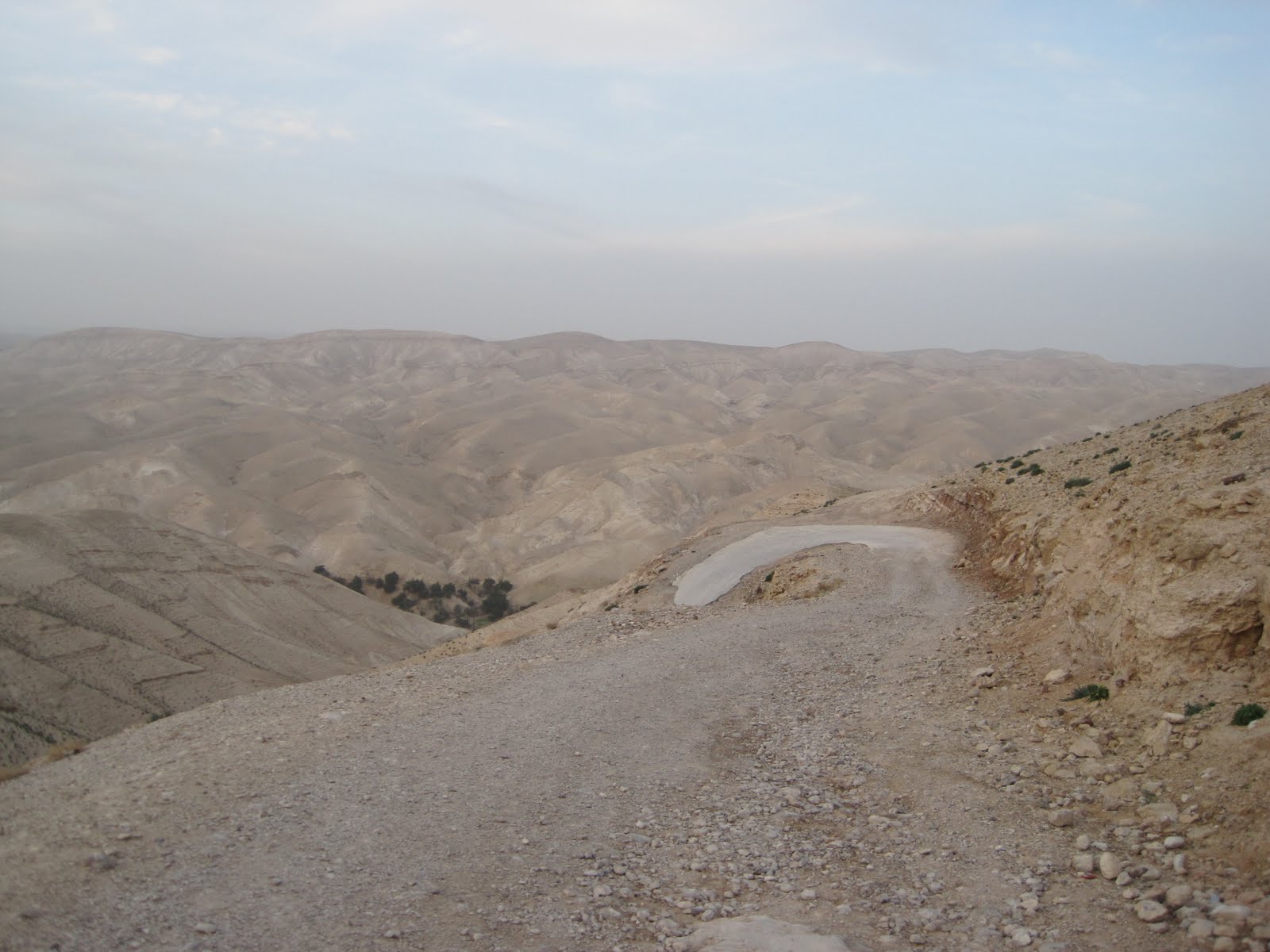
Picture: Judean Wilderness, Israel (February, 2010)

Wilderness Wanderings

This week’s lectionary Gospel passage is the Markan account of Jesus’ Baptism, followed by his 40-day time in the wilderness as he prepared for his ministry. Now for most of us, conjuring up images of a wilderness takes some thought as we sit in the midst of skyscrapers, paved roads, and fenced lawns. So we try to imagine thick, wooded landscapes with hanging vines obstructing our way and our view. But, think about it, the wilderness that Jesus knew was probably desert–unobstructed, yes, but with nothing to mark your way, nothing to “hang on to” when you felt like you were getting lost. And what about the pathway? Rather than being merely difficult to tread, it was changing all the time, as the winds and sands continually blew over it, marring its very existence. And then…the temptations…so much more evident in the wilderness–the temptation to take control, the temptation to take the easy way out, the temptation to turn back. So, why in the world would Jesus spend time in this seemingly God-forsaken wilderness?

Jesus, rather than depriving himself, was emptying himself. Without paved pathways and landscapes marking our way, we are vulnerable. And it is when we are the most vulnerable that we realize that we need God. When the temptations are staring us in the face, we need God more than ever. And that is also when we realize that the wilderness is far from being God-forsaken. God is always there but, finally, the fact that we are empty makes us acutely aware of God’s Presence in a way that we’ve never known. In fact, the wilderness is God-bearing and by emptying ourselves, by entering the wilderness, we finally make room to become God-bearing too.

Several years ago, I had the opportunity to visit Hampton Court, near London, which probably has some of the most beautiful gardens in the world. As we walked through the gardens, we were struck by row upon row of colorful blooms—a horticulturist’s dream. There were roses and camellias and daffodils of all sizes and colors and just the fact that they were all so perfect was utterly amazing. The beauty of Creation was at its most picturesque. As we walked through the gardens, there was one area that looked extremely odd among the perfectly manicured plats. It looked forgotten and overgrown, full of weeds and not a flower in sight. It reminded me of those “open for adoption” litter signs where you know that the next mile or so will be littered with trash as a symptom of the “forgotten child”. I thought it was very odd in this plethora of perfection to see something so forgotten, so fallow, and so hopeless. There was even a chain across the entrance barring any more investigation. Someone, I thought, ought to take control here and do something! But as I was about to leave, I noticed a sign. According to the sign, in order for these gardens to bloom throughout the season with continual colors, there is a system of “rolling fallow”—a crop rotation of sorts. This wilderness-looking area was just that—a fallow, resting wilderness—an intentional wilderness in order that it might be nurtured and fed. It was not dead—it was allowing God to work on it.

Maybe that’s what we’re called to do in this season of Lent–to create an intentional wilderness, a place stripped of those things on which we rely, a place where we become the most vulnerable, a place where we have no control, a place where we can meet God, a place where, finally, we can become a God-bearer. Maybe Lent is the time when we finally let go and allow God to work on us that we might burst forth on Easter morning in radiant bloom.

So go forth this season into the wilderness that you might finally be prepared to know God!

Grace and Peace,

Shelli

Ash Wednesday

Lent, which, literally, means “springtime” is a time of nurturing and preparation. And, like springtime, it is also a time of growth and renewal, a re-greening and bringing back to life of our winter-worn souls. Our forty days of Lent are reminiscent of the forty trying days that Jesus spent in the dry and secluded wilderness as he readied himself for his ministry. In the same way, this is a preparation time for us as we begin that walk toward the cross and into a deeper walk with God.

Joan Chittister says that “Lent is not an event. It is not something that happens to us. It is at most a microcosm of what turns out to be a lifelong journey to the center of the self. The purpose of Lent is to confront us with ourselves in a way that’s conscious and purposeful, that enables us to deal with the rest of life well.” She calls it a “growing season”, rather than a “penitential season”. We are not called to wallow in guilt during this time; we are not necessarily called to deprive ourselves of things we need; we are called to begin to look at things differently.

So on this Ash Wednesday, as we begin this journey, we are called to repentance, to a turning around, to change. People often look upon this day with fear and trembling. It is not meant to be that way. But it is a day that forces us to look at ourselves and our own lives and, perhaps for some of us, that can be a little uncomfortable. Think of it, though, as a threshold that begins a journey into new life, a window to a new way of seeing, and a doorway to a new way of being. It is a time for clearing, a time for preparing the ground for planting; it is a time for breathing out, letting out all the things that stand in the way of your relationship with God, thereby making way to breathe in what God offers. It is the day when we say “here I am, God, just as I am. But I am ready. I am ready to change! I am ready to be renewed and made whole.” And it is the day when we finally admit that we cannot do it alone and that somewhere in the fallow of our lives, God comes in and we are made whole.

So Ash Wednesday is not just a day of morose belittling of ourselves. A rabbi once told his disciples, “Everyone must have two pockets, with a note in each pocket, so that he or she can reach into the one or the other, depending on their needs. When feeling high and mighty one should reach into the left pocket, and find the words: “Ani eifer v’afar; I am dust and ashes. But when feeling lowly and depressed, discouraged or without hope, one should reach into the right pocket, and, there, find the words: “Bishvili nivra ha’olam…For my sake the world was created.”
Lent is not about giving things up; it is about emptying your life that you may be filled. Lent is not about going without; it is about making room for what God has to offer. And this beginning of Lent is not about clothing yourself in the morbidness of your humanity; it is about embracing who you are before God.

So go toward the Cross and embrace the you that God is breathing in!

Grace and Peace,

Shelli