You Start at the Very Beginning…

Dawn in the wildernessScripture Text:  Mark 1: 1-8

The beginning of the good news of Jesus Christ, the Son of God.  As it is written in the prophet Isaiah, “See, I am sending my messenger ahead of you, who will prepare your way;
the voice of one crying out in the wilderness: ‘Prepare the way of the Lord, make his paths straight,’”

John the baptizer appeared in the wilderness, proclaiming a baptism of repentance for the forgiveness of sins. And people from the whole Judean countryside and all the people of Jerusalem were going out to him, and were baptized by him in the river Jordan, confessing their sins. Now John was clothed with camel’s hair, with a leather belt around his waist, and he ate locusts and wild honey. He proclaimed, “The one who is more powerful than I is coming after me; I am not worthy to stoop down and untie the thong of his sandals. I have baptized you with water; but he will baptize you with the Holy Spirit.”

Do you remember the song from “The Sound of Music”?  “You start at the very beginning.  A very good place to start.  When you read, you begin with A-B-C; when you sing you begin with Do-Re-Mi.  The first three notes just happen to be Do-Re-Mi. Do-Re-Mi-Fa-So-La-Ti…..oh let’s see if we can’t make it a little bit easier…”  (Yeah, I’m a Sound of Music dork.)  We’re used to that…starting at the beginning, learning our A-B-C’s before we jump headlong into reading Tolstoy or something.  But, the writer of the Gospel According to Mark seemed to just sort of want to get this show on the road.  We’ve become so accustomed to the beauty and poetry of the nativity that somehow that becomes the season for us.  But here…”The beginning of the good news of Jesus Christ, the Son of God.”  That’s it.  That’s all you get.  No announcement of Jesus’ birth, no birth story, no stable, no inn, no manger, no Mary and Joseph and the babe, no shepherds, no magi.  Just that.  It’s sort of like the Gospel writer is saying “refer to the previous volumes”.  But, of course, most Biblical scholars will tell you that there WERE no previous volumes of the Gospel but that this one was the first.  So, what is that beginning?


Then it goes on:  As it is written….Essentially, the beginning of the good news of Jesus Christ, the Son of God, is everything that came before–all the prophets, all the judges, all the Wisdom, all the kings, Elijah, Moses, Ruth, Jacob, Abraham, Sarai, all the exiles returning home, all the burning bushes and parting waters, all the covenants, all those generations upon generations of people who wandered in the wilderness.  And now…now appearing in the wilderness is this wild, somewhat unkempt, bear of a man who clothes himself in camel’s hair and eats what appears to be whatever crosses his path in the brush.  There were certainly those with “proper” upbringing and “acceptable” expression of their religious beliefs that probably would have been a bit embarrassed by the display.  I mean, maybe it would have gone down easier if it had been someone a tad bit more “traditional”.  (But then, really, was Jesus all that status quo?)  And yet, I’m fascinated with this character of John the Baptist.  He knew who he was.  He knew his place.  He was called to prepare the way.  He was called to BE the voice crying out in the wilderness.  He was called to prepare the way of the Lord.


The beginning of the good news of Jesus Christ, the Son of God.  Here we are, in the wilderness of our lives, wandering a little aimlessly at times, trying our best to connect to God, to feel God’s Presence in our lives.  And yet, we know that God did not plunk down in the middle of the bustling city of Jerusalem.  God did not come in the way that was planned or imagined.  The Son of God emerged into the wilderness that was already there, already so full of God that the very earth shook.  The truth is, God had been there all along.  The good news of Jesus Christ was always beginning.  The same is true for us today.  What we are living is not some sort of prelude of a life to come; it is the very beginning of the story.  Maybe that’s our shortcoming.  Maybe we live lives limited by the chapters surrounding us.  But God…God came and comes over and over and over again, beginning, recreating, starting us over.  Advent is the season of beginnings–the beginning of the church year, the beginning of us, the beginning of what comes next.  Advent is not a preface to the high holy day on which we celebrate the Savior’s birth.  Advent reminds us that we, even now, are the beginning of the good news of Jesus Christ, the Son of God.  “See, I am sending my messenger ahead of you, who will prepare your way; the voice of one crying out in the wilderness: ‘Prepare the way of the Lord, make his paths straight.”  The truth is, the story ALWAYS is at the beginning!


When you come to the end of all the light you know, and it’s time to step into the darkness of the unknown, faith is knowing that one of two things shall happen: Either you will be given something solid to stand on or you will be taught to fly. (Edward Teller)


FOR TODAY:  How are you called to prepare the way for Christ?  How are you called to begin again?


Grace and Peace,

Shelli


The Pilgrim’s Way

the_journeyScripture Passage:  Genesis 12: 1

Now the Lord said to Abram, “Go from your country and your kindred and your father’s house to the land that I will show you.

Have you ever noticed that no one spends much time standing still in the Bible?  The story begins with God breathing life into Creation and, in essence, making us a home, a place.  But it doesn’t take but a few chapters before we are on the move–aliens, immigrants, sojourners.  It’s pretty clear that God calls us to be pilgrims on this Way, traveling light and gathering all of Creation together as we move. And along the way, we hear lots of words like “sent forth” and “go” and “follow”.  We are called to be a people on the move (at least figuratively and probably even a little literally), essentially migrating from one place to the next, from one way of being to another.  And most of the time, those that came before us moved freely through their journey without a map, without real plans or even real provisions.  Most of the time they were just journeying to a place they did not know but that they knew that God would show them. 

So what has happened to us?  How did we become so planted? How did our lives become so safe?  It was never that way in the beginning.  The journey of faith was a wildly unpredictable one into places unknown. The journey of faith called its travelers to be pilgrims in the wilderness, sojourners through foreign lands.  Oh, we like to think of ourselves as journeyers, particularly we Methodists who readily espouse Wesley’s notion of faith as movement, as, to coin his words, “going on to perfection”.  (Gee, there’s that “go” thing again!)  And yet, we will do everything possible to avoid getting driven to the wilderness or left without everything that we need (or at least the latest technological gadget).  We tend to separate ourselves from discomfort or inconvenience or chaos.  We stick to our plans.  But wildness and chaos often creates a certain energy.  It wakes us up; it makes us pay attention.  Maybe that’s why Lent begins in the wilderness.

Have you ever noticed that when you travel you see a lot more than when you’re just driving to and from work?  Is it because there’s more to see?  Or is it that when one is unfamiliar territory, one is more aware of the surroundings, more open to seeing things as they are?  Seeing oneself as a pilgrim, a wanderer, is the same thing.  It keeps our eyes open and our minds alert.  We notice God’s Presence; we notice God’s People; we do not see ourselves as “owners” or even squatters.  We see ourselves as part of Creation.  We begin to see that we are called not to arrive but to journey.  Our faith IS the journey.  So Lent begins in the wilderness and asks us to travel deep within ourselves, beyond our preconceptions, beyond our assumptions, beyond our plans.  We go, open to what God has to show us along the way. 

It may be that when we no longer know what to do, we have come to our real work. And when we no longer know which way to go, we have begun our real journey. (Wendell Berry)

So as we make this Lenten journey, what do you see?  What are you missing?  Where are you being called to go? (And does that have to involve your cell phone?)

Grace and Peace,

Shelli

Poustinia


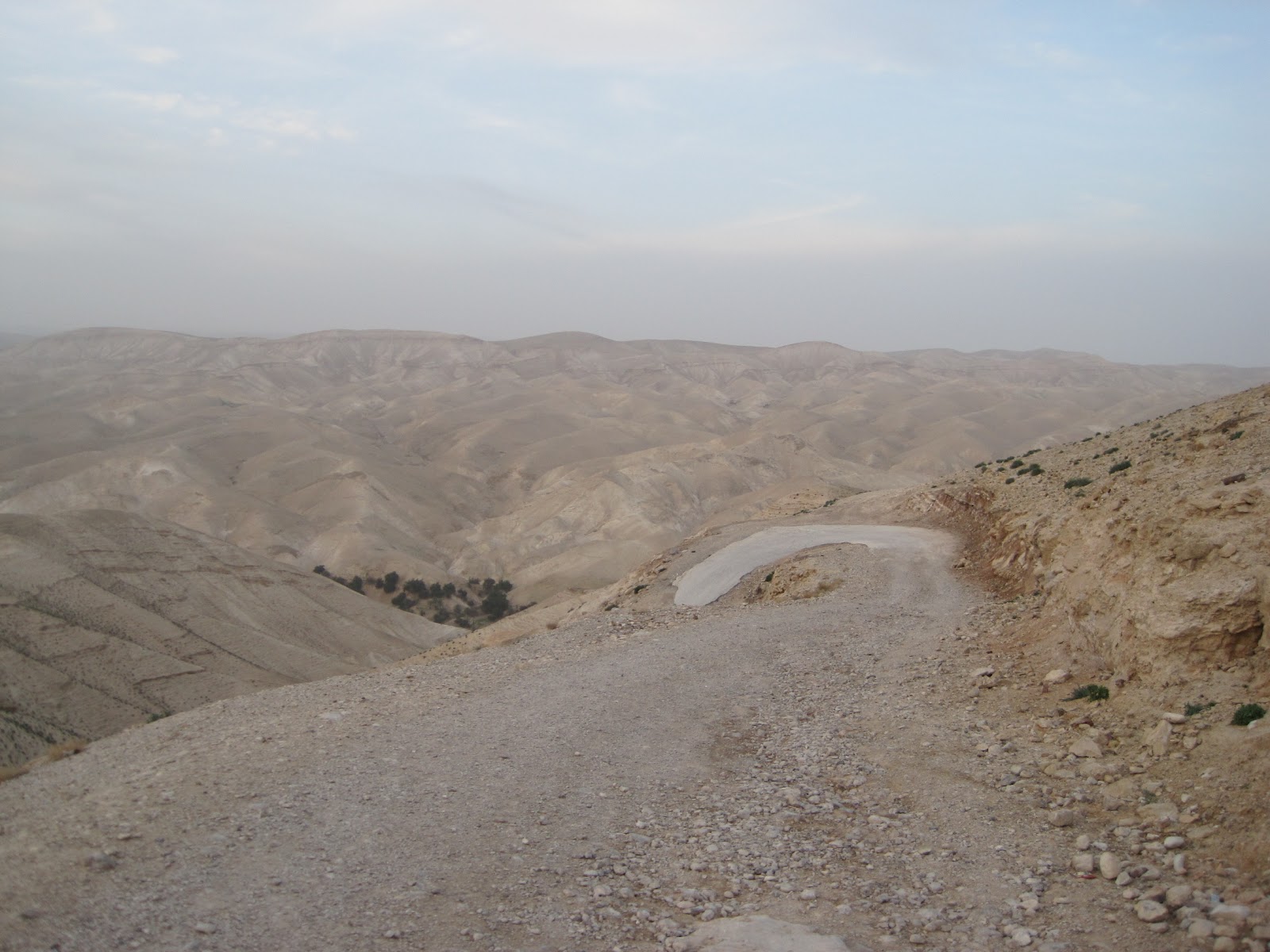
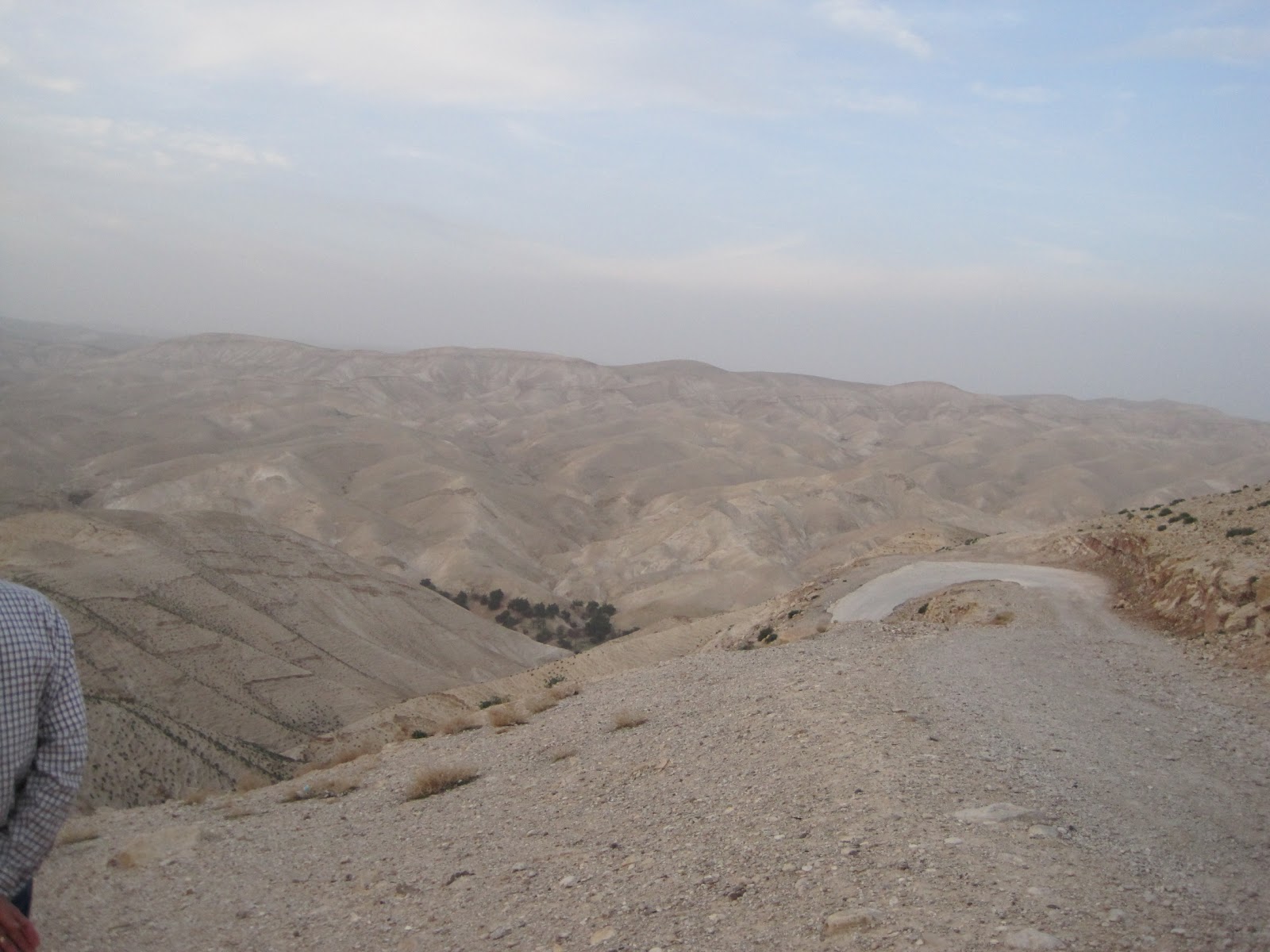
The Judean Wilderness, February, 2010

Scripture Passage:  Matthew 4: 1-11

Then Jesus was led up by the Spirit into the wilderness to be tempted by the devil. He fasted forty days and forty nights, and afterwards he was famished. The tempter came and said to him, “If you are the Son of God, command these stones to become loaves of bread.” But he answered, “It is written, ‘One does not live by bread alone, but by every word that comes from the mouth of God.’” Then the devil took him to the holy city and placed him on the pinnacle of the temple, saying to him, “If you are the Son of God, throw yourself down; for it is written, ‘He will command his angels concerning you,’ and ‘On their hands they will bear you up, so that you will not dash your foot against a stone.’” Jesus said to him, “Again it is written, ‘Do not put the Lord your God to the test.’” Again, the devil took him to a very high mountain and showed him all the kingdoms of the world and their splendor; and he said to him, “All these I will give you, if you will fall down and worship me.” Jesus said to him, “Away with you, Satan! for it is written, ‘Worship the Lord your God, and serve only him.’” Then the devil left him, and suddenly angels came and waited on him.

Well, you know it’s the first Sunday in Lent when you read of the temptation of Christ in the wilderness.  To be honest, most of us are incredibly uncomfortable with this passage.  After all, how can Jesus, Son of God and Son of Man, the gift of the father’s unfailing grace, Emmanuel, God With Us, the Savior of the World be tempted?  How can that even be possible? And why would someone like Jesus even risk it?  What, really, is Jesus doing out in the wilderness all by himself?  What, really, is the purpose at all?  I mean, it almost sounds like this was some sort of proof that Jesus was who he was.  I’ve always been just a bit distrustful of “proof” of the Divine.  So, what is this all about?

In Russian, the word poustinia means “a desert, a lonely and silent place”.  It is a place of solitude.  In the Russian Orthodox tradition, a poustinik was one who was called by God to live alone in the desert with God.  But the notion was not looked upon as a solitary life removed from the rest of the world.  Because it was there that he or she prayed, fasted, and made oneself available to humanity.  Think of the poustinik as humanity’s listener.  The idea was that even though the poustinik lived in solitude, there was always a part of him or her that was open to the world, a door to a life of solitude that invited the world in and sent the person forth.

And yet, this pilgrimage into the wilderness is not really part of the world in which most of us live.  Our culture may be a bit to goal-oriented and scheduled for that.  We tend to respond better to words like “connection”, “community”, and “fellowship”.  (Those are the words on which religious entities build good mission statements, aren’t they?)  Going out into the desert or the wilderness alone to find oneself or center oneself sometimes sounds to us a little selfish, as if the person is not participating with others, not caring for others.  Maybe our problem is that we’ve forgotten the door.  We forgot that there is always a door between solitude with God and the world, between the community of faith and that part of the Godself that each of us hold inside of us.  It is not an either-or.  The poustiniks understood that.  They stepped into the solitude to connect with God while at the same time keeping a foothold on the world, being available in case the world needed them or open to what God needed them to take into the world.  It was a way of listening and a way of active faith. 

Maybe that’s why this passage is so difficult for us.  We forgot that there was always a door.  Jesus was not shutting himself away from the world.  Jesus was called to the world (good grief, he was the Savior of the World, was he not?).  But in the bustling and noisy ways of the world, it is important to find the door, to listen to God, to enter the solitude of our deepest self so that we can finally hear where we are called to go.  There will always be voices pulling us away, pulling us toward things that we think we need, things that we think will help us in life, or things that will give us the power to do what we think we should do.  But deep within us is a holy place of solitude, a place where we can listen to God unencumbered by the voices of the world.   Some of us need to go into the wilderness to hear it; others need to only listen where we are.  Jesus trek into the wilderness was not because he needed to get away from the world but rather so that he could hear the world’s needs and God’s calling to fill them with grace.

The poustinia is within, and one is forever immersed in the silence of God. foreverlistening to the word of God, forever repeating it to others in word and deed.  (Catherine Doherty)

On this Lenten journey as we traverse through the wilderness, think of those place of solitude in your life.  Where are those place where you are at your best at listening to the needs of the world, at listening to what God is calling you to do?

Grace and Peace,

Shelli

What Is Left

Flower in AshesScripture Passage: Joel 2: 1-3

Blow the trumpet in Zion; sound the alarm on my holy mountain! Let all the inhabitants of the land tremble, for the day of the Lord is coming, it is near— a day of darkness and gloom, a day of clouds and thick darkness! Like blackness spread upon the mountains a great and powerful army comes; their like has never been from of old, nor will be again after them in ages to come. Fire devours in front of them, and behind them a flame burns. Before them the land is like the garden of Eden, but after them a desolate wilderness, and nothing escapes them.

I know.  What a way to begin the season–darkness and gloom, devouring fire and flame, and desolate wilderness!  I know what you’re thinking.  Can we go back to that manger scene now?  Can we go back to being bathed in light with the hope of the world nestled in our arms?  Well, the problem, is that somewhere on this journey between seasons, we forgot.  We forgot who and whose we were.  Somewhere along the way we became self-sufficient and sure of ourselves.  Somewhere along the way, we thought we had figured it out, thought we were so right.  Somewhere along the way the trumpet announcing the birth of our Savior became our own horn.  Somewhere along the way we forgot that we were blessed not by what God has given us but by what God has called us to do.  You know–scattering the proud and bringing down the powerful, filling the hungry and sending the rich away.  (Hmmm, that sounds distantly and vaguely familiar.) And now we sit in ashes wondering what to do next.

Lent is our chance to begin again.  Because, think about it, those ashes that you are going to spread on your forehead today are what is left.  They are what has survived.  After all of the devouring fires scorching the gardens, they are left.  They are the remnant.  They are the hope for what will come next.  So we begin our Lenten journey in ashes because we repent for what we have done.  But that is not the end.  God does not leave us on the ash heap alone.  God picks us up and recreates us, walking us through the wilderness, through the valley of the shadow of death, through the Cross, to Life.  The ashes are the beginning.

I’ve used this before on Ash Wednesday (and for those who will hear me later in the day, you have two more chances to hear it in a sermon!), but it’s such a great reminder, I couldn’t resist.  A rabbi once told his disciples, “Everyone must have two pockets, with a note in each pocket, so that he or she can reach into the one or the other, depending on their needs.  When feeling high and mighty one should reach into the left pocket, and find the words: “Ani eifer v’afar; I am dust and ashes.  But when feeling lowly and depressed, discouraged or without hope, one should reach into the right pocket, and, there, find the words: “Bishvili nivra ha’olam…For my sake was the world created.”

So what will you do with what is left?  What will you do with your share of ashes?  Repent and turning–that is what this day is about.  No longer do we wallow in morbid shame and guilt; no longer do we pound ourselves down for our past mistakes; no longer do we sit on the ash heap sullen and morose.  This is the day when we begin to begin again.  Pick yourself up!  Dust yourself off!  And start.  This is the day when we begin the journey to life.  But we are called to travel light.  God has given what we need.

My soul magnifies the Lord, and my Spirit rejoices in God my Savior, for he has looked with favor on the lowliness of his servant.  Surely, from now on all generations will call me blessed; for the Mighty One has done great things for me, and holy is his name.  (Luke 1: 46b-49)

As you begin this Lenten journey, what things do you need to leave behind? What things do you need to take with you?  Remember, we are traveling light.  The wilderness journey is long and difficult.  But we are traveling with the one who created us and calls us to live life freely and blessed.

Grace and Peace,

Shelli


On the Other Side of the Wilderness

“Christ in the Desert”
Ivan Kramskoi, 1872
Tretyakov Gallery, Moscow

This Week’s Lectionary Passage:  Luke 4: 1-13
Jesus, full of the Holy Spirit, returned from the Jordan and was led by the Spirit in the wilderness, 2where for forty days he was tempted by the devil. He ate nothing at all during those days, and when they were over, he was famished. 3The devil said to him, “If you are the Son of God, command this stone to become a loaf of bread.” 4Jesus answered him, “It is written, ‘One does not live by bread alone.’” 5Then the devil led him up and showed him in an instant all the kingdoms of the world. 6And the devil said to him, “To you I will give their glory and all this authority; for it has been given over to me, and I give it to anyone I please. 7If you, then, will worship me, it will all be yours.” 8Jesus answered him, “It is written, ‘Worship the Lord your God, and serve only him.’” 9Then the devil took him to Jerusalem, and placed him on the pinnacle of the temple, saying to him, “If you are the Son of God, throw yourself down from here, 10for it is written, ‘He will command his angels concerning you, to protect you,’ 11and ‘On their hands they will bear you up, so that you will not dash your foot against a stone.’” 12Jesus answered him, “It is said, ‘Do not put the Lord your God to the test.’” 13When the devil had finished every test, he departed from him until an opportune time.

Every year in this first week of Lent we read of Jesus, led or driven by the Spirit, intentionally going out into the wilderness.  On purpose?  Who does that?  Who chooses to relinquish control and put oneself at the mercy of the elements or whatever else might come along? Well, obviously Jesus.  So what is our take-away of that?  Are we really supposed to follow?  After all, our lives have been a veritable exercise in learning to maintain control–of our homes, our families, our finances, our health, our time, and even our spiritual life.  And then, this.  Jesus leaves all the comforts and control of home and goes out into the wilderness by himself.  I mean, really, anything could happen out there, right?  He is hungry.  He is vulnerable.  And he surely knows that he is in danger.  And sure enough, temptation looms.  Jesus, Son of God and Son of Man, the gift of the God’s unfailing grace, the ground of our hope, and the promise of our deliverance from sin and death, is driven not just into the wilderness but into the depths of his humanity.  And it is there that he is tempted to raise himself up, to fill his emptiness, to place himself above others, to guarantee his own being and his own protection. 

The truth is, though, no one, not even Jesus, can save oneself.  That’s just not the way it works.  Maybe that’s what the wilderness teaches us–that we cannot save ourselves, that we cannot guarantee what will or won’t happen to us, that we are not, much as we hate to admit it, in control.  Now there are those that will say that this whole account was some sort of divine plan by God.  I have a hard time with that.  I mean, really, what point wout that prove?  All that says is that God is some sort of divine game player and we are nothing but pawns on an earthly gameboard.  And after all, is Jesus human or isn’t he?  I’ve been told that he was.  You know–fully human.  He was not above it all.  He was not a super hero.  And he was certainly not a game piece.  He encountered the same human weaknesses that we do every day.  Real weaknesses, real happenings in one’s life, are part of being real, part of being human. 

The truth is that there are some things for which we just cannot prepare.  I mean, think about it, we go along living our lives the best we can and then, without warning, a meteor comes screaming across the sky.  Do you know why astronomers and cosmologists weren’t expecting it?  They didn’t know that it was coming because it was too small to see.  That, too, is what the wilderness teaches us.  Sometimes the small things that we dismiss in our lives are the things that can hurt us, can slowly, bit by bit, pull us away from who we are, from who God calls us to be.

God does not inflict the wilderness on us.  Jesus was not led into this dark and foreboding place to pass some sort of Divine test.  Because, remember, a test does not always possess a right or wrong answer.  Think about a chemical test.  You put two or more elements together not to see if they will pass but to compel them to change.  Jesus went into the wilderness to change, to be fully human, and to find deep within himself the piece of the Godself that calls him home.

So, in this Lenten season, let us intentionally enter the wilderness, not to prove something or because God is waiting to see whether or not we fail, but because the wilderness is the way home.

The Promised Land lies on the other side of a wilderness.  (Havelock Ellis)

Grace and Peace,

Shelli

LENT 1B: Driven

Judean Wilderness, near Jerusalem, Israel, 2010

Lectionary Passage: Mark 1: 9-12 (13-15)
In those days Jesus came from Nazareth of Galilee and was baptized by John in the Jordan. And just as he was coming up out of the water, he saw the heavens torn apart and the Spirit descending like a dove on him. And a voice came from heaven, “You are my Son, the Beloved; with you I am well pleased.” And the Spirit immediately drove him out into the wilderness.

Jesus was driven out into the wilderness.  First he gets baptized and the Spirit descends upon him.  He is claimed by the Spirit.  And then the same Spirit that claims him somehow compels him to go out into the wilderness alone–no supplies, no map, no compass, no cell phone with that neat little GPS app.  Driven out into the wilderness…You know, I used to think that I understood this wilderness thing.  I used to picture Jesus going out into the wilderness, into the trees, into nature, to pray and commune with God.  Perhaps my idea of a wilderness was somewhat skewed by visions of thick East Texas pine trees or perhaps the clammy sensation of the Costa Rican rainforest.  After all, nature is always a great place to become closer to God.

And then I saw the Judean wilderness, the same wilderness into which Jesus was driven by the Spirit.  I stood there on that mountain with a view of winds and sands and nothingness, the true depiction of forsakenness and despair.  And, standing there, I thought about this image of Jesus going out into the wilderness.  On purpose?  He went on purpose?  This is not a wilderness for the faint of heart and certainly not for one with such a faulty sense of direction as I seem to have.  This wilderness has no trees, no real markings of any kind.  The faint pathways change as the winds blow the sands wherever they want.  Even if one began this wilderness journey with some faint sense of where he or she was headed, the pathway would move in an instant and the traveler would be stranded, vulnerable, with no real sense of direction at all.

So into this vulnerable state, Jesus was driven.  If you read the passage, the Spirit claimed him at his baptism and then drove him into a journey that had no obvious pathway at all.  The mere thought of it terrifies us.  After all, don’t we do everything we can do to avoid the wilderness, to avoid a loss of control, a loss of our sense of direction, a loss of the knowledge of where we are and where we are going. But last I checked, the same Spirit supposedly descended on me as descended on Jesus.  So am I to assume that that Spirit is now driving me into the wilderness?  As one who was also baptized, who also had this same Spirit, am I being compelled to go beyond what I know?  But, I will tell you, I did not plan for the wilderness.  I do not have everything I need.  I need to pack.  I need to prepare.  (I probably need new shoes!)  And so I wait.  But that baptism thing keeps tugging at us.  You know, it’s not really meant to be a membership ritual.  It is meant, rather, to be the driving force in our lives.  It is the thing that drives us into the wilderness–if only we will go.

Contrary to the way most of us live our lives, faith is not certainty or knowledge.  It is not, I’m afraid, a sure and unquestioning sense of where one is going, even, for us seemingly progressive theologians (because we are ALL theologians!), in a “big picture” way.  It is not about being saved from something.  Faith is not about learning or being shown the way.  We are not given a map.  It’s just not that clear.  In fact, it’s downright murky, almost like sandy in the air.  No, I think that faith is about entering The Way, being driven into the wilderness, where one is vulnerable, unprepared, and usually scared to death.  And in that death, in that yielding, in that realization that we’re not really sure where it is we’re supposed to go, we encounter God.  And then in the next instant, the winds will blow the path away and, once again, we are in darkness until we realize that God is still there, not pointing to show us, but walking with us.

Every Lenten season we read of the wilderness into which Jesus was driven.  It is the affirmation that Jesus was not a superhero or a star of Survivor.  Rather, Jesus was driven into the deepest depths of human frailty and vulnerability and, unsure of where to go, found God.  Wandering the wilderness is not about finding your way but rather being open and vulnerable enough that The Way will find you.

So, continuing with our act of giving up so that we can take on, on this fourth day of Lent, think of those things that you work to control–time, space, people.  Let go of something that you control and be vulnerable, if only for a day.

Grace and Peace on this Lenten Journey,

Shelli

The promised land lies on the other side of a wilderness.{Havelock Ellis}

Grace and Peace on this Lenten Journey,

Shelli

ADVENT 2B: The Beginning of the Story

ADVENT 2B Lectionary:  Mark 1: 1-8:

The beginning of the good news of Jesus Christ, the Son of God.  As it is written in the prophet Isaiah, “See, I am sending my messenger ahead of you, who will prepare your way; the voice of one crying out in the wilderness:  ‘Prepare the way of the Lord, make his paths straight,’” John the baptizer appeared in the wilderness, proclaiming a baptism of repentance for the forgiveness of sins. And people from the whole Judean countryside and all the people of Jerusalem were going out to him, and were baptized by him in the river Jordan, confessing their sins. Now John was clothed with camel’s hair, with a leather belt around his waist, and he ate locusts and wild honey. He proclaimed, “The one who is more powerful than I is coming after me; I am not worthy to stoop down and untie the thong of his sandals.I have baptized you with water; but he will baptize you with the Holy Spirit.”

Admit it…John the Baptist scares us a little bit–a wilderness man, a wild evangelist, wearing a suit of camel’s hair and making a meal of locusts and honey.  Really?  Why couldn’t the messenger have been someone a little more traditional, someone a little more easier to be around?  But, then again, have you ever known God to stay within the boundaries that we’ve drawn?  Maybe that’s the whole point.  I mean, here is a messenger, paving the path, preparing the way for the coming of the Lord.  No Mary and Joseph, no baby, no stable, no shepherds, no magi, no angels…just…boom…the One is coming that will baptize you with the Spirit of God…the One is coming who will change your life and change your ways and change the world from what we know it to be…the One is coming who will bring us all into the Reign of God.  Hold on…get ready!

The writer of Mark’s Gospel leaves us suspended in time, waiting, rather than living through the whole story together.  Many spiritual writers call that a state of liminality, a point of being betwixt and between, the moment between what is and what will be, a place in which the old world is left behind but we’re not sure what the new one looks like just yet.  It is a point between two times that intersect and become one.  So, are you ready? Well, if you’re not, you need to get that way.  Because in this Gospel, the good news has already begun, whether we’re prepared or not.

Throughout this version of the Gospel, there is a sense of urgency, a sort of abruptness, that somehow compels us to get on board with it, to not tarry with things that do not matter and do not prepare us for the coming. The writer of Mark cuts to the chase:  humanity has waited and prepared itself for this for centuries.  We are reminded of that as the passage pulls in the words of Isaiah, the foretelling of that time when God would come and be among us, when God would come and save us.  Now is the time.  The Christmas celebration for all its splendor and all its beauty and all its twinkling lights is first and foremost the fulfillment of God’s promise of salvation.  This IS the beginning of the good news of Jesus Christ, the Son of God.  This IS the beginning of our story.

But there is another implication here.  In this Advent season, as we wait with expectant hope, we are also reminded that our expectations are limited by our own lives.  God has so much more in store that what we could ever fathom.  Maybe that’s why the writer of Mark quickly takes us to the wilderness and wilds of our lives (and to the bizarre wilderness man!).  You see, God will not be plunked down in the middle of the bustling city of Jerusalem.  God will not come in the way that we plan or imagine how God will come.  Rather, God will emerge in the wilderness of our lives and we will realize that God has been there all along.  We do not have to go to Jerusalem or prepare a grand entry to encounter God.  God comes to us.  We just have to be open to whatever God’s coming is.  And we have to be willing to enter a new beginning.  What we are living is not the prelude; it’s the beginning of the story.

In this season of Advent, give yourself the gift of the wilderness–those wild and untamed places in your lives where you might just experience the coming of God anew.  In other words, all this planning and preparation…forget about it!  Just open yourself to the coming of Christ!

Grace and Peace,

Shelli