Ponder

Yes, this year’s calendar says it’s Christmas Eve.  But Advent has not quite given way to the next season yet.  Today is also the fourth Sunday of Advent so, just for a few more hours, we will wait…and we will ponder.  This Scripture passage finally tells us what is next. Annunciation literally means “the announcement”.  The word by itself probably holds no real mystery.  But it is the beginning of the central tenet of our entire Christian faith—The Annunciation, The Incarnation, The Transfiguration, The Resurrection.  For us, whether we realize it or not, it begins the mystery of Christ Jesus.  For us, the fog lifts and there before us is the bridge between the human and the Divine.

The text says that Mary was much perplexed.  The truth is, this young girl was so confused at first. Well, of course she was confused!  And on top of that, she was terrified.  You see, to put it into the context in which Mary lived, there is a folktale that is told in the Apocryphal Book of Tobit that tells of a jealous angel who would appear on a bride’s wedding night each time she married and kill her bridegroom. This story, of course, was part of the culture in which Mary lived.  She had grown up hearing that story. And remember, that even though Mary and Joseph had yet to be formally married, they were betrothed.  This is more than just being engaged.  The commitment had already been made.  There had already been a dowry given. So, Mary could have thought that this angel was coming to kill her bridegroom.  Not only would she lose her intended spouse but she would be left with nothing.  As one who was already betrothed, she would essentially be relegated to the first-century’s view of the class of widow with no resources.  Then the angel tells her not to be afraid.  Don’t be afraid? Good grief…she was terrified!

I think Mary’s initial response (as its translated in our Scriptures) is one of the most profound phrases ever: “How can this be?” How can this happen when it doesn’t make sense?  Why me?  Why of all the people in the world that you could have chosen, why choose me?  In other words, you have got to be kidding me!  We identify with this.  Even when we intend to obey God, we struggle when it is so far out of the parameters of the life we have that is makes no sense.  It is the question of faith. It is what we all ask about our lives.  Because, surely, in this moment, Mary saw her world toppling down.  And the world waited.  God waited.  How can this be?  Because, you see, it CAN’T be–not without God and, interestingly enough, not EVEN without Mary.

The passage tells us that Mary pondered these things.  I love that image of pondering.  So, what does it mean to ponder?  If you read this Scripture, it does not mean thinking something through until you understand it or until you “get it”.   Nowhere does it say that Mary was ever completely sure about what was going to happen.  Nowhere does it say that she ever stopped asking questions, that she ever stopped pondering what this would mean for her life.  It really doesn’t even tell us that she actually stopped being afraid.  Nowhere does it say that she expected this turn of events. 

And then there is this angel that shows up.  What if Mary had said no?  What if her fear or her plans had gotten the best of her?  What if she was just too busy planning for whatever was going to happen next in her life?  What if she really didn’t have time to do any pondering today? Now, as much as we’d like to think that we have the whole story of God neatly constructed between the covers of our Bible or on that nifty little Bible app that you have on your iPhone, you and I both know that there is lots of God’s work that is missing.  We really just sort of get the highlights (or at least what the writers think are highlights).  Who knows?  Maybe Mary wasn’t the first one that God asked to do this.  Maybe she was the second, or the tenth, or the 386th.  After all, this is a pretty big deal.  I mean, this pretty much shoots that whole long-term life plan thing out of the water. 

But, you see, this story is not about Mary; it’s about God.  And through her willingness to ponder, her willingness to let go of the life that she had planned, her willingness to open herself to God’s entrance into her life and, indeed, into her womb, this young, dark-haired, dark-skinned girl from the wrong side of the tracks was suddenly thrust into God’s redemption of the world.  It is in this moment that all those years of envisioning what would be, all those visions that we’ve talked about, all of the waiting, all of the preparing, it is here, in this moment, that they begin to be.  This is the moment.  Just let it be.  And ponder what that means.

That’s what this whole Advent journey has been about:  Preparing us to respond, to respond not to the gifts that we think God will bring, not to what we have experienced before, but to what God offers us and, indeed, asks of us in this moment. We are no different from Mary.  God is waiting on our response; waiting to hear whether or not we, too, will say “yes” to birthing the Christ Child in our own lives.

So, God waits patiently for Mary to respond. The world stops, hangs suspended if only for a time, its very salvation teetering on the brink of its demise. Oh, sure, if Mary said no, God could have gone to someone else. Surely God could have found SOMEONE to birth the salvation of the world. But it wouldn’t have been the same. After all, the Divine did not just plunk a far-removed piece of the Godself into a womb. Our understanding is that, yes, the Christ was fully Divine; but Jesus was “born of a woman”, fully human and, as a human, Jesus carried Mary’s unique and specific DNA with him. Mary was not just a container through which God came into this little world. Mary’s DNA, Mary’s response, Mary’s “how can this be?”, Mary’s “yes” is written all through the salvation of the world. In this moment, this moment for which the world has waited, the moment for which we have prepared…in this moment, the history of the world begins to turn.  The Light begins to come into focus and the heavens begin winging their way toward us, full of expectancy, full of hope.  Mary said “yes” and the Divine began to spill in to the womb of the world. Salvation has begun.  The world is with child.

Grace and Peace,

Shelli

Us

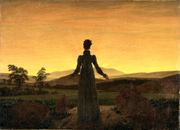
“Woman Before the Rising Sun”, Caspar David Friedrich, 1818

OK, I’m assuming that you think I’ve lost my mind.  Why this Scripture?  I can pretty much guarantee that no one reading this has ever heard a sermon on this passage.  It’s not anywhere in our lectionary.  (In fact, to pull it off the site from which I usually copy the Scriptures, I had to go to Matthew 1:18 and back up.)  It’s definitely an odd scripture to use on the day before Christmas Eve, the day when we finally emerge from the darkness into the glorious Light.  I mean, we usually skip these verses.  (Admit it, you do!  You don’t read this!) It’s full of hard-to-pronounce words that none of us want to have to read aloud and, frankly, they’re kind of boring.  So, why are we reading them?  Because the whole story is buried in the details…

For some years, I’ve been interested in ancestry, in MY ancestry. It’s become quite the project.  I have over 2,000 people noted on Ancestry.com, 2,000 people to whom I am somehow related.  It started as an interest; it’s now part of me.  It’s part of me because I have on some level gotten to know these persons whose DNA pulses through me, whose DNA actually MAKES me.  I’ve learned their stories.  I’ve found out where they were born and where they moved in their lives.  That’s important.  And in the process of doing this, I’ve found people to whom I am related, some of which I already knew!  Even if you don’t know 2,000 people to whom you are somehow related, recognizing that those people (even unknown) are connected to your life will help you know yourself better.  Ralph Waldo Emerson once said that “every [person] is a quotation from his ancestors.”  So, these people in this passage we read (whether or not we can pronounce their names) are part of that very human part of Jesus.  Jesus is a quotation from them.  They are part of this Incarnation we are about to celebrate.  They are part of us.  They are the people that God employed to show us what God-with-us meant.

Oh, I suppose God could come into the world with no help from us, with no help from all those faithful ones who came before us.  But what would it mean?  Why bother?  After all, the name of the Christ child is “God With US”.  Doesn’t that mean something?  God did not just drop the baby out of the sky like some sort of Divine UPS package.  The story is incomplete without those that came before. And it is incomplete without us.  Because without us, without every one of us, without EACH of us, God never would have come at all.  God came as Emmanuel, “God with US”, and calls us into the story.

And what a story it is!  It is a story of those that were called and those that ran away, a story of some who were exiled and some who wrestled, a story of scared and wandering people sent to new places and new lives with new names. The story includes prophets and poets, priests and kings.  It is a story of movement between darkness and light and, always, a hope for a Savior.  This line of David shown by the writer known as Matthew is 42 generations of God’s people, six sets of seven generations that lived and questioned and prayed and worshipped and wondered and sometimes shook their fists at God and then handed it off to the children that followed them.  Now you might remember that the number 7 is one of those numbers that connotes perfection or completeness, the hallowed finishing.  So, six completed ages of the history of God’s people waiting and watching and walking the journey brings us to the seventh, the New Creation, the beginning of what is next.

The Incarnation is the mingling of God with humanity.  There’s no way out.  The Divine is even now pouring into our midst and we are changed forever.  But we have to birth the Godchild into our lives.  Knowing that we could never become Divine, the Divine became us.  The world is turned upside down.  And so, God stayed around to show us how to live in this new world.  The writer of Matthew is right.  All this DID take place to fulfill what has been spoken by the Lord through the prophets.  The Light is just beyond our sight, ready to dawn, ready to call us into it that we might continue the story.  We are all walking together.  As Ram Dass said, “we’re all just walking each other home”.

As we come to the end of this path down which we have travelled our Advent journey (because tomorrow morning’s Scripture is a definite change in timbre), we have changed.  But we haven’t done it by ourself.  Breathe in the presence of those ancestors that surround you now.  Tomorrow the journey will change.  Let us go together and see this thing that has happened. 

Open your eyes.  The Light is about to dawn.

Grace and Peace,

Shelli

Doxology

This passage that our lectionary assigns us for the fourth Sunday of Advent is essentially a doxology.  Just like the Old Testament passage that we read a couple of days ago, it usually doesn’t get much attention.  I mean, would you want to hear a sermon on this or the Anunciation?  This comes at the end of Paul’s Letter to the Romans.  Interestingly, though, it’s not found in every translation of the letter and in some it appears in a different place (like after Chapter 14 or something).  So, truthfully, we’re not sure what it is. Scholars think that it is quite possible that Paul did not write these verses but that they were attached to the end of the letter perhaps AS a doxology, a statement of praise and proclamation, by a later redactor.  But regardless of who wrote it, this is a statement of response.  It is, to use Paul’s words, an “obedience of faith.”  The Incarnation of God in Jesus Christ invokes our response; otherwise, it is virtually meaningless.  German theologian Helmut Thielicke said that, “faith can be described only as a movement of flight, flight away from myself and toward the great possibilities of God.”  The whole Scripture in its fullness is about our response, about our movement, our journey.  It is our faith that moves it and opens up the possibilities that God envisioned.

We read this doxology alongside the veritable imminence of Jesus’ birth, the story of Mary as God-bearer, as the one who responded to God’s call to birth the Savior into the world.  The story is about to unfold.  And, yet, the story has been there all along.  As Christians, we come into a story that is already there.  God has been calling and people have been responding for thousands of years before Jesus.   It’s not new; it’s continuing.  The Letter to the Romans is the Apostle Paul’s understanding of that story.  (It’s really incredible.  You should read it “cover to cover”, so to speak, if you haven’t already.  It is truly a masterpiece.)  And at the end, either Paul or someone who read Paul’s letter and then wrote a response of praise, added this doxology.  It was the writer’s praise to God for the unveiling of something for them that had been around from the very beginning.

So why are we reading a doxology?  Doesn’t that come at the end of something?  Isn’t that the point where we pick up our purse or put our jacket back on?  Isn’t that the point where we put our bulletin away and get ready to get out of there first so we can go eat?  Well, here’s the deal.  We are days away from Christmas Eve, days away from the end of all our looking and waiting and preparing for the coming of God yet again.  And part of our preparing is thinking about what comes next, what we’re going to do with all this preparing, all this waiting, all this changing that we’re doing to ready ourselves for God.  See, if you’re not thinking about what you’re going to do with it, what actual response you’re going to make, then the preparation is worthless.  The call means nothing without a response and the proclamation is empty without the doxology.

Advent is not just the “pre-Christmas” season.  This is a real stand-alone season.  These days leading up to Christmas Eve call us to envision what God envisions and then move toward it.  I think it’s a season that teaches us to see through the shadows of the world.  Because this world often seems random and meaningless, full of pain and despair, sickness and loneliness, and even death.  But into this world that is often callous and lacking in compassion, directionless and confused; into our lives that many times are wrought with grief and a sense that it is all for naught; into all of it is born a baby that holds the hope of the world for the taking.  We just have to be ready, open, and willing to take it—and respond.  The great illustrator and writer, Tasha Tudor said, “the gloom of the world is but a shadow.  Behind it, yet within our reach, is joy.  Take joy!”  This is what this doxology says:  All of this that has been laid out for you, all of this that has been created; all of this that has for so long been moving toward your life…take it.  Take joy! 

As we’ve said, Advent is a season of preparation.  It is a season of becoming one who can welcome the Light of Christ, Emmanuel, God-with-us, into our lives.  So, as we come toward that here at the end of this season, we have to clear a path for what is coming into our lives.  We often don’t equate Advent with things like surrendering and letting go.  Those seem to be more “Lentish” to us.  But Advent is about making room and that is about surrendering and letting go of those things that will impede us.  So, put down all those heavy things you carry.  The baby is coming!  Rejoice!  And listen for how you are called to respond. 

Lyrics: ”The Point of Arrival”, by Carrie Newcomer

First it is a bitter pill
A rubber band stretched til it snaps
Sitting crossed legged on the floor
My empty hands are in my lap
What is to become of me
Here at my surrendering
Where I arrive at the end
The place where I begin again
First we fold in then open out
There is a faith that’s only found in doubt
Acceptance is the closing of the cycle
The end that marks the point of arrival
This is where I lay it down
What I don’t want to haul around
The buzzing of what can’t be seen
And living always in between
First we fold in then open out
There is a faith that’s only found in doubt
Acceptance is the closing cycle
The end that marks the point of arrival
Looking down at my hands
Finally I understand
The empty space has changed somehow
And it’s filled with hallelujah now
Hallelujah hallelu
It’s hard as stone but yet it’s true
Acceptance is the closing of the cycle
The end that marks the point of arrival
If I let go of who’s to blame
Of what can’t be changed
And will never be the same
Close the book with one last look
Letting go of all the time it took
Hallelu hallelujah
Hallelu hallelujah
Hallelu hallelujah

Grace and Peace,

Shelli

Illumination

Today is the winter solstice in the Northern Hemisphere, the shortest day (and the longest night) of the year.  The actual solstice occurs where I live at 9:27 (CST) this evening (3:27 a.m. Universal time on December 22nd).  That moment is the point when Earth’s axis will be tilted the farthest away from the sun than at any other point in the year.  It is the point where the sun is as far south as it will ever be relative to the Earth.  (And winter has begun, so Happy Winter!)  The word “solstice” is derived from the Latin “solstitium”, from two words meanings “sun” and “stand still”.  Technically, this comes from the fact that during the days surrounding the solstice, the sun appears at its lowest point in the sky and then seems to have the same noontime elevation for several days in a row.  To early astronomers, the sun appeared to hang in the sky, suspended, paralyzed, as if waiting for some word to move on.

So today we read the passage that speaks of the first light, the first time that the light was spoken into being.  I think some people have this notion that nothing existed prior to that.  But it did.  God was there.  God was there in the midst of what is described as a formless, disordered void, as a darkness that covered and consumed everything as winds swept over the waters.  There wasn’t “nothing”; there was a seemingly dark, chaotic, noisy something.  It was actually a something that God had created.  And then “in the beginning” (not the only beginning, just the beginning of this part of the story!), God, in God’s infinite wisdom, spoke the light into being.  And the light pushed its way into the darkness, parting the grasp on everything that the darkness had held.  Now note that this isn’t the sun.  (That came later.)  Sometimes we make the mistake of reading this passage and we tend to think of the sun as the source of all light.  But go back and read beyond the passage I showed.  The sun doesn’t come into play until the “fourth day” of the passage so there must have been eons of time between when light came to be and the creation of this sphere of hot plasma that reflects it.  The First Light was something different.  The First Light was a new creation, parting and intersecting the darkness, weakening its grasp on everything, and shining into what was ahead.  The First Light is what God created to lead the way to everything else.

It is interesting (but not surprising) that, for us, the darkest day of the year occurs so near to the expected illumination of Christmas Day.  It actually wasn’t an accident, even though it was pretty concocted.  When the early Christians (which, granted, were in the Northern Hemisphere) started playing around with the calendar, they took what they knew to fill in the holes, so to speak.  Apparently, no one knew when Jesus’ birth had occurred.  Think about it.  It may have taken the magi months or maybe even a few years to get there and then there was the whole flight to Egypt thing.  Time was just lost.  So, tradition holds (of note, if someone leads into something with “tradition holds”, assume that there is zero substantive proof to anything that is about to be said!)…BUT…tradition holds that creation, the beginning of everything that was, occurred on March 25th (don’t ask…no clue!).  So, to early Christians, that seemed a great date on which to set the Anunciation.  Fast forward nine months…December 25th must be the birth. Alrighty then!  It was around the time of the winter solstice (in the northern hemisphere in which it was being chosen).  So, we have a date!

So, today, we sit in the darkness, still waiting, still hoping, still looking for the Light.  It is a long and empty darkness, sometimes overwhelming.  This is the day that, even in the joyousness of the season, we can’t help but remember grief and hurt and the pain that still surrounds us.  But, just as in that first moment of Creation, God will come into the darkness and do something new.  When you think about it, just about everything new has begun in the darkness.  Creation began in the darkness.  The birth of Jesus so many years ago began in the darkness.  Even the story of the Resurrection begins “while it was still dark”.  I think God always begins in the darkness because that is where illumination happens.  Light cannot push its way into a well-lit room.  Light comes when it is dark and foreboding.  Light comes when we are straining to see it.  Newness is born in the darkness of a womb and then it comes to be, pushing away the darkness in which it was born.

In the midst of the darkness, God dwells, unknown and mysterious, the Word that was created and dwelled in the darkness even before light came to be.  And even in our darkest places, the first light begins to break through.  That, my friends, is indeed the message of the season.  God tiptoes into the night and gently, very gently, hands us hope for our world, peace for our souls, and light for our longest nights in the form of a baby who shows us the way to walk through the darkness so that everyone might begin to see the world through a new light.  When we are standing in the light, and we look at the darkness, we don’t see darkness.  Light does that—it teaches us to see even through the darkness. Ralph Waldo Emerson once said that “when it is dark enough, [we] see the stars.” There is a Maori Proverb that says to turn your face to the [light] and the shadows will fall behind you.  This is the longest night, a night of creation, the birth of a new season as the earth miraculously turns on its axis toward light.  This is the night we sit vigil for the Light that is about to break.  And it is very, very good.

Lyrics: ”Singing in the Dark”, by Carrie Newcomer

We gather in morning
The darkest hour of night
The darkest days of the winter
Feeling for the light
Sitting in the silence
As all the world’s asleep
The monks of Gethsemane
The watch they daily keep

I am a wayfaring stranger
Hungry for some grace
A soul forever searching
A pilgrim to this place
I am here to meet whatever
Is listening for me here
While all the world is waiting
At the turning of the year

Singing in the dark
Calling up the day
Joining with the voices
Opening the way
Sitting here in vigil
Waiting for the spark
That bursts into being
Singing in the dark

It’s there at every hour
It happens everywhere
In the tenderest of times
In faithful common prayer
The seen and the unseen
For the many by the few
There is always someone
Singing in the dark for you

Singing in the dark
Calling up the day
Joining with the voices
Opening the way
Sitting here in vigil
Waiting for the spark
That bursts into being
Singing in the dark

The prayer is never over
And the work is never done
Never done
We all raise up our voices
And our voices become one
Voices become one
Voices become one

When we think that we are lost
And out there on our own
And the dawn is in the distance
Still we are not alone
Heaven is right here
If we open up our heart
And join the choir
That is singing in the dark

Singing in the dark
Calling up the day
Joining with the voices
Opening the way
Sitting here in vigil
Waiting for the spark
That bursts into being
Singing in the dark

Grace and Peace,

Shelli

Ideal

The time in which Micah prophesied was a time of great turmoil and violence.  The Assyrians had already invaded the region, had captured Samaria (capital of the northern kingdom), and had attacked several towns in Judah.  Corruption was at its height among the rulers and the people were reaching a point of despair.  Their expectations more than likely would have been for God to send a great warrior, a ruler who would quash the growing threat and instill a sense of safety for all against their enemies. But, instead, the prophet promises a ruler, a new Davidic king, who will bring peace.

But keep in mind that the original prophecy and the current-day Jewish interpretation does not associate this promise with the coming of Jesus (yeah, again).  In fact, there’s some disagreement as to whether we’re even talking about the right Bethlehem! (There was one in Zebulun, near present-day Nazareth) I don’t think it matters but I do think that the Old Testament should stand within the context in which it was written.  This was the promise of a king that would bring a time of peace against the Assyrians and for the time thereafter.  But for the Gospel writers, this understanding was illumined through Jesus Christ.  Again, neither is the “right way” or the “wrong way” to understand it.  Either way, God offers hope and promise of new life.  

So, who is this “one of peace”?  I mean, as near as I can tell, the world has never experienced peace.  For as long as history has been written, the earth has rocked on its axis with threats or acts of war and violence and intentional ways to divide us.  Sadly, a good portion of those acts have been because of religious differences and between warring religious factions!  Rulers have come and gone, pushing each other aside.  Borders have moved and shifted, sometimes to the point of leaving behind homeless refugees with no place to call home.  And in the midst of it all, Jesus was born.  Great theologians and spiritual thinkers have written of the peaceful time to come.  St. Augustine of Hippo even laid the groundwork for what would become the “Just War Theory” on which all global “rules” of war are based.  (In seminary, I did a whole long project paper on the Just War Theory primarily because I thought the whole thing sounded like an oxymoron.)

But peace still seems to be elusive for us.  Could it be that the promise of peace is elusive because we’re waiting for someone else to do something?  Jesus did not bring peace as if it could be manifest with some sort of magic earthly pill. Instead, Jesus showed us a different Way, a radical Way, the Way of Peace. Jesus did not bring peace; Jesus brought the love of peace.  What Jesus showed us was indeed radical.  It was a different Way than the one to which the world was and is accustomed.  This Way of Peace is not merely an absence of war.  I mean, think about it, there was a cease-fire in place for several years between Russia and Ukraine…until there wasn’t.  There was a cease-fire in place for several years between Israel and Hamas…until there wasn’t.  No, peace has to do with so much more, a pervasive and radical re-imagining of the way we live in this world. 

Peace cannot be until we respect one another, whether or not we agree.  Peace cannot be until we honor one another’s life, respect one another’s sovereignty, until food and water and housing and safety is available for all.  Peace cannot be until we realize that this earth in which we live, all of its creatures, all of its resources, and all of its beauty are entrusted to us not for our consumption but for our care.  “Blessed are the peacemakers, for they will be called children of God.”  The “one of peace” has indeed come but peace itself is up to us as children of God.  Each of us has a part. Our journey toward the Light is a Way of Peace.

During this season of Advent, we have talked a lot about peace.  It is easy to limit it, if not dismiss it, as nothing more than the ideal—the ideal way to be, the ideal way to live, the ideal way for the world.  It’s easy to assume that it cannot come to be in the world in which we live.  I mean, that “little town of Bethlehem” is not in Israel right now.  It’s in the West Bank.  It has a wall around it, a wall that you walk through surrounded by a literal maze of barbed wire and guards.  That doesn’t feel very peaceful.  So, peace remains elusive.  Maybe peace cannot exist on the macro level that we crave so badly.  Maybe the world really isn’t capable of peace at all.  I don’t know. 

But what if our prayer for peace begins with ourselves?  Maybe inner peace IS what we need to pursue because it seems that that would be the beginning of a broader peace.  If each of us chose peace for ourselves, just as we choose light, just as we choose hope, that peace would begin to radiate beyond us.  Maybe that is the way of peace.  Maybe just because we’re not in a position to affect global diplomacy doesn’t mean that part of it is not up to us.  Start with yourself.  Choose peace.  In this season of hope, choose peace.  And go from there. That is my prayer for the season.  And they shall live secure, for now he shall be great to the ends of the earth; and he shall be the one of peace.…Dona nobis pacem…grant us peace. Amen.

Grace and Peace,

Shelli

Immanence

The Bible is a story of a journey, a movement from one place to another, one time to another, one way of being to another.  It is full of stories of going beyond and coming home. And woven through those stories are stories of us building and constructing and attempting to wall off our understanding of God.  Throughout the Scriptures, God sends us forth, we begin to walk, and then we build something, then God sends us forth, we begin to walk, and then we wall something off, on…and…on…It has continued for thousands of years and continues today.  See, we understand the notion of God being everywhere, of God not being limited to what we build and what we wall off.  But most of us still find ourselves in the midst of building projects throughout our lives.  Some of those projects are for houses, some are for churches or grand cathedrals, and some are for ourselves and our own lives.  Does it make it seem better?  Does it bring God closer?  Or does it just make us a little more comfortable?

This poor Scripture doesn’t get a whole lot of Advent attention because it shares a week with Mary’s story and, not surprisingly, most people would not choose Nathan and David over Mary and the angel in the middle of Advent.  I’ve never preached it.  I’ve barely written on it.  But it’s still a great story and reminder for the season.  The text we read wraps up the promise that God made to Abram in the twelfth chapter of Genesis.  The people have a land that they can claim as their own and they can live in peace.  And David’s reign as king has been pretty much legitimized. Things seem to be going well.  And so, David envisions now a more permanent structure to house the ark of the Lord.  In other words, David now desires to build a temple in Jerusalem. I don’t know if he feels a little guilty that HE has a house and God doesn’t (as if God isn’t IN the house of cedar already and as if the moveable tent that had “housed” God for so long as the Ark of the Covenant moved from place to place was somehow no longer sufficient.).  Maybe he really felt that God needed to be given God’s due, that a grand and glorious structure would show honor to God.  In a shamefully cynical view, perhaps David wanted to just know EXACTLY where God was, as if he could once again wall God off into a limited space, thereby protecting God or maybe even himself.  In other words, he wanted to know that there was a place where he could go where he KNEW God would be.

But that night the Lord intervenes by way of Nathan with a promise not necessarily of a permanent “house” but, rather a permanent dynasty, an everlasting house of the line of David.  David has risen from shepherd boy to king and has apparently felt God’s presence through it all.  He now sits in his comfortable palace and compares his “house” to the tent that “houses God” in his mind.  So, for whatever reason, he decides that God needs a grand house too.  God, through the prophet Nathan, responds by asking, in a sense, “Hey! Did you hear me complaining about living in a tent? No, I prefer being mobile, flexible, responsive, free to move about, not fixed in one place.” God then turns the tables on David and says, “You think you’re going to build me a house? No, no, no, no. I’M going to build YOU a house. I’ll build you a house that will last much longer and be much greater than anything you could build yourself with either wood or stone. I’ll build you a house that will shelter the hopes and dreams of your people long after ‘you lie down with your ancestors.’” And God promises to establish David and his line forever. 

The truth is, we all desire permanence; we want something on which we can stand, that we can touch, that we can “sink our teeth into”, so to speak.  We want to know the plan so that we can fit our lives around it.  Well, if this was going to make it easier to understand God, go ahead.  But Franciscan Fr. Richard Rohr warns us that “God is always bigger than the boxes we build for God, so do not waste too much time protecting your boxes.”  (from Everything Belongs) (That’s actually one of my favorite quotes!)  The truth is, this is a wandering God of wandering people.  This is not a God who desires to or can be shut up in a temple or a church or a closed mind.  This is not a God who desires to be (or can be) “figured out.”  This God is palatial; this God is unlimited; this God will show up in places that we did not build. (and sometimes in places that we really wouldn’t go!)  This God does not live in a house; this God dwells with us—wherever we are.  This God comes as a traveler, a journeyer, a moveable feast.  And this God shows up where we least expect God to be—such as in a god-forsaken place on the outskirts of acceptable society to a couple of scared people that had other plans for their lives.  This God will be where God will be.  And it IS a permanent home.

In this Advent season, we know that God comes.  That is what we celebrate; that is what we remember; that is what we expect.  After all, this God we worship is the one that is with us, Emmanuel.  But in this particular year, so many of us bemoan the fact that our churches are either empty or only 25% full.  We long for a large group of us this Christmas Eve crowded into a sanctuary with our candle as we sing “Silent Night” and usher Christmas in together. Those moments are transcendent.  They make us aware of something beyond us.  But they also bring God’s Presence into our lives.  They are both transcendent, lifting us beyond, and immanent, bringing God into being for us WITH us.

That is also what Advent does.  Advent both makes us aware of a God who is beyond our reach and opens us up to a God who is present and immanent among us, to the God who desires to dwell within us.  The mystery of God is that One who cannot be contained in the largest of cathedrals, One who is beyond our reach, beyond our knowing, beyond our understanding, comes to us as one of us, as a baby, in a seemingly godforsaken place for which the world had no room or on a cross on the outskirts of town.  God indeed makes a home for us.  Sometimes it’s in a packed cathedral with a candle pointing us beyond what we know.  And sometimes God comes to us when we are alone, perhaps when we wish we could be somewhere else, perhaps when there is no room, and makes a home in us.  That is the mystery of God.  But you have to make room.  Transcendence is sometimes hard to attain but immanence, the notion of God dwelling with you, dwelling within you, is even harder.  I think God DOES want a sanctuary.  But it doesn’t look a temple or church.  This Advent, make room for the God within you.     

Lyrics: ”Sanctuary”, by Carrie Newcomer

Will you be my refuge
My haven in the storm
Will you keep the embers warm
When my fire’s all but gone?
Will you remember
And bring me sprigs of rosemary
Be my sanctuary
‘Til I can carry on
Carry on
Carry on

This one knocked me to the ground
This one dropped me to my knees
I should have seen it coming
But it surprised me

Will you be my refuge
My haven in the storm
Will you keep the embers warm
When my fire’s all but gone?
Will you remember
And bring me sprigs of rosemary
Be my sanctuary
‘Til I can carry on
Carry on
Carry on

In a state of true believers
On streets called us and them
It’s gonna take some time
‘Til the world feels safe again

Will you be my refuge
My haven in the storm
Will you keep the embers warm
When my fire’s all but gone?
Will you remember
And bring me sprigs of rosemary
Be my sanctuary
‘Til I can carry on
Carry on
Carry on

You can rest here in Brown Chapel
Or with a circle of friends
Or quiet grove of trees
Or between two bookends

Will you be my refuge
My haven in the storm
Will you keep the embers warm
When my fire’s all but gone?
Will you remember
And bring me sprigs of rosemary
Be my sanctuary
‘Til I can carry on
Carry on
Carry on
Carry on

Grace and Peace,

Shelli

Immanuel

During this season of Advent this year, we have read texts that get louder and louder with prophetic messages of what is to come.  This is the thing of which Christmas’s are made.  This one is no different.  I will tell you, though, that this is not usually considered the easiest scripture passage to talk about.  So, it should be noted that this is not even in this year’s lectionary assignments and I STILL chose it!

So, in this passage, we read of the signs and wonders that were shown to the House of David.  “Here, listen people, there is a young woman with child.  She shall bear a son and the world will change.”  That’s essentially what it says.  As Christians, we often read this as a prophetic sign of what will come, a prophet’s vision of the coming of Christ, Immanuel.  But, read it again.  This is in the present tense.  The young woman IS with child.  (as in already) So, which is it?  Is it a child born immediately after this writing or are we talking about the birth of Jesus?  After all, the writer known as Matthew depicted it differently.  Is it then or is it later? 

The sign is a child.  The child’s name, Immanuel (or “God with us”) reinforces the divine promise to deliver the people from sure demise.  The child is born of a young woman, the Hebrew “almah”, which means a young woman of marriageable age.  Many scholars think that the young woman may have been Ahaz’s wife and her son the future king Hezekiah. If the author had wanted to depict the woman as a virgin, the word “betulah” would have been used.  But in the Greek translation of the Old Testament, the word was translated as “parthenos” or “virgin”.  So, here’s the deal.  At the risk of blowing your whole view of prophecies about the coming Christ out of the water, so to speak, this passage in its purest form is not about Jesus.  It’s an account of a promise made to a people in 8th century BCE that find themselves in the dangerous position of being situated between two warring factions.  Caught between Judah and Assyria, they were afraid.  So, the prophet Isaiah delivers these words.  Essentially, the prophet is telling the people that God is with them, that God will save them, that their enemies will be thwarted, that a child will be born who will become the ruler they need.

Fast forward to the first century after the birth of Christ.  The writer we know as Matthew, who most think was a very devout (and probably educated) Jew, reiterates these well-known words in the first chapter:

22All this took place to fulfil what had been spoken by the Lord through the prophet:  23 ‘Look, the virgin shall conceive and bear a son, and they shall name him Emmanuel’, which means, ‘God is with us.’ 

For the writer of Matthew’s Gospel, the birth of Jesus was the coming of God into the world, Emmanuel, God with us.  I’m not convinced that he actually understood the original verse as a prophecy of Jesus’ birth.  I think it was more that he finally understood the meaning of Immanuel.  He finally grasped the meaning of what he had always been taught, what he had always knew.  He finally understood what it meant for God to be with us.  And then all those translators that came after that capitalized on that notion, perhaps in an effort to explain the unexplainable, to rid the text of the ambiguities that were probably meant to be there in the first place.

So, which is it?  Is it a virgin or a young woman?  Is it talking about Hezekiah or Jesus?  Is it what the writer known as Isaiah probably wrote or what the writer known as Matthew assumed or what the later redactors translated?  Yes.  All of the above.  The text and, indeed, the whole Bible is ambiguous at best.  Who are we kidding?  Faith is ambiguous.  It encompasses surety and doubt, light and darkness, life and death.  I don’t really get wrapped up in what “really” happened.  It doesn’t bother me if this is actually talking about Hezekiah.  But it was part of the Matthean writer’s tradition.  It meant something to him.  Somewhere in the words, in the text of his faith, he saw God.  He felt God.  To him, it meant Immanuel.  And so, what better way to depict the first century nativity story that we love?  The coming of God WAS foretold–over and over and over again–through sacred stories told and shared by a waiting people.  It continues to be told, the story of God who breathed Creation into being, who entered the very Creation that held the God-breath, and who comes into each of our lives toward the glorious fulfillment of all that was meant to be.

I don’t think that God ever intended to lay it all out for us like some sort of lesson for us to memorize.  God doesn’t call us to have it all figured out but rather to live it, to open our eyes to all the signs and wonders of the world, to all the ways that God walks with us, to all the ways that God calls us to follow, to become.  All of the above, the obvious and the ambiguous, are part of the Truth that God reveals (whether or not our human minds can fathom it as “true”).  The Scriptures are not an historic account of the world.  Oh, they have those echoes because the context in which they were set and written was indeed the world.  But the Scriptures are the story of God, a God who has always been with us, a God who is with us even now, a God who will come in final and promised glory when the world is finally swept in to that peaceable kingdom.

We are about to begin our journey to Bethlehem.  It is a road that is filled with ambiguities–loss and finding, sorrow and joy, fear and assurance, doubts and fears, a manger and a cross.  But along the way are signs of the God who is always with us, Immanuel, who carries us from moment to moment and from eon to eon with the promise of new life.  The Season of Advent is one that takes time and sort of muddles it.  We are swept into the past, the present, and the future, all at once. Then it happens again–over and over and over again. Time becomes merely a marker that we might sort of know where we are.  But wherever we stand, God has always been with us, God is with us now, and God will be with us forever.  That is Immanuel, God with us.  Let us go and see this thing that the Lord has made known.

Lyrics: “The Handing Over Time”, by Carrie Newcomer

The creek beds dries and then it fills
The shadows lengthen as shadows will
The last wild roses go to seed
The summer birds they take their leave
As the light goes golden golden

Here we are here I am
Here we stand in the handing over time
All that shines all that rusts
In the light and borrowed dust
It all comes round and round again

Curtains of leaves drift away
The fields are filled with wheels of hay
The yellow finches fade to gray
At least the ones who choose to stay
As the light goes golden, golden

Here we are here I am
Here we stand in the handing over time
All that shines all that rusts
In the light and borrowed dust
It all comes round and round again

Something fine and true and deep
Happened when I was asleep
Something there right in my palm
It was here and then it’s gone

The creek bed dries and then it fills
The shadows lengthen as shadows will
As the light goes golden golden

Here we are here I am
Here we stand in the handing over time
All that shines all that rusts
In the light and borrowed dust
It all comes round and round again

Grace and Peace,

Shelli