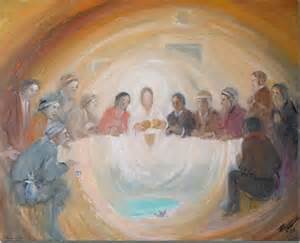
The Body of Christ Given For You

So in August of Year B of the lectionary (as in this year), we talk about a lot of bread.  In fact, we end up with four weeks of bread, manna, and Parker House rolls (kidding, not those!).  What is that about?  Well, bread is sustenance; bread is comfort; bread is an ordinary thing, something that most of us eat every day in some form.  Now Jesus says, “I am the bread of life.”  Bread is what we need. 

“The Body of Christ given for you.”  You probably hear it at least once a month, maybe more.  What does that mean?  What does it mean for the Body of Christ to be given for you?  When you go up to the altar rail and you are handed that piece of essentially ordinary bread and you hear those words, what does that mean?  Part of it is a reminder of Jesus’ death, the body—the literal body—that was given out of love for us.  But if that’s all it was, this meal would only be a symbolic remembrance of that.  There’s more.  Isn’t that just like Jesus?  There’s ALWAYS more.  You see, that holy meal is not just so we can remember that Jesus died for us; I think it’s really about remembering that Jesus lived for us.  Jesus became us.  Jesus walked this earth as one of us.  Jesus died as one of us.  Jesus, God Incarnate, became one of us and when this very earthly Jesus was gone, we were left with the Spirit of God surrounding and flooding in to every aspect of our lives.  We were left with this–the Body of Christ.  The Body of Christ given for you.  So now what?

The Gospel passage for this week follows up to last week’s passage about the Feeding of the 5,000 (or more…there’s ALWAYS more.)  It’s a little funny.  It’s like these people are chasing Jesus throughout this lakeside region, almost stalking him.  They wanted more.  But Jesus was no dummy.  He essentially tells them, “Look, you’re not looking for me because you understood what I said and want to give your life to me and follow the Way; you’re looking for me because you want your needs met.  You want me to give you more food or more stuff or more guarantees of safety and security or more of what you desire.  You don’t really want to change; you just want to be filled up.” Instead, Jesus offers himself.  He offers himself as the bread of life.  Whoever comes to me will never be hungry, and whoever believes in me will never be thirsty.  So, is this about bread, or isn’t it?  Is it about literal, material bread that fills our stomachs and provides sustenance for life?  Or is it about being filled spiritually, having one’s soul filled with all this is God?  Yes…both of those.  Jesus is talking about both of those.

Jesus is trying to connect physical hunger and spiritual hunger.  The two cannot be separated.  It is the Word made flesh and the ordinary made Holy.  After all, what good is food that fills our stomachs if we are spiritually hungry?  And, yet, what does it say about God’s Presence if one is so hungry that he or she cannot see past that?  Mahatma Gandhi once said that “there are people in the world so hungry, that God cannot appear to them except in the form of bread.”  It is true.  The two cannot be separated.  Jesus knew that.  So, Jesus offered food for the hungry—in every way. (That’s the reason he just came out of figuring out lunch for more than 5,000 people!)  The Body of Christ given for you.  But beyond just offering bread, Jesus became bread, became that sustenance that fills our lives in every way.  Jesus, God Incarnate, was God, was the life-giving bread that our bodies and our souls so crave.  Jesus gave us himself.  Jesus gave us the very Body of Christ.

So here we are, the Body of Christ, each of us called to become the very incarnation of God in our midst, each of us called to become bread, living bread that is offered to others, each of us called to become the very real presence of Christ in the world, each of us called to now be the Word made flesh.  That’s right, WE are called to be that.  We come to the table every month, sometimes more.  We come with thanksgiving for what Jesus gave us.  We come to remember Jesus’ life, death, and resurrection.  But we also come because at that table, in that place, somehow ordinary bread and ordinary wine (or grape juice, in the case of us United Methodists!) becomes something that sustains us forever, something that means we will never hunger or thirst again.  And that ordinary table becomes a great banquet to which everyone is invited.  And we, ordinary people with ordinary gifts somehow, some way, somehow become the Body of Christ.

I want to ask you…How many of you like flour—just flour, nothing else?  How about shortening?  Maybe, some raw eggs?  OK, how many of you go for your daily treat of baking soda?   See, none of those by themselves make a whole lot of sense.  But all of them, along with some sugar, some bananas, and some pecans, make my grandmother’s banana bread.  You see, you take these ordinary things and put them together and they become incredible.  We are no different.  Ordinary people, ordinary gifts, and you take them and put them together and somehow, some way, they become the Body of Christ.  Woodrow Wilson once said of our country: “America is nothing if it consists merely of each of us; it is something only if it consists of all of us.”  It’s the same with the Body of Christ.  We are not a group of individuals clustered together into a church; we are the Body of Christ—each of us and all of us, together.  Oh, individually, we are important, we are loved.  God created us.  But together, oh, together, we’re the very Body of Christ.  Together, we’re extraordinary!

You know, those people came back, wanting more from Jesus.  What they didn’t understand was that there was always more.  In the 4th century, St. Augustine said that our souls are restless until they find their rest in God.  We will always hunger, we will always thirst, until we figure out that it is this—this table, these people, this banquet, this Body of Christ–that sustains us.  The Body of Christ given for you.  And then God gives all of us gifts to become bread, to become wine, to become the Body of Christ for the world.

Years ago, I was at a church where I was one of six or so clergy, so we weren’t always in each worship service.  One Communion Sunday, I was not in the middle and the last services.  I was going to get things done.  But I kept getting pulled away, needing to go across the Plaza to the other building.  At one point, crossing the Plaza, I glanced out onto the street.  It was a little street called Fannin in downtown Houston and there was an older man who was trying very painstakingly to cross four lanes of museum district traffic with a walker and only his daughter supporting him.  The traffic was whizzing by and it was not good.

I grabbed the crossing guard that we had and made him stop the traffic and went out and helped him across.  It took a really long time and by the time he got across, he was exhausted (and there were four lanes of traffic that were very irritated with me).  I asked the guard to go get a chair and we sat him down right there on the curb of Fannin underneath one of the sprawling Oaks with cars speeding by.  His daughter didn’t know what to do.

I started talking to him and he told me that he just wanted to come for Communion.  He was on his way to be checked into the hospital and he just wanted Communion.  He didn’t belong to our church; I had never met him.  But he needed more.  He said that he didn’t think he had the energy, though, to walk all the way into the sanctuary.  I told him that I was one of the pastors.  I told him to stay there, sitting on this chair on the curb under the Oak tree with cars whizzing by and I would make this happen.

I ran into the sanctuary just as they were serving Communion.  Now, for those of you that are not familiar with St. Paul’s, it is very high church, very proper.  Everything is done right.  The worship is stupendous.  But I leaned over the Communion rail to one of the other pastors.  “Terry, I need two to go.  I’ll explain later.” 

So, with bread and cups, I went outside and served the man and his daughter.  They were both crying.  They got it.  I’m sad to say that that man went into the hospital and passed away a week later.  That would be the last time that he took Communion.  But on that street corner, under the Oak tree, with cars whizzing by, was the Body of Christ.  The ordinary not only becomes holy; the two become unable to be separated. That IS the Body of Christ.

So, when we come to that table, ordinary and gifted as we are, we receive the bread and receive the cup, and our hunger and our thirst will subside, and somehow, some way, the very real presence of Christ will be there, the living bread, the eternal cup.  And through the Mystery of God, even we, each of us, will become the Body of Christ.  And then we will go into the world and be the Body of Christ for others. (And you just thought it was a bite of bread and grape juice!)

Eat this bread.  Drink this cup.  Come to me and never be hungry.  Trust in me and you will not thirst.  The Body of Christ given for you.   Amen.

Grace and Peace,

Shelli

A Miraculous Feast

It was early in the morning and the sun had just begun to peak through the window above where he slept.  He really hadn’t gotten that much sleep.  The excitement and expectation was just too overwhelming.  It hadn’t been until right before he had gone to bed that his parents had finally given him permission to go.  He had been begging them for days.  He didn’t think his father really understood.  That seemed odd to him, given the fact that his father was so involved and so well-respected at the temple.  After all, his father went to the temple every day and was close to God.  That’s really what he wanted.  He wanted to be close to God, to feel God, to know God.  And all the townspeople had been talking about this man who was so close to God, who could show you how to be close to God.  He wanted to hear him.

So, he sprang out of bed and hurriedly put on his clothes.  He didn’t want to be late.  He wanted to get a good seat near the upper part of the hill so that he could hear.  He wanted to be near this man they called Jesus.  Just as he was running through the house, his mother called him back.  He rolled his eyes.  He did NOT want to be late.  He turned around.  His mother was standing there with a basket covered with a cloth.  She had packed him a lunch. He didn’t really feel that he needed a lunch.  He just wanted to hear what Jesus was going to say.  But he would humor her.  Maybe a lunch would be a good thing.  He took the lunch and returned her hug.  And then as he stepped out of the doorway and began to walk toward the lakeside beach, he glanced in the basket.  Hmm…five loaves and two fishes…that would be good…it was just enough for him.  It was all he would need.

When he got to the beach, there were already people gathering.  He thought he saw someone that could be this man Jesus through the crowd.  And then the crowd started moving, away from the beach and up the mountain side.  He could feel the cool air coming off of the lake as they went up the mountain.  It felt good.  Near the top of the mountain, Jesus sat down on a rock and his disciples sat down around him.  The small boy pushed through the crowd and positioned himself on a rock.  What a great spot!  He could see Jesus.  He could hear Jesus.  He was going to find out how to be close to God! He was with Jesus!

This is, of course, a familiar Scripture to us.  Many of us have read it since our childhood.  We have seen paintings and stained glass and countless other renditions that depict this story.  It is an amazing story to us, probably one of our favorites.  Apparently, this story was liked by everyone when it was first told, also.  Because it is not told just once, not twice, not just three times; rather, this story is the only gospel miracle that is told in its fullness in all four renditions of the Gospel. Apparently, this is a story to which we need to pay attention.  Because not only is it a story about Jesus; it is the story of a crowd.  It is a story of us.  We are the ones sitting on the grass, witnessing these signs, and receiving food from Jesus.

But what we end up concentrating on is the miracle that Jesus obviously did, taking a small amount of food and feeding an entire mountain of people.  But somewhere along the way, we forget that Jesus did not make something out of nothing.  This was not a magic trick.  We forget about the small boy, unnoticed, uncounted (remember that the 5,000 would have just been the men!), a small boy who just wanted to get closer to God.

Think back—barley loaves and fish—the cheaper food for the poor.  Barley was very inexpensive and for these communities surrounding the Lake of Galilee, fish would have been plentiful.  This was all the boy had.  It might have been a real sacrifice for his mother to pack that lunch at all. But soon after they reach the far side of the lake, he sees the disciples moving through the crowd.  They seemed to be looking for something.  And then he heard one of them ask someone if they knew of anyone in the crowd who had some food.  The little boy looked up.  “Oh”, he said, standing and running toward the disciple, “I do.  I have brought food.  Take it.  Take my food.  I want Jesus to have what I have brought.”  The boy had been right.  It was just enough.

Now at the risk of destroying your view of this story, notice that it doesn’t say that the boy’s lunch was the ONLY food.  It doesn’t say that the rest of the crowd did not have lunch.  Commentators have suggested that maybe some people in the crowd had things tucked away, holding it back to make sure that they had enough.  After all, do you really think more than 5,000 people would travel on foot and show up for a day-long extravaganza with no food?  Perhaps, then the miracle lies in the fact that the young boy was the first.  He was the first to offer his food, the first to offer all he had, the first to demonstrate an understanding of the abundance that God’s offers.  The fact that everyone eventually ended up with food may mean, in fact, that his generosity and openness to giving inspired others to do the same.  Generosity and caring about others became contagious.  It moved through the crowd.  You’ve experienced that, experienced those times when the spirit of generosity is pervasive.  And that IS a miracle.  Jesus WAS the one who performed that miracle.

I want to be like that little boy.  I want to, without reservation, willingly and joyfully offer what I have to Christ.  I want to bring what I have to the table of life that all might be able to share in it.  But I am like many on that hill that day and probably many of you.  I hold back, afraid that there will not be enough and offer only what I think I can do without—my spare time, my spare change, even my spare thoughts.  We are taught by our society to live our lives with an assumption of scarcity, assuming that there will not be enough when it is all said and done and so we hold back, rationalizing our reserves and hoarding our gifts that God has so generously shared with us.  We give in to the fear of not having enough. 

But that little boy looked at Jesus and saw abundance, rather than scarcity.  His faith gave him the ability to see that God had provided for him and would continue to do so and so he offered what he had with joy and extravagant generosity.  Oh, I want to be like that little boy. 

When you get to the end of this familiar Gospel story, Jesus leaves the stage.  He withdraws once again to the mountain alone.  And the crowd and we are left behind.  And as the sun sets on the scene, there is an empowering absence that descends upon us, a spirit of extravagant generosity and radical hospitality.  Can you feel it, that almost palpable spirit moving through the crowd?  Jesus has shown us what to do and now it is ours to actually do.  Meeting Jesus means that we have said we are willing to let our lives be changed.  Jesus did not come to us just to be a miracle-worker.  Jesus is not a vending machine-like character that gives us everything we think we need.  Jesus came, rather, to initiate the building of the Kingdom of God and calls us to follow.

And, as if that weren’t enough, there were leftovers!   So, Jesus tells the disciples to gather up all these fragments and save them.  Nothing is wasted.  Nothing is discarded.  Every morsel is important. Every morsel is part of this ongoing banquet.  Jesus is always preparing for the next crowd that might need something.  The story ends with Jesus still meeting the needs of each and every one, even those that might show up a little late, even those that are yet to come. The story is right—this WAS a miracle!   

Grace and Peace,

Shelli

A Deserted Place

You know, sometimes discipleship is just downright exhausting.  Oh, who are we kidding?  Sometimes just being a normal person trying to keep your head above water is downright exhausting.  Sometimes it seems too hard or too much or too complicated.  Discipleship (and life, for that matter) is really sort of a balancing act.  It is full of rhythms of converging order and chaos, beginnings and ending, and pulsing light and dark and sometimes we struggle to somehow balance all those aspects of life as we continue our journey forward. 

This passage depicts a time in the life of the disciples not unlike that.  Remember that the verses preceding the ones we read are the account of the death of John the Baptist (Why did we read that again?).  And at this point, we are told that the apostles return from sort of their first tour of service and gather around Jesus, telling him everything that had been happening with their mission.  They are excited.  They have wonderful stories of healings and teachings and people that are really listening to them.  They are becoming witnesses of the Gospel and things are beginning to change!  And yet, they are realizing that this discipleship thing is hard; it’s exhausting; sometimes it’s just frustrating.  And during this time, John the Baptist had been brutally executed.  This is certain to have cast a somber shadow over their elation at the success of their mission.  This had to be scary.  After all, John had been part of Jesus’ work.  John had, essentially, been one of them, doing what they’re doing.  But, as we know, we cannot always control or predict what happens in life. And so, in the midst of their shock and sadness and grief, and probably fear, Jesus tells the apostles (and himself), to “come away and rest”.  He tells them to go to a deserted place, a quiet place.  It was a place of Sabbath.

Now, probably with very little effort, we, too, will identify with this busy life, the throng of demands, the ongoing needs of those around us, and, possibly, even with the dangers that somehow impede our journeys.  We can even identify with those times when, like these disciples, we feel that we can’t even take time to eat, those times when there’s so much going on, when there are so many balls being juggled, that you feel like you can’t even breathe.  You’ll notice here that there were verses that we skipped in this week’s prescribed lectionary passage.  They are the account of the feeding of the five thousand.  Yeah, I’m thinking that wasn’t a time of rest, that was NOT a deserted place.  As much as the disciples wanted to serve, wanted to BE disciples, that was hard.  You can imagine that they wanted so badly to go off and rest, to go off and be by themselves to grieve, to reflect, to be.  So, Jesus tells them to stop, desist, take some time to care for themselves, and not to feel that they have to immediately respond to every cry in the world.  Yeah, Jesus got it!  Jesus knew we were human.

It is a lesson for us all.  It is part of the lesson that Jesus is trying to make the disciples realize.  They are not God; they are not the saviors of the world; they are limited human beings who need to rest.  They are not called to do all the work themselves.  Remember, they are the ones that are called to call others who call others who call others.  We are not in this alone.  This is part of human reality and, more importantly, it is part of that rhythmic dance of creation to which we all belong.  And so, the disciples did what Jesus had said to do and got into a boat and went to a deserted place.

But, as we all know, just because we choose a time to sail away does not mean that the rhythm of life stops.  We are told that there were people on the shore who recognized them and hurried to greet them.  (Don’t you hate that?  Leave me alone!)  But these people needed something—they were hungry for what Jesus offered.  Jesus responded to their needs, teaching and caring for them.  The disciples were there too, perhaps a little miffed that their “deserted place” had now become a somewhat public arena.  In the verses that the lectionary omits, they wanted to send them away.  This was their time; this was when they were supposed to rest.  But Jesus told them, “no, give them something to eat, sustenance for their bodies and food for their souls.”  So, in a way that is so familiar to us, he took the food, and blessed it and gave it to the disciples to serve the people around them.  Rest would come.

In her book, Sabbath Keeping, Donna Schaper says that “Sabbath is a way of living, not a thing to have or a list to complete.  By observing it we become people who both work and rest, and who know why, when, and how we do either.  We also recognize the occasions on which we do both at the same time.  We know how to pray, how to be still, how to do nothing.  Sabbath people know that “our” time is really God’s time, and we are invited to live in it.  We are living our eternity now—this Tuesday and Wednesday, this Saturday and Sunday.”  Isn’t that what we are trying to do—find that rhythm of life to which God invites us, that balancing act, if you will, that is God’s call to us?  This is the way that our time and God’s time converge and become one.  This is the way that our hearts beat the heartbeat of God and our ears hear God’s music.

The Jewish culture in which Jesus and the disciples lived was one that embraced time much more than space.  The understanding was that, contrary to the way we look at time, all hours were not alike.  Each hour was unique and the only one given at that moment.  Each hour held its own identity and its own purpose and within all of those hours, the Sabbath, those times when God calls us to rest and renew and return to our deepest relationship with God, were like great cathedrals, the Holiest of Holies, that sanctified time from which God then sent us into the world.

But we have lost that rhythm of being sent out into the world and renewed within God’s sanctified time, as God’s work prepares us to be sent forth again.  We are so busy doing our own work that we’re not allowing God to do God’s work on us.  It is wrapped in this holy time of rest with God that we get this glimpse of the holy and the sacred that exists for us even now.  It is what gives us the vision to do the work that needs to be done.  It allows us a chance to once again get in touch with God’s purposes for us and for the world.  It is a way of emptying ourselves.  Mother Teresa once proclaimed, “Let us remain as empty as possible so that God can fill us up.”  This is the way that God fills us up.  It is the way of becoming Sabbath, the Holiest of Holies, consecrated for God.  It is part of being a disciple.

This idea of the Sabbath being holy is not new.  In fact, ancient Judaism saw Sabbath rest and eternity as one, of the same essence.  Abraham Heschel relates a legend that claims that “at the time when God was giving the Torah to Israel, [God] said to them:  My children!  If you accept the Torah and observe my commandment, I will give you for all eternity a thing most precious that I have in my possession.  And what, asked Israel, is that precious thing which Thou wilt give us if we obey Thy Torah?  The world to come.  Show us in this world an example of the world to come.  The Sabbath is an example of the world to come…The Sabbath possesses a holiness like that of the world to come.”

I know.  Sabbath is hard.  There is just too much to do.  There are just so many hours in the day.  There are too many people depending on me.  If I don’t do it, it won’t happen.  Are any of these resonating with any of you? John Westerhoff, who is a well-known theologian, calls the phrase “if I don’t do it, it won’t happen” a proclamation of atheism.  Wow!  None of us are in this alone.  If you don’t do it, either someone else will or it just wasn’t meant to happen.  If you believe in the God who is always with you, always holding you, always guiding you; if you believe in the God who created you and loves you so much that this God would give you this gift of Sabbath to make you aware of that, if you believe in the God who calls us into this household of believers where we support each other into becoming the Body of Christ, then why don’t you believe that God will somehow empower you to find a way to get everything done that needs done?  Go back and read the Gospel passage again.  There was work to be done—LOTS of work to be done–and the disciples waited in the boat. “Come away and rest.”

In 1951, Rabbi Abraham Heschel wrote what I think is the quintessential classic entitled The Sabbath.  In it, Heschel says that “unless one learns how to relish the taste of Sabbath while still in this world, unless one is initiated in the appreciation of eternal life, one will be unable to enjoy the taste of eternity in the world to come.  Sad,” he says, “is the lot of the one who arrives inexperienced and when led to heaven has no power to perceive the beauty of the Sabbath…”

The traditional Jewish Sabbath begins at sundown, the Christian Sabbath with morning worship.  In both, Sabbath time begins with the lighting of candles and a stopping—to welcome the Sabbath in.  The Jewish understanding is that the Sabbath is welcomed in like a queen.  It is more than rest; it is promise.  It is a release from whatever enslaves us.  For the early Jews, that was actually embodied slavery; for us, it is choosing to be released from clocks and commitments and phones and schedules and all those burdens that we bear.  Marcia Falk writes that “three generations back my family had only to light a candle and the world parted.  Today, Friday afternoon, I disconnect clocks and phones.  When night fills my house with passages, I begin saving my life.” This is the beginning of sacred time.  This is the beginning of eternity.  This is where we find life.

Sabbath is not rest the way we think.  Sabbath is connection.  Sabbath is responding to God’s invitation to enter the holiest of holies, to leave ourselves behind, if only for a day, and find ourselves. Sabbath is not a nap, not a withdrawal. Sabbath is rest in the God we know, the God who is wanting us to connect, wanting us to find ourselves.

Grace and Peace,

Shelli

Why Exactly Are We Reading This?

“Herod’s Birthday Feast”, Edward Armitage, 1868

Why are we reading this and what, pray tell, does this have to do with us?  No, I didn’t choose to write on this passage.  It’s actually the chosen Gospel passage for this week based on the Revised Common Lectionary.  And, when you say you’re going to write on the lectionary, this is what you get.  So why is this Gospel passage part of our Scriptures at all?  It’s often recognized as one of those so-called “texts of terror” and seems to be tastelessly and somewhat haphazardly nestled among tales of Jesus’ healing and teaching and miracle-making.  And then this passage appears which isn’t even really focusing on Jesus at all.  That is the reason that I love the Lectionary.  It invites us to broaden our scope of what life holds and our view of where God is and how God moves in and through our lives.  No longer can we pick and choose that to which we will listen or plan the way in which God speaks in our lives.  No longer are we limited to our thirteen favorite passages.  Instead, we must open ourselves to God’s Holy Presence in every aspect of life, including those things that we’d rather just ignore.

We usually know John the Baptist as our “Advent guy”.  He was the one that leaped in the womb when Mary, pregnant with Jesus, entered the house.  He would grow up to be this wild wilderness-sort of man who wore animal skins and ate locusts and honey and preached a seemingly hell-fire and brimstone version of repentance to all he saw.  He was the forerunner, the one who would point to the Light that was to come.  And, if you remember, he was the one that baptized Jesus.  And after the baptism, we are told that John was arrested.  And today’s passage begins to come to be.

It’s an odd story, almost fable-like.  Herod Antipas has had John arrested because John had denounced Herod for putting aside his legitimate wife and marrying the wife of his brother. (Whoever told us that soap operas were a modern invention?)  And yet, on some level, Herod found John sort of fascinating, maybe even respected what he had to say and yearned to hear more, although he definitely thought it was disturbing and confusing and there was no way he could admit this fascination to anyone.  But he certainly did not wish him dead.  But this was not the case with Herod’s wife. So, in order to accommodate his wife’s wrath, he has John arrested.

And then Herod throws himself a birthday party, a big to-do with lots of good food, good wine, and dancing.  And the entertainment for the evening was provided by the young, beautiful, dancing daughter of either Herod’s new (and John had contended illegitimate) wife or of Herod himself (the passage is a little confusing on that fact).  Some people think that this was Salome’, who is depicted as one of the “bad girls” of the Bible. (Don’t know one way or the other!)  Well Herod was so pleased with her performance that he promises her anything.  The world was hers.  She could have anything that she wanted.

So, the young girl runs to her mother just outside the room.  Here was Herodias’ chance.  Her nemesis John would meet his demise and she would be rid of him forever.  And the young girl returns to the party and makes the fateful request for John the Baptist’s head on a platter.  Herod must have nearly choked.  This was not what he wanted!  His vengeful wife and this spoiled child had crossed the line.  He knows that no matter who John is, he does not deserve death.  But, as the governor, he was in what he construed as a tenuous position at best.  After all, he had made a promise and had voiced it aloud in front of numerous witnesses.  If he didn’t follow through with it, no one would trust him again.  So, to save face and to secure the balance of power, he complied.  After all, he was governor.  Some things have to be done for the good of society and for the preservation of the way things are.  And, let’s be honest, there is not one of us here who doesn’t want to be liked by others.  Herod was no different.

But this is not just an historical account about Herod.  I really do think that somewhere in this passage, we are meant to find and look at ourselves and our own lives.  Because we, too, make our own concessions—not to the point, obviously, of ordering someone’s death but in our own way we also bow to convenience and convention.  On some level we all live our lives wanting to be victorious and successful, wanting people to like us, and, like Herod, we sometimes miss the opportunity to do the right thing.  We close our ears and our minds and we look away, hoping the whole messy thing will just go away (or at least we won’t have to read about it!).  And we miss the opportunity to stand up and be who God is calling us to be.

Maybe that is the reason that this horrible story is here in the first place; otherwise, we’d all be tempted to start thinking that this Christian walk involves following some sort of miracle working-healing-rock star-Superman character.  Well, sign us all up for that!  But it’s not about that.  Jesus kept telling everyone not to say anything about all those miracles because following Christ does not mean going where the miracles are; it means becoming Christ-like.  It means becoming holy.  It means, finally, becoming human—fully human as Christ showed us how to be.

This story is one that is not about Jesus; it is rather about one of his followers, one who never wavered in his powerful witness.  This, like so many of the Scriptures, is a story of contrasts.  I think maybe the Gospel is a story of contrasts.  Think about it.  It’s always presented this way:  You can follow the crowd, be accepted, be what the world expects you to be.  You can follow the norms that society has laid down for us.  Or you can follow Jesus.  You can back away into the crowd and say that something should be done or ask why no one is doing anything.  Or you can follow Jesus.  You can BE the change.   We’re not called to admire Jesus; we’re called to become like Jesus.  And sometimes that means that we stand up.  Sometimes that means that we speak out. Sometimes that means we don’t follow the jerks down a terrible storyline.

Years ago I had the opportunity to visit Auschwitz.  I was struck by the obvious, of course. But what surprised me was what was around it.  It is located on a former military base in southern Poland near Krakow.  It’s out in the country away from the town with a railroad track running straight through it.  But around it are farmhouses—century-old farmhouses.  In other words, they were there in 1942.  And I wondered why they didn’t say anything.  There were cattle cars coming and going and the smell of burning flesh at times.  And I realized that as German as I am, those could be my relatives.  Why didn’t they say anything? Would I have said anything?  I fear that answer.

See, holiness is sort of a complex thing.  We crave it, we pursue it, and we try our best to attain it.  But most of us have to be honest with ourselves.  We want it at our beckoning and on our terms.  We don’t want to stir things up or get involved in places that are uncomfortable, that might reflect badly upon us.  We are a lot more like Herod than any of us care to admit.  We opt for convenience and convention and complacency and in a way spend our lives fearing the mystery of holiness, fearing what entering holiness and the unknown would mean for our lives.  Because, I will tell you, holiness will mess up your life more than you can possibly imagine.

You know, I once heard someone refer to the Christian life as linear—as a sequence of steps as we move from creation, through growth and the pursuit of Christian perfection so that we might finally reach that place where we are one with God.  I don’t think that’s right.  I don’t think of Christian perfection, or heaven, or whatever you imagine it to be as something to which we somehow graduate.  It’s actually here and now.  If we just open our eyes, we will see glimpses of the sacred and the holy everywhere.  We will be aware that God is calling us to do something different–now.  And I think God knows that there is a time when things that are wrong come to light.  There is a time when we really are called to look at our own lives and sort of re-evaluate. When we finally stop doing what we think we should be doing or maintaining the life we’ve worked so hard to build or trying to please those who we think we should be pleasing and listen for that which God is calling us to be we will become aware of that holiness of which we are already a part.

There is no doubt that this is still a bizarre thing to include in our Lectionary or even in our Scriptures.  But maybe it’s a call to us to redefine what we think our lives are.  Maybe it’s a way of realizing that becoming holiness does not mean our comfortable business as usual.  Retired United Methodist Bishop William Willimon says that “It’s a fearful thing to commend our spirits to God because well, who knows what God will do with our lives?”  That is the crux—submitting one’s life to God means that one gives up control, gives up the “plan” that one has laid out for his or her life.  Submitting one’s life to God means that one’s life as he or she knows it ends.  And that is indeed a scary thing. 

A familiar poem by Robert Frost includes the line, “Two roads diverged in a wood, and I, I took the one less traveled by, and that has made all the difference.”  That is it.  That is discipleship.  It is not straight; it’s not linear; it is not easy; it is not predictable.  Sometimes it’s messy.  Sometimes you will lose standing or power or that comfortable existence that you’ve so hard to maintain.  Sometimes you will find yourself waiting for someone else to do something, to do the right thing.  What if that’s supposed to be you?  Sometimes you have to stand and do the right thing. 

How would history have changed if Herod had done the right thing, if he had ignored his need for power or recognition and instead had done what he knew was right?  We’ll never know.  What would have happened if some of those farmhouses had had the courage to speak out?  We’ll never know.  But we can do the right thing now.  We can stand and speak for justice and equality and mercy.  We can be the change that the world needs.  That’s what discipleship is.  It’s showing the world what it means to be courageous, to be the one, to be fully human.

Grace and Peace,

Shelli

Healed

We’re getting used to Jesus and the disciples crossing that lake.  The reason is that at this point this lake WAS the center of their lives.  Many were fishermen.  All used it to get to places.  So, they go back across the lake and it is there that the writer of Mark’s Gospel sets the stage for two healing stories sort of nestled against each other.  We’re familiar with these healing stories.  But they make us wonder aloud, don’t they?  Does that still happen?  Did it really happen the way we think? Why doesn’t that happen to us? Or are we reading something into these stories that aren’t there?  We often hear these healing stories couched as a testament to individual faith, as a depiction of healing that comes because of the level of faith that a person holds.  Really?  So, what does that say about those who are NOT healed in the way we think they should be?  What does that say about their faith?  What does it say about our faith?

The truth is that healing is not based on a lottery or some sort of magic talisman.  Maybe we’ve not understood it completely.  I mean, look at these stories.  Why these particular people?  They could not be more different.  One was rich and one was poor; one was young and one was, by first century standards, old; and one was a part of the class that ran the society, that enjoyed power and prestige and all the benefits that that might bring in our world and the other—well, the other had to forcefully push her away into the crowd from the forgotten fringes of those who were not valued and who were not considered part of acceptable society.

But it doesn’t say that they were “fixed”.  It doesn’t say that things were put back into place as they were before.  It actually doesn’t even imply that they were cured.  God doesn’t fix things; God transforms them.  But I don’t think that transformation happens because of our faith in God.  In fact, I think it’s a little misleading and, in some cases, downright dangerous to hang all our hopes on some sort of fairy-tale-type ending that we have created in our minds.  That’s not faith and it’s not usually very healing.  Healing happens because of God’s faith in us, God’s faith in what we can be and what this world can become, God’s faith that we can trust that miracles can happen (and do every day!), and that even we can be healed.  (Not “fixed”, not put back the way we were, but healed.)  Even we can be made whole—maybe not in a moment, maybe not in a month, maybe not in a decade.  Have faith that God will make you whole.  Now THAT’S transformative!

So, another story…you know the one:  A young girl named Dorothy is at home minding her own Kansas business when an unforeseen tornado whisks her away to the other side of life.  Now things wouldn’t have been so bad, except that in this dreamy nightmare, her house has inadvertently landed on a witch and the witch’s sister is extremely displeased.  So, Dorothy, with directions from a good witch, makes her way down the yellow-brick road to see the Wizard of Oz.  If only she can get to the Wizard, she will find her way home.  If only she can make it there, everything will be fixed.  And along the way, with the wicked witch hot on her tail, she meets this motley cast of characters, all of whom are bemoaning their lot in life, thinking, “if only…”.  The Scarecrow contends that if he only had a brain, he could think, he could confer, he could consult, he could be.  And, for the Tin Man, if only he had a heart, he would love, he would be human.  And the Lion…he could reclaim his identity if only he had courage.  And Dorothy?  Well, we all know…if only she could just get home.

So, did you ever think of this as a healing story?  At the risk of destroying your childhood memories, the story did not end like most fairy tales do. So, do you remember what happened with the Wizard of Oz?  The Scarecrow found his brain when his mind was opened.  The Tin Man found his heart once he filled it with compassion and love for others because that is how you become human.  And the Cowardly Lion finally gains the courage and the power that he most craved, but with it comes the responsibility to live and speak for justice and mercy for every single one of God’s children.  And then there’s Dorothy…we remember that at that point, the curtain was torn away and the Wizard of Oz was unveiled.  And there he was…one of us…nothing glamorous, just an ordinary (and extremely short) human.  But it didn’t matter.  Because the healing and the recreation was already there before, already a part of the journey.  And as long as Dorothy believed that there was something somewhere over the rainbow, she knew she would make it home.  And the way home—the way to healing, and renewal, and recreation–is already deep within you (although, admittedly, it helps if you have the most incredible red shoes known to us!).  God saw to that long ago.  It’s called grace…simply grace.  But, as Frederick Buechner said, “there’s only one catch…the gift of grace can be yours only if you’ll reach out and take it.  And maybe being able to reach out and take it is a gift too.”        

Healing does indeed happen.  Transformation happens.  I think it happens a lot more often than we think.  I think we sometimes miss it because we’re looking for what was, what will never be again, and we miss that we’re already on the road to healing.  The United Methodist Book of Worship says this about healing: 

So, part of living a life of faith is to trust that God holds a vision for something more, something beyond what we have now or had before.  Healing is not fixing or putting things back the way they were before; healing is bringing wholeness and oneness with God into someone’s life; healing is making God’s vision for us come to be; and, sometimes, it is trusting in the unknown and that which doesn’t make sense at all.  Albert Einstein once said that “there are two ways to live: you can live as if nothing is a miracle or you can live as if everything is a miracle.”  Miracles and healing are all around us; but they don’t necessarily look like what we’ve imagined and definitely not what we’ve necessarily planned.  So, we need to open ourselves to God transforming us and, yes, we have been given the mind, the heart, and the courage to do just that.  God has put enough faith in us to walk toward healing, toward wholeness, toward who God envisions we can be.  We just enough faith to put one foot in front of the other and keep walking.

Grace and Peace,

Shelli

Stilled

So before we dive in, (that was a pun) I want to invite you to a little imagery.  What in your life needs to be calmed?  What is the thing that you feel like you just can’t control, just can’t get a handle on which way to go?  What is the storm that scares you and turns you and sometimes feels like it has knocked you off your feet?  We all have it, that thing that we’d just like someone to “fix”.  And I want you to imagine that storm.

This Gospel passage is one of the most familiar and oft-quoted stories in the Gospels.  Many of us can recall listening to this story as it was read to us from one of those children’s storybook bibles or seeing it depicted in paintings and pictures.  We like this story.  It tends to sometimes gives us a sense of composure about our lives, knowing that Christ can calm the storms, purge our fears, and make our lives into the way that we like them once again.

Here, Jesus stands on the edge of the boat with his arms outstretched over the whitecaps of a raging lake (it’s a like, rather than a sea).  With that image in mind, the text may become for us a miracle story demonstrating the divine power of Jesus.  This Jesus in whom we believe, this Jesus in whom we put our faith, can do anything—can pick up the pieces of our lives and put them back together, can calm the raging waters that frustrate our otherwise calm repose, and can turn our lives into what we cannot, calming the storms of disapproval, rejection, failure, meaningless, illness, and even death and providing us a veritable sanctuary to see all those things through. 

But the problem is that if we stop there, if for us Jesus becomes the one who always “fixes” things, who calms the chaos and puts things back the way they were, then I think we have missed a large part of who Jesus is.  Sometimes I think it’s good to be reminded that Jesus is not a superhero.  The promise is NOT that he will put things back the way they were; the promise is that life is more, that there is more waiting for us beyond what we see, and that we will always, always, always have someone with us as we walk through these storms.

I remember when I was a young adult.  I had moved to Denver with Apache Corporation and was facing my first winter beyond the (relatively) mild winters of South Texas.  Now you have to understand that I was an only daughter as well as an only granddaughter.  I was used to having things “fixed” for me. As I sat in my apartment on that coldest night that I had encountered so far in my new surroundings, the weatherman on the news, in an effort to insert some other facts of interest into an otherwise perilous situation, told us that oil in a car will congeal at 22 degrees below zero (Fahrenheit).  He then followed this fun fact with the prediction that the temperature that night would fall to 27 degrees below zero.  I thought of my brand new car sitting outside of the apartment building and I panicked.  I did the only thing I knew to do.  As the independent and assured young woman that I was, I called my dad. When I told him the dilemma (after waking him at 11:30 his time), his response completely threw me: “Shelli, I know that you think I have the answers to all of life’s questions, but, think about it—I have lived in Katy, TX my entire life.  Why would I know the answer to this question?  I think it was at that moment that my dad moved from being my “fixer” to being my father.  I think it’s safe to assume that the disciples had fallen into the same boat, so to speak.  Jesus was always there, always pulled them out of the murky water, always saving them usually from themselves. 

So, think about the passage again.  It was evening.  It was beginning to be dark as the light of day began to tip beneath the horizon.  And it was now that Jesus had suggested that they make their way to the other side of the lake, away from the familiar crowds, toward the unknown, perhaps the unfriendly and unwelcoming, with their small little entourage of boats.  Why would they do this?  Think about it.  They did not have access to the “Severe Weather Center” on their local news broadcast or that neat little weather app on your phone.  They had no navigation equipment or GPS.  They had no idea what they were getting into.  The darkness was always a symbol for the wilderness, for danger.  And the other side of the lake?  Completely unknown.  So, Jesus suggests that they venture into the wilds of the unknown, to leave the safety of the harbor behind.

And as they get out into the middle of the lake, a great windstorm arises, so great that the waves crash against the boats carrying Jesus and the disciples.  Now you have to remember that this was not a huge boat.  First century fishing boats were probably about 20 feet long and had no cover over them.  You couldn’t go down under deck.  The hull would have been maybe only four feet deep.  So before long, water begins to fill up the small boat. Not even the experienced fishermen in the bunch could do anything about this.  So they turn to Jesus.  Jesus will save them.  Jesus will fix this.  “Jesus, save us!”

And there is Jesus, sound asleep on the boat cushion at the rear of the boat.  You can imagine what the disciples thought.  “Are you kidding me?  Here we are, dying, and you are asleep!  What are you thinking?  Get up and save us!  Get up now!”  Now, odd as this may be to us, you can’t really blame Jesus.  He had to be tired.  He had been teaching in the hot sun and the crowds just wouldn’t leave him alone.  So, he lay down and he rested.  Everything would be alright.  And then he is jolted awake by these overly-dramatic disciples who can’t seem to take care of themselves or each other.  “Good grief,” he thought, “have you learned nothing from me?” So he got up and with a few simple words, “Peace! Be still!”, the storm subsided.  And they floated for a few moments, not saying a word to each other, as the boat glided through the water as if on glass.  Then Jesus turned to them.  “Have you no faith?  Have you learned nothing from me?”

So, as I mentioned before, we’re all familiar with this story.  It’s reading has been sort of drilled into us from an early age.  What if we’re reading it wrong?  What if Jesus didn’t really calm the waves but rather calmed the disciples’ stress and anxiety about them?  What if Jesus, with calming wisdom, simply guided the boat into a calm place, into a still cove that was sheltered from the winds and waves?  What if Jesus with a peace-filled repose took the helm and steered the boat away from the waves and then in the quietness, looked at the disciples and said peacefully, “Shhh….calm…everything is going to be OK.” What if Jesus wisely gave the disciples room to breathe?

At the risk of destroying your perceptions about the story, the notion that Jesus somehow fixes our lives by taking the storms away doesn’t really jive with the rest of the scriptures.  God doesn’t fix things; The Bible is not the story of a magician. God re-creates them.  And sometimes it means just looking at something differently or perhaps from a different place.  But all of us are often trying to escape the storm.  So, we look for something that will get us out of it.  But even when God steers us into the quiet, into the stillness, that doesn’t mean that it will always be that way or that we should stay there.  That is not the final plan.

When I was little, we used to swim in rice wells (because, you know…Katy).  It was fun and a little scary.  You had to crawl up onto this huge pipe and walk out on it over the water.  As the water gushed out of the pipe, it created these swirling typhoon-like waves of water.  And you jumped off and were forced down into it by the waters barreling out.  And then you swam a little and got out and did it again.  But you know what?  We never went into the still waters around the edge of the pond.  You know why?  It was dangerous.  It was rancid.  That’s where the snakes were. The safest place was the constantly-swirling water.

13th century mystic Mechtild of Magdeburg said that “the day of my spiritual awakening was the day I saw—and knew I saw—all things in God and God in all things.”  You know, when we read this passage, we see God on the shore, amidst safety and predictability.  And we see God in the calming of the storm.  But we may miss the God in the darkness as our little boat sails away from the disappearing light.  We may miss God in the storms themselves that we encounter that make us realize that God has given us enough faith to get us through.  And we miss God in the unfamiliarity of the far shore, in the unknown lands toward which we sail.  We also miss the way God guides us into a place where we can sort of regroup and ready ourselves for the rest of the journey.  For us, fear is something we are supposed to overcome.   And yet, Jesus didn’t rebuke the disciples because they were afraid; his frustration was that they didn’t have faith to know that God was there with them, with them no matter what life brings.  That is why in the midst of all these storms and all this noise, in the midst of everything that goes on in our lives, we hear Jesus saying, “Peace! Be still…Come and follow me—not the noise, not the ones that tell you that life can be fixed. Untie your boats from the harbor and follow me.” And, in the meantime, God may steer you into a cove until you’re ready for the rest of the journey. God is not going to fix it; God is going to show you a new thing.  All you have to do is follow, no matter what the journey holds, because we’re on our way to Life.       

Grace and Peace,

Shelli

Seeds

It seems that Jesus was big on botanical images, doesn’t it?  But they work.  You plant seeds, you feed and care for them, and they grow into a plant, right?  But I think there’s something else.  Plants don’t grow because we make them grow.  Plants grow because that’s what plants do.  We can’t hurry them.  We can’t control them.  We can’t predict when they will bloom.  Oh, we can shape them and prune them and help them along but they’re pretty much going to do what they’re meant to do.  Regardless of how much we plan and how much we do, we cannot make our plant grow.  We are not called to plan when the harvest will happen or when it will end.  They sprout, they grow, they produce fruit, and they die.  They’re part of that cycle of life.  They’re part of us.  It doesn’t mean that we have nothing to do with it, though.  We are the scatterers and the gatherers.  We are the planters and the harvesters.

Next, Jesus once again uses that familiar little mustard seed.  We’ve read that many times before.  It’s tiny, really nothing more than a spec.  Now often when we read of this beloved mustard seed, so many of us imagine this tiny seed that grows into this big beautiful tree.  (I don’t know.  Was there a Sunday School picture that depicted that?) You’ve heard that image.  People like to use it to depict what even a tiny bit of faith can do.  But I’m not so sure that’s what it was meant to say.  Because, see, that tiny mustard seed does not, no matter how hard it tries, no matter what we do to help it, grow into a majestic redwood.  It grows into a bush (or if it’s REALLY persistent, a sort of bushy, squatty tree), a very ordinary bush with an ordinary harvest that will end up in our spice rack or as a spread on our sandwich.  There’s nothing really surprising about the outcome.  It’s what is supposed to happen.  It’s what God has promised.

So, interestingly enough, Jesus used something incredibly ordinary to illustrate his point.  But even run-of-the-mill ordinary things can be extraordinary.  A couple of months ago, I bought some egg rolls.  But when I got ready to eat them, I realized I had no Chinese mustard.  How can you eat egg rolls without Chinese mustard? (Well, I can’t) So, I thought, well how hard can that be to make?  All it takes is a little dry mustard, a little rice vinegar, and some ice water.  Easy, right?  Well, yes, if you want to create something that will clean out your sinuses for the next decade!  Just for the record, mustard, small though it might be, packs quite a dramatic punch!

So, what, really, is Jesus trying to teach us with this string of parables?  It sort of sounds like the disciples were getting the teacher’s notes and the rest of us were just on our own.  No, I think Jesus just wanted us to look at things differently.  I think Jesus wanted us to have faith in the faith that God had in us.  Faith is a gift.  God supplants the seeds of faith into our lives—ALL of our lives.  And they begin to grow. But, lest we think that faith can be charted into some perfectly-increasing line graph through our life, we need to remember that there is no prescribed pathway for our faith.  “Measuring faith” is not up to us.  God gives us whatever we need.

So, if someone tells you that “you don’t have enough faith” or that “you just need to have more faith”, have faith in the faith that God has in you.  Each of us has been given the faith that we need to be who God calls us to be.  Sometimes it will, indeed, feel like your faith could move mountains.  And sometimes it just doesn’t seem to fit into who you are.  Sometimes it seems empty and elusive.  Sometimes it seems like you’ve lost it.  (St. John of the Cross penned it as the “dark night of the soul” in his well-known 16th century poem) Perhaps those times in your life are times when your faith lays in winter fallow, regenerating, re-seeding, preparing for the new growth to come.  To be honest, if everyone was constantly moving mountains, the world’s topography would be totally confusing.  Sometimes, it takes faith to get out of bed. On those days, that’s enough.  Sometimes the silence of faith is more powerful than the loud, mountain-moving chorus.

The truth is, most of our life is lived between the times of planting and the times of harvest.  Most of our life is spent waiting on fruit, waiting on completion, waiting on something that we might never see in this life (I think Moses could tell us a thing or two about that.  Sometimes the promised land is not ours to enter).  But those fallow times are never wasted.  They, too, are part of the life cycle.  In fact, it is those times of fallow, those times of waiting when our faith is what gets us through.  Have faith in the faith that God has in you.  The harvest is coming.  Maybe you’ll see it; maybe you won’t.  But your faith is part of what brings it into being—no matter how small you think the seed might be.  So, whatever you do, however small it seems, just keep scattering seed and have faith in the faith that God has in you.

Grace and Peace,

Shelli