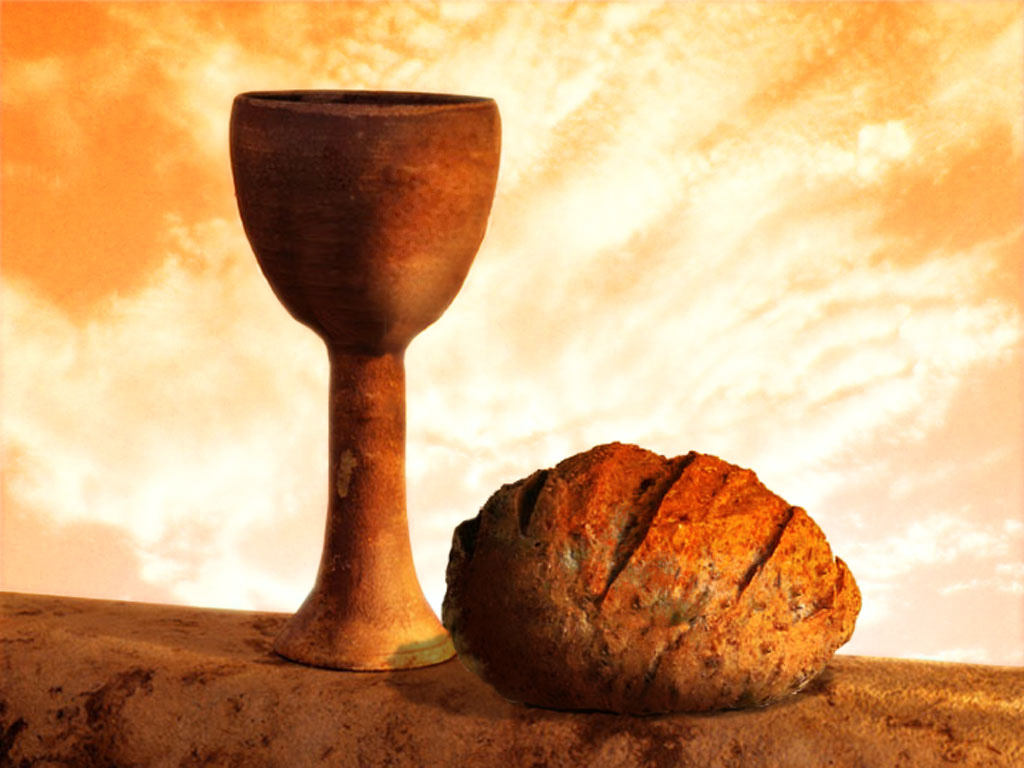
Flesh and Blood, Literally…

Lectionary Passage:  John 6: 51-58
To read this passage online, go to http://bible.oremus.org/?passage=John+6:51-58&vnum=yes&version=nrsv.

Yes, more about bread!  But we can’t help but read this passage and think of our own Eucharistic language.  That is probably intentional.  Commentators think that this sixth chapter of the version of the Gospel story by the writer that we call John might have actually been composed over time and that the implications to the Eucharist might have been added later.  It, like our participation in Holy Communion, is an opening of oneself to a life in Christ.  The bread and the cup are lenses through which we can see things differently.  When taken literally–the notion of eating flesh and drinking blood–, they are downright shocking to the ears of this world.  So, if not literal, then are they merely symbols?

The truth is that this idea of “living bread” is something more.  It is more than just an over-spiritualized connection to the idea of God.  Rather, it is meant as a real, even a physical, maybe EVEN a literal, connection to the real God that is ever-present in our life.  This is hard for us.  We tend to be a little more Puritanical than most of us would care to admit.  We tend to try to separate the spiritual from the physical, perhaps trying to hold off at bay that physical self that is sometimes so raw, so vulnerable and exposed, perhaps even so dirty from that seemingly pristine image of God that we hold so dear.  But is that what Jesus intended here?  Listen:  “Those who eat my flesh and drink my blood abide in me, and I in them.”

So what would it mean to connect to God, to literally abide in God, in every aspect of our being?  What would it mean to actually become the living, breathing image of God Incarnate?  We all wear skin.  We all live and breathe and walk around in this absolutely incredible physical body that is not disconnected from our soul or from our spiritual selves but actually part of it.  What does it mean to realize and affirm that God loves all of us–our souls AND our bodies?  And what, then, in turn, would it mean to love God in the same way?

The last things that Jesus did had nothing to do with making sure that the Disciples had all the Scriptures memorized or that they believed the right way or worshipped appropriately.  Jesus did not leave them instructions on how to be righteous or right.  Rather, in those last hours, he fed them bread and wine, things they could see, smell, and taste.  And then he touched their feet, caressing them lovingly, pouring cool water over them and wiping them with a towel.  And, lastly, he said the words that they needed to hear:  “Do this–not BELIEVE this or UNDERSTAND this or SPOUT this to the masses–but DO this.  Do this in remembrance of me.”

Stanley Hauerwas claims that “Christianity is not a set of beliefs or doctrines one believes in order to be a Christian, but rather Christianity is to have one’s body shaped, one’s habits determined, in such a way that the worship of God is unavoidable.”  Our faith is not limited to the spiritual.  It really is literal; it really does have to do with the flesh and the blood and sometimes even those funny looking, flat-bottomed things with the not-so-pretty toes at the end of our legs.  God created all of us.  God loves every molecule of our being.  And with every thing we are, we are called to love God, to become one with God, to live in full Communion with nothing left behind.

And, when you think about it, those senses, those very literal expressions of our bodies, are the ways that we connect to each other.  So, stop, and see, hear, smell, taste, and touch and do this in remembrance of me.  Eat this bread and drink this wine–together.  And kneel and wash and serve–together.

The day of my spiritual awakening was the day I saw–and knew I saw–all things in God and God in all things. (Mechtild of Magdeburg, 13th century mystic)

Grace and Peace,

Shelli

As God in Christ…

Ruins of Coventry Cathedral

Lectionary Passage: Ephesians 4: 25-5:2To read this passage online, go to http://bible.oremus.org/?passage=Ephesians+4:25+-+5:2&vnum=yes&version=nrsv

I’m not usually a big Ephesians fan.  I mean, first of all, it probably wasn’t even written by Paul but rather by a seemingly zealous (and sometimes over-zealous) disciple of his.  There are problems with it–mainly for women!  But this passage speaks something hauntingly real, something with which we can identify regardless of our gender or our place, regardless of where we are in life.  We are called to discard our old nature and don a new one.  Well, there you go!  How easy is that?  We are called to see that we are part of one another, that not speaking the truth to others is the same as not speaking the truth to ourselves.

But lest you think that this is some sort of sappy morality check where we all stand and sing “Kum-ba-yah”, think again!  It is not a vision of good or right behavior.  It is not a call to all be the same so that we can all just get along.  It is the call to be something different, to leave our old selves behind and see ourselves anew.  No longer can we dismiss our shortcomings as “only human”.  Rather, we are called to see ourselves as fully human, fully living imitations of Christ, and immersing ourselves in the Truth that is God, in the Truth that is who we are called to be.

OK, full confessions….I got mad at someone today.  No, let me elaborate:  I got REALLY mad at someone today.  I felt violated, taken advantage of…you name it.  You’ve been there.  I thought I had it all figured out.  And then, I began working on the notes for this week’s lectionary passages.   And, there, as if our Sovereign Creator saw fit to provide some sort of show of colossal sacred humor, there it was:  “Be kind to one another, tenderhearted, forgiving one another, as God in Christ has forgiven you.”  Are you kidding me?  NOW?  You throw this at me NOW when I’m so incredibly justified????  So, in my own show of incredible restraint, I slammed the book shut and headed off to the sanctuary.  (Now, see, that’s the good part of no longer working in oil and gas.  Their sanctuaries did not hold near the draw that ours does.) And I sat there in the darkened sanctuary, struggling to be at peace.  And I saw something that I’d never seen before.  I looked at Jesus in the Gethsemane Window.  I’ve always assumed that he carried a look of resolve, a look of incredible peace.  But, today, I saw a look of ire.  Spilling out of him was an anger so immense, so intense, that it consumed him.  What were they doing asleep?  Don’t they know how hard I tried?  Don’t they know what this means?  And then…take this cup, take it from me, so that I can be who you call me to be.

I’m sure it’s wrong, wrong to saddle Jesus with so much humanity.  But isn’t that why we’re all here?  Because Jesus was human, fully human.  Third-century theologian, Athanasius, is attributed with the words, “Christ became human that we might become divine.”  To expect yourself to be perfect is not even spiritual, much less realistic.  I mean, if you were perfect, why would you need Christ, why would you need God?

The first time that I ever encountered this passage with any real intent was on a choir trip.  (Because, in my previous oil and gas life, I actually sang!)  Our choir was invited to be part of a national music festival in Coventry Cathedral in England.  Now you have to know that Coventry Cathedral, a beautiful middle-age cathedral, was destroyed by bombing during World War II.  Everything that they knew was gone, burned, ashes….And, so, in 1940, their provost ordered the words inscribed on the altar that was left:  “Father, forgive.”  Today there stands a brand new cathedral next to the ruins of the old one dedicated to the work of reconciliation.  And where the altar stands, engraved with those words, are two statues, gifts from two countries celebrating the work of reconciliation that the cathedral had proclaimed.  The countries who gave the statues are Germany and Japan, the very destroyers of what was.

And so, that year that we were there, the festival commissioned a musical arrangement of their own creed, if you will.  It is called their Litany of Reconcilation.  It recognizes who we are and affirms what we can become:
 
All have sinned and fallen short of the glory of God.
The hatred which divides nation from nation, race from race, class from class,
Father Forgive.

The covetous desires of people and nations to possess what is not their own,

Father Forgive.

The greed which exploits the work of human hands and lays waste the earth,
Father Forgive.

Our envy of the welfare and happiness of others,

Father Forgive.

Our indifference to the plight of the imprisoned, the homeless, the refugee,

Father Forgive.

The lust which dishonours the bodies of men, women and children,

Father Forgive.

The pride which leads us to trust in ourselves and not in God,
Father Forgive.

Modern Coventry Cathedral

The litany ends with this:

Be kind to one another, tenderhearted, forgiving one another, as God in Christ has forgiven you.

Grace and Peace,

Shelli

CALLING: Choosing to See Abundance

For many years now, I’ve been sort of fascinated with the whole idea of calling and what the notion of that means.  I thought maybe I’d start writing some of these thoughts on the blog every now and then.  I would love to hear your own thoughts, your own stories or notions of calling.

Yes, we claim that we are all called–each and every one of us.  I don’t know about you, but I probably put that in almost every sermon or lesson that I put together.  But do we truly believe that God has called us?  What does that mean?  Does it give us permission to just, then, continue down the road we’re on, thinking that that is where God plunked us down so surely that is where God called us to be?  And here’s one for you:  Is it a calling simply because God envisions it?  In other words, what happens to a calling that, for want of a better word, falls on deaf ears?  Is it still a calling?  What happens to that vision that God has for us if we never stop and open ourselves enough to see exactly what it is?  What happens to God’s calling for me if I’ve already figured out what my life is about?  What am I supposed to be?

I think all of us ask ourselves those questions.  But, do you think there is something that you’re “supposed” to be?  Well, I suppose it would be easier if God had simply set us on the right road and just told us to walk down the line in the middle, never veering, never turning, perhaps just stopping for rest every seven days or so.  Then we could all walk forward, perfectly aligned, like a bunch of good little Stepford soldiers marching to wherever God led us.  OK, so all we’d have to do is stay on the line, right?  Just keep moving.  Really?  I know there are those who claim that kind of “right and wrong”, “righteous and evil” theology but I personally don’t think that’s exactly how it works. 

After all,  remember what the all-powerful God did in creating us.  This all-powerful being gave away part of the Godself, relinquished part of what made God omnipotent.  God made a world and filled it with abundance.  And then God made us, images, however shadowy, of the very Godself that created us.  And God took a piece of the power that God held and gave it away.  It’s called free will.  All of a sudden, this great Creator was no longer omnipotent.  God can do everything–everything, that is, except make us choose.  And, really, if you were God (or, for that matter, even if you were you), wouldn’t you rather someone choose to love you, choose to be with you, choose to be who you envisioned them to be? 

So, I guess that straight line down the middle of the road has sort of faded away (or maybe it was never there in the first place!).   Maybe that was the whole idea.  Maybe we weren’t called to see the road at all but rather to see the abundance through which it takes us. Maybe that is the way we choose to love, choose to be with God, choose to love God.

And back to the other question:  Is it a calling if we do nothing?  Or does God’s calling to us come to be in our response?  First and foremost, God calls us into holiness, into that sacred mystery that is God.  God calls us to know the Godself, to know the very image of God in which we were created, to know the very best self that we can be.  But, more specifically, God calls each of us in unique ways.  God calls us to use our gifts, our talents, our individual circumstances, the persons in our life, to live that calling and become who God calls us to be.  God can do all things–all things, that is, except respond.  Look around.  Look at the incredible abundance that God has poured into your life.  What is your response?

Vocation does not come from willfulness. It comes from listening.  I must listen to my life and try to understand what it is truly about—quite apart from what I would like it to be about—or my life will never represent anything real in the world, no matter how earnest my intentions…Vocation does not mean a goal that I pursue.  It means a calling that I hear.  (Parker Palmer, in Let Your Life Speak:  Listening for the Voice of Vocation, 4.)   

Grace and Peace,

Shelli

Were You There When Jesus Was Handed Over?

Pontius Pilate presenting a scourged Christ to
the people (Ecce homo!) (Behold the Man!)
Antonio Ciseri (1871)

Today’s Scripture Passage: Mark 15: 1-19
.
To read today’s portion of the account of the Passion, click on the below link:
http://bible.oremus.org/?ql=200591899

So they bound Jesus, led him away, and handed him over.  He was no longer in control of his own self and his own destiny.  He was at the mercy of the powers that be.  He was at the mercy of the world’s need for control and stability.  At this point, we are looking for him to get out of it.  We are looking for him to be Lord, to be in control, to fix this that has gone totally awry.  But he says nothing; he does nothing.  This doesn’t make sense at all.  All of these years, all of these hopes and promises–all for naught, all for this.

Station #1 (Via Dolorosa)
“Jesus is Condemned to Death”
Jerusalem, Israel

And to make matters worse, it seems, if only for a moment, that Pilate somewhat teasingly begins to back track a bit.  He gives the people an out.  He gives  them a chance to release someone, to, in effect, redeem someone.  But they don’t choose Jesus.  Once again, humanity makes the wrong choice.  They choose Barabbas, a common prisoner, one who deserved what he got, to be released in the place of Jesus.  And so, once again, Jesus was handed over. Crucifixion was imminent.

Handed over.  We don’t do well with this.  We are a people who like control.  We don’t like to leave things up in the air.  We don’t like the idea of not knowing what will happen.  So, the thought of being handed over is totally counter to the way we think.  But, when you think about it, this was not the first time that Jesus had been handed over.  Think back.  Years ago, on a cold, dark, but star-filled night, God came into a God-forsaken animal stall in a small town outside of Jerusalem surrounded by political unrest and abject poverty, surrounded by a world that did not understand.  And it was there that God gave up a piece of the Godself and handed it over to humanity.  God intentionally handed a piece of the Divine into the world to become human, to become us.  God relinquished control of a piece of the Godself.  It was God’s gift to us. 

Stations #10 (Via Dolorosa)
“Jesus is Stripped of His Garments”
Jerusalem, Israel

You see, this fully human Jesus was never really in control.  As one who was fully human, he didn’t have the need that most of us do to control his destiny but rather handed his life back to God.  But in an effort to control our own lives, humanity handed him over to be crucified by the world.  Humanity took the greatest and most miraculous gift that it has ever been given, a gift that God with extravagant and unquenchable love wanted us to have, one that God freely and lovingly handed over to us, and tossed it aside.  We handed it over to control, to political unrest, to abject poverty.  We handed over the piece of God that came to dwell with us in the interest of trying to maintain what we thought was the way to live.  We didn’t know what we had and we allowed the world to take it away.  The truth is, we never really made room for God from the very beginning.  There was never room in the inn.

Jesus has been handed over.  There is the sound of nails being driven into wood that echoes and bounces from one hill to the next.  Black clouds begin to form over the wilderness. The beloved daughter of Zion has given up her child and handed him over to be crucified.  Humanity has thrown its gift away.  But as Jesus is forced to begin the walk through the streets of Jerusalem carrying his cross, God’s work continues–the work of redeeming all of Creation into new life.

So what happened to Barabbas?  When you think about it, he was the first to be redeemed.  Maybe he wasn’t the wrong choice at all for he, too, was a beloved child of God.  So did he know it?  Or is he just like all the rest of us–not even realizing the gift of life that we’ve been given? 

The Body of Christ given for you…Eat this bread
The Love of God poured out for you…Drink this cup

So, on this Holy Thursday, think about what God has handed over to you.  What things in your life have you handed over to God and what things have you handed over to the world?  And think about where you would have been when Jesus was handed over.  The Way to the Cross is to be handed over to God, to give up control.  What does that mean in your life?

Grace and Peace,

Shelli