(part of the “Waiting on the World to Change” Advent Series)
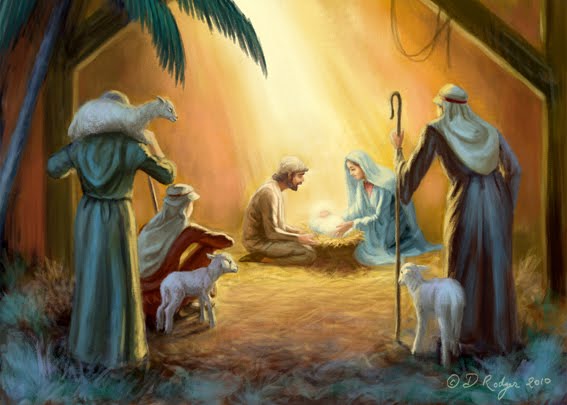
Luke 2: 1-20
In those days a decree went out from Emperor Augustus that all the world should be registered. 2This was the first registration and was taken while Quirinius was governor of Syria. 3All went to their own towns to be registered. 4Joseph also went from the town of Nazareth in Galilee to Judea, to the city of David called Bethlehem, because he was descended from the house and family of David. 5He went to be registered with Mary, to whom he was engaged and who was expecting a child. 6While they were there, the time came for her to deliver her child. 7And she gave birth to her firstborn son and wrapped him in bands of cloth, and laid him in a manger, because there was no place for them in the inn.
8In that region there were shepherds living in the fields, keeping watch over their flock by night. 9Then an angel of the Lord stood before them, and the glory of the Lord shone around them, and they were terrified. 10But the angel said to them, “Do not be afraid; for see—I am bringing you good news of great joy for all the people: 11to you is born this day in the city of David a Savior, who is the Messiah, the Lord. 12This will be a sign for you: you will find a child wrapped in bands of cloth and lying in a manger.” 13And suddenly there was with the angel a multitude of the heavenly host, praising God and saying, 14“Glory to God in the highest heaven, and on earth peace among those whom he favors!” 15When the angels had left them and gone into heaven, the shepherds said to one another, “Let us go now to Bethlehem and see this thing that has taken place, which the Lord has made known to us.” 16So they went with haste and found Mary and Joseph, and the child lying in the manger. 17When they saw this, they made known what had been told them about this child; 18and all who heard it were amazed at what the shepherds told them. 19But Mary treasured all these words and pondered them in her heart. 20The shepherds returned, glorifying and praising God for all they had heard and seen, as it had been told them.
It’s finally here, this night of nights. The Light for which we’ve waited and journeyed toward peers into the darkness and the world is changed forever. This is the moment when the world really did change. We love this story. Most of us could probably recite it from memory. But the story may not be EXACTLY the way we think. It’s not like there was someone with a video camera following them around that night. Only two of the canonical Gospel writers even tell the story and they tell it very differently. The non-canonical Gospel According to James tells it in more detail but the birth takes place in some sort of cave. (But, in all honesty, where did you actually read about a stable?) The same account also brings in a midwife, which, when you think about it, makes a whole lot of sense. So, no, I’m not trying to tear down your much-beloved story. The truth is, it’s not about the story; it’s about the birth. It’s also about the Light. It’s about the Light of God coming into the world, however that may have happened.
This is the story of Light. It’s the Light that has always been there, the light that was created so long ago. It’s the light that led people home over and over again. But it was always a light that was hidden in a cloud or shrouded on a mountain or even set in the promise of a bow in the clouds. In fact, there was belief that if you saw that Light, indeed, if you saw God face-to-face, you would die. But this night, this story, tells of Light not shining onto the earth but coming into the earth, mingling with us and giving us life. This is the night that our story becomes the story of Light.
The Bible is not about people trying to get to God or get to the Light; it’s about the story, the story of God. And this part of it, this chapter that we read and relive tonight, this holy night is not the climax of the story; it is a new chapter, a new beginning. 19th century American author and pastor Henry Van Dyke once asked “And now that this story is told, what does it mean? How can I tell? What does life mean?” And then he answered himself by saying, “If the meaning could be put into a single sentence, there would be no need of telling the story.”
This is the night of the story of God coming out of the darkness and out of the shadows and showing us what we could not see before. The Light is beginning to dawn. It’s not a new light. But this time, the heavens themselves spilled into the earth so that the story would become ours. This is the story of Light. It’s also the story of us. So, what comes next? Go into the Light…and follow God to write your story.
And change? HAS the whole world changed? I mean, we’ve been waiting and hoping and trying to make this happen. But the truth is, it did. Think of it as a turn of a corner. There was nothing wrong with the story before. It’s how we got here. It’s part of it. It was our journey. And now, we turn. It changes. That’s what stories do. The truth is, the world HAS changed…over and over and over again. We will change again, not when Jesus returns, but when we realize that we are the ones that are called to change the world. THAT was God’s vision. It’s happening, a little at a time, over and over again. We are called to be the image of Christ, to be the change that the birth of Jesus brought to the world.
The people who walked in darkness have seen a great light; those who lived in a land of deep darkness— on them light has shined. (Isaiah 9:2)
This text speaks of the birth of a child, not the revolutionary deed of a strong man, or the breath-taking discovery of a sage, or the pious deed of a saint. It truly boggles the mind: The birth of a child is to bring about the great transformation of all things, is to bring salvation and redemption to all of humanity. As if to shame the most powerful human efforts and achievements, a child is placed in the center of world history. A child born of humans, a son given by God. This is the mystery of the redemption of the world; all that is past and all that is to come. All who at the manger finally lay down all power and honor, all prestige, all vanity, all arrogance and self-will; all who take their place among the lowly and let God alone be high; all who see the glory of God in the lowliness of the child in the manger: these are the ones who will truly celebrate Christmas. (Dietrich Bonhoeffer)
[Verse 1]
Every December, I stop to remember
The humble entrance of our King
An infant so precious
Makes men bow in reverence
I’m still in wonder when I think
[Chorus]
That in one night
The whole world changed
As the heavenly host proclaimed
Glory to God and peace on earth
In a manger our Savior lay
It was the moment the whole world changed
[Verse 2]
Sometimes I imagine
The way that it happenеd
When shepherds knеlt to worship Him
A love that was perfect
And no one deserved it
I’m still moved to tears when I think, oh, woah
[Chorus]
That in one night
The whole world changed
As the heavenly host proclaimed
Glory to God and peace on earth
In a manger our Savior lay
It was the moment the whole world changed
[Interlude]
Oh woah, oh, oh
Oh-oh-oh-oh
Oh-oh-oh-oh
Oh-oh-oh-oh-oh-oh-oh
[Bridge]
Jesus Christ, Emmanuel
Isn’t He so wonderful?
This is our moment to worship
Mighty God and Prince of Peace
Lord of Lords and King of Kings
This is our moment to worship
[Chorus]
Just like that night
The whole world changed
As the heavenly host proclaimed
Glory to God and peace on earth
In a manger our Savior lay
It was the moment the whole world changed
[Outro]
You changed everything, oh
Oh-oh-oh
Merry Christmas!
Shelli




 Dancing to God