Gather Us In

Scripture Passage:  Psalm 107: 1-3, 17-12 (Lent 4B Psalter)

1O give thanks to the Lord, for he is good; for his steadfast love endures forever. 2Let the redeemed of the Lord say so, those he redeemed from trouble 3and gathered in from the lands, from the east and from the west, from the north and from the south…

17Some were sick through their sinful ways, and because of their iniquities endured affliction;18they loathed any kind of food, and they drew near to the gates of death. 19Then they cried to the Lord in their trouble, and he saved them from their distress;20he sent out his word and healed them, and delivered them from destruction. 21Let them thank the Lord for his steadfast love, for his wonderful works to humankind. 22And let them offer thanksgiving sacrifices, and tell of his deeds with songs of joy.

This psalter is one of thanksgiving, thanking God for the promise of deliverance and for deliverance and redemption itself.  We left out some of the other trouble (in the verses that were skipped) but these words deal with illness and distress.  It also reminds us of the reading about the snakes in Numbers and God’s deliverance and healing.

I love verse 2 and the image of God gathering in the redeemed from all the lands, from east and west and north and south.  It reminds us that though there are many ways that we are separated from God—illness, desperation, our own transgressions—there are even more ways TO God.  And maybe the words of this Psalm are meant to remind us of that.  After all, we are human.  We tend to get mired in where we are.  When things are going well, we forget to reach for God.  And often when the darkness descends upon us, we often deem ourselves “not ready” to do the reaching, as if we need to “clean our lives up a bit” before we let God back into them. 

Whichever applies to us at any given time, we somehow identify with “some who were sick”.  Other translations read “some were fools and took rebellious paths.”  In some ways, that’s even more uncomfortable for us.  After all, we can blame “sickness” on something else.  But when we play the fool, it somehow is laid completely on us.  But, regardless, God redeems.  God ALWAYS redeems.  We don’t have to wait until we’re better, or cleaned up, or “prepared” to let God in.  God is just there, always ready to either deliver, redeem, or just walk us home.

But the Psalm continues.  The Lord sees and knows our pain, our distress.  God delivers us, sometimes picking us up and setting us on our feet headed toward the way that God calls us to go.  And then we give thanks.  We give thanks individually and corporately.  The whole community rejoices with thanksgiving and retells what God has done with great joy.  (That sounds like the Communion liturgy, doesn’t it?)

Worshipping together…that used to be so easy.  You just got up early (and once a year even an hour earlier!!!)  and went to church and planted yourself in a fairly comfortable pew (probably the very same pew each Sunday) and you did your thing.  But the last year that has changed.  We have been forced as a community to revisit what worship is.  I think (and, I have to say, I even hope) that it will change the way we do “church”, the way we look at “church” forever.  For most of my life, church has probably been somewhat inconvenient.  There’s been a wrestling with the surrounding culture for “Sunday” and “church” has had to increasingly share its day with professional sports events and, increasingly, other activities. (Like we forgot that our Jewish brothers and sisters have ALWAYS shared a day!) So, churches have entered the realm of competing for an audience.  (Ugh…THAT’S not good!  That’s getting a little too close to that merchandising God thing again!)

Maybe the pandemic has finally made us realize that we have been asking focusing on the wrong thing.  Corporate worship is not about attendance; it is not about measuring success on how many “butts are in the pews”, so to speak; it is, as the Psalm says, about gathering, gathering in from all directions, gathering in those that are hurting, those that have given up, and those that think they have everything figured out.  And gathering involves opening—opening up the doors, opening up the streaming services, opening through Zoom connections. 

This Lenten season as we wander in the wilderness of not only a journey to the cross, but also a journey through a pandemic, a journey that is sometimes a lonely one, let us focus on gathering.  Let us focus on ways to gather, ways to worship, ways to be together, and then find the myriad of ways that we can tell people what God has done and is doing in our lives.  Maybe if we shift our focus to “keeping Sabbath” rather than “going to church”, we will discover a God who has been there all along—wherever we are present.      

Human beings may separate things into as many piles as we wish—separating spirit from flesh, sacred from secular, church from world.  But we should not be surprised when God does not recognize the distinctions we make between the two.  Earth is so thick with divine possibility that it is a wonder we can walk anywhere without cracking our shins on altars. (Barbara Brown Taylor)

Grace and Peace,

 Shelli

Belove

Lectionary Passage:  John 3: 14-21 (Lent 4B)

14And just as Moses lifted up the serpent in the wilderness, so must the Son of Man be lifted up, 15that whoever believes in him may have eternal life. 16“For God so loved the world that he gave his only Son, so that everyone who believes in him may not perish but may have eternal life. 17“Indeed, God did not send the Son into the world to condemn the world, but in order that the world might be saved through him. 18Those who believe in him are not condemned; but those who do not believe are condemned already, because they have not believed in the name of the only Son of God. 19And this is the judgment, that the light has come into the world, and people loved darkness rather than light because their deeds were evil. 20For all who do evil hate the light and do not come to the light, so that their deeds may not be exposed. 21But those who do what is true come to the light, so that it may be clearly seen that their deeds have been done in God.”

This is it: THE verse.  So what we do with THE verse?  It’s on street corners and billboards and T-Shirts and tattoos and faces and signs at sporting events.  I think it is often read as some sort of great reward for doing the right things.  You know, if you do everything you’re supposed to do, you’ll be rewarded when it’s all said and done.  And if you don’t, well you’re just out of luck.  So, look at me…do what I do, go to church where I go, be what I am, look like I look.  I’m saved; are you?  (Define that!  Do we really understand what that means?)

But I think we’ve read it wrong.  For God so loved the world—not the ones in the right church or the right country or the right side of the line—but the WORLD.  God loved the world, everything about the world, everyone in the world, so much, so very, very, VERY much, that God came and walked among us, sending One who was the Godself in every way, to lead us home, to actually BRING us home, to lead us to God.  Are you saved?  Yes…every day, every hour, over and over and over and over again.  I’m being saved with every step and move and breath I take.  I think that’s what God does.  God loves us SO much that that is what God does.  God is saving us.  God came into the world to save the world.  So why would we interpret this to mean that God somehow has quit loving some of us or that we have to somehow bargain with God to begin loving us or that “being saved” is a badge of honor?  See, God loves us so much that God is saving us from ourselves. 

The reference to the snake refers to the Old Testament lectionary reading for this week (Numbers 21:4-9 if you need to be reminded of it)  It is the account of the Lord sending poisonous serpents into the wilderness that can be countered by making a serpent and putting it on a pole so that everyone who looks at it will live even though they were bit by a poisonous snake.  (OK….whatever!)  So, essentially, it’s like this:  You think your main problem is snakes?  Alright, here it is.  Look at it hanging there on the tree.  Quash your fear, let your preconceptions go.  There…no more snakes.  You don’t have to fear snakes. 

So, this time?  You have let the world order run your life.  You have become someone that you are not.  You have allowed yourself to be driven by fear and preconceptions and greed.  You have opted for security over freedom, held on to what is not yours, and settled for vengeance rather than compassion and love.   I created you for more than this.  I love you too much for this to go on.  Look up.  Look there, hanging on the tree, there on the cross.  Stare at the Cross.  Enter the Cross.  See how much I love you.  In this moment, I take all your sin, all your misgivings, all your inhumanity and let it die with me.  All is well.  All is well with your soul.  There…no more death.  You don’t have to fear death.

In this season of Lent, we inch closer and closer to the cross.  We shy away.  It’s hard to look at.  But perhaps it’s not the gory details, but the realization that we are the culprits.  Lent provides a mirror into which we look and find ourselves standing in the wilderness of ourselves, sometimes fearful of what we might find.  But the Cross is our way out (not our way “in” to God, but our way “out” of ourselves).  Because God loves us so much that God cannot fathom leaving us behind.  The Cross is the place where we finally know that. For God so loved the world that he gave his only Son, so that everyone who believes in him may not perish but may have eternal life. Indeed, God did not send the Son into the world to condemn the world, but in order that the world might be saved through him. 

Thomas Long, the well-known professor of preaching at Candler School of Theology once said it like this:  In Christian language, to be truly human is to shape our lives into an offering to God. But we are lost children who have wandered away from home, forgotten what a truly human life might be. When Jesus, our older brother, presented himself in the sanctuary of God, his humanity fully intact, he did not cower as though he were in a place of “blazing fire and darkness and gloom.” Instead, he called out, “I’m home, and I have the children with me.”

In this wilderness season, it is easy to feel lost.  It is easy to feel alone.  It is easy to wonder where to turn next.  But this passage is a reminder that we are not alone.  God is always there and has given us a promise.  You…you are my beloved child.  Believe.  Belove.  Know that I am always with you, always carrying you home.

Salvation is not only a goal for the afterlife; it is a reality of everyday that we can taste here and now. (Henri J.M. Nouwen)

Grace and Peace,

 Shelli

What We Need

Lectionary Passage:  Exodus 16: 2-3, 9-15
2The whole congregation of the Israelites complained against Moses and Aaron in the wilderness. 3The Israelites said to them, “If only we had died by the hand of the Lord in the land of Egypt, when we sat by the fleshpots and ate our fill of bread; for you have brought us out into this wilderness to kill this whole assembly with hunger.”…  9Then Moses said to Aaron, “Say to the whole congregation of the Israelites, ‘Draw near to the Lord, for he has heard your complaining.’“ 10And as Aaron spoke to the whole congregation of the Israelites, they looked toward the wilderness, and the glory of the Lord appeared in the cloud. 11The Lord spoke to Moses and said, 12“I have heard the complaining of the Israelites; say to them, ‘At twilight you shall eat meat, and in the morning you shall have your fill of bread; then you shall know that I am the Lord your God.’“ 13In the evening quails came up and covered the camp; and in the morning there was a layer of dew around the camp. 14When the layer of dew lifted, there on the surface of the wilderness was a fine flaky substance, as fine as frost on the ground. 15When the Israelites saw it, they said to one another, “What is it?” For they did not know what it was. Moses said to them, “It is the bread that the Lord has given you to eat.

Fear comes easily in the wilderness.  We convince ourselves that we will not have what we need.  We convince ourselves that we are mistreated and that everything is hopeless.  We identify then with this story.  Here they were—they had been wandering in the wilderness for a long time.  They were hungry and saw no way to alleviate that hunger.  When they had left Egypt, they had been filled with hope.  There was new life ahead.  But here they were—alone, forsaken, and seeing no way out of this predicament.  They were thinking about the place that they had left.  It was hard there too.  They were enslaved to the culture, their life was not their own, and they had no way forward.  But they had enough to eat.  That was at least something.  They were very afraid.

And once again, the Lord speaks.  God assures Moses that they are not alone.  God tells Moses that the people have been heard, that God has heard their complaints and surely knows the fears they feel.  Help is on the way!  Each evening, quails will cover the camp, providing the people with meat.  And each morning, as the dew lifts, it will leave behind a gift.  Covering the wilderness will be a fine, flaky substance.  It will be the bread that the people need, the sustenance for life.  Do not fear!  The Lord has come.

This passage doesn’t really let us know what the peoples’ response was to the provision of this food.  It goes on to describe the notion that the food was only provided for the gathering.  There was no way to keep and hold the food for later. (Apparently the wilderness has no doggie-bags!)  So, the questions that arise for us include whether or not we allow our preconceived notions of what we should have get in the way of what God provides. Are we so focused on what we need that we miss what God provides? And, probably just as importantly, what happens when our fears of not having enough, our innate need to keep and hold onto what we have, gets in the way of sharing with others or even readying ourselves for God to provide for us yet again?

Lent has always typically been a season of denying oneself.  And while, for me, giving up chocolate is so hard that it does indeed become a spiritual experience, perhaps we sometimes miss the point.  If you are one of those people that has given something up for Lent, don’t forget to focus not on what you’re denying yourself but why.  See, this journey through the wilderness reminds us that God will provide and teaches us to be open to the way that happens—again and again and again.  Maybe it’s not what we had in mind.  Maybe it’s not what we would have ordered from Door Dash.  Maybe it’s not even the thing for which we were actually hungering.  Maybe it will turn out to be quails and some sort of bizarre flaky substance attached to the bushes.  God does not provide what we want; God provides what we need.  And for those of us who are overfed and over-indulged and accustomed to getting exactly what we want, the lesson IS what we need.

You have succeeded in life when all you really want is only what you really need.   (Vernon Howard)

Grace and Peace,

 Shelli

By Grace

Lectionary Passage:  Ephesians 2:1-10 (Lent 4B)

You were dead through the trespasses and sins in which you once lived, following the course of this world, following the ruler of the power of the air, the spirit that is now at work among those who are disobedient. All of us once lived among them in the passions of our flesh, following the desires of flesh and senses, and we were by nature children of wrath, like everyone else. But God, who is rich in mercy, out of the great love with which he loved us even when we were dead through our trespasses, made us alive together with Christ—by grace you have been saved— and raised us up with him and seated us with him in the heavenly places in Christ Jesus, so that in the ages to come he might show the immeasurable riches of his grace in kindness toward us in Christ Jesus. For by grace you have been saved through faith, and this is not your own doing; it is the gift of God— not the result of works, so that no one may boast. For we are what he has made us, created in Christ Jesus for good works, which God prepared beforehand to be our way of life.

There’s actually two parts to this passage.  There’s a “before” and there’s an “after”.  BEFORE you were dead…and AFTER you weren’t.  BEFORE you were of this world…and AFTER you weren’t.  BEFORE you had it wrong…and AFTER you don’t.  That’s probably enough.  We can just stop there. 

No, not going to stop…The writer of this letter (who is more than likely not the Apostle Paul but rather a later follower or disciple of Paul’s) seems to be really focused on continuing this separation between this world and God, between the “sinful” world and God’s promise of grace and life.  Paul had introduced the notion of being justified by grace through faith, the notion that God was a redemptive God, that it was a process by which we traversed the experience of this world and along the way encountered God.  But, here, that word “saved” appears, as if it’s past tense, as if it is some badge of honor that we earn and wear as we continue to seem to be forced to live in this sin-filled world in which we live.  Somewhere along the way eschatology became realized, “already”, rather than something to which we look and live into.

Now keep in mind that this letter was probably written in the late first century.  Jesus had come, died on the cross, and the Resurrection on which everything that is “Christian” is based had happened.  And Jesus had promised to return.  That had been imminent for Paul.  And, yet, it hadn’t happened yet.  The first century followers of Christ (it still wasn’t “Christianity”, per se, the way we think of it today) were wondering if perhaps they had misunderstood, perhaps they had gotten the whole thing wrong.  So, the emphasis for the writer of Ephesians (as well as others), was a notion of salvation as something that had already happened, an emphasis on the crowned Jesus sitting at the right hand of God.  And for those of us who are still mired in the throes of worldly evil and worldly despairs, there became a separation, a dualism that was put into place that pretty much exists even today.  So many of us live in this world, burdened by sin, and hope against hope that God will swoop in and save us. And it becomes even easier for us to separate the world into the “saved” and the “unsaved”, those who “get it” and those who don’t.

Really?  Is that it?  What happened to “God did not send the Son into the world to condemn the world, BUT in order that the world might be saved through him.“?  God’s vision of the Kingdom of God is not to shun the world or even to rid us of all things worldly.  God’s vision of the Kingdom of God is to recreate the world into what it is called to be–the whole world, not the ones who follow the rules or the ones who are “good”, but everyone.  So, in this life of faith, we do not magically crossover to being “saved” from being “unsaved” and then sit back and wait for God to pluck us out of our miserable existence.  Rather, we yield to new meanings and new circumstances as God recreates our lives into Life and brings about the fullness of the Kingdom of God throughout this wonderfully created world in which we live.

That’s what Lent is about–new meanings and new circumstances.  Maybe it’s about dropping the “but” in life, ridding ourselves of the dualism that we have so carefully constructed to affirm our own understanding of who God is.  God created the life that each of us has.  Why would God call us to leave it behind?  Rather God is recreating it as we speak, bringing it into being, into the image that God envisions for it.  You know, if we look at things with the eyes of a world where God is not, a world that waits for God to return, there is always a “but”; BUT if we look at all of Creation with the eyes of faith, with the eyes of those who believe in a God who came into our midst to show us how much we are loved, everything has an AND.  Another word for that is grace—undeserved, unmerited, uncontrollable.  It is God’s gift to each of us.  And all we are and all we do and all that happens to us comes by grace.  We are saved not by what we do (or don’t do); we are saved by grace.

Nothing worth doing is completed in our lifetime; therefore we must be saved by hope. Nothing true or beautiful makes complete sense in any immediate context of history; therefore we must be saved by faith. Nothing we do, however virtuous, can be accomplished alone; therefore, we are saved by love. (Reinhold Niebuhr)

Grace and Peace,

 Shelli

All We Like Sheep

Scripture Passage:  Psalm 78: 52-54

52Then he led out his people like sheep and guided them in the wilderness like a flock. 53He led them in safety, so that they were not afraid; but the sea overwhelmed their enemies. 54And he brought them to his holy hill, to the mountain that his right hand had won.

We tend to think of the wilderness as a place where we are sort of thrown out into virtually alone. We imagine wandering, looking for solace, looking for companionship, looking for someone to help us out of where we are. We search for God as if God is somehow parked at the exit of the wilderness holding a sign with our name on it as we disembark. And yet this psalm reminds us that even in the wilderness we are not alone, that God leads us and guides us through the treacherous terrain. There are times when God, as it says, guides us IN, wandering, living the wilderness. It says that we are led to safety and brought to a place that is holy, that is of God. So, why then, here in the wilderness, do we feel so alone?

We are accustomed to pastoral images in the Bible, beautiful images of the flock being led or shepherds on the hillside. We know what it is supposed to connote. The shepherd guides the sheep to the place where they will be well-fed and cared for, the place where they will grow and flourish into maturity. There is soft, green grass, blue skies, and other sheep in the fold to keep them company as they grow together. But this is not what it looks like right now. Where is the green grass? Where are the blue skies? Where are my trusty companions? And so, searching for our image of where a shepherd is supposed to lead, we leave to look for greener pastures or easier pathways. But the grass isn’t really greener, the skies really aren’t any clearer, and in our confusion, we fall, tumbling down the gulley, bruised and tired.

As we have said before, the wilderness is not just something to rush through. God does not always lead us out of the desolation that surrounds us. As the passage says, God leads us through or in the wilderness, helping us navigate the rough paths and the difficult sightlines and, when the time is right, bringing us home. Our problem is that we don’t envision ourselves like sheep because we are trying so hard to be the shepherd of our own lives, to be in control, to be the guide. We are afraid of losing control of our lives. And so, we often wander away and get lost. We may end up in a place that is not ours to be. But think about sheep. Sheep are seldom characterized as one of the smartest beings on the farm and yet, sheep know to whom they belong. Sheep know how to follow. Sheep know how to be part of a flock, holding each other up, helping each other see the shepherd. And when, as happens every now and then, a sheep gets lost, the sheep trusts that the shepherd will come and bring the sheep home.

Lent is a season that teaches us to be more like sheep, to follow God through the wilderness, learning the things that it teaches, accepting the things that it offers, and knowing, that, when it is time, God will guide us out of this lostness, out of despair, out of the loneliness.  You don’t have to fix it; you don’t have to hurry; you don’t have to make it something it is not.  Just follow.  Just live.  But by following God’s lead, we will see beauty we have never seen and companionship we have never known.  That’s what you get when you’re part of a flock. The promise is that, when the time is right, we WILL be led home.

God…leads us step by step, from event to event.  Only afterwards, as we look back over the way we have come and reconsider certain important moments in our lives in the light of all that has followed them, or when we survey the whole progress of our lives, do we experience the feeling of having been led without knowing it, the feeling that God has mysteriously guided us. (Paul Tournier)

Grace and Peace,

 Shelli

Snake-Handling

Scripture Passage:  Numbers 21: 4-9 (Lent 4B)

4From Mount Hor they set out by the way to the Red Sea, to go around the land of Edom; but the people became impatient on the way. 5The people spoke against God and against Moses, “Why have you brought us up out of Egypt to die in the wilderness? For there is no food and no water, and we detest this miserable food.” 6Then the Lord sent poisonous serpents among the people, and they bit the people, so that many Israelites died. 7The people came to Moses and said, “We have sinned by speaking against the Lord and against you; pray to the Lord to take away the serpents from us.” So Moses prayed for the people. 8And the Lord said to Moses, “Make a poisonous serpent, and set it on a pole; and everyone who is bitten shall look at it and live.” 9So Moses made a serpent of bronze, and put it upon a pole; and whenever a serpent bit someone, that person would look at the serpent of bronze and live.

OK, this is just odd!  It’s one of those passages that probably wouldn’t have made it into the lectionary except that the Gospel writer that we know as John included it.  (We’ll read that this week too!)  Personally, I think it’s a little over the top–sending poisonous snakes.  I mean, it seems that the people were only asking for a little variety in their menu.  Isn’t this a little out of proportion?  I mean, really:  complaining…bad; poisononous snakes all over the place…REALLY bad.

But from the very beginning of Creation, as one of the Aramaic translations of the Hebrew Bible explains, the snake has slithered on its belly and eaten only dust and yet it has done so without a word of complaint.  So, then, what better character to rule over the people who have murmured over a choice of food?  Essentially, the snake comes to teach humility and patience.  But we as humans cannot resist being more than a little squeamish at the character.  There is something about a snake that demands our full attention.  When someone mentions that a snake is nearby, we don’t ask what lessons can be learned.  Instead, we climb on the furniture or over one another to get out of the way.

Our full attention…to how many things do we give that?  And how many things would we rather climb on the furniture or run to get out of the way rather than dealing with them?  And it is interesting that in order to save the people from the plague of snakes, God gave them a snake.  So, when someone is bitten by a snake, he or she is to look at a snake.  What sense does that make?  Think about it…we are to look at our fear; we are to look at those things that tempt us; we are to look at those things that distract us and pull us away from God.  (Goodness…that sounds a lot like this season of Lent!)  And God, in God’s infinite wisdom puts them on a pole so that we cannot avoid seeing them.

But only in the wisdom of God do we counter something that we fear with that which we fear.  Here, God’s antidote for the snakes is a snake.  Isn’t that sort of paradoxical?   We have to look beyond that with which we are uncomfortable.  We have to look into a sight that brings such fear, such loathing, that it is hard for us to find God’s presence in it.  And, deep within it, is the sight of humility and patience, a creature that, according to Creation mythology, had resigned itself to surrendering to that which ruled its life.  And by looking into one’s fear, by looking into one’s death, one is freed—the ultimate paradox. 

It is notable, too, that nothing is said to imply that God destroys the snakes.  Essentially, God does not destroy the enemy—God recreates it.  Isn’t that an incredible thing?  You see, we need to recognize that the traditional Jewish reading of the “Garden of Eden” story differs from the classical Christian version.  While the snake has often been identified in both faiths as Satan (or haasatan), the Jewish understanding is not that of something or someone outside of God’s command or a rebel against divine authority.  Rather, it’s sort of a prosecuting attorney, entrusted with testing, entrapping, and testifying against us before the heavenly court.  It’s part of God’s way of maintaining order.  It’s part of God’s way of showing us a mirror to look at ourselves.  So, from that standpoint, these snakes or serpents are not enemies but, rather, part of our ourselves.  (On some level, maybe that’s more uncomfortable even than enemies!  I mean, it makes it a whole lot harder to run away from it then!)

So, the simple equation is this:  the cure for snakes is a snake…the cure for something is to stare it straight in the face.  Where have we heard that before?  Centuries later, God did it again.  The cure for our death is death—death of those things that stand in the way of our relationship with God, death of those things that make us less than human, death of those things that are not part of who we are as images of God.  And, if you remember, the cure for a life of pain and suffering and temptation is life eternal.  Snakes for snakes; death for death; life for life.

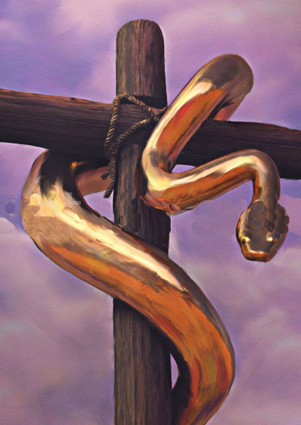
Those whose eyes are fixed on the Son of Man as he is lifted up ultimately see God’s healing of the world.  The Cross is that thing at which we are forced to look, forced to see a part of us that we do not want to see, forced to see the way we murmur and complain about our lives when they’re really not that bad.  In an odd way, the cross is that snake on a pole.  So as hard as it may be, stand still.  It doesn’t make sense in this world.  It’s gruesome and loathsome and filled with danger.  But God, in God’s infinite wisdom, takes it and turns it into life.  We don’t need to become snake-handlers; we just need to be aware of that to which we should be looking.  So, in this wilderness season of Lent, walk now, toward the cross—the instrument of death that gives you life.       

Our faith begins at the point where atheists suppose it must be at an end.  Our faith begins with the bleakness and power which is the night of the cross, abandonment, temptation and doubt about everything that exists!  Our faith must be born where it is abandoned by all tangible reality; it must be born of nothingness, it must taste this nothingness and be given it to taste in a way that no philosophy of nihilism can imagine. (H.J. Iwand)

Grace and Peace,

 Shelli

Surely the Lord is In This Place

Ladder of Divine Ascent, 12th cen, Monastery of St. Catherine, Sinai

Scripture Passage:  Genesis 28: 10-17

10Jacob left Beer-sheba and went toward Haran. 11He came to a certain place and stayed there for the night, because the sun had set. Taking one of the stones of the place, he put it under his head and lay down in that place. 12And he dreamed that there was a ladder set up on the earth, the top of it reaching to heaven; and the angels of God were ascending and descending on it. 13And the Lord stood beside him and said, “I am the Lord, the God of Abraham your father and the God of Isaac; the land on which you lie I will give to you and to your offspring; 14and your offspring shall be like the dust of the earth, and you shall spread abroad to the west and to the east and to the north and to the south; and all the families of the earth shall be blessed in you and in your offspring. 15Know that I am with you and will keep you wherever you go, and will bring you back to this land; for I will not leave you until I have done what I have promised you.”   16Then Jacob woke from his sleep and said, “Surely the Lord is in this place—and I did not know it!” 17And he was afraid, and said, “How awesome is this place! This is none other than the house of God, and this is the gate of heaven.”

Jacob came to a certain place, a certain place in the wilderness. I don’t think it was a particularly holy place. It was just an ordinary place with an ordinary stone. But then Jacob dreamed. And what a wild dream that was! Now, remember the “back story” of this. Jacob is not just wandering through the wilderness to get a little exercise. He is fleeing from his family and from the hatred of his brother Esau (you know that one that Jacob tricked into giving up his birthright.) Jacob is also fleeing from himself, from his own trickery and his duplicity. Perhaps he has had enough of himself. He is at the lowest point of his life. He is afraid, afraid of what will come next, afraid of Esau, probably a little afraid of God. The wilderness was nothing compared to the fear that Jacob felt.

And then a dream, a remarkable dream, probably the world’s most famous dream, fills his night.  He dreams that a ladder or, more likely, a stairway or a ramp extends from earth to heaven.  (Although, that really messes up that song!)  And on this ladder (or stairway or ramp or ziggurat or whatever it was), there were divine beings traversing up and down.  In this dream, we on earth were not left, as we sometimes think, to our own devices, to wander in the wilderness alone, and the place of the Divine, the Sacred, Heaven, or whatever you want to call this realm, is no longer off-limits to us.  In the wilderness, the two are intertwined, a part of one another.

The point is that, when the dream had ended, God was there.  The Hebrew is a little ambiguous.  It is not clear if God was “before” Jacob or “beside” him.  I think maybe the ambiguity is the point.  No matter where we are, God is there.  And then, Jacob, this one who is always looking out for himself, is given the promise that those before him had been given—land, prosperity, presence, and homecoming.  God promises to bring Jacob home.  Jacob realizes that he has encountered God and he claims God’s promises as part of who God calls him to be.

We are like Jacob.  Sometimes we, too, are wandering in fear—fear of being found out, fear of our past and what we’ve done, fear of the future, fear of the unknown, fear that it will not go as planned.  Perhaps we are afraid of what it means to encounter God, to follow Jesus, to come near to the Cross (not the cleaned-up one…the Golgotha one).  Perhaps we are afraid that our lives will change beyond our control.  We want to encounter God, but we want to do it on our terms. We don’t dare to even imagine that we could possibly do what God is calling us to do. And so, we stay here, afraid of who we are, feet firmly planted in what we know. Maybe “fear not” is calling us to encounter the God who walks with us.  For surely the Lord is in this place and I did not know it!  I was so wrapped up in fear that I did not realize that God was holding it.

To live with the conscious knowledge of the shadow of uncertainty, with the knowledge that disaster or tragedy could strike at any time; to be afraid and to know and acknowledge your fear, and still to live creatively and with unstinting love: that is to live with grace. (Peter Abrahams)

Grace and Peace,

 Shelli