Shadows

Scripture Text: Psalm 23 (KJV)

23 The Lord is my shepherd; I shall not want. He maketh me to lie down in green pastures: he leadeth me beside the still waters. He restoreth my soul: he leadeth me in the paths of righteousness for his name’s sake. Yea, though I walk through the valley of the shadow of death, I will fear no evil: for thou art with me; thy rod and thy staff they comfort me. Thou preparest a table before me in the presence of mine enemies: thou anointest my head with oil; my cup runneth over. Surely goodness and mercy shall follow me all the days of my life: and I will dwell in the house of the Lord for ever. (Psalm 23, KJV)

Most of us can say this Psalm in our sleep.  We love the pastoral images of the shepherd.  We love the restoring still waters.  We love the table set and prepared for us.  But verse 4…”Yea, though I walk through the valley of the shadow of death…”  Right there in the middle of all this pastoral light is a bit of darkness.  It’s a hard verse.  We know that we will walk through darkness.  We know that we all encounter the shadow of death, the pall that hangs over us when a loved one dies or when one’s death is imminent.  Because the truth is, we were not promised that life would not be hard or hold losses; we were promised that we would not walk it alone and that Light would be on the other side.

This wilderness season of Lent is a season of shadows.  During this time, we walk through the shadow of the Cross, the shadow of death, and, even, the shadow of our former selves.  Maybe that’s the point of Lent–to wrestle us away from our comfortable, perfectly-manicured lives, from all those things that we plan and perceive, from all those things that we hide and, finally, teach us to traverse the nuances that the journey holds.  But think about something.  What exactly creates shadows?  The answer is light.  Light must be behind the shadowed object.  So, the shadow of the Cross, the shadow of death, even the shadow of our former selves cannot be without the Light illuminating it.

This season of Lent is one that by its very nature is a journey through wilderness, through loss and despair and doubt and not really knowing what comes next. It is a journey through a place where all of a sudden God is not as God should be. No longer is God a freshly cleaned-up deity handing out three cotton candy wishes to faithful followers. In the wilderness, we find God in the trenches and in the silence of our lives. Or maybe it is that this is the place that we finally notice God at all. When our lives are emptied out, when our needs and our deepest emotions are exposed, is the time that a lot of us realize that God was there all along. Maybe Lent is way of getting to the depths of ourselves, the place where in our search for God, we find our faith in God, and there in the silence we find our hope and our Light.

In her book, When God is Silent, Barbara Brown Taylor tells “a story from the Sufi tradition about a man who cried, “Allah! Allah!” until his lips became sweet with the sound. A skeptic who heard him said, “Well! I have heard you calling out but where is the answer to your prayer? Have you ever gotten a response?” The man had no answer to that. Sadly, he abandoned his prayers and went to sleep. In his dreams, he saw his soul guide, walking toward him through a garden. “Why did you stop praising?” the saint asked him. “Because I never heard anything back,” the man said. “This longing you voice IS the return message,” the guide told him. The grief you cry out from draws you toward union. Your pure sadness that wants help is the secret cup.”

Life is filled with shadows, places that you did not plan to go, places that scare you and challenge you, places that are filled with pain.  But God did not call us to walk through blinding Light.  God called us to learn to see.  Maybe the shadows help us do that.  Maybe the shadows are the reason we see the Light.  And the Light will show us the way.

To live with the conscious knowledge of the shadow of uncertainty, with the knowledge that disaster or tragedy could strike at any time; to be afraid and to know and acknowledge your fear, and still to live creatively and with unstinting love: that is to live with grace. (Peter Abrahams)

Grace and Peace,

 Shelli

Jesus Wept

“Jesus Lamenting Over Jerusalem”, Gary E. Smith

Scripture Text: Luke 19: 41-45

41As he came near and saw the city, he wept over it, 42saying, “If you, even you, had only recognized on this day the things that make for peace! But now they are hidden from your eyes. 43Indeed, the days will come upon you, when your enemies will set up ramparts around you and surround you, and hem you in on every side. 44They will crush you to the ground, you and your children within you, and they will not leave within you one stone upon another; because you did not recognize the time of your visitation from God.” 

If only…How many times does our grief and our feeling of loss begin with those words?  Jesus knows his time on earth is coming to an end.  He had to feel regrets over things he saw as incomplete, even undone.  He looked out over Jerusalem, his beloved city, the Holy City, and he knew.  His mission was to bring peace, not just an absence of war, but a peace that resides in the deepest part of every soul. Because the One whose name was never uttered, the Great I-AM, the Creator and Sustainer of the World had come to call and the world did not always seem to notice.  The world glanced at God-With-Us and then went back to its way of doing things.  Wars continued to rage; poverty and hunger were still there; there were still divisions; and not everyone really paid attention.  Jesus knew.  Jesus knew that the world was not completely ready.  So, he wept over the city.  He wept over the people.  He wept over the world.

The truth is, we are seldom the “finishers” of the things we start.  If Jesus’ work had been finished during his time on earth, there would be no need for faith.  There would be nothing left for God to call us to do.  But it had to hurt.  We all want to see what we start to come to fruition.  But sometimes God calls us to begin the story that we will not finish.  This is what Jesus knew in that moment.

There is an old wisdom story that tells of those that were building one of the amazing old cathedrals.  Now, keep in mind, these cathedrals did not take a year, or ten years.  They took centuries.  Those that started the work knew that they would never see the fruits of their labors.  But they poured their heart out, nevertheless. So, someone asked a builder of these great cathedrals what he was doing.  His response was that he was laying bricks.  He was right.  So, the person asked another person that was working on the project.  He responded that he was making a living for his children and his family.  He was right.  Then the person asked a third builder.  His response?  “I am building a cathedral.”

See, we’re all building a cathedral. That will be the end of the story.  That’s what we envision.  And yet, we want so badly to see the fruits of our gifts.  We want to reap the benefits of what we give.  But the story is not about what happens now; it is about the ending that will come. So, what we could imagine that could be is huge.

Sometimes we grieve for the moment—for what happened or did not happen, for what we did or didn’t say, for those moments that we cannot get back again, for what was.  And we weep.  But God is taking all that we’ve done and calling others to complete it—to build a cathedral.  So as we wander in this wilderness of loss and grief and things left incomplete or undone, we weep.  And then we remember that God is REALLY good at showing us the way out of the wilderness.  There is an Arab proverb that says if you expect to see the results of your work, then you have simply not asked a big enough question.

One of my favorite poems is by Ann Weems.  Here are the words:

God did not wait till the world was ready, till nations were at peace. God came when the Heavens were unsteady and prisoners cried out for release. God did not wait for the perfect time.  God came when the need was deep and great.

In the mystery of the Word made flesh the maker of the Stars was born. We cannot wait till the world is sane to raise our songs with joyful voice, or to share our grief, to touch our pain. 

God came with Love.  Rejoice!  Rejoice! And go into the Light of God.  Amen.

You and I are incomplete.  I’m unfinished.  I’m unfixed.  And the reality is that’s where God meets me is in the mess of my life, in the unfixedness, in the brokenness.  I thought he did the opposite, he got rid of all that stuff.  But if you read the Bible, if you look at it at all, constantly he was showing up in people’s lives at the worst possible time of their life. (Mike Yaconelli)

Grace and Peace,

 Shelli

Jerusalem Awaits

Scripture Text: Mark 9: 2-10

2Six days later, Jesus took with him Peter and James and John, and led them up a high mountain apart, by themselves. And he was transfigured before them, 3and his clothes became dazzling white, such as no one on earth could bleach them. 4And there appeared to them Elijah with Moses, who were talking with Jesus. 5Then Peter said to Jesus, “Rabbi, it is good for us to be here; let us make three dwellings, one for you, one for Moses, and one for Elijah.” 6He did not know what to say, for they were terrified. 7Then a cloud overshadowed them, and from the cloud there came a voice, “This is my Son, the Beloved; listen to him!” 8Suddenly when they looked around, they saw no one with them any more, but only Jesus. 9As they were coming down the mountain, he ordered them to tell no one about what they had seen, until after the Son of Man had risen from the dead. 10So they kept the matter to themselves, questioning what this rising from the dead could mean.

We read this weeks ago before we began this wilderness journey.  It’s interesting now after we’ve let go and denied our comforts and acknowledged our losses to read it again with new eyes, eyes that only the wilderness can give us.  The wilderness has taught us to see things differently, to open our minds and widen our souls.  It has called us to remove the veil that we have created in our lives to shield us from the things that do not make sense in our world.  The journey through the wilderness has brought us to this place, brought us back to this mountain. 

The truth was that Jesus knew that this account would only make sense in light of what was to come.  The disciples would know when to tell the story.  They saw more than Jesus on the mountain.  They saw who and what he was.  And long after Jesus is gone from this earth, they will continue to tell this strange story of what they saw.  For now, he would just walk with them.  God’s presence remains. The Hebrews understood that no one could see God and live.  You know, I think they were right.  No one can see God and remain unchanged.  We die to ourselves and emerge in the cloud, unveiled before this God that so desires us to know the Sacred that has always been with us.  

The truth is, when we are really honest with ourselves, we probably are a little like the disciples.  We’d rather not really have “all” of God.  We’d rather control the way God enters and affects our lives.  We’d rather be a little more in control of any metamorphosis that happens in our lives.  We’d rather be able to pick and choose the way that our lives change.  We’d rather God’s Presence come blowing in at just the right moment as a cool, gentle, springtime breeze.  In fact, we’re downright uncomfortable with this devouring fire, bright lights, almost tornado-like God that really is God.

Here in the wilderness, with bright white lights and shrouds of wonder, we have seen God.  Here, in this place, where the wilderness has brought us.  We have arrived open-eyed and soul-ready for God’s Presence to be made known.  And then the lights dim and, if only for a little while, God stops talking.  And in the silence, Jesus starts walking down the mountain toward Jerusalem. 

You know, on some level, for all the dramatic sequences of this story, I think the way down the mountain is the point of it all.  I mean, think about it, the disciples went up as students and came down as followers.  The way down is where the transformation begins to be, when they know where they had to go.  Now I’m sure that Jesus knew that the ones who walked with him were not ready.  I’m sure he knew that they thought they had more time with him.  I’m sure he knew that they doubted themselves.  But it was time.  And Jesus knew that if they followed, they would know the way.  And in this moment, Jesus’ journey to the Cross begins.

And us?  I’m sure Jesus knows how difficult this has been for us.  I’m sure Jesus knows that there is a part of us that would’ve liked to have avoided the whole thing, to move from the Mardi Gras party right into the sanctuary when they are setting up the Easter lilies.  But then we would have missed the wilderness and the meaning it holds.  The wilderness has taught us that it is where we must go.  You see, in this wilderness, we have changed.  We have learned to let go, to get out of ourselves, to see things differently.  We have learned to listen.  We have learned to follow.  We have learned to grieve.  And that is what we will do.  Jerusalem awaits.

The rare moment is not the moment when there is something worth looking at, but the moment when we are capable of seeing. (Joseph Wood Krutch)

Grace and Peace,

 Shelli

Plotting Our Resurrection

Scripture Text: John 11: 33-44

33When Jesus saw her weeping, and the Jews who came with her also weeping, he was greatly disturbed in spirit and deeply moved. 34He said, “Where have you laid him?” They said to him, “Lord, come and see.” 35Jesus began to weep. 36So the Jews said, “See how he loved him!” 37But some of them said, “Could not he who opened the eyes of the blind man have kept this man from dying?” 38Then Jesus, again greatly disturbed, came to the tomb. It was a cave, and a stone was lying against it. 39Jesus said, “Take away the stone.” Martha, the sister of the dead man, said to him, “Lord, already there is a stench because he has been dead four days.” 40Jesus said to her, “Did I not tell you that if you believed, you would see the glory of God?” 41So they took away the stone. And Jesus looked upward and said, “Father, I thank you for having heard me. 42I knew that you always hear me, but I have said this for the sake of the crowd standing here, so that they may believe that you sent me.” 43When he had said this, he cried with a loud voice, “Lazarus, come out!” 44The dead man came out, his hands and feet bound with strips of cloth, and his face wrapped in a cloth. Jesus said to them, “Unbind him, and let him go.”

This has always been at the very least a strange story to me.  I think I once had some image of Lazarus walking out of the tomb, with tattered grave clothes dangling and an unbearable stench following him, and then dressing and sitting down for a nice fish dinner with Jesus and his sisters.  But the Scripture is not here to show us magic or to in some way depict a God that with the veritable snap of a finger can just put everything back like it was before. (Well, I don’t know, I supposed God CAN, but why?  That’s not really the way God works.  God has something much better in store.)  This story is taken as a precursor to Jesus’ own Resurrection.  It was Jesus’ way of promising life.  But, ironically, it is also the act that turns the tide toward Jesus’ demise.  Here, standing within two miles or so from Jerusalem, the journey as we know it begins to wind to an end.  Even now, the Sanhedrins are gathering their swords and the night is beginning to fall.  And Jesus is grieving.  As one who is fully human, Jesus fully experienced loss and grief.

So, why would Jesus do that?  Surely, he knew what might happen.  Surely, he knew how many red flags his presence near Jerusalem had already raised.  And what about Lazarus?  Who was this mysterious man whose main part in the whole Biblical story is to die and be raised?  Why do this with someone as seemingly insignificant as this?  Maybe it is because Lazarus is us–you and me.  Maybe the whole point of the passage is not to point to Jesus’ Resurrection but to our own.  Do you think of yourself as journeying toward resurrection?  Do you believe this?  Sure, we talk about journeying to God, about journeying to the Promised Land, whatever that might be, and about journeying to where God calls us.  But do you think of it as resurrection?  Do you think of yourself dying and then raised?  Maybe each of us is Lazarus.  Maybe that is what Jesus wanted us so badly to believe and live—to show us how to grieve and then to teach us Life.

We often depict this Lenten journey as our journey to the Cross, our journey with Christ.  So, does it stop there?  I think the story goes on.  Jesus is Resurrected.  Maybe that’s what Jesus was trying to show us–not that we would be somehow plucked from death in the nick of time and not that God really has the intention of putting our lives back together like some sort of Humpty-Dumpty character, but that we, too, are journeying toward resurrection, toward new life. 

Lent is the journey that shows us that.  Lent shows us that the journey through the wilderness is sometimes hard, sometimes painful. Lent shows us not that death will not claim us but that death will not have the final word.  Lent shows us that our faith tells us that there is more.  Lent shows us what it means for Christ to unbind even us–even you and me–and let us go.  Through all of life’s transitions, through all of life’s sad endings, through all of life’s unbearable turns, there is always a beginning.  There is always Resurrection and resurrection–over and over and over again.  That’s what this wilderness of loss teaches us—to plot our own resurrection.  It is not the final say.

There was, indeed, something I had missed about Christianity, and now all of a sudden I could see what it was.  It was the Resurrection!  How could I have been a church historian and a person of prayer who loved God and still not known that the most fundamental Christian reality is not the suffering of the cross but the life it brings?…The foundation of the universe for which God made us, to which God draws us, and in which God keeps us is not death, but joy.  (Roberta Bondi)

Grace and Peace,

 Shelli

Wilderness Rhythms

Scripture Text: 1 Samuel 23: 14-17

14David remained in the strongholds in the wilderness, in the hill country of the Wilderness of Ziph. Saul sought him every day, but the Lord did not give him into his hand. 15David was in the Wilderness of Ziph at Horesh when he learned that Saul had come out to seek his life. 16Saul’s son Jonathan set out and came to David at Horesh; there he strengthened his hand through the Lord. 17He said to him, “Do not be afraid; for the hand of my father Saul shall not find you; you shall be king over Israel, and I shall be second to you; my father Saul also knows that this is so.”

David is one that spends a lot of time in the wilderness according to the Scriptures. He seems to always have issues. (You think?) Here, he is running, running for his very life. He knows that Saul is coming after him. So, he runs into the “strongholds of the wilderness”. Isn’t that interesting that this place that holds such danger, such peril, such forsakenness, is, here, a place of protection? David stays there, hidden away, as the wilderness surrounds him and holds him. I suppose given the alternative (you know, like when a really angry man with an army is chasing you), the wilderness appears to be a very attractive place. And it becomes easy to enter its wilds and close ourselves off to the world.

With all this talk about wilderness, it would be easy for us to think that the wilderness is a place for us to stay. Now, don’t get me wrong. Sometimes I would like nothing better than to close myself off and not have to deal with my part of the world. Sometimes, I would love to just stay in my room for days on end and write. But even though God calls us into the wilderness in certain seasons of our lives, the wilderness is not meant to be our permanent home. The wilderness is not a place where we put down stakes and plant roots. The wilderness is not a home; it is an encounter. It is the place that pushes us. If a wilderness begins to offer us solace, we have, sadly, tamed its wilds.

I’ve thought again about those early Desert Mothers and Fathers, who spent the better part of a lifetime wandering in the wilderness, communing with God, and writing the tales. But they did not live in the wilderness as a home; they did not tame it enough that they could close themselves off. Imagine them moving in a way that their feet never really touched the ground.

When you think about it, the Bible is a story of movement. God creates life and just as quickly pushes it into the wilds. The creatures wander for a time and then they begin to plant their feet and build walls and boundaries. So God, with loving hands, pushes them farther out into the world. They wander and then they begin building walls and boundaries of a different kind. So, God pushes them out into the world again, telling them to go and wander, to find a new way.  The Bible is a story of the rhythms of God driving us into the world and our building of walls and boundaries. Then God drives us out and we build walls and boundaries.  It happens over and over and over again. It is no different here. David is driven into the wilderness and then decides, “you know, I’ll stay awhile and let it offer me solace and protection”. It did not last long.

Lent, like the wilderness, is not meant to be our home; it is meant to be our way of life. Because when we wander in the wilderness, we are free, we are vulnerable. University of Houston’s Dr. Brene’ Brown tells us that connection begins by allowing ourselves to be seen; in other words, being vulnerable, leaves us open to encounter. If we quit wandering and sit down and plant our feet and build a home that is not meant to be, that is not ours, we close ourselves off to change, to encounter. We close ourselves off to God. So, if you feel the need to stay where you are, to build a home, to wall yourselves off, at least find an opening so you can see the sun and breathe the air and know that God is always there.

Our true home is in the present moment.  The miracle is not to walk on water. The miracle is to walk on the green earth in the present moment. Peace is all around us–in the world and in nature–and within us–in our bodies and our spirits. Once we learn to touch this peace, we will be healed and transformed. (Thich Nhat Hanh)

Grace and Peace,

 Shelli

Lost and Found

Scripture Text: Luke 15: 4-6

4“Which one of you, having a hundred sheep and losing one of them, does not leave the ninety-nine in the wilderness and go after the one that is lost until he finds it? 5When he has found it, he lays it on his shoulders and rejoices. 6And when he comes home, he calls together his friends and neighbors, saying to them, ‘Rejoice with me, for I have found my sheep that was lost.’

As we have come to know, the wilderness is treacherous. It is tiresome and mind-draining. It often seems to lengthen time even as one makes his or her way through it. We become impatient. We want it to end. We want to shorten the time that it has its hold on us. We want to take shortcuts to get to the end, so we veer off the path, away from our course, thinking that we have it all figured out. We find ourselves lost.

It is easy in times of wilderness to think that you are alone. It is tempting to assume that you have somehow ended up there of your own doing and that you and you alone are responsible for finding your way out. We’ve all been lost before. We’ve all been in situations where we just can’t seem to find our way back. We’ve all had times whether they be physical, emotional, or even spiritual when we lose our way or we feel ourselves mired in lostness and grief. We backtrack, trying to find the pathway down which we came so that we can “start again”. But everywhere we look, the choices of where to go all look the same. It becomes overwhelming. We turn and we turn and we panic and we run through this maze of choices over and over again.

When I was young, I was told that if I was lost, I should stay where I was. (Sometimes we’re smarter when we’re children, because we know to listen.) I think intellectually we all know that we should stay on the path and keep walking and yet, as adults, we somehow think we can fix it. We can wander with panic through life with no compass and no real help. We can try this way and that way and backtrack and veer off to nowhere. We can convince ourselves that we need no help, that we can do it. We can be tempted by the shortcuts that are offered along the way. And we stay lost.

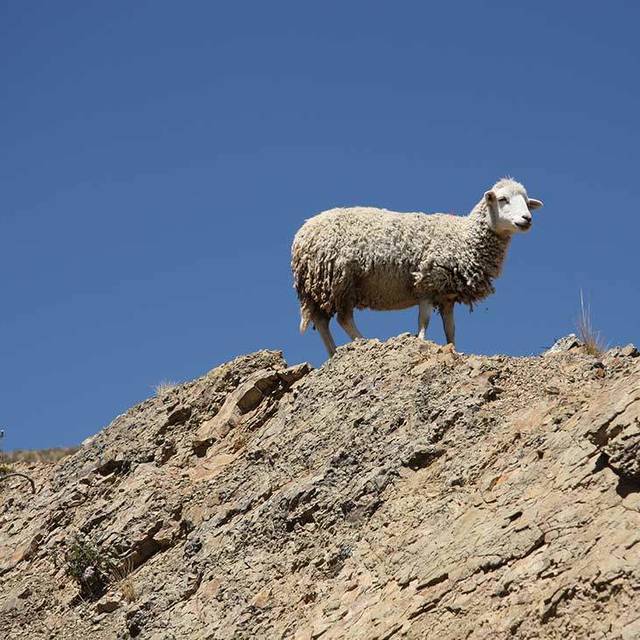
Sometimes we are the lost sheep. Sometimes the wilderness seems to consume us. Sometimes the road through it seems to lengthen with each step. But where we did get the notion that solitude meant that we were alone? This wilderness journey is not one that we travel alone. God walks with us, holds us when we need to be held, and when we become the lost sheep, the one who has wandered away, God is there too. God doesn’t “fix” our way through the wilderness or speed up our wilderness time, but we are always wilderness-found.

We just have a little bit more time of this Lenten wilderness. We know that it will get harder. We know that, like many wilderness paths, it will seem to lengthen and become more treacherous as we near the end of its hold. But we do not walk it alone. Jesus, walking to the Cross, was never alone. He was in solitude; he was in prayer; he was often deserted by those who traveled with him; he often found himself mired in lostness and grief. But God has walked this way before. God knows the way. So, God will always make sure that even though the way is hard, we are always wilderness-found. And God lays us on the Divine shoulders and rejoices.

Often when the heart is torn with sorrow, spiritually we wander like a traveler lost in a deep wood.  We grow frightened, lose all sense of direction, batter ourselves against trees and rocks in our attempt to find a path.  All the while there is a path–a path of Faith–that leads straight out of the dense tangle of our difficulties into the open road we are seeking. (Helen Keller)

Grace and Peace,

 Shelli

God’s Delight

Scripture Text: Psalm 119: 9-16 (Lent 5B Alternative Psalter)

9How can young people keep their way pure? By guarding it according to your word.

10With my whole heart I seek you; do not let me stray from your commandments.

11I treasure your word in my heart, so that I may not sin against you.

12Blessed are you, O Lord; teach me your statutes.

13With my lips I declare all the ordinances of your mouth.

14I delight in the way of your decrees as much as in all riches.

15I will meditate on your precepts, and fix my eyes on your ways.

16I will delight in your statutes; I will not forget your word.

Do you delight in God?  It’s a strange word, probably one we don’t use that often.  The dictionary says it means to “please someone greatly”.  I don’t know if that really works here.  I mean, I don’t really think of God as “pleasing me greatly”, as if that’s what God is trying to do—just please me, like it’s all about me. (Because I’m clear that it’s not all about me!)  No, this rather make me think of some of the wisdom passages that speak of daring to have a love for God that is deeper than you even thought possible, a love that comes from the very depths of one’s soul, (read Song of Songs or Song of Solomon when you get a chance!) from the place that you did not think it was even possible to access.  It’s a love that is so deep that you seem to become a part of what you love, a part of the very experience that IS God.  I think THAT’S what delighting in God is.

See, so many of us think of God as some sort of barely accessible character on the outskirts of our lives, watching over us, maybe even supervising us.  But I don’t get the impression that that’s what God desires.  Why in the world would God have created everything that is and then filled the earth (or, I don’t know, maybe even some other places!) with humans and other creatures just to watch them and make sure they behave.  That sounds very exhausting to me.  No, I think God created us because we are God’s delight.  We are part of what makes God delight, along with all the rest of Creation. 

So, perhaps delighting in God is coming closer to the delight that God has for us.  And if it is something that God does, then, by my calculation, it is holy.  Perhaps, then, delighting in God is to acknowledge that holiness, to dare to come closer, to actually get out of ourselves, and experience it, to know delight.  In Hebrew thought, to “know” is not just limited to intellectual capacity.  It is not just understanding facts or that something exists.  To know God is not just to know OF God.  To “know” connotes a familiarity, an intimacy.  To know God is to delight in God.

In this wilderness season, we have encountered the unfamiliar, a strangeness that is not that to which we are accustomed.  And yet, as we travel, we have grown to know it, to know the path itself rather than the destination.  That is delight.  The whole idea of delighting in God just as God delights in us sort of, to me, loosens some of those limits that we have placed upon our relationship with God.  No longer is God that overwhelming deity that supervises me or controls me like a puppet on a string.  No longer is God something for which I’m required to clean up my act or be presentable to encounter.  No longer is God waiting until I have enough faith or enough belief or whatever else before I can approach God.  God does not wait for us to change; God waits for us to delight in God.  God is always there delighting in me, delighting in all of us.  And when we come to understand that, when we come to know God with the intimacy of our Creator, of our very source of being, then we, too, can delight. 

This season of Lent is one that reveals to us that deep and abiding relationship with God.  It is a relationship where God delights in us and we delight in God.  And rather than following the rules that we’ve laid out or acting “appropriately”, delight can almost be characterized as a type of holy play, a conversation between our soul and its Creator.  To delight in God is to know who God created us to be.  It is a oneness with God (not a BECOMING God—that will never happen.  God is God; we are not.)  Delighting is not being “godly”; delighting is knowing God in the deepest part of your being.  What a delight! 

With so much in creation, why did You bother to make this blue planet so beautiful?  Why was it worth the effort?  This blue planet is insignificant, seemingly unimportant, yet You have made it painfully beautiful.  Why?  The answer, I think, is that is the way You do everything.  Beauty—mighty and small—delights You.  This tiny planet delights You.   (Andrew Greeley)

Grace and Peace,

 Shelli