Between

Lectionary Scripture Text: Psalm 31: 1-5, 15-16

1In you, O Lord, I seek refuge; do not let me ever be put to shame; in your righteousness deliver me.  2Incline your ear to me; rescue me speedily. Be a rock of refuge for me, a strong fortress to save me.  3You are indeed my rock and my fortress; for your name’s sake lead me and guide me, 4take me out of the net that is hidden for me, for you are my refuge.

5Into your hand I commit my spirit; you have redeemed me, O Lord, faithful God.  15My times are in your hand; deliver me from the hand of my enemies and persecutors.  16Let your face shine upon your servant; save me in your steadfast love.

What do we do with this day, this Holy Saturday?  We are still grieving.  The reality of it all is beginning to sink in, beginning to be real.  Jesus is gone, dying alone on some hill that we don’t even know.  So, what do we do today?  How do we pick up the pieces in the midst of our pain and despair and just go on with our lives?  Oh, we 21st century believers know how the story ends.  We’ve already jumped ahead and read the next chapter many, many times.  (Don’t tell those that don’t read ahead, but it all works out in the end.)

And yet, we do ourselves no favors if we jump ahead to tomorrow.  After all, the Scriptures tell us that Jesus rose on the third day, the THIRD day, as in one-two-three.  The third day doesn’t happen without today.  It must be important, right?  But, oh, it’s just so painfully quiet.  The sanctuary is dark, awaiting to be redressed for its coronation.  The bells are quiet, hanging expectantly for tomorrow.  And we still sit here draped in black with our Easter brights hanging there ready for us to don.  What are we supposed to do today?

Tradition (and the older version of the Apostles’ Creed) holds that Jesus died, was buried, and descended into hell.  So is that what this day is?  Descent?  Good grief, wasn’t the Cross low enough?  The well-disputed claim is that Jesus descended into death, descended into hell, perhaps descended into Gehenna (Greek) (Hebrew–Gehinnom, Rabbinical Hebrew–גהנום/גהנם), the State of ungodly souls.  Why?  Why after suffering the worst imaginable earthly death would Jesus descend into hell?  Well, the disputed part is that Jesus, before being raised himself, descended to the depths of suffering and despair and redeemed it, recreated it.  The sixth century hymnwriter, Venantius Fortunatus claimed that “hell today is vanquished, Heaven is won today.” Why is that so out of bounds of what God can do?  Don’t we believe that God is God of all?  Or does it give us some sense of comfort to know that we are not the worst of the bunch, that there are always Judas’ and Brutus’ that have messed up a whole lot worse than any of us and so are destined to spend eternity on the lowest rungs of hell?  But, oh, think about the power and grace and amazing love of a God who before the Divine Ascent into glory, descended into the depths of humanity and redeemed us all, every single one of us, perhaps wiped out the hell of each of our lives rung, by rung? 

Welcome, happy morning! age to age shall say:
Hell today is vanquished, Heav’n is won today!”
Lo! the dead is living, God forevermore!
Him, their true Creator, all His works adore!

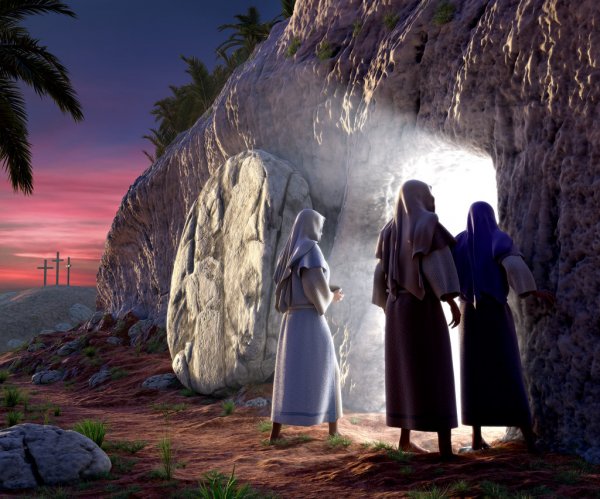
And, yet, again, we cannot leave it all to Christ to do.  Just as we were called to pick up our cross yesterday, we are called to descend down into the depths, plunging into the unknown darkness, so that God can pick us up again, set us right, and show us a new Way.  And so, this day, we stand between, between death and life, between hell and heaven, between a world that does not understand and a God who even in the silence of this day has begun the redeeming work.  In some ways, this is the holiest day of the week.  How often do we stand with a full and honest view of the world and a glimpse of the holy and the sacred that is always and forever part of our lives?  How often do we stand together and see ourselves as both betrayers and beloved children of God?  How often do we stand in the depths of our human state and yet know that God will raise us up.  This is a pure state of liminality, a state, as the Old English would say, “betwixt and between.”  It is where we are called to be.  It is the place of the fullness of humanity as it claims both human and divine.  In the silence of this day, we stand with God.  And we wait, we wait expectantly for resurrection. 

Do you remember how we started this whole thing?  Do you remember the Creation account from Genesis, how how God spoke Creation into being, how God spoke US into being.  So today we wait for God to say us into being again.  It is where we should always be.  We won’t though.  We won’t be there. (Remember, we’ve had this problem before.)  And maybe on some level, it’s too much for us to always be there, always be waiting expectantly for God.  Because, granted, today IS very wilderness-like.  In fact, you could say that it is the ultimate wilderness—lonely, forsaken, no clear path ahead.  I know.  You thought we were going to “wrap” this whole wilderness thing up, right?  But, see, wilderness is an opportunity.  It’s an opportunity for God to say us into being again.  But at least we can remember what this day feels like as we stand between who we were and what we will be. 

So, for today, keep expectant vigil.  Do not jump ahead.  We can only understand the glory of God when we see it behind the shadow of death.  But, remember, shadows only exist because the Light is so very, very bright. 

The shadows shift and fly.

The whole long day the air trembles,

Thick with silence, until, finally, the footsteps are heard,

And the noise of the voice of God is upon us.

The Holy One is not afraid to walk on unholy ground.

The Holy Work is done, and the world awaits the dawn of Life.

(“Saturday Silence”, Ann Weems, in Kneeling in Jerusalem)

You must give birth to your images.  They are the future waiting to be born.  Fear not the strangeness you feel.  The future must enter you long before it happens.  Just wait for the birth, for the hour of new clarity. (Rainer Maria Rilke) 

Grace and Peace,

 Shelli

Handed Over

Lectionary Scripture Text (Good Friday):

16Then he handed him over to them to be crucified. So they took Jesus; 17and carrying the cross by himself, he went out to what is called The Place of the Skull, which in Hebrew* is called Golgotha. 18There they crucified him, and with him two others, one on either side, with Jesus between them. 19Pilate also had an inscription written and put on the cross. It read, ‘Jesus of Nazareth,* the King of the Jews.’ 20Many of the Jews read this inscription, because the place where Jesus was crucified was near the city; and it was written in Hebrew,* in Latin, and in Greek. 21Then the chief priests of the Jews said to Pilate, ‘Do not write, “The King of the Jews”, but, “This man said, I am King of the Jews.” ’ 22Pilate answered, ‘What I have written I have written.’ 23When the soldiers had crucified Jesus, they took his clothes and divided them into four parts, one for each soldier. They also took his tunic; now the tunic was seamless, woven in one piece from the top. 24So they said to one another, ‘Let us not tear it, but cast lots for it to see who will get it.’ This was to fulfil what the scripture says, ‘They divided my clothes among themselves,  and for my clothing they cast lots.’ 25And that is what the soldiers did.

Meanwhile, standing near the cross of Jesus were his mother, and his mother’s sister, Mary the wife of Clopas, and Mary Magdalene. 26When Jesus saw his mother and the disciple whom he loved standing beside her, he said to his mother, ‘Woman, here is your son.’ 27Then he said to the disciple, ‘Here is your mother.’ And from that hour the disciple took her into his own home.

28 After this, when Jesus knew that all was now finished, he said (in order to fulfil the scripture), ‘I am thirsty.’ 29A jar full of sour wine was standing there. So they put a sponge full of the wine on a branch of hyssop and held it to his mouth. 30When Jesus had received the wine, he said, ‘It is finished.’ Then he bowed his head and gave up his spirit.

******************

            I am standing here but it does not seem real.  I want to hold him, to comfort him, to cradle him in my arms like I did when he was a baby.  But the guards are holding us back.  Oh, please, I don’t think I can stand anymore.  But I must stand with him.  He has to know that I am here with him.  He has to know how much I love him, how much I hurt for him, how I would trade places with him if I could.

All of the memories are flooding into my head.  I remember that night when the angel came to me.  (Luke 1:26-38) I did not understand.  I was so afraid.  But I knew I had to say yes.  I had no idea what I was agreeing to do.  And then for nine months I carried the baby in my womb. It was joyous.  In one respect, it was just like any other pregnancy, like the others I had after that.  And yet, it was different.  I always felt like there was someone there with me, guiding me, loving me, helping me through it.  It’s hard to explain.  

The birth itself was hard, downright scary in fact.  (Luke 2:1-20) We traveled to Bethlehem.  It was so far, so painful.  And then when we finally arrived, it was so crowded.  The streets were wild.  I remember that nice man who let us bed down in the room that housed his animals.  I remember the first time I looked into his eyes–those dark, compassionate eyes.  Even as a baby, he had compassionate, loving eyes.  He was special.  I knew that he was special when he came into the world.  I just didn’t know how wonderful he would be. 

I remember that day in the temple when we went for the Purification. (Luke 2:22-40) That strange man that I had never met took him from me.  He cradled him in his arms.  It was as if they had known each other always.  And he told me my soul would be pierced.  Oh, how right he was! 

I remember the day that my cousin’s son baptized him.  He didn’t know I was there.  I hid behind the trees.  After all, he was an adult; he didn’t need his mother always looking on.  And I remember when his ministry started.  He was so brave, so fearless.  It scared me at times.  I thought something like this might happen.  But I am so incredibly proud of him.  I am so proud of what he became, what he made others become that he touched in his life.  He was special.

No, this does not seem real.  Somebody needs to help him.  Please, please, he’s asking for water.  Please, someone give him water.  I’m afraid this is it.  I’m afraid he cannot take it anymore.  I’m afraid he’s going to give up.  Perhaps it would be better.  Perhaps it is better to let go…Oh, how I love him! How I want to go back, to hold him just once more!  It is over.  It is all over.  He is gone.  What did it all mean?  I don’t understand.  Why the angel?  Why the star?  Why did it all happen if it was going to end this way?  What does God have in mind for him?  He promised me that it would be for good.  He promised me that it would be OK.  I guess I have to believe that, hold on to it, hope.  Someday maybe I’ll see it.

I wanted to stay here until they gave me his body, but I don’t think I can.  There are others here too–Jesus’ friend Mary, who has always been so lovely toward me, and the disciples.  I hope they all realized how much he loved them, how he would do anything for them, how he wished the best for them.  The rain is really coming down now and the skies are angry, angry like me.  The wind is blowing so hard, I can no longer stand against it.  There are rocks and debris sliding down the mountain above us.  It seems that the world is breaking apart.  Will the world ever know what it has lost?  Will the world ever know what it did?  Will God ever forgive this world for killing my son, their son, God’s son?  Someone just told me that the temple curtain has split in two.  It is as if the holy has spilled into the world.  I can’t explain it.

My son came into this world wrapped in so much hope.  He was supposed to change the world.  He was supposed to open the eyes of the world to what it could be, what it could become.  Is it all for naught?  Or, someday, will we finally understand why he came?  Someday, I know, that God will make it all make sense.  But, now, today, I am grieving more than I could know.  The loss is unbearable, a thick wilderness of loss through which I cannot find my way.  But what a gift I’ve had!  What an incredible gift that was taken away all too soon!  I have to leave this place, as hard as it is.  Shabbat is starting in a few minutes.  I must go prepare, light the candles, and usher in the joy of the Sabbath.  I must go rest.  I need it.  I need it to resurrect my hurting soul.  God will be with me.  Let it be.

“My soul magnifies the Lord, and my spirit rejoices in God my Savior, for he has looked with favor on the lowliness of his servant. Surely, from now on all generations will call me blessed; for the Mighty One has done great things for me, and holy is his name. His mercy is for those who fear him from generation to generation. He has shown strength with his arm; he has scattered the proud in the thoughts of their hearts. He has brought down the powerful from their thrones, and lifted up the lowly; he has filled the hungry with good things, and sent the rich away empty. He has helped his servant Israel, in remembrance of his mercy, according to the promise he made to our ancestors, to Abraham and to his descendants forever.”  (Luke 1:46-55) Shalom, my dear Son!  May God’s Light stay with you!

******************

We have all experienced loss and grief.  It DOES seem like a wilderness.  You want so badly to go back.  But the pathway behind you seems to have closed.  You can only walk forward.  But God takes grief and loss and redeems it.  God doesn’t take it away.  It is part of us just as the wilderness journey through which we’ve traveled will always be.  But God helps us restructure our lives and finds a place for loss, a healing, joyful place. 

The point of this journey through Holy Week is to empty, to surrender, to let God in.  It is the completion of the process of Lent in which we have made room for our death, for our surrender to God.  Resurrection is finding that place that is just for us.  The wilderness teaches how to be open to that, how to prepare our lives for re-creation.  That is what God does—gives us the gift of re-creation.  But, for now, we will grieve, and we will feel loss and God will hold us until we can hold it ourselves.  It is finished.

There is a journey you must take.  It is a journey without destination.  There is no map.  Your soul will lead you.  And you can take nothing with you.  (Meister Eckhart, 14th century) 

Grace and Peace,

Shelli

When Everything Changes

Scripture Text: John 13: 1-17, 31b-35

Now before the festival of the Passover, Jesus knew that his hour had come to depart from this world and go to the Father. Having loved his own who were in the world, he loved them to the end.2The devil had already put it into the heart of Judas son of Simon Iscariot to betray him. And during supper3Jesus, knowing that the Father had given all things into his hands, and that he had come from God and was going to God,4got up from the table, took off his outer robe, and tied a towel around himself.5Then he poured water into a basin and began to wash the disciples’ feet and to wipe them with the towel that was tied around him.6He came to Simon Peter, who said to him, “Lord, are you going to wash my feet?”7Jesus answered, “You do not know now what I am doing, but later you will understand.”8Peter said to him, “You will never wash my feet.” Jesus answered, “Unless I wash you, you have no share with me.”9Simon Peter said to him, “Lord, not my feet only but also my hands and my head!”10Jesus said to him, “One who has bathed does not need to wash, except for the feet, but is entirely clean. And you are clean, though not all of you.”11For he knew who was to betray him; for this reason he said, “Not all of you are clean.”12After he had washed their feet, had put on his robe, and had returned to the table, he said to them, “Do you know what I have done to you?13You call me Teacher and Lord—and you are right, for that is what I am.14So if I, your Lord and Teacher, have washed your feet, you also ought to wash one another’s feet.15For I have set you an example, that you also should do as I have done to you.16Very truly, I tell you, servants are not greater than their master, nor are messengers greater than the one who sent them.17If you know these things, you are blessed if you do them.  31When he had gone out, Jesus said, “Now the Son of Man has been glorified, and God has been glorified in him.32If God has been glorified in him, God will also glorify him in himself and will glorify him at once.33Little children, I am with you only a little longer. You will look for me; and as I said to the Jews so now I say to you, ‘Where I am going, you cannot come.’34I give you a new commandment, that you love one another. Just as I have loved you, you also should love one another.35By this everyone will know that you are my disciples, if you have love for one another.”  

This is the night when everything changes.  I always thought that the disciples assumed that they had more time, that somehow Jesus would pull it out in the end.  After all, to them, the mission had just begun.  How could these three years be for naught?  Was I wrong to join it?  Was it a waste of time?  The air hangs heavy with change.  Something is wrong.  The wilderness seems to be overtaking them.

It’s a hard day.  We know what is coming tomorrow.  We have read over and over again—the story of loss and betrayal, of the disciples sleeping, of Jesus’ surrender, of Jesus being dragged off to the house of Caiaphas on this very night.  We have over and over and over experienced regret and bewilderment and grief.  This is the night that everything changes, when the wilderness week seems to fold onto us, almost choking us.    

But can you feel it?  Can you feel the love tonight?  Can you feel something beyond where you were?  Do we ever remember the love of this night?  They came together for a Passover dinner.  I always thought that they were alone, gathered in some sort of stuffy upstairs room, maybe with Leonardo da Vinci standing on the side painting the scene for posterity.  But then I saw, even if it was a “traditional understanding” of the place, the Upper Room in the Old City of Jerusalem.  It was big, bigger than I had ever imagined.  What dawned on me was that this was Passover, the community gathering.  Jesus wasn’t just there crammed into some sort of painting with the disciples; he was there with the whole community, sharing life and community and food.  But at some point, he sat down with his closest friends and it became intimate.  It became a dinner of love on that last night.  They shared food; they shared wine; and Jesus washed their feet.  Jesus showed them what intimacy and love for another human really meant–that one would become vulnerable, would do for another what perhaps was not the most comfortable thing to do, that one would change for another, as hard as that might be.  Love became not a caring or a sharing but an entering, an entering into the life of another.

This foot washing thing is hard.  It is way too intimate for most of us westerners.  After all, we are pretty private, seemingly reserved; we honor each other’s imaginary space.  But once a year, the church I once served would have a foot washing at the mid-day Maundy Thursday service.  It wasn’t just a ceremonial thing to show us how it was done.  There wasn’t one clergy washing the feet of some brave designated congregant.  It was the whole service.  Everyone came.  We worshipped in silence for about twenty-five minutes and one by one, people would remove their shoes and place their feet in the water to be washed.  It was completely quiet except for the sloshing of the water in the pail.  Toward the end, the clergy would switch places and someone would wash our feet. 

It was a small service, intimate really.  I remember the first year we did it.  We were reticent, hesitant to trust that people would come through.  So, admittedly, we had a couple of “ringers”.  Well, the ringers came and then the rest did.  One by one, they all came.  I sat there on the floor moved by something that I had never experienced.  I was touching people’s feet.  They had removed their shoes at the pew and had walked barefoot to the seat where we had the plastic tub in which water would be poured over their feet.  It was incredible.

And then Caroline came.  Caroline–in her full Nigerian dress and gele (the elaborate head covering they wear) and her permanent posture of prayer.  She came and she sat and she placed her foot in the water.  I picked up her foot.  Caroline and her family were part of the Nigerian freedom movement.  She had come from the tribes and had wanted more.  She had worked hard, always putting aside her own desires for what she thought was important–others and God.   She had lost her young husband in that movement and had raised her four young sons alone.  I looked at this older woman’s foot in my hands, deep with lines of life and passion, and I had tears in my eyes.  It was a foot that as a young child had run barefoot through African jungles.  It was a foot that had marched for freedom.  It was a foot that had known grief, and pain, and joy.  I was holding life.  I was not holding someone’s foot.  I was holding their life.  I was affirming them, praying for them, washing away for them all the things that got in the way of what they so treasured.  As I was gingerly washing Caroline’s foot, she raised her hands, looked up into the ceiling, and she began to pray.  They were words from one of the tribal communities in Nigeria that I did not understand and composed a prayer that I understood completely.  It was incredible.  It was love at its deepest level–love for Christ, love for humanity, love for each other, love for God and all that we have together. 

Caroline died a few years ago.  We grieved at her funeral.  But we also danced, danced with joy.  (I think we need to start dancing with joy at funerals!) She left the most incredible love.  At her memorial service, I remembered that day when I washed her feet.  I remembered that day that was filled with love, that was filled with the Presence of Christ on that night.  It had changed me.

You see, love is a funny thing.  It is not perfectly complete.  Jesus knew that on that night.  He and the disciples did not sing “Kum-ba-yah” and then leave.  In Jesus’ life, love meant rejection and exile, frustration and misunderstanding, Presence and turning, welcome and redemption.  This very night, Love would be apathy and betrayal, surrender and pardon.  But, in this moment, Love was a bunch of friends who had a dinner together and had their feet washed.  They were feet filled with lines of life and passion.  Jesus washed their feet and held their life.  That’s all love is about.  Love is Life.  Love brings us together in a way that does not subdue us into one but embraces who we are.  Love takes all that we are and creates Love.  Love changes us.  It turns the wilderness into a place of Love.  Nothing else can create itself.  But Love can.  That’s why we love one another.  That’s why Jesus commanded us to love.

On this night, we take all that we are, sinners and saints, kings and vagabonds, the betrayer and the beloved, the anointed and the one who anoints, the nay-sayers and the ones who miss the signs of the sacred, the pharisee and the rule-breaker, the faith-filled and the doubter, Caroline and me and you–we are all here, gathered together, showered in the most incredible love imaginable.  Can you feel the Love tonight?  You feel it because you’ve been changed.  Tomorrow we will kneel at the cross.  But, tonight, in this moment, can you feel the Love? 

If the world is sane, then Jesus is mad as a hatter and the Last Supper is the Mad Tea Party…In terms of the world’s sanity, Jesus is crazy as a coot, and anybody who thinks he can follow him without being a little crazy too is laboring less under a cross than under delusion. (Frederick Buechner)

Grace and Peace,

 Shelli

Waiting on You

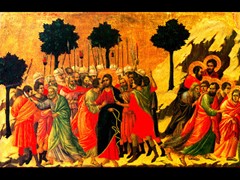
“The Kiss of Judas”, Ducio de Buoninsegna, 1308

Scripture Text: John 13: 21-32

21After saying this Jesus was troubled in spirit, and declared, “Very truly, I tell you, one of you will betray me.” 22The disciples looked at one another, uncertain of whom he was speaking. 23One of his disciples—the one whom Jesus loved—was reclining next to him; 24Simon Peter therefore motioned to him to ask Jesus of whom he was speaking. 25So while reclining next to Jesus, he asked him, “Lord, who is it?” 26Jesus answered, “It is the one to whom I give this piece of bread when I have dipped it in the dish.” So when he had dipped the piece of bread, he gave it to Judas son of Simon Iscariot. 27After he received the piece of bread, Satan entered into him. Jesus said to him, “Do quickly what you are going to do.” 28Now no one at the table knew why he said this to him. 29Some thought that, because Judas had the common purse, Jesus was telling him, “Buy what we need for the festival”; or, that he should give something to the poor. 30So, after receiving the piece of bread, he immediately went out. And it was night. 31When he had gone out, Jesus said, “Now the Son of Man has been glorified, and God has been glorified in him. 32If God has been glorified in him, God will also glorify him in himself and will glorify him at once.

Jesus knew who would betray him.  It was his friend, the one that had accompanied him as he traveled around the lake teaching, the one who had met his family, the one who on those long nights after those just-as-long frustrating days had listened to him.  In fact, it would be the one he trusted.  The one who held the purse that bought them small but nourishing meals and paid their way, the one that had figured out how to budget the money so that they could get to Jerusalem.  It was the one that had it together.  It was the last one that he would have thought would do this.  But Jesus knew who would betray him.  It hurt, hurt more deeply than anyone would ever know.  Et Tu, Judas?  Even you, Judas?

The others will probably never figure it out.  They are too busy trying to figure out who it is (and trying to make sure that it’s not them!)  Isn’t that what we do?  In an odd sort of way, this Scripture brings out all our fears.  We ask the dreaded question, “Is it I?  Is it I, dear Lord, who will betray you?”  But then we, like the disciples, tell ourselves that whatever it is we mess up can’t possibly be as bad as “that other guy”.  And so, the world blames Judas for all of our wrongs.  Because, if we make Judas look bad, then maybe we won’t look as bad as we know we might be.  Dante would place him in the fourth level of the ninth rung of hell.  (Now let me tell you, that is NOT good.)  According to Dante’s Inferno, Judas shares this rung with Brutus and Cassius, who played a part in the murder of Julius Caesar.  (Et Tu, Brute?)  We are no better.  As long as there is a Judas, we have seemed to allay our fears that we are not the worst.  And yet, we’re always afraid that that may not be the case.

But don’t you sometimes think Judas sort of gets a bad rap?  What if he really thought that Jesus would pull it out in the end?  Maybe in his own misguided and controlling way, he was trying to leave an opening for Jesus to “prove” that he was God.  But Jesus was not there to prove anything; Jesus was there to redeem it.  I think Judas is all of us.  There’s a part of Judas in us, the one that is fearful of the outcome and tries to hurry it along or control it or change it, the one who tries to control what will happen, the one who really isn’t very innocent at all.  There is a part of us that lives in fear that we may not be able to change it. 

But, really, do you think God desires our innocence?  If that was the case, we might as well all hang it up right now!  The truth is that none of us is innocent.  Innocence died a really long time ago.  (Or maybe it never existed at all.) And God didn’t have any need to resurrect that.  God does not desire our innocence; God desires us.  I once heard a professor refer to the Garden of Eden, the symbol of our “innocence”, as the “Kindergarden of Eden”.  It was a place we journeyed through, a place that at the time was right for us, a place that prepared us for what would come next.  But we have moved on.  Innocence is overrated.  God instead desires repentance, reconciliation, and redemption.  God calls us to turn toward God, be with God, and accept that gift of forgiveness that God offers us.  That’s all it takes.  If God wanted perfect people, I’m thinking God would have made them.  God would have populated the world with a bunch of pod-people and things probably would have gone a lot smoother.  I don’t know…maybe God wanted better dinner conversation.  Maybe God desired a good story or a good laugh sometimes.  Or maybe, just maybe, God wanted us to choose God rather than being compelled by fears and control. 

So, God offers forgiveness for whatever we’ve pulled in the past.  Barbara Brown Taylor, in Speaking of Sin, contends that it is sin that is our only hope.  Because it is when we know that we have failed, when we know that we have moved farther away from God, when we name what it is that stands in our way, that the doors will swing open with a force we never knew and all of a sudden, we find ourselves sitting at the table in a place that we did not think we deserved.  Isn’t God incredible?  So, why do we need to blame Judas?  We are all looking for God.  Sometimes we just make bad choices.  Sometimes we find ourselves fearfully lost in the wilderness.  But, regardless of how fearful we are, God always offers us another chance.  Forgiveness is the starting point for change, the beginning of the rest of our eternity.

Madeleine L’Engle tells an old legend that “after his death Judas found himself at the bottom of a deep and slimy pit.  For thousands of years he wept his repentance, and when the tears were finally spent he looked up and saw, way, way up, a tiny glimmer of light.  After he had contemplated it for another thousand years or so, he began to try to climb up towards it.  The walls of the pit were dank and slimy, and he kept slipping back down.  Finally, after great effort, he neared the top, and then he slipped and fell all the way back down.  It took him many years to recover, all the time weeping bitter tears of grief and repentance, and then he started to climb again.  After many more falls and efforts and failures he reached the top and dragged himself into an upper room with twelve people seated around a table.  “We’ve been waiting for you, Judas.  We couldn’t begin till you came.”

This is the wilderness we walk when we are fearful of what will happen, fearful of what will become of us.  We, too, find ourselves “over-reaching”, trying to control things that are not ours to control because we are scared.  But God is there, waiting.  The table is always set for that moment when we show up.  Even you!  We can’t begin until you come!

The soldiers are there with their swords and lanterns.  The high priest’s slave is whimpering over his wounded ear.  There can be no doubt in Jesus’ mind what the kiss of Judas means, but it is Judas that he is blessing, and Judas that he is prepared to go out and die for now.  Judas is only the first in a procession of betrayers two thousand years long, If Jesus were to exclude him from love and forgiveness, to one degree or another he would have to exclude us all.  Maybe this is all in the mind of Jesus as he stands with his eyes closed, or possibly there is nothing in his mind at all.  As he feels his friend’s lips graze his cheek for an instant, maybe he feels nothing else…It is not the Lamb of God and his butcher who meet here, but two old friends embracing in a garden knowing that they will never see one another again.  (Frederick Buechner)

Grace and Peace,

Shelli

Surrender

Scripture Text: John 12: 20-36

20Now among those who went up to worship at the festival were some Greeks. 21They came to Philip, who was from Bethsaida in Galilee, and said to him, “Sir, we wish to see Jesus.” 22Philip went and told Andrew; then Andrew and Philip went and told Jesus. 23Jesus answered them, “The hour has come for the Son of Man to be glorified. 24Very truly, I tell you, unless a grain of wheat falls into the earth and dies, it remains just a single grain; but if it dies, it bears much fruit. 25Those who love their life lose it, and those who hate their life in this world will keep it for eternal life. 26Whoever serves me must follow me, and where I am, there will my servant be also. Whoever serves me, the Father will honor. 27“Now my soul is troubled. And what should I say—‘Father, save me from this hour’? No, it is for this reason that I have come to this hour. 28Father, glorify your name.” Then a voice came from heaven, “I have glorified it, and I will glorify it again.” 29The crowd standing there heard it and said that it was thunder. Others said, “An angel has spoken to him.” 30Jesus answered, “This voice has come for your sake, not for mine. 31Now is the judgment of this world; now the ruler of this world will be driven out. 32And I, when I am lifted up from the earth, will draw all people to myself.” 33He said this to indicate the kind of death he was to die. 34The crowd answered him, “We have heard from the law that the Messiah remains forever. How can you say that the Son of Man must be lifted up? Who is this Son of Man?” 35Jesus said to them, “The light is with you for a little longer. Walk while you have the light, so that the darkness may not overtake you. If you walk in the darkness, you do not know where you are going. 36While you have the light, believe in the light, so that you may become children of light.” After Jesus had said this, he departed and hid from them.

And now the conversation turns to this talk of death and loss.  This is uncomfortable for us.  This is not the kind of wilderness we want.  We’d like to run now, to hastily make our exit back through that heavy gate behind us.  We’re not sure that our journey really prepared us at all.  But it is too late.  The hour has come. 

The reading starts by telling us of the arrival of some Greeks. Now this may seem to us to be sort of periphery to the point of the story but it’s not. For you see, this arrival of the Greeks is something new. It marks the beginning of an entirely new section of the Gospel. These are not merely Greek-speaking Jews, but Gentiles who have made the pilgrimage to Jerusalem for the Passover feast. These are non-Jews, Gentiles from across the sea who wanted to meet the Hebrew holy man. This is the beginning of the world seeing Jesus and knowing who he is.  They approach Philip and request to “see” Jesus, to have a meeting with him. Perhaps they want to know more of who this Jesus is. Perhaps they just want to talk to him. Or perhaps they want to become disciples. But regardless of why they are here, their arrival points to the fulfillment of the church’s future mission—to make disciples of Jesus Christ for the redemption of the world. This is the decisive dividing line between Jesus coming as a Jewish Messiah and Christ, through his death and resurrection, to fulfilling God’s promise for the renewal and redemption of all of Creation. Now is the time for the Son of Man to be glorified.  Jesus did not just come to save you and me.  Remember, Jesus is the Savior of the World.  Uncomfortable as that may be for some of us, Jesus has begun to draw the world into the Cross.  Jesus came for everyone.

Change is all around us.  Our world is beginning to shake a bit.  Sure, we could run, go back to our old ways, to the comfort and safety of home.  We could yell and scream and demand that someone put it back the way it was.  The problem is that nothing stays the same.  Even if we could return, it would not feel like home.  For you see, this wilderness journey has changed us.  We have lived this season of clearing and surrender.  We are different.  We don’t look different, but we do see differently.

But what is this thing with wheat?  (OK, to the end, Jesus seemed to continue speaking in confusing parables!)  So, here’s your botany lesson.  Wheat is a caryopsis, meaning that the outer “seed” and the inner fruit are connected. The seed essentially has to die so that the fruit can emerge. If you were to dig around in the ground and uproot a stalk of wheat, you would not find the original seed. It is dead and gone. In essence, the grain must allow itself to be changed.  So what Jesus is trying to tell us here is that if we do everything in our power to protect our lives the way they are—if we successfully thwart change, avoid conflict, prevent pain and discomfort—then at the end we will find that we have no life at all.  He goes on…” Those who love their life lose it, and those who hate their life in this world will keep it for eternal life. Whoever serves me must follow me, and where I am, there will my servant be also. And whoever does this, God will honor.”  Whoever follows Jesus through his death, will become part of his everlasting life.

You see, we cannot go back to what we know because it is no longer ours.  The Light has become part of us.  Jesus wanted us to understand not just that he was leaving, not just that his death was imminent, but that this journey to the cross was not just his to make, but ours, as uncomfortable as that may be for us. Now is the time to walk with Jesus to the cross.

Martin Luther once said that “discipleship is not limited to what you can understand – it must transcend all comprehension. Plunge into the deep waters beyond your own understanding, and I will help you to comprehend. Bewilderment is the true comprehension. Not to know where you are going is the true knowledge. In this way Abraham went forth from his father, not knowing where he was going. That is the way of the cross. You cannot find it in yourself, so you must let me lead you as though you were a blind man. Not the work which you choose, not the suffering you devise, but the road which is contrary to all that you choose or contrive or desire – that is the road you must take. It is to this path that I call you, and in this sense that you must be my disciple.

This Lenten wilderness journey was not preparing us for this by building us an armor to protect us or make us more comfortable with what is about to be.  It was preparing us by stripping away all that we know, all that we have planned, all that we think makes us who we are.  THIS wilderness is a place of Holy Discomfort.  It prepares us to truly see Jesus and to realize that the journey to the Cross is not something that we watch, not something that we just walk along offering Jesus moral support; rather, the journey to the Cross is ours.  The air has changed.  Jesus is walking to the Cross. And so are we.

I have discovered over time that the cross is supposed to take its toll on us.  It forms us to find God in the shadows of life.  Ironically enough, it’s the cross that teaches us hope…it is this hope that carries us from stage to stage in life, singing and dancing around dark corners. (Joan Chittister)

Grace and Peace,

 Shelli

Abide

Scripture Text: John 12: 1-11

12Six days before the Passover Jesus came to Bethany, the home of Lazarus, whom he had raised from the dead. 2There they gave a dinner for him. Martha served, and Lazarus was one of those at the table with him. 3Mary took a pound of costly perfume made of pure nard, anointed Jesus’ feet, and wiped them with her hair. The house was filled with the fragrance of the perfume. 4But Judas Iscariot, one of his disciples (the one who was about to betray him), said, 5“Why was this perfume not sold for three hundred denarii and the money given to the poor?” 6(He said this not because he cared about the poor, but because he was a thief; he kept the common purse and used to steal what was put into it.) 7Jesus said, “Leave her alone. She bought it so that she might keep it for the day of my burial. 8You always have the poor with you, but you do not always have me.” 9When the great crowd of the Jews learned that he was there, they came not only because of Jesus but also to see Lazarus, whom he had raised from the dead. 10So the chief priests planned to put Lazarus to death as well, 11since it was on account of him that many of the Jews were deserting and were believing in Jesus.

Holy Week has begun. We have walked this wilderness road to the cross throughout this Lenten season—letting go, acknowledging our discomforts, fears, and losses, and changing, most of all, changing–and now it is upon us. Most of us don’t really know what it is that we’re supposed to do with this week. We have gone through this season hearing its call to repentance, to emptying, to looking at things differently. But, still, the ending is beginning to loom bigger than we imagined it would be. What is it, exactly, that we’re supposed to do with this week?  After all, this is the week that Jesus surrenders and lets himself be handed over.

We are not used to a Christ who does nothing, who just surrenders. We are, rather, more comfortable when Jesus is showing us how to do what we’re supposed to do as followers. We like a Jesus who is strong and confident leading our team.  We are not accustomed to such a passive Christ. I looked up the word “passive” in an etymological dictionary. The root is the Latin passiuus. And then, surprisingly, it says “See Passion.” The etymological root of passion, the term that we use to describe Jesus’ suffering journey to the cross, is the Latin passionem, or suffering. And it says “See Passive.” The two words are related. The “Passion”, this time of suffering and letting go and being “handed over”, is a movement from planned and intentional action to no longer being in control. All of Jesus’ actions are accomplished. It is finished. It is a time of waiting—waiting for others’ response.  Jesus has shown us how to let go, how to surrender.

In the reading for this Holy Monday, we find this passive Jesus. He visits the home of friends, the home of those whom he had served, those for whom he had done things. And, it says, they give a dinner for him. Jesus is the guest of honor. After all the doing, after all the action, after all the stuff, he now spends time with friends. And they serve him. And then the passage tells us that Mary takes a pound of costly perfumed nard, breaks the seal, and lavishly pours it onto Jesus’ feet. Then as the oil runs down his feet and begins to drip onto the floor, she bows and wipes his feet with her hair. The whole house is filled with this overwhelming fragrance, sort of a combination of mint and ginseng, sickeningly sweet.

Well, the disciples just couldn’t leave it alone. What in the world was she doing? Here is this man who has worked for years to bring peace and justice to the world, to heal others, to end poverty and oppression and you waste this oil by pouring it out on him! That oil could have been sold. Things could have been done with that money! We could have done great ministry with what you just poured on his feet! But you have wasted it! You have squandered it!

Jesus responds. “Leave her alone,” he says. You see, she gets it. She understands. I do not have long to be with you. She knows where I am going. And she responds. This woman loves Jesus. In fact, she loves Jesus so much that she defies the expected and instead pours out the abundance of her life and anoints Jesus for his burial. This is not the time to talk about budgets or the ways things are normally done. This is the time of Jesus’ waiting and her response. As she anointed Jesus, Mary entered Jesus’ Passion and understood what it meant to have a personal relationship with Christ.

There are those in our society that would describe that breakthrough as being “born again”. But that phrase, commonplace and probably overused and misused as it is today, was not even around over a hundred years ago. Instead, the words that were used to describe this coming into who Jesus is was to say that one was “seized by the power of a great affection.” Isn’t that an incredible phrase—to be “seized by the power of a great affection”? You see, we 21st century folks usually think we have it all figured out. We know what we’re called to do to make disciples of Jesus Christ. We live our lives as best we can within the framework of what God wants us to do. And we do what we can for others by reaching out in the name of Christ. All of that is wonderful. But are we truly “seized by the power of a great affection”? Why do you think Jesus did everything that he did while he was on this earth? Was it just to show us what it is we’re supposed to do? No, Jesus was more than merely an exemplary human being put here for us to emulate. Jesus came to reveal God’s love, to show us how much God loves each of us and how much God desires us, to make known once and for all the affection that God has for all of God’s Creation and for us as children of God. Jesus was God made known, Emmanuel.

There is a story from the Sufi mystical tradition of a disciple that comes to an elder for direction“Where shall I find God?” the disciple asked the elder. “God is with you,” the Holy One replied. “But if that is true,” the disciple asked, “why can I not see this Presence?” “Because you are like the fish who, when in the ocean, never notices the water.” It is not that God is not with us; it is that we are unaware of that incredible PresenceWhen we finally stop doing what we think we should be doing, let go, and listen for that which God is calling us to be we will become aware of that extraordinary Presence that is God. And in that becoming, we enter the anointed Christ-life.

In our faith understanding, the Sacrament of Baptism is the beginning of our life as a Christian, a new life in Christ, the beginning of a journey toward oneness with God, toward the life of Christ. The waters of Baptism remind us of God’s ever-Presence in our lives, of God’s claim on us, and of the great love that God has for us that was revealed in Christ. It is sacramental because it is God’s love made visible for us. Through this sacrament, we enter this journey with God.

In much the same way, Mary poured the oil upon Jesus. The act was sacramental. Mary understood that love. She entered that love. Indeed, she was “seized by the power of a great affection”. And in pouring the oil, in wiping his feet, she entered Jesus’ Passion. She became part of Jesus’ journey to the cross. In Baptism, God uses water to make God’s love visible to us. And as Mary poured the oil on Christ, she made her love visible to God. And immersed in that love, we will find ourselves “seized by the power of a great affection.”

This is the week when we come to the end of all our doing. This is the wilderness week when we let go and walk with Christ through betrayal and suffering and last suppers and final endings. This is the week when we finally realize that we can do nothing else. And on that final day, as the passive Christ is handed over, there is nothing more for him to do other than wait for our response. Who will follow me? Who will come to me with all your misery and your sins, with all your trouble and your needs, and with all your longings to be loved?  Who will follow me through the wilderness? Who will hand over their lives just as I have done that you too might be raised to new life? Because it is then that the oil will be poured out for you in much the same way as you are immersed in the waters of your Baptism.

This week is not an easy one to walk. Sometimes we are still not sure what it is that we’re supposed to do. But this week is not about us; it is not about what we do or how we do it; this week is the week that we are called to be “seized by the power of a great affection”, to become one with Christ, to enter Christ’s suffering and passion and waiting, to make our very lives a sacramental journey. And as we come closer and closer in this wilderness to what seems to be a final ending, we will finally be aware that we are never really alone. God calls us. God is waiting for our response.  Let go and let God.

Our hosannas sung, our palms waved, let us go with passion into this week…. It is a time to greet Jesus as the Lord’s Anointed One,to lavishly break our alabaster and pour perfume out for him without counting the cost. It is a time for preparation. (Ann Weems)

Grace and Peace,

 Shelli

A Procession Through the Back Door

Scripture Text: Mark 11: 1-11

When they were approaching Jerusalem, at Bethphage and Bethany, near the Mount of Olives, he sent two of his disciples 2and said to them, “Go into the village ahead of you, and immediately as you enter it, you will find tied there a colt that has never been ridden; untie it and bring it. 3If anyone says to you, ‘Why are you doing this?’ just say this, ‘The Lord needs it and will send it back here immediately.’” 4They went away and found a colt tied near a door, outside in the street. As they were untying it, 5some of the bystanders said to them, “What are you doing, untying the colt?” 6They told them what Jesus had said; and they allowed them to take it. 7Then they brought the colt to Jesus and threw their cloaks on it; and he sat on it. 8Many people spread their cloaks on the road, and others spread leafy branches that they had cut in the fields. 9Then those who went ahead and those who followed were shouting, “Hosanna! Blessed is the one who comes in the name of the Lord! 10Blessed is the coming kingdom of our ancestor David! Hosanna in the highest heaven!” 11Then he entered Jerusalem and went into the temple; and when he had looked around at everything, as it was already late, he went out to Bethany with the twelve.

Here we are—bustling city, Passover festival, and a parade!  It seems that we’re not in the wilderness anymore!  Whew!  We made it!!!  As Jesus comes into Jerusalem, there is excitement and joy.  He is here!  And they honor him.  But, to be honest, we probably read a little bit more into this parade than is there.  From the time I was little, I had this sense that Jesus came into the middle of the city, flanked by all of the crowds.  He was “it.”  (But then it didn’t make much sense as to why it went so badly so fast.)  The truth is, Jesus was not “it” in Jerusalem.  Jesus was heading what was then a small fledgling movement on the outskirts of established religion and recognized society. 

He was coming down a narrow road that winds down Mt. Olivet and was then entering through the eastern gate of Jerusalem, the “back door” of the city, for all practical purposes.  The Western gate was the main gate.  It was the one where all the military pomp and circumstance entered, a gate fit for royalty.  Hmmm!  It seems that Jesus makes a habit of coming in the back door—into forgotten grottos and wilderness baptisms and ministries that begin around a lake rather than a bustling Holy City.  So, this seems only fitting.  Maybe that’s the point.  God doesn’t always enter in the way we expect, doesn’t always show up when it fits the best into our schedule or our circumstances.  Instead, God slips in through the back door of our wilderness lives when we sometimes barely notice and makes a home with us.

So, the onlookers stay around for just a little while.  And then the back-door parade fizzles.  As the road goes by the Garden of Gethsemane and down toward Bethany and the outer walls of Jerusalem, many leave and go back to their lives.  Maybe they had something to do; maybe they didn’t want to contend with all the holiday traffic in downtown Jerusalem; or maybe they were afraid of what might happen. So, Jesus enters the gate of the city almost alone, save for a few of the disciples.

Where are we in this moment?  Jerusalem is here.  The wilderness through which we’ve traveled is behind us.  But it has prepared us for a new wilderness of sorts.  As followers, we know that the road is not easy.  It will wind through this week with the shouts of “Crucify him” becoming louder and louder.  We will experience pain and grief and even betrayal.  The road is steep and uneven.  And the shouting stones and clanging iron against wood will be deafening.  But this is the way—the way to peace, the way to knowing God, the way Home.  This is our road; this is our Way; this is the procession to life.  The way to the Cross, through the wilderness of this week is our Way to Life.

The truth is the wilderness through which we’ve wandered these past weeks was not just to get us here; it was to prepare us for the wilderness to come.  And now we have to decide.  Are we the ones running away or are we following Jesus?  The ahead will be hard and painful.  We know that.  But it is the way to life.  The gate is just up ahead. And as followers of Jesus, we, too, are again driven into the wilderness.  But this wilderness is different.  Rather than encompassing a broad sweeping desert, it is contained within these walls; rather than pathways that are difficult to see, we know the road all too well; and rather than a time of solitude, the noises are deafening.  But we can no longer sit on the steps outside the gate.  Jerusalem awaits. And Jesus has begun his walk to the Cross.

Our hosannas sung, our palms waved, let us go with passion into this week.

It is a time to curse fig trees that do not yield fruit; a time to cleanse our temples of any blasphemy.

It is a time to greet Jesus as the Lord’s Anointed One, to lavishly break our alabaster and pour perfume out for him without counting the cost.

It is a time for preparation.

The time to give thanks and break bread is upon us.

The time to give thanks and drink of the cup is almost here.

Eat, drink, remember

As each of us asks ourselves, “Is it I who will betray you?”

And on that darkest of days, each of us must stand beneath the tree and watch the dying if we are to be there when the stone is rolled away.

The only road to Easter morning is through the unrelenting shadows of that Friday,

Only then will the alleluias be sung; Only then will the joyful dancing begin.

“Holy Week”, by Ann Weems. In Kneeling in Jerusalem

The miracle of the Red Sea,” the rabbis taught, “is not the parting of the waters. The miracle of the Red Sea is that with a wall of water on each side, the first Jew walked through.” The implications are clear: God is not in this alone. Yes, God may be all-powerful and eternally unfailing, but that’s not the point. The real key to the coming of the reign of God on earth, the rabbis imply, is not God’s fidelity. The real determinant between what ought to be and what will be in this world is the mettle of our own unflagging faith that the God who leads us to a point of holy wakefulness stays with us through it to the end. The key to what happens on earth does not lie in God’s will. All God can do is part the waters. It lies in the courage we bring to the parting of them. It lies in deciding whether or not we will walk through the parting waters of our own lives today. Just as surely as there was need for courage at the Red Sea, just as surely as there was need for courage on Jesus’ last trip to Jerusalem, there is need for it here and now, as well. (Joan Chittister, in “The Road to Jerusalem is Clear:  Meditations on Lent”, National Catholic Reporter, March 30, 2001)

Grace and Peace,

 Shelli