17So if anyone is in Christ, there is a new creation: everything old has passed away; see, everything has become new! 18All this is from God, who reconciled us to himself through Christ, and has given us the ministry of reconciliation; 19that is, in Christ God was reconciling the world to himself, not counting their trespasses against them, and entrusting the message of reconciliation to us. 20So we are ambassadors for Christ, since God is making his appeal through us; we entreat you on behalf of Christ, be reconciled to God. 21For our sake he made him to be sin who knew no sin, so that in him we might become the righteousness of God.
We’ve read this before, this “new creation” stuff. We’ve read that God has reconciled us to the Godself through Jesus Christ. OK, now that we’ve gone over our main theology…The truth is, what does that mean? After all, we’re only humans. Right? We’re sinful and messed up and many of us have no idea what this actually means. I mean, what does it mean to be human? We read the Creation stories. God created us. Why? Was it to become something different? Was it to become better? Or are we doomed?
I think many of us tend toward Gnosticism. We imagine the notion of a good God, a God who created us as humans, as sinful, as not “of God”. We have the notion of a divine spark that might pull us out of our plight of humanity, our sinful state. But, remember, God created us. God created us as human. Do you really think God would create us as bad and then expect us to claw our way out of our created demise? That’s bizarre.
So, along came Jesus. So many of us relegate him to a super hero of sorts, a “super human” that is somehow above all this that we have to endure. Really? See, we are told that Jesus was born of a human, born as a human. Otherwise, Jesus never would have been able to reconcile us to God. Jesus came as one of us, as Emmanuel, the one among us, the one who was one of us, the one who showed us the way to be not just “merely human” but “fully human”.
Jesus was fully human and fully divine. Call it the sacred “And”, the very reconciliation of God to the Creation that God so dearly loves. THAT is our understanding of the Cross. The Cross was not a way “out”. It certainly wasn’t a punishment for being human. I don’t even think it necessarily “wipes” our sins out (oh dear, I’m going there!). For me, the Cross is the ultimate reconciliation, the new Creation. It is the place where God recreates humanity, recreates the world, finally gives us a notion as to what it means to be “fully human”. “Fully human” is not “just human” or “merely human”. “Fully human” is the way that Jesus lived, the Way that Jesus walked. “Fully human” is what we’re called to become—not “godly”, certainly not Divine”—just what we were created to be all along.
So, the breathing…Breathe out the notion that you are “merely human” or “only human”. Oh, my goodness, God created you for so much more. And breathe in the message of the Cross, that we are reconciled and made new, that God invites us and walks with us to what God intends for us to be.
Jesus didn’t come to make us Christian; Jesus came to make us fully human. (Hans RMadeleine L’Engle)
13“You are the salt of the earth; but if salt has lost its taste, how can its saltiness be restored? It is no longer good for anything, but is thrown out and trampled under foot. 14“You are the light of the world. A city built on a hill cannot be hid. 15No one after lighting a lamp puts it under the bushel basket, but on the lampstand, and it gives light to all in the house. 16In the same way, let your light shine before others, so that they may see your good works and give glory to your Father in heaven.
17“Do not think that I have come to abolish the law or the prophets; I have come not to abolish but to fulfill. 18For truly I tell you, until heaven and earth pass away, not one letter, not one stroke of a letter, will pass from the law until all is accomplished. 19Therefore, whoever breaks one of the least of these commandments, and teaches others to do the same, will be called least in the kingdom of heaven; but whoever does them and teaches them will be called great in the kingdom of heaven. 20For I tell you, unless your righteousness exceeds that of the scribes and Pharisees, you will never enter the kingdom of heaven.
So, you apply for a new job. You get the job and you are then handed a job description, a very detailed list of what your role is and what responsibilities you have. At the top, it has your title. Basically, it tells you who you are, right? And then you have a list of responsibilities. So, the job description answers two very basic questions that are probably pretty fundamental questions of life: “Who are we?” and “What are we to do?” It sounds so easy, so straightforward. All you have to do is follow the list of responsibilities and you will be what it says at the top of the page (or at least some semblance of it).
But what if you didn’t really apply for that job? What if you didn’t mean at all to be given that job? What if, without any real warning, you are handed a shiny new nametag and a job description that describes what you should do when you weren’t even sure that that’s what you wanted to be. That’s a little bit like what it may feel like when you first read today’s Gospel passage.
I mean, straight out of the blue. “You are the salt of the earth.” “You are the light of the world.” I’m sorry, you said I’m what? But, Jesus, really, we just wanted to be followers. We just wanted to follow you to eternity, to stand here and bask in your goodness and your mercy and begin to feel like it was all going to turn out alright. We wanted to you to lead us, show us where to go. You know, sort of like that shepherd and sheep metaphor that you kept using. THAT’S what we signed up to do. So, what does it mean to be the salt of the earth and the light of the world, exactly? I think we may be getting this wrong.
So, what does it mean to be called to be salt, to be called the salt of the earth, as the Scripture says? I mean, salt has many uses. It purifies; it seasons; it preserves. It is a nutrient that we need. It is an antiseptic. It adds support and buoyance (remember that ships float higher on salt water than fresh water). So maybe we are called to be multi-faceted, to not just walk one road toward that Presence of God that we think we have identified and nailed down in our lives, but to rather open ourselves to the notion that God appears when we least expect it. And we are called to be ready, to be open, to do whatever it is that God calls us to do in that moment.
But, interestingly, salt is of no use to salt. We cannot serve ourselves. We are part of a community. “Being salt” means that we are called to become that embodied Presence of God in the world and for the world and, rather than making everyone and everything into what reflects our own personal image of God, we are rather called to season what we touch so that the flavor that is God comes through.
Then there’s light. We’re called to be light too? Good grief! That’s a lot! You know, light is something that cannot be hidden or it is no longer light. So, if we are light, it means that we, too, are seen. We are meant to be seen, meant to be the ones that illumine the way of Christ, that clarify it for others, that reveal it in the darkness. We are the ones that light the way for others.
That’s a pretty tall order. It’s also rather overwhelming, when you think of the magnitude of it. I mean, it’s not like light puts itself out for a while and then comes back when it’s ready. Being light is pretty much a full time job. It’s also an uncomfortable job sometime. Light doesn’t just illumine the goodness and those things that are worthy of such revelation; light has a habit of shining into the darkest corners of the world and revealing those things that are in need of change, those things that God calls us to change. And light, true all-encompassing light, does not pick and choose where its rays will shine. It illumines all in its path taking it unto itself.
So, “you are the salt of the earth”. “You are the light of the world.” Notice that Jesus is not saying that you “should be” salt or light or that you should “try to be” salt and light or that you will become salt and light someday. No, Jesus says you ARE salt and light. You just are. You don’t debate it. You don’t second-guess it. You don’t wonder about it. You just go and be it. You are salt and light. Period.
The problem is that you are salt. The problem is that you are light. It doesn’t mean that you ignore or shun the ways of the world; it means you change them. The very reason that the Gospel is so powerful is that it actually thrusts us into reality and allows us to move forward in a way that restores everything around us, not only spiritually, but also materially and emotionally. So why do we often fail at that? It’s probably because more times than we’d like to admit we allow the culture to shape our faith, rather than being the salt that our world so desperately needs. We have allowed our light to be hidden because sometimes it’s uncomfortable to be the one that speaks the Truth.
We can no longer stand by and let the Truth be usurped. We can no longer hide afraid of what others may think. We cannot excuse ourselves from speaking out because it might shake up our comfortable existence or change how others look at us. We have to stand up for the Gospel—because we are salt and we are light. We are the shapers and the illuminators. We must speak for those who cannot. We must stand up for those that the world says are not worthy or are not one of us. We must tear down walls that others try to build and invite the Gospel in. The Gospel is not a viewpoint. It is not an opinion. It is not an alternative fact, to coin a new word in our society. The Gospel is a truth-teller. See, the problem is that the Gospel is our own call to action. We can no longer stand on the sidelines. We have to preach the message that Jesus preached even in the face of a world who would it seems rather not hear it. Will you accept the position? The choice is yours. We’re called to be salt. We’re called to be light. Most of all, we’re called to be who God calls us to be.
I want to pay the highest compliment anyone could ever pay:You are the light of the world.You are the salt of the earth.You are the leven in the loaf.So, go and be light. Go and be salt. Go and be leven. (Marcus Borg…who admitted he stole it from William Sloan Coffin)
When Jesus saw the crowds, he went up the mountain; and after he sat down, his disciples came to him. 2Then he began to speak, and taught them, saying:
3“Blessed are the poor in spirit, for theirs is the kingdom of heaven. 4“Blessed are those who mourn, for they will be comforted. 5“Blessed are the meek, for they will inherit the earth. 6“Blessed are those who hunger and thirst for righteousness, for they will be filled. 7“Blessed are the merciful, for they will receive mercy. 8“Blessed are the pure in heart, for they will see God. 9“Blessed are the peacemakers, for they will be called children of God. 10“Blessed are those who are persecuted for righteousness’ sake, for theirs is the kingdom of heaven. 11“Blessed are you when people revile you and persecute you and utter all kinds of evil against you falsely on my account. 12Rejoice and be glad, for your reward is great in heaven, for in the same way they persecuted the prophets who were before you.
In these words, a part of Jesus’ Sermon on the Mount, arguably the greatest sermon ever given, Jesus was laying before us an alternate way of being, a way that God calls us to be. It was a reversal of the usual value system. He was calling us to expect something different than what we see around us. It can’t have been accepted all that well. I mean, he was telling them that the way the world was was not really working, that the society that they had built was not the way it should be. You and I both know–people don’t like that.
Each beatitude begins in the present and moves to the future. So, start now but expect it to result in something different. Expect that when God finishes this new creation, justice and righteousness and peace will finally and always prevail. And in our seemingly small way, by living in this life now, by living a life of gentleness in this time of violence, a life of pure devotion to God in this time of competing allegiances, and a life in which we truly hunger and thirst for that day of expected justice and righteousness for all, we will become the future.
No longer can Christianity be seen as a philosophy of life that would make us healthy, wealthy, and wise. That whole prosperity gospel thing that is so prevalent right now, where if you pray and do right and say the right things and vote the right way, God will somehow reward you with a life of ease and plenty and you will come out on top is totally and completely debunked with this Scripture. It instead shows us a way of walking that is different from what we know. And we are expected to do something to make that happen.
Dietrich Bonhoeffer said this: Humanly speaking, we could understand and interpret the Sermon on the Mount in a thousand different ways. Jesus knows only one possibility: simple surrender and obedience, not interpreting it or applying it, but doing and obeying it. That is the only way to hear his word. He does not mean that it is to be discussed as an ideal; he really means us to get on with it.
The promise is not that being blessed means that our lives will become easier. It doesn’t have anything to do with having a nice house or a good job or living a life of ease and plenty. Being blessed means having a bless-ed relationship with God and with God’s people who share this planet with you. It means seeing yourself not as better or nicer than others, but as one who is a part of God’s bless-ed Creation. And from that standpoint, the beatitudes are meant to be not instructive but descriptive of that relationship. They are not meant to be a checklist of what makes us a better person. They are a vision of a community—an alternative community than the one in which we live. Truth be told, being “blessed” has more to do with being used by God than it does getting stuff or having your life be easier.
Christ’s coming into this world as our Messiah brought about for us the conception of what Shalom is, the vision of what God’s full and final Kingdom looks like. And even as the world groans with pain, we get a sense that perhaps some of it are the pains of birthing God’s Reign into being. We are in the midst of a holy labor, a holy gestation as God’s vision comes to be. And in our expectation of what will come to be, we find our faith. And in the meantime, what part do we play? What is expected of us? How are we supposed to live as people of faith in this sort of chaotic world in which we find ourselves now?
We live in a time when people tell us to live well and do well. But Jesus says, Blessed are the poor in spirit, for theirs is the Kingdom of heaven.
We live learning ways to make our life the best we can. But Jesus says, Blessed are those who mourn, for they will be comforted.
We live in a society that tells us to stand up for ourselves, to put ourselves first. But Jesus says, Blessed are the meek, for they will inherit the earth.
We live trying to satisfy ourselves in every way. But Jesus says, Blessed are those who hunger and thirst for righteousness, for they will be filled.
We live in a place that teaches us to hold onto what we have and protect it. But Jesus says, Blessed are the merciful, for they will receive mercy.
We live in a place that calls us to fill our minds and live within the morals we know and the rules we have designed. But Jesus says, Blessed are the pure in heart, for they will see God.
And we live in a country that is trying so desperately to protect itself and its wa of life, so desperately to put itself first. But Jesus says, Blessed are the peacemakers, for they will be called children of God.
It’s hard because it’s not what our world looks like. We live by expecting to be blessed not in this world but in the way that God envisions we will be. We are blessed not because we draw close to God but because God draws close to us and because of where we are, we notice.
I won’t take no for an answer,” God began to say to me when God opened his arms each night wanting us to dance. (St. Catherine of Sienna)
The next day he saw Jesus coming toward him and declared, “Here is the Lamb of God who takes away the sin of the world! 30This is he of whom I said, ‘After me comes a man who ranks ahead of me because he was before me.’ 31I myself did not know him; but I came baptizing with water for this reason, that he might be revealed to Israel.” 32And John testified, “I saw the Spirit descending from heaven like a dove, and it remained on him. 33I myself did not know him, but the one who sent me to baptize with water said to me, ‘He on whom you see the Spirit descend and remain is the one who baptizes with the Holy Spirit.’ 34And I myself have seen and have testified that this is the Son of God.” 35The next day John again was standing with two of his disciples, 36and as he watched Jesus walk by, he exclaimed, “Look, here is the Lamb of God!”
37The two disciples heard him say this, and they followed Jesus. 38When Jesus turned and saw them following, he said to them, “What are you looking for?” They said to him, “Rabbi” (which translated means Teacher), “where are you staying?” 39He said to them, “Come and see.” They came and saw where he was staying, and they remained with him that day. It was about four o’clock in the afternoon. 40One of the two who heard John speak and followed him was Andrew, Simon Peter’s brother. 41He first found his brother Simon and said to him, “We have found the Messiah” (which is translated Anointed). 42He brought Simon to Jesus, who looked at him and said, “You are Simon son of John. You are to be called Cephas” (which is translated Peter).
So, last week, the Scripture led us through Jesus’ Baptism and the notion of God’s claim on his life. But you know what? Jesus didn’t become who God called him to be when he was born. He didn’t become who God called him to be when people began to flock into his presence. He didn’t even become who God called him to be in that moment of his baptism. Jesus became who God called him to be when he stood, wet with the waters of baptism, and claimed it for himself. Because in that moment, as he responded, his ministry began.
It is the same for us. It is the moment when, for each of us, God calls us and God reminds us that we are a son or daughter of God with whom God is well pleased. So, what now? What happens next? What happens after we are baptized, after the Spirit descends into our lives. I mean, we can’t go back to the way it was before. So we have to go forward. We have to do something. So, what is it? What is next?
Come and see…
So, John the Baptizer comes with two of his disciples, points them toward Jesus, and then he sort of drops out of sight. He’s still part of the story but we know that he had no doubt where the story was to go next. So, the two that were with him wanted to know more. They began looking for Jesus. And Jesus’ response? It wasn’t an interview or a test of who they were. It was an invitation. “Come and see”, come and experience what God has for you. It says that they remained with him all day, no longer just hearing about Jesus, but getting to know who he was, and, in essence, becoming a part of the story themselves. In those hours as they spent time experiencing the Christ, they became disciples.
The passage tells us that it became 4:00 in the afternoon of the next day and they wanted to know where Jesus was staying. Many scholars think that that time of day and the fact that Jesus was apparently leaving to go stay somewhere implies that it was probably the Sabbath. And that’s important. Because, as you know, Sabbath was a practice that they did every week—not when the weather was good, not when they didn’t have something else to do, not when there was not a sports event. It was their way of practicing to be an artist in their spiritual walk.
So, they ask Jesus where he was staying. It’s a way of getting to know who he was, because Jesus would have stayed with his relatives or possibly some close friends for the Sabbath. It’s sort of like asking someone who their people are. And Jesus tells them to “come and see”. In other words, come go with me, come experience what I experience, come enter my life, come encounter who I encounter. Come be a part of my story. But the clincher is that BECAUSE it was the Sabbath, wherever they went, they would have to stay there. They couldn’t travel on the Sabbath so from sundown Friday evening to sundown Saturday evening, they would be, essentially, locked up with Jesus. There was no going back. Once you’re locked up with Jesus, I’m pretty sure your life will dramatically change.
Come and see…
You know, years ago, the evangelism and church growth “gurus” came up with something called an “elevator talk”. Their claim was that, as Christians, as those called to lead people to Christ, we should have in our metaphorical back pocket a 20 second “sound bite” that would lead people to Christ. Really? Are you kidding? I also thought that was bizarre. I mean, I’m not sure trapping strangers in an elevator and giving them your 20-min treatise of what you think it all means is the best method. Jesus never told anyone to do that. I mean, tell me what sound bite you’re going to use to capture the essence of all the Scriptures, all of Jesus’ life, and everything that God is. Jesus didn’t do sound bites; Jesus did relationships. Come my friend, come and see…
Come and see…
And then we are told their names. So, why does that matter? Because God doesn’t just throw a blanket over humanity to see who will pick it up. Think about it. Nowhere in the Bible does God really ask and wait for volunteers. Nowhere do we read of God pointing at someone and yelling, “hey, you”. Because we know that “hey, you” does not create relationship. No, God is much more intimate with us than that. God gives us a name, a holy act of creation, and we are called to live into that name. Jesus called each of these people one by one. And has done the same with us. Each of us has a unique part of the story to tell. It’s all there. Just come and see—all of you.
Come and see…
The Lord plays and diverts [the Godself] in the garden of Creation, and if we could let go of our own obsession with what we think is the meaning of it all, we might be able to hear God’s call and follow…When we are alone on a starlit night…when we see children in a moment when they are really children; when we know love in our own hearts…such times…provide a glimpse of the cosmic dance. (Thomas Merton)
[Verse 1] Come and see Come follow me Back to the place where He’s staying And He’ll not mind For there you will find All that your faith has been waiting
[Verse 2] Come and see Come follow me To a road where believing is seeing There’s work to do And words of Truth To find in your heart for the speaking
[Chorus] Come and see Come and see (ooo ooo ooo-oo oo oo ooo) Come and see Come and see (ooo ooo ooo-oo oo oo ooo)
[Verse 3] Come see the Way The Truth, and the Life Come see the Light that is living Come now and see How the truth sets you free Come live the life He is giving
13Then Jesus came from Galilee to John at the Jordan, to be baptized by him. 14John would have prevented him, saying, “I need to be baptized by you, and do you come to me?” 15But Jesus answered him, “Let it be so now; for it is proper for us in this way to fulfill all righteousness.” Then he consented. 16And when Jesus had been baptized, just as he came up from the water, suddenly the heavens were opened to him and he saw the Spirit of God descending like a dove and alighting on him. 17And a voice from heaven said, “This is my Son, the Beloved, with whom I am well pleased.”
This Sunday is Baptism of Christ Sunday. On this Sunday every year, the Sunday following Epiphany Sunday, we remember Jesus’ Baptism. We also remember our own since the two are inextricably wound together. And many of your pastors will celebrate by tossing water at you. I always loved tossing water. It’s playful and I think worship should always have some remnant of play. But, more than that, it’s joyful.
The reading begins simply: “Then…” It is such a common connector, that we probably sort of gloss over it. But look a little more closely. It wasn’t just the thirty years that Jesus had waited to commit to public ministry. It was the centuries upon centuries and ages upon ages that all of Creation had waited for the dawn to break. In essence, from that very moment when we are told in the first chapter of Genesis that God’s Spirit swept over the face of the waters, Creation has been groaning and straining for this very moment, the very moment when life would emerge from the water.
Thirty years was, in fact, the traditional time that a rabbi waited to be committed to God. In those thirty years, Jesus would have been caring for his mother, and making a living, and preparing himself for ministry. I don’t really think that, contrary to what some may say, Jesus was confused about these roles. He was always serving God. But now…then…the time had come. And as eternity dawns, Jesus is ready to begin. And so, he goes to John at the Jordan to be baptized and for a very short amount of time was then actually a disciple, a follower, of John’s.
Because Jesus was from Nazareth, he would have had to make a trip of about 70 miles in order to arrive at the Jordan. This was in some sense a sort of “mini-pilgrimage”, an intentional journey to be baptized by John. Now, according to the Matthean version of the Gospel, John knew who Jesus was. So, you can imagine, how uncomfortable he might have been at actually baptizing Jesus, at actually accepting this Son of God as part of his following. But Jesus reassures John. “Let it be so now.” Now is the time. It is now. “And,” asserts Jesus, “this is the way to fulfill all righteousness.” This is the way to fulfill the will of God. At this moment, in an odd twist of events, Jesus and John become partners in carrying out God’s plan for salvation. And so, just as each of us received the gift of water in our own Baptism, Jesus kneels in the Jordan and John bends over him and baptizes him. And from the water, the work has begun.
From the water, the heavens are opened and the Spirit emerges. And we hear what all the world has always been straining to hear: “This is my Son, the Beloved, with whom I am well pleased.” Even though the writer of the Gospel has presented Jesus as the Son of God in the birth story, it is not until this moment that the title is actually conferred. From the water, comes Jesus Christ as Savior and Redeemer of all of Creation. From the water, comes life.
So, with this story, we consider our own baptism. I don’t remember mine. I was about 7 months old. But I know it happened. And, see, “remembering” your baptism is not merely a recounting of some hazy memory; it is rather remember who you are, remembering that from those waters came life. It is not as important for us to remember the day of our baptism as it is that we remember that we were, that we or someone on our behalf affirmed who we were—a daughter or son of God, the Beloved, with whom God is well pleased. That’s what it’s about. Our baptism is not our becoming. We were already there. God had already imprinted blueprints of who we would be deep into our being. Our baptism is when we begin that long and somewhat arduous journey of joining with God in living into who we are.
Caroline Westerhoff says that “at baptism we are incorporated into Christ’s body, infused with Christ’s character, and empowered to be Christ’s presence in the world. [And then], ministry is not something in particular that we do; it is what we are about in everything we do.”[i] In other words, our own Baptism sweeps us into that dawn that Jesus began.
Jesus was still wet with water after John had baptized him when he stood to enter his ministry in full submission to God. As he stood in the Jordan and the heavens spilled into the earth, all of humanity stood with him. We now stand, wet with those same waters, as we, too, are called into ministry in the name of Christ. As we emerge, we feel a cool refreshing breeze of new life. Breathe in. It will be you always. Something has happened. Maybe we can’t explain it; maybe we don’t even understand it; but in the midst of the noisiness of life, in the midst of things that we don’t think can lend to our spiritual walk at all, in the midst of everything we know and everything we don’t, God takes ordinary, everyday water, wet, cold, nothing special and from the water, we emerge with new life.
Brothers and sisters in Christ: through the sacrament of baptism we are initiated into Christ’s holy church. We are incorporated into God’s mighty acts of salvation and given new birth through water and the Spirit. All this is God’s gift, offered to us without price.
Remember your Baptism and be thankful…
The future enters into us, in order to transform itself in us, long before it happens. (Rainer Maria Rilke)
Grace and Peace,
Shelli
[i] Caroline A. Westerhoff, Calling: A Song for the Baptized, (Cambridge, MA: Cowley Publications, 1994), xi.
In the time of King Herod, after Jesus was born in Bethlehem of Judea, wise men from the East came to Jerusalem, 2asking, “Where is the child who has been born king of the Jews? For we observed his star at its rising, and have come to pay him homage.” 3When King Herod heard this, he was frightened, and all Jerusalem with him; 4and calling together all the chief priests and scribes of the people, he inquired of them where the Messiah was to be born. 5They told him, “In Bethlehem of Judea; for so it has been written by the prophet: 6‘And you, Bethlehem, in the land of Judah, are by no means least among the rulers of Judah; for from you shall come a ruler who is to shepherd my people Israel.’” 7Then Herod secretly called for the wise men and learned from them the exact time when the star had appeared. 8Then he sent them to Bethlehem, saying, “Go and search diligently for the child; and when you have found him, bring me word so that I may also go and pay him homage.”
9When they had heard the king, they set out; and there, ahead of them, went the star that they had seen at its rising, until it stopped over the place where the child was. 10When they saw that the star had stopped, they were overwhelmed with joy. 11On entering the house, they saw the child with Mary his mother; and they knelt down and paid him homage. Then, opening their treasure chests, they offered him gifts of gold, frankincense, and myrrh. 12And having been warned in a dream not to return to Herod, they left for their own country by another road.
Happy Epiphany! All the waiting is over. The twelve days are behind us and we are set, ready to start our journey. Are you packed? I know, I don’t usually get around to posting beyond Advent and Lent, but I’m really, really, really going to try. I’ll try to post once a week in line with the Lectionary passages and we’ll see what happens. And then, for Lent…well, we’ll see what happens!
So, today is Epiphany. Many of you probably read this passage for Epiphany Sunday this past Sunday. But today is the day. So, let’s read it again. Because, now is the time. What now? What do we do after it all ends? The truth is, “after” is when it begins, “after” is when it becomes real, and “after” is the whole reason we do this at all.
The text that we read is the one that our lectionary designates for every Epiphany Sunday, regardless of what Lectionary year it is. It begins by setting us “in the time of King Herod”. And in it, we find that the last question of Advent comes not at Christmas but afterward and is asked not by an individual but by a group. They believe that the star (or, for some, an unusual conjunction of heavenly bodies that produces an especially bright light) marks the birth of a special child destined to be a king. And they ask, “Where is the child who has been born king of the Jews?
And so, Herod hears that a king had been born in Bethlehem. Well, the formula is simple—a king is born, but a king is already here; and in Herod’s mind and the minds of all those who follow him, there is room for only one king. The passage says that King Herod was frightened and all Jerusalem with him. They probably were pretty fearful. After all, there was a distinct possibility that their world was about to change. It seemed that the birth of this humble child might have the ability to shake the very foundations of the earth and announce the fall of the mighty. Things would never be the same again.
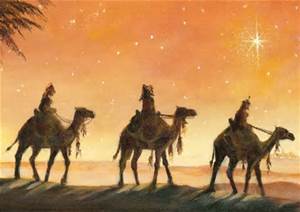
So, Herod relies on these wisest ones in his court. The writer of Matthew’s Gospel says that they’re from the East. Some traditions hold that these wise ones were Magi, a Priestly caste of Persian origin that followed Zoroastrianism and practiced the interpretation of dreams and portents and astrology. Other traditions depict them with different ethnicities as the birth of this Messiah begins to move into the whole world. In fact, it was the early Western church that gave them names that depict this. (No, these names are not in the Bible.) But according to tradition, Melchior was a Persian scholar, Caspar was a learned man from India, and Balthazar, a scholar with a Babylonian name. These three areas represented the known world at that point. The Messiah had come to every nook and cranny of the world.
But, regardless of who they were, somewhere along the way, they had heard of the birth of this king and came to the obvious place where he might be—in the royal household. So, sensing a rival, Herod sends these “wise ones” to find the new king so that he could “pay homage” to him. We of course know that this was deceitful. His intent was not to pay homage at all, but to destroy Jesus and stop what was about to happen to his empire. It was the only way that he could preserve what he had.
According to the passage, the wise men know that Christ was born; they needed God’s guidance, though, to find where Christ was. When they get to the place where the star has stopped, the passage tells us that they were “overwhelmed with joy”. They knelt down and paid the new king homage and offered him gifts fit for a king. Even though later interpreters have often tried to place specific meanings on these gifts of gold, frankincense, and myrrh, it is possible that the writer of the Gospel of Matthew simply thought that these gifts, exotic and expensive as they were, were gifts that would be worthy of a great and mighty king. They were gifts of joy, gifts of gratitude, gifts of celebration.
And then the passage tells us that, heeding a warning in a dream, these wise and learned (and probably powerful and wealthy) members of the court of Herod, left and returned to their own country, a long and difficult journey through the Middle Eastern desert. But rather than returning to their comfortable lives and their secure and powerful places in the court of Herod, they left and went a different way. They knew they had to go back to life. But it didn’t have to be the same.
So they slip away. Herod is furious. He has been duped. So he issues an order that all the children two years old and younger in and around Bethlehem should be killed. The truth is that Jesus comes into the world as it actually is, not as we wish it to be. Evil and greed are real and the ways of the world can and do crush life.
So, think about something. This IS part of the Christmas story. It is the final chapter that sets the stage for who this newborn King in the manger or the feed trough or whatever it was actually is for the world. We know the story. He was born to Mary and Joseph, the descendants of David. He was born into a family that had always expected him, had always hoped for him, had always dreamed that one day, one day, the world would be a better place because he came to be.
But, all too quickly, God moved. God moved beyond this family, beyond these generations. And the angel appeared to those shepherds, the untouchables, the ones with whom no one mingled because, frankly, they smelled bad. They smelled like sheep. I mean, who wants to smell like sheep? (ACTUALLY, Pope Francis once said that a shepherd SHOULD smell like sheep if he or she is really a shepherd.) But who wants to mingle with those in the bottom rung of society, those who everyone needs but who no one wants to be around? But God was there. And they came, these shepherds. They responded to the call to come and see this thing that has happened.
First to the family. Then to the ones in our community, whether or not we choose to accept them or love them. And then God moved again. God came to those Magi, those foreigners, the ones from the East. They were not citizens. They were interlopers. They were visitors, maybe even immigrants, certainly not believers. They were the ones that we typically would fear. But they came. And they changed. They came and the world knew that this newborn King had come.
Almost a century later, the writer of the Gospel According to John would write that “For God so loved the world that he gave his only Son, so that everyone who believes in him may not perish but may have eternal life.” (John 3:16) Oh, you thought that was a new thought. No, that was those shepherds. That was those Magi. That was us. Because we are the world.
So, what do we do with this? We love. We become the world. We cut through all the imperialism happening right now, all the racism happening right now, all the fear-mongering being drummed up right now, and we just love. Because, see, we are not individuals. We are the world. And when we see that, we also see that God comes.
Our God is the One who comes to us in a burning bush, in an angel’s song, in a newborn child. Our God is the One who cannot be found locked in the church, not even in the sanctuary. Our God will be where God will be with no constraints, no predictability. Our God lives where our God lives, and destruction has no power and even death cannot stop the living. Our God will be born where God will be born, but there is no place to look for the One who comes to us. When God is ready God will come even to a godforsaken place like a stable in Bethlehem. Watch…for you know not when God comes. Watch, that you might be found whenever, wherever God comes. (Ann Weems)
(Yes, amazingly, this was MORE THAN 40 YEARS AGO!)
In the beginning was the Word, and the Word was with God, and the Word was God. 2He was in the beginning with God. 3All things came into being through him, and without him not one thing came into being. What has come into being 4in him was life, and the life was the light of all people.
5The light shines in the darkness, and the darkness did not overcome it. 6There was a man sent from God, whose name was John. 7He came as a witness to testify to the light, so that all might believe through him. 8He himself was not the light, but he came to testify to the light. 9The true light, which enlightens everyone, was coming into the world. 10He was in the world, and the world came into being through him; yet the world did not know him. 11He came to what was his own, and his own people did not accept him. 12But to all who received him, who believed in his name, he gave power to become children of God, 13who were born, not of blood or of the will of the flesh or of the will of man, but of God. 14And the Word became flesh and lived among us, and we have seen his glory, the glory as of a father’s only son, full of grace and truth.
15(John testified to him and cried out, “This was he of whom I said, ‘He who comes after me ranks ahead of me because he was before me.’”) 16From his fullness we have all received, grace upon grace. 17The law indeed was given through Moses; grace and truth came through Jesus Christ. 18No one has ever seen God. It is God the only Son, who is close to the Father’s heart, who has made him known.
The Light has come! The Dawn is here!
God created Light.
And Light pushed the darkness into the shadows.
Light came and the world looked different, illuminated for the first time.
Light invited us to journey in a different way, to walk with Light.
But we wandered in the darkness, often mistaking shadows for Light.
The darkness sometimes made us afraid so we befriended darkness.
And then darkness taught us that we could see more clearly with Light.
So there, there in the darkness, we began to find Light.
Light began to flicker and shimmer over the waters and the earth and filled our space.
Light was like nothing we had ever known.
Light surrounded us and invited us into itself.
But we held back in the darkness, holding the Light at bay.
So, Light continued to shine into everything, even the dark and jagged corners of our world.
When we were lost, Light looked for us and we were found.
When we were grieving, Light held our hand.
When we were more comfortable in the darkness, Light waited patiently and beckoned us toward itself.
And when we could not find the Light, Light showed us our strength and our faith.
And then, undeterred, Light came, tiptoeing into our world, into even the darkness, without welcome or accolade.
And Light was laid aside.
So, quietly, oh so quietly, Light began to dance, filling the room, filling the world, filling us with Light.
Those who knew darkness suddenly knew Light.
Those who relied on shadows saw the way Light moves through them.
Light played. Light danced. Light shimmered into the shadows of the world.
And Light invited us to join, to play, to dance, to shimmer.
And then we became part of the Light.
And even the darkness was filled with Light.
Light has dawned. And Light asks us to dance—even in our darkness. And we find that we are full of Light.
The Light has come! The Dawn is here! Go and be Light! Merry Christmas! (SW 2021)
When the star in the sky is gone,
When the Kings and Princes are home,
When the shepherds are back with their flocks,
The Work of Christmas begins:
To find the lost,
To heal the broken,
To feed the hungry,
To release the prisoner,
To teach the nations,
To bring Christ to all,
To make music in the heart. (Howard Thurman)
Thank you so much for joining me in this series! I know the world hasn’t dramatically changed while we’ve been reading and thinking and commenting. But I think it’s changed a little. Thank you!Keep waiting on the world to change…and working on it too!
All the Presents have been opened I’ve been up since early dawn Sharing calls with friends and family Dear old Santa’s come and gone
As we gather around the table Holding hands we bow our heads I thank the Lord for all of you And this is what I said
I pray for peace to shine on a world that’s torn apart I pray for faith to comfort and heal on troubled heart For hope to restore our spirits, when the hopeless lose their way May His everlasting Love surround us This is what I pray
As we celebrate thе season and all the love that wе embrace I’ll make sure to count my blessings when I see my children’s face When I think about this Christmas right before I fall asleep There’s still one thing I’ve to do to make this day complete
I pray for peace to shine on a world that’s torn apart I pray for faith to comfort and heal on troubled heart For hope to restore our spirits, when the hopeless lose their way May His everlasting Love surround us This is what I pray
I pray for peace to shine on a world that’s torn apart I pray for faith to comfort and heal on troubled heart For hope to restore our spirits, when the hopeless lose their way May His everlasting Love surround us This is what I pray
May His everlasting Love surround us This is what I pray






 Dancing to God