WALK TO JERUSALEM: Metamorphosis

Scripture Text:  Matthew 17: 1-9
Six days later, Jesus took with him Peter and James and his brother John and led them up a high mountain, by themselves. And he was transfigured before them, and his face shone like the sun, and his clothes became dazzling white. Suddenly there appeared to them Moses and Elijah, talking with him. Then Peter said to Jesus, “Lord, it is good for us to be here; if you wish, I will make three dwellings here, one for you, one for Moses, and one for Elijah.” While he was still speaking, suddenly a bright cloud overshadowed them, and from the cloud a voice said, “This is my Son, the Beloved; with him I am well pleased; listen to him!” When the disciples heard this, they fell to the ground and were overcome by fear. But Jesus came and touched them, saying, “Get up and do not be afraid.” And when they looked up, they saw no one except Jesus himself alone. As they were coming down the mountain, Jesus ordered them, “Tell no one about the vision until after the Son of Man has been raised from the dead.”

So here we have the story of a child born into anonymous poverty and raised by no-name peasants.  He grows up, becomes a teacher, probably a rabbi, a healer, and sort of a community organizer.  He asks a handful of people to become his followers, to help him in his mission.  They leave everything they have, give up their possessions and their way of making a living, they sacrifice any shred of life security that they might have had, and begin to follow this  person around, probably often wondering what in the world they were doing. And then one day, Jesus takes them mountain climbing, away from the interruptions of the world, away from what was brewing below.  Don’t you think they were sort of wondering where they were going?  Oh, if they only knew what would come!  And there on the mountain, they see Jesus change, his clothes taking on a hue of dazzling, blinding white, whiter than anything they had ever seen before.  And on the mountain appear Moses and Elijah, standing there with Jesus—the law, the prophets, all of those things that came before, no longer separate, (and certainly not replacements one for the other) but suddenly swept into everything that Christ is, swept into the whole presence of God right there on that mountain. 

So Peter offers to build three dwellings to house them. I used to think that he had somehow missed the point, that he was in some way trying to manipulate or control or make sense of this wild and uncontrollable mystery that is God. I probably thought that because that’s what I may tend to do. But, again, Peter was speaking out of his Jewish understanding. He was offering lodging—a booth, a tent, a tabernacle—for the holy. For him, it was a way not of controlling the sacred but rather of honoring the awe and wonder that he sensed.  And then the voice…”This is my Son, the Beloved; with him I am well pleased; listen to him!” OK…what would you have done? First the mountain, then the cloud, then these spirits from the past, and now this voice…”We are going to die. We are surely going to die,” they must have thought. And then Jesus touches them and in that calm, collected manner, he says, “Get up and do not be afraid.”  And then, just as suddenly as they appeared, Moses and Elijah drop out of sight. In Old Testament Hebrew understanding, the tabernacle was the place where God was. Here, this changes. Jesus stays with them alone. Jesus IS the tabernacle, the reality of God’s presence in the world. And all that was and all that is has become part of that, swept into this Holy Presence of God.

And so the disciples start down the mountain. Jesus remains with them but he tells them not to say anything. The truth was that Jesus knew that this account would only make sense in light of what was to come. The disciples would know when to tell the story. They saw more than Jesus on the mountain. They also saw who and what he was. And long after Jesus is gone from this earth, they will continue to tell this strange story of what they saw. For now, he would just walk with them. God’s presence remains.

The Greek term for “transfiguration” is “metamorphosis”, deriving from the root meaning “transformation”. It is, literally, to change into something else. There is no going back. The truth is that the disciples probably got a little bit more of God’s presence than they wanted. Because there was more than just Jesus changed on that mountain. The disciples would never be the same again. We will never be the same again. The Hebrews understood that no one could see God and live. You know, I think they were right. No one can see God and remain unchanged. We die to ourselves and emerge in the cloud. The truth is, when we are really honest with ourselves, we probably are a little like the disciples. We’d rather not really have “all” of God. We’d rather control the way God enters and affects our lives. We’d rather be a little more in control of any metamorphosis that happens in our lives. We’d rather be able to pick and choose the way that our lives change. We’d rather God’s Presence come blowing in at just the right moment as a cool, gentle, springtime breeze. In fact, we’re downright uncomfortable with this devouring fire, bright lights, almost tornado-like God that really is God.

Remember the words of the Isaac Watts hymn: “Were the whole realm of nature mine, that were an offering far too small; love so amazing, so divine, demands my soul, my life, my all.” God’s power is God’s power. It does not just come to us; we enter it—taking with it all that we are. It is not a warm and fuzzy relationship; it is wild and risky, full of awe and wander. It is mystery. It is more than anything that we can possibly imagine. It is a complete and total metamorphosis. There is no going back.

This account of the Transfiguration of Jesus seems to us that it should be the climax of the Jesus story—the quintessential mountain-top experience. After all, how can you top it—Old Testament heroes appearing, God speaking from the cloud, and Jesus all lit up so brightly that it is hard for us to look at him. But there’s a reason that the lectionary places this reading immediately before we begin the journey to Jerusalem.  In some ways, it is perhaps the climax of Jesus’ earthly journey. Jesus tells the disciples to keep what happened to themselves, if only for now. And then the lights dim. Moses and Elijah are gone, and, if only for awhile, God stops talking.

Have you ever been mountain climbing? The way up is hard. You have to go slowly, methodically even. You have to be very careful and very intentional. You have to be in control. But coming down is oh, so much harder. Sometimes you can’t control it; sometimes the road is slick and seems to move faster than your feet. And sometimes, through no fault or talent of your own, you get to the bottom a little bit sooner than you had planned. Yes, it’s really harder to come down.  Jesus walked with the disciple in the silence. The air became thicker and heavier as they approached the bottom. As they descended the mountain, they knew they were walking toward Jerusalem.

The Transfiguration is only understood in light of what comes next. Yes, the way down is a whole lot harder. We have to go back down, to the real world, to Jerusalem. We have to walk through what will come. Jesus has started the journey to the cross. We must do the same.
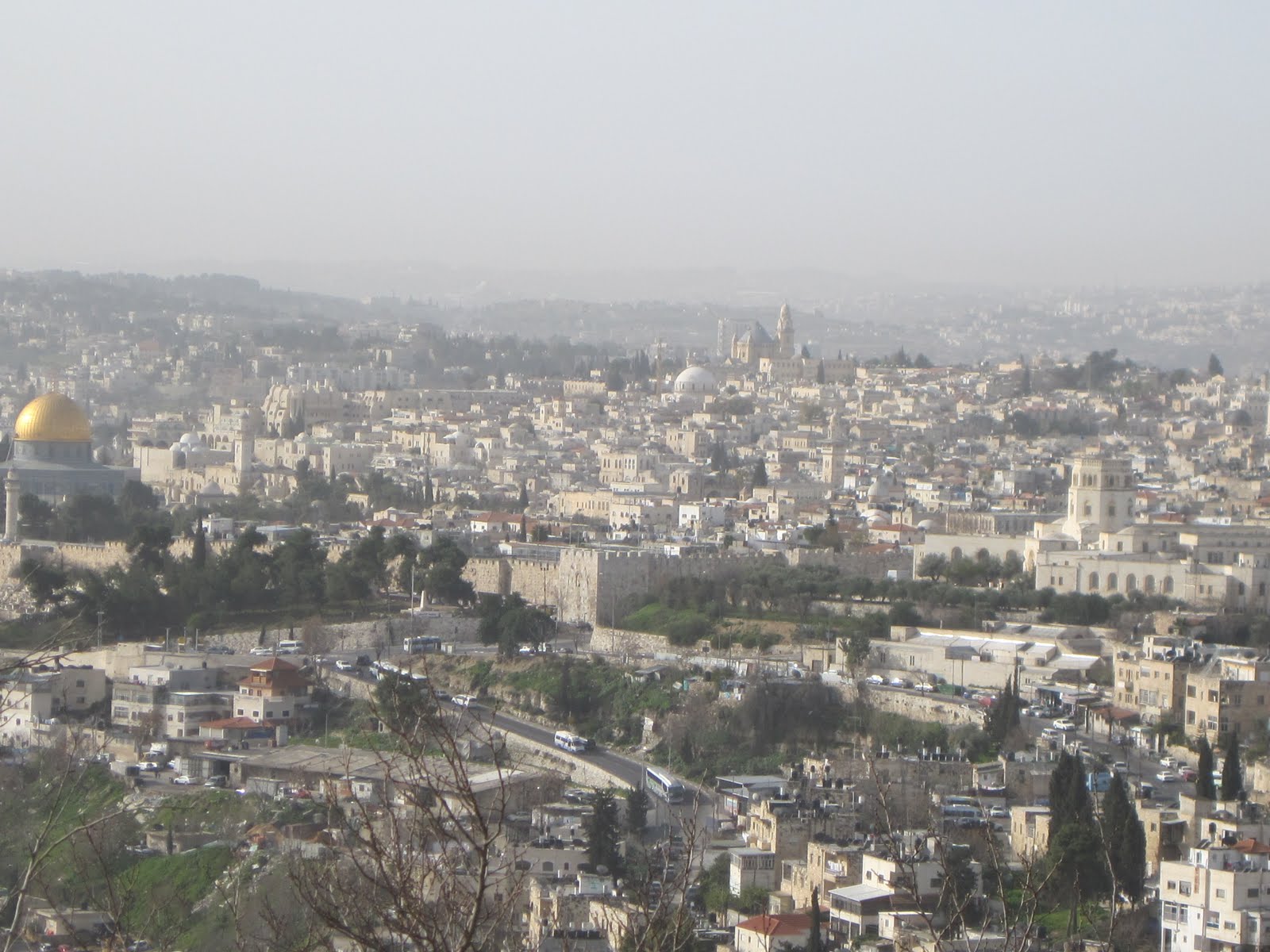
Jerusalem, Israel
February, 2010
Just outside Jerusalem we came to a gate called Truth.  We called to the gatekeeper to let us in.  “The latch is not on,” he replied.  “Anyone who will can enter.”  We went closer, but seeing how great and how heavy was the gate, we looked for a way around.  There must be a way around…The pilgrims trudge toward the death of God.  Only with bowed heads and closed eyes will they be able to see the way to Jerusalem.  (from Kneeling in Jerusalem, by Ann Weems, 63-64)
Our Lenten journey is rounding the bend and we see the city up ahead.  The path has changed us.  So, go cut a palm branch and I will see you in Jerusalem!
Grace and Peace,
Shelli

Receiving and Giving

During both of the “high” seasons of the church year, we talk a lot about change and growth.  Both of them point toward a “high point” and tell us that we have to prepare, that we have to get ready.  When you think about it, Advent points us toward a birth and Lent points us toward a re-birth.  During Advent, we are told over and over again that we have to open our lives and open our heart so that we can receive the Christ-child into our heart, so that we will know what it means for Jesus Christ to enter our life.  In essence, we have to be virgin, pure, open to receive and birth Christ in our own life.  Tis the season of receiving!

During this season of Lent, though, things change.  It is not just about receiving Christ or believing that Christ was resurrected or viewing Christ as the Messiah, or the Savior, or God Incarnate.  We have to do more than just believe the story.  We have to do more than just believe in Jesus Christ.  The only way to prepare oneself to walk this way of the Cross is through total and complete surrender of everything one thinks and everything one is.  We have to begin to become one with the Risen Christ.  We have to enter the Way of Christ. We have to give our lives and our hearts and everything we know over to God.  We become one with God.  You see, the point, I think, is that Jesus did not merely die on the cross to wipe my sin away or insure me everlasting life.  I think it was a bigger deal than that.  The cross is the point of recreation.  God took something so horrific, so unimagineable, so inhumane, and turned it into life.  All of Creation, all that we know, all that we thought changed at that moment.  The earth shook and gasped because nothing would ever be the same again.  The intention was not to just clean each of us and set us back on the same path.  We really are supposed to become something new.  And without death (as in “dying to self”), without handing over one’s life, without letting go of all those things to which you hold so tightly that really have meaning only to you, without giving all that you have and all that you are, God cannot make something new.  God cannot create life.  Tis the season of giving!

There are very few people who realize what God would make of them if they abandoned themselves into [God’s] hands and let themselves be formed by grace.  (St. Ignatius of Loyola, 16th century)

So, follow the one who came that you might have life!

Grace and Peace,

Shelli

LENT 1A: Failed Gardeners

LECTIONARY PASSAGE:  Genesis 2: 15-17, 3: 1-7
The Lord God took the man and put him in the garden of Eden to till it and keep it. And the Lord God commanded the man, “You may freely eat of every tree of the garden; but of the tree of the knowledge of good and evil you shall not eat, for in the day that you eat of it you shall die.”  Now the serpent was more crafty than any other wild animal that the Lord God had made. He said to the woman, “Did God say, ‘You shall not eat from any tree in the garden’?” The woman said to the serpent, “We may eat of the fruit of the trees in the garden; but God said, ‘You shall not eat of the fruit of the tree that is in the middle of the garden, nor shall you touch it, or you shall die.’“ But the serpent said to the woman, “You will not die; for God knows that when you eat of it your eyes will be opened, and you will be like God, knowing good and evil.”  So when the woman saw that the tree was good for food, and that it was a delight to the eyes, and that the tree was to be desired to make one wise, she took of its fruit and ate; and she also gave some to her husband, who was with her, and he ate. Then the eyes of both were opened, and they knew that they were naked; and they sewed fig leaves together and made loincloths for themselves.

Gideon’s Spring, Israel, Feb. 2010

Spring has begun to peek out from behind the winter clouds.  In fact, here in Houston where I live, we have had some incredibly beautiful days.  But my gardens look like anything but spring.  I just haven’t been able to find the time to get something done.  So every time I walk outside my house, I am reminded of my current status as a failed gardener, reminded that where there once had been beauty, there is nothing but desolate dirt.

It’s interesting that we read this passage the first Sunday of Lent.  We just had Ash Wednesday.  We were just reminded that we are dust.  But from dust comes life.  Perhaps this is as much a story about life as it is about death and sin.  After all, as the story goes, they didn’t actually die from eating of the tree.  Or did they?  What was gone was innocence.  What was gone was that unblemished connection to God.  What was gone was that childhood view that nothing could ever go wrong.  There are those whose faith understanding is that we are called to return to the Garden.  That sounds stupid to me.  Why would God create this whole incredible universe and then expect us to stay locked in a garden?

But the truth was, they did die—they died to themselves.  And God began to show humanity the way home, the way through temptation and exile and wandering in the wilderness.  God began to show humanity what it was like to return.  Our whole faith journey may be more about returning home, returning to God, than about anything else.  I, personally, don’t think we’re headed back to this metaphorical Garden; otherwise, it would seem that God would be apparently content with plunking us down into some sort of pre-perfected existence where we could just enjoy the beauty.  I think that was only the beginning.  God has a whole lot more in store for us.  Maybe the point of the story is not that Adam and Eve messed it up for all of humanity and got us banished from some imaginary garden.  Maybe the point of the story is that our eyes can be opened, that we can gain vision beyond ourselves.  Maybe the point of the story is to remind us what tilling and tending really is.   It’s hard work.  It’s more than just cleaning up a few weed scragglers that have snuck into one’s otherwise-pristine existence.  It’s about going where you have not; it’s about navigating weeds and storms and the temptation to plant what will not grow; it’s about getting your hands dirty; it’s about learning to see life where there is only dust and dirt.  It’s about going into the world with a faint memory of what beauty and life is and bringing it to be around you.  It’s not about returning to the Garden; it’s about returning to God.  So, actually, there is no such thing as a failed gardener.  There is always more planting and tending to do for the life that God continually offers.

So, go and be tenders of the life that God offers! 

Grace and Peace,

Shelli 

A New Creation

Genesis:  1: 1-5
In the beginning when God created the heavens and the earth, the earth was a formless void and darkness covered the face of the deep, while a wind from God swept over the face of the waters. Then God said, ‘Let there be light’; and there was light. And God saw that the light was good; and God separated the light from the darkness. God called the light Day, and the darkness he called Night. And there was evening and there was morning, the first day.

This is normally not a passage for Easter Day.  What happened to the empty tomb?  What happened to the dawn of the Eastern morn?  What happened to the Resurrected Christ?  I actually think it’s all there:  A formless void–nothingness, chaos, injustice, persecution, evil, death–is recreated into order while God’s Spirit sweeps across its being.  A light appears…a first light…a light that has never been before…a light separated from the darkness of death and despair and hell.  It is the dawn of the Light.  It is the first day of the New Creation.  Christ the Lord has Risen!  ALLELUIA!  ALLELUIA!  ALLELUIA!…

This thing that God has done…this turning despair into hope and death into life…is surely the greatest act of Creation!  God again took a formless void, an instrument of hopelessness and death, a manifestation of denial and betrayal, of injustice and evil, and there…there in the first light of this morning…we see glorious Light…we see hope…we see life as we’ve never seen it before.  There…there in the light of the dawn is our eternity!

Welcome, happy morning!  Age to age shall say: 
Hell today is vanquished, Heaven is won today.”
Lo! the dead is living, God forevermore! 
Him, their true creator, All his works adore.
Earth with joy confesses, Clothing her for spring, 
All good gifts returned with her returning King,
Bloom in every meadow, leaves on every bough,
speak his sorrows ended; Hail his triumph now.
Thou, of life the author, Death didst undergo, 
Tread the path of darkness, saving strength to show;
Come then, true and faithful, now fulfill thy word; 
Tis thine own third morning, Rise, O buried Lord!
Welcome, happy morning!  Age to age shall say: 
“Hell today is vanquished, Heaven is won today!
Lo! the dead is living, God forevermore! 
Him, their true creator, All his works adore.
                                          (“Welcome Happy Morning”, hymn by Fortunatus (ca. 535-600), trans. by John Ellerton)   

Christ the Lord is Risen!  ALLELUIA!…And there was evening and there was morning the first day…

Grace and Peace,

Shelli

Unless You Repent…

This Week’s Lectionary Gospel Passage:  Luke 13: 1-9
At that very time there were some present who told him about the Galileans whose blood Pilate had mingled with their sacrifices. He asked them, “Do you think that because these Galileans suffered in this way they were worse sinners than all other Galileans? No, I tell you; but unless you repent, you will all perish as they did. Or those eighteen who were killed when the tower of Siloam fell on them—do you think that they were worse offenders than all the others living in Jerusalem? No, I tell you; but unless you repent, you will all perish just as they did.” Then he told this parable: “A man had a fig tree planted in his vineyard; and he came looking for fruit on it and found none. So he said to the gardener, ‘See here! For three years I have come looking for fruit on this fig tree, and still I find none. Cut it down! Why should it be wasting the soil?’ He replied, ‘Sir, let it alone for one more year, until I dig around it and put manure on it. If it bears fruit next year, well and good; but if not, you can cut it down.’” (NRSV)

Hmmm!  Maybe we should try the Psalm.  They’re usually a little more friendly, not quite as prickly to the touch, right?  The truth is, we do not like to be threatened and this sounds very threatening.  We’d rather listen to the soothing melodies of assurance and unconditional love and grace.  Repentance is just too stressful, just too harsh and unyielding.  But, unless you repent…
 
I think the problem is that we look at repentance as something negative.  We envision repentance as some sort of self-denial.  We think that we can no longer be who we are but instead we must become some sort of stamped-out “stepford” Christian in order to “measure up” to Jesus Christ.  To quote the old, much-overused, and oft-abused slogan “What Would Jesus Do?” (WWJD), we use Christ as some sort of divine measuring stick of what is good and what is evil, what is right and what is immoral, and, more importantly, what is it that would win us favor and life with God?  So, what would Jesus do?  Well, I’m convinced that he’d throw that rot out with that batch of bad figs!  Because repentance is not negative.  It does not mean losing who you are.  It means discovering the wonder of who you are meant to be.
 
The Greek word that is usually translated as “repentance” is metanoia.    In Classical Greek, it meant to change one’s mind, one’s heart, one’s soul, one’s life.  Penance was not a part of it.  It simply meant to follow a different road.  I think that IS what Jesus would do.  Why is that so difficult for us?  Is the road that we’re on so grand?  For most of us, probably not.  It is just comfortably familiar.  But don’t we deserve more than comfortable?  We are told of a new life, a new creation, an existence of perfect harmony and shalom.  I don’t think that’s necessarily limited to our next life, or heaven, or the other side of the rainbow, or however you envision it.  I think it’s down that road.  But…unless you repent…unless you change course, let go of the life that you’ve created, and listen to the road that beckons before you, you will remain comfortable and secure and right where you are. And then you will die! But, oh, what you will miss!
 
The road ahead looks dark now and even a little bleak.  The skies are blackening and there’s this awful hammering of metal against wood up ahead.  There is shouting and chaos.  It IS tempting to pull the covers over our head and just stay in for the day.  But just beyond that hill, just ahead, through those rocks and trees, there is a tiny flicker of light.  Let us go and see this thing that has happened.  Frederick Buechner says, “To repent is to come to your senses. It is not so much something you do as something that happens. True repentance spends less time looking at the past and saying, “I’m sorry,” than to the future and saying, “Wow!” (Buechner, Wishful Thinking, 79)  But, unless you repent…
 
So, repent and believe the Gospel!
 
Shelli

Picture: Israel (February, 2010)

Facing Jerusalem

This week’s Lectionary Gospel Passage:  Luke 13: 31-35:
At that very hour some Pharisees came and said to him, “Get away from here, for Herod wants to kill you.” He said to them, “Go and tell that fox for me, ‘Listen, I am casting out demons and performing cures today and tomorrow, and on the third day I finish my work. Yet today, tomorrow, and the next day I must be on my way, because it is impossible for a prophet to be killed outside of Jerusalem.’ Jerusalem, Jerusalem, the city that kills the prophets and stones those who are sent to it! How often have I desired to gather your children together as a hen gathers her brood under her wings, and you were not willing! See, your house is left to you. And I tell you, you will not see me until the time comes when you say, ‘Blessed is the one who comes in the name of the Lord.’”

This time at the beginning of Lent is hard for us. We read the assigned lectionary Gospel passage for this week with much trepidation. If we were watching it on a big screen, this would be the time that we would begin to cover our eyes. It is because as we move into this season of Lent, this season of our journey to the cross, we begin to get a sense of what is about to happen. We want to yell to Jesus, “Go back…go back to where you were…go back to what you were doing before…go back and do it differently this time…be safe…be careful.” But we also know that it is too late. After all, how could it be done differently? Jesus is not known for being safe and careful.

The writer of the Gospel According to Luke gives us clues that tell us that the time for “going back” has lapsed. The passage begins “at that very hour”. Time has come together. The future has poured into what is now. Now is the time. It was apparent that Jesus knew that too. Jesus was looking beyond where he was, beyond these towns in which he was teaching and spreading the Good News, beyond Galilee. Jesus was looking ahead. He had to face it. He had to face Jerusalem.

I think that this is part of what this season of Lent calls us to do—to look beyond, to extend our vision, to see past those things that get in the way of being who God calls us to be. It means that we can no longer stay safe and secure and wrapped in the planned predictability of our lives. It means that the time has passed for us to stand looking longingly at the fertile Galilees of our lives with the calmed waves and the fruitful harvest. It is time. It is time to brave the wilderness, to begin our pilgrimage through the barren desert, and to finally, at this very hour, face our own Jerusalem.

You see, one thing that we need to get straight in reading this Scripture is that, with the exception of one boyhood trip with his parents, Jesus had not been to Jerusalem. Jesus’ ministry was in Galilee. In fact, most of his ministry sort of centered around a lake. (We actually call it the Sea of Galilee—sort of a misinterpretation. It’s really a large and very deep fresh water lake.) From the middle of this lake, you can look around to the cities that line its banks—Tiberias and Sephoris, the cities built by Herod Antipas, the ruins of the ancient city of Magdala, Bethsaida, Capernaum—and between the lake and the Mediterranean Sea was Cana and Nazareth. This was the area in which Jesus’ ministry began. Jesus was not commuting to work in Jerusalem. Jerusalem was still a long way off, through the wilderness and beyond the fertile area of Galilee.

And even here, Jesus was probably perceived as a threat by Herod. It would have been much easier for Herod to get rid of Jesus. After all, this was the Herod that had already killed John the Baptist (and getting rid of Jesus would probably have elevated Herod’s somewhat meager ranking as a ruler.) And Herod had his own vision working as he tried to lead the Galilean people to a new world—a world where Rome was the center and where the values were totally opposed by the teachings of Jesus. So, yes, Jesus was a threat.

There are differing notions as to what Jesus meant when he referred to Herod as a “fox”. In the Old Testament writings, the fox was often associated with destruction and Jewish dietary laws classified the jackal as “unclean.” To the first century Greeks, the fox was seen as clever but unprincipled. Whatever Jesus’ intended meaning was, it was clear that Jesus dismissed Herod Antipas as powerless to stop his mission to establish the Kingdom of God. As Jesus responded, he was going to do what he came to do and then he would be on his way. The mission was set. So with this Scripture, we begin to get a sense that Jesus is looking toward and facing Jerusalem.

Jesus is no longer merely “preparing” to go to Jerusalem. He is headed there. He has set his face toward the holy city. To Jesus, the danger was not in the Herods of the world but, rather, those things that got in the way of his mission. But he turns toward the city with regrets and heartache. And Jesus laments for Jerusalem.
In The Gospel According to Matthew, this lament is placed once Jesus is in Jerusalem. We have this image of Jesus standing on the Mount of Olives overlooking Jerusalem and lamenting for what could have been. But in the gospel by the writer known as Luke that we read today, the lament is part of Jesus’ Galilean experience. It is indeed a lament but rather than Jesus bemoaning what could have been, it is instead a challenge to the people to become a part of this mission, to “get their house in order”, so to speak, and to become a part of that new humanity that is of Jesus Christ. Jesus does not want Jerusalem to become a symbol of a city that rejects and kills the messengers of God; Jesus wants it to be the Holy City of God that it proclaims to be. After all, this is not an ordinary city. This is the city that claims that the presence of God is in its midst, right there in the temple in the heart of the city near Mt. Zion. And yet, this city, too, has fallen into a different cadence, marching to the beat of prosperity and security and a positioning of power toward those around it. This holy city, the city of the temple, the city that should know better, would be the one that when the time came, would reject Jesus. Jesus knew this. So he turns his face toward Jerusalem and begins the journey toward the cross.

And, once again, lest we somehow lapse into an understanding of Jerusalem’s rejection of Jesus as only attributed to the 1st century Jewish believers, we need to realize that we are part of it. Jesus was not rejected by a religion; Jesus was rejected by a culture and a society that thought that they were so right and so comfortable that they did not want to or have a need to change. Jesus was rejected by a culture and a way of life that is very much like our own.

But there’s another point to the Scripture. Even knowing the rejection waiting for him in Jerusalem, Jesus still expresses the wish to love and protect the people, gathering them together as a hen does her chicks. Jesus never stoops to their level. He never judges or rants and raves about what is right, or what is moral, or what is going to happen to them because they have rejected him. He is the perfect image of God—the loving parent, the mother hen, who more than anything else, just wants to love her children and desires for them that they feel that love.

So where do we come in? In this season of Lent, what does it mean for us to face Jerusalem? Well, my friends, we need to remember that Lent is about more than giving up chocolate. It is also about turning our face toward our Jerusalem. It’s about being honest when we look at our cities, our culture, our ways of living in this world and dealing with our fellow brothers and sisters, and, most of all, being honest with ourselves.
Think about it. Jesus did not back down, even in the midst of numerous warnings. Instead, he kept working toward the vision that God had for the world. The mission was more important than his own preservation. Risking himself, God brought the Kingdom of God into the beloved city of God. He gathered in the people of God and then with deep and profound lament, had to face the very real truth that they were not going to change—not yet. And so he just loved them.

Where is your Jerusalem? Where is your city that refuses to change? What is it that you need to face? What is it in your life that stands in the way of your knowing how very much God loves you? What is it in your life that stands in the way of your loving God enough to love God’s children—ALL of God’s children?

You see…long ago in the holy city of Jerusalem, we saw the face of Jesus. It was the face of a man who longed for and worked for change. But it was also the face of God, who came that we might have life and have it abundantly. In his book The Faces of Jesus, Frederick Buechner says that “take it or leave it, the face of Jesus is, if nothing else, at least a face we would know anywhere—a face that belongs to us somehow, our age, our culture; a face we somehow belong to. Like the faces of the people we love, it has become so familiar that unless we take pains we hardly see it at all. Take pains. See it for what it is and to see it whole, see it too for what it is just possible that it will become: the face of Jesus as the face of our own secret and innermost destiny: The face of Jesus is our face.”

That’s what Lent is about. It is more than reliving Jesus’ journey from the fertile waters of Galilee to the harsh and painful reality of the holy city of Jerusalem. Lent is instead about our own journey, our own pilgrimage from the Galilees of our life to that moment when we truly face Jerusalem. It is about clearing away those things that obstruct God’s vision for our lives, that tie us to our own way of being that we have constructed, and that get in the way of us realizing that when everything is said and done, it is all because God just wants to love us and wants us to feel that love. So, open your eyes, look toward Jerusalem so that you can finally say, “Blessed is the one who comes in the name of the Lord.”

So, go…face Jerusalem this Lenten season!

Shelli

Picture: Jerusalem, Israel (February, 2010)

When Nothing Else Makes Sense

A Good Friday Sermon…

Lectionary Text: John 18: 1-19:42

This is the road that we have all walked before. Most of us would rather not. We would rather just close our eyes and wake up when the whole awful thing has ended. We would rather open our eyes and see that everything is alright or, even better, back where it used to be. This is grief. We have all experienced it. We have all felt loss and despair; we have all felt as if the very foundations of our world have been ripped away and left us standing to fend for ourselves. We have all felt at times like the abyss in which we find ourselves is consuming us and that there is no way out. And grief is the one thing that does not get easier each time you do it. Each time cuts a little sharper and a little deeper until nothing of our lives make sense in light of the way it was before. This is the road we walk when nothing else makes sense.

The road we walk today is no different. Oh, perhaps it seems to be, because intellectually we already know the ending to the story. But it is grief nevertheless. We sit here in this darkened sanctuary contemplating what was done on this day. We can hear the sounds of a world going about its business. That’s always a bit odd for me. There’s a part of me that expects the world, if only for a moment, to stop and grieve my grief, to revere what I revere, and to feel this in the same way that I do. But that does not happen. It is mine to feel and mine through which to walk.

If we are feeling this today, can you imagine what the disciples must have been feeling? They were on the ground floor of something wonderful; they were part of changing the world. This radical roving man who they had agreed to follow for life was doing something incredible! What was happening now, though? Was it only five days ago that we came to town? Was it only five days ago that we were at the height of these years—processing into town with all those people cheering us on? Was it just last night that we were eating dinner together? And, now this? What went wrong? Surely this would turn out alright! After all, this man works miracles! But there was to be no miracle this time.

Their grief was insurmountable. And, around them the world was continuing on. We as followers of Jesus ourselves have this sense of this execution being a big deal, as if the whole of Jerusalem and surrounding areas shut down for the day to be a part of it. But the truth was, this happened all the time. This was just one more Roman crucifixion in the life of a city that lived in perilous and often tenuous times on the world stage. And, so the life around them did not stop. And they had to face their grief in the midst of it all.

And at this point, they had to also look at themselves, uncomfortable as that may have been. What part had I played in this whole sequence? What would I do now? And we 21st century disciples also have to ask where we would be in the story. There was Peter, wallowing in guilt for not standing up for his friend, for denying his own belief. He had wanted so badly to be part of Jesus’ “inner circle”. But why couldn’t he come through when it mattered? There were the fishermen James and John. They had willingly followed Jesus, giving up everything they knew. What would they do now? Jesus was their everything. What about Mary Magdalene? Jesus was the first person that had accepted her, that had loved her simply for who she was? And now that was gone. And Judas…Judas carried the heaviest grief of all. He didn’t know whether or not he could live with himself. The very foundations of their world were gone as they watched their whole world nailed to a cross and slip away. None of this made any sense at all.

We Christians have spent centuries trying to make sense of the cross, perhaps even trying to take our own humanity and our own part out of the equation. The truth is that Jesus was put to death because we as humans expected something different. It was humans who took control and did this. But there are more theories of the cross and its atoning power than most of us will ever fathom. It has been described by some as a cosmic battle between good and evil, a battle that God seems to lose at first only to pull it out in the end. Then there is the belief that the cross depicted God’s love in such that we humans might be compelled to follow in faith. And there are those for whom the cross is the satisfaction paid to God for the sins of the world, a substitution of the redeemer for the sinful, implying that God somehow demands a ransom in order to release our redemption and salvation. In all honesty, I struggle with all of these. In fact, none of them by themselves really makes sense to me.

It seems, to me that the cosmic battle takes humanity out of the picture, relegating us to bystanders. If there is no humanity associated with the cross, what, really is the point? And while the notion of God’s love depicted by the cross is of paramount importance to us, if we leave it there, it sort of turns it into an overly sentimental description of the incredible mystery and power of God. Is that all there is? And, probably the most popular understanding in our history, the understanding of the cross as a satisfaction paid to God for our sins does not really make sense for me. Think about it. God created us in the image of Godself. It would not make sense, then, for God to have to be talked into loving us. True redemption is not a required sacrifice, but an act of overwhelming love by God who desires us as much as we need God. It is we humans that try desperately to come up with a reason for the cross, with a reason for Jesus’ death. Perhaps there was no reason. Perhaps God truly took the senseless, the inhumanness of our humanity, and made sense of it.

Truthfully, though, there is no single understanding of the cross that has been accepted by everyone. None of them are mutually exclusive. And none, alone, really make sense of something that is so filled with the pervasive mystery of God. In a way that sometimes makes little sense to us, God turned suffering into joy, betrayal into forgiveness, and death into life. From that standpoint, the cross, for me, could be counted as God’s highest act of Creation in all of time. The cross is God’s overwhelming love made tangible and real and accessible for each of us.

God took something so horrific, so senseless, so utterly inhumane, and so personally painful and recreated it. But when you think about, God had done that before. If you remember, in the beginning, there was nothingness, senselessness and God created all that there is, bringing order to the senselessness. And it was very, very good. And now, at the depth of our grief, in the face of what seems to us senseless, God once again creates life. And once again, all of Creation responds. Other Gospel writers depict the Crucifixion by saying that the whole earth shook, rocks were split, graves opened and the temple curtain that had always separated the sacred from the ordinary was torn in two. As the earth opened up, surely seeming to the world that Creation was undoing itself, the holiest of holies spilled into it. In this moment, when all we see are endings, when grief overwhelms us, when our very lives seem to have been swallowed up, God recreates everything. In this moment, the universe has changed. Death is not just avoided or bypassed but is indeed swallowed up by life. In this moment, death itself is defeated. And God looked at it all. It is finished. And it is very, very good.

There’s still a lot in this world that doesn’t make sense. September 11, 2001 still clangs loudly in our hearts, with its almost jarring effects of despair and hopelessness, suffering and death, and its intrusive way that it has affected our well-tuned and carefully planned lives. Communities were devastated, lives were shattered, and the pall of an incredible hopelessness still to some extent hangs in our hearts over Ground Zero.

Like many other landmarks around it, the Liberty Community Gardens in Battery Park were almost totally destroyed on that day, buried in dust and ashes. What was left was later trampled by the hundreds of workers and then finally destroyed when it was designated as the place where the smashed fire trucks and rescue vehicles would be temporarily discarded.
But more than 2,800 miles away, there were some 75,000 people in the city of Seattle who responded to their own shock and sadness of that day by bringing more than a million flowers to the International Fountain in the Seattle Center. By depositing beauty, it was their way of honoring those who had suffered in the devastation. It was there way of creating something new. But we know that we cannot hold life in our hands. And so as the flowers started to decay, echoing their own tales of death and stench and despair, hundreds of volunteers began the painstaking effort of separating the flowers from the paper, plastic, mementos, and wires that were mixed with them and then chopped and mashed the 80 cubic yards of flowers into mulch for composting.

If you garden at all, you know that compost is a metaphor for renewal, a natural part of life and death, a reminder of new hope gained from loss. It is a reminder of rebirth and recreation. From the sadness of the twin towers, was birthed a source of life.

But the story doesn’t end there. One of the volunteers had an idea. And so, in September of 2002, a year after the desolation of the Battery Park Gardens, thirty-two donated boxes were each filled with forty to fifty pounds of the compost and flown to New York City. And on September 28, 2002, the New York gardens were rededicated—to abundance and beauty, and to a future life recreated from present death. Things will never be back to the way they were before, but God has sown the beginning of something new. But we had to wait to see it in all its fullness.

We had always envisioned a Savior that would make the world around us alright again. Instead God in Christ began recreating the world into that which it is supposed to be. That, of course, is hard to grasp as we stand at the foot of the cross watching our Lord writhe in pain and despair. But Jesus Christ came as fully human, with all of the feelings and emotions that we experience. Christ knew what it was like to be human, knew what it was like to feel pain, and knew what it was like to grieve. It is tempting to ask where God was through all this. God was there. God went to the cross first.

After the Crucifixion, this defeated little band of disciples had no hope. As you can imagine, they had no expectation of anything else to come. Everything in which they believed, in which they had invested their lives, had died on the cross. It seemed to them that the world had been right and they had been wrong. Joan Chittister says that “the road behind us becomes what frees us for the road ahead.” In this moment, God was already freeing them from grief and recreating joy.

And us…there is something in all of us that struggles with the thought of God suffering. We instead imagine a God that stands apart from us, shielded from pain, and prepared to pick up the pieces of our lives when we need it. But God, in God’s infinite wisdom rather recreates our lives from the inside, from the point of our deepest pain and suffering, from the cross, and even we become new Creations whether or not we can see it now. The cross is the rebirth of humanity in all its fullness. In this moment, it is death that dies.

It is hard for us to see right now. It is hard to see clearly through the tears of grief. Christ died on a cross in immense suffering and pain. And those who love him grieve a grief such that they have never known. As we sit here in this dark sanctuary and listen to the bells toll, we will once again feel the finality of it all. But Louis L’Amour once wrote that “there will come a time when you believe everything is finished. That will be the beginning.” And just when nothing else makes sense, it is in that moment that your eternity has begun.

In the Name of Christ Crucified, in the Name of overwhelming Love.

Grace and Peace,

Shelli