Station IX: On the Other Side

"Under the Baobab Tree:  African Stations of the Cross"
“Under the Baobab Tree: African Stations of the Cross”

Scripture Passage: Luke 10: 30-33

30Jesus replied, “A man was going down from Jerusalem to Jericho, and fell into the hands of robbers, who stripped him, beat him, and went away, leaving him half dead. 31Now by chance a priest was going down that road; and when he saw him, he passed by on the other side. 32So likewise a Levite, when he came to the place and saw him, passed by on the other side. 33But a Samaritan while traveling came near him; and when he saw him, he was moved with pity.

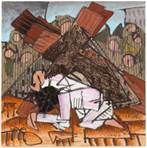
For us, we have the sense that this procession to the Cross was some sort of grand parade but, truthfully, this was something that happened regularly.  It really was just another crucifixion in the big scheme of society.  And most would have assumed that this poor criminal, already tried, convicted, and sentenced, already rejected by society, was just being dragged to a death that he must deserve.  And, besides, this was the eve of the Passover.  There was so much to be done–errands, food to be prepared, houses to clean.  So think of all the passersby, scurrying through their lives, many complaining about the traffic and the clogged roads that the procession was causing.  So, many would have just passed by on the other side, not wanting to touch or be touched by hopelessness and despair and death or maybe just not wanting or having the time to get involved.  And, then, again, Jesus falls.

Tradition tells us that Jesus collapsed for a third time not far from where he would be crucified.  A Roman column indicates the location of his third and final fall.  It has become part of a wall of a Coptic church.  During the Crusader period, there was a large monastery here, the remains of which are still visible today.  Standing there, you can see the roof of St. Helena’s Chapel, a part of the Church of the Holy Sepulchre, where a community of Abyssinian monks live today.  This is the place where Jesus would fall for the last time.  This is the end of the road, so to speak.  The next station will be on the other side, preparing him for crucifixion.  This is the last place where those along the way could show mercy, the last place where they could help, where they could stoop down and gently help him to his feet.  But most would pass by on the other side.

This is uncomfortable for us.  After all, where would we have been in the procession?  I hate to admit it, but I’m not the most patient person in the world. I’m afraid that I would have been avoiding the traffic,trying to get everything done, trying to get everything in place by sunset.  We are so accustomed to living a life of faith needing Jesus.  We know we need Jesus.  We know that we are not complete without God.  We do not always live that way, often trying to fix things and change things and make it look like we don’t need anyone.  But we know we do.  We need Jesus.  But, here, here is the place where Jesus needs us.  How can that be?  How can the Savior of the World need me?  These three falls that are depicted in the Via Dolorosa, the Way of the Cross, uncomfortably show Jesus as vulnerable, as betrayed, and as needing us.  So where are you standing?

Jesus still needs us.  We are called to be there to feed the starving, to house the homeless, to clothe the poor.  We are called to be there to comfort the afflicted, to hold the grieving, to love the unloved.  We are called to be there to welcome the sinner and forgive the unforgiven.  We are called to open our church doors to all the children of God.  We are called to be Christ, to be Compassion, to be Love each and every time one of us falls.  So in this Lenten season, let us not relegate our faith to the other side of the road.  Let us walk the way that Jesus walked.

Grace and Peace,

Shelli
Station VIII: Lament

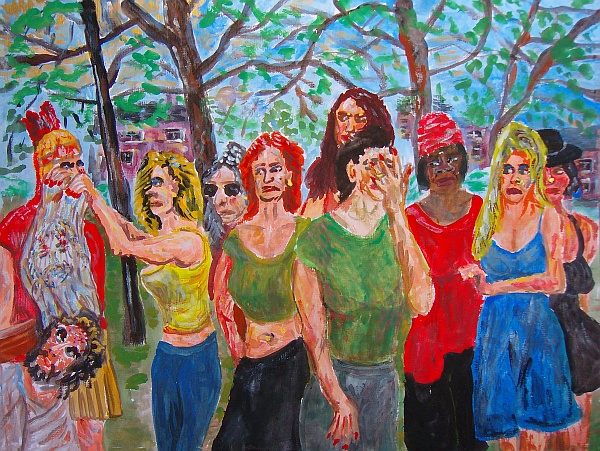
"The Women:  Veronical Wipes Jesus' Face and Jesus Meets the Women of Jerusalem, St. Mary's Church, Barton-on-Humber, April 4, 2007
“The Women: Veronical Wipes Jesus’ Face and Jesus Meets the Women of Jerusalem, St. Mary’s Church, Barton-on-Humber, April 4, 2007

Scripture Passage: Luke 23: 27-31

27A great number of the people followed him, and among them were women who were beating their breasts and wailing for him.28But Jesus turned to them and said, “Daughters of Jerusalem, do not weep for me, but weep for yourselves and for your children.29For the days are surely coming when they will say, ‘Blessed are the barren, and the wombs that never bore, and the breasts that never nursed.’30Then they will begin to say to the mountains, ‘Fall on us’; and to the hills, ‘Cover us.’31For if they do this when the wood is green, what will happen when it is dry?”

The eighth station on this holy walk is marked by a stone with a Latin cross on the wall of a Greek Orthodox church.  Near the cross, an inscription reads, “Christ the Victor.”  Tradition has designated this as the place where Jesus encounters the women of Jerusalem.  The women were convinced of his holiness.  I don’t think they understood it completely.  After all, who did?  (After all, who does?)  But they knew that he was something special.  After all, he had paid attention to them, these women, these ones who were given no place in society other than to birth babies.  He saw them as something more.  And they were grateful.  And today they grieved.

As Jesus and the crowd moved closer to the end, the wailing got louder and louder.  Jesus, covered in dirt and sweat and near death, lifted his head and looked into their eyes.  “Do not weep for me,” he said, “but weep for the world.”  Weep for the world; cry for the world; grieve for the world. In other words, those that suffer in the world, those parts of the world that are not life-giving, those part of people’s lives that are not the vision that God holds–those things should bother you.  Those are the things for which you should weep.

Weeping is hard for us.  Our culture is pretty well emotionally controlled, for the most part.  In fact, there are those that grow up thinking that tears and grief and crying are a sign of weakness.  We do not know how to lament.  And, yet, think of all those psalms of lament.  They are prayers.  Laments are prayers.  Weeping is prayer.  These are prayers for what could be and is not, prayers for what should have been that fell short, and prayers for the hurting in our world.  Jesus is telling these women to pray, to wake up, and to work to change the world.  He is acknowledging that they understand this vision and that, now, they have work to do.  It is a way of putting others before self.  It is a way of engaging yourself and your faith in bringing the Kingdom of God in its fullest into being.  It is a way of continuing the life of Jesus Christ.

I saw a feature news story by NBC’s Brian Williams last night on Camden, New Jersey.  A bustling boomtown in the first half of the 20th century, Camden is now America’s poorest city and the one with the highest crime rate.  Surrounded by relatively affluent suburbs, it is the place that we drive by, wondering why no one does anything.  Its residents that fill the inner city row houses seldom venture outside for fear of the safety of themselves and their children.  It is the way we hide poverty and despair in plain sight.

http://www.nbcnews.com/video/rock-center/51110367

So on this Lenten journey, learn what it means to weep for the world.  Pray for the world and for others who hurt and grieve and bleed, those who fear and cry and need.  Learn to lament, an active lament that will make you part of bringing the world into that vision that God holds.  Open your eyes to see the pain that exists in plain sight.  Our Lenten journey calls us to do something to change the world.

Grace and Peace,

Shelli

Station VII: Betrayed

Station 07-EScripture Passage:  Matthew 26: 20-23

20When it was evening, he took his place with the twelve; 21and while they were eating, he said, “Truly I tell you, one of you will betray me.” 22And they became greatly distressed and began to say to him one after another, “Surely not I, Lord?” 23He answered, “The one who has dipped his hand into the bowl with me will betray me.

The seventh station on the Via Dolorosa is Jesus’ second fall.  Marked by a Roman column housed in a Catholic Chapel, it is the traditional place where the Gate of Judgment stood.  This is the place where judgments were passed on those that had committed crimes.  And here, passing out of the city, Jesus falls again.  Though surrounded by a host of onlookers and curious tourists, he is alone, deserted and betrayed by those whom he had loved.  You can surmise that they were fearful for themselves, perhaps even fearful that there would be no one to carry the message into the future.  But let’s be honest.  They just weren’t there.  The night before, Jesus had dipped his hand into a bowl that others at the table would also touch and dip.  Jesus knew that the one who had dipped his hand into the bowl with him would betray him.

I know.  The story picks up with Judas right after the verses of Scripture that I used.  We like thinking of Judas as the poster boy of betrayal.  That’s an easy way out, to blame it on the most obvious perpetrator, the one who makes us all look like saints.  And yet, Jesus’ words as the writer of this Gospel portrayed them, says “the one who has dipped his hand…”  Think about it.  It was a community bowl.  ALL of those at the table dipped their hands in the bowl.  The truth is, Jesus probably knew that he would be alone on this day, that all would in their own way betray him–one by a kiss, one by a denial, and others by stepping back into their fears that they, too, might be found out.

Polish-born writer Isaac Singe said that “when you betray someone else you also betray yourself.”  The reason, I think, is because betrayal cuts so deep that you lose a part of yourself.  If someone asked you what the opposite of faith is, you’d probably immediately say doubt.  But, think about it, doubt compels one to search, compels one to question, compels one to grow.  Doubt and faith are inextricably intertwined.  The opposite of faith, the antithesis of faith, of journeying toward who you are called to be is more than likely betrayal.  It is completely contrary to “love your neighbor” as well as to “love God with [all you are]”.  Betrayal is a loss of who one is called to be.

And so Jesus falls, alone, defeated, betrayed.  He was feeling the ultimate of rejection.  All he had left was hope.  And so he breathed deeply and continued on.  And his betrayers cowered behind closed doors feeling a loss that they could not describe.  Surely not I…surely not I…surely not I.

In this Season of Lent, think of ways that you betray who you are called to be, ways that you cut yourself off from life, from others, from God.  Then, rise up, for you faith has made you whole.

Grace and Peace,

Shelli 

Station VI: No Longer Hidden

Station 06-HScripture Passage: Luke 8: 43-48:

43Now there was a woman who had been suffering from hemorrhages for twelve years; and though she had spent all she had on physicians, no one could cure her. 44She came up behind him and touched the fringe of his clothes, and immediately her hemorrhage stopped. 45Then Jesus asked, “Who touched me?” When all denied it, Peter said, “Master, the crowds surround you and press in on you.” 46But Jesus said, “Someone touched me; for I noticed that power had gone out from me.” 47When the woman saw that she could not remain hidden, she came trembling; and falling down before him, she declared in the presence of all the people why she had touched him, and how she had been immediately healed. 48He said to her, “Daughter, your faith has made you well; go in peace.”

The sixth station of the Stations of the Cross, named Veronica Wipes the Face of Jesus, does not come directly from Scripture but rather from the hearts and the traditions of the early European Christians. Tradition holds that Jesus healed a young woman named Veronica in his early ministry and as a sign of her deep and abiding gratitude for him, she accompanied him to the place of his execution. When she wiped his sweating face along this walk, the imprint of his face supposedly remained on the cloth. Eusebius, in his Historia Ecclesiastica, tells how at Caesarea Philippi lived the woman who Jesus healed of the blood disorder. In the West, she was identified as Martha of Bethany; in the East, she was called Berenike, or Beronike, the name appearing in the Acts of Pilate. The derivation of the name Veronica comes from the words “Vera Icon”, or “true image”.

This man had shown her great compassion when she thought there was none. The bleeding had started and had never stopped. And so, always, she was deemed unclean and, therefore, unacceptable, untouchable, shunned. This was a last effort to claim her life, to become a person of value and worth again in a society that so carefully laid out who was acceptable and who was not. She had, carefully, made her way through the crowds that day avoiding the stares and recoils that others held for her. And then she touched him. It was only a touch but she could feel something. She cowered back into the crowd trying to hide. But he saw her, compelling her forward and her life was never the same again.

And so on this day, she could not just hide out in the crowd. He needed someone–companionship, mercy, compassion. She didn’t care what she was risking. After all, this is the one who had given her her life. She could do this one thing. And when she wiped his face, she felt that same burst of power that she had felt before, a life-giving, life-awakening power. And she was left with the image of Christ.

Whether we take this literally or not, whether we believe that she was healed or that Christ’s imprint adhered to a cloth, is not the point. You see, each of us was made in the image of God. We are not destined to BE God but to be an image, a reflection of the Godself into the world and into the lives of each and every one that we meet. And when we show compassion, when we show mercy, when we step forward and show love to those who need it the most, the imprint of that image DOES stay with us. We become a reflection of the Christ, an image of the God who gave us life and calls us to show it to the world. And as Jesus walked toward death, the image of the Christ remained, no longer hidden, on the one who reached out to one in need. Reaching out to others does not mean that we are Christ; it means that we are human, fully human, the way Christ showed us to be.

So in this season of darkness and shadows, remain no longer hidden but step forward into this Walk of Christ and help someone in need. And the imprint of Christ, the image of the very Godself, will stay with you always.

Grace and Peace,

Shelli

The Season of Unpreparation

Scripture Passage: Mark 6: 7-12
7He called the twelve and began to send them out two by two, and gave them authority over the unclean spirits.8He ordered them to take nothing for their journey except a staff; no bread, no bag, no money in their belts;9but to wear sandals and not to put on two tunics.10He said to them, “Wherever you enter a house, stay there until you leave the place.11If any place will not welcome you and they refuse to hear you, as you leave, shake off the dust that is on your feet as a testimony against them.”12So they went out and proclaimed that all should repent.

What do you mean we’re not supposed to take anything with us?  This journey is hard.  There might be danger along the way.  We have to be prepared.  Admit it.  That’s what we all think.  After all, this journey to the cross is hard.  We’re not even halfway there–just sixteen days or so–and we’ve already encountered more than we really thought we could handle.  And now we’re told to go out there virtually unprepared for what will come next.

Maybe that’s our problem.  Maybe we mistake this Lenten journey as a time of preparing us for the Cross when, actually, we’re being called to unprepare ourselves, to put it all aside and encounter the raw roughness of the road itself.  This season is not a season of preparation but, rather, a season to shake the dust off, to clear our minds of any baggage that we have brought to this place, and to leave empty-handed, open, ready to receive.

It’s not something that we do well, this letting go, this allowing ourself to appear vulnerable, out of control, and unprepared.  I mean, we know that we have to walk this walk.  We know what’s coming.  We know what we have to go through.  And so we don some sort of cross-cut suit of armor to protect us, to make it just a little bit easier.  But think what Jesus did at the beginning of this journey.  He went into the desert, unprepared, taking nothing.  He did encounter danger–the danger of his own needs, his own desires, his own vision of what his life could hold.  What he encountered was himself.  And then he shook off the dust and left, returning to the road itself.  St. Catherine of Sienna once said that “all the way to God is God.”

This road to the Cross IS the road to which we are called.  It is the Way of God.  The challenge for us in this season is not to prepare ourselves for what is to come, but to clear the way. 

Grace and Peace,

Shelli

Station V: Anonymous Bystander

Scripture Passage:  Mark 15: 21-24
They compelled a passer-by, who was coming in from the country, to carry his cross; it was Simon of Cyrene, the father of Alexander and Rufus. 22Then they brought Jesus to the place called Golgotha (which means the place of a skull). 23And they offered him wine mixed with myrrh; but he did not take it. 24And they crucified him, and divided his clothes among them, casting lots to decide what each should take.

We know the town from where he came–Cyrene, an ancient Greek colony that became a Roman colony near modern-day Shahhat, Libya.  We know that he was a father of two sons.  Beyond that, this man Simon is essentially an anonymous bystander.  We don’t know why he was there at all.  Had he intended to come and bring his sons to this gory event or had they planned to visit Jerusalem, perhaps steep themselves in history and a little shopping, without realizing what this day would bring?  We don’t know what about him prompted the guards to literally pluck him out of the crowd.  All we know is that this man lives in history as the one, the only one, who helped Jesus carry his cross to Golgotha.

The Scriptures do not say that he responded in any way other than to do it.  It is interesting that in all those years upon years of God’s calls being met with “no, not me, please not me” that this anonymous man about whom we know little would be the one to do this.  So God calls a scared, young, no-name peasant girl to bring Jesus into the world and a foreign, probably dark-skinned, anonymous bystander to carry him out.  Isn’t that just like God?  Here, just before the end, God slips one more Divine reversal in.

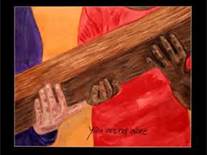
You know, Simon had to be afraid.  Good grief.  Here he was in the middle of the processional to a crucifixion!  What if they killed him too?  What would happen to his sons?  His family was miles away.  How would they even know what had happened to him?  And, yet, he didn’t seem to question his role.  He put his hand on Jesus’ shoulder as if to say, “I’m here.”  Then he leaned down and picked up the heavy cross, being careful to place his hands rather than running them down the splintering wood.  And then they began to walk–Jesus and this man, this dark-skinned anonymous man who Jesus had never met, this child of God, this new disciple, this one who without hesitation carried the cross of his Savior.  He would go through the gates and up the hill, touching the edge between life and death. 

But, again, I have to ask, where were those disciples?  Where were those who Jesus had called, who Jesus had groomed, who had been part of Jesus’ ministry, who had been Jesus’ friends?  Why was it THIS man and not them?  Why was it Simon that when it was all said and done was the first to take the yoke of Christ unto himself?  After all, it seems, the disciples would have been in the best position.  It would have made a whole lot more sense.  But, then, where would we be?  Where would those of us who Jesus had called, who Jesus had groomed, who are part of Jesus’ ministry?  Why isn’t it us touching the edge between life and death?  Why do we hold back?

28 ‘Come to me, all you that are weary and are carrying heavy burdens, and I will give you rest. 29Take my yoke upon you, and learn from me; for I am gentle and humble in heart, and you will find rest for your souls. 30For my yoke is easy, and my burden is light.’  (Matthew 11: 28-30).  See, we read this with such comfort at what Jesus can do for us.  But what does it mean to “take my yoke”?  For, THAT is the way that our souls will rest.

So, on this Lenten journey, move from being an anonymous bystander to a disciple of Christ.

Grace and Peace,

Shelli


Station IV: In the Silence of Grief

Scripture Passage: Luke 2: 7
And she gave birth to her firstborn son and wrapped him in bands of cloth, and laid him in a manger, because there was no place for them in the inn.

The hurt in Mary’s eyes is evident.  This is her son.  This was the child that she carried in the womb, birthed into the world in the rough hues of that cold desert night shielded only by a stable, or a cave, or a grotto, or something of the like.  This was the child that she nurtured and saw grow into a young man.  This was the child that she never understood, the one who seemed to choose his own path, the one who even at a young age always seemed to have some sort of incredible innate wisdom.  This was the child that would rather sit at the feet of the rabbis, would rather soak in all of the eons of lessons, than play like the other children.  This was the young man that had made her so proud, full of compassion and empathy, always thinking of others, always standing up for the poor and the outcast.  This was the young man who had more courage than she had ever seen.  Where did he get that?  She remembers that night long ago in Bethlehem.  They almost didn’t get there in time.  They almost didn’t have a place.  But there he was.  Even the first time that she looked into his eyes, she knew.  This child was different.  Born of her and, yet, not really ever hers.  He always seemed to belong to something bigger.  But she could pretend.  She could think that he was hers.  And she could love him more than life itself.  And now, today, the pain is almost to great to bear.  It looked like this was it.  Was it all for naught?  After all, she herself had given up so much.  What meaning did it have?  Why was it ending so soon?  It couldn’t be time to give him back–not yet.

This station is another one that is considered “non-canonical”.  But we know that Mary was there.  Love would put her there.  Love would make her want to pick him up and hold him, cradle him like she did that cold Bethlehem night.  The station is marked with a relief carved in stone.  The church next to it still has the mosaic floor from an earlier Byzantine church that stood on the premises.  In the floor is an image of a pair of sandals facing north, supposedly marking the place where Mary stood in suffering silence when she saw her son carried on the cross.  

The Mary we know is usually silent.  With the exception of that story of the wedding at Cana when she told Jesus to fix the problem with the wine, she is usually depicted as almost stoic.  I don’t think stoicism has anything to do with it though.  Mary’s grief and pain were real.  When Jesus encountered her this one last time, they both knew it.  And they both felt Mary’s deep, unending, nurturing love.  Perhaps that is what we are to glean from this–that in the midst of one’s grief and pain and unbearable loss is the deepest love imagineable.  We see it in Mary and we know that at this moment, this is what God is feeling too.  After all, both have given themselves for the world and both are shattered  that the world is throwing their love back.  

At this point, nothing need be said.  The love is evident–the love of Mary, the love of God.  It is a love that we must experience–self-giving, suffering, silent–if we are to understand who God is and who God calls us to be.   It is the love that we are called to have for one another, a love that in the deepest of grief pulls us up and pulls us through, a love that would compel us to stand up for another, a love that, finally, creates room, a love that is of God.

So, in this Lenten season, let us, finally, learn to love one another. 

Grace and Peace,

Shelli