Station V: Anonymous Bystander

Scripture Passage:  Mark 15: 21-24
They compelled a passer-by, who was coming in from the country, to carry his cross; it was Simon of Cyrene, the father of Alexander and Rufus. 22Then they brought Jesus to the place called Golgotha (which means the place of a skull). 23And they offered him wine mixed with myrrh; but he did not take it. 24And they crucified him, and divided his clothes among them, casting lots to decide what each should take.

We know the town from where he came–Cyrene, an ancient Greek colony that became a Roman colony near modern-day Shahhat, Libya.  We know that he was a father of two sons.  Beyond that, this man Simon is essentially an anonymous bystander.  We don’t know why he was there at all.  Had he intended to come and bring his sons to this gory event or had they planned to visit Jerusalem, perhaps steep themselves in history and a little shopping, without realizing what this day would bring?  We don’t know what about him prompted the guards to literally pluck him out of the crowd.  All we know is that this man lives in history as the one, the only one, who helped Jesus carry his cross to Golgotha.

The Scriptures do not say that he responded in any way other than to do it.  It is interesting that in all those years upon years of God’s calls being met with “no, not me, please not me” that this anonymous man about whom we know little would be the one to do this.  So God calls a scared, young, no-name peasant girl to bring Jesus into the world and a foreign, probably dark-skinned, anonymous bystander to carry him out.  Isn’t that just like God?  Here, just before the end, God slips one more Divine reversal in.

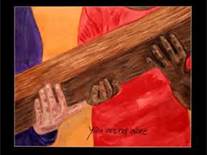
You know, Simon had to be afraid.  Good grief.  Here he was in the middle of the processional to a crucifixion!  What if they killed him too?  What would happen to his sons?  His family was miles away.  How would they even know what had happened to him?  And, yet, he didn’t seem to question his role.  He put his hand on Jesus’ shoulder as if to say, “I’m here.”  Then he leaned down and picked up the heavy cross, being careful to place his hands rather than running them down the splintering wood.  And then they began to walk–Jesus and this man, this dark-skinned anonymous man who Jesus had never met, this child of God, this new disciple, this one who without hesitation carried the cross of his Savior.  He would go through the gates and up the hill, touching the edge between life and death. 

But, again, I have to ask, where were those disciples?  Where were those who Jesus had called, who Jesus had groomed, who had been part of Jesus’ ministry, who had been Jesus’ friends?  Why was it THIS man and not them?  Why was it Simon that when it was all said and done was the first to take the yoke of Christ unto himself?  After all, it seems, the disciples would have been in the best position.  It would have made a whole lot more sense.  But, then, where would we be?  Where would those of us who Jesus had called, who Jesus had groomed, who are part of Jesus’ ministry?  Why isn’t it us touching the edge between life and death?  Why do we hold back?

28 ‘Come to me, all you that are weary and are carrying heavy burdens, and I will give you rest. 29Take my yoke upon you, and learn from me; for I am gentle and humble in heart, and you will find rest for your souls. 30For my yoke is easy, and my burden is light.’  (Matthew 11: 28-30).  See, we read this with such comfort at what Jesus can do for us.  But what does it mean to “take my yoke”?  For, THAT is the way that our souls will rest.

So, on this Lenten journey, move from being an anonymous bystander to a disciple of Christ.

Grace and Peace,

Shelli


Station IV: In the Silence of Grief

Scripture Passage: Luke 2: 7
And she gave birth to her firstborn son and wrapped him in bands of cloth, and laid him in a manger, because there was no place for them in the inn.

The hurt in Mary’s eyes is evident.  This is her son.  This was the child that she carried in the womb, birthed into the world in the rough hues of that cold desert night shielded only by a stable, or a cave, or a grotto, or something of the like.  This was the child that she nurtured and saw grow into a young man.  This was the child that she never understood, the one who seemed to choose his own path, the one who even at a young age always seemed to have some sort of incredible innate wisdom.  This was the child that would rather sit at the feet of the rabbis, would rather soak in all of the eons of lessons, than play like the other children.  This was the young man that had made her so proud, full of compassion and empathy, always thinking of others, always standing up for the poor and the outcast.  This was the young man who had more courage than she had ever seen.  Where did he get that?  She remembers that night long ago in Bethlehem.  They almost didn’t get there in time.  They almost didn’t have a place.  But there he was.  Even the first time that she looked into his eyes, she knew.  This child was different.  Born of her and, yet, not really ever hers.  He always seemed to belong to something bigger.  But she could pretend.  She could think that he was hers.  And she could love him more than life itself.  And now, today, the pain is almost to great to bear.  It looked like this was it.  Was it all for naught?  After all, she herself had given up so much.  What meaning did it have?  Why was it ending so soon?  It couldn’t be time to give him back–not yet.

This station is another one that is considered “non-canonical”.  But we know that Mary was there.  Love would put her there.  Love would make her want to pick him up and hold him, cradle him like she did that cold Bethlehem night.  The station is marked with a relief carved in stone.  The church next to it still has the mosaic floor from an earlier Byzantine church that stood on the premises.  In the floor is an image of a pair of sandals facing north, supposedly marking the place where Mary stood in suffering silence when she saw her son carried on the cross.  

The Mary we know is usually silent.  With the exception of that story of the wedding at Cana when she told Jesus to fix the problem with the wine, she is usually depicted as almost stoic.  I don’t think stoicism has anything to do with it though.  Mary’s grief and pain were real.  When Jesus encountered her this one last time, they both knew it.  And they both felt Mary’s deep, unending, nurturing love.  Perhaps that is what we are to glean from this–that in the midst of one’s grief and pain and unbearable loss is the deepest love imagineable.  We see it in Mary and we know that at this moment, this is what God is feeling too.  After all, both have given themselves for the world and both are shattered  that the world is throwing their love back.  

At this point, nothing need be said.  The love is evident–the love of Mary, the love of God.  It is a love that we must experience–self-giving, suffering, silent–if we are to understand who God is and who God calls us to be.   It is the love that we are called to have for one another, a love that in the deepest of grief pulls us up and pulls us through, a love that would compel us to stand up for another, a love that, finally, creates room, a love that is of God.

So, in this Lenten season, let us, finally, learn to love one another. 

Grace and Peace,

Shelli  

Station III: Vulnerable

“Station III”, painting by Chris Gollon
Commissioned in 2000 by
St. John on Bethnal Green, London

Scripture Passage:  Matthew 7:25
The rain fell, the floods came, and the winds blew and beat on that house, but it did not fall, because it had been founded on rock.

The third station of this Way of the Cross is the image of Jesus falling under the weight of the cross.  It is one of the non-Canonical stations and yet we know that the sheer exhaustion alone would be enough to make this a reality for any human.  That’s right.  Lest we forget, Jesus was human.  God did not come to earth to live as a figure resembling one of our super heroes, above the fray, untouchable, undaunted by the difficulties of human life.  No, God came as one of us, struggling and vulnerable.  And as Jesus falls, we feel that vulnerability.  It is uncomfortable for us.  After all, if this one on whom we rely, in whom we place all of our hopes and our dreams, is vulnerable, what does that say about out own lives?

Maybe the crux of this Walk is that we ARE supposed to be vulnerable.  Living a life of faith does not place some sort of impermeable bubble around us.  Regardless of what many will tell you, walking this walk does not guarantee that you will be healthy, wealthy, and wise.  If anything, it points to our vulnerability in the most profound way.  As humans, we will at times experience sadness, despair, and the deepest grief imagineable.  We experience those not because we are weak but because we are real.  And Jesus experienced the same thing because he, too, was real.  And, when you think about it, what kind of God is it who will plunge the Divine Self into the deepest of despair and the vulnerability?  It is the kind of God that does more than pull us out of it but rather lays at the bottom of it all and cradles us until it subsides.  But we will only experience that when we allow ourselves to be vulnerable, when we allow ourselves to be real, when we finally allow ourselves to need others, to let them in to our darkness.

This depiction of Jesus falling under the weight of the Cross affirms that vulnerability is part of us.  It also compels us toward the vulnerable, the hurting, the outcast, for it is there that we will find in ourselves empathy and compassion, and, finally, a Love greater than we thought we could have.  If we allow ourselves to be vulnerable, we will be able to see the same in others.  We are not called to become a Super Hero; we are called to cross boundaries and be Christ for others when they need it the most and, perhaps with even greater faith than that, we are called to let others into our grief and pain.  We are the ones who both lift the fallen and allow ourselves to be lifted.  Sometimes we will fall.  Sometimes life will hurt.  But we are never there alone.  But it takes great faith to know that.

Jesus will fall two more times on this Walk.  Life goes on.

Grace and Peace,

Shelli  

Station II: Take Up Your Cross

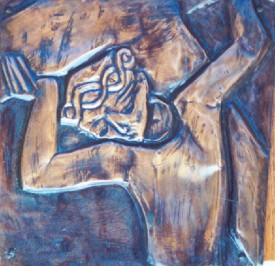
Copper Plate Depicting Station II
Samarpan Spiritual Leadership Center
Poway, CA

Scripture Passage:  Luke 9: 18-24
18Once when Jesus was praying alone, with only the disciples near him, he asked them, “Who do the crowds say that I am?”19They answered, “John the Baptist; but others, Elijah; and still others, that one of the ancient prophets has arisen.”20He said to them, “But who do you say that I am?” Peter answered, “The Messiah of God.”21He sternly ordered and commanded them not to tell anyone,22saying, “The Son of Man must undergo great suffering, and be rejected by the elders, chief priests, and scribes, and be killed, and on the third day be raised.”23Then he said to them all, “If any want to become my followers, let them deny themselves and take up their cross daily and follow me.24For those who want to save their life will lose it, and those who lose their life for my sake will save it.

The second station of the Via Dolorosa depicts Jesus taking up his cross.  Tried in a sham trial and condemned to death, Jesus is handed the heavy blocks of wood that have been hastily bound together.  What began as God’s creation pushed through from the soil has been taken and turned into an instrument of death.  So, Jesus takes up his cross.  The gates of the fortress open and Jesus is pulled to his feet and handed the heavy wood.  He begins to walk what would become known as the Way of the Cross, the Way of Sorrows, the Via Dolorosa.  He passes through the gate.  There is no turning back.

We are told to take up our cross and follow.  Surely that doesn’t mean this!  Surely the Gospel writers meant it metaphorically, meant that we shoul learn to be like Jesus, to follow his example.  It can’t mean this.  Surely we’re not supposed to take this literally!  So, what does that mean to take up our cross then?  If Jesus was nothing more than an example of how we’re supposed to live, we could have just as easily followed Mother Teresa or someone else that did a really good job of being a human.  And when you think about it, Jesus kept getting himself into trouble.  He continuously broke the rules and there are indications in the Gospel accounts that he may possibly have dealt with some anger management issues.  So, how do we follow THAT?  We deny ourselves, take up our cross, and follow.  Now?  Now, when things are not going well?  NOW we’re supposed to follow?

Jesus was not just an example of how to live; Jesus was the very embodiment of the Way to God.  And this Way of the Cross, this way of sorrows, this Via Dolorosa is part of that.  It is not rational to us; it doesn’t make sense.  But Jesus didn’t come to make sense; Jesus came to show us the Way to Life.  Being a disciple, a follower of Christ has little to do with behaving (Thanks be to God!).  Being a disciple means that we take all of this life that we hold dear, all of this life with which we’ve surrounded ourselves, all of these rules and all of these “right” way of doing things and lay them aside.  And we begin walking–through the gate, into the mystery of something that we don’t understand.  In essence, we walk into the unknown carrying nothing but our faith.   We deny ourselves and open our eyes to what God has placed before it.  That is our Way; that is our Cross.  And we walk this Way of the Cross.  It means more than following; it means becoming the very Way itself.  It means yielding ourself to the mystery that is beyond what we know and becoming who we were always meant to be.  It will take us through every aspect of life–through darkness and light, through suffering and joy, through doubt and faith.

It is not an easy way.  The cross is heavy.  The rough-hewn wood is splintering into my skin. Those along the pathway that are yelling and jeering make it even more painful.  This was not what I had planned.  I never thought that it would turn out like this.  I mean, I had so much more to do.  But I will go because I know that I do not walk this way alone.  Life as we know it is not all bathed in light.  Perhaps the darkness ensues at times to show us that God is there, even there, in the darkness, walking with us.  And I also know that somewhere down this road, there is more Light and more Love and more Life than anything that I could have conjured up.  And somewhere it will all make sense.  But, for now, I will take up my cross and walk this Way.

http://www.youtube.com/watch?v=IUFJJ-5K_LY&feature=player_detailpage

Grace and Peace,

Shelli

Station I: Condemned

Scripture Passage: Luke 23: 20-25
20Pilate, wanting to release Jesus, addressed them again; 21but they kept shouting, “Crucify, crucify him!” 22A third time he said to them, “Why, what evil has he done? I have found in him no ground for the sentence of death; I will therefore have him flogged and then release him.” 23But they kept urgently demanding with loud shouts that he should be crucified; and their voices prevailed. 24So Pilate gave his verdict that their demand should be granted. 25He released the man they asked for, the one who had been put in prison for insurrection and murder, and he handed Jesus over as they wished.

It has begun.  Our recognition of Christ’s Passion is not just relegated to those few heartwrenching hours on Good Friday or even to the few fast-moving days leading up to it.  Christ’s Passion actually began years ago in a small grotto or stable in Bethlehem.  Now do not think that I am one of those that thinks that God sent Christ to our little earth for the sole purpose of dying.  I just can’t see a God who is that cold and calculating.  Christ was not sent here to die but to live and to, at the same time, show us how to do the same. That was the point. 

And yet, even as early as the moment when Herod heard of the possibility of Jesus’ existence and ordered him (and all of the other male children of that age) killed, Jesus was condemned.  Actually, I think you can go back farther than that.  I mean, really, think about it–born in a barn or something to parents that really sort of appear to be illegal immigrants in sort of a no-name town just outside of the hustle and bustle of the holy city.  Jesus came into this world alien, poor, and condemned.  So this condemnation of Pilate’s, sparked on by those in majority rule, those who were trying desperately to maintain life as they knew it, is yet another step in this walk of a sadly condemned Christ.

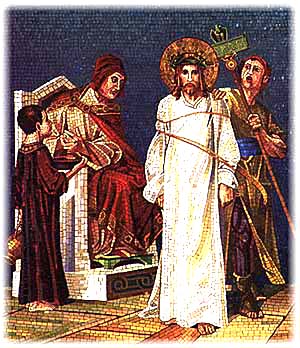
This first Station of the Cross begins at the Praetorium, the court of law, located in the Fortress of Antonia, north of the Temple Mount.  Pilate is depicted as the accuser and, yet, if it had really been left up to him, Jesus would have been flogged and sent home.  But Pilate was swept into a whirlwind of political and personal agendas.  Jesus was essentially a victim of the conflicts of a society in chaos as its members postured to place themselves higher and stay ahead of the game.  After all, this man was expecting us to change!  So as the crowd became louder and louder as they tried to get the last word, Pilate had no choice but to hand down the sentence that would change the world.

We stand in awe of Jesus.  We are amazed at one who can hold so true to their convictions.  And we blame Pilate and the crowd and the disciples.  (I mean, really, where ARE they???)  And yet, where would we be?  Where would you be?  Would you have put your financial security, your reputation, perhaps even your life on the line to stand up for the condemnation of the innocent, to speak out in the way God calls you to speak?  DO you ever do that?  I have to confess that I fall embarrassingly short of that calling.  Jesus has been condemned to death and we stand not really knowing what to do next.  And so we sit quietly in the warmth of our comfortable lives while the world goes on.

On this Lenten journey, let us truly walk this Way of the Cross by speaking out for the condemned, by standing up for what is right, by being Christ in the world.  Let us finally kneel at the manger and worship Emmanuel, God With Us.  Let us find room this time.

Grace and Peace,

Shelli

Intersection

The Way of the Cross
Pieter Brueghel the Younger (1603)
Koninklijk Museum Voor Schone Kunsten (Belgium)

Scripture Passage:  Matthew 11: 28-30
28“Come to me, all you that are weary and are carrying heavy burdens, and I will give you rest.29Take my yoke upon you, and learn from me; for I am gentle and humble in heart, and you will find rest for your souls.30For my yoke is easy, and my burden is light.”

In this Season of Lent, we are called to deepen our own walk with Christ.  This means moving beyond what Christ does for us.  Oh, don’t get me wrong.  Christ does everything for us.  But our relationship with Christ does not stop at that.  God is more than some sort of divine vending machine.  We are called to do more than worship the God who gives us everything; we are called to enter the Way of Christ itself, the Way of the Cross.  It means experiencing all of Christ–the birth, the ministry, the life, the Passion, the crucifixion, the death, the Resurrection–on the deepest and most profound level.  It means moving from being an observer to being a participant with Christ.  It also means entering our own humanity at the deepest level. It means becoming real.  Sadhu Sundar Singh says  that “if we do not bear the cross of the Master, we will have to bear the cross of the world, with all of its earthly goods.  Which cross have you taken up?  Pause and consider.

Over the last few years, I have become more and more drawn into the Stations of the Cross, that 4th century devotional tool that helped pilgrims flocking to the Holy Land from all parts of the world to walk in the Way of Christ.  It has become more than a way of prayer.  It is real, full of the depth and breadth of human experience and emotion, full of the power to move one beyond oneself, full of Christ.  These Stations, also called the “Way of the Cross”, the “Way of Sorrows”, the “Sorrowful Way”, and the “Via Dolorosa”, are a pilgrimage not just to the historical places of Jesus (because, truth be known, the places marked as stations in the streets of Jerusalem are really just good guesses) but to the Way to which we are called.

In this walk of faith, we are clear that we are called to worship and revere God, our Creator, the very Spirit that runs beneath us and at the same time courses through our veins.  This is the God who is there just ahead of us, calling us forward, calling us home.  This is our very source of gravity, that straight and perfect plumb-line that connects us to the Holy and the Sacred.  And yet, in science, relative strength is measured not just with the vertical pull of gravitational force, but with the horizontal relationship to that force itself. And true horizontality, the strongest point, occurs at the intersection with the vertical.  This Way that we walk with Christ, this horizontal side-by-side with Jesus gives meaning to our worship and reverence and draws it strength at that point.

So in the midst of our Lenten journey, remember that it is more than becoming a better person, more than developing a deeper relationship with God.  It is about worshipping and walking, walking and worshipping.  It is about entering the way of Christ.  So in the midst of these writings, let us walk this Way of the Cross.

Grace and Peace,

Shelli  

STATION XIV: Jesus is Laid in the Tomb

Before the station, pray: I adore you, O Christ, and I bless you, because by your holy cross, you have redeemed the world.

Read John 19: 38-42

…They took the body of Jesus and wrapped it with the spices in linen cloths…Now there was a garden in the place where there was a new tomb in which no one had ever been laid. And so, because it was the Jewish day of Preparation, and the tomb was nearby, they laid Jesus there.

We have walked away from graves before and left the remains of a life behind us. But this…this is different. And so we strip our altars and we strip our lives and we try to make room for you. And then we wait. We wait for you to come. We wait for you to rise. We keep vigil and we enter into deep prayer, knowing the day will come. And we wait. We wait for our eternity to be born. We waited for your coming once before, for your birth. But this is different. Now we wait for our own. And you…you are even now busy descending into hell, gathering up all that ever was so that it will forever be. And so we wait for the Easter dawn.

Father, forgive.

Jesus, In the darkness, we wait for your light. Give us patience and strength. But more than that, give us the vision that you see for the dawn. Empower us to be your Easter people. In the Name of our Redeemer, the One who give us life. Amen.