Becoming Light

In these last days of Advent, we experience both excitement and panic as we prepare for Christmas Day. But, again, Advent is meant to be more than just a precursor to Christmas Day. This is the time of preparation for Jesus’ coming, of course. But that means that it is also our time to become–become the one who receives God into our lives. The Gospel According to John begins with images of Christ as light coming into the world, enlightening all of the darkness on the earth until it is no more. And we, as children of the light, receive that light.

But what does that mean to receive light? We know that looking directly at light is uncomfortable and, at times, downright dangerous. Our eyes are not meant to look directly at something so bright. The light, then, is not merely something at which we look. That is not light’s purpose; otherwise it would be nothing more than a pretty decoration. The purpose of light is to illumine the darkness. We are not called to look at it, but to enter it. And in entering it, we become it, we become a reflection of that light for the world. It doesn’t take much–after all, one tiny light can wipe out absolute darkness–one light–your light. But the lights of many of us is what makes the world so bright. Jesus came as the light and calls us to become that light.

So go forth and become light!

Grace and Peace,
Shelli
Becoming Christmas

The hours are ticking by. Christmas is almost here. I’ve finished the last of the wrapping, although the decorating that I’ve planned never got done. And I have LOTS of baking and cooking that needs to happen before the big day. I will say, though, that I’m having a wonderful and blessed Advent. I have walked through the waiting, the preparation, and the receiving. Oh, it won’t be perfect, but it will be. That’s what’s important. And now…these last few days…these are the days when we become–become mystery…become real…become human–these are the days when we become Christmas.

What does that mean–to become Christmas? Doesn’t Christmas happen all on its own? But, think about it, God did not come for God’s own edification; God did not come to give us some sort of excuse to once again bask in the commercializing of our lives; and God did not come to give us a holiday. No, the point is that God came and in it we become–we become who God calls us to be. We become Christmas–the Christ Mass, the living embodiment of Christ.

Christmas is about openness and receiving; Christmas is about freedom and giving; and Christmas is about love–of Christ, of each other, and of ourselves. Christmas is about finding our way. As a people, we wandered in the desert for years looking for our way; we listened to prophets and kings who told us where to go; and we waited for someone to give us a nudge in the right direction. And she gave birth to her firstborn son and wrapped him in bands of cloth, and laid him in a manger, because there was no place for them in the inn. This is the moment for which we have waited. But it is not about the moment. One cannot take the image of the nativity and freeze it in time. Because there is so much more to do–after all, we have to become Christmas!

Grace and Peace,
Shelli

God-Bearing

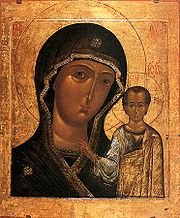
I am fascinated by the image of Mary in the Christmas story. I actually think that we Protestants underestimate her a bit. The Roman Catholics do a much better job of practicing a certain reverence toward Mary, the Mother of God. But those of the Orthodox tradition do it best. She is the subject of icons and other incredible images. She has hymns and liturgies and whole worship emphases. The Greek transliteration for Mary is Theotokos. In English, we just sort of loosely translate it as Mary, The Mother of God. But the literal interpretation of the title is “God-bearer”. What an incredible thing! What does it mean to be a “God-bearer”?

In our Western thinking, we either sort of accept the whole Virgin Birth phenomenon as part of our faith understanding or we fight it tooth and nail. To be honest, I guess I don’t get wrapped up in the whole thing. I mean…think about it…if you woke up tomorrow and there was proof that the whole virgin birth thing happened, what would it do to your image of God? And, conversely, if you woke up and some well-learned person had determined that there was proof beyond a shadow of a doubt that Jesus was NOT born of a literal virgin, what would it do to your image of God? For me, nothing either way. God still came in the most mysterious and miraculous way. More importantly, God came. God came and burst forth into our humanity in a way that we never could have imagined. And God still came and opened the door that we might glimpse the eternal. Isn’t that enough?

But whether or not Mary was a literal virgin, whether or not God somehow bypassed the whole law of human conception and whether or not we can really explain what happened, God came. And Mary agreed beyond a shadow of a doubt to become a womb for God, to become a God-bearer. For me, the point is not the virgin birth itself; it is rather that God came to someone who was virgin–pure, not violated by pre-conceptions, not influenced by something that came before, open to receiving. Mary, the God-bearer, showed us what it means to bear God. It means to become virgin. It means to become a womb. It means to be ready to receive Christ in the purest form. From that standpoint, aren’t we all called to be “God-bearers”?

So go forth and be a womb, be a God-bearer.

Grace and Peace,
Shelli

What Do You Want for Christmas?

“What do you want for Christmas?” When I was little, that was a big question. What do I want for Christmas? In the weeks before, I would painstakenly look at every TV commercial and every toy catalog that I could find so I would know the answer. And then we would go to the department store and stand in line to see Santa so that I could be sure and tell him what I wanted for Christmas. (Of course, everyone knew that the department store Santa was only a helper–after all, the REAL Santa was up at the North Pole directing things.) I was truthfully a little afraid of Santa. You had to step up to this massive Santa-throne and then sit on this strange man’s lap. He was always a little sweaty too. (But, of course, I guess if you had to wear a heavy fuzzy suit, big boots, fake beard, and sit under the photographer’s light for all those hours in the muggy Houston December, you’d be sweaty too!) But, the important thing was that Christmas morning, I would wake up and there it would be–the thing I wanted most, the thing my heart desired, the thing without which I thought I could not live–there it was under the tree!

As an adult, most of us don’t know how to answer that question. What do I WANT? Well, truthfully, I hadn’t really thought about it. I guess whatever you want to give me. Sure, there are things I’d like; a repaired and healthy economy so that everyone had a job would be nice; or, if you’re really asking, how about peace on earth? How about no hunger or homelessness? How about an innate respect for each other’s lives? How about everyone being aloud to do and be what God calls them to? Yeah…those would make nice gifts. But, sadly, they probably won’t be under the tree on Christmas morning. I think back to my childhood. It seemed that all I had to do was desire something in my deepest being and it would be there.

Why CAN’T we do that as adults? What do you desire in the deepest part of your being? It’s God. Deep in us, past all of the greed and fear and prejudices and pre-conceived notions in our lives, is a deep and abiding desire for God. And interestingly enough, when we desire God, God comes. There it is–the thing I want the most, the thing my heart desires, the thing without which I cannot live–God comes when we desire God. Won’t Christmas morning be a glorious thing?

So go forth and desire God!

Grace and Peace,
Shelli

Free to Receive

The first step in being ready to receive is to open oneself to what is being given. This means that we have to prepare ourselves, ridding ourselves of our pre-conceived illusions of what we are going to get. Freeing ourselves to receive is a way of entering a true Sabbath, a resting, a pure openness to receive what one is blessed to receive. It probably seems odd to talk about Sabbath rest in the middle of Advent. But the Sabbath in its purest sense is but a taste of the world to come. So what, then, are we looking toward in this Advent season? The Advent season is a looking toward the ultimate Sabbath, the coming of God into Creation as it enters its very fullness, its very perfection, the very essence of what it is supposed to be.

The birth of Christ was the beginning, a taste of the world to come, the point at which we realized that the world was not meant to look like what we had planned. Our Advent journey prepares us to rebirth Christ in our own lives, it prepares us to taste once again what is to come, and to inch that much closer to the world that God envisions. But to do that we have to rid ourselves of our own illusions, we have to enter a Sabbath way of thinking, a Sabbath way of receiving God in whatever way God chooses to come. If we are not open to God’s coming, if we are not purely and wholly free of ourselves and ready to receive God into our lives, we will be looking for God to come into that place for which we have so carefully prepared and made ready and God, in perfect God-wisdom, will instead come through the back door of our hearts and settle in the dark grottos of our lives where only those who are poor in Spirit and humble in life and who crave the light with all their being will see. So, open your life to all of your life, because that is when God comes.

So go forth and be free to receive!

Grace and Peace,
Shelli

A Receiving Spirit

So how do you foster a receiving spirit in this Season of Giving? By nature, our consumer-driven society are not ordinarily givers–at least not in the true sense. Oh, don’t get me wrong…all of us give to that small number of carefully-picked non-profits (including our church) each year. And this is definitely the season that our charitable giving jumps way up. Perhaps it’s the little bit of Santa in all of us; perhaps it’s the colder weather that makes us realize how fortunate we are to be warm and dry and comfortable and nested in the midst of those who love us when there are those that are cold and alone living right there with us; and (let’s face it) perhaps it’s part of our year-end tax planning–whatever it is that drives us to give, we’ll take it!

So, once again, how do you foster a receiving spirit in this Season of Giving? If you’re really honest with yourself, giving is easier than receiving. Giving means that you are the one in control. Giving means that you are the one choosing what, how much, and even whether or not to give at all. But how well do we receive? How well do we let someone else choose the wrong style of decorative item for our home, spend way too much (or way too little) for our taste, or give a gift that we were not expecting and for which we had no reciprocating item to give. I’ve gotten better at that. I give what I can. Others do too! Things don’t have to even out. Give them that–that is a gift too!

Truthfully, this is the most incredible gift of this season–the lesson of receiving. Bishop William Willimon says that “This strange story tells us how to be receivers. The first word of the church, a people born out of so odd a nativity is that we are receivers before we are givers. Discipleship teaches us the art of seeing our lives as gifts. That’s tough, because I would rather see myself as a giver. I want power–to stand on my own, take charge, set things to right, perhaps to help those who have nothing. I don’t like picturing myself as dependent, needy, empty-handed.”[i] But, once again, wasn’t that how God came that night–dependent, needy, empty-handed? God came as a helpless, vulnerable baby to show us how to receive what the world offers and when we enter that paradoxical mystery, we will find and receive what God offers.

So go forth and receive in humility and vulnerability and immense grace! That is the greatest gift you can give!

Grace and Peace,
Shelli

[i] William Willimon, “The God We Hardly Knew”, in Watch for the Light: Readings for Advent and Christmas, (Plough Publishing, 2001), Dec. 14.

Children Do Christmas Well

Children do Christmas well. Maybe it’s the toys; maybe it’s Santa; maybe it’s the fantastical images of sugarplums, eight tiny reindeer, and a little drummer boy dancing in their heads. But I think it’s something more. I think it has more to do with receiving. By that, I don’t mean WHAT they get, but rather HOW they get.

I remember going to my Grandmother and Granddaddy’s on Christmas Eve. It was wonderful–lots of food, lots of people, and LOTS of gifts. But my favorite (believe it or not) was leaving–getting in the car with new gifts in tow and setting out from home. It was always late at night, usually freezing cold, and the short 7-mile drive was magical. There was the radio tower that we passed with the red light on top. Surely, I thought, that was Rudolph. There was the prospect of lots of neat gifts. But, more than anything, there was an expectancy that hung in the air. It was all but palpable, as if the cool, fog settling over the Texas prairie somehow shrouded what was to come until Christmas morning. I think as a child I somehow juxtaposed the stories of Baby Jesus and Santa and let my mind wander into visions of a manger awash in starlight surrounded by gifts from the jolly man in the red suit. That’s OK. The point was that I was expecting something. I KNEW something wonderful was going to happen. And I was ready for whatever it was. I was ready to receive whatever I was given.

Children carry no baggage or lists. They have no pre-conceived notions of what Christmas should be. They’re not worried about whether or not they have all the groceries or all the right gifts for everyone. They’re not worried about wrapping the gifts. Children KNOW that you will love what they give you, because that is the way they receive things. Maybe that’s why God burst forth into humanity in the rather unlikely guise of a child. God didn’t come as a prince or a king with set ways of being addressed and set rules of being received. God came as a child, offering nothing but Godself and, as a child, showed us how to receive what is given. In this case, it was a child who needed help in a helpless situation. And in that God showed us how to receive from others. Because, after all, children do Christmas well!

Go forth with the heart of a child and receive the child!

Grace and Peace,
Shelli