Mixed Messages

Lectionary Gospel for Ash Wednesday:  Matthew 6: 1-6
Beware of practicing your piety before others in order to be seen by them; for then you have no reward from your Father in heaven.“So whenever you give alms, do not sound a trumpet before you, as the hypocrites do in the synagogues and in the streets, so that they may be praised by others. Truly I tell you, they have received their reward. But when you give alms, do not let your left hand know what your right hand is doing, so that your alms may be done in secret; and your Father who sees in secret will reward you.  “And whenever you pray, do not be like the hypocrites; for they love to stand and pray in the synagogues and at the street corners, so that they may be seen by others. Truly I tell you, they have received their reward. But whenever you pray, go into your room and shut the door and pray to your Father who is in secret; and your Father who sees in secret will reward you.

On the way home last night, I heard some pieces of an interview with a political figure questioning another well-known political figure’s religion.  The claim was that it was difficult to discern whether or not this person practiced “legitimate Christianity”.  Really?  And what in the world, pray tell, is “legitimate Christianity”?  And how do you know?  I mean, especially since we’re apparently suppose to be in our rooms with the door shut praying in secret!  But then, aren’t we supposed to be out in the world showing the love of Christ?  Whew!  Well, regardless of the fact that it must have been a slow news day, sometimes it’s just a whole lot of mixed messages, isn’t it?

Today we begin this season of mixed messages.  First of all, Lent itself, literally “springtime”, means that we begin clearing all of the winter debris that has grown and gathered in the flowerbeds and leaving room for new life.  This season is about both pruning and fertilizing, cutting and nurturing.  It’s about cleaning out and freshening up.  Theologically, this season brings images of walking through darkness toward the light, of giving up and taking on, of death and new life.  We are told to let go and to take up, to lay down and to rise up.  We are told to breathe in and to breathe out.  And now, to pray in secret and go out and serve the world.  So, is your head spinning?  Maybe that’s why this season is so difficult.  There’s no baby; there’s no star; there’s not even, when you think about, anybody around to tell us not to be afraid.  No one comes to tell us what is going to happen.  There is no appropriately convenient Lenten anunciation.  We just have to start walking that pathway toward Jerusalem with both assurance and humility.  But this time, in many ways we walk alone.  This God who has walked with us every step of the way has seemed to have gone on at least a few steps ahead of us.  Where Advent kept pushing us back, telling us to wait, in many ways, this season of Lent is pulling us kicking and screaming into something we do not understand, something that, given the choice, we might choose not to do, choose to go back into our room and shut the door.  Mixed messages…

I’ve shared this story before, but it is one of my favorites:  A rabbi once told his disciples, “Everyone must have two pockets, with a note in each pocket, so that he or she can reach into the one or the other, depending on their needs.  When feeling high and mighty one should reach into the left pocket, and find the words: “Ani eifer v’afar; I am dust and ashes.  But when feeling lowly and depressed, discouraged or without hope, one should reach into the right pocket, and, there, find the words: “Bishvili nivra ha’olam…For my sake was the world created.”

Talk about mixed messages!  We are dust and ashes, resembling that cast-off debris.  And we are loved more than we can even fathom.  We are so very human, struggling with greed and hubris, with some inflated sense of our own worth that makes us think we are better than others or deserve more than others, makes us think that there is some sort of “legitimate Christianity” in which we are called to participate to prove our very worth.  And, yet, somewhere in the midst of our humanity, in the midst of all those things that we do not do or those things we do not do well, there is a piece of the Divine.  Bishvili nivra ha’olam.  Do you even know how much you are loved?  Do you even know how to imagine a God that has given you the world?

Perhaps the mixed messages are because we cannot let go, cannot see what God is offering, cannot fathom how much we are loved.  Today is the day when we proclaim we are dust, when we confess our sins and lay prostrate before the ruins of our lives.  Today is the day when we take burned palm branches and allow them to be smeared across our forehead in the faint shape of a cross.  Today is the day that we remember we are dust, remember that we are particles of waste that are left from what was.  Today is the day when we go in our room and shut the door.  But the only reason we do this is so that we will stop what we are doing, look at our lives, and know how very much we are loved.  Bishvili nivra ha’olam.  For your sake, the world was created. 

Faith is about mixed messages–letting go and taking on, human and Divine, death and life, sending and return.  Perhaps this Season of Lent is about realizing that there is a Holy and Sacred “And” connecting it all.   Lent is not about giving things up; it is about emptying your life that you may be filled.  Lent is not about going without; it is about making room for what God has to offer.  And today is not about clothing yourself in the morbidness of your humanity; it is about embracing who you are before God.

There was once a question posed to a group of children:  “If all the good people in the world were red, and all the bad people in the world were green, what color would you be?”  A little girl thought for a moment.  Then her face brightened, and she replied:  “I’d be streaky!”  We would all be streaky.  To be human is to be a mixture of the unmixable, to be streaky.  It is to live incomplete, yet yearn for completion; to be imperfect, yet long for perfection; to be broken, yet crave wholeness.  It is to live with mixed messages.  And as we begin what is essentially our own journey to the cross, we note that it is one that not only recognizes but embraces the fact that there are many conflicting and disjointed ideals that God, in God’s infinite mystery and wisdom, allows to exist together—arrogance and humility, good and bad, faith and doubt, human and divine, cross and resurrection, death and life—none can exist without its counterpart.  It is about living a life of breathing out and breathing in.  Neither can exist alone.

So…remember…you are dust and ashes…breathe out…..

For you the world was created…breathe in….

In this Season of Lent, I invite you to join me in my own Lenten practice of trying to post something to this blog each day.  I would also invite you to let me know that you are reading it and join in the conversation!  And if this is not enough for you, I’m also “re-posting” my blog from a few years ago based on the book, Bread and Wine.  The blog is located at http://breadandwine-lentenstudy.blogspot.com/ or you can get there through the Dancing to God blog.

And in this Season of Lent, this season of giving up so that we can take on, I invite you to find those things in your life that you need to put down, need to let go, and also those things that you need to cherish.  So on this first day of Lent, find something that is dusty.  (This may be easier for some of us than others!)  Pick it up, clean it off, and put it in a place of honor.  Let it be your reminder for this entire season that the world was created for you.  But that sometimes you have to get dusted off!

Grace and Peace on this Lenten Journey,

Shelli

A Must See!

Lectionary Passage:  John 1: 43-46 (47-51)
The next day Jesus decided to go to Galilee. He found Philip and said to him, “Follow me.”Now Philip was from Bethsaida, the city of Andrew and Peter.Philip found Nathanael and said to him, “We have found him about whom Moses in the law and also the prophets wrote, Jesus son of Joseph from Nazareth.”Nathanael said to him, “Can anything good come out of Nazareth?” Philip said to him, “Come and see.”

At the risk of overusing movie metaphors, I saw an advertisement for a movie that touted that the critics had dubbed it “a must see.”  We all know what that means.  It means that someone is telling us that we need to try to find time to go see this movie, that perhaps our lives will be more enriched by the very act of taking the time to watch a movie.  It doesn’t mean that it’s inviting us to rewrite it or recast it or, for that matter, even critique it.  It doesn’t mean that there’s going to be a quiz at the end of it to make sure that we understood it in the way that the writer intended.  And it’s not even maintaining that we have to commit every line and every scene to permanent memory.  It’s inviting us to simply come, to put down what we’re doing and quit worrying about what we’re not doing, if only for a couple of hours, and come experience it.  It’s inviting us to come and see.  And the claim is that in some small way, our lives might be enriched by the act.

The Scripture that is used here is only part of our lectionary Gospel passage for this week.  But in this short segment, we meet Nathanael.  Most of us don’t know much about him.  After all, he was never part of the “Big 12” as far as we can tell.  But that usually didn’t matter much to the Gospel writer that we know as John.  In this version of the Good News of Jesus Christ, the notion of “disciple” is broader than Jesus’ inner crowd.  You see, Nathanael is a whole lot like us.  He wanted to understand who this Christ was and, yet, it didn’t make sense to him.  Shouldn’t there be something more?  Shouldn’t this be obvious?  How can anything this incredible come out of this little nothing town?  After all, in the first century, Nazareth wasn’t much.  There was no Roman settlement there which means, more than likely, that there was little work.  In fact, you wonder how a carpenter family even eeked out a living there.  It was probably just a couple of houses, a blip on a map.  It was nothing anyone would ever really want to see.  Yes, Nathanael was trying to make sense of this, to put it into a perspecive that made sense to him.  He was trying to take this Presence of God that was beyond anything that he could imagine fit into his notion of who God was.  But Philip’s response was simply, “Nathanael, just come and see.”  In other words, put down all of your preconceived ideas of who you think God should be and what you think God should look like and from where you think God should come, and just come and experience the Presence of God.

I don’t think that Philip was promising that Nathanael would see something tangible that would prove the existence of God.  After all, “seeing” is not limited to what we do with our eyes.  Philip is instead offering Nathanael the experience of God.  But in order to experience God, to “come and see”, one has to put everything else aside.  We cannot see God by listening to something else; we cannot see God when our hands are holding too tightly to what we think we need; and we cannot see God when our minds are so full of who we think God should be.  We’re not being called to figure God out or know everything there is about God.  You know what?  We’re not even called to be perfect renditions of what God envisions we should be.  I think God’s a lot more filled with grace than we give God credit for being.  And I don’t think we’re called to be “godly” people.  I hate that word.  Being “like God” is really God’s area!  Shhhhh!  Just come and see. 

Last week’s lectionary passages included the first few lines of Genesis.  We read of God’s spirit “sweeping over the face of the waters.”  In other words, God’s Presence was not just standing beside or standing over Creation.  God’s Presence washed over Creation, consumed it, made it part of the Divine.  We are no different.  Seeing God is about letting God’s Spirit sweep over you.  It is about experiencing God in every fabric of your being.  Joseph Wood Krutch said that “the rare moment is not the moment when there is something worth looking at, but the moment when we are capable of seeing.”  So, for all of us who are waiting for that one incredible moment when we finally see God, stop.  Just come and see.  It’s a “must see”!

What is right now so important, to what are you holding so tightly, and what are you doing now that means you cannot come and see?

The Days That Come After

In the beginning when God created the heavens and the earth,the earth was a formless void and darkness covered the face of the deep, while a wind from God swept over the face of the waters.  Then God said, “Let there be light”; and there was light.And God saw that the light was good; and God separated the light from the darkness.God called the light Day, and the darkness he called Night. And there was evening and there was morning, the first day. (Genesis 1: 1-5)

In those days Jesus came from Nazareth of Galilee and was baptized by John in the Jordan.And just as he was coming up out of the water, he saw the heavens torn apart and the Spirit descending like a dove on him.And a voice came from heaven, “You are my Son, the Beloved; with you I am well pleased. (Mark 1: 9-11)

I saw a movie trailer for a new movie called “Extremely Loud and Incredibly Close,” which is apparently a story of a young boy’s life after his father is killed in the 9/11 terrorist attacks.  The trailer ends with these words written on the screen:  “This is not a story about 9/11; it is a story about the days that come after.”  I thought that was a very profound statement.  After all, do we sometimes focus so much on specific times and specific days that we lose what it means to live the rest of them?  In some way, living a life of faith means getting beyond endings.  Maybe it even means getting beyond beginnings.  It means doing something with all of them as part of the totality of life.

Yesterday we remembered the Baptism of Jesus and through that also remembered our own.  And our lectionary readings for the day included the first five verses of Genesis.  We all know that it is the beginning of the story of Creation, the beginning of life, the beginning of our own beginnings.  But, truth be told, it wasn’t the beginning of EVERYTHING.  After all, it says that before it all, the earth did exist.  It’s just that it was a formless, shapeless void.  Perhaps it was a chaotic mass of swirling, meaningless matter.  And then God Said.  Those are the most powerful words imaginable.  With one simple statement, God creates order, shape, life.   As God’s Spirit sweeps over the waters, meaningless matter becomes earth.  It is not perfect; it is not the way it will be; it is the way it should be.  It is good.

But we know it doesn’t stop there.  The days go one and God creates sky, and land, and seas.  Then, rather than directly creating (we sometimes gloss over this), God appoints the earth to start creating, to bring forth vegetation.  God calls Creation to create.  Then God creates suns, and moons, and animals, and us.  And then, as the pinnacle of Creation, God creates Sabbath rest, completion, a taste of eternity.  You see, it doesn’t stop at “in the beginning”. The days that come after are what makes Creation the way it was intended to be.

And in those days that Creation continued,  once again God’s Spirit moved over the waters.  And this time, the heavens were torn apart (not opened, but violently ripped apart in a way that they could never go back together in the same way), and God’s Spirit decended.  And once again, God spoke:  “You are my Son, the Beloved, with whom I am well pleased.”  Once again, God Said. It is good.

The days that come after are the days.  Beginnings and endings are only markers, turning points, crosswalks.  We are told to “remember our baptism and be thankful.”  Truth be told, I don’t remember mine.  I was just a baby.  But remembering is not about the beginning; it is about the days afterward.  So, as people of faith, what will we do with those days afterward?  Faith is not about baptism; it is about the days that come after.

What will you do with your days that come after?

Grace and Peace,

Shelli

P.S.  As a programming note, I’m going to try to post a blog entry twice a week or so during this Season of Epiphany and then return to daily posts during our Lenten journey.  Thanks for staying with me!  Shelli

Beginning the Journey

Whew! It’s over–this season of running and shopping and baking and wrapping and giving and getting and dressing and partying and, oh yeah, worshipping the Christ who has come!  Now we can go back to normal.  Whew!  It’s over!  But what is the deal with all this light around?  Really?  So what was the point?  Truth be told,  as Christmas is the celebration of God’s coming, Epiphany is the manifestation of our going.  Epiphany is the beginning of the journey.  So, in other words, don’t get too comfortable!  There is work to do!

This season of Epiphany probably gets sort of glossed over.  I don’t know, maybe we’re tired.  Maybe we’ve eaten too much or run too much or just too much-ed.  Or maybe we just don’t understand what it’s about.  Epiphany is about making Jesus real, making the Christ child part of your life.  It is about doing beginning to travel down a road that you’ve never traveled before.

We know the story of the Wisemen, those learned ones who came to pay homage to the new king.  I suppose it was just a politically correct fulfillment of accepted etiquette.  There was a new king in town and they would greet him and give him the proper gifts and perhaps he would remember them in the future. (And in the meantime, perhaps the press would treat them kindly in this politically volatile season!) It was, after all, the proper and the smart thing to do. But instead, something happened.  Perhaps it was the star; perhaps it was the king; perhaps it was some sort of divine inspiration.  But, whatever it was, these wandering souls got it.  They saw a pathway that was different than the one that they were on, they saw where God was calling them to go.  And so they went home by another way.

Many of you have heard the Henry Van Dyke story of “The Other Wise Man”.  It is the story of a magi named Artaban, who waited impatiently for the star to shine so that he could travel with the other magi to see the new king. In fact, he had sold all of his possessions and bought three jewels—a sapphire, a ruby, and a pearl—to give to the new baby king.  And, then, he finally saw what he had been waiting for as the dark eastern sky was filled with light.  He hurried to join his friends so that he could meet the king.  But on the way, he came upon the form of a man lying on the side of the road, motionless and dying.  He knew that if he stayed to help the dying stranger, he would miss meeting the Messiah.  So, with a heavy heart, he stayed and cared for the man until his strength returned.  And in return, the man, a Jew, blessed his travel to Bethlehem, where he told him the king had actually been born.  So, left behind by the others, Artaban was forced to sell the sapphire, buy a train of camels, and provisions for the journey. 

But he arrived there three days after the others had departed.  He entered a cottage and found a young mother singing her baby to sleep.  And quietly, the woman told him that the new king and his family had fled secretly in the night.  Suddenly there was a noise outside as Herod’s soldiers came for the child.  Artaban went to the doorway and met the soldiers, telling them that he was alone in the house.  When the soldier did not believe him, he reached in his pocket and pulled out his ruby and gave it to him.  The soldiers went away.  The woman blessed him.

Artaban spent his life searching for the king.  In all this world of anguish, he found many to help, but no one to worship.  He fed the hungry, clothed the naked, healed the sick, and comforted those in despair.  Thirty-three years later, he came for the last time to Jerusalem and was met with a flurry of activity as the city prepared to crucify Jesus of Nazareth.  On hearing this, Artaban knew that this was what he was called to do.  The pearl, the last of his riches, could be offered as ransom for the king’s life.  It was then that a young slave girl was dragged through the streets and threw herself at Artaban’s feet.  Save me, she begged, they are going to kill me.  He sadly took the pearl from his pocket.  It gleamed with radiance as he handed it to the girl so that she could buy her life.  The earth began to shake around him; the sky darkened; and it was then that a heavy tile hit Artaban on the head.  As he lay there, the slave girl bent over him to try to hear what he was saying.  It was then that she heard a faint voice from above—“verily I say unto thee,  Inasmuch as thou hast done it unto one of the least of these my brethren, thou hast done it unto me.”  A calm radiance came over Artaban’s face and he breathed one last breath.  His journey had ended.  His treasures were accepted.  He had met the King many, many times.

Well, obviously, this is fiction.  There’s no basis to it.  It’s not Scriptural.  But the point is that we are the other wisemen.  We are the ones called to the work.  We are the ones that will meet the King.  Maybe we will see it to fruition; more than likely, we will not.  The point is that it’s not about the end-result.  It’s about the journey.  It’s about making the Christ-child real in your lives.  It’s about meeting the King. But more than that, it’s about getting it! It’s about making it real. It’s about letting the Light illumine your life.


God came and the Light shined into our midst.

We are called to follow, to walk in the way illumined by the Light.
Let us follow the Light as it guides us on our journey.
Let us follow the Light as it leads us to Life.
So, in this season of Epiphany, make the newborn Christ real in your life!  There is work to be done!

Grace and Peace,

Shelli     

The First Day: And Heaven and Nature Sing!

Joy to the World , the Lord is come!
Let earth receive her King;
Let every heart prepare Him room,
And Heaven and nature sing,
And Heaven, and Heaven, and nature sing.

Joy to the World, the Savior reigns!
Let men their songs employ;
While fields and floods, rocks, hills and plains
Repeat the sounding joy,
Repeat, repeat, the sounding joy.

No more let sins and sorrows grow,
Nor thorns infest the ground;
He comes to make His blessings flow
Far as the curse is found,
Far as, far as, the curse is found.


He rules the world with truth and grace,
And makes the nations prove
The glories of His righteousness,
And wonders of His love,
And wonders, wonders, of His love.

(Isaac Watts, 1719)

The day has dawned!  Sometime in the night, God tiptoed into the world and made a home.  And the world will never be the same again.  Most of us barely noticed.  Most of the world wakes this morning and goes on with their lives.  That’s OK.  If God had wanted fanfare, then I supposed God would have come with a bit more flourish and drama.  But instead, God enters as one of us, quietly slipping the Divine into our midst with as little noise as possible.  (Although I suppose it’s hard to enter quietly with a multitude of angels in tow!)

When Isaac Watts first wrote the familiar Christmas carol “Joy to the World”, he didn’t mean for it to be a carol at all.  The words were originally written to celebrate the triumphant second coming of Christ rather than the birth that we celebrate this morning.  I think that’s the reason it works, though.  God’s coming into the world is not merely something that happened more than 2,000 years ago.  Today is not the celebration of the anniversary of Jesus’ birth as if it is some sort of historic relic that we hold; rather, today–THIS day–IS the coming of God into our midst, the realization that even now, Heaven is spilling into our lives, making a home, and Heaven and Nature are singing together.

God comes quietly, tiptoeing into our lives each and every day of our existence.  A new Light has dawned and every day is Christmas!  So when the Holy and Sacred dawn in our life, are we called to join in loud acclaim, or are we called to silently open our our lives and let the Divine spill in?  With all respect to Mr. Watts, I’m not a big watcher of the “Second Coming” of Christ.  I don’t know what that looks like and the Scriptures are not that specific about it.  I think the point of Christmas is that the Lord is come!  God came quietly into our world as the Christ child more than 2,000 years ago.  It was the First Day of the new dawn.  And the Light has been rising each every day since.  And for every heart that quietly opens and makes room for God to tiptoe in and make a home, the Light becomes brighter.  Rather than waiting for God’s coming, let us see that God is here.  Let us see that every day is Christmas.  (And, along the same lines, perhaps every day is the triumphant coming for which we are looking until God’s Kingdom and the recreation of all is complete!)  Joy to the World!  The Lord is come!

The Lord is come!  Let us now go and see this thing that has taken place!


On this First Day of Christmas, open the gift of the Holy and the Sacred, the gift of the Christchild and then open your heart that you might prepare room for God to come each and every day!

Merry Christmas!

Shelli     

Maybe This Night Will Be The Night

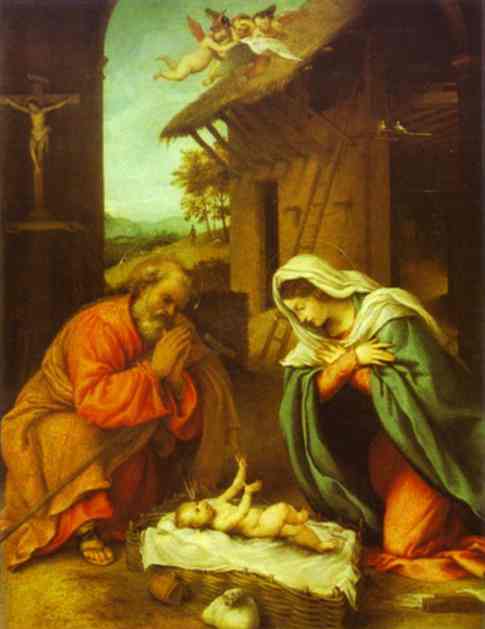
“The Nativity”
Lorenzo Lotto, 1523
National Gallery of Art
Washington D.C., USA

Luke 2: 1-14 (KJV) 
And it came to pass in those days, that there went out a decree from Caesar Augustus that all the world should be taxed.  (And this taxing was first made when Cyrenius was governor of Syria.) And all went to be taxed, every one into his own city. And Joseph also went up from Galilee, out of the city of Nazareth, into Judaea, unto the city of David, which is called Bethlehem; (because he was of the house and lineage of David:) To be taxed with Mary his espoused wife, being great with child. And so it was, that, while they were there, the days were accomplished that she should be delivered.

And she brought forth her firstborn son, and wrapped him in swaddling clothes, and laid him in a manger; because there was no room for them in the inn. And there were in the same country shepherds abiding in the field, keeping watch over their flock by night. And, lo, the angel of the Lord came upon them, and the glory of the Lord shone round about them: and they were sore afraid. And the angel said unto them, Fear not: for, behold, I bring you good tidings of great joy, which shall be to all people. For unto you is born this day in the city of David a Saviour, which is Christ the Lord. And this shall be a sign unto you; Ye shall find the babe wrapped in swaddling clothes, lying in a manger.

And suddenly there was with the angel a multitude of the heavenly host praising God, and saying, Glory to God in the highest, and on earth peace, good will toward men.

Mary and Joseph have arrived.  The crowds are almost too much to take, pushing and crushing as the couple makes their way through them.  Mary doesn’t feel well.  She really needs to just lie down and rest.  And when you don’t feel well, the last place you want to be is somewhere that is not home, somewhere foreign, somewhere so crowded, so unwelcoming.  They need to hurry.  There is not too much time left. 

They stop at a small inn up on the hill overlooking the shepherds’ pastures down below.  Joseph leaves Mary for a moment and goes to make arrangements for a place to stay.  But when he returns, his face looks frustrated, almost in tears.  He tells Mary that the inn is full.  In fact, the whole town is full.  There is no place to stay.  There is no room.  But he tells Mary that the innkeeper has given them permission to at least go into the stableroom to keep warm.  He’s freshening the hay now.  Well, it will have to do.

You know, I think the innkeeper gets a bad wrap.  I mean, was he supposed to kick someone else out?  And consider this:  This was not the Hilton.  It probably wouldn’t even qualify as a roadside motel.  It was probably just a couple of small beds in the innkeeper’s home.  And first century houses were often just a room or maybe two of actual living quarters anyway.  The second or third room was attached to the house and used to house the animals that were so much a part of their life.  No one in this small town would have owned a large “ranch” estate. The stable probably wasn’t “out back” the way we think.  It was part of the home.  So the innkeeper was possibly, on some level, bringing Mary and Joseph, bringing strangers, into his home. What that means is that the Divine came into the world because someone acted human.  Isn’t that amazing?

So Mary and Joseph entered the stableroom and, surrounded by animals, tried to get some rest.   They could still hear the crowded city outside.  They could hear the Roman guards yelling as they tried to control the crowds.  It made the place feel every more foreign, even more foreboding.  But directly overhead, was the brightest star they had ever seen.  It was as if the tiny little stable was being bathed in light.  So Mary laid down and closed her eyes.  She knew that the time was almost here.  She knew that the baby was coming into the world.

And on this night of nights, into a cold, dirty stable in a small town filled with yelling and pushing crowds, into a place occupied by soldiers, into a place that did not feel like home, into a world that had no room, God comes.  The door to the Divine swings open and God and all of heaven burst into our little world, flooding it with Light and Life.  And yet, the child in the manger bathed in light, the very Incarnation of the Divine, Emmanuel, God With Us, the Messiah, is, still, one of us.  God takes the form of one of us–just an ordinary human–a human like you and me–to show us what it means to be one of us, to be human, to be made in the image of God.

God comes into a world that is unprepared for God, that has no room for God.  God comes into places that are unclean, unworthy, unacceptable for us, much less for the Divine.  God comes into places that most of us would not go, out of fear of the other, out of fear of the unknown, out of fear of the darkness. And there God makes a home.  The Divine begins to pour into the world and with it a vision of the world pouring into the Divine.  This night, though, is not the pinnacle of our lives but, rather, the beginning.  God comes, bathed in Light, in the humblest of disguises immagineable, into the lowliest of places we know, into the darkest night of the soul, that we might finally know that all of the world is of God, all of the world is bathed in the Divine.  God comes so that we might finally see life as we are called to see it and live life as we are called to live it, filled with mercy and compassion and awareness of our connectedness to all the world.  God comes so that we might finally be human, so that we might finally make room. 

Perhaps the world will never be completely ready for God.  If God waited for us to be completely prepared, God would never come at all.  But this God doesn’t need our preparation. This God doesn’t need to come into a place that is cleaned up and sanitized for God.  Instead, God comes when and where God comes.  God comes into godforsakenness, into a world that is occupied by foreignness, where the need for God is the greatest, into a world that cries out for justice and peace, and there God makes a home.  God comes into the darkness and bathes it in light.

The time is almost here.  In just a few hours the door to the Divine will swing open and God and all of heaven will burst into the world.  If you stop and listen, just for a moment, you can hear the harps eternal in the distance as they approach our lives.  Can’t you feel it?  Doors opening, light flooding in, the earth filled with a new vision of hope and peace.  Maybe, just maybe, tonight will be different.  Maybe this is the night that the world chooses peace and justice and love.  Maybe this is the night that the world takes joy. Maybe this is the night when the world realizes that it is already filled with the Divine.  Maybe this is the night when we become human.  Maybe this is the night that we make room.

O holy Child of Bethlehem, descend to us, we pray;
Cast out our sin, and enter in, be born in us today.
We hear the Christmas angels the great glad tidings tell;
O come to us, abide with us, our Lord Emmanuel!
(Phillips Brooks)
On this night of nights, give yourself the gift of making room for God.  Give yourself the gift of being human.  Give yourself the gift of making this night the beginning of God’s coming into the world.
Merry Christmas!
Shelli

And Hear the Angels Sing!

“But you, Bethlehem Ephrathah, though youa are small
among the clans of Judah, out of you will come for me one
who will be ruler over Israel, whose origins are from of old,
from ancient times.” (Micah 5:2)

The day is almost upon us.  We’ve got presents wrapped and under the tree and your kitchen probably smells like the cookies that just came out of the oven (or perhaps a tastefully-chosen cinnamon and eggnog candle that mimics the same effect.)  Here at St. Paul’s, we’re approaching the end of the week of frenzy that has included a mad scramble to make sure we have all the information for the 9,846 different bulletins that are needed over the next few weeks. (Well, maybe that’s a gross exageration, but you get the idea!)  Plans are in place.  I think we’re ready…

Really?  We do this every year.  We walk through Christmas sort of like we’re preparing for a very familiar play.  The sets are in place; the costumes are ironed; the lines are memorized.  In those days a decree went out… Mary and Joseph get to Bethlehem at the appropriate time and the innkeeper, following the lines, tells them that there’s no room.  The baby shows up on cue and we light our candles and sing Silent Night and then hang around with the shepherds while we wait a week for The Wisemen to make their appearance.  And then we go back to our lives.  Really?  So, how’s that mystery thing working for you?

God doesn’t usually show up on cue or in the way we’ve planned for God to show up.  Perhaps God shows up when we’ve gone back to our lives.  God tends to show up not where the beckoning is loudest but where the need is greatest.  God comes when our questions are so overwhelming that we begin to doubt and gives the Divine a face and a name.  God comes when the world is not prepared, when the world, mired in oppression and poverty and greed, has not yet gotten around to cleaning itself up and making itself presentable, when the world has made no room and so God makes a home in a place that we assumed was downright godforsaken and bathes it in light.  God comes into our darkness and illumines our way.  God comes in mystery not to confuse us or make it harder to believe but to give us a taste of the transcendent mystery and amazing miracle that is part of us all.  God will come when and where and in the way that God will come.  And more than likely it will be outside of the box we’ve built for God.  When you realize that you do not know, it is there that you will finally see Emmanuel, the God who has been with us the whole time.  Rainer Maria Rilke said to “have patience with everything unresolved in your heart and try to love the questions themselves.  The point is, to live everything.  Live the questions now.  Perhaps, then, someday far in the future, you will gradually, without even noticing it, live your way into the answer.”

Mary and Joseph are close to Bethlehem.  The roads are getting busier and the dust is making it harder to see.  It’s like traveling in darkness.  They are tired.  It would be nice to have a soft bed.  And they do not know what is up ahead.  They do not know what the future holds.  Let it be according to your Word!

And ye, beneath life’s crushing load, Whose forms are bending low,
Who toil along the climbing way with painful steps and slow,
Look now! for glad and golden hours come swiftly on the wing:
O rest beside the weary road, and hear the angels sing.

(Edmund H. Sears, 1849)
         On this day before Christmas Eve, give yourself the gift of mystery.  Let go of your preconceptions (and even your regrets!) about what Christmas holds and what you’ve planned Christmas to be and hear the angels sing!