Heightened Awareness

Lent is depicted as a 40-day journey, a pilgrimage into the one that we are called to be.  It is a paradoxical season of pruning for growth, letting go to gain, and dying to live.  It’s sometimes dark, often difficult, and usually completely disconcerting to those of us who live in this “save yourself first”  “American Dream” that worships power and closes its eyes to greed and shuts its doors to need.  We don’t know what to do with Lent.  If we can just get through these 40 days, we can go back to life as we know it.  We can go back to a life in which we are not called to give things up or look at our shortcomings or stare helplessly into death.  Just 40 days…and it will all be over.  And we look ahead to that.

But, alas, then we would have missed the point.  Lent is not about having 40 days of good behavior.  It’s not about proving that one has the willpower to give something up or take on something for 6 1/2 weeks.   I don’t think it’s even about repentance, although penitence and turning are part of it.  I think Lent has to do with heightening awareness of what is right there in front of us.  It has to do with learning to see–really see.  And the point is that that awareness doesn’t leave when we roll out the Easter lilies and allow ourselves once again to sing Alleluias.  We do not return to life as usual.  (At least that is the hope!)  Instead, the usual changes.  It takes on new meaning, new significance.  It changes the way we live our life.  And, more importantly, we are changed.  Our eyes have been opened.  These forty days are not temporary.  Rather, they are a journey to another place (or maybe to the place where we are!).  And at the end of the journey, at the end of all we know, when we have lost all that we have built, all that we have counted on, and all with which we are comfortable–it is then that the dawn will break and we will see it all.

Lent is not about teaching us to live for 40 days; it is about teaching us to live.  It is about opening our eyes and allowing us to see for the first time that we are not journeying toward God; rather, we are journeying into an awareness of the God who is already here and an awareness of the person that God has already created within us. Truth be told, it is never over.

And yet, I tend to move pretty fast through life.  I drive too fast, I pack my calendar too full, and I probably miss a lot of what is going on.  It’s hard to be fully aware when you’re speeding down the road.  Maybe Lent’s darkness is meant to slow us down, is meant to make us work to see, is meant to hone our other senses so that we can truly see in every way.  This is not life as usual.  Maybe we need to slow down and look at what is going by.

So, continuing with our act of giving up so that we can take on, on this eighth day of Lent, what is it that you see for your life?  Give up the image of what you think you see.  And slow down.  Open your eyes to the encounter with God that awaits you if you are only aware. 

Grace and Peace on this Lenten Journey,

Shelli

LENT 2B: Religiosity on Life Support

Lectionary Text:  Romans 4: 13-17 (18-25):
For the promise that he would inherit the world did not come to Abraham or to his descendants through the law but through the righteousness of faith.If it is the adherents of the law who are to be the heirs, faith is null and the promise is void.For the law brings wrath; but where there is no law, neither is there violation.For this reason it depends on faith, in order that the promise may rest on grace and be guaranteed to all his descendants, not only to the adherents of the law but also to those who share the faith of Abraham (for he is the father of all of us,  as it is written, “I have made you the father of many nations”) —in the presence of the God in whom he believed, who gives life to the dead and calls into existence the things that do not exist.

In our pragmatic 21st century minds, sometimes it is much easier to grasp at the obvious and to make that the basis of our belief.  But, as Paul reminds us, if our whole faith system depends on nothing more than adhering to the set of laws or interpretations that have been laid down by those that came before us, what good is faith?  Remember that faith is about relationship.  The law is not bad.  In fact, it’s usually a necessary construct to help us understand, to help us point to that which we believe.  But it is not the end all.  It is not the God who offers us relationship.

Now, that said, I personally struggle with those who profess to be “spiritual and not religious”.  Really?   For me, it’s a little like traveling without baggage, which can mean that your not weighted down and are essentially free to do what you want, but, chances are, at some point you’re going to find yourself virtually unprepared for what you encounter.  To put it another way, how many of you really want to go to dinner with someone who always leaves their wallet at home?  They may be fun to talk to and all, but is that really the way we live?

There is a story told among Zen Buddhists about a nun who one day approached a great patriarch to ask if he had any insight into the Nirvana sutra she had been reading. “I am illiterate,” the man replied, “but perhaps if you could read the words to me I could understand the truth that lies behind them.” Incredulous, the nun responded, “If you do not know even the characters as they are written in the text, then how can you expect to know the truth to which they point?”  Patiently the patriarch offered his answer, which has become a spiritual maxim for the ages: “Truth has nothing to do with words. Truth can be likened to the bright moon in the sky. Words, in this case, can be likened to a finger. The finger can point to the moon’s location. However, the finger is not the moon. To look at the moon, it is necessary to gaze beyond the finger, right?” (from a commentary by Daniel G. Deffenbaugh, available at http://www.workingpreacher.org/preaching.aspx?lect_date=3/4/2012&tab=3, accessed 27 February, 2012.)

Now I don’t think Paul would in any way dismiss religion or even the rules.  He’s just reminding us that they have their limitations.  They are not God.  In fact, it is easy for them to become idols of worship in and of themselves (and last I read that was frowned upon!).  But they have their place.  They provide a systematic way of at least attempting to understand something that, in all honesty, really makes no sense to us.  (And, to turn it around, professing to be “spiritual and not religious” actually has a good chance of becoming a religion in and of itself.)  An authentic faith, it seems, is one that weaves what doesn’t make sense into understanding, laughter into prayer, and a grace-filled encounter of the Divine into our everyday life.  It is about both transcendence and meaning and, on a good day, the weaving together of the two into a Holy Encounter with the Divine Presence that it always in our life. 

You cannot practice religion for religion’s sake.  That would certainly be the death of your being.  You need to somehow breathe life into it.  That’s where spirituality comes in.  But spiituality cannot stand alone because it has nothing on which to stand.  Together they are religiosity on life support—a practice of faith, an embrace of the faith community, a recognition of one’s call to help and serve others, all with the Spirit of God, the life of your being, breathed into onself. 

G.K. Chesterton said to “let your religion be less of a theory and more of a love affair”.

On and on…continuing with our act of giving up so that we can take on, on this seventh day of Lent, think about the rules that you follow in your life and in your faith.  Which of them give you life?  Which of you them do not?  Let go of those rules that do not give you life, even if they are the “untouchable” ones!  It’s not about rules; it’s about life! 

Grace and Peace on this Lenten Journey,

Shelli

Without

It is often said that Lent is a journey within, a pilgrimage into the very depths of oneself to reflect honestly on where we are and where we need to go.  I think that is true.  But it could also be said that Lent is about being without and doing without for this practice too is incredibly soul-exposing.  It’s also completely foreign to anything to which we are accustomed.  After all, we are a collecting and using people.  We are overfed, overfurnished, overdriven, overworked, overspent, overdressed and, often, overexposed.  We do not know how to do without.  We do not know how to be without. And so, if you’re like me, you buy more books on how to do Lent, how to do without during this wilderness season.  (Because, after all, you can never have enough books!)  But what we’re really called to do is to learn to do without.

I saw a feature on one of the morning news shows the other day about nomophobia, one of the newest phobias.  The claim is that if you can’t be without your cell phone for long periods of time, then you may possibly suffer from nomophobia.  According to a survey 70% of women and 61% of men live in fear of losing their phone or not having it available when they need it.  The survey found that people check their phones 34 times each day and 75% of those polled have used their phone while in the bathroom.  Warning signs include obsessively checking for your mobile device, worrying about losing your phone or being without it, never turning it off (you can turn it off???) , and being anxious if you lose reception.  In all seriousness, though, I have to admit that this is me.  I don’t think that I can do without my cell phone.  But, really, surely there’s an “app” for that!

But, seriously, I don’t think the message of Lent is necessarily to deprive ourselves of what we need or even what we think we need. God doesn’t necessarily call us to live some sort of stoic life that it totally devoid of things that we enjoy.  The created world holds too much beauty for that to be the case. But it is true that we surround ourselves with the things that define us.  And, hopefully, that’s more than a bunch of stuff.  So perhaps Lent is more about realizing what is important and affirming what it is in your life that you cannot do without, realizing what it is that defines you.  And all of that is within.   And I’m betting that the list is a lot shorter than any of us think it will be.  Think about it.  What could you do without?  Really?  You can’t let that go?

Richard Byrd once said that “half the confusion in the world comes from not knowing how little we need.”  Lent is not about adjusting what we have; it is not about deprivation; it is about perspective, about determining what it is in our life that we cannot do without and then taking it deep within.  Think of it as clearing away the clutter to make room for what is important, to make room for what it is that defines you.

OK, no one ever promised that this would be easy…continuing with our act of giving up so that we can take on, on this sixth day of Lent, think about the one material thing in your life that would be the hardest to do without.  Now take a sabbath from it.  Just a sabbath–a seventh of the day.  Go without it for, oh, about 3 1/2 hours today.  

Grace and Peace on this Lenten Journey,

Shelli

Well, I found this very interesting…I did find the button on top of the phone that shut the whole thing off.  And when I turned it back on, there was, of course, the familiar apple logo on it.  Have you ever looked at that?  It’s an apple with a bite out of it.  And, get this, the bite is about 1/7 of the apple.  Like I said, it’s not about deprivation, just perspective.

Overreaching

The Temptations of Christ, 12th century mosaic,
St. Mark’s Basilica, Venice, Italy

Lectionary Passage:  Mark 1: (9-12) 13 (14-15):
He was in the wilderness forty days, tempted by Satan; and he was with the wild beasts; and the angels waited on him.

And (Alternatively!):  Matthew 4: 1-11:
Then Jesus was led up by the Spirit into the wilderness to be tempted by the devil. He fasted forty days and forty nights, and afterwards he was famished. The tempter came and said to him, “If you are the Son of God, command these stones to become loaves of bread.” But he answered, “It is written, ‘One does not live by bread alone, but by every word that comes from the mouth of God.’” Then the devil took him to the holy city and placed him on the pinnacle of the temple, saying to him, “If you are the Son of God, throw yourself down; for it is written, ‘He will command his angels concerning you,’ and ‘On their hands they will bear you up, so that you will not dash your foot against a stone.’” Jesus said to him, “Again it is written, ‘Do not put the Lord your God to the test.’” Again, the devil took him to a very high mountain and showed him all the kingdoms of the world and their splendor; and he said to him, “All these I will give you, if you will fall down and worship me.”  Jesus said to him, “Away with you, Satan! for it is written, ‘Worship the Lord your God, and serve only him.’” Then the devil left him, and suddenly angels came and waited on him.

The Gospel writer known as Mark doesn’t seem to be that worried about Jesus being tempted.  In fact, he’s almost dismissive of it–acknowledging that it happened but not delving into it too much.  And yet, surely temptation is something with which we can all identify and connect.  After all, it happens to the best of us!  The Matthean Gospel, though, seems to be extremely concerned about it, going into great detail.  First, Jesus is tempted to turn stones into bread, to guarantee that he had what would sustain him.  It is the temptation to live with a theology of scarcity, filling and filling (and filling!) our lives with stuff and hoarding what we need that we might always be prepared, always be sustained, always have enough.  Next Jesus is tempted by his need to be validated, his need to be liked.  We all have that.  We want people to like us.  We want people to like who we are and what we do.  And, finally, Jesus is tempted with the American Dream–the desire to be in control, to have all the power and glory that we need.  Jesus was tempted with greed, with affirmation and impressiveness, and with power.  And, to be honest, think what Jesus’ ministry in which he was entering would look like if he had these things.  Think of all the good we could do if we had all the resources we need, if people looked upon has the authority, and if we had the power to change the world. (So, at your next Church Council retreat, maybe that’s, after all, not the best question!)

Now, when you read this, do not imagine a little red man with horns running around disturbing Jesus on his wilderness retreat.  The truth is, that wild and fantastical personification of evil is, in the big scheme of things, a pretty modern (and pretty far-fetched) notion.  On some level, it makes it easier, shifting the blame of our human overreachings and our spiritual shortcomings to something other than ourselves.  Rather, Scriptural writers probably envisioned more of a constructive adversary, perhaps a compelling force of some sort (probably something other than a third party entity!) that would empower us to look at ourselves and our own lives, to look at those things that drive us and center us.  It calls us to an honest reflection of who we are and who we are meant to be.

And so Jesus was tempted.  That’s bothersome for us.  After all, he is the one we look to for the model life.  And if Jesus is tempted, what hope do we have for figuring this all out?  Temptation is an interesting thing.  Think of it as a turn, a fork in the road.  Do we choose to follow our wants, our needs, our desires?  Or do we let them go and follow who we really are called to be?  That’s uncomfortable.  And so, it is easier to blame it on that little red man with horns or, to be totally inclusive, the phantom seductress who wiles her prey into what she wants.  Really?  So it has nothing to do with us?  We’re just pawns on a game between good and evil, between the holy and the ways of this world, between God and this imaginary personification of evil.  Really?

Well, that would neatly wrap it up, wouldn’t it?  But I don’t think that’s the way it works.  I think this very human Jesus (thanks be to God!) went out into this wilderness to pray, to search, to discover who God called him to be.  And while he was there, he was tempted to overreach.  Dr. Albert Outler once said something to the effect that sin is not falling short, but overreaching.  It is not being more human (as if being human, being made in the image of God, could be bad!) than we are called to be, but attempting to be more Divine.  Maybe sin and tempation are about our dabbling in God’s business.  It is about letting ourselves be controlled by greed and insecurity, by the need to be affirmed and liked, and by the lust for power.  (So have you listened to the political rhetoric lately?  I rest my case.) But the truth is, sustenance is short-lived, affirmation and being “spectacular” is really hard to maintain (after all, don’t you sometimes just want to wear your warm-ups and no make-up and sit in the back of the sanctuary?), and, as Lord Acton put it, “power corrupts.”  So, on that note, this passage is not an historical narrative about Jesus’ altercation with the devil; rather, it is a lesson of the wilderness:  Instead of yielding to your fears and your desires, follow that which is everlasting sustenance, that which is gracious and unconditional love, and that which is life-giving.

Jesus wasn’t showing us how not to be tempted or even that temptation is evil.  Rather, once again, it’s about perspective.  We are not expected or called to be anything other than human–nothing less and nothing more.  That’s the lesson that this Lenten Wilderness teaches us.  It’s not about us.  It’s about The Way.  So, where do we find ourselves on The Way?

So, continuing with our act of giving up so that we can take on, on this First Sunday of Lent (oh yeah, did you know we don’t count the Sundays?), take a look–where are you tempted by greed, by the need to be affirmed, by the desire to control?  Give them up.  Become human–nothing more, nothing less.  (OK, then, just pick one!)

Grace and Peace on this Lenten Journey,

Shelli


LENT 1B: Driven

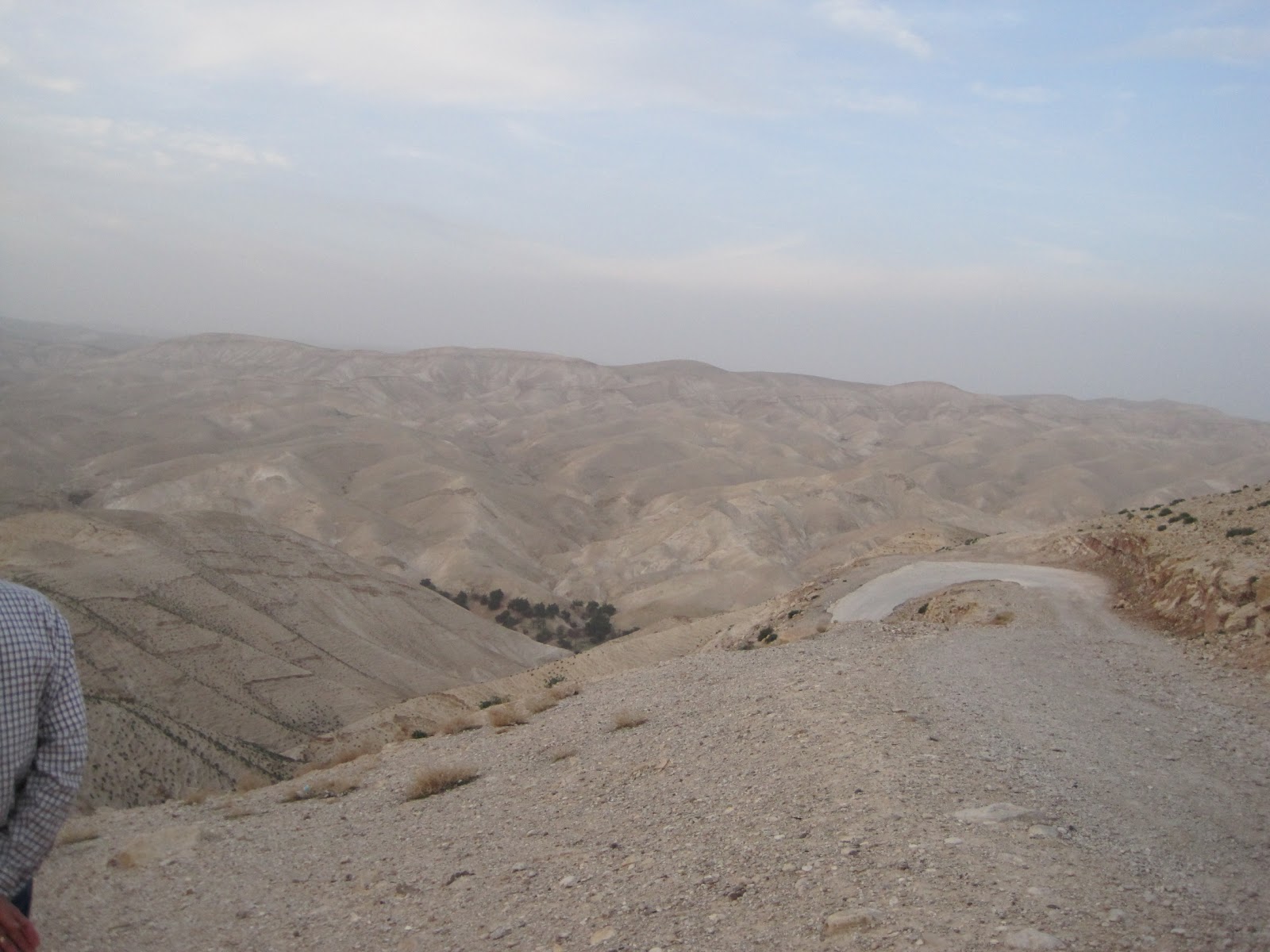
Judean Wilderness, near Jerusalem, Israel, 2010

Lectionary Passage: Mark 1: 9-12 (13-15)
In those days Jesus came from Nazareth of Galilee and was baptized by John in the Jordan. And just as he was coming up out of the water, he saw the heavens torn apart and the Spirit descending like a dove on him. And a voice came from heaven, “You are my Son, the Beloved; with you I am well pleased.” And the Spirit immediately drove him out into the wilderness.

Jesus was driven out into the wilderness.  First he gets baptized and the Spirit descends upon him.  He is claimed by the Spirit.  And then the same Spirit that claims him somehow compels him to go out into the wilderness alone–no supplies, no map, no compass, no cell phone with that neat little GPS app.  Driven out into the wilderness…You know, I used to think that I understood this wilderness thing.  I used to picture Jesus going out into the wilderness, into the trees, into nature, to pray and commune with God.  Perhaps my idea of a wilderness was somewhat skewed by visions of thick East Texas pine trees or perhaps the clammy sensation of the Costa Rican rainforest.  After all, nature is always a great place to become closer to God.

And then I saw the Judean wilderness, the same wilderness into which Jesus was driven by the Spirit.  I stood there on that mountain with a view of winds and sands and nothingness, the true depiction of forsakenness and despair.  And, standing there, I thought about this image of Jesus going out into the wilderness.  On purpose?  He went on purpose?  This is not a wilderness for the faint of heart and certainly not for one with such a faulty sense of direction as I seem to have.  This wilderness has no trees, no real markings of any kind.  The faint pathways change as the winds blow the sands wherever they want.  Even if one began this wilderness journey with some faint sense of where he or she was headed, the pathway would move in an instant and the traveler would be stranded, vulnerable, with no real sense of direction at all.

So into this vulnerable state, Jesus was driven.  If you read the passage, the Spirit claimed him at his baptism and then drove him into a journey that had no obvious pathway at all.  The mere thought of it terrifies us.  After all, don’t we do everything we can do to avoid the wilderness, to avoid a loss of control, a loss of our sense of direction, a loss of the knowledge of where we are and where we are going. But last I checked, the same Spirit supposedly descended on me as descended on Jesus.  So am I to assume that that Spirit is now driving me into the wilderness?  As one who was also baptized, who also had this same Spirit, am I being compelled to go beyond what I know?  But, I will tell you, I did not plan for the wilderness.  I do not have everything I need.  I need to pack.  I need to prepare.  (I probably need new shoes!)  And so I wait.  But that baptism thing keeps tugging at us.  You know, it’s not really meant to be a membership ritual.  It is meant, rather, to be the driving force in our lives.  It is the thing that drives us into the wilderness–if only we will go.

Contrary to the way most of us live our lives, faith is not certainty or knowledge.  It is not, I’m afraid, a sure and unquestioning sense of where one is going, even, for us seemingly progressive theologians (because we are ALL theologians!), in a “big picture” way.  It is not about being saved from something.  Faith is not about learning or being shown the way.  We are not given a map.  It’s just not that clear.  In fact, it’s downright murky, almost like sandy in the air.  No, I think that faith is about entering The Way, being driven into the wilderness, where one is vulnerable, unprepared, and usually scared to death.  And in that death, in that yielding, in that realization that we’re not really sure where it is we’re supposed to go, we encounter God.  And then in the next instant, the winds will blow the path away and, once again, we are in darkness until we realize that God is still there, not pointing to show us, but walking with us.

Every Lenten season we read of the wilderness into which Jesus was driven.  It is the affirmation that Jesus was not a superhero or a star of Survivor.  Rather, Jesus was driven into the deepest depths of human frailty and vulnerability and, unsure of where to go, found God.  Wandering the wilderness is not about finding your way but rather being open and vulnerable enough that The Way will find you.

So, continuing with our act of giving up so that we can take on, on this fourth day of Lent, think of those things that you work to control–time, space, people.  Let go of something that you control and be vulnerable, if only for a day.

Grace and Peace on this Lenten Journey,

Shelli

The promised land lies on the other side of a wilderness.{Havelock Ellis}

Grace and Peace on this Lenten Journey,

Shelli

Mixed Messages

Lectionary Gospel for Ash Wednesday:  Matthew 6: 1-6
Beware of practicing your piety before others in order to be seen by them; for then you have no reward from your Father in heaven.“So whenever you give alms, do not sound a trumpet before you, as the hypocrites do in the synagogues and in the streets, so that they may be praised by others. Truly I tell you, they have received their reward. But when you give alms, do not let your left hand know what your right hand is doing, so that your alms may be done in secret; and your Father who sees in secret will reward you.  “And whenever you pray, do not be like the hypocrites; for they love to stand and pray in the synagogues and at the street corners, so that they may be seen by others. Truly I tell you, they have received their reward. But whenever you pray, go into your room and shut the door and pray to your Father who is in secret; and your Father who sees in secret will reward you.

On the way home last night, I heard some pieces of an interview with a political figure questioning another well-known political figure’s religion.  The claim was that it was difficult to discern whether or not this person practiced “legitimate Christianity”.  Really?  And what in the world, pray tell, is “legitimate Christianity”?  And how do you know?  I mean, especially since we’re apparently suppose to be in our rooms with the door shut praying in secret!  But then, aren’t we supposed to be out in the world showing the love of Christ?  Whew!  Well, regardless of the fact that it must have been a slow news day, sometimes it’s just a whole lot of mixed messages, isn’t it?

Today we begin this season of mixed messages.  First of all, Lent itself, literally “springtime”, means that we begin clearing all of the winter debris that has grown and gathered in the flowerbeds and leaving room for new life.  This season is about both pruning and fertilizing, cutting and nurturing.  It’s about cleaning out and freshening up.  Theologically, this season brings images of walking through darkness toward the light, of giving up and taking on, of death and new life.  We are told to let go and to take up, to lay down and to rise up.  We are told to breathe in and to breathe out.  And now, to pray in secret and go out and serve the world.  So, is your head spinning?  Maybe that’s why this season is so difficult.  There’s no baby; there’s no star; there’s not even, when you think about, anybody around to tell us not to be afraid.  No one comes to tell us what is going to happen.  There is no appropriately convenient Lenten anunciation.  We just have to start walking that pathway toward Jerusalem with both assurance and humility.  But this time, in many ways we walk alone.  This God who has walked with us every step of the way has seemed to have gone on at least a few steps ahead of us.  Where Advent kept pushing us back, telling us to wait, in many ways, this season of Lent is pulling us kicking and screaming into something we do not understand, something that, given the choice, we might choose not to do, choose to go back into our room and shut the door.  Mixed messages…

I’ve shared this story before, but it is one of my favorites:  A rabbi once told his disciples, “Everyone must have two pockets, with a note in each pocket, so that he or she can reach into the one or the other, depending on their needs.  When feeling high and mighty one should reach into the left pocket, and find the words: “Ani eifer v’afar; I am dust and ashes.  But when feeling lowly and depressed, discouraged or without hope, one should reach into the right pocket, and, there, find the words: “Bishvili nivra ha’olam…For my sake was the world created.”

Talk about mixed messages!  We are dust and ashes, resembling that cast-off debris.  And we are loved more than we can even fathom.  We are so very human, struggling with greed and hubris, with some inflated sense of our own worth that makes us think we are better than others or deserve more than others, makes us think that there is some sort of “legitimate Christianity” in which we are called to participate to prove our very worth.  And, yet, somewhere in the midst of our humanity, in the midst of all those things that we do not do or those things we do not do well, there is a piece of the Divine.  Bishvili nivra ha’olam.  Do you even know how much you are loved?  Do you even know how to imagine a God that has given you the world?

Perhaps the mixed messages are because we cannot let go, cannot see what God is offering, cannot fathom how much we are loved.  Today is the day when we proclaim we are dust, when we confess our sins and lay prostrate before the ruins of our lives.  Today is the day when we take burned palm branches and allow them to be smeared across our forehead in the faint shape of a cross.  Today is the day that we remember we are dust, remember that we are particles of waste that are left from what was.  Today is the day when we go in our room and shut the door.  But the only reason we do this is so that we will stop what we are doing, look at our lives, and know how very much we are loved.  Bishvili nivra ha’olam.  For your sake, the world was created. 

Faith is about mixed messages–letting go and taking on, human and Divine, death and life, sending and return.  Perhaps this Season of Lent is about realizing that there is a Holy and Sacred “And” connecting it all.   Lent is not about giving things up; it is about emptying your life that you may be filled.  Lent is not about going without; it is about making room for what God has to offer.  And today is not about clothing yourself in the morbidness of your humanity; it is about embracing who you are before God.

There was once a question posed to a group of children:  “If all the good people in the world were red, and all the bad people in the world were green, what color would you be?”  A little girl thought for a moment.  Then her face brightened, and she replied:  “I’d be streaky!”  We would all be streaky.  To be human is to be a mixture of the unmixable, to be streaky.  It is to live incomplete, yet yearn for completion; to be imperfect, yet long for perfection; to be broken, yet crave wholeness.  It is to live with mixed messages.  And as we begin what is essentially our own journey to the cross, we note that it is one that not only recognizes but embraces the fact that there are many conflicting and disjointed ideals that God, in God’s infinite mystery and wisdom, allows to exist together—arrogance and humility, good and bad, faith and doubt, human and divine, cross and resurrection, death and life—none can exist without its counterpart.  It is about living a life of breathing out and breathing in.  Neither can exist alone.

So…remember…you are dust and ashes…breathe out…..

For you the world was created…breathe in….

In this Season of Lent, I invite you to join me in my own Lenten practice of trying to post something to this blog each day.  I would also invite you to let me know that you are reading it and join in the conversation!  And if this is not enough for you, I’m also “re-posting” my blog from a few years ago based on the book, Bread and Wine.  The blog is located at http://breadandwine-lentenstudy.blogspot.com/ or you can get there through the Dancing to God blog.

And in this Season of Lent, this season of giving up so that we can take on, I invite you to find those things in your life that you need to put down, need to let go, and also those things that you need to cherish.  So on this first day of Lent, find something that is dusty.  (This may be easier for some of us than others!)  Pick it up, clean it off, and put it in a place of honor.  Let it be your reminder for this entire season that the world was created for you.  But that sometimes you have to get dusted off!

Grace and Peace on this Lenten Journey,

Shelli
A Must See!

Lectionary Passage:  John 1: 43-46 (47-51)
The next day Jesus decided to go to Galilee. He found Philip and said to him, “Follow me.”Now Philip was from Bethsaida, the city of Andrew and Peter.Philip found Nathanael and said to him, “We have found him about whom Moses in the law and also the prophets wrote, Jesus son of Joseph from Nazareth.”Nathanael said to him, “Can anything good come out of Nazareth?” Philip said to him, “Come and see.”

At the risk of overusing movie metaphors, I saw an advertisement for a movie that touted that the critics had dubbed it “a must see.”  We all know what that means.  It means that someone is telling us that we need to try to find time to go see this movie, that perhaps our lives will be more enriched by the very act of taking the time to watch a movie.  It doesn’t mean that it’s inviting us to rewrite it or recast it or, for that matter, even critique it.  It doesn’t mean that there’s going to be a quiz at the end of it to make sure that we understood it in the way that the writer intended.  And it’s not even maintaining that we have to commit every line and every scene to permanent memory.  It’s inviting us to simply come, to put down what we’re doing and quit worrying about what we’re not doing, if only for a couple of hours, and come experience it.  It’s inviting us to come and see.  And the claim is that in some small way, our lives might be enriched by the act.

The Scripture that is used here is only part of our lectionary Gospel passage for this week.  But in this short segment, we meet Nathanael.  Most of us don’t know much about him.  After all, he was never part of the “Big 12” as far as we can tell.  But that usually didn’t matter much to the Gospel writer that we know as John.  In this version of the Good News of Jesus Christ, the notion of “disciple” is broader than Jesus’ inner crowd.  You see, Nathanael is a whole lot like us.  He wanted to understand who this Christ was and, yet, it didn’t make sense to him.  Shouldn’t there be something more?  Shouldn’t this be obvious?  How can anything this incredible come out of this little nothing town?  After all, in the first century, Nazareth wasn’t much.  There was no Roman settlement there which means, more than likely, that there was little work.  In fact, you wonder how a carpenter family even eeked out a living there.  It was probably just a couple of houses, a blip on a map.  It was nothing anyone would ever really want to see.  Yes, Nathanael was trying to make sense of this, to put it into a perspecive that made sense to him.  He was trying to take this Presence of God that was beyond anything that he could imagine fit into his notion of who God was.  But Philip’s response was simply, “Nathanael, just come and see.”  In other words, put down all of your preconceived ideas of who you think God should be and what you think God should look like and from where you think God should come, and just come and experience the Presence of God.

I don’t think that Philip was promising that Nathanael would see something tangible that would prove the existence of God.  After all, “seeing” is not limited to what we do with our eyes.  Philip is instead offering Nathanael the experience of God.  But in order to experience God, to “come and see”, one has to put everything else aside.  We cannot see God by listening to something else; we cannot see God when our hands are holding too tightly to what we think we need; and we cannot see God when our minds are so full of who we think God should be.  We’re not being called to figure God out or know everything there is about God.  You know what?  We’re not even called to be perfect renditions of what God envisions we should be.  I think God’s a lot more filled with grace than we give God credit for being.  And I don’t think we’re called to be “godly” people.  I hate that word.  Being “like God” is really God’s area!  Shhhhh!  Just come and see. 

Last week’s lectionary passages included the first few lines of Genesis.  We read of God’s spirit “sweeping over the face of the waters.”  In other words, God’s Presence was not just standing beside or standing over Creation.  God’s Presence washed over Creation, consumed it, made it part of the Divine.  We are no different.  Seeing God is about letting God’s Spirit sweep over you.  It is about experiencing God in every fabric of your being.  Joseph Wood Krutch said that “the rare moment is not the moment when there is something worth looking at, but the moment when we are capable of seeing.”  So, for all of us who are waiting for that one incredible moment when we finally see God, stop.  Just come and see.  It’s a “must see”!

What is right now so important, to what are you holding so tightly, and what are you doing now that means you cannot come and see?