Emergence

Lectionary Passage:  Jeremiah 1: 4-10
4Now the word of the Lord came to me saying,5“Before I formed you in the womb I knew you, and before you were born I consecrated you; I appointed you a prophet to the nations.”6Then I said, “Ah, Lord God! Truly I do not know how to speak, for I am only a boy.”7But the Lord said to me, “Do not say, ‘I am only a boy’; for you shall go to all to whom I send you, and you shall speak whatever I command you,8Do not be afraid of them, for I am with you to deliver you, says the Lord.”9Then the Lord put out his hand and touched my mouth; and the Lord said to me, “Now I have put my words in your mouth.10See, today I appoint you over nations and over kingdoms, to pluck up and to pull down, to destroy and to overthrow, to build and to plant.”

This account of the calling of Jeremiah includes the things that so many call stories do (including, probably, most of ours).  They include a calling from God, a promise that God will help and support and walk with the one that God has seen fit to call.  Then it includes an argument.  “No, no, no, not me.  I have my life all planned out.  This cannot be happening.  In fact, this is really going to mess up my plans.”  But, finally, it includes a response.  In Jeremiah’s case, God puts the words in his mouth, promising him that he would know what to say and when to say it.  And from that time on, Jeremiah is single-minded in what he is called to do.  But the problem is that the words that Jeremiah was called to say were not what people planned on hearing.  In fact, Jeremiah’s message didn’t resonate at all with the society to which he was appointed to serve.  He wasn’t called to tell them how great they were doing; instead, he was called to pluck up, pull down, destroy, and overthrow.  And then, and only then, is he called to build and plant.  What is that about?  This plucking and pulling and destroying and overthrowing doesn’t sound like God’s work.  In fact, it just sounds like out and out chaos.

So did you forget?  Did you forget what God does with chaos?  Read Genesis 1.  God took chaos and created order.  And, as I recall, it turned out pretty well. And yet, we often forget that.  We would much rather God take the plans that we’ve conjured up for our lives and have God just continue them. But sometimes we have to pluck and pull and even destroy and overthrow.  Sometimes, we just need to start again with a new plan.  But change is hard. Change is scary.  Walking that tightrope can tip us into opportunity or crisis at any turn.  So how do we prepare for that?

Maybe we don’t.  Maybe preparation comes not in the form of plans but rather a sort of clearing of our minds and our souls so that God can fill us.  Maybe preparing for change, preparing for what God is going to do in our lives, has to involve plucking and pulling and destroying.  Maybe deep in that chaos is a certain holiness, a newness that has just begun to emerge from its womb.  And God, rather than stamping some sort of holy approval on our comfortable and complacent existence, calls us into a new way of being.  God is always recasting the vision for our lives, always pushing us out of our comfort zones, and always birthing us into newness. 

But God reminded Jeremiah that even in that womb, he was not alone.  God is there in our transformation.  But we can’t stay there.  God has too much in store for us.  So, all through our lifetime, as we emerge from womb to womb, God is birthing us closer and closer to the life that God has created just for us.  Maybe we’re not called so much to plan our lives but rather to emerge.

Grace and Peace,

Shelli 

Water Plus a Miracle

Lectionary Passage:  John 2: 1-11
On the third day there was a wedding in Cana of Galilee, and the mother of Jesus was there.2Jesus and his disciples had also been invited to the wedding.3When the wine gave out, the mother of Jesus said to him, “They have no wine.”4And Jesus said to her, “Woman, what concern is that to you and to me? My hour has not yet come.”5His mother said to the servants, “Do whatever he tells you.”6Now standing there were six stone water jars for the Jewish rites of purification, each holding twenty or thirty gallons.7Jesus said to them, “Fill the jars with water.” And they filled them up to the brim.8He said to them, “Now draw some out, and take it to the chief steward.” So they took it.9When the steward tasted the water that had become wine, and did not know where it came from (though the servants who had drawn the water knew), the steward called the bridegroom10and said to him, “Everyone serves the good wine first, and then the inferior wine after the guests have become drunk. But you have kept the good wine until now.”11Jesus did this, the first of his signs, in Cana of Galilee, and revealed his glory; and his disciples believed in him.

We actually refer to this story that we read from the Gospel According to John as part of our marriage service order, mentioning that in it, “Jesus graced a wedding at Cana of Galilee and gave us the example for the love of one another.”  I’m not really sure why because the truth is this passage is not about marriage; it’s about wine.  So last week we read of Jesus’ baptism and now we read of his first miracle.  He definitely got the show on the road, so to speak.  And yet, the story is a little odd.  We read later of teaching, of healing, of including, even of raising from the dead.  So what’s this thing about wine?  Why was this act important enough to put in the Gospel and, particularly, to place it where it is the first miracle that we find Jesus doing?

Well, according to the Mishnah (which is essentially a redaction of the oral tradition of Judaism and a documentation of the traditional understandings of Scripture), the wedding would take place on a Wednesday if the bride was a virgin and on a Thursday if she was a widow. The bridegroom and his friends made their way in procession to the bride’s house. This was often done at night, when there could be a spectacular torchlight procession. There would be speeches and expressions of goodwill before the bride and groom went in procession to the groom’s house, where the wedding banquet was held. It is probable that there was some sort of religious ceremony, but we have no details. The processions and the feast are the principal items of which we have knowledge. The feast was prolonged, and might last as long as a week (so, OK, that would be quite a lot of wine!).

So Mary, the mother of Jesus, is at the wedding, although her role seems to be more than that of a guest. Perhaps the couple was an extended family member or something.  But she seems to be one of the first to know that the wine is running out. She instructs the servants to do whatever Jesus tells them to do, and they appear willing to take her instructions.  Now you have to understand that this was an embarrassing situation.  The wine has run out, and there appears to be no solution.  Either no more wine is available, or there is no money to buy more wine. The guests seem unaware of what is happening. If something is not done, all will be embarrassed. Some commentators even inform us that litigation was possible in such cases. (Can you imagine being sued for not providing enough food and drink at a marriage ceremony?)  But, regardless, it is clear that Jesus mother expects Jesus to do something out of the ordinary.  She expects him to fix the problem.

In the setting of this story, Jesus has not yet begun to perform all the miracles and the teaching and yet his mother thought he could do this.  It’s unclear whether or not Mary really understood what “hour” to which Jesus was referring or if she really grasped who this man that she had brought into the world was, but, timing aside, Jesus helps out and fills a need.  Maybe it’s a message to us that Jesus didn’t just come for the “big”, splashy things.  Maybe it’s a reminder that God is in even the ordinary, those seemingly small things in life that we think we can handle, that we think don’t really even matter to God.

But this?  I mean, really, wine?  Why didn’t he turn the water into food for the hungry or clothing for the poor?  Why didn’t he end the suffering of one of those wedding guests who were forced to live their lives in pain?  Why didn’t he teach those that were there that God is more impressed by who we are than what we do?  Now THAT would have been a miracle.  But instead Jesus, in his first miraculous act, creates a party, a feast.  Maybe it’s a reminder that we ought to just relax and trust God a little more.  Maybe it’s trying to tell us that God is indeed in every aspect of our life.  And maybe it’s telling us that life is indeed a feast to be celebrated.

And think about the wine itself.  It begins as ordinary grapes.  Well, not really.  If you go even farther back, you start with water.  Everything starts with water.  And then those ordinary grapes with just the right amount of water, the right amount of sunlight, and the right amount of nutrients fed to them from the rich, dark earth begin to seed.  And then we wait, we wait for them to grow and flourish and at just the right time, they are picked and processed and strained of impurities and all of those things that are not necessary.  And then they are bottled and tucked away while again, we wait.  They are placed in just the right temperature, with just the right amount of light, and just the right amount of air quality, and we wait.  We wait and until it becomes…well, a miracle.


And Biblical theologians have over and over pointed to the relationship that this story has with the Eucharist.  Think about it.  We take ordinary bread and ordinary wine (or in our case, ordinary Welch’s Grape Juice), and through what we can only describe as a Holy Mystery, a veritable miracle,  those ordinary things become holy.  They become for us the body and blood of Christ, the very essence of Christ to us, for us, and in us. 
And remember that when the wine ran out, Jesus did not conjure up fresh flagons of wine.  Rather, he took what was there, those ordinary, perhaps even abandoned vessels of ordinary, everyday water and turned it into a holy and sacred gift.  Water and a miracle…

So this story of wine makes a little more sense.  Wine is water—plus a miracle.  But in case it is lost on us, remember that our bodies are roughly two-thirds water.  No wonder the ancient sages always used water as a symbol for matter itself.  Humans, they taught, are a miraculous combination of matter and Spirit—water and a miracle—and thus unique in all of creation.  No wonder that wine is such a powerful, sacramental, and universal symbol of the natural world—illumined and uplifted by the Divine.  Wine is water, plus spirit, a unique nectar of the Divine, a symbol of life.

And we, ordinary water-filled vessels though we are, are no different.  God takes the created matter that is us and breathes Spirit into us, breathes life into us.  We, too, are water plus a miracle.  So as we lift the chalice today, let it be a reminder of Christ’s Spirit infused into us, living in us.  13thcentury German mystic Meister Eckhart said that “every creature is a word of God.”  It’s another way of reminding us that we are water plus a miracle.

So maybe this story of Jesus’ first miracle is not as odd as we thought.  Our lectionary places it immediately following the remembrance of Jesus’ baptism and the remembrance of our own.  It is the point where God’s Spirit, where the holy and sacred itself, was poured into each of us.  So, yes, we are a miracles, created matter, Spirit-breathed.  We are the good wine that God has saved for now.  We are water plus a miracle.

Go be the miracle you were created to be!

Grace and Peace,

Shelli

We Have Risen! We Have Risen Indeed!

To read today’s Gospel passage, click on
http://bible.oremus.org/?ql=200846939

THE LORD IS RISEN!

THE LORD IS RISEN INDEED!

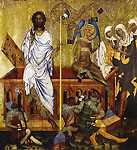
“The Resurrection of Christ”
Vyssi Brod Hohenfurth, c. 1350

Christ, the Lord, is risen today, Alleluia!
Sons of men and angels say, Alleluia!
Raise your joys and triumphs high, Alleluia!
Sing, ye heavens, and earth, reply, Alleluia!

Love’s redeeming work is done, Alleluia!
Fought the fight, the battle won, Alleluia!
Lo! the Sun’s eclipse is over, Alleluia!
Lo! He sets in blood no more, Alleluia!

Vain the stone, the watch, the seal, Alleluia!
Christ hath burst the gates of hell, Alleluia!
Death in vain forbids His rise, Alleluia!
Christ hath opened paradise, Alleluia!

Lives again our glorious King, Alleluia!
Where, O death, is now thy sting? Alleluia!
Once He died our souls to save, Alleluia!
Where thy victory, O grave? Alleluia!

Soar we now where Christ hath led, Alleluia!  Following our exalted Head, Alleluia!
Made like Him, like Him we rise, Alleluia!  Ours the cross, the grave, the skies, Alleluia!

Hail, the Lord of earth and Heaven, Alleluia!  Praise to Thee by both be given, Alleluia!
Thee we greet triumphant now, Alleluia!  Hail, the resurrection, thou, Alleluia!

King of glory, Soul of bliss, Alleluia!  Everlasting life is this, Alleluia!
Thee to know, Thy power to prove, Alleluia!  Thus to sing and thus to love, Alleluia!

(Charles Wesley, 1739)

The day has arrived!  After all this time of anunciation and birth, of baptism and ministry, of teaching and healing, of calling and response, of temptation and darkness, of dying and crucifixion, this Day of Resurrection has dawned.  Christ has risen!  Christ has risen indeed!

But lest we lapse into thinking of this day as a commemoration of The Resurrection of Christ, as a mere remembrance of what happened on that third day so long ago, we need to realize that this day is not just about Jesus’ Resurrection; it is also about our own.  We who carried our cross, we who died to self, are this day given new life.  God has recreated us into who God calls us to be.  And, in a way, that is almost more scary than the dying.  There is no going back.  The self that we knew before is no more.  We are a new creation.  We have risen!  We have risen indeed!

You see, Jesus did not die and magically come back to life.  God did not undo what had been done.  There was still a bloody cross standing on an unknown hill called Golgotha.  Rather, God created something new–a new way of seeing and a new way of being.  Do you remember the first time God did that?

In the beginning when God created the heavens and the earth,the earth was a formless void and darkness covered the face of the deep, while a wind from God swept over the face of the waters. Then God said, ‘Let there be light’; and there was light. And God saw that the light was good; and God separated the light from the darkness. God called the light Day, and the darkness he called Night. And there was evening and there was morning, the first day. (Genesis 1: 1-5)

From the void, from the darkness, God created Light and Life.  Truthfully, if you look at it from a literal view, nothing has really changed.  Jesus, sadly, is still dead.  But through eyes that have been resurrected, nothing will ever be the same again.  Maybe resurrection comes not in raising one above life, but in raising life to where it is supposed to be.  Jesus was the first to cross that threshold between–between death and life, between the world and the sacred, between seeing with the eyes of the world and seeing with the eyes of the Divine.  Resurrection is not about being transplanted to a new world but rather being called to live in this one with a new way of seeing.  It means being recreated into the one that God envisions you to be.  It means being given a new way of seeing where love is stronger than death, where hope abides, and where life has no end.  It means being capable of glimpsing the Holy and the Sacred, the promise of Life, even in this life, even now.  This day of Easter is now only about Jesus’ Resurrection; it is about ours!  So, what do you plan to do with your new life?

The end of all our exploring…will be to arrive where we started…and know the place for the first time. (T.S. Eliot)

King of glory, Soul of bliss, Alleluia! Everlasting life is this, Alleluia!
Thee to know, Thy power to prove, Alleluia! Thus to sing and thus to love, Alleluia!

Everlasting life is truly this!

Grace and Peace,

Shelli

Thank you for joining with me on this Lenten journey!  I have been so blessed by all the comments and the reflections that you have shared.  We will do this again.  In the meantime, I’m going to take a little “blogging sabbatical” and return on April 25th with posts two or three times a week.  I will do the “every day” thing again later!  Let me know if you or others that you know want to join the Google group and get emails each time I post.  And comment!  Let’s start a discussion!   You can email me at swilliams@stpaulshouston.org.  Let me hear from you! 

The Day Between

What do we do with this day, this Holy Saturday?  We are still grieving.  The reality of it all is beginning to sink in, beginning to be real.  Jesus is gone, dying alone on some hill that we don’t even know.  So, what do we do today?  How do we pick up the pieces in the midst of our pain and despair and just go on with our lives?  Oh, we 21st century believers know how the story ends.  We’ve already jumped ahead and read the next chapter many, many times.  (Don’t tell those that don’t read ahead, but it all works out in the end.)

And yet, we do ourselves no favors if we jump ahead to tomorrow.  After all, the Scriptures tell us that Jesus rose on the third day, the THIRD day, as in one-two-three.  The third day doesn’t happen without today.  It must be important, right?  But, oh, it’s just so painfully quiet.  The sanctuary is dark, awaiting to be redressed for its coronation.  The bells are quiet, hanging expectantly for tomorrow.  And we still sit here draped in black with our Easter brights hanging there ready for us to don.  What are we supposed to do today?

Tradition (and the older version of the Apostles’ Creed) holds that Jesus died, was buried, and descended into hell.  So is that what this day is?  Descent?  Good grief, wasn’t the Cross low enough?  The well-disputed claim is that Jesus descended into death, descended into hell, perhaps descended into Gehenna (Greek, Hebrew–Gehinnom, Rabbinical Hebrew–גהנום/גהנם), the State of ungodly souls.  Why?  Why after suffering the worst imaginable earthly death would Jesus descend into hell?  Well, the disputed part is that Jesus, before being raised himself, descended to the depths of suffering and despair and redeemed it, recreated it.  The sixth century hymnwriter, Venantius Fortunatus claimed that “hell today is vanquished, Heaven is won today.” Why is that so out of bounds of what God can do?  Don’t we believe that God is God of all?  Or does it give us some sense of comfort to know that we are not the worst of the bunch, that there are always Judas’ and Brutus’ that have messed up a whole lot worse than any of us and so are destined to spend eternity on the lowest rungs of hell?  But, oh, think about the power and grace and amazing love of a God who before the Divine Ascent into glory, descended into the depths of humanity and redeemed us all, perhaps wiped out the hell of each of our lives rung, by rung? 

And, yet, again, we cannot leave it all to Christ to do.  Just as we were called to pick up our cross yesterday, we are called to descend down into the depths, plunging into the unknown darkness, so that God can pick us up again, set us right, and show us a new journey.  And so this day, we stand between, between death and life, between hell and heaven, between a world that does not understand and a God who even in the silence of this day has begun the redeeming work.  In some ways, this is the holiest day of the week.  How often do we stand with a full and honest view of the world and a glimpse of the holy and the sacred that is always and forever part of our lives?  How often do we stand together and see ourselves as both betrayers and beloved children of God?  How often do we stand in the depths of our human state and yet know that God will raise us up.  This is a pure state of liminality, a state, as the Old English would say, “betwixt and between.”  It is where we are called to be.  It is the place of the fullness of humanity as it claims both human and divine.  In the silence of this day, we stand with God.  And we wait, we wait expectantly for resurrection, we wait for God to say us once again.  It is where we should always be.  We won’t though.  We won’t be there. (Remember, we’ve had this problem before.)  And maybe on some level, it’s too much for us to always be there, always be waiting expectantly for God.  But at least we can remember what this day feels like as we stand between who we were and what we will be. 

So, for today, keep expectant vigil.  Do not jump ahead.  We can only understand the glory of God when we see it behind the shadow of death.  But, remember, shadows only exist because of Light. 

“Welcome, happy morning!” age to age shall say:
“Hell today is vanquished, Heav’n is won today!”
Lo! the dead is living, God forevermore!
Him, their true Creator, all His works adore!

Refrain
“Welcome, happy morning!”
Age to age shall say.

Earth her joy confesses, clothing her for spring,
All fresh gifts returned with her returning King:
Bloom in every meadow, leaves on every bough,
Speak His sorrow ended, hail His triumph now.

Refrain

Months in due succession, days of lengthening light,
Hours and passing moments praise Thee in their flight.
Brightness of the morning, sky and fields and sea,
Vanquisher of darkness, bring their praise to Thee.

Refrain

Maker and Redeemer, life and health of all,
Thou from heaven beholding human nature’s fall,
Of the Father’s Godhead true and only Son,
Mankind to deliver, manhood didst put on.

Refrain

Thou, of life the Author, death didst undergo,
Tread the path of darkness, saving strength to show;
Come, then True and Faithful, now fulfill Thy Word;
’Tis Thine own third morning; rise, O buried Lord!

Refrain

Loose the souls long prisoned, bound with Satan’s chain;
All that now is fallen raise to life again;
Show Thy face in brightness, bid the nations see;
Bring again our daylight: day returns with Thee!

Refrain
Just wait…
Grace and Peace,
Shelli

Were You There at the End?

Today’s Scripture Passage: Mark 15: 34-47.
To read today’s portion of the account of the Passion, click on the below link:
http://bible.oremus.org/?ql=200678972

It’s 3:00.  The bells have begun to toll.  The sky is black and rumbling. After hanging there for hours, Jesus is nearing death.  He cries out from the depth of his forsakenness, the depth of his loneliness and abandonment.

Standing in the background, we want to help.  We want to bring comfort and a swift and painless death.  But we don’t.  Instead we stand by, not really knowing what to do, not really knowing if we should get involved, put our own selves at risk perhaps.  The truth is, we don’t really want to get our hands dirty.  Why do we think that because Jesus is our Savior, we should become nothing more than inert bystanders?  Well, we’ve never been told that.  No where in Scripture does it tell us to sit back while Jesus does all the hard stuff.  Oh, it would definitely be more palatable to just sort of walk way from this whole ugly mess and wait for it to pass, maybe show up Sunday morning for the grand processional with not even a bloodstain on us.

And then, it is over.  Jesus cries out and breathes his last breath on this earth.  The last piece of humanity that was at its fullest, the last shred that was what God envisioned, goes away in one last long and drawn out exhale.  God breathed us into being and is now exhaling and slipping away.  It is finished.  Jesus is gone.

Suddenly, the earth shakes and flashes of lightning cut across the darkened sky.  Torrential winds begin to blow across the earth and rain begins pouring onto the land.  The curtain of the temple, the veil that separates the Holy of Holies from us, that separates holiness from the earth, is torn in two and heaven and earth begin to spill together.  In some ways, they become almost undistinguishable from each other.  It is almost as if they somehow belong together, perhaps that they always belonged together. 

And then, from the shadows emerge the women.  They are those who are powerless, meaningless in society.  They are those whom Jesus loved.  And they were there even at the end.  Because the Sabbath was beginning, Joseph of Arimethea, an outsider in Jesus’ circle, asked for Jesus body.  And after anointing him, Joseph buried him in a borrowed tomb.  Even in death, Jesus had no home.  Even in death, the world did not make room.  And so the stone was rolled into place.  And those who loved him tried to go back to their lives.

So, were you there at the end?  Were you there when Jesus died, when the world changed, and when Jesus was buried in an unmarked grave?  The women knew where he was buried.  But no one else seemed to know.  They were not there.  So, what now?  We were always told to follow Jesus.  Where is he now?  Well you see, this would be the point at which we are compelled to pick up our cross and follow.  This would be the place where we die to self, where we leave our selves behind and go forward.  This would be the place where we experience the wholeness of who Jesus is.  This is the moment for which we’ve been preparing on this forty-day journey.  Just as the earth and heaven have spilled together, becoming undistinguishable, so have death and life.  No longer can we see where one ends and another begins because death has been recreated as life, death itself has had the breath of God breathed into it. The Protestant notion of the “empty cross” does not even make sense.  The cross is not empty; it is full of life–all of life. 

But we have to wait.  We have to enter the Cross on this day.  We have to follow Christ.  We have to die with Christ this day–die to self, die to greed and selfishness and putting ourselves ahead of others, die to prejudice and exclusion and a lack of compassion for our brothers and sisters in this holy earth.  Today we die.  And then we wait.  For God has gone on ahead.  God entered death first and asked us to do the same, asked us to follow, asked us to take up our cross.  So, take up your cross and follow.  For those who believe that God redeems, death is now part of life, earth is now part of heaven, and endings are now part of our beginning.  The birthing is not over.  It is never really finished.  On this night it all spills together and waits for God’s redeeming work.  On this night the earth once again waits with expectant hope for birth to happen.  But this time, it is ours!
 

Silent night! Holy night!
All is calm, all is bright,
Round yon Virgin Mother and Child!
Holy Infant, so tender and mild,
Sleep in heavenly peace!
Silent night!  Holy night!
Son of God, loves pure light
Radiant beams from Thy Holy Face
With the dawn of redeeming grace,
Jesus, Lord, at Thy Birth!

So, even as we wait in darkness, even as we grieve this night, God has only begun creating Life.  So, were you there at the end?  If we’re not there at the end, we’ll miss what comes next.  In the silence and holiness of this night, God is with us, walking us through to Life.
The point of Holy Week is to empty.  It is the completion of the process of Lent in which we have made room for our death…Resurrection is finding that place that is just for us.  In the beginning of Holy Week, we find ourselves spiritually homeless.  But when we are homeless, we are ready to be sheltered.  The shelter from death, in life, is on its way.  We don’t need to fear the emptiness.  (Donna E. Schaper, in Calmly Plotting the Resurrection, p. 80.)
Grace and Peace,
Shelli


Were You There When They Crucified My Lord?

Today’s Scripture Passage: Mark 15: 20-33
.
To read today’s portion of the account of the Passion, click on the below link:
http://bible.oremus.org/?ql=200598988

So they led him away and they hung him on the cross.  They chided him to save himself.  But Jesus was even too weak to carry his own cross.  They randomly pluck a man out of the crowd to help him carry it.  Now if we were doing the staging of this, we probably would have written in one of the disciples to do this, one of those who had traveled with Jesus these past years and received so much love and so much of life from Jesus.  It would have made more sense for one of those whom Jesus had stooped down below last night to wash his feet in a poetic depiction of incredible mutuality.  But that’s not what happened.  As it becomes more and more difficult for Jesus to carry his cross, it is a stranger who stoops to serve Jesus.  We really know very little about Simon—is he black, brown, white, olive-skinned?  Does it matter?  He was from Libya—a foreigner to the city of Jerusalem.  Anonymously plucked out of the crowd to help a bleeding dying man, he stooped and hoisted the cross that Jesus was carrying to his own shoulder.  Even at this late hour, God has orchestrated a Divine reversal in what the world expected.  Isn’t that just like God?  But, you have to wonder, where were the disciples?  Where were you?

The account says that they brought Jesus to Golgotha.  The name derives from the Aramaic golgolta, meaning “skull” or “place of the skull”.  Early tradition assumed that this was a site west of the city.  And when the Lukan Scripture was translated into Latin, it became known as “Calvary.”  But somewhere in history, the site was lost.  Perhaps it wasn’t even a specific site at all but a sort of general area away from the bustle of the city where these crucifixions would occur.  In 330, the Emperor Constantine tore down a Roman temple to Aphrodite and built the Church of the Holy Sepulcher, which tradition now recognizes as the last stations of Jesus’ journey to the cross, the site of the Crucifixion, and the site of the burial.  The present structure, built by the Crusaders, still houses the Constantine structure and the tradition.  Maybe it’s best that it’s like that.  Maybe it’s best that the actual site of Jesus’ final moments is not really known and even that Jesus’ final resting place is more of a tradition than a known place.  After all, would you have been there anyway? Maybe the anonymity is the whole point, sort of a depiction of our faith journey as we wander with no real knowledge of where it is we’re going–only that God is calling us there.

So, accompanied by an anonymous person to an anonymous place, Jesus is crucified.  The one who not so long ago had been surrounded by friends and followers, who a short time ago had preached to thousands on a hillside near the Galilean lake, and who only days ago had been showered with palm-branches in acclaim for who he was, was totally alone.  The one who had come into the world to save the world was now going to die in a shroud of anonymity.  It’s pointless to ask the question as to whether or not you were there.  You weren’t.  I wasn’t.  No one was. 

The life that began in the humble anonymity of a rough-hewn manger was ending the same way on a rough-hewn cross.  Maybe that was the whole point.  We bring nothing into this world and we take nothing out.  We are here for but a short time that, by the very Grace of God, is hopefully so filled with life and love that when our life here has ended, love still remains.  We do not know exactly where Jesus was born and we can’t pinpoint the location where he died.  What we do know is that while Jesus hung on the cross waiting those agonizing hours to die, God had plunged down to the very depths of humanity, to the places of loneliness and despair, to the places of abandonment and darkness, to the places where we are sometimes afraid to go.  And there, God began to say Creation into being once again.  The cross is God’s highest act of Creation yet. And when it was all said and done, it was Love that remained.

H.J. Iwand said that “our faith begins at the point where atheists suppose it must be at an end.  Our faith begins with the bleakness and power which is the night of the cross, abandonment, temptation, and doubt about everything that exists!  Our faith must be born where it is abandoned by all tangible reality; it must be born of nothingness, it must taste this nothingness, it must taste this nothingness and be given it to taste in a way that no philosophy of nihilism can imagine.”  So, in all probability, the explanation of the Cross is that there is no explanation.  At humanity’s lowest point, whether or not we bother to show up at all, it is only God who can save us.

Were you there when they crucified my Lord?
Oh, sometimes it causes me to tremble, tremble, tremble.
Where you there whey they crucified my Lord?

When it was noon, darkness came over the whole land until three in the afternoon…

Grace and Peace,

Shelli

Where Were You As Jesus Stood Accused?

“Christ Accused by the Pharisees”
Duccio de Buoninsegna, (1308-11)

Today’s Scripture Passage: Mark 14: 53-72
.
To read today’s portion of the account of the Passion, click on the below link:
http://bible.oremus.org/?ql=200505621

Most of us don’t read this portion of The Passion a whole lot.  We like the image of Jesus’ Anointing and we love the notion of The Garden of Gethsemane but this…this is not to our liking.  This is the story of Jesus as The Accused.  And we all know that doesn’t make sense.  What did Jesus ever do wrong?  And yet, here he is, before the court.  But this man who had spent his ministry welcoming others in was alone.  Oh, wait a minute…there’s Peter behind that sleeping elderly Scribe with the bad complexion.  Peter, his friend, his confidante, his disciple (Peter, as in Saint!) is there, but keeping a safe distance.  Well, I suppose he has too.  After all, the future of the Christian church rests with him, right?  He has to keep up appearances, do the right thing.  The important thing is that he is here, that Jesus knows he is here.  The important thing is that, deep down, Jesus knows how much he loves him and supports him.

Oh, we’re good at this, aren’t we?  We’re good at figuring out how to keep up appearances, at figuring out how to offer love and support while still maintaining our own place in life.  It’s difficult to associate ourselves with certain people or certain issues, even though we agree.  You see, we have to maintain our position so, please, understand, I support you, but I can’t speak out just now.  I know you understand how much I love you.

COCK A DOODLE DOOOOOOO!

What was that?  That was a lot of noise!  But, seriously, it’s hard to associate with certain people.  I love them; I support them; you know, I even think that they’re treated badly by both the society and, sadly, the church, but I just can’t.  What good would it do for me to forego my position just to make a statement on their behalf?

COCK A DOODLE DOOOOOOO!

Geez!  What IS that noise?  This man is my friend.  I love him.  But I can’t.  I can’t be seen with him right now.  I know he understands.

COCK A DOODLE DOOOOOOO!

And so Jesus stood alone. And Peter wept.  Peter wept for his friend but probably more than that he wept for what he was not.

I have to say that I am not a “rabble rouser”.  I tend to live my life with as little drama as I can muster.  In fact, I have to admit that I would be often standing in the back of the courtroom silently supporting the accused but not wanting to put my own self in jeopardy.  We’re all like that.  Isn’t that interesting that we talk so much, cannot put our cell phones or our emails aside and, yet, we are silent?  It is a dangerous and destructive silence.  It is like standing in the back of the courtroom and watching the innocent of all innocents accused and not speaking out.  Because you see, it is silence that crucified Jesus; it is silence that allowed the religious Crusades of the Middles Ages exist; it is silence that created slavery as the blotch on our nation’s history; it is silence that closed its eyes to Auschwitz hoping against hope that it would go away; it is silence that allowed segregation to exist in this country until late in the 20th century; and it is silence that continues to allow our church and our nation to limit who is part of us, who is part of the Kingdom of God.

And so Jesus stood accused.  Peter was in the background, safely hidden away.  Where were you? 

So, on this Wednesday of Holy Week, how would you answer? Were you there as Jesus stood accused?  Were you in the back of the courtroom?  What things do you know are wrong but about which you are silent?  Where do you voice your passions?  Where do you voice your Passion?

Grace and Peace,

Shelli