REMEMBERING OUR JOURNEY: When We Came to Be


"Birth of Christ", Robert Campin, c. 1425-1430

Scripture Text:  Luke 2: 1-7

In those days a decree went out from Emperor Augustus that all the world should be registered. This was the first registration and was taken while Quirinius was governor of Syria. All went to their own towns to be registered. Joseph also went from the town of Nazareth in Galilee to Judea, to the city of David called Bethlehem, because he was descended from the house and family of David. He went to be registered with Mary, to whom he was engaged and who was expecting a child. While they were there, the time came for her to deliver her child. And she gave birth to her firstborn son and wrapped him in bands of cloth, and laid him in a manger, because there was no place for them in the inn.

“In those days, a decree went out.”…There it is!  It is probably the best known story of all time and a great story it is–forced occupation, poor couple, long trip, impressive ancestry,  a last-minute birth, animals, humble beginnings, angels, assurance, surprise visitors, well-trained angelic choir, and God.  (You know, in hindsight, if there had been a coach and a glass slipper, this would have been perfect!)  But, seriously, think about it.  This story has gripped the world for more than twenty centuries.  Jesus of Nazareth was born a human gift to this world, born the way we were all born.  No, the Scripture doesn’t speak of morning sickness and labor pains.  In fact, in our haste to welcome the Christ child into our lives each Christmas Eve, we forget the humanness of the birth.  We forget that he first appeared in the dim lights of that grotto drenched with the waters of Creation, with the smell of God still in his breath.  We forget that Mary was in tears most of the night as she tried to be strong, entering a realm she had never entered, questioning what the angel nine months before had really convinced her to do.  We often sort of over-romanticize it, forgetting that Jesus was human.

But that night, that silent night, was the night when the Word came forth, Incarnate.  In its simplest form, the Incarnation is the mingling of God with humanity, the mingling of God with us.  It is God becoming human and, in turn, giving humanity a part of the Divine.  It is the mystery of life that always was coming into all life yet to be.  This night, this silent night, was the night that we came to be.  In this moment, Humanity and the Divine are somehow suspended together, neither moving forward, both dancing together in this grotto.  This is the night for which the world had waited.

God has come, sought us out.  Eons of God inviting us and claiming us and drawing us in did not do it.  So God came, came to show us the sacredness that had been created for us, the holy in the ordinary that we kept missing.  God has traversed time and space and the barrier between us and the Divine and as God comes across the line, the line disappears.  God is now with us.  We just have to open our eyes.  And then, the walk began, a walk that is passing through Galilee and, soon, Jerusalem and Golgotha.  And at each point, God asks us to dance again.  And we will never be the same again.  This notion of “Emmanuel”, God With Us, means that all of history has changed.  It means that we have changed.  Lest we over-romanticize that night as one of beauty and candlelight and “Silent Night”, that night was the night we came to be.  We have passed through to another time with our feet still firmly planted here.  God is not asking us to be Divine.  We are not called to be God.  God is asking us to be who God created us to be and came to walk with us to show us what it meant to be human, to be made, not into God, but in the very image of the Divine.

Tradition tells us that the birth happened just a few miles from Jerusalem.  We think of it as another world.  We think of it in the silence without remembering that God came into the midst of a world that is filled with pain and darkness, filled with danger and injustice, filled with the stench of death.  We forget that Jesus was born just a short distance way from a place that is called Golgotha with a waiting cross.  But God still came.  God always comes.  God came to show us Light in the darkness and Life in the midst of death.  God came to show us how to be.  Our journey that we are on now is not separate from that night.  That night was the night it began, the night that God, even in the face of the madness of this world, poured the Sacred and the Divine into our lives.  We were changed forever.  And we can’t separate our past from who we are now.  We can’t help but carry the manger with us on this journey and try our best to make room.  It is part of us.  It is part of when we came to be.  It is what sent us on this journey, the journey that leads us to Jerusalem.

We have become so accustomed to the idea of divine love and of God’s coming at Christmas that we no longer feel the shiver of fear that God’s coming should arouse in us.  We are indifferent to the message, taking only the pleasant and agreeable out of it and forgetting the serious aspect, that the God of the world draws near to the people of our little earth and lays claim to us.  The coming of God is truly not only glad tidings, but first of all frightening news for everyone who has a conscience. (Dietrich Bonhoeffer)

On this day in this Lenten journey, remember when you came to be.  What do you remember about knowing what that means?

Grace and Peace,

Shelli

REMEMBERING OUR JOURNEY: When Things Began to Change


Church of the Annunciation, Nazareth, Israel

Scripture Text:  Luke 1: 30a-38

“Do not be afraid, Mary, for you have found favor with God. And now, you will conceive in your womb and bear a son, and you will name him Jesus. He will be great, and will be called the Son of the Most High, and the Lord God will give to him the throne of his ancestor David. He will reign over the house of Jacob forever, and of his kingdom there will be no end.” Mary said to the angel, “How can this be, since I am a virgin?” The angel said to her, “The Holy Spirit will come upon you, and the power of the Most High will overshadow you; therefore the child to be born will be holy; he will be called Son of God. And now, your relative Elizabeth in her old age has also conceived a son; and this is the sixth month for her who was said to be barren. For nothing will be impossible with God.” Then Mary said, “Here am I, the servant of the Lord; let it be with me according to your word.” Then the angel departed from her.

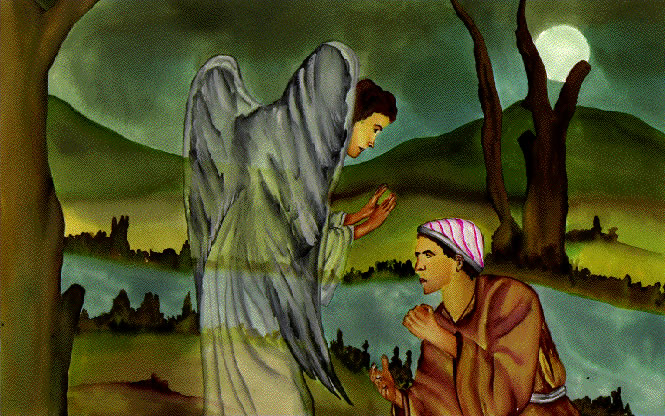
Think back.  Think back to that time when things began to change.  Think back to the announcement.  Think back to the point where our world as we know it was rocked to its foundations as God revealed the very Godself to us, bursting into our world, the world that we thought was the one.  For us, it began the mystery that is Jesus Christ, the mystery that brought us here, the mystery that will take us to Jerusalem.  But in this moment we remember, the fog lifted and there before us was the bridge between the human and the Divine.  This IS the beginning of Jesus Christ.  We often sort of skip over that sometimes, choosing not to get much beyond that night of mangers and stars and visiting field hands.  Think about it.  Jesus was fully human and this human Jesus, like all of us, had to be grown and nurtured in the womb before the miracles started.  March 25th (that would be nine months before Christmas) is celebrated as The Feast of the Annunciation, the veritable turning point of all human history.  It is was in this moment that God stepped through the fog into humanity and, just like every human before and every human since, must wait to be fully birthed into this world.  So, let it be…

In the beginning when God created the heavens and the earth, the earth was a formless void and darkness covered the face of the deep, while a wind from God swept over the face of the waters.  Then God said, “Let there be light”; and there was light. (Genesis 1: 1-3)

And in some traditions, March 25th is regarded as the first day of Creation.  (Now, really, I don’t even begin to see THAT as a real date!  But it’s a good thing to remember and that date is as good as any, right?)  So, let’s go with it.  March 25th marks the beginning, when God’s Spirit moved across the face of the waters bringing Light into the Darkness.  So the Annunciation…the announcement of the coming of Christ, the coming of God, into our little world…is that day when once again the darkness begins to fill with Light.  So, begin at the beginning and count forward…to the birth of God into the world. Like Creation, the coming of Christ was the Light pushing the darkness away.  It was when things began to change.  The world was with child.

So on this first day of the week leading up to the entrance into Jerusalem, we realize how close we really are, realize that, once again, things are about to change.  It is scary as the ground beneath us begins to shift and the shadows around us begin to move about.  But think about that moment when things began to change.  Can you imagine what Mary must have thought?  She was young, she had plans, she had her whole life ahead of her.  “How can this be?” we read.  In today’s vernacular, it would read, “Are you kidding me?  I had my whole life planned.  It was safe.  It was known.  It was figured out.”  And, if only for a moment, God and the world waited expectantly in the silence.  And so as everything she knew and everything she planned toppled around her, she said “yes” and entered the mystery of God.  And we, those who would follow, those who come into this sometimes maddening, always-changing world, those who are tempted to play it safe and planned, will also say yes.  And in that moment, once again, God’s Spirit will sweep over the face of the waters and bring Light into the darkness.

Hope holds with it the promise that God always answers our questions by showing up, not necessarily with what we ask for but with remarkable gifts that change our lives and the world.   (Mary Lou Redding)

So as things begin to change, envision Light, envision the Light as it moves into the darkness.  What does it mean to follow?  What does it mean to say “yes” when the world is rocking on its foundations?

unfiltered-light

Grace and Peace,

Shelli


A Feast of Fools

April FoolLectionary Text:  1 Corinthians 1: 18-20 (21-24) 25

For the message about the cross is foolishness to those who are perishing, but to us who are being saved it is the power of God. For it is written, “I will destroy the wisdom of the wise, and the discernment of the discerning I will thwart.” Where is the one who is wise? Where is the scribe? Where is the debater of this age? Has not God made foolish the wisdom of the world?..For God’s foolishness is wiser than human wisdom, and God’s weakness is stronger than human strength.

What an odd day this is!  We have set aside and declared an entire day dedicated to nothing but pranks and fools and all out silliness.  I supposed with everything going on right now, a little silliness is not such a bad thing!  If someone were looking at this world from afar, they would surely think us more than odd. Precursors of our April Fools’ Day include the Roman festival of Hilaria, held on March 25th (which, interestingly enough, is also the Feast of the Anunciation, exactly nine months before the Feast of the Birth of Christ) and the Medieval Feast of Fools set of December 28th, when pranks are played in Spanish-speaking countries. In Iran, jokes are played on the 13th day of the Persian new year (Nowruz), which falls on April 1 or 2.  This day, celebrated as far back as 536 B.C.E. is called Sizdah Bedar and is the oldest prank tradition in the world still alive today.  In Poland, Prima Aprilis (“April 1st”, in Lat.) is a day full of jokes.  Hoaxes are prepared by people, media, and even public institutions.  Serious activities are usually avoided.  This conviction is so strong that the anti-Turkish alliance with Leopold I, signed on April 1, 1683, was backdated to March 31st.  Did I say that we were an odd bunch?

So what is this “foolishness” of which Paul writes?  He was really the only one that really ever dared to speak of the foolishness of the Cross, the veritable foolishness of God.  And he’s right, because in terms of the world, the Cross IS utter foolishness.  The world says “mind your own business”, Jesus says “there is no such thing as your own business.”  The world says “buy low, sell high”; Jesus says “give it all away.”  The world says “take care of your health”; Jesus says “surrender your life to me.”  The world says, “Drive carefully–the life you save could be your own”; Jesus says “whoever would save his life will lose it, and whoever loses his life for my sake will find it.”  The world says “get what you are due”; Jesus says “love your neighbor as yourself.”  Essentially, if someone were looking at us from afar, they would think us all a bit odd.  After all, who gives up what they’ve gained, what they’ve accomplished, changes one’s life completely, and follows someone to an instrument of death?:  That, indeed is just foolishness in terms of this world.

In his book, The Faces of Jesus, Frederick Buechner says that “if the world is sane, then Jesus is mad as a hatter and the Last Supper is the Mad Tea Party…In terms of the world’s sanity, Jesus is crazy as a coot, and anybody who thinks he can follow him without being a little crazy too is laboring less under a cross than under delusion.” (Buechner, The Faces of Jesus, p. 61)  Think about it.  It is really pretty ludicrous.  (At first glance, it probably resembles an April Fool’s prank.)  It’s actually downright absurd.  Here in this season, we are called to enter Christ’s suffering, called to follow Christ to the Cross.  Are we nuts?  That could get someone killed!

And yet, there…there up on the altar every single Sunday is that beautiful gleaming cross.  Yeah, we all have them.  We polish them, we wear them, and we hang them on our walls.  I’ve seen them on bumper stickers, billboards, tattoos, and cupcakes. (You know, I guess you can put anything on top of a cupcake!)  But maybe sometimes we clean it (the cross, not the cupcake) up too much.  Maybe we have forgotten the stench of death emanating from it or the sight of a mangled body hanging from it.  Maybe we have forgotten the foolishness of it all.  Maybe it is just too much for us.  After all, we’re good Methodists, people of the “empty cross”.  But it’s NOT empty; it’s full of life–life born from death, life recreated from despair and hopelessness and the end of all we knew.  But this promise of life did not just pop out of a cupcake.  It did not just appear in the midst of an array of carefully-placed lilies one Easter morning surrounded by spirited renditions of Handel’s best music.  God took something so horrific, so dirty, so unacceptable and recreated it into Hope Everlasting.  Daniel Migliore calls it God’s greatest act of Creation yet.  But in terms of what we know, what we expect, even what we deserve, it is an act of utter foolishness.  Who writes this stuff?  In terms of this world, it is fool’s gold; but in terms of God’s Kingdom coming into being, it is a veritable Feast of Fools because it takes us and turns us into the wise.  But perhaps wisdom is not about worshipping a gleaming, pristine cross but rather looking at an instrument of death and seeing the life it holds.  I know…none of it makes sense.  If it all made sense, we wouldn’t need it at all.

And, truth be told, the Scriptures are full of accounts of the wise and powerful ones mocking and getting mocked, never really understanding this lowly carpenter’s son born of a scared young girl from a no-name town.  But notice that it is the ones who are considered fools–the outsiders, the shunned, the ones who do not measure up to society’s standards–that get it.  So, maybe you have to be a fool. After all, don’t you think that those who followed Jesus to the Cross thought to the very end that something else would happen.  Perhaps they thought that at the last moment, someone would jump up and yell “April Fool’s”, implying that it would have been the most tasteless prank ever.  But that’s not how it happened.  Jesus died that day and in that moment, Creation changed as the Sacred and the Holy poured into this foolish world.  And we, we have been gathered in, into a Feast of Fools.  Thanks be to God!

Faith, you see, is largely an intuitive process, not a summing up of “data.” Faith listens to life and hears something new. Faith drifts off during a sermon and lands on new terrain. Faith sings a new song and suddenly knows more. Faith feeds a stranger and responds differently to one’s own meal. Faith makes wild leaps, risks strange thoughts, dashes outside the box, asks foolish questions, hears unexpected voices. Little by little, faith’s “whole being”grows deeper and deeper, broader and broader.  (Tom Ehrich)

On this Lenten journey, think what it means to play the fool.  Think what it means to let go of the wisdom of this world and take on the Wisdom that is God.  (No joke!)

Grace and Peace,

Shelli

Returning Home

Returning HomeScripture Text:  Joel 2: 12-13

Yet even now, says the Lord, return to me with all your heart, with fasting, with weeping, and with mourning; rend your hearts and not your clothing. Return to the Lord, your God, for he is gracious and merciful, slow to anger, and abounding in steadfast love, and relents from punishing.

By my count, this is the 30th day (27th without the Sundays) of Lent.  We are coming closer.  Our journey’s footprint is beginning to narrow, honing in on our destination.  Things are beginning to change.  You can feel it in the air.  If you listen, really listen, you can hear the voices growing louder.  There’s a part of us that wants to go back, perhaps hide away until it is all over but we know that’s not the way it works.  The journey with all of its twists and turns are part of life.  We speak of going out into the world, of “broadening” our mission, often with a sense of leaving home behind.  But Lent teaches us something different.  Our journey’s map is one of widening circles as we gather the world in and, yet, the point of it, the center, tends to become a little clearer with each step.  We begin to sense the center of all these circles.  We begin to feel at home.

I have several times had the wonderful gift of sharing final journeys.  It is a time of remembering, yes, but it is more.  In the last few years of my grandmother’s life, she seemed to be gathering her memories around her, trying to recap them, trying to capture what was important so that she could leave it behind intact.  Maybe that’s what we should do when things begin to change.  Rather than walking blindly and fearlessly into the unknown as if we have some sort of prideful martyr complex, maybe we are called to gather what we have learned, those whom we have loved, those memories that are part of us, and claim them.  God calls us forward on this journey to leave behind things like material items and things to which we hold to our detriment, things that are not ours to hold.  God calls us forward not to leave our selves behind but to claim the real self that we are.  And those memories, those things we have learned, those we have loved are part of our real self.  They are part of God’s way of returning us to God.

Ann Danielson said that “home is where your story begins“.  I don’t think that’s limited to the place that you were born, the place in which you began.  Home is not meant to be a place.  It is meant to be a way of being.  Maybe that means that each new beginning, each time our story begins, is home.  Our journey is not one of going to a place we do not know but one of returning, returning to who we are called to be, returning to God.  That is what Lent teaches us.  It is a season of reflection and introspection.  It is a season of gathering and pruning, of knowing which things we are called to release and what we are called to hold.  Lent is the season when we reset our journey once again so that it is calibrated with our story, so that the journey is one both of returning home and being home.  It is a journey of returning and re-turning.  Lent is a season when we finally know what it means to be home, to know what claims us, to know what give us life.

Our true home is in the present moment.  The miracle is not to walk on water. The miracle is to walk on the green earth in the present moment. Peace is all around us–in the world and in nature–and within us–in our bodies and our spirits. Once we learn to touch this peace, we will be healed and transformed. (Thich Nhat Hanh)

On this 30th day of Lent, as the pathway begins to turn, remember from where you’ve come.  Gather what is important, what is part of you, those things you need to claim.

Grace and Peace,

Shelli


Package Deal


Vitruvian Man, Leonardo da Vinci, c. 1490.

Scripture Text:  Romans 8: 6-11 (Lent 5A)

To set the mind on the flesh is death, but to set the mind on the Spirit is life and peace. For this reason the mind that is set on the flesh is hostile to God; it does not submit to God’s law—indeed it cannot, and those who are in the flesh cannot please God. But you are not in the flesh; you are in the Spirit, since the Spirit of God dwells in you. Anyone who does not have the Spirit of Christ does not belong to him.  But if Christ is in you, though the body is dead because of sin, the Spirit is life because of righteousness. If the Spirit of him who raised Jesus from the dead dwells in you, he who raised Christ from the dead will give life to your mortal bodies also through his Spirit that dwells in you.

So many times, this Scripture is one of those that is read as if being “human”, being “flesh” is bad, as if somehow body and spirit are not compatible existing together in Creation.  That’s not the way it was intended.  After all, didn’t God created us as “flesh”?  For Paul, of the “flesh” is not “human”, per se, but rather a perversion of who we should be as humans. But it is the “way of the Spirit” that brings life.  Without the Spirit, the essence of Life breathed into the body ultimately dies.  The two belong together.  God’s Spirit brings breath and life.  Paul’s words are not mean to be dualistic, separating two unlike things, but, rather, transformational, depicting the salvific act of transforming sides of a whole that need each other.

Once again, it is a good Lenten passage. We tend to get wrapped up in those things of the “flesh”—our needs, our desires, our fears. Paul is not saying that we dispense with them as bad. Paul is making the claim that the Spirit can breathe new life into them. There is no sense in fighting to sustain our identity apart and away from God. It will ultimately die. Paul has more of a “big picture” understanding than we usually let him have. He’s saying that the flesh in and of itself is not bad but the Spirit brings it to life. I don’t think he is drawing a dividing line between darkness and light, between mind and Spirit, between death and life; rather, he is claiming that God’s Spirit has the capability of crossing that line, of bringing the two together, infused by the breath of God. It is a spirituality that we need, one that embraces all of life. It is one that embraces the Spirit of Life that is incarnate in this world, even this world. I mean, really, what good would the notion of a disembodied Spirit really do us? Isn’t the whole point that life is breathed into the ordinary, even the mundane, so that it becomes holy and sacred, so that it becomes life?

And here’s the important part.  Verse 1 of this chapter from Romans says that there is “no condemnation”.  In other words, through Jesus Christ, we are more than flesh.  We are more than those things that we think “make us”.  We are more than the identity that the world inflicts upon us.  Through Christ, we are “flesh embodied”.  Our flesh and our spirit, our body and our soul, our humanness and that piece of the Godself that was so lovingly and graciously supplanted in us is one, undivided.  It is that total self that God loves–not just the Spirit, not just the things that are not of this “flesh”, but everything.  We are a package deal.  Don’t you love package deals?

In his book, Everything Belongs, Richard Rohr says that “in mature religion, the secular becomes the sacred. There are no longer two worlds. We no longer have to leave the secular world to find sacred space because they’ve come together.” In essence, our body and our spirit are one. That is what Paul was saying. Life in the Spirit is an embrace of our whole being. There are no parts that are elevated above the others. It is a new way of learning to see. It is a new way of learning to be. Everything becomes one in God. There are no good parts and bad parts. Everything is waiting to be transformed in the Spirit.

Here’s another way to illustrate it. How many of you like to eat raw eggs? How about a nice tasty tablespoon of flour? Or, perhaps you would rather have a wholesome cup of sickeningly sweet Karo syrup? Well, obviously, none of those things sound that appetizing. In fact, for most of us, they all sound downright disgusting. (I say “most” because I do know someone that eats syrup.  He knows who he is!) But if you take those things and combine them, along with some other ingredients, you get my Grandmother’s pecan pie. Alone, they are worthless. But as a whole, they are wonderful.

We cannot pick and choose what parts of our lives we want to be with God. All of the mail is opened and read. For if one is to live a true life of holiness, there is nothing left out or hidden from sight. There is no secular. It is all sacred. There is no thought in our mind that is not part of the spirit. And there is not one of us that is of lesser importance than another in a true community of faith. Every part of us, no matter what it looks like, no matter what is tastes like, is necessary to make the recipe wonderful. Life in the spirit means that everything belongs in a perfectly balanced recipe for life that perfectly reflects and perfectly reveals all that there is and all that there is meant to be. That’s us–we’re a package deal.  Thanks be to God!

The rare moment is not the moment when there is something worth looking at, but the moment when we are capable of seeing. (Joseph Wood Krutch)

On this day in your Lenten journey, think what it would mean to embrace your whole life, every part of it, as the gift that God meant it to be.

Grace and Peace,

Shelli

Lending Breath

Breathing OutScripture Text:  Ezekiel 37: 1-14 (Lent 5A)

The hand of the Lord came upon me, and he brought me out by the spirit of the Lord and set me down in the middle of a valley; it was full of bones. He led me all around them; there were very many lying in the valley, and they were very dry. He said to me, “Mortal, can these bones live?” I answered, “O Lord God, you know.” Then he said to me, “Prophesy to these bones, and say to them: O dry bones, hear the word of the Lord. Thus says the Lord God to these bones: I will cause breath to enter you, and you shall live. I will lay sinews on you, and will cause flesh to come upon you, and cover you with skin, and put breath in you, and you shall live; and you shall know that I am the Lord.” So I prophesied as I had been commanded; and as I prophesied, suddenly there was a noise, a rattling, and the bones came together, bone to its bone. I looked, and there were sinews on them, and flesh had come upon them, and skin had covered them; but there was no breath in them. Then he said to me, “Prophesy to the breath, prophesy, mortal, and say to the breath: Thus says the Lord God: Come from the four winds, O breath, and breathe upon these slain, that they may live.” I prophesied as he commanded me, and the breath came into them, and they lived, and stood on their feet, a vast multitude. Then he said to me, “Mortal, these bones are the whole house of Israel. They say, ‘Our bones are dried up, and our hope is lost; we are cut off completely.’ Therefore prophesy, and say to them, Thus says the Lord God: I am going to open your graves, and bring you up from your graves, O my people; and I will bring you back to the land of Israel. And you shall know that I am the Lord, when I open your graves, and bring you up from your graves, O my people. I will put my spirit within you, and you shall live, and I will place you on your own soil; then you shall know that I, the Lord, have spoken and will act,” says the Lord.

The idea of God creating and recreating over and over again is not new to us.  But most of us do not this day live in exile.  We are sitting comfortably at home; we are residing in the place where our identity is claimed.  So how can we, then, understand fully this breathing of life into death, this breathing of hope into despair?  The image is a beautiful one and yet we sit here breathing just fine.  We seldom think of these breaths as the very essence of God.  In the hymn, “I’ll Praise My Make While I’ve Breath”, Isaac Watts writes the words, “I’ll praise my God who lends me breath…”  Have you ever thought of the notion of God “lending you breath”?  Think about it.  In the beginning of our being, God lent us breath, ru’ah, the very essence of God.  And when our beings become lifeless and hopeless, that breath is there again.  And then in death, when all that we know has ended, God breathes life into dry, brittle, lifeless bones yet again.  Yes, it is a story of resurrection.

God gave us the ability to breathe and then filled us with the Breath of God.  We just have to be willing to breathe.  It’s a great Lenten image. It involves inhaling.  It also involves exhaling.  So exhale, breathe out all of that stuff that does not give you life, all of that stuff that dashes hopes and makes you brittle, all of that stuff that you hold onto so tightly that you cannot reach for God.  Most of us sort of live our lives underwater, weighed down by an environment in which we do not belong.  We have to have help to breathe, so we add machines and tanks of air.  But they eventually run out and we have to leave where we are and swim to the top.  And there we can inhale the very essence of God, the life to which we belong.  God lends us breath until our lives become one with God and we can breathe forever on our own.

“Lending breath”…it is ours, but only for a moment, only for a breath.  We do not keep it, we do not store it away.  Like manna, we fill our lungs to capacity as only they are designed by God to do and then we exhale.  We let go.  We release that breath of life into Creation to make room to breathe again.  Most of us take it for granted, this rhythmic breathing in and breathing out.  We don’t really think about each of these breaths that have been lent to us, these God-breathed gasps that are ours for only a short time.  Actually, more of life is like that than we like to think.  We like to think that we are in control, that we orchestrate our breathing in and our breathing out.  But, really, the breath is not ours.  It is God-breathed.  It is what give us life, over and over and over again.  In a way, each and every moment, we are resurrected.  We begin again.  But we forget that.  Lent reminds us, reminds us that there is more than what we control, more than what we know.  Lent reminds us that the air we breathe is not our own, that we need to exhale.

God gave us the ability to breathe and then filled us with the Breath of God.  We just have to be willing to breathe.  It’s a great Lenten image. It involves inhaling.  It also involves exhaling.  So exhale, breathe out all of that stuff that does not give you life, all of that stuff that dashes hopes and makes you brittle, all of that stuff that you hold onto so tightly that you cannot reach for God.  Most of us sort of live our lives underwater, weighed down by an environment in which we do not belong.  We have to have help to breathe, so we add machines and tanks of air.  But they eventually run out and we have to leave where we are and swim to the top.  And there we can inhale the very essence of God, the life to which we belong.  God lends us breath until our lives become one with God and we can breathe forever on our own.

That is often the problem for many of us. We breathe in when we should be breathing out. It is, on some level, a sort of “spiritual asthma”. When a person suffers from asthma, it is not, as many people think, that they cannot get air into their lungs; it is that they can’t get air out. And, as a result, their lungs are too full to receive life-giving air. The breathing cycle is disrupted and the person, swelling with over-inflation, begins gasping for breath.  This spiritual asthma is a similar dilemma. If we hold onto those things with which we fill our lives, to our habits and our fears and our misconceptions of what our life should be, there is no room left for the life-giving breath of God.  If we do not leave room, God cannot lend us breath.

Not only is another world possible, she is on her way. On a quiet day, I can hear her breathing. (Arundhati Roy)

On your Lenten journey, learn to breathe.  Learn to know from whom that breath comes.  And then learn to exhale.  What do you need to breathe in and, perhaps even hard, what do you need to breathe out?

Grace and Peace,

Shelli

(And check our the weekly Lectionary notes at journeytopenuel.com )


Psalm 23: A Season of Shadows

ShadowsPsalter for Today:  Psalm 23 (Lent 4A) (KJV) 

The Lord is my shepherd; I shall not want.

He maketh me to lie down in green pastures: he leadeth me beside the still waters.

He restoreth my soul: he leadeth me in the paths of righteousness for his name’s sake.

Yea, though I walk through the valley of the shadow of death, I will fear no evil: for thou art with me; thy rod and thy staff they comfort me.

Thou preparest a table before me in the presence of mine enemies: thou anointest my head with oil; my cup runneth over.

Surely goodness and mercy shall follow me all the days of my life: and I will dwell in the house of the Lord for ever.

(Yes, I used KJV because, according to my Grandmother, you cannot read Psalm 23 in any other version…)

Lent is a season of shadows.  During this time we walk through the shadow of the Cross, the shadow of death, and, even, the shadow of our former selves.  Maybe that’s the point of Lent–to wrestle us away from our comfortable, perfectly-manicured lives, from all those things that we plan and perceive, from all those things that we hide and, finally, teach us to traverse the nuances that the journey holds.  And yet, think about it.  What exactly creates shadows?  The answer is light.  Light must be behind the shadowed object.  So, the shadow of the Cross, the shadow of death, even the shadow of our former selves cannot be without the Light.

This season of Lent is one that by its very nature is a journey through wilderness, through loss and despair and doubt and not really knowing what comes next. It is a journey through a place where all of a sudden God is not as God should be. No longer is God a freshly cleaned-up deity handing out three cotton candy wishes to faithful followers. In the wilderness, we find God in the trenches and in the silence of our lives. Or maybe it is that that is the place that we finally notice God at all. When our lives are emptied out, when our needs and our deepest emotions are exposed, is the time that a lot of us realize that God was there all along. Maybe Lent is way of getting to the depths of ourselves, the place where in our search for God, we find our faith in God, and there in the silence we find our hope.

In her book, When God is Silent, Barbara Brown Taylor tells “a story from the Sufi tradition about a man who cried, “Allah! Allah!” until his lips became sweet with the sound. A skeptic who heard him said, “Well! I have heard you calling out but where is the answer to your prayer? Have you ever gotten a response?” The man had no answer to that. Sadly, he abandoned his prayers and went to sleep. In his dreams, he saw his soul guide, walking toward him through a garden. “Why did you stop praising?” the saint asked him. “Because I never heard anything back,” the man said. “This longing you voice IS the return message,” the guide told him. The grief you cry out from draws you toward union. Your pure sadness that wants help is the secret cup.”

Now, don’t get me wrong. I am not one of those people that think that God sends us suffering or heartache or grief to make us stronger or to test our faith or just to prove something. I don’t think I’d have a lot of respect for a God that has so little compassion for those who love God so much. God is always there, listening and guiding, and wanting us to get a sense of the holy and the sacred to which we’ve been called. But the point is that those times when life is not that great, when we struggle in the very depths of our being, are the times when God reaches through our waiting and our struggles and we can finally hear the silence that is God. We experience the biggest part of God when our need is the greatest.

Now I know that this Psalm brings about different thoughts and memories for each of us—some wonderful, some painful, some bittersweet. It’s probably one of those few passages that you can actually recite all the way through. It goes beyond the words, beyond the rhythm, beyond the hearing. It is truly beloved. It is a glimpse of the holy and the sacred.

My own standout experience with it happened several years ago. I was in seminary with little or no worship experience. I went to the funeral of one of my great aunts. And then, after the perfunctory family lunch (with our rather large family) and the funeral, we began to make our way to the cemetery for the burial. It was just a short drive. As we arrived, one of the ministers came up to me and asked me if I would like to read the Scripture at the graveside. Well, I have to tell you, when you’re in seminary, have little or no worship experience, and must now do this in front of your entire rather large family, many of whom are thinking it’s odd or wrong or at the very least just sort of cute that this woman is going to seminary to become a pastor, it’s a little overwhelming. I opened the funeral handbook (yes, there’s a funeral handbook! Perhaps we’re not as smart as you think!). And there, there it was…this wonderful Psalm. I would read that. But I did not choose it because I had opened to it; I did not choose it because it was familiar to me and I knew that there weren’t any hard words. I chose it because I knew that my grandmother, though nearly deaf, could hear it.  As I began to read, there was a stillness that settled over the crowd. The Spring wind that had been blowing all day stopped and all I heard was the faint sound of some wind chimes near the cemetery entrance. And I heard my voice but it didn’t sound like it was coming from me. As we got into the car to go, my grandmother whispered to me, “I heard you.” Don’t think it was a miracle; she didn’t hear a word I said. But it was part of her.   She had repeated it for 92 or 93 years at that point. She no longer needed to listen to the words. She could hear them anyway.

Several years later, I stood in another cemetery beside my grandmother’s casket, reading these words again.  This time I had graduated from seminary and had a little experience in worship. But don’t get me wrong…there was also my entire rather large family, many of whom are thinking it’s odd or wrong or at the very least just sort of cute that this woman has become a pastor. At the cemetery, I read the Scripture. I chose the same Psalm, not because my grandmother could hear it, but because I could.  (I will say that my grandmother always insisted that this Psalm could ONLY be read in the King James Version, so let that be a lesson too!)

Life is filled with shadows, places that you did not plan to go, places that scare you and challenge you, places that are filled with pain.  But God did not call us to walk through blinding Light.  God called us to learn to see.  Maybe the shadows help us do that.  Maybe the shadows are the reason we see the Light.

Blessed are the ears which hear God’s whisper and listen not to the murmurs of the world. (Thomas A’Kempis)

On this fourth Sunday of the Lenten season, look into the shadows.  Live with them.  Let them lead you to the Light.

Grace and Peace,

Shelli