The Pilgrim’s Way

the_journeyScripture Passage:  Genesis 12: 1

Now the Lord said to Abram, “Go from your country and your kindred and your father’s house to the land that I will show you.

Have you ever noticed that no one spends much time standing still in the Bible?  The story begins with God breathing life into Creation and, in essence, making us a home, a place.  But it doesn’t take but a few chapters before we are on the move–aliens, immigrants, sojourners.  It’s pretty clear that God calls us to be pilgrims on this Way, traveling light and gathering all of Creation together as we move. And along the way, we hear lots of words like “sent forth” and “go” and “follow”.  We are called to be a people on the move (at least figuratively and probably even a little literally), essentially migrating from one place to the next, from one way of being to another.  And most of the time, those that came before us moved freely through their journey without a map, without real plans or even real provisions.  Most of the time they were just journeying to a place they did not know but that they knew that God would show them. 

So what has happened to us?  How did we become so planted? How did our lives become so safe?  It was never that way in the beginning.  The journey of faith was a wildly unpredictable one into places unknown. The journey of faith called its travelers to be pilgrims in the wilderness, sojourners through foreign lands.  Oh, we like to think of ourselves as journeyers, particularly we Methodists who readily espouse Wesley’s notion of faith as movement, as, to coin his words, “going on to perfection”.  (Gee, there’s that “go” thing again!)  And yet, we will do everything possible to avoid getting driven to the wilderness or left without everything that we need (or at least the latest technological gadget).  We tend to separate ourselves from discomfort or inconvenience or chaos.  We stick to our plans.  But wildness and chaos often creates a certain energy.  It wakes us up; it makes us pay attention.  Maybe that’s why Lent begins in the wilderness.

Have you ever noticed that when you travel you see a lot more than when you’re just driving to and from work?  Is it because there’s more to see?  Or is it that when one is unfamiliar territory, one is more aware of the surroundings, more open to seeing things as they are?  Seeing oneself as a pilgrim, a wanderer, is the same thing.  It keeps our eyes open and our minds alert.  We notice God’s Presence; we notice God’s People; we do not see ourselves as “owners” or even squatters.  We see ourselves as part of Creation.  We begin to see that we are called not to arrive but to journey.  Our faith IS the journey.  So Lent begins in the wilderness and asks us to travel deep within ourselves, beyond our preconceptions, beyond our assumptions, beyond our plans.  We go, open to what God has to show us along the way. 

It may be that when we no longer know what to do, we have come to our real work. And when we no longer know which way to go, we have begun our real journey. (Wendell Berry)

So as we make this Lenten journey, what do you see?  What are you missing?  Where are you being called to go? (And does that have to involve your cell phone?)

Grace and Peace,

Shelli

Re-Patterned

RoundaboutScripture Passage:  Romans 4: 1-5, 13-17 (Lent 2A)

What then are we to say was gained by Abraham, our ancestor according to the flesh? For if Abraham was justified by works, he has something to boast about, but not before God. For what does the scripture say? “Abraham believed God, and it was reckoned to him as righteousness.” Now to one who works, wages are not reckoned as a gift but as something due. But to one who without works trusts him who justifies the ungodly, such faith is reckoned as righteousness…For the promise that he would inherit the world did not come to Abraham or to his descendants through the law but through the righteousness of faith. If it is the adherents of the law who are to be the heirs, faith is null and the promise is void. For the law brings wrath; but where there is no law, neither is there violation. For this reason it depends on faith, in order that the promise may rest on grace and be guaranteed to all his descendants, not only to the adherents of the law but also to those who share the faith of Abraham (for he is the father of all of us, as it is written, “I have made you the father of many nations”) —in the presence of the God in whom he believed, who gives life to the dead and calls into existence the things that do not exist.

We are creatures of habit.  We cling to our patterns of life sometimes for our very identity.  And it is no different with our faith.  Our ways of believing, our ways of worship, our ways of practicing our faith are, for most of us, virtually untouchable.  (If any of you have ever tried to make any changes in a worship service, you know EXACTLY what I’m talking about!)  We are open to change as long as WE don’t have to change.  We are open to doing things differently as long as it doesn’t affect us.  Does that sound a little bit uncomfortably familiar?

The audience to whom Paul was probably writing were really no different.  They had grown up with norms of what was “right” and “righteous”, what made them acceptable before God and as people of faith.  For them, their revered patriarch Abraham was blessed because he followed God and did the right things (which also happened to of course be the things that they were doing).  And now here is Paul daring to write that that’s not what it meant at all, that it had nothing to do with what Abraham did or whether he lived and practiced his faith in the right way but that he had faith in a God that freely offered relationship, in a God that freely and maybe even a little haphazardly offered this relationship to everyone.  Faith is not something that you define or check of your list of “to do’s”; faith is something that you live.

In this Season of Lent, we talk a lot about giving up old ways and taking on new patterns in life.  Lent is a season of re-patterning who we are and how we live.  Maybe it’s a time to let go of the things that we assume, those habits that are so ingrained in us that we don’t even realize that they are there, things that have somehow become so much a part of our lives that they have by their nature changed who we are.  Think of Lent as the season that asks us to drive on the other side of the road.  I remember the first time I did that.  It was in New Zealand.  Now if you’ve been to New Zealand, you understand that the miles and miles of rolling hills patterned only by sheep farms is a good place to learn to drive on the other side.  There is lots of room for “correction”, shall we say.  That wasn’t the problem.  The problem was the more heavily populated areas where we had to deal with other people’s habits and ways of being.  (As in when you had to worry about other people on the road!)  And in the middle of every town was what they call a “round-about”.  It was sort of fun to get on but getting off was a completely different story.  My brain did not work that way.  I couldn’t make myself turn the right way (or the wrong way) while I was driving on what was to me the “wrong” side of the road.  (So, needless to say, we would just drive around that circle several times!)  It was one of the scariest things I’ve ever done.

Paul was trying to get people to look at things differently, to think differently, perhaps even to drive on the other side of the road.  “Leave the old patterns and the old rules and the old ways of thinking behind,” he was saying, and get on.  It’s a little scary and you might have to drive around it a few times.  But just do it.  Open your eyes and look at things differently.  Open your lives to faith.  Oh, don’t get me wrong, our rules and our patterns can help us at times.  They give us foundations, sort of a tangible guide to support us on this journey.  They are necessary.  They are a means of grace.  But the passage reminds us that these rules and foundation are just that.  They are not an end unto themself.  It takes faith to breathe life into them, to make them come alive.  It takes faith to give us the ability to back away from ourselves sometimes and figure out in what ways our life needs to be re-patterned.  (Otherwise, we just keep driving around in circles!)  Lent calls us to look at all of our life with a critical eye, to discern what is purely habit and what is truly a way of living out our faith.  Lent calls us to look at things differently, to really see rather than just assume.  Lent calls us to have enough faith to drive on the other side of the road.

In faith there is enough light for those who want to believe and enough shadows to blind those who don’t. (Blaise Pascal)

As we continue on this Lenten journey, take a look at your habits, at those things that you just take for granted.  Which ones are life-giving?  Which ones hinder faith and openness?

Grace and Peace,

Shelli

The Dwelling Place

Open HouseScripture Passage: Psalm 27:4

One thing have I desired of the Lord, that will I seek after; that I may dwell in the house of the Lord all the days of my life, to behold the beauty of the Lord, and to enquire in his temple. (KJV)

The Psalmist gives us great comfort, this idea of dwelling with God forever.  It is our hope; it is our promise; it is what our faith is all about.  So what does it mean to “dwell”?  One definition is to “stay” or to “reside in permanent residence.”  That is usually the way we think of this notion–to live with God, to stay with God forever.  For us, a “dwelling” is something permanent, a structure that protects us and gives us shelter.  It is the place where we can go when life gets to be too much and when we need rest and sustenance.  It is the place where we can hide ourselves away and heal.  It is the place that feels like home. 

But dwellings also wall us off from the rest of the world, setting up boundaries of what is “mine” and what is “yours”.   They allow us to ignore the needs and the lives of those who are not within our walls.  I live in an older neighborhood in Houston.  Once filled with a few older Victorian homes and lots of small 1920’s bungalows (I have one of those), it is now becoming a victim of the so-called “McMansion” syndrome as bungalow after bungalow is torn down so that a sprawling three-story (or even four-story) Victorian wannabe can take over the entire lot.  So, beyond mere protection and shelter, the dwelling has creeped beyond its own boundaries and taken on an identity all its own.

Is this how we read these words now, as if we have somehow taken up residence with God and God’s sprawling house?  Is that what it means to dwell with God, to stay, to hide, take move into a permanent structure (perhaps with other like-minded children of God)?  But there is another meaning of the word “dwell”.  It is also defined as “to linger over” or “ponder”.  So what, then, would it mean to spend all the days of one’s life pondering God, lingering with God?  I don’t think God calls us to stay with God but rather to be with God.  The walls of dwellings sound to me far too limiting of a limitless God. (Which is the reason that the image of Christ becomes the new Temple, the new Dwelling.)  But this dwelling that we have somehow conjured up in our minds is not where God lives but rather where we want God to be, the place where we envision pulling God into our notion of who God is.  But to be, to be with God, means to go where God is, to open one’s mind and heart and soul to being the very image of God, to being the dwelling of God.

Once again, it requires us to make room, to clear our lives of the “stuff” that we have accumulated and to perhaps open the doors and windows and let the fresh air and light in.  God IS our sustenance, our shelter, even, at times, our protector.  But God does not wall us off from the rest of the world.  We are called to go forth, to be God’s image in the world.  We are called to ponder, to linger over, to become.  Doesn’t that sound a little familiar?  Mary treasured all these words and pondered them in her heart. (Luke 2: 19, NRSV)  And then, if you remember, she became the very dwelling of the Godself, the God-bearer, the one that birthed God into the world.  We are not called to stay with God; we are called to be with God, to be a dwelling place for God with God in God.  We are called to be the God-bearers.  It is home, the place where we can truly rest our souls.

My ego is like a fortress.  I have built its walls stone by stone to hold out the invasion of the love of God.  But I have stayed here long enough.  There is light over the barriers.  O my God…I let go of the past, I withdraw my grasping hand from the future, and in the great silence of this moment, I alertly rest my soul.  (Howard Thurman)

On this Lenten journey, what does it mean for you to dwell in God, to ponder?  What does it mean to become a dwelling place for God?

Grace and Peace,

Shelli

To Boldly Go Where No One Has Gone Before

Star TrekScripture Passage:  Genesis 12: 1-4a (Lent 2A)

Now the Lord said to Abram, “Go from your country and your kindred and your father’s house to the land that I will show you. I will make of you a great nation, and I will bless you, and make your name great, so that you will be a blessing. I will bless those who bless you, and the one who curses you I will curse; and in you all the families of the earth shall be blessed.”  So Abram went, as the Lord had told him; and Lot went with him.

We are familiar with this story that our lectionary brings for this second week of Lent.  We know it well.  Abram is called to go forth, called to leave what he knows and become someone new.  We know that it will end with him becoming Abraham.  It is the beginning of Israel, the beginning of Judaism, and, ultimately, the beginning of us and our own faith story.  The story quickly moves from a broad sweep of humanity to a focus on one family and one person.  Perhaps it was a way of reminding us that humanity is not just a glob of no-name people but is rather made up of individuals, each children of God in their own right.

We like this story of our hero Abraham.  What courage, what persistence, what faith it would take to leave one’s home, to leave everything that one knows and to follow God.  It is that to which we all aspire and to which most of us fall incredibly short.  We struggle with what leaving would mean for us.  After all, what would it mean to you to just lock your doors and walk away, never looking back at the comforts and certitudes of your existence?  And, yet, think about it.  Abram’s people were nomadic, wandering aliens.  Their sense of “home” was not the same as it is for us.  And family?  Well, Abram had more than likely outlived his parents and he had no children.  Who was he leaving behind?  What was he leaving?  Maybe God was calling him from hopelessness and loneliness and barrenness and finally showing him home.  Maybe God was not calling him away but toward.  Maybe that was the promise.  And yet, Abram still had to have the faith to go into the unknown, to trust in the promise that God was beginning to reveal.

Maybe that’s the point that we are supposed to learn–not that God calls us to leave behind what we know but that God calls us to journey into the unknown, to journey beyond what we know, to journey far past those things of which we are certain.  It is called faith.  We are not called to know, to be certain.  We are called to trust that the Promise is real.  Do you remember the Star Trek mission–“to boldly go where no man has gone before”?  (Well, it was the 1960’s so I’ve made it more inclusive for the title of this post.)  I’m not really that big a Star Trek fan but I remember watching it when I was little.  There was something that drew me in.  Perhaps it was that notion of going beyond, traveling to a place where no one had ever been, a place where parents and mentors and clergy, where books and Scriptures and songs could talk about but never really fully depict exactly what it was.

God does not call us to “figure it out”.  There are no “right” answers.  In fact, I have found that really good discussions of faith matters generally create more questions.  (Thanks be to God!)  God doesn’t expect us to blindly follow into certainty but rather to leave what we know behind and journey far into the unknown, into the wilds of our lives where the pathway is less paved and worn down by others.  Maybe that is why Lent begins not in the Temple but in the wilderness, where the winds blow the pathways into changing patterns rather than roads and the sands swirl and blind us at times.  Maybe it is when we leave behind what we know that we can finally hear the way Home.  That is the Promise in which we trust–that somewhere beyond what we have figured out and what we have planned and for which we have prepared is the way Home.

Today we are bombarded with a theology of certitude. I don’t find much biblical support for the stance of “God told me and I’m telling you, and if you don’t believe as I do, you’re doomed.” A sort of “My god can whip your god” posture. From Abraham, going out by faith not knowing where he was being sent, to Jesus on the cross, beseeching the Father for a better way, there was always more inquiring faith than conceited certainty. (Will D. Campbell)

As this second week of Lent begins, of what are you certain?  What would it mean for you to leave your certainty behind and journey into the unknown?

Grace and Peace,

Shelli

Psalm 32: A Season of Clearing

WeedingPsalter for Today:  Psalm 32: 1-5

Happy are those whose transgression is forgiven, whose sin is covered.

Happy are those to whom the Lord imputes no iniquity, and in whose spirit there is no deceit.

While I kept silence, my body wasted away through my groaning all day long.

For day and night your hand was heavy upon me; my strength was dried up as by the heat of summer. Selah

Then I acknowledged my sin to you, and I did not hide my iniquity; I said, “I will confess my transgressions to the Lord,” and you forgave the guilt of my sin. Selah

We don’t really like talking about confession very much, do we?  We’d rather just assume that the whole notion of the cross just covered all sins past, present, and future so that we can talk about things that are more to our liking–love, grace, acceptance, even forgiveness.  And the language of iniquity and confession is so archaic to many, not really part of our mainstream thinking about what church and faith should hold.  (I suppose it doesn’t hold a lot of attraction for our “feel good” society either.)  And so, to be honest, we sort of just look at our “light” side, so to speak, burying the dark and the unmentionables behind closed doors, keeping our sins and transgressions hidden from sight hoping maybe, just maybe, they’ll just somehow evaporate and go away.  Maybe if we quit talking about them, just take them off the table, they’ll just slip away unnoticed.  The words of the Psalm sort of haunt us though.  Keeping silent is not the same as reconciling. Burying one’s transgressions and shortcomings just takes too much of our life and too much of who we are to handle.

This season of Lent brings up a lot of discussion about sin and confession.  Have you noticed that?  We also hear quite a bit of farming and gardening language, don’t we?  We hear words like “fertile ground” and “new growth”.  We like those.  They give us hope and a chance at new life.  But even the most inexperienced of gardeners knows that plants do not grow and flower without a little preparation, without a little room.  I am feeling that right now each time I look at my sad flowerbeds that are still full of winter brush choking out most promises of growth or life.  There are a few apparently very hearty flowers peeking through with their little pink blooms but for the most part, they are literally begging for me to help them.  We are no different.  We need room.  We need to clear the underbrush and all that is choking out our life.  We need to recognize and acknowledge those things in our life that separate us from God and separate us from who we are before God.  From that standpoint, acknowledgement of sins, confession, is life-giving.

The French philosopher, Simone Weil once said that “all sins are attempts to fill voids.”  You see, I think we’re a lot like those growing plants.  God left us a little room for growth, a little breathing space.  But emptiness is hard to hold, hard to maintain.   And over time, it is easy for things to seep into that space that do not belong, things that choke out life for us.  It is imperative for us to know that, to acknowledge those things, so that we can then let them go.  That is what confession does.  It’s not a matter of wallowing in guilt or proving one’s remorse.  Confession is the clearing.  It once again leaves room to grow.  It frees us to be who God calls us to be.

Now don’t get me wrong.  I don’t think God is standing back waiting for us to confess our sins so that forgiveness can be handed to us.  This is not a barter system.  I believe that God has already forgiven, is already making that space ready.  God does not demand our confession like some sort of callous judge.  The confession is for us.  It is the way that the door opens again.  It is the way that we make room again.  Silence denies that open door.  Silence denies the grace that God is always and forever offering.  Repentance is a way of beginning again.  It doesn’t change what has happened.  It doesn’t erase the consequences or the hurt or the change in one’s life.  It just once again makes room to grow.  The fact that we don’t talk much about confession anymore is not short-changing God; it is short-changing us.  Oh sure, there will always be those wonderful parts of who we are that peek through like little pink flowers.  But think what life would look like if you got rid of all that underbrush, if you truly allowed room for God to work.

Providence watches over each of us as we journey through life, providing us with two guides:  repentance and remorse.  The one calls us forward. The other calls us back.  Yet they do not contradict each other, nor do they leave the traveler in doubt or confusion.  For the one calls forward to the God, the other back from the evil. And there are two of them, because in order to make our journey secure we must look ahead as well as back.  (Soren Kierkegaard)

On this first Sunday of Lent, what are those things that you have buried in your life?  What needs to be done to reconcile so that you can begin again?

Grace and Peace,

Shelli

Poustinia


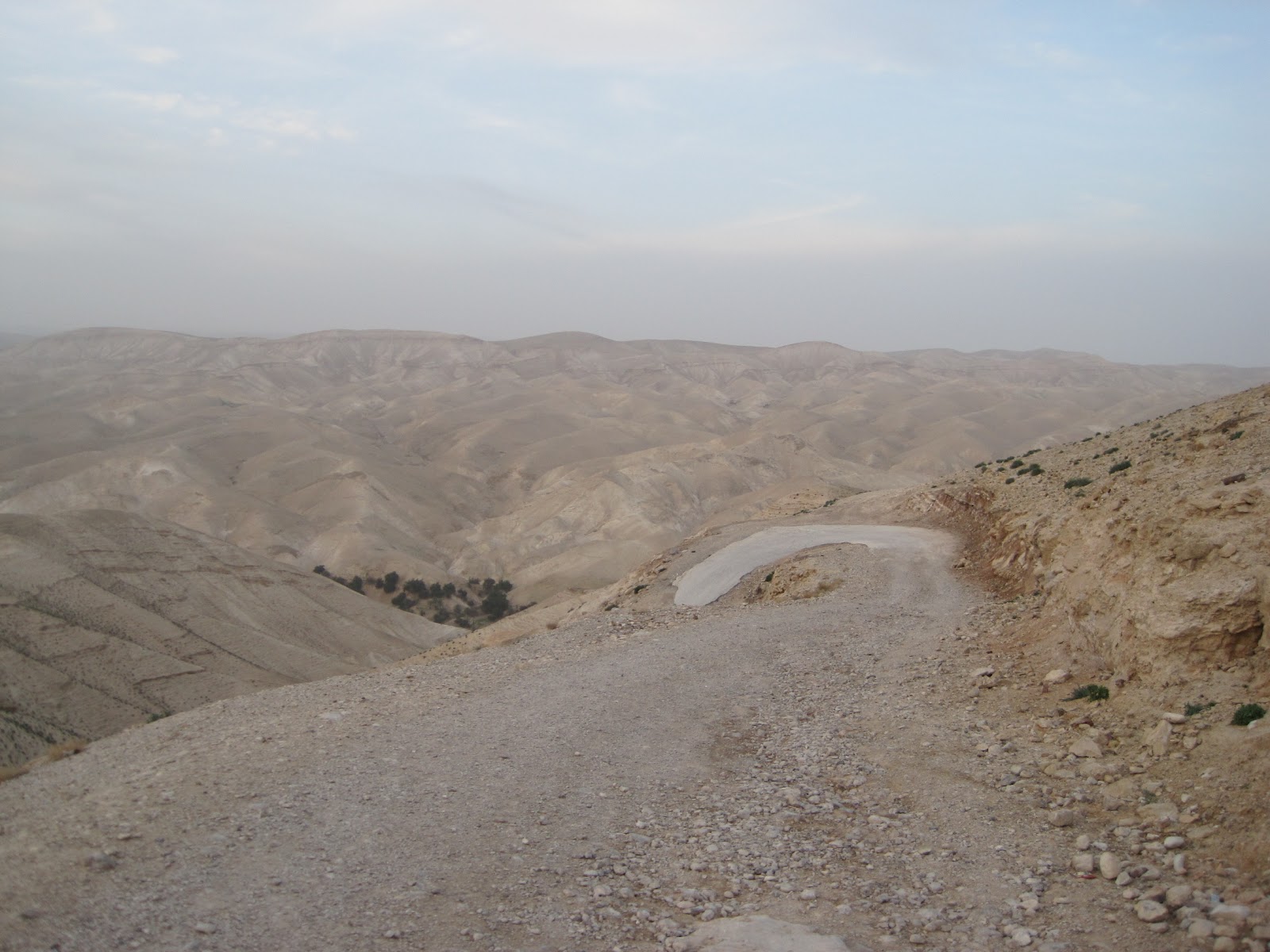
The Judean Wilderness, February, 2010

Scripture Passage:  Matthew 4: 1-11

Then Jesus was led up by the Spirit into the wilderness to be tempted by the devil. He fasted forty days and forty nights, and afterwards he was famished. The tempter came and said to him, “If you are the Son of God, command these stones to become loaves of bread.” But he answered, “It is written, ‘One does not live by bread alone, but by every word that comes from the mouth of God.’” Then the devil took him to the holy city and placed him on the pinnacle of the temple, saying to him, “If you are the Son of God, throw yourself down; for it is written, ‘He will command his angels concerning you,’ and ‘On their hands they will bear you up, so that you will not dash your foot against a stone.’” Jesus said to him, “Again it is written, ‘Do not put the Lord your God to the test.’” Again, the devil took him to a very high mountain and showed him all the kingdoms of the world and their splendor; and he said to him, “All these I will give you, if you will fall down and worship me.” Jesus said to him, “Away with you, Satan! for it is written, ‘Worship the Lord your God, and serve only him.’” Then the devil left him, and suddenly angels came and waited on him.

Well, you know it’s the first Sunday in Lent when you read of the temptation of Christ in the wilderness.  To be honest, most of us are incredibly uncomfortable with this passage.  After all, how can Jesus, Son of God and Son of Man, the gift of the father’s unfailing grace, Emmanuel, God With Us, the Savior of the World be tempted?  How can that even be possible? And why would someone like Jesus even risk it?  What, really, is Jesus doing out in the wilderness all by himself?  What, really, is the purpose at all?  I mean, it almost sounds like this was some sort of proof that Jesus was who he was.  I’ve always been just a bit distrustful of “proof” of the Divine.  So, what is this all about?

In Russian, the word poustinia means “a desert, a lonely and silent place”.  It is a place of solitude.  In the Russian Orthodox tradition, a poustinik was one who was called by God to live alone in the desert with God.  But the notion was not looked upon as a solitary life removed from the rest of the world.  Because it was there that he or she prayed, fasted, and made oneself available to humanity.  Think of the poustinik as humanity’s listener.  The idea was that even though the poustinik lived in solitude, there was always a part of him or her that was open to the world, a door to a life of solitude that invited the world in and sent the person forth.

And yet, this pilgrimage into the wilderness is not really part of the world in which most of us live.  Our culture may be a bit to goal-oriented and scheduled for that.  We tend to respond better to words like “connection”, “community”, and “fellowship”.  (Those are the words on which religious entities build good mission statements, aren’t they?)  Going out into the desert or the wilderness alone to find oneself or center oneself sometimes sounds to us a little selfish, as if the person is not participating with others, not caring for others.  Maybe our problem is that we’ve forgotten the door.  We forgot that there is always a door between solitude with God and the world, between the community of faith and that part of the Godself that each of us hold inside of us.  It is not an either-or.  The poustiniks understood that.  They stepped into the solitude to connect with God while at the same time keeping a foothold on the world, being available in case the world needed them or open to what God needed them to take into the world.  It was a way of listening and a way of active faith. 

Maybe that’s why this passage is so difficult for us.  We forgot that there was always a door.  Jesus was not shutting himself away from the world.  Jesus was called to the world (good grief, he was the Savior of the World, was he not?).  But in the bustling and noisy ways of the world, it is important to find the door, to listen to God, to enter the solitude of our deepest self so that we can finally hear where we are called to go.  There will always be voices pulling us away, pulling us toward things that we think we need, things that we think will help us in life, or things that will give us the power to do what we think we should do.  But deep within us is a holy place of solitude, a place where we can listen to God unencumbered by the voices of the world.   Some of us need to go into the wilderness to hear it; others need to only listen where we are.  Jesus trek into the wilderness was not because he needed to get away from the world but rather so that he could hear the world’s needs and God’s calling to fill them with grace.

The poustinia is within, and one is forever immersed in the silence of God. foreverlistening to the word of God, forever repeating it to others in word and deed.  (Catherine Doherty)

On this Lenten journey as we traverse through the wilderness, think of those place of solitude in your life.  Where are those place where you are at your best at listening to the needs of the world, at listening to what God is calling you to do?

Grace and Peace,

Shelli

After the Garden


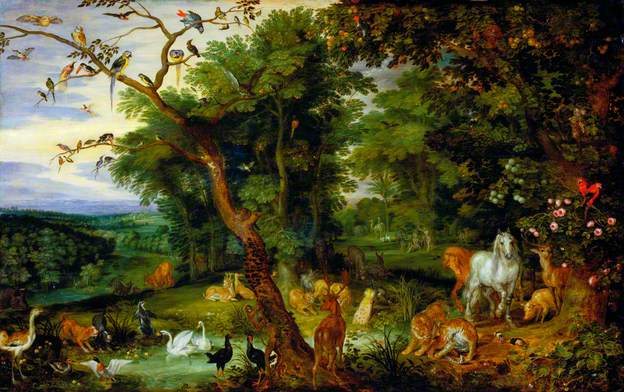
"The Garden of Eden with the Temptation in the Background", by Jan Brueghel the elder, c. 1600, (Victoria and Albert Museum, London)
“The Garden of Eden with the Temptation in the Background”, by Jan Brueghel the elder, c. 1600, (Victoria and Albert Museum, London)

Scripture Passage:  Genesis 2: 15-17, 3: 1-7 (Lent 1A)

The Lord God took the man and put him in the garden of Eden to till it and keep it.  And the Lord God commanded the man, “You may freely eat of every tree of the garden;  but of the tree of the knowledge of good and evil you shall not eat, for in the day that you eat of it you shall die.”…Now the serpent was more crafty than any other wild animal that the Lord God had made. He said to the woman, “Did God say, ‘You shall not eat from any tree in the garden’?” The woman said to the serpent, “We may eat of the fruit of the trees in the garden; but God said, ‘You shall not eat of the fruit of the tree that is in the middle of the garden, nor shall you touch it, or you shall die.’“ But the serpent said to the woman, “You will not die; for God knows that when you eat of it your eyes will be opened, and you will be like God, knowing good and evil.”  So when the woman saw that the tree was good for food, and that it was a delight to the eyes, and that the tree was to be desired to make one wise, she took of its fruit and ate; and she also gave some to her husband, who was with her, and he ate. Then the eyes of both were opened, and they knew that they were naked; and they sewed fig leaves together and made loincloths for themselves.

So at the beginning of this year’s Lenten season, the Lectionary propels us back into our somewhat sketchy past.  St. Augustine and myriads of theologians to follow would have called it the “original sin”, as if it is the cause of all other sins that follow.  Now, admittedly, I don’t like to get stuck on that idea of original sin.  I’m pretty sure that if the first humans had not messed up, someone soon after would have.  But this is the story we have.  We have images of humans walking in a beautiful garden hand in hand without a care in the world.  And then we have some sort of talking snake or prehistoric serpent or some other obnoxious creature that pulls them away from who they are and who they are meant to be.  And they give in.  They give in to the first temptation to be someone they are not.  Then they realize their mistake much too late to change the course of their action.  Well, we know the story.  (Oh, who are we kidding? We’re LIVING the story!)  They are no longer innocent and the beauty of the garden is lost forever.

This has always been an odd story to me.  Now, admittedly, I’m sure it is of no surprise to most of you that I tend to assume that this is fable rather than a literal historical account. But just because it probably isn’t “true” does not mean that it is not full of “Truth”.  In some respects, this is the rawest, most profound, most human Truth that there is.  After all, we all wander down the wrong road every now and again and some of us do it daily without even intending it.  And we all live with consequences of trying to overreach, trying to be someone we’re not, trying to assume things that are not ours to assume.  We all live with consequences of, essentially, overstepping and overreaching and trying to be the god of our own life.  And we all lose that innocence that we once had.

But, really, does God want a bunch of mindless innocents walking around in this world?  If that were the case, then God would never have shared the part of the Godself with us that is known as free will.  You see, God in God’s infinite wisdom gave up omnipotence for relationship.  God doesn’t want a bunch of robotic beings following the Great Divine because they know nothing else.  God created us to desire, to choose, to follow God of our own volition.  Innocence is way overrated.  You see, if God wanted us to stay in some sort of garden, fenced off from the rest of the world, I guess God would have left us there, protected from the world and, mostly, from ourselves.  I really don’t think that this journey we’re on returns us to the Garden, whatever that was.  That was our beginning.  The journey returns us to God, to who God envisions that we can be.  Think of the Garden as our womb, the place that protected and shielded us until we were ready for the journey, until we found that part of ourself that chose to follow, that chose God. 

So what do we do after the garden?  We follow where God leads us; we follow that innate sense that all of us have to return to God and to whom we are called to be.  You see, we have no more excuses.  Read the end of the passage.  Our eyes have been opened.  We know where we fall short; we know that we cannot do this by ourself; we know that God is God and we are not.  And in that is our beginning.  Thanks be to God!

Sin is our only hope, because the recognition that something is wrong is the first step toward setting it right again.  (Barbara Brown Taylor, Speaking of Sin:  The Lost Language of Salvation)

So on this Lenten journey, open your eyes.  Open your eyes and take a good hard look at yourself.  What do you need to choose to leave behind?  Where do you choose to go? What does your beginning, your escape from innocence, look like?

Grace and Peace,

Shelli