Procession

palm_sunday_roadToday’s Lectionary Passage:  Luke 19: 28-40

28After he had said this, he went on ahead, going up to Jerusalem. 29When he had come near Bethphage and Bethany, at the place called the Mount of Olives, he sent two of the disciples, 30saying, “Go into the village ahead of you, and as you enter it you will find tied there a colt that has never been ridden. Untie it and bring it here. 31If anyone asks you, ‘Why are you untying it?’ just say this, ‘The Lord needs it.’” 32So those who were sent departed and found it as he had told them. 33As they were untying the colt, its owners asked them, “Why are you untying the colt?” 34They said, “The Lord needs it.” 35Then they brought it to Jesus; and after throwing their cloaks on the colt, they set Jesus on it. 36As he rode along, people kept spreading their cloaks on the road. 37As he was now approaching the path down from the Mount of Olives, the whole multitude of the disciples began to praise God joyfully with a loud voice for all the deeds of power that they had seen, 38saying, “Blessed is the king who comes in the name of the Lord! Peace in heaven, and glory in the highest heaven!” 39Some of the Pharisees in the crowd said to him, “Teacher, order your disciples to stop.” 40He answered, “I tell you, if these were silent, the stones would shout out.”

I love Palm Sunday at St. Paul’s.  I love starting on the Plaza out in what hopefully abundant sunlight and just enough of a breeze to cool us off without wrapping the banners around us.  (That happened to me one year as I turned the corner along Main Street.)  It is grand; it is glorious, taking us into the sanctuary with celebration, waving our palm branches and singing the well-known Palm Sunday hymns.   And yet, we know what’s coming.  We know that the celebration will end and reality will set in.  So there’s a sense that we love the processional while wanting to hold back just a bit, stay in the procession just a bit longer, basking in the excitement.

Jesus is in the bustling capital city.  He is no longer in the villages and open country of his home.  The celebratory parade is also a protest march.  The disciples should have known what was happening.  Jesus had already laid it out for them.  But they still did not comprehend what he had said.  At this moment Jesus begins the sharp descent down the Mt. of Olives, winding his way toward Jerusalem.  The road that he walked is a steep decline into the Garden of Gethsemane and then begins to ascend toward Mt. Moriah and then to the place of the temple. At this moment, the crowd sees him as a king, as one who will get them out of where they are.  So this is a parade that befits a king.  “Hosanna”, “the Coming One”, the one who restores Jerusalem. 

Jesus enters.  This is the moment.  This is it.  What they didn’t recognize is that Jesus entering from the east brought them something that they had never had before—the dawn of peace, truth, justice, and love.  What they didn’t recognize is that Jesus had indeed come to restore them not to what was but to what should’ve been all along.  So,sadly, the parade would fizzle.  As it turns and begins moving toward Bethany, toward the edge of the walled city, people turn and go back to their lives.  And Jesus, virtually alone, with a few disciples in tow, enters the gate.  Jesus is in Jerusalem.

Well, of course, we know what happens after that.  The stage is set.  The characters are in place.  The next five days would play out in a way that is, of course, NOT “in a way befitting”.  But, for now, this procession, this entrance, is important.  Processions always are.  They are transitions.  They take us from place to the next. Processions are a call to begin something different, to enter that new thing that God is doing.  Essentially, this Palm Sunday processional is exactly that—a calling to move to a different place.  It is scary because we know what lies ahead.  We know that just beyond those city gates lies a city that will not be kind over the next several days, a city that will certainly not act in a way befitting of who it is and who it is called to be.  It is a city that is not in procession, a city that will attempt to silence the cries to change the world.
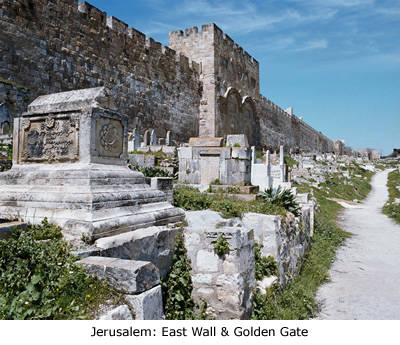
Eastern Golden Gate of JerusalemWe are always in procession, always moving from one way of being to another. We are moving from darkness to light, from living with a fear of scarcity to living with an embrace of the abundance that God offers, from self-centeredness to self-surrender, from a certainty of who we are and who we should be to faith in a God who will lead us to a new thing.  In this procession, we are moving from death to life.  There, up ahead, there are the gates of the city. The waters have parted.  The question is, is this the point where we drop out and go back to our lives? Or do we stay in procession, walking with Jesus, walking through the gates, knowing what lies ahead?  Havelock Ellis once said that “the promised land always lies on the other side of a wilderness.”  This is our wilderness.  This is our movement from slavery to freedom.  This is our procession to life.  So, keep walking. 

…Our hosannas sung, our palms waved, let us go with passion into this week…It is a time for preparation…The only road to Easter morning is through the unrelenting shadows of that Friday.  Only then will the alleluias be sung; only then will the dancing begin. (From “Holy Week”, by Ann Weems, in Kneeling in Jerusalem)

Grace and Peace,

Shelli

Climax

clouds-floating-over-a-mountainScripture Passage:  Mark 9: 2-9

2Six days later, Jesus took with him Peter and James and John, and led them up a high mountain apart, by themselves. And he was transfigured before them, 3and his clothes became dazzling white, such as no one on earth could bleach them. 4And there appeared to them Elijah with Moses, who were talking with Jesus. 5Then Peter said to Jesus, “Rabbi, it is good for us to be here; let us make three dwellings, one for you, one for Moses, and one for Elijah.” 6He did not know what to say, for they were terrified. 7Then a cloud overshadowed them, and from the cloud there came a voice, “This is my Son, the Beloved; listen to him!” 8Suddenly when they looked around, they saw no one with them any more, but only Jesus.  9As they were coming down the mountain, he ordered them to tell no one about what they had seen, until after the Son of Man had risen from the dead.

How did we get here so fast?  Everything seemed to just fly by.  Wasn’t it just a few days ago that we were reading of the birth of a child?  Wasn’t it just awhile ago that Jesus was beginning his ministry and calling the disciples to journey with him? In the big scheme of things, we’ve gotten to this point pretty fast.  Here it is—a child born into anonymous poverty and raised by no-name peasants turns out to be the Son of God.  He grows up, becomes a teacher, a healer, and capable of hosting large groups of people with just a small amount of leftovers.  Then he asks a handful of people to become his followers, to help him in his mission.  They leave everything they have, give up their possessions and their way of making a living, they sacrifice any shred of life security that they might have had, and begin to follow this person around, probably often wondering what in the world they were doing.  And we’ve essentially read through all of this in a matter of a few months since early December.  And then one day, Jesus leads them up to a mountain, away from the interruptions of the world.

Now, this is sort of interesting.  There is no proof of an actual geographically-charted mountain.  It is presented as if it just rose up, uninterrupted, from the terrain, as if it is rather a part of the topography of God.  Even for people, such as myself, who cannot claim a single, stand alone, so-called “mountain-top experience” that brought them to Christ but rather came year by year and grew into the relationship…even for us…this IS the mountain-top experience.  And there, on that mountain, everything changes.  The clothes that Jesus was wearing change, taking on a hue of dazzling, blinding, white, whiter than anything that they had ever seen before.  And on the mountain appeared Elijah and Moses, representing the Law and the prophets, the forerunners of our faith, standing there with Jesus.  Peter wanted to build three dwellings to house them.  For me, that’s sort of an interesting part of the story.  Dwellings…I guess because that would keep them here, essentially bound to our way of living.  Dwellings…to control where they were.  Dwellings…to somehow put this incredible thing that had happened into something that made sense, to bring it into the light of the world where we could understand it.  But, instead, they are veiled by a cloud and from the cloud comes a voice, “This is my Son, the Beloved, listen to him!”  “Listen to him!”  And then they were gone and Jesus stood there alone.

The account of the Transfiguration of Jesus seems to us that it should be the climax of the Jesus story.  After all, how can you top it—Old Testament heroes appearing, God speaking from the cloud, and Jesus all lit up so brightly that it is hard for us to look at him.  But there’s a reason that we read this at this point.  In some ways, it is perhaps the climax of Jesus’ earthly journey.  Jesus tells the disciples to keep what happened to themselves, if only for now.  This is the ultimate in thin places, those places of liminality, “betwixt and between” what is and what will be, those places that if we dare to enter, we experience that glimpse of the sacred and the holy.  The light is so bright it is blinding.  God’s glory is so pervasive that we cannot help but encounter it.  And these Old Testament characters?  They show us that this is not a one-time “mountain-top” experience.  It is part of life; it is part of history; it is part of humanity.  Rather than everything of this world being left behind in this moment, it is all swept into being.  It all becomes part of the glory of God.

And then the lights dim.  There are no chariots, Moses and Elijah are gone, and, if only for awhile, God stops talking.  And in the silence, Jesus starts walking down the mountain toward Jerusalem.  From our vantage point, we know what happens there.  And he asks us to follow and gives us all the portions we need to do just that.  And we can.  Because now we see the way to go.  Let us now go to Jerusalem and see this thing that has happened.

The journey to Bethlehem was much more to my liking.  I am content kneeling here, where there’s an aura of angels and the ever-present procession of shepherds and of kings who’ve come to kneel to the Newborn to whom we are newborn.  I want to linger here in Bethlehem in joy and celebration, knowing once I set my feet toward Jerusalem, the Child will grow, and I will be asked to follow. The time of Light and Angels is drawing to a close.  Just when I’ve settled contentedly into the quiet wonder of Star and Child, He bids me leave and follow.  How can I be expected to go back into darkness after sitting mangerside, bathed in such Light?  It’s hard to get away this time of year; I don’t know how I’ll manage.  It’s not just the time…the conversation along the way turns from Birth to Death.  I’m not sure I can stand the stress and pain; I have enough of those already.  Besides, I’ve found the lighting on the road to Jerusalem is very poor.  This time around, there is no Star…

view-of-city-of-jerusalemThe shepherds have left; they’ve returned to hillside and to sheep.  The Magi, too, have gone, having been warned in a dream, as was Joseph, who packed up his family and fled.  If I stay in Bethlehem, I stay alone.  God has gone on toward Jerusalem. (“Looking Toward Jerusalem”, from Kneeling in Jerusalem, by Ann Weems, p. 14-15.)

“If any want to become my followers, let them deny themselves and take up their cross daily and follow me.” (Luke 9: 23b)

Grace and Peace,

Shelli

Encounter

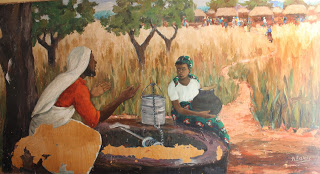
"Women at the Well", part of a mural by Emmanuel Nsama, Zambia
“Women at the Well”, part of a mural by Emmanuel Nsama, Zambia

Scripture Passage:  John 4: 5-26

5So he came to a Samaritan city called Sychar, near the plot of ground that Jacob had given to his son Joseph.6Jacob’s well was there, and Jesus, tired out by his journey, was sitting by the well. It was about noon.7A Samaritan woman came to draw water, and Jesus said to her, “Give me a drink.”8(His disciples had gone to the city to buy food.)9The Samaritan woman said to him, “How is it that you, a Jew, ask a drink of me, a woman of Samaria?” (Jews do not share things in common with Samaritans.)10Jesus answered her, “If you knew the gift of God, and who it is that is saying to you, ‘Give me a drink,’ you would have asked him, and he would have given you living water.”11The woman said to him, “Sir, you have no bucket, and the well is deep. Where do you get that living water?12Are you greater than our ancestor Jacob, who gave us the well, and with his sons and his flocks drank from it?”13Jesus said to her, “Everyone who drinks of this water will be thirsty again,14but those who drink of the water that I will give them will never be thirsty. The water that I will give will become in them a spring of water gushing up to eternal life.”15The woman said to him, “Sir, give me this water, so that I may never be thirsty or have to keep coming here to draw water.”16Jesus said to her, “Go, call your husband, and come back.”17The woman answered him, “I have no husband.” Jesus said to her, “You are right in saying, ‘I have no husband’;18for you have had five husbands, and the one you have now is not your husband. What you have said is true!”19The woman said to him, “Sir, I see that you are a prophet.20Our ancestors worshiped on this mountain, but you say that the place where people must worship is in Jerusalem.”21Jesus said to her, “Woman, believe me, the hour is coming when you will worship the Father neither on this mountain nor in Jerusalem.22You worship what you do not know; we worship what we know, for salvation is from the Jews.23But the hour is coming, and is now here, when the true worshipers will worship the Father in spirit and truth, for the Father seeks such as these to worship him.24God is spirit, and those who worship him must worship in spirit and truth.”25The woman said to him, “I know that Messiah is coming” (who is called Christ). “When he comes, he will proclaim all things to us.”26Jesus said to her, “I am he, the one who is speaking to you.”

The journey has shifted.  No longer are Jesus’ words limited to those in his immediate circle.  He leaves the confines of what he knows and begins to turn to outsiders, those who tradition and cultural and societal norms have rejected. First on the list are the Samaritans.  The less than civil relationship between the Jews and the Samaritans dated back at least 1,000 years before the birth of Christ.  Both believed in God.  Both had a monotheistic understanding of the one true God, the YHWH of their shared tradition of belief.  But where the temple of YHWH for the Jews existed on Mount Zion in Jerusalem, the Samaritans instead worshipped God on Mount Gerizim near the ancient city of Shechem.  And with that, a new line of religious understanding was formed.  The Samaritans believed that their line of priests was the legitimate one, rather than the line in Jerusalem and they accepted only the Law of Moses as divinely inspired, without recognizing the writings of the prophets or the books of wisdom.   What started as a simple religious division, a different understanding of how God relates to us and we relate to God, eventually grew into a cultural and political conflict that would not go away.  The tension escalated and the hatred for the other was handed down for centuries from parent to child over and over again.

So, here is Jesus breaking all of the boundaries of traditional religion.  He, unescorted, speaks to a woman.  He speaks to a woman of questionable repute.  And he speaks to the enemy. The truth is, there is nothing about this woman that is wrong or sinful or anything else that we try to tack on her reputation.  This woman was just different.  Her life had been difficult.  She lived in the shadows of humanity.  And the most astonishing thing is that this seemingly low-class woman who is a Samaritan becomes the witness to the Gospel of Jesus Christ.  Once again, the Gospel is found not in Jerusalem and not on Mt. Gerizim but in our shared existence as part of this “new humanity”.

Now, the woman does miss Jesus’ point.  She looks upon Jesus as some sort of miracle worker, rather than seeing that he offers a new way of being.  Even this story deals with suffering—the woman surely suffered.  Good grief, she was there by herself—couldn’t even face the crowd.  And Jesus—well Jesus was just thirsty.  “Give me a drink…I thirst.” We all have needs; we all have fears—that is the nature of our true humanity.  And maybe the story teaches us that from our need we will realize who God is.  Maybe, in fact, it is IN our very need that we find God, those times when we are unsure of ourselves and not quite so confident that we are heading the right direction in our lives.  So, this woman’s new life begins when she recognizes Jesus’ true identity.  Maybe that’s our problem.  We are still looking for the Jesus that will make our lives easier rather than the one who will give us new life.  We are still looking for a Jesus that will affirm where we are rather than leading us to this new thing that God is doing.  We are still looking for a Jesus that will become our own personal Savior, our own private Messiah, rather than the Salvation and Life of the world.

Our faith journey is not just ours.  Contrary to what some may tell you, you are not carrying the sole responsibility for “getting it right”.  The journey, rather is made up of encounters with those that God places in our path.  At each turn, we grow, we change, our pathway broadens.  The procession to the Cross has already begun.  We are walking together, gathering others into our midst as we walk.  This is what Jesus did.  The journey to the Cross began long before the gates of Jerusalem at the end of the Palm Sunday Road.  The journey began “in the beginning”.  The journey weaved through a garden, into the lessons learn from the stories of an ark, and was there as its followers were carried into exile.  The journey held deliverance and led us up to a mountaintop.  It has held prophets’ voices and the wisdom of sages.  On it were two women named Naomi and Ruth who held each other through their trials.  It was the road for kings and judges and those who were trying to figure out why a life had fallen apart.  The journey turned into a small town outside of Jerusalem where life and clarity and salvation were born.  It returned us to the place of exile, which this time held deliverance.  The journey is one of water and wine and welcome for all.  This journey has taught us how to love and how to thirst.  It has shown us what it means to have faith and not need certainty.  It has taught us that questions are part of it all.

We are still gathering in.  And now it turns…one more mountain to climb and then the procession will enter Jerusalem.  But that is not the end; there is always more up ahead.  But we do not travel alone.  God has already gone before us and still walks with us to show the Way.  So, as our Lenten journey nears Jerusalem, remember from where you’ve come and remember what you have received from those that you have encountered on the way.  Remember who and whose you are.  Remember that you do not walk alone.

Grace and Peace,

Shelli

Add Water and Stir

wedding-feast-cana-ic-4025Scripture Passage:  John 2: 1-11

On the third day there was a wedding in Cana of Galilee, and the mother of Jesus was there. 2Jesus and his disciples had also been invited to the wedding. 3When the wine gave out, the mother of Jesus said to him, “They have no wine.” 4And Jesus said to her, “Woman, what concern is that to you and to me? My hour has not yet come.” 5His mother said to the servants, “Do whatever he tells you.” 6Now standing there were six stone water jars for the Jewish rites of purification, each holding twenty or thirty gallons. 7Jesus said to them, “Fill the jars with water.” And they filled them up to the brim. 8He said to them, “Now draw some out, and take it to the chief steward.” So they took it. 9When the steward tasted the water that had become wine, and did not know where it came from (though the servants who had drawn the water knew), the steward called the bridegroom 10and said to him, “Everyone serves the good wine first, and then the inferior wine after the guests have become drunk. But you have kept the good wine until now.” 11Jesus did this, the first of his signs, in Cana of Galilee, and revealed his glory; and his disciples believed in him.

This was an embarrassing situation—the wine has run out, and there appears to be no solution.  Either no more wine is available, or there is no money to buy more wine. The guests seem unaware of what is happening. If something is not done, all will be embarrassed. Some commentators even inform us that litigation was possible in such cases. (Can you imagine being sued for not providing enough food and drink at a marriage ceremony?)  But, regardless, it is clear that Jesus mother expects Jesus to do something out of the ordinary.  She expects him to fix it.  Maybe it’s a message to us that Jesus didn’t just come for the “big”, splashy things.  Maybe it’s a reminder that God is in even the ordinary, those seemingly small things in life that we think we can handle, that we think don’t really even matter to God.

But this?  I mean, really, wine?  Why didn’t he turn the water into food for the hungry or clothing for the poor?  Why didn’t he end the suffering of one of those wedding guests who were forced to live their lives in pain?  Why didn’t he teach those that were there that God is more impressed by who we are than what we do?  Now THAT would have been a miracle.  But instead Jesus, in his first miraculous act, the first of his signs, creates a party, a feast.  Maybe it’s a reminder that we ought to just relax and trust God a little more.  Maybe it’s trying to tell us that God is indeed in every aspect of our life.  And maybe it’s telling us that life is indeed a feast to be celebrated.

And think about the wine itself.  It begins as ordinary grapes.  Well, not really.  If you go even farther back, you start with water.  Everything starts with water.  And then those ordinary grapes with just the right amount of water, the right amount of sunlight, and the right amount of nutrients fed to them from the rich, dark earth begin to seed.  And then we wait, we wait for them to grow and flourish and at just the right time, they are picked and processed and strained of impurities and all of those things that are not necessary.  And then they are bottled and tucked away while again, we wait.  They are placed in just the right temperature, with just the right amount of light, and just the right amount of air quality, and we wait.  We wait and until it becomes…well, a miracle.

And remember that when the wine ran out, Jesus did not conjure up fresh flagons of wine.  Rather, he took what was there, those ordinary, perhaps even abandoned vessels of ordinary, everyday water and turned it into a holy and sacred gift.  Water and a miracle…So this story of wine makes a little more sense.  Wine is water—plus a miracle.  But in case it is lost on us, remember that our bodies are roughly two-thirds water.  No wonder the ancient sages always used water as a symbol for matter itself.  Humans, they taught, are a miraculous combination of matter and Spirit—water and a miracle—and thus unique in all of creation.  No wonder that wine is such a powerful, sacramental, and universal symbol of the natural world—illumined and uplifted by the Divine.  Wine is water, plus spirit, a unique nectar of the Divine, a symbol of life.  And we, ordinary water-filled vessels though we are, are no different.  God takes the created matter that is us and breathes Spirit into us, breathes life into us.  We, too, are water plus a miracle.  13th century German mystic Meister Eckhart said that “every creature is a word of God.”  It’s another way of reminding us that we are water plus a miracle, God-breathed, holy and sacred.

So in this week “between”, that week when you don’t want to essentially jump into the Passion stories way too soon, we are moving–moving from Bethlehem through Galilee to Jerusalem, moving from birth through growth to maturity, moving from life to death to life again.  This is the week in which the Procession begins.  And here we remember, we remember this child born among us; we remember this child delivered to us; we remember our baptism.  And, now, we remember that that baptism calls us to be something, calls us to be water plus a miracle.  The water has been added.  Now start stirring.  Let your Lenten journey be one that moves your life into what it should be–a miracle.

Grace and Peace,

Shelli

Lenten Threshold

Celtic Cross-2Scripture Passage: John 1: 1-14

In the beginning was the Word, and the Word was with God, and the Word was God.2He was in the beginning with God.3All things came into being through him, and without him not one thing came into being. What has come into being4in him was life, and the life was the light of all people.  5The light shines in the darkness, and the darkness did not overcome it.6There was a man sent from God, whose name was John.7He came as a witness to testify to the light, so that all might believe through him.8He himself was not the light, but he came to testify to the light.9The true light, which enlightens everyone, was coming into the world.10He was in the world, and the world came into being through him; yet the world did not know him.11He came to what was his own, and his own people did not accept him.12But to all who received him, who believed in his name, he gave power to become children of God,13who were born, not of blood or of the will of the flesh or of the will of man, but of God.14And the Word became flesh and lived among us, and we have seen his glory, the glory as of a father’s only son, full of grace and truth.

Happy St. Patrick’s Day!  Yes, even those of us who are in traditions where we honor few feast days of saints get in to this one and don our green.  Now, admittedly, most of us don’t even know much about Patrick or his tradition, save a few legends about snakes and stuff.  Patrick was said to have been born Maewyn Succat (Lat., Magonus Succetus) in Roman Britain in the late 4th century.  When he was sixteen, he was captured by Irish raiders and taken as a slave to Ireland, where he lived for six years before escaping and returning to his family.  He wrote that his faith grew in captivity and he prayed daily.  The story is told that one day Patrick heard a voice saying “your ship is ready” and took it to mean that it was time to return home.  Fleeing his master, he traveled to a port two hundred miles away, found a ship, and sailed home.  He entered the church and later returned to Ireland as a missionary.  By the eighth century, he had become one of the patron saints of Ireland.

Patrick’s life, like his Celtic tradition, is based on pilgrimage.  Life in this tradition is about growing and moving and not “pitching our tent” in one place too long.  It is about connecting to all of Creation, about honoring and revering all as sacred.  It is about treating all of life sacramentally, embracing it as a gift from God and a way to God.  Embracing the Celtic spirit means going on a journey, open to moving from one place to another, one thought to another, one way of seeing to another.  In the midst of this journey, Celtic spirituality recognizes the importance of crossing places, seeing them as thresholds of growth.  These places are truly looked upon as sacred spaces.  Bridges and gateways express a determined refusal to be stopped by what blocks our way; causeways open up pathways to places that have been inaccessible; and burial grounds mark the crossing place from life to death, from “this world” to an “other world”, from time and space to eternity and infinity.      These thresholds prevent us from becoming islands, closed off to change and moving forward.  The thresholds open up new worlds and new possibilities.  Thresholds are bridges between the now and the to be.

For us, this Celtic tradition holds a lot of things that can help us on our Lenten journey.  In fact, they are notions that we spend a good part of our Lenten season trying to grasp.  Lent itself is a threshold, a sacred doorway to growth and connection, to learning to embrace our own lives as gifts, as sacramental journeys toward a new oneness with God.  It is a journey to the ultimate threshold of all, the gateway between life and death, between the world that we know and the Way that we are called to go.  Lent keeps us from staying behind when God is moving just ahead.  There is an Old English word, “liminality”, that literally means “betwixt and between”.  It is a place of intersection, a threshold, between what is and what will be.  And we are called to that place, to the intersection of this world and the world to which God calls us.  We are called to be “betwixt and between”, with our feet firmly planted in this world and our heart, our soul, and our mind stretching beyond ourselves, stretching to God.

And the snakes?  Well the legend credits St. Patrick with banishing all the snakes from Ireland.  Evidence suggests, however, that post-glacial Ireland never had any snakes.  But some suggest that Patrick was instrumental in ridding the Celtic Christians of all the “serpents” that were so common in their pre-Christian Druid belief, of helping them get rid of those things that got in the way of their movement, of their threshold, of their journey toward God.  Hmm!  Sounds like Lent to me!

So, as we journey during this Lenten season, let us embrace our threshold, let us embrace all of time and all of space that has brought us to this place, and then let us journey toward the Way that God is calling us.

Rath De ‘ort (Gaelic, pronounced Rah Day urt, “The Grace of God on you.”)

Shelli

Station XI: Regrets

crucifixion-22Scripture Passage: Mark 15: 22-32

22Then they brought Jesus to the place called Golgotha (which means the place of a skull).23And they offered him wine mixed with myrrh; but he did not take it.24And they crucified him, and divided his clothes among them, casting lots to decide what each should take.  25It was nine o’clock in the morning when they crucified him.26The inscription of the charge against him read, “The King of the Jews.”27And with him they crucified two bandits, one on his right and one on his left.29Those who passed by derided him, shaking their heads and saying, “Aha! You who would destroy the temple and build it in three days,30save yourself, and come down from the cross!”31In the same way the chief priests, along with the scribes, were also mocking him among themselves and saying, “He saved others; he cannot save himself.32Let the Messiah, the King of Israel, come down from the cross now, so that we may see and believe.” Those who were crucified with him also taunted him.

The eleventh station of the Via Dolorosa is marked by a beautiful Latin shrine.  This is the place where tradition tells us that soldiers nailed Jesus’ hands and feet to the cross.  It is only 9:00 in the morning.  For us, the thought of arriving at this eleventh station seems much longer, days really.  But it is still only mid-morning.  The sounds are deafening.  The clanging rings out over the land and settles into our hearts–a nail of greed, a nail of selfishness, nails of betrayal and hatred and war, nails of hunger and poverty, nails of not accepting and loving each other, nails of being so sure of one’s beliefs, so sure of one’s understanding of who God is and what God desires, that we miss seeing what God is trying to show us.  It is finished.  In the Name of Jesus Christ, you are forgiven.

It is here that our regrets sink in. It is here that we want to go back, we want a redo.  We would do it differently next time. We would not ask so many questions as to why he was doing what he was doing and to whom.  We would just watch and listen and learn from him how to love.  We would not fight and grapple with each other over who was in charge, over who was the most important, over who was his favorite.  Instead, we would bask in his spirit and his radiance and his love of equality for all.  And when asked if we knew who he was, we would not betray him.  Rather, we would step forward no matter the cost.  Because grace is not cheap.  But now we know how incredibly rich it really is.  Yes, we would stand up and be counted as one who follows him, who brings healing and love to the world, who doesn’t need credit or acclaim, and who is willing to lose one’s life to find it.  But there are no redos just now.

Regrets can be debilitating.  They can pull us into the past and keep us there.  It is not healthy.  Regrets can also be life-giving if we allow them to compel us to change, to perhaps turn a corner that we did not see before, to become something new, a New Creation, to become the one that God calls us to be.  And, yet, we still want the easy way out.  After all, we are empty cross people, Resurrection people!  And so maybe we walk away from this moment entirely too quickly.  After all, it makes us uncomfortable and God offers us life.  So too quickly we let it go, too quickly we move past our regrets without letting them change us.

The most difficult thing for us to face is that so little has changed.  We still try to be the one on top.  We still shut the door to those who are not like us.  We still close our doors so we don’t have to think about poverty or homelessness.  We still justify war.  We still will do anything it takes to defend the life that we have created.  We still betray.  We forget to love; we forget to bring healing; we forget to lose our life.  So, would we crucify Jesus today?  Would things go differently?  Only we can tell…

So on this Lenten journey, stop for a moment.  Look at the cross.  And let your regrets of what should have been done differently change your pathway.

Grace and Peace,

Shelli

Anointing Presence

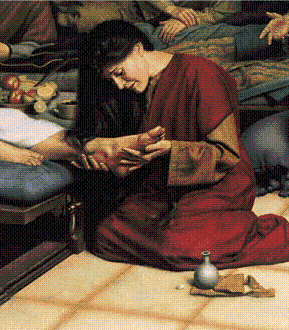
mary-anoints-jesusThis Week’s Lectionary Passage: John 12: 1-8
Six days before the Passover Jesus came to Bethany, the home of Lazarus, whom he had raised from the dead. 2There they gave a dinner for him. Martha served, and Lazarus was one of those at the table with him. 3Mary took a pound of costly perfume made of pure nard, anointed Jesus’ feet, and wiped them with her hair. The house was filled with the fragrance of the perfume. 4But Judas Iscariot, one of his disciples (the one who was about to betray him), said, 5“Why was this perfume not sold for three hundred denarii and the money given to the poor?” 6(He said this not because he cared about the poor, but because he was a thief; he kept the common purse and used to steal what was put into it.) 7Jesus said, “Leave her alone. She bought it so that she might keep it for the day of my burial. 8You always have the poor with you, but you do not always have me.”

Several years ago a friend of mine forwarded me one of those prepared video streams with the background music that everyone emails around.  I have to admit that many of them have very little substance and some are bordering on being downright hokey, but this one struck me.  It told of a teacher who asked her students to list the Seven Wonders of the World and write about them.  They began work and most of them came up with the same ones that most of us would:  Egypt’s Grand Pyramids, The Taj Mahal, The Grand Canyon, the Panama Canal, the Empire State Building, St. Peter’s Basilica, and the Great Wall of China (yeah, I know, it depends on what list you’re using, doesn’t it?).  But, to the point, one girl seemed to be having difficulty.  The teacher asked her to read hers aloud so that maybe the others could help.  Her answers to the question “What are the Seven Wonders of the World?” were these:  to see, to hear, to smell, to touch, to feel, to laugh, and to love. 

The story said that you could have heard a pin drop.  What a really incredible answer!  It’s more than just those biological senses that we have to make life enjoyable.  Rather, those are the things that connect us to each other.  Those are the gifts that give us a common humanity and draw us together.  The ability to see, to hear, to smell, to touch, to feel, to laugh, and to love—any of them enable us to reach out and connect to the world around us.  

This story is told in all four canonical Gospel accounts.  But it’s never told the same way twice, illustrating yet again that the Bible is not an historical narrative but rather a way to connect us to God and to each other.  The fact, though, that costly and seemingly extravagant perfumed oil is poured onto Jesus is always the same.  So what does that mean?  What could this costly nard mean in our relationship to God?  I think on some level, it represents presence.  It represents the way that we connect, the way that we relate.  It represents the way that we love.  After all, this story is all about presence and connecting with each other.  They have a dinner together; they are served; Mary touches Jesus’ feet; Mary wipes his feet with her hair.  (You will notice that in none of the accounts is Mary checking her email or texting her friend while she is doing this!)  She is present–fully and completely present.

Sometimes I think that our society (myself included!) sometimes forgets what that’s about.  What does it mean to be present, to fully and completely engage with another, to enter their world, to open yourself up to them, to who they are, to the God that you see in them?  If each of us indeed has a piece of the Godself in us, an image of God in our being, then engaging with each other in this very moment is the very crux of our spiritual journey.  It is the way that we journey to God, becoming aware of the moment and the experience that God has placed before us right now.  Alfred North Whitehead supposedly once said that “the present is holy ground.”  Maybe that’s what Jesus was trying to get across.  “Look, look at me now, be with me now.  Take this moment that God gives you now and feel it, for it is offering you each other–see, hear, smell, touch, feel, laugh, love.  In other words, live loving God and neighbor with all your heart and your soul and your might, with everything that you have.”

On this Lenten journey, we are coming closer and closer to the Cross.  Do not be afraid.  Take each step as it comes and extravagantly anoint it.  See, hear, smell, touch, feel, laugh, love.  The point is the journey itself and what you do while your on it.  Eternity is not “out there” somewhere.  It is here, it is now, beckoning you on this path.

Grace and Peace,

Shelli