And They Took Joseph to Egypt

Lectionary Text:  Genesis 37: (1-4, 12-22) 23-28:
So when Joseph came to his brothers, they stripped him of his robe, the long robe with sleeves that he wore;and they took him and threw him into a pit. The pit was empty; there was no water in it.Then they sat down to eat; and looking up they saw a caravan of Ishmaelites coming from Gilead, with their camels carrying gum, balm, and resin, on their way to carry it down to Egypt.Then Judah said to his brothers, “What profit is it if we kill our brother and conceal his blood?Come, let us sell him to the Ishmaelites, and not lay our hands on him, for he is our brother, our own flesh.” And his brothers agreed.When some Midianite traders passed by, they drew Joseph up, lifting him out of the pit, and sold him to the Ishmaelites for twenty pieces of silver. And they took Joseph to Egypt.

And they took Joseph to Egypt…so matter-of-fact, so simple, so explanatory.  But far from being merely historical data, this six word sentence represents a turning point in the story.  With these words the Genesis story turns the corner, moving from a story of a somewhat dysfunctional family as their lives are intricately woven with the breath of God to the story of a people growing into God’s people.  We begin to prepare for the Exodus story.  Nothing will ever be the same again.  We know what is to come–slavery, plagues, wilderness, and, finally, deliverance, redemption.  This is the stuff of transformation.

When this Scripture (sorry, I cut off the first part!) was read this morning, I was struck by these words.  I know that I’ve passed them over time and time again. After all, this is an important story and there’s a lot to grasp–favorite sons, dreams, beautiful coats, family squabbles, murder, intrigue, conspiracy, enemies, slavery, lies.  (And just for the record, I would like it to be noted that no matter what I did to my brother Donnie growing up, I NEVER sold him into slavery!)  And then you take a breath and, oh yeah, “and they took Joseph to Egypt.”  What struck me is how similar those words are to some others:

Text:  Matthew 17: 1-9
Six days later, Jesus took with him Peter and James and his brother John and led them up a high mountain, by themselves.And he was transfigured before them, and his face shone like the sun, and his clothes became dazzling white.Suddenly there appeared to them Moses and Elijah, talking with him.Then Peter said to Jesus, “Lord, it is good for us to be here; if you wish, I will make three dwellings here, one for you, one for Moses, and one for Elijah.”While he was still speaking, suddenly a bright cloud overshadowed them, and from the cloud a voice said, “This is my Son, the Beloved; with him I am well pleased; listen to him!”When the disciples heard this, they fell to the ground and were overcome by fear.But Jesus came and touched them, saying, “Get up and do not be afraid.”And when they looked up, they saw no one except Jesus himself alone.As they were coming down the mountain, Jesus ordered them, “Tell no one about the vision until after the Son of Man has been raised from the dead.”

Today is the Feast of the Transfiguration.  When I realized that earlier this week, I thought it was just odd.  I mean, really, don’t we celebrate that right before Lent begins?  But the abrupt ending to today’s Old Testament Scripture made me think a little bit more about it.  In this Matthean account of the Transfiguration, the writer has Jesus and the disciples headed down the mountain.  They were talking.  Jesus warned them to be quiet about what they had just seen.  And in the same breath, he gave them a foretaste of what would come.  So, we have Jesus walking down the mountain.  Where is he going?  He’s going to Jerusalem.  And we know what happens there.  This is the turning point.  There is no going back.  A new way of being has begun.

And they took Joseph to Egypt…And they took Jesus to Jerusalem.

We all have Egypts.  We all have Jerusalems.  They are those watershed moments in our lives that are bumpy and rough and uncomfortable.  They are that way because it means that we have changed.  We have been through a transition; we have been transformed; we have been transfigured into something else.

We don’t know what Monday morning will hold for our economy.  There are those who will say that our “best years” are behind us, those who yearn for the 40’s and the 50’s when the United States was “on top of the mountain.”  Really?  I’m pretty clear that our African-American brothers and sisters will disagree with you.  Are our “best years” the ones in which only some of us are on top?  That’s sad.  I don’t think so.  Perhaps we’re being sold to Egypt.  I don’t know.  Maybe we’ve got a long wilderness ahead.  Maybe we are walking down that mountain headed for who knows what.  Maybe we will find ourselves in Egypt.  Maybe we will find ourselves in Jerusalem.  Maybe we will find ourselves enslaved by something we never saw coming or crucified by those who want to maintain things the way they are.  Maybe there is a rough road ahead.  Maybe not.  Maybe our stocks will pop back up tomorrow and everything will be hunky dory.  Maybe not.  Whatever happens, we are in the midst of change. The road to change is not always an easy one.  But somewhere on that road, we will find transformation.  We will find deliverance.  We will find redemption.  But right now we’ve got to come down from the mountain…After all, I think it’s WAY too cloudy to see what’s going on up here.  (Hmmm!  Maybe that’s our whole problem.)

And they took Joseph to Egypt…and you know what?  No one was ever the same again.  We’ve been to the mountaintop…now is the time to move on.

Grace and Peace,

Shelli

WALK TO JERUSALEM: Metamorphosis

Scripture Text:  Matthew 17: 1-9
Six days later, Jesus took with him Peter and James and his brother John and led them up a high mountain, by themselves. And he was transfigured before them, and his face shone like the sun, and his clothes became dazzling white. Suddenly there appeared to them Moses and Elijah, talking with him. Then Peter said to Jesus, “Lord, it is good for us to be here; if you wish, I will make three dwellings here, one for you, one for Moses, and one for Elijah.” While he was still speaking, suddenly a bright cloud overshadowed them, and from the cloud a voice said, “This is my Son, the Beloved; with him I am well pleased; listen to him!” When the disciples heard this, they fell to the ground and were overcome by fear. But Jesus came and touched them, saying, “Get up and do not be afraid.” And when they looked up, they saw no one except Jesus himself alone. As they were coming down the mountain, Jesus ordered them, “Tell no one about the vision until after the Son of Man has been raised from the dead.”

So here we have the story of a child born into anonymous poverty and raised by no-name peasants.  He grows up, becomes a teacher, probably a rabbi, a healer, and sort of a community organizer.  He asks a handful of people to become his followers, to help him in his mission.  They leave everything they have, give up their possessions and their way of making a living, they sacrifice any shred of life security that they might have had, and begin to follow this  person around, probably often wondering what in the world they were doing. And then one day, Jesus takes them mountain climbing, away from the interruptions of the world, away from what was brewing below.  Don’t you think they were sort of wondering where they were going?  Oh, if they only knew what would come!  And there on the mountain, they see Jesus change, his clothes taking on a hue of dazzling, blinding white, whiter than anything they had ever seen before.  And on the mountain appear Moses and Elijah, standing there with Jesus—the law, the prophets, all of those things that came before, no longer separate, (and certainly not replacements one for the other) but suddenly swept into everything that Christ is, swept into the whole presence of God right there on that mountain. 

So Peter offers to build three dwellings to house them. I used to think that he had somehow missed the point, that he was in some way trying to manipulate or control or make sense of this wild and uncontrollable mystery that is God. I probably thought that because that’s what I may tend to do. But, again, Peter was speaking out of his Jewish understanding. He was offering lodging—a booth, a tent, a tabernacle—for the holy. For him, it was a way not of controlling the sacred but rather of honoring the awe and wonder that he sensed.  And then the voice…”This is my Son, the Beloved; with him I am well pleased; listen to him!” OK…what would you have done? First the mountain, then the cloud, then these spirits from the past, and now this voice…”We are going to die. We are surely going to die,” they must have thought. And then Jesus touches them and in that calm, collected manner, he says, “Get up and do not be afraid.”  And then, just as suddenly as they appeared, Moses and Elijah drop out of sight. In Old Testament Hebrew understanding, the tabernacle was the place where God was. Here, this changes. Jesus stays with them alone. Jesus IS the tabernacle, the reality of God’s presence in the world. And all that was and all that is has become part of that, swept into this Holy Presence of God.

And so the disciples start down the mountain. Jesus remains with them but he tells them not to say anything. The truth was that Jesus knew that this account would only make sense in light of what was to come. The disciples would know when to tell the story. They saw more than Jesus on the mountain. They also saw who and what he was. And long after Jesus is gone from this earth, they will continue to tell this strange story of what they saw. For now, he would just walk with them. God’s presence remains.

The Greek term for “transfiguration” is “metamorphosis”, deriving from the root meaning “transformation”. It is, literally, to change into something else. There is no going back. The truth is that the disciples probably got a little bit more of God’s presence than they wanted. Because there was more than just Jesus changed on that mountain. The disciples would never be the same again. We will never be the same again. The Hebrews understood that no one could see God and live. You know, I think they were right. No one can see God and remain unchanged. We die to ourselves and emerge in the cloud. The truth is, when we are really honest with ourselves, we probably are a little like the disciples. We’d rather not really have “all” of God. We’d rather control the way God enters and affects our lives. We’d rather be a little more in control of any metamorphosis that happens in our lives. We’d rather be able to pick and choose the way that our lives change. We’d rather God’s Presence come blowing in at just the right moment as a cool, gentle, springtime breeze. In fact, we’re downright uncomfortable with this devouring fire, bright lights, almost tornado-like God that really is God.

Remember the words of the Isaac Watts hymn: “Were the whole realm of nature mine, that were an offering far too small; love so amazing, so divine, demands my soul, my life, my all.” God’s power is God’s power. It does not just come to us; we enter it—taking with it all that we are. It is not a warm and fuzzy relationship; it is wild and risky, full of awe and wander. It is mystery. It is more than anything that we can possibly imagine. It is a complete and total metamorphosis. There is no going back.

This account of the Transfiguration of Jesus seems to us that it should be the climax of the Jesus story—the quintessential mountain-top experience. After all, how can you top it—Old Testament heroes appearing, God speaking from the cloud, and Jesus all lit up so brightly that it is hard for us to look at him. But there’s a reason that the lectionary places this reading immediately before we begin the journey to Jerusalem.  In some ways, it is perhaps the climax of Jesus’ earthly journey. Jesus tells the disciples to keep what happened to themselves, if only for now. And then the lights dim. Moses and Elijah are gone, and, if only for awhile, God stops talking.

Have you ever been mountain climbing? The way up is hard. You have to go slowly, methodically even. You have to be very careful and very intentional. You have to be in control. But coming down is oh, so much harder. Sometimes you can’t control it; sometimes the road is slick and seems to move faster than your feet. And sometimes, through no fault or talent of your own, you get to the bottom a little bit sooner than you had planned. Yes, it’s really harder to come down.  Jesus walked with the disciple in the silence. The air became thicker and heavier as they approached the bottom. As they descended the mountain, they knew they were walking toward Jerusalem.

The Transfiguration is only understood in light of what comes next. Yes, the way down is a whole lot harder. We have to go back down, to the real world, to Jerusalem. We have to walk through what will come. Jesus has started the journey to the cross. We must do the same.

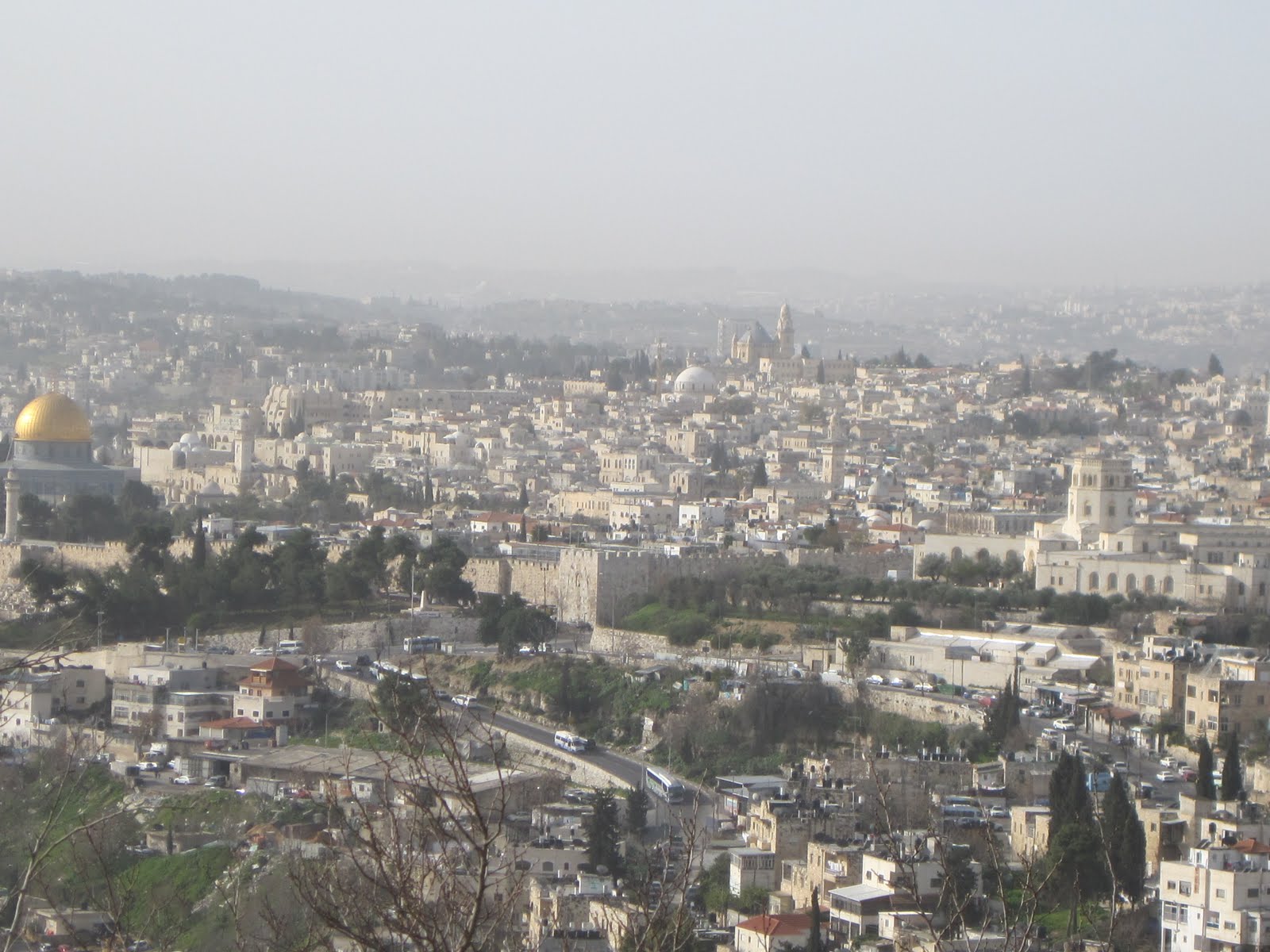
Jerusalem, Israel
February, 2010
Just outside Jerusalem we came to a gate called Truth.  We called to the gatekeeper to let us in.  “The latch is not on,” he replied.  “Anyone who will can enter.”  We went closer, but seeing how great and how heavy was the gate, we looked for a way around.  There must be a way around…The pilgrims trudge toward the death of God.  Only with bowed heads and closed eyes will they be able to see the way to Jerusalem.  (from Kneeling in Jerusalem, by Ann Weems, 63-64)
Our Lenten journey is rounding the bend and we see the city up ahead.  The path has changed us.  So, go cut a palm branch and I will see you in Jerusalem!
Grace and Peace,
Shelli

Extra-Ordinary Time

This is the LONGEST Epiphany Season. Ordinary Time seems to drone on and on and on.  Well, it is not your imagination.  The way the calendar falls, this is truly the longest Epiphany season we could ever have.  The cavern between the “high holy” seasons this year is indeed deep and wide, a veritable ocean of ordinary time.  The Lectionary has us reading the Sermon on the Mount.  You know, for the first time, I’ve noticed how much the word “you” is used in that discourse.  Oh, surely he means “you” as in those around him–the disciples, the religious elite, and the passers-by–you know, those to whom he was speaking.  Well, one thing about long seasons is that you have more time to ponder meaning.  And this pondering has become a bit uncomfortable.  Because if we truly enter the story the way we’re called to do.  If the Holy Scriptures become the Word, the very essence of God, rather than merely a dusty narrative composed over a couple of thousand years, then, sadly and uncomfortably, we become “you”.

Jesus is speaking to us or the Scriptures mean nothing; Jesus is wanting us to listen and to hear or he wouldn’t have bothered saying it at all.  So in this ordinary time, we become the passersby, perhaps turn into the religious elite, and if all goes well, if we really bother to stop and listen and hear, then we, too, become the disciples.  You see, Jesus over and over again uses the ordinary, the every day, and the expected to frame what he wants to say.  He uses the rules that we societies have created and the roles that its members play.  And then he goes beyond where we are, calling us to a greater and greater existence, calling us to be better than even we could have imagined, calling us to live fully into that image of God in which we have been created.  And this time between times, this ordinary season, becomes something extra [ordinary].  Yes, this is the LONGEST Epiphany Season…call it the most Extraordinary Time ever.

So finally listen and hear the call to be extra-ordinary…

Shelli                                                                                 

It was easy to love God in all that was beautiful.  The lessons of deeper knowledge, though, instructed me to embrace God in all things. 

                                                                       (St. Francis of Assisi)

Grace and Peace,

Expectations

Lectionary Passage:  Matthew 5: 21-37 (Epiphany 6A)
    “You have heard that it was said to those of ancient times, ‘You shall not murder’; and ‘whoever murders shall be liable to judgment.’ But I say to you that if you are angry with a brother or sister, you will be liable to judgment; and if you insult a brother or sister, you will be liable to the council; and if you say, ‘You fool,’ you will be liable to the hell of fire. So when you are offering your gift at the altar, if you remember that your brother or sister has something against you, leave your gift there before the altar and go; first be reconciled to your brother or sister, and then come and offer your gift. Come to terms quickly with your accuser while you are on the way to court with him, or your accuser may hand you over to the judge, and the judge to the guard, and you will be thrown into prison. Truly I tell you, you will never get out until you have paid the last penny.

     You have heard that it was said, ‘You shall not commit adultery.’ But I say to you that everyone who looks at a woman with lust has already committed adultery with her in his heart. If your right eye causes you to sin, tear it out and throw it away; it is better for you to lose one of your members than for your whole body to be thrown into hell. And if your right hand causes you to sin, cut it off and throw it away; it is better for you to lose one of your members than for your whole body to go into hell. “It was also said, ‘Whoever divorces his wife, let him give her a certificate of divorce.’ But I say to you that anyone who divorces his wife, except on the ground of unchastity, causes her to commit adultery; and whoever marries a divorced woman commits adultery.
     “Again, you have heard that it was said to those of ancient times, ‘You shall not swear falsely, but carry out the vows you have made to the Lord.’ But I say to you, Do not swear at all, either by heaven, for it is the throne of God, or by the earth, for it is his footstool, or by Jerusalem, for it is the city of the great King. And do not swear by your head, for you cannot make one hair white or black. Let your word be ‘Yes, Yes’ or ‘No, No’; anything more than this comes from the evil one. (NRSV) 

And yet another week of reading the Sermon on the Mount…So are you getting the sense that we’re actually supposed to be listening to it? This is not an easy discourse full of pretty little stories interspersed with a few light-hearted jokes to keep our attention. You see, we really ARE supposed to do this. Jesus, like any good teacher, begins where we are. He acknowledges the usual view of what righteousness was (and perhaps is)—that a murderer will be judged; that those who leave offerings will be rewarded; that adulterers will be punished…the list goes on. But the whole point is that it’s not enough. Jesus doesn’t frame his words as prohibitions or a list of rules to be followed. That would, in fact, be far too simplistic. After all, why would we really need faith to follow a list of rules? It’s not about rules; it’s about expectations. And there IS something more that is expected of us who dare to realize that we are children of God. The rules are there. They will stay there. They help us order our society and give us boundaries for our lives. But we are expected to go beyond them, to be better than the society we have ordered and the boundaries we have drawn. And here, it is not just about behaviors; it also applies to attitudes and emotions. Indeed, it is about every aspect of our being. It’s a pretty radical way of looking at things. But, really, it’s Jesus. Did you expect anything less?

This week’s reading reminds us yet again that God came in Jesus Christ not to enforce the rules, but to reorder the world itself. God does not have a checklist or a lucky-number scorecard. Rather, God became flesh, dwelt among us, and showed us what it meant to live with an ever-present God in our midst. So, what is it that you expect from God? More than you can possibly imagine. And what is it that you expect from yourself? Expect more. Expectations are funny things. They may not always turn out the way we envisioned, but if you don’t expect something, nothing happens at all. So envision what life would look like if it really was the way Jesus depicted it. And who knows? You might be surprised.

Most people see what they want to, or at least what they expect to.

                                                                                             (Martha Grimes)

Grace and Peace,

Shelli

Transfigured

Today is Transfiguration Sunday, the Sunday when we read of Elijah being taken up to heaven in a whirlwind and the Gospel passage that depicts the Transfiguration of Jesus on the mountain top. Both of these sometimes seem to be sort of fantastical, hard-to-believe images. I mean, after all, the whirlwind, the chariot, bright lights, descending clouds, and, of course, Old Testament heroes and prophets reappearing. But, you know, anything can happen on that mountain. After all, it is on the mountain that we can see beyond ourselves; it is on the mountain that everything is illumined in all directions; and it is on the mountain that God appears to us.
We don’t really know if there was a real “mountain” or not. (In all truth, the literal topography just doesn’t seem to work!) For me, a metaphorical one works just as nicely. It is that place where God appears to me. Some people claim to have had one stand-out, quintessential experience that turned their whole life toward God. For me, I have had a series of mountain-top and near-mountain-top experiences throughout my life. None stand out as “the one”, but each one in its own way has redirected me toward God, toward the cross, and has indeed changed my life.
I think that is the reason that we read of this Transfiguration right before Lent. It is our redirecting, our refocusing, if you will, from our ordinary everyday lives toward the Lenten journey–the journey to the cross. In many ways, the Transfiguration is the climax of the human experience of Jesus–the mountain-top experience. And then Jesus tells the disciples to keep what happened to themselves, if only for now. And then the lights dim. There are no chariots, Moses and Elijah are gone, and, if only for awhile, God seems to be silent. And it is in that silence that Jesus walks down the mountain toward Jerusalem. And he asks us to follow. And we can–because now we see the way to go. Because we have truly been changed!
So go forth from the mountain and begin your journey to the cross!
Grace and Peace,
Shelli

Change

We have heards lots of talk about change lately. We have heard lots of calls to change. And we have been presented with reasons why we have no choice other than to change. But, as we all know, change does not come easy. It is fraught with the unknown, a perilous journey through the wilderness. It is filled with choices and decisions. And, probably the most uncomfortable thing of all, it means that there is no return. There is no going back once the wheels of change have begun.

Isn’t that what we’re all about, though? Isn’t that what our faith journey means? God does not call us to stand still, feet planted, ignoring the winds that are blowing around us. If that were the case, don’t you think the world would be a bit more stable? But, really, who of us live a life that has not changed over the past year, perhaps even over the last three months? For that matter, who of us lives the same life that we did yesterday? No, God calls us to walk this walk through change and, for that matter, to be a part of the change itself. If that were not the case, the Gospels would not be full of things like fishermen being asked to give up their careers and their lifestyles, magi taking a different road than what they had planned, and the very heavens being torn apart.

We are called to change. Not only that, we are called to be part of making that change happen. God did not create the world and then put out a call for its preservation. Instead, God is continually turning darkness into light and death into life. And throughout it all, waters are divided, the heavens are torn apart and curtains separating worlds are ripped apart if for no other reason that that we can get a glimpse of the way things are supposed to be. So, we are a people of change–called to change ourselves, our lives, and the whole of Creation in which we live.

It is not easy. It is not comfortable. But, after all, that is not what we were promised! We were not promised that our lives would be preserved; we were promised that they would be transformed. But transformation must happen from the inside out. When we become the change, the change will happen.

Only those who live beyond themselves ever become fully themselves. (Joan Chittister)

So go forth and be the change!

Grace and Peace,
Shelli

Do You Have God in Your DNA?

There’s a church that I pass most mornings in my neighborhood (unless I go a different way so I can buy coffee!) that has one of those ever-changing metallic letter boards with messages or sermon titles or just passing whimsies–I’m not sure which. This week the message is this: Do You Have God in Your DNA? Now often the messages on this board strike me as a little trite or unrefined, but I think this week’s poses an interesting question. After all, as humans, we associate DNA with the very basis of our individuality, our makeup, the thing that makes us who we are. Now I don’t really think that God has “DNA”, per se, but what would it mean for God to impart divine individuality or eternal order and makeup into who we are. Well, of course, God has. After all, we are “made in God’s image”. God has made us who we are and who we will be and breathed a part of the Godself into us.

So what does it mean to make one in your image? I think it means to imagine what they will be, to impart a piece of your own self into them (much like an artist or a composer putting all that they know and all that they have and all that they are into a masterwork). I think that’s what God has done in creating each of us–imparted a piece of the Godself, a piece of the Divine into us, a DNA, if you will, that is not of this existence, but of one to come. God did not create us and then leave us to our own devices. We are not inventions engineered to certain specifications. We are, rather, artistic and musical renderings that are affected by time and space and the definitive input of those who cross our path, those who play us or repaint us or just enjoy the fact that we’re here. But somewhere deep within our being is a part of God, an image that is not our Creation, an order that is not our doing, and an individuality that we share only with the One who breathed us into being.

So go forth and be the image buried deep within your DNA…

Grace and Peace,
Shelli