Breathing Out

This is always such an odd day in our church calendar. In fact, if we were to back away from the notion of it a bit, far enough to watch ourselves getting the remnants of burned leaves smeared on our foreheads while at the same time told that we are no better than the very ashes that are dripping down into our eyes and settling on our shirt, we, too, would think that was a very, very weird practice.  Because in terms of where we stand in this society, in this culture, this is indeed very, very bizarre.

And I think that may be the point.  Just like the passage from the Gospel account by the writer known as Matthew that we read every Ash Wednesday, we are being reminded that the “normal” way we do things, the things that are accepted by our society are not the things that bring us closer to God, that bring us closer to the vision that God has for us.  We cannot align with the ways of this world and at the same time become the one that God envisions.  The two ways are incompatible.  Where the world wants to build walls and borders to control who is in and who is out, Jesus called us to welcome the stranger, release the prisoner, feed the hungry,…you know, all those Sermon on the Mounty-type things.  We cannot hold both ways within us.  We will metaphorically, spiritually, and certainly explode.  You cannot breathe everything in at once.

That is often the problem for many of us.  We breathe in when we should be breathing out.  It is, on some level, a sort of “spiritual asthma”.  When a person suffers from asthma, it is not, as many people think, that they cannot get air into their lungs; it is that they can’t get air out.  And, as a result, their lungs are too full to receive life-giving oxygen.  The breathing cycle is disrupted and the person, swelling with over-inflation, begins gasping for breath. 

This spiritual asthma is a similar dilemma.  If we hold onto those things with which we fill our lives, to our habits and our fears and our misconceptions of what our life should be, to those plans and those preparations that we’ve so carefully laid, there is no room left for the life-giving breath of God.  And we are left with dust and ashes.

But there is more.  This is not just a day of morose belittling of ourselves.  A rabbi once told his disciples, “Everyone must have two pockets, with a note in each pocket, so that he or she can reach into one or the other, depending on their needs.  When feeling high and mighty, sort of overinflated, if you will,one should reach into the left pocket, and find the words: “Ani eifer v’afar; I am dust and ashes.  But when feeling lowly and depressed, discouraged or without hope, one should reach into the right pocket, and, there, find the words: “Bishvili nivra ha’olam…For my sake was the world created.”  That is the breathing in and the breathing out.  And they are both necessary for the journey.

On this Ash Wednesday, breath out…breathe out the ways of this world. Breathe out the norms to which you are accustomed.  Do this so that there is room to breathe in…to breathe in who you are supposed to be, to breathe in life.  Lent is not just about giving things up; it is about emptying your life that you may be filled.  Lent is not just about going without; it is about making room for what God has to offer.  And today is not about clothing yourself in the morbidness of your humanity; it is about embracing who you are before God.

So…remember…you are dust and ashes…breathe out…..

For you the world was created…breathe in….

BIG BREATH…Amen.

Grace and Peace,

Shelli

The Cloud of Knowing

Seeing things differently is not a new theme for us.  I mean, think about it.  Here we have the story of a child born into anonymous poverty and raised by no-name peasants.  He grows up, becomes a teacher, probably a rabbi, a healer, and sort of a community organizer.  He asks a handful of people to become his followers, to help him in his mission.  They leave everything they have, give up their possessions and their way of making a living, they sacrifice any shred of life security that they might have had, and begin to follow this person around, probably often wondering what in the world they were doing. And then one day, Jesus takes them mountain climbing, away from the interruptions of the world, away from what was brewing below.  Don’t you think they were sort of wondering where they were going?  I mean, MOUNTAIN CLIMBING?  Don’t we have more important things to accomplish?  Shouldn’t we stay here where the action is?

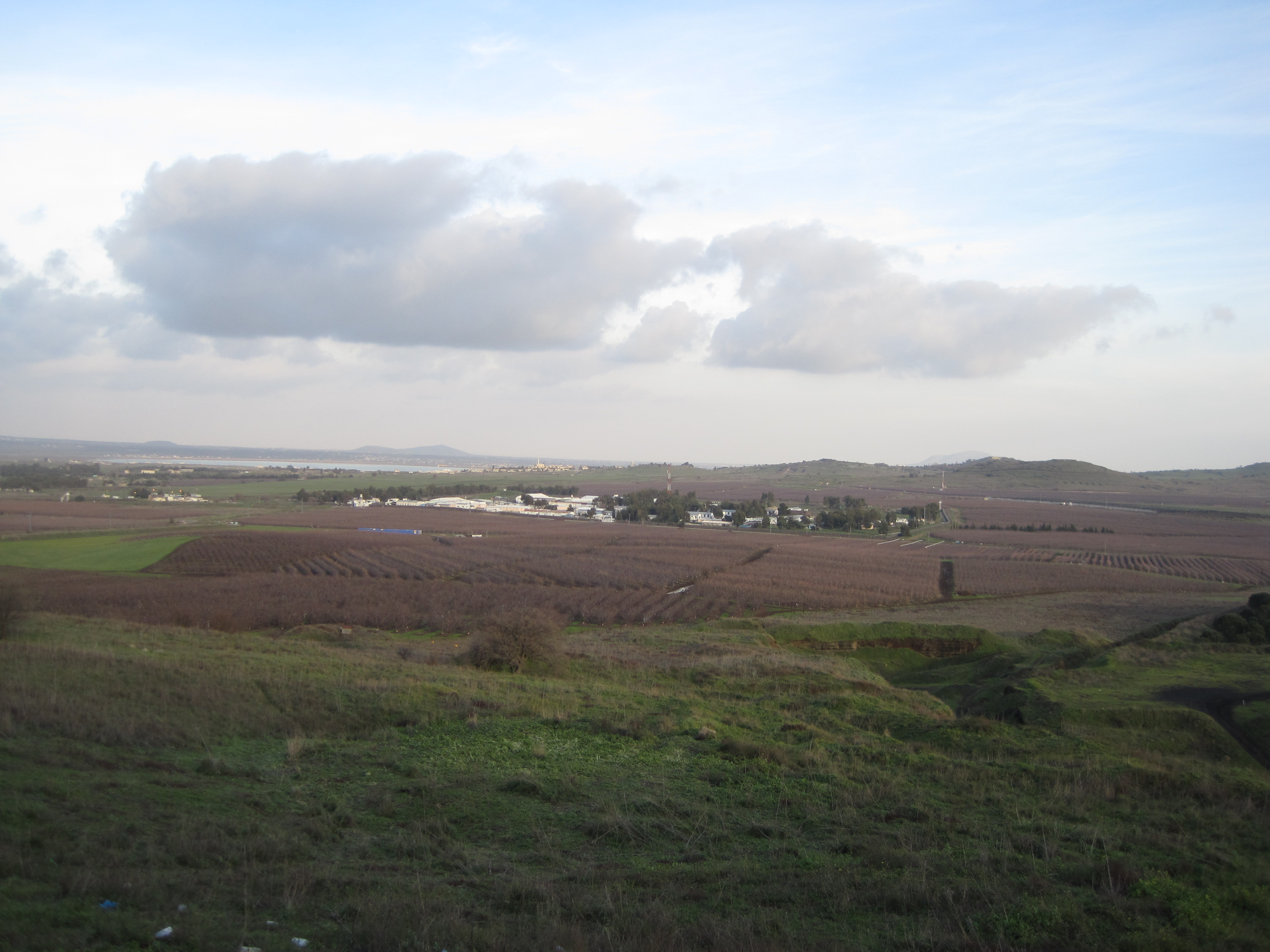
We don’t really know what mountain this was.  There is speculation that perhaps it occurred on Mount Tabor or Mount Hermon, both of which are some of the tallest mountains in the Galilean area and both of which are prime spots in the Jezreel valley.  The Franciscans built their Church of the Transfiguration on Mt. Tabor, so perhaps you can now use the familiar words that “tradition holds” that that is where the mountain is.  But no one really knows.  Some even surmise that there IS no geographic location, presenting it as if it just rose up, uninterrupted, from the rough-hewed terrain.  Either way, the mountain is part of the topography of God.  Even for people, such as myself, who cannot claim a single, stand alone, so-called “mountain-top experience” that brought them to Christ but rather came year by year and grew into the relationship…even for us…this IS the mountain-top experience.  And there, on that mountain, veiled in a cloud, everything changes.

Now remember that for this likely Jewish audience, mountains were typically not only a source of grandeur, but also divine revelation.  And also remember that in their understanding, God was never seen.  I like that—allowing God to be awesome, allowing the mystery of God to always be. God was the great I AM, one whose name could not be said, one whose power could not be beheld.  And so, this cloud, a sort of veiled presence of the holiness of God, was something that they would have understood much better than we do.  In fact, they would have assumed that if Moses or anyone else actually saw God, they would die.

And there on the mountain, they see Jesus change, his clothes taking on a hue of dazzling, blinding white, whiter than anything they had ever seen before.  It wasn’t that light was suddenly shining on him, illuminating him.  Jesus WAS the light.  And on the mountain appears Moses and Elijah, standing there with Jesus—the law, the prophets, all of those things that came before, no longer separate, but suddenly swept into everything that Christ is, swept into the whole presence of God right there on that mountain.

So, Peter offers to build three dwellings to house them.  I used to think that he had somehow missed the point, that he was in some way trying to manipulate or control or make sense of this wild and uncontrollable mystery that is God.  I probably thought that because that’s what I may tend to do.  But, again, Peter was speaking out of his Jewish understanding.  He was offering lodging—a booth, a tent, a tabernacle—for the holy.  For him, it was a way not of controlling the sacred but rather of honoring the awe and wonder that he sensed.

And then the voice…”This is my Son, the Beloved; with him I am well pleased; listen to him!” OK…what would you have done?  First the mountain, then the cloud, then these spirits from the past, and now this voice…”We are going to die.  We are surely going to die,” they must have thought.   And then Jesus touches them and in that calm, collected manner, he says, “Get up and do not be afraid.”

And then, just as suddenly as they appeared, Moses and Elijah drop out of sight.  In Old Testament Hebrew understanding, the tabernacle was the place where God was.  Here, this changes.  Jesus stays with them alone.  Jesus IS the tabernacle, the Light of the world, the reality of God’s presence with us.  And all that was and all that is has become part of that, swept into this Holy Presence of God.

And so the disciples start down the mountain.  Jesus remains with them but he tells them not to say anything.  The truth was that Jesus knew that this account would only make sense in light of what was to come.  The disciples would know when to tell the story.  They saw more than Jesus on the mountain.  They also saw who and what he was.  And long after Jesus is gone from this earth, they will continue to tell this strange story of what they saw.  For now, he would just walk with them.  God’s presence remains. 

Jesus walked down the mountain with the disciples in the silence.  The air became thicker and heavier as they approached the bottom.  As they descended the mountain, they knew they were walking toward Jerusalem.  The veil that had been there all those centuries upon centuries was beginning to lift.  The Transfiguration is only understood in light of what comes next.  Yes, the way down is a whole lot harder.  We have to go back down, to the real world, to Jerusalem.  We have to walk through what will come. Jesus has started the journey to the cross.  We must do the same. The journey to Jerusalem awaits.

Grace and Peace,

Shelli

Just Go

Simon got up early that morning.  No big surprise there…he ALWAYS got up early.  He was always the first one up in the morning, hurriedly dressing and then going behind the house to untangle the still-damp nets from the day before.  As he got them ready for yet another day of fishing, he smelled the fish cooking in olive oil and the fresh bread baking in the oven.  It smelled good just like it does every morning.   He began to hear stirring in the house as the children got up and began to help their mother. It was just an ordinary day.

After breakfast he made his way the mile or so down to the shore where he and his brother had left the boat.  It was a good, sturdy boat and they felt so fortunate that they were finally doing well enough to buy it.  He carried the heavy nets that still smelled of yesterday’s catch.  As he approached the boat, he saw that Andrew was waiting for him and had already begun to untie the boat and ready it for the day.  So without even saying good morning to each other, they together hoisted the heavy nets up to the boat, Andrew got on, and Simon pushed the boat into the water, walking into the lake until it was about waste deep.  He then pulled himself up into the boat as it moved toward the middle of the lake.

This was his favorite part of the morning—that quiet trip from Bethsaida down the shores of the lake.  They were headed toward Tabgha this morning, near the Capernaum side of the lake but it was usually not near as busy.  The fog was lifting and you could see all around the lake itself.  Then they slowed and, without speaking, Simon and Andrew put their nets down into the lake to see what they could catch.  Yes, it was just another ordinary day.  

After about two hours of a really unbelievable catch, Simon steered the boat back toward the shores below Capernaum.   He looked up on the hill and saw the synagogue at the top of the hill.  It made him feel good just to look at it.  He hoped that someday he would be able to make the trip to Jerusalem and see the temple that it faced.  As they neared the shore, they began to drop their net again hoping to snare some of the common musht fish that tended to congregate there at the shore.  As the net went down, he looked up.  There on the shore was a man, a man he had seen before around the lake, a man that he thought they called Jesus. He had heard about this man, a rabbi, he thought.  Just then the man spoke:  “Follow me.”  Simon turned around expecting to see the one whom Jesus was calling standing behind him.   But there was only lake.  He touched Andrew’s arm and they both looked up.  “Follow me,” Jesus said again, “and I will make you fishers of people.”

But something happened.  Simon and Andrew looked at each other in disbelief.  You want me to do WHAT? After all, they were fishermen.  They had nothing to offer and no real gifts.  But Jesus repeated his call.  They knew that he was asking them to join him, to join him in ministry.  And they both knew that they would go.  They lifted up the nets, now filled with fish—more fish than they had seen in the last two weeks combined.  They pulled the nets up out of the water and then tied the boat to the shore.  As they stepped into the water, the sun seemed to shine brighter than ever.  The synagogue on the hill was radiant in light.  It was just an ordinary day.  But life would never be the same again.  And they couldn’t do anything else.

OK, I took a little poetic license with the story.  But the point is that Simon and Andrew were not especially gifted people.  In the first century around this lake called Galilee, Simon and Andrew were pretty ordinary.  But Jesus asked them to follow anyway.  And they went.  In fact, the text says they went immediately.  They didn’t wait until they had enough money or enough time or enough talent.  They didn’t hold back because they thought they were too old or too settled.  They just went.

Simon would become Peter, the “rock”, one of Jesus’ apostles and ultimately would be made a saint in the tradition of the church.  Frederick Buechner says, “Our calling is where our deepest gladness and the world’s deepest hunger meet.”  Think about what that means.  God calls us.  Sometimes it’s pretty scary.  Sometimes we want to run away.  Sometimes we try to hide on the back pew hoping no one will notice that we’re there.  Sometimes it means that we have to leave the life we’ve built behind.  And sometimes it just means that we need to do something different.  But following wherever God leads means that we will truly find joy.  We will finally know what it’s all about.  So, what about you?  Where is God calling you?  We are all called but it usually means that we have to fish in different waters and look at things in different ways.  And, if we’re honest with ourselves, we will find that we can’t do anything else.  God is calling you.  So, what now?  Just go…

Grace and Peace,

Shelli

Creation, Yet Again

Easter Lily (DT 8087007)

Scripture Text:  John 20: 1-18

Early on the first day of the week, while it was still dark, Mary Magdalene came to the tomb and saw that the stone had been removed from the tomb. So she ran and went to Simon Peter and the other disciple, the one whom Jesus loved, and said to them, “They have taken the Lord out of the tomb, and we do not know where they have laid him.” Then Peter and the other disciple set out and went toward the tomb. The two were running together, but the other disciple outran Peter and reached the tomb first. He bent down to look in and saw the linen wrappings lying there, but he did not go in. Then Simon Peter came, following him, and went into the tomb. He saw the linen wrappings lying there, and the cloth that had been on Jesus’ head, not lying with the linen wrappings but rolled up in a place by itself. Then the other disciple, who reached the tomb first, also went in, and he saw and believed; for as yet they did not understand the scripture, that he must rise from the dead. Then the disciples returned to their homes.

But Mary stood weeping outside the tomb. As she wept, she bent over to look into the tomb; and she saw two angels in white, sitting where the body of Jesus had been lying, one at the head and the other at the feet. They said to her, “Woman, why are you weeping?” She said to them, “They have taken away my Lord, and I do not know where they have laid him.” When she had said this, she turned around and saw Jesus standing there, but she did not know that it was Jesus. Jesus said to her, “Woman, why are you weeping? Whom are you looking for?” Supposing him to be the gardener, she said to him, “Sir, if you have carried him away, tell me where you have laid him, and I will take him away.” Jesus said to her, “Mary!” She turned and said to him in Hebrew, “Rabbouni!” (which means Teacher). Jesus said to her, “Do not hold on to me, because I have not yet ascended to the Father. But go to my brothers and say to them, ‘I am ascending to my Father and your Father, to my God and your God.’” Mary Magdalene went and announced to the disciples, “I have seen the Lord”; and she told them that he had said these things to her.


THE LORD IS RISEN!

THE LORD IS RISEN INDEED!

Christ, the Lord, is risen today, Alleluia!   Sons of men and angels say, Alleluia!

Raise your joys and triumphs high, Alleluia!  Sing, ye heavens, and earth, reply, Alleluia!

Love’s redeeming work is done, Alleluia!  Fought the fight, the battle won, Alleluia!

Lo! the Sun’s eclipse is over, Alleluia!  Lo! He sets in blood no more, Alleluia!

Vain the stone, the watch, the seal, Alleluia!  Christ hath burst the gates of hell, Alleluia!

Death in vain forbids His rise, Alleluia!  Christ hath opened paradise, Alleluia!

Lives again our glorious King, Alleluia!  Where, O death, is now thy sting? Alleluia!

Once He died our souls to save, Alleluia!  Where thy victory, O grave? Alleluia!

Soar we now where Christ hath led, Alleluia!  Following our exalted Head, Alleluia!

Made like Him, like Him we rise, Alleluia!  Ours the cross, the grave, the skies, Alleluia!

Hail, the Lord of earth and Heaven, Alleluia!  Praise to Thee by both be given, Alleluia!

Thee we greet triumphant now, Alleluia!  Hail, the resurrection, thou, Alleluia!

King of glory, Soul of bliss, Alleluia!  Everlasting life is this, Alleluia!

Thee to know, Thy power to prove, Alleluia!  Thus to sing and thus to love, Alleluia!

(Charles Wesley, 1739)

The day has arrived!  After all this time of anunciation and birth, of baptism and ministry, of teaching and healing, of calling and response, of temptation and darkness, of dying and crucifixion, this Day of Resurrection has dawned.  After this long and difficult journey that we have taken, we come to this day with new eyes and as a new creation.  Christ has risen!  Christ has risen indeed!

But lest we lapse into thinking of this day as a commemoration of The Resurrection of Christ, as a mere remembrance of what happened on that third day so long ago, as some sort of shallow anniversary of Christ’s rising, we need to realize that this day is not just about Jesus’ Resurrection; it is also about our own.  We who carried our cross, we who died to self, we who journeyed through the wilderness and through those gates, are this day given new life.  God has recreated us into who God calls us to be.  And, in a way, that is almost more scary than the dying.  There is no going back.  The self that we knew before is no more.  We are a new creation.  We are a re-creation.

We have risen! 

We have risen indeed!

From the void, from the darkness, God created Light and Life.  No, correct that.  The Scripture begins “while it was still dark”.  God did not wait until the light to come to begin the work of Creation and this time is no different.  While it was still dark, while we strained to see hope and grieved what had come to be, God began.  That is what we are called to do.  We cannot wait until the world is ready.  Our work begins in the darkness with God.

Truthfully, if you look at it from a literal view, nothing has really changed.  Jesus, sadly, is still dead.  The human Jesus, the Jesus born into this world on that long ago night in Bethlehem, was gone.   But through eyes that have been resurrected, nothing will ever be the same again.

Maybe resurrection comes not in raising one above life, but in raising life to where it is supposed to be.  Jesus was the first to cross that threshold between–between death and life, between the world and the sacred, between seeing with the eyes of the world and seeing with the eyes of the Divine.  Hell has been vanquished.  Wesley wrote that “Christ hath burst the gates of hell”.  What that means is that everything, everything that God has created, everything above, below, within, around, everything we see, everything we know, everything we wonder about, everything we do not understand, has been made anew.  Resurrection is not about being transplanted to a new world but rather being called to live in this one as a new creation.  It means being recreated into the one that God envisions you to be.  It means being given a new way of seeing where love is stronger than death, where hope abides, and where life has no end.  It means being capable of glimpsing the Holy and the Sacred, the promise of Life, even in this life, even now.  This day of Easter is now only about Jesus’ Resurrection; it is about ours!  So, what do you plan to do with your new life?

The end of all our exploring…will be to arrive where we started…and know the place for the first time. (T.S. Eliot)


King of glory, Soul of bliss, Alleluia! Everlasting life is this, Alleluia!

Thee to know, Thy power to prove, Alleluia! Thus to sing and thus to love, Alleluia!

Everlasting life is truly this!

Happy Easter!

Shelli


It is Finished

???????????Scripture Text:  John 19: 14-30

Now it was the day of Preparation for the Passover; and it was about noon. He said to the Jews, ‘Here is your King!’ They cried out, ‘Away with him! Away with him! Crucify him!’ Pilate asked them, ‘Shall I crucify your King?’ The chief priests answered, ‘We have no king but the emperor.’ Then he handed him over to them to be crucified.

So they took Jesus; and carrying the cross by himself, he went out to what is called The Place of the Skull, which in Hebrew* is called Golgotha. There they crucified him, and with him two others, one on either side, with Jesus between them.  Pilate also had an inscription written and put on the cross. It read, ‘Jesus of Nazareth,* the King of the Jews.’ Many of the Jews read this inscription, because the place where Jesus was crucified was near the city; and it was written in Hebrew,* in Latin, and in Greek. Then the chief priests of the Jews said to Pilate, ‘Do not write, “The King of the Jews”, but, “This man said, I am King of the Jews.”’ Pilate answered, ‘What I have written I have written.’ When the soldiers had crucified Jesus, they took his clothes and divided them into four parts, one for each soldier. They also took his tunic; now the tunic was seamless, woven in one piece from the top. So they said to one another, ‘Let us not tear it, but cast lots for it to see who will get it.’ This was to fulfil what the scripture says,  ‘They divided my clothes among themselves, and for my clothing they cast lots.’  And that is what the soldiers did.

Meanwhile, standing near the cross of Jesus were his mother, and his mother’s sister, Mary the wife of Clopas, and Mary Magdalene. When Jesus saw his mother and the disciple whom he loved standing beside her, he said to his mother, ‘Woman, here is your son.’ Then he said to the disciple, ‘Here is your mother.’ And from that hour the disciple took her into his own home.  After this, when Jesus knew that all was now finished, he said (in order to fulfil the scripture), ‘I am thirsty.’ A jar full of sour wine was standing there. So they put a sponge full of the wine on a branch of hyssop and held it to his mouth. When Jesus had received the wine, he said, ‘It is finished.’ Then he bowed his head and gave up his spirit.

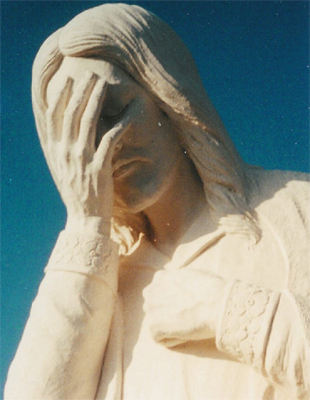
It is finished–all the announcing, all the birthing, that star over the manger, the shepherds, the wisemen, the ministry around the lake, the welcoming, the pushing, the encouraging, the healing, the teaching, the last meal–it is finished.  What would we do for just one more moment, one more moment to kneel at the feet of the Savior and worship and love and learn and bask in a Presence that we can’t even explain?  What would we change about how we had done it, how much we paid attention, how much we were aware?  What would we tell Jesus that we did not? What would we do rather than betray him, betray his trust, his love, his faith in who we are and what we can do?

This is the most difficult for us Protestant Christians, those of us who have chosen to spend the whole of our church year bowing before the “empty Cross”, the depiction of Christ’s Resurrection and the promise of our own salvation.  And while I’m not willing to trade the large gleaming empty cross at the front of the sanctuary and permanently replace it with a Crucifix, I think that we do miss part of what the Cross means if we choose to never enter the pain and the suffering that is Christ’s.  In fact, Howard asks, “Where, suddenly, is the theology that teaches that because the Savior did it all, we thereby are reduced to the status of inert bystanders?”  Because, truthfully, when the chips were done, the people stood by.  WE stood by.  We stand by and we let Christ suffer, wait for Christ to finish up this whole messy ordeal, hand us a lily and a pretty bonnet, and invite us to joyfully sing “Christ the Lord is Risen Today” and go on about our business.

The season of Lent, though, is about entering the experience of the Cross—the whole experience.  Because how can one understand the joy of Resurrection without experiencing the pain and suffering and even the death of Crucifixion?  The two cannot be separated.  We are called to enter and bear all that is Christ—the pain, the suffering, the death, and, just when we think “it is finished”, the joy of rising to eternal life, to an eternity of oneness with God.  If we are to truly understand what that means, we must, then, embrace the entirety of the message of the Cross.  And so, perhaps, if only for awhile (maybe 40 days or so!), we should spend this Season of Lent truly looking at the “pre-Easter” experience of the Cross.  You will be amazed what that Easter morning Cross, gleaming in the sunlight of a newly created day, looks like if you understand how God created it, if you have experienced all that is God.

So, in this moment, in this moment when it is all finished, the moment that, for now, our journey ends, what do we do?  What is next?  You know, this thing would have been a whole lot easier to piece together and market if Jesus had died a hero.  But Jesus did not come as a hero; Jesus came as a servant, a humble human servant, to show us what life means.  So, were you there?  Sometime I wonder if I was.  Sometimes I’m too busy or too tired or too convinced that I already have it figured out.  Sometimes I forget to be there.  I have taken this whole journey wanting so badly to be near Jesus, wanting so badly to be connected, to be one.  But sometimes I forget to be there.  Sometimes I want to jump ahead and set up for the Easter celebration.  But today, in this moment, we are called to be there, to stand, perhaps alone, and be with Jesus on the Cross, to be there when it is finished.  Hard as it may be, we have to live the end, to live the “it is finished” before we can live the beginning.  So sit here at the Cross, in this moment, this finished moment.

After the Crucifixion, this defeated little band of disciples had no hope. As you can imagine, they had no expectation of anything else to come. Everything in which they believed, in which they had invested their lives, had died on the cross. It seemed to them that the world had been right and they had been wrong. Joan Chittister says that “the road behind us becomes what frees us for the road ahead.” In this moment, God was already freeing them from grief and recreating joy.  And us…there is something in all of us that struggles with the thought of God suffering. We instead imagine a God that stands apart from us, shielded from pain, and prepared to pick up the pieces of our lives when we need it. But God, in God’s infinite wisdom rather recreates our lives from the inside, from the point of our deepest pain and suffering, from the cross, and even we become new Creations whether or not we can see it now. The cross is the rebirth of humanity in all its fullness. In this moment, it is death that dies.  Truthfully, it is DEATH that is finished.  It is hard for us to see right now. It is hard to see clearly through the tears of grief. Christ died on a cross in immense suffering and pain. And those who love him grieve a grief such that they have never known.  And just when nothing else makes sense, it is in that moment that your eternity has begun.   There is Light ahead but for now, just for a moment, we sit here at the Cross.  It is finished.  It is in this moment that we finally just let it be.

There will come a time when you believe everything is finished. That will be the beginning. (Louis L’Amour)

This is the moment.  This is the moment that you begin.  Jesus did not die a hero to emulate; he died to give us Life.  No longer a bystander, we are called to enter that Life.  What does that mean?  Go forward…you can’t see it just yet but your eternity has begun!

Grace and Peace,

Shelli


The Last Time


"The Last Supper", Jesus Mafa

Scripture Text:  John 13: 1-17, 31b-35

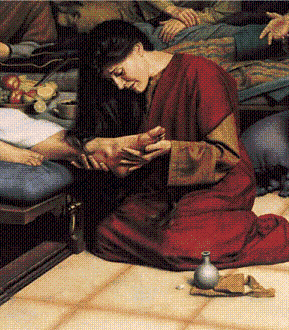
Now before the festival of the Passover, Jesus knew that his hour had come to depart from this world and go to the Father. Having loved his own who were in the world, he loved them to the end. The devil had already put it into the heart of Judas son of Simon Iscariot to betray him. And during supper Jesus, knowing that the Father had given all things into his hands, and that he had come from God and was going to God, got up from the table, took off his outer robe, and tied a towel around himself. Then he poured water into a basin and began to wash the disciples’ feet and to wipe them with the towel that was tied around him. He came to Simon Peter, who said to him, “Lord, are you going to wash my feet?” 7Jesus answered, “You do not know now what I am doing, but later you will understand.” Peter said to him, “You will never wash my feet.” Jesus answered, “Unless I wash you, you have no share with me.” Simon Peter said to him, “Lord, not my feet only but also my hands and my head!” Jesus said to him, “One who has bathed does not need to wash, except for the feet, but is entirely clean. And you are clean, though not all of you.” For he knew who was to betray him; for this reason he said, “Not all of you are clean.” After he had washed their feet, had put on his robe, and had returned to the table, he said to them, “Do you know what I have done to you? You call me Teacher and Lord—and you are right, for that is what I am. So if I, your Lord and Teacher, have washed your feet, you also ought to wash one another’s feet. For I have set you an example, that you also should do as I have done to you. Very truly, I tell you, servants are not greater than their master, nor are messengers greater than the one who sent them. If you know these things, you are blessed if you do them.

“Now the Son of Man has been glorified, and God has been glorified in him. If God has been glorified in him, God will also glorify him in himself and will glorify him at once. Little children, I am with you only a little longer. You will look for me; and as I said to the Jews so now I say to you, ‘Where I am going, you cannot come.’ I give you a new commandment, that you love one another. Just as I have loved you, you also should love one another. By this everyone will know that you are my disciples, if you have love for one another.”

Sometimes life spins a little out of control. Sometimes things don’t go exactly like the carefully scripted plan we have in our own minds. Sometimes we have to let go or leave behind those in our lives before we’re actually ready to do so. Our lives are full of “last times”, those special, much-too-fleeting moments that we spend with those we love. It is those times when all we can do is trust that the groundwork has been laid for what must continue. That had to be a little of what Jesus was going through on this night. Think about it…he had spent his ministry gathering those around him, teaching them, loving them, and indeed shaping them into who they were. And now…here he was completely out of time…the end was approaching. Night had begun to fall. All he could do was trust that the seeds he had planted in his followers would continue to grow and flourish even in a new environment and a new time. So on this night, he invited all those who love him—this somewhat motley crew of misfits and ordinary ones to sit around the table and enjoy their time together. He knew what was about to happen. He knew that this would be the last.

That is where we enter the story…in the midst of this evening meal…this Passover meal…the last meal. The feast is prepared. The loved ones are gathered together. We have visions of a perfect meal and a perfect time together. But, as all of us know, that is not always the way that family meals come together. This was no exception. Nestled beneath this wonderful feeling of closeness and fellowship were chords of betrayal and distrust, signs of denial and misunderstandings, and an all-too-constant stream of arguing among the disciples. Does that sound familiar?

But in this Passover meal that we have come to call the Last Supper, Jesus chooses to share himself—his very body and blood with all of those that were gathered—this denying, betraying, bickering, and beloved lot. It was a way of giving them something to remember him so that they would not feel so alone without him. He gave them something to hold onto—to touch and to taste—something to do to keep Christ close in their hearts, to feel the very real Presence of Christ forever. On this night, Jesus gives the gift of himself and a way for all of us to remember who we are.

Our culture probably doesn’t do well with “lasts”.  We seem to be always rushing to the next thing, not wanting to hurt or grieve or even hold on to what may be somewhat painful moments in our lives.  We rush to get “over it”, to move on.  As many of you know, I am dealing with my own set of “lasts” right now.  As I prepare to close my chapter at St. Paul’s and begin a new chapter at FUMC, Cleveland, Tx, the “lasts” seem to be coming in a flurry right now.  I am such that I tear up and sometimes even blatantly bawl at the emptiness and, yet, I really want to savor it, to feel every moment of it, to remember it, to make it a part of me, and to leave a part of myself.  That is what Jesus was trying to do.  I don’t think he was trying to “get them through it” and he was definitely not wanting to rush for it to be over.  He was wanting them to experience it, to savor it, indeed, to remember it.  Do this in remembrance of me.  The beauty of this last meal was the intimacy and the relationship.  These were friends dining together–friends who had loved and argued, celebrated and cried, friends who had been called together one by one.  They were all different, coming from different lifestyles with different gifts to offer.  They were us.  We are them.  And this was the moment that they would remember when everything had changed.

For on this night of nights, Jesus drew them in, not to take care of them, but to help them remember. They had to remember enough to hand the memory on.  The Greek word for it is anamnesis.  We would translate it as remembering.  But it is more.  It is not merely remembering those things that happened to us; it is remembering what came before and what was passed on, remembering what was part of our tradition and our heart.  It is finding a memory of what came before that leads you on your journey beyond.  We often tout “institutional memory” as if it is a way of remembering what happened to whom and where and when.  But it is more.  It is a way of imparting what is important, what matters, what gives life to those that come next.  It is a way of giving it wings to fly and breath to survive.  That is why this night was so important.  Jesus did not choose to shut himself off and grieve what was coming but instead immersed himself in a circle of friends so that he could live through them.  Experiencing a “last time” alone is painful; experiencing a “last time” with a gift of friends and a meal will remain forever.

This is the night we remember, the night that Jesus broke the bread and shared the cup, the night that Jesus knelt and washed the feet of the disciples, the night that Jesus forgave betrayal and welcomed life.  A few hours later the soldiers would come and the end would begin.  But the memory of that last time will last forever.  Do this in remembrance of me.

The glad hosannas are no longer heard.  The shouting is over, the palms are gathered; the shadows lengthen; the plotting begins in earnest. Knowing the outcome, we come with heavy hearts.  And what do we hear?  An unchanged and unchanging message of love; God’s love, a poet’s love, a woman’s love.  God’s love, foretold by Isaiah, in the shape of a servant.  (Moira B. Laidlaw)

On this night of nights, we remember.  But we also experience our own “lasts”.  What memories have been imparted to you?  What do you remember that makes you?  What can you impart to those that come after you?  Embrace your lasts, hold them, love them, and then pass them along.

Grace and Peace,

Shelli


It’s About the Bread

Communion-breadScripture Passage:  John 13: 21-32 (Holy Wednesday)

After saying this Jesus was troubled in spirit, and declared, “Very truly, I tell you, one of you will betray me.” The disciples looked at one another, uncertain of whom he was speaking. One of his disciples—the one whom Jesus loved—was reclining next to him; Simon Peter therefore motioned to him to ask Jesus of whom he was speaking. So while reclining next to Jesus, he asked him, “Lord, who is it?” Jesus answered, “It is the one to whom I give this piece of bread when I have dipped it in the dish.” So when he had dipped the piece of bread, he gave it to Judas son of Simon Iscariot. After he received the piece of bread, Satan entered into him. Jesus said to him, “Do quickly what you are going to do.” Now no one at the table knew why he said this to him. Some thought that, because Judas had the common purse, Jesus was telling him, “Buy what we need for the festival”; or, that he should give something to the poor. So, after receiving the piece of bread, he immediately went out. And it was night.  When he had gone out, Jesus said, “Now the Son of Man has been glorified, and God has been glorified in him. If God has been glorified in him, God will also glorify him in himself and will glorify him at once.

(Sorry…Wednesday’s post is a little late!) We started this week with the account of the anointing of Jesus, a story that shows us what it means to extravagantly serve our Lord. Tuesday’s text was one that showed us the meaning of following Jesus, indeed what it means to “take up our cross”. And then today…no extravagant anointing, no taking up any crosses…just a prediction of a betrayal of the worst kind as the dark pall of death begins to enshroud our week.

This passage is indeed a difficult one. Look how it begins…”Jesus was troubled in spirit.” He knew. He knew that a friend would betray him. It made him angry and indignant. But, more than that…it had to hurt. That has to be one of the worst pains imaginable. Because…think about it…betrayal is not something that you do to a stranger. You do not speak of inadvertently cutting someone off in traffic as a “betrayal”. For, you see, betrayal…true betrayal…is a deep-cutting blade that that can only cut into the closest of relationships. As painful as it may be, betrayal only happens in the midst of true intimacy. And that is the most painful of all.  “Very truly, I tell you, one of you will betray me.” What? The disciples looked at each other flabbergasted. NOT one of us. (And even if it was one of us, it is certainly not I. Maybe him or him or him. But I KNOW it’s not me! I love you! You are my Lord!) So Simon Peter leans in…Jesus…come here…come on, you can tell me…who is it? And Jesus, with perfect parabolic eloquence responds…It is the one to whom I give this piece of bread when I have dipped it in the dish. And then he hands it to Judas. Do quickly what you are going to do.  But the disciples didn’t get it. Well, of course not…because it really doesn’t make sense. So they began speculating. You know what I bet he really MEANT to say? He MUST have been telling him to buy something for the festival or to give something to the poor. (After all, just a few days ago, Judas was worried about the poor and why money was not being spent on them rather than on the extravagant anointing of our Lord!) NOW it makes sense. Because NONE of us could betray Jesus. And so the other disciples are removed from the betrayal, relieved of the blame.

So Judas leaves immediately. Even in the midst of betrayal, he is quietly obedient, knowing in his heart of hearts where he really belongs and is not going. And the passage ends as the darkness of night falls.  We know what happens after that. It was Judas who led the authorities to the garden a little way east of the walls of the city and it was Judas who signaled to them which of the men standing there in the dark was Jesus. It all changed with a single kiss as Judas’ lips graze Jesus’ cheek.

But I think, in all honesty, we may be a little too eager to jump on the “blame Judas” band wagon. After all, there is probably a little Judas in all of us. There are those times for all of us when we inadvertently choose the darkness, either intentionally or unintentionally. There are those times when our greed or maybe even our fears drive us to choose the security of wealth or the selfishness of our own preservation, fleeting as it may be, over trust in Christ. There are times when our own blindness toward others compels us to choose our own personal bread, rather than a community feast. And there are times when even our love for our Lord is so shrouded in the darkness of greed, and insecurity, and selfishness towards others that we once again hand him over to be crucified in our hearts. We all must ask the question “Is it I”? And we all must face the uncomfortable truth that sometimes it is.

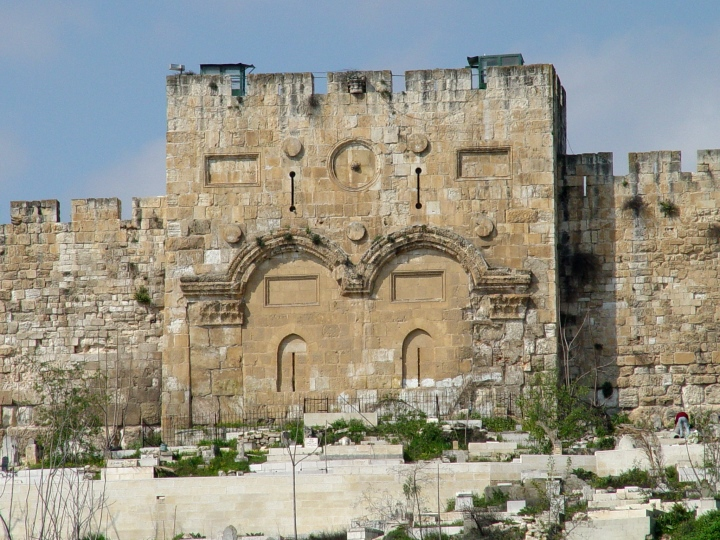
And we know what happened to Judas. As the writer of Matthew’s Gospel accounts, when Jesus was condemned to death, Judas could not face himself. What had he done? And so he hanged himself, a victim of his own choices and his own action. And to this day, Judas lives on as the veritable poster child of the worst sin imaginable, known to all as the one who handed the Savior of the World over to be crucified. His name has literally become a noun, the description of the worst that one can do. Dante places him on the 4th level of the 9th circle of the inferno, hanging out for the ages in the bowels of hell between Brutus and Cassius, who conspired in the assassination of Julius Caesar. And we, like the other eleven disciples, breathe a collective sigh of relief that it was not us, that we were not the one that betrayed our Lord.

And yet, the story does not end there. With all respect to the 14th century Italian poet, I think he may have missed that. I do think that Judas ended up in hell, the worst hell imaginable, a self-imposed banishment from God, a place where he could not conceive that he would ever be forgiven because he could not forgive himself. So in that place with the blood of Christ on his hands, he saw no end other than his own.

I’ve read this Scripture many times. I’ve even preached on it a few. But this time, something else leapt off the page for me. (I love it when that happens!) I missed it before. It was the bread. Jesus said “the one to whom I give this bread.” The point is, he gave it to all of them. They were all betrayers but, more importantly, they were also all beloved.  I once heard Walter Brueggemann talk about the liturgy that we use for our Eucharist. Before we take the bread, before we take the cup, we confess. We name our sin. We name our betrayals. And then, we are told “In the Name of Jesus Christ, you are forgiven.” The words do not specify that we are forgiven if we are good or that we are forgiven if we’re only on the first couple of circles of Dante’s vision of hell. Nowhere does it say that we are forgiven of limbo or lust or gluttony but if we get to the fourth circle (which is greed) or below, we are doomed. Nowhere does it say that. And Brueggemann points out that with those words, with the simple words “In the Name of Jesus Christ, you are forgiven,” we are wiped clean, spotless, if only for a moment. Oh, but what a moment!

Because, you see, the good news is that God does not love us in spite of who we are; God loves us because of who we are—the betrayer and the beloved, the Judas and the one whom Jesus loved. God loved us before any human person could show love to us—a “first” love, an unlimited, unconditional love—loved us so much that when we are handed this bread, we are handed the real presence of Christ—all of us—the bumbling disciples, those unnamed people that were in the periphery of the picture that day, the beloved and the betrayer, and me. I, Judas, no matter what I do, am forgiven. That was the part of the story Dante forgot. Forgiveness is not payment for a job well done; it is our chance to start again.

Judas was there at the table. Jesus served him as one of his own. It still hurt. But God’s unfathomable grace and God’s forgiveness is bigger than our own selfish betrayal, bigger than any hell we could ever imagine or conjure up for ourselves.  You know, it’s about the bread…

And so, Madeleine L’Engle tells an old legend that after his death Judas found himself at the bottom of a deep and slimy pit. For thousands of years he wept his repentance, and when the tears were finally spent he looked up and saw, way, way up, a tiny glimmer of light. After he had contemplated it for another thousand years or so, he began to try to climb up towards it. The walls of the pit were dank and slimy, and he kept slipping back down. Finally, after great effort, he neared the top, and then he slipped and fell all the way back down. It took him many years to recover, all the time weeping bitter tears of grief and repentance, and then he started to climb again. After many more falls and efforts and failures he reached the top and dragged himself into an upper room with twelve people seated around a table. “We’ve been waiting for you, Judas. We couldn’t begin till you came.” (From “Waiting for Judas”, by Madeleine L’Engle, in Bread and Wine: Readings for Lent and Easter (Maryknoll, NY: Orbis Books, 2003), 312.)

That is the crux. None of us are innocent. All of us are forgiven. Holy Thursday does not end in betrayal; it ends in love. Perhaps rather than trying to lay blame for what happened at the Cross, perhaps rather than using Judas as the scapegoat for all of our own sins, we should let the Cross be what it is—a place of healing, a place of reconciliation, a place of forgiveness, a place of life recreated. Because of the Cross, all of us are invited to the table and each of us, no matter who we are, no matter what we’ve done, no matter what we will do, is handed the bread. Each of us is the one to whom I give this bread.

In the Name of Jesus Christ, you are forgiven.

(In the Name of Jesus Christ, I, Judas, am forgiven.)

The body of Christ given for you. Take, eat, in remembrance of me.

The soldiers are there with their swords and lanterns.  The high priest’s slave is whimpering over his wounded ear.  There can be no doubt in Jesus’ mind what the kiss of Judas means, but it is Judas that he is blessing, and Judas that he is prepared to go out and die for now.  Judas is only the first in a procession of betrayers two thousand years long, If Jesus were to exclude him from love and forgiveness, to one degree or another he would have to exclude us all.  Maybe this is all in the mind of Jesus as he stands with his eyes closed, or possibly there is nothing in his mind at all.  As he feels his friend’s lips graze his cheek for an instant, maybe he feels nothing else…It is not the Lamb of God and his butcher who meet here, but two old friends embracing in a garden knowing that they will never see one another again. (Frederick Buechner)

We are journeying through Holy Week.  Things are changing and what we know will come is imminent.  But forgiveness is abundant.  We are all Judas’s.  What are the Judas parts of you?  What does it mean to be forgiven?  Have you forgiven yourself?  None of us are innocent.  All of us are forgiven.

Grace and Peace,

Shelli