When We Started to Become

WaterScripture Text:  Mark 1: 4-11

John the baptizer appeared in the wilderness, proclaiming a baptism of repentance for the forgiveness of sins. And people from the whole Judean countryside and all the people of Jerusalem were going out to him, and were baptized by him in the river Jordan, confessing their sins. Now John was clothed with camel’s hair, with a leather belt around his waist, and he ate locusts and wild honey. He proclaimed, “The one who is more powerful than I is coming after me; I am not worthy to stoop down and untie the thong of his sandals. I have baptized you with water; but he will baptize you with the Holy Spirit.”  In those days Jesus came from Nazareth of Galilee and was baptized by John in the Jordan. And just as he was coming up out of the water, he saw the heavens torn apart and the Spirit descending like a dove on him. And a voice came from heaven, “You are my Son, the Beloved; with you I am well pleased.”

Looking back from our journey, we remember, we remember the day that we started to become.  At this point, we remember that day in the Jordan, all of Creation dripping from the sacred waters. And, yet, that whole idea of Jesus being baptized is sometimes odd for us.  After all, part of what we associate with baptism is forgiveness.  How can one who is supposed to be sinless be forgiven?  But the fact that Jesus was baptized only suggests that Jesus associated himself with the need to gather God’s people and to prepare for the Lord’s coming with a gesture of repentance, an entrusting of oneself wholly and completely to God. It also reminds us that Baptism is not about us. We cannot baptize ourselves. It is about God’s presence in our life.

I think the Baptism account from the Gospel According to Mark is my favorite.  Only in this version do we hear of the “heavens being torn apart”—not opened for a time as in Matthew and Luke—but torn apart. The Greek word for this means “schism” (which, interestingly enough, is similar to chaos, similar to what God’s Creation ordered.). It’s not the same as the word open. You open a door; you close a door; the door still looks the same. But torn—the ragged edges never go back in quite the same way again. At this point of Jesus’ baptism, God’s Spirit becomes present on earth in a new way. A brand new ordering of Creation has begun. The heavens have torn apart. They cannot go back. Nothing will ever be the same. Everything that we have known, everything that we have thought has been torn apart and that is the place where God comes through. And the heavens can never again close as tightly as before.  This is when we started to become.

This story of Jesus’ Baptism calls us to remember our own. It is more than being showered or sprinkled with remnants of God’s forgiveness.  It is our beginning, our very “becoming”, as the gift of God’s grace washes away those things that impede our relationship with God and gives us new birth, new life. Just as God swept over the waters when Creation came to be, God swept across the waters so that we would become.  And it calls us to do something with our life.  But I actually don’t remember the day of my baptism. It happened when I was a little over seven months old, on Palm Sunday, April 15, 1962. It was at First United Methodist Church, Brookshire, TX and Rev. Bert Condrey was the officiant. I had a special dress and lots of family present. That would be all I really know.  And yet we are reminded to “remember our baptism”. What does that mean for those of us who don’t? I think “remembering” is something bigger than a chronological recount of our own memories. It is bigger than remembering what we wore or where we stood or who the actual person was that touched our head with or even immersed us in water. It means remembering our very identity, our creation, what it is that made us, that collective memory that is part of our tradition, our liturgy, our family.  It means remembering not just how the journey began but that in its very beginning we became part of it.  And now this same journey takes us to the cross.

That is what “remembering” our baptism is. It’s not just remembering the moment that we felt that baptismal stream; it is remembering the story into which we entered. It is at that point that the Christian family became our own as we began to become who God intends us to be. And for each of us, whether or not we noticed it, the heavens tore apart, spilled out, and the Holy Spirit emerged. And we, too, were conferred with a title. “This is my child, my daughter or son, my beloved, with whom I am well pleased.”  You are part of something beyond yourself, beyond what you know, and beyond what you can remember. Rainer Maria Rilke once said that “the future enters into us, in order to transform itself in us, long before it happens.” Your past now reaches far back before you were here and your future is being transformed and redeemed in you even as we speak.

After he was baptized, Jesus stood, dripping wet, to enter his ministry. The heavens tore apart and poured into the earth. All of humanity was there in that moment—those gone, those to come, you, me. So we remember now how we still stand, wet with those same waters, as we, too, are called into ministry in the name of Christ. It is up to us to further the story. This day and every day, remember your baptism, remember that you are a daughter or son of God with whom God is well pleased and be thankful. You are now part of the story, part of this ordering of chaos, part of light emerging from darkness, part of life born from death. You are part of God’s re-creation. And it is very, very good.  This is the journey for which we live; this is the journey for which we were created; this is the journey that gives us Life.  And, in this moment, we remember when we started to Become. 

Your life is shaped by the end you live for.  You are made in the image of what you desire. (Thomas Merton)

On this Lenten journey, we continue to gather our past into our Lives and we remember what made us, remember when we became who we are, when we began this journey.  What does it mean to you to “Remember your Baptism”?

Grace and Peace,

Shelli
 

How Much is Too Much?

anointing-jesus-feetLectionary Passage for Today: John 12: 1-11

Six days before the Passover Jesus came to Bethany, the home of Lazarus, whom he had raised from the dead.2There they gave a dinner for him. Martha served, and Lazarus was one of those at the table with him.3Mary took a pound of costly perfume made of pure nard, anointed Jesus’ feet, and wiped them with her hair. The house was filled with the fragrance of the perfume.4But Judas Iscariot, one of his disciples (the one who was about to betray him), said,5“Why was this perfume not sold for three hundred denarii and the money given to the poor?”6(He said this not because he cared about the poor, but because he was a thief; he kept the common purse and used to steal what was put into it.)7Jesus said, “Leave her alone. She bought it so that she might keep it for the day of my burial.8You always have the poor with you, but you do not always have me.”9When the great crowd of the Jews learned that he was there, they came not only because of Jesus but also to see Lazarus, whom he had raised from the dead.10So the chief priests planned to put Lazarus to death as well,11since it was on account of him that many of the Jews were deserting and were believing in Jesus.

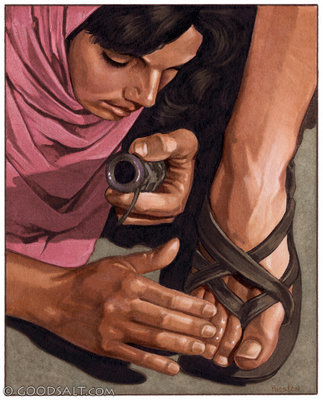
Perhaps no one noticed when Mary got up and left the room.  Perhaps no one noticed when she quietly returned carrying a jar full of oil.  But then they noticed…With drama befitting a king, she raised the jar, broke the seal and in one movement, poured the entire bottle onto Jesus’ feet.  Then as the oil slowly runs down his feet and begins to drip to the floor, she wipes his feet with her hair.  The whole house is filled with this overwhelming fragrance. And the empty jar is cast aside.

In our faith understanding, the Sacrament of Baptism is the beginning of our life as a Christian, a new life in Christ, the beginning of a journey toward oneness with God, toward the life of Christ.  The waters of Baptism remind us of God’s ever-Presence in our lives, of God’s claim on us, and of the great love that God has for us that was revealed in Christ.  It is sacramental because it is God’s love made visible for us.  Through this sacrament, we enter this journey with God.  And the Eucharist is, for us, an entering into that Presence of God.  It makes God’s Presence real.  We don’t understand it.  It’s a wonderful holy mystery.  But somewhere in that bread, somewhere in that juice, is the very real Presence of God.

But you can’t help but listen to the story of Mary’s anointing without hearing the same language—Mary took, poured, and wiped.  We will hear those same words this Thursday in the account of Jesus’ last meal:  Jesus took the bread, poured out the wine, and wiped the feet of the disciples, and through these common gestures and such common touch, Jesus shows us what true love is.  And as Mary takes, and pours, and wipes, she shows that same love toward Christ, and as the storm clouds begin to gather outside, this small crowded house in Bethany becomes a cathedral, the bottle that held the oil becomes a font, and this simple meal becomes a Eucharist. Through her touch, through her love, the ordinary becomes sacred.  Mary enters Jesus’ life and he becomes part of her.  Her life becomes an extravagant sacrament that shows Jesus’ love to the world.  And she, with Jesus, is on the journey to the Cross.  And the whole world is now forever filled with the fragrance of that perfume.

So, how much is too much?  Where did Mary cross the line?  Where was the point when someone could have reasonably said, “stop, that’s enough”?  Well, the truth is, I wish I could be more like her, wish I could give all of myself without holding back, wish I could break the jar and break the rules, and do something extravagant for love rather than for the right reason.  Because in this moment, Mary began walking with Jesus to the cross.  In this moment, she abandoned herself and poured everything out.  In that moment she became sacrament.  I don’t think it was too much.

In this holiest of weeks, become sacrament.  Do not count the cost.  Break the seal and pour yourself out.

Grace and Peace,

Shelli

Add Water and Stir

wedding-feast-cana-ic-4025Scripture Passage:  John 2: 1-11

On the third day there was a wedding in Cana of Galilee, and the mother of Jesus was there. 2Jesus and his disciples had also been invited to the wedding. 3When the wine gave out, the mother of Jesus said to him, “They have no wine.” 4And Jesus said to her, “Woman, what concern is that to you and to me? My hour has not yet come.” 5His mother said to the servants, “Do whatever he tells you.” 6Now standing there were six stone water jars for the Jewish rites of purification, each holding twenty or thirty gallons. 7Jesus said to them, “Fill the jars with water.” And they filled them up to the brim. 8He said to them, “Now draw some out, and take it to the chief steward.” So they took it. 9When the steward tasted the water that had become wine, and did not know where it came from (though the servants who had drawn the water knew), the steward called the bridegroom 10and said to him, “Everyone serves the good wine first, and then the inferior wine after the guests have become drunk. But you have kept the good wine until now.” 11Jesus did this, the first of his signs, in Cana of Galilee, and revealed his glory; and his disciples believed in him.

This was an embarrassing situation—the wine has run out, and there appears to be no solution.  Either no more wine is available, or there is no money to buy more wine. The guests seem unaware of what is happening. If something is not done, all will be embarrassed. Some commentators even inform us that litigation was possible in such cases. (Can you imagine being sued for not providing enough food and drink at a marriage ceremony?)  But, regardless, it is clear that Jesus mother expects Jesus to do something out of the ordinary.  She expects him to fix it.  Maybe it’s a message to us that Jesus didn’t just come for the “big”, splashy things.  Maybe it’s a reminder that God is in even the ordinary, those seemingly small things in life that we think we can handle, that we think don’t really even matter to God.

But this?  I mean, really, wine?  Why didn’t he turn the water into food for the hungry or clothing for the poor?  Why didn’t he end the suffering of one of those wedding guests who were forced to live their lives in pain?  Why didn’t he teach those that were there that God is more impressed by who we are than what we do?  Now THAT would have been a miracle.  But instead Jesus, in his first miraculous act, the first of his signs, creates a party, a feast.  Maybe it’s a reminder that we ought to just relax and trust God a little more.  Maybe it’s trying to tell us that God is indeed in every aspect of our life.  And maybe it’s telling us that life is indeed a feast to be celebrated.

And think about the wine itself.  It begins as ordinary grapes.  Well, not really.  If you go even farther back, you start with water.  Everything starts with water.  And then those ordinary grapes with just the right amount of water, the right amount of sunlight, and the right amount of nutrients fed to them from the rich, dark earth begin to seed.  And then we wait, we wait for them to grow and flourish and at just the right time, they are picked and processed and strained of impurities and all of those things that are not necessary.  And then they are bottled and tucked away while again, we wait.  They are placed in just the right temperature, with just the right amount of light, and just the right amount of air quality, and we wait.  We wait and until it becomes…well, a miracle.

And remember that when the wine ran out, Jesus did not conjure up fresh flagons of wine.  Rather, he took what was there, those ordinary, perhaps even abandoned vessels of ordinary, everyday water and turned it into a holy and sacred gift.  Water and a miracle…So this story of wine makes a little more sense.  Wine is water—plus a miracle.  But in case it is lost on us, remember that our bodies are roughly two-thirds water.  No wonder the ancient sages always used water as a symbol for matter itself.  Humans, they taught, are a miraculous combination of matter and Spirit—water and a miracle—and thus unique in all of creation.  No wonder that wine is such a powerful, sacramental, and universal symbol of the natural world—illumined and uplifted by the Divine.  Wine is water, plus spirit, a unique nectar of the Divine, a symbol of life.  And we, ordinary water-filled vessels though we are, are no different.  God takes the created matter that is us and breathes Spirit into us, breathes life into us.  We, too, are water plus a miracle.  13th century German mystic Meister Eckhart said that “every creature is a word of God.”  It’s another way of reminding us that we are water plus a miracle, God-breathed, holy and sacred.

So in this week “between”, that week when you don’t want to essentially jump into the Passion stories way too soon, we are moving–moving from Bethlehem through Galilee to Jerusalem, moving from birth through growth to maturity, moving from life to death to life again.  This is the week in which the Procession begins.  And here we remember, we remember this child born among us; we remember this child delivered to us; we remember our baptism.  And, now, we remember that that baptism calls us to be something, calls us to be water plus a miracle.  The water has been added.  Now start stirring.  Let your Lenten journey be one that moves your life into what it should be–a miracle.

Grace and Peace,

Shelli

Dripping

The Jordan River, Israel

Scripture Passage:  Mark 1: 4-11

4John the baptizer appeared in the wilderness, proclaiming a baptism of repentance for the forgiveness of sins.5And people from the whole Judean countryside and all the people of Jerusalem were going out to him, and were baptized by him in the river Jordan, confessing their sins.6Now John was clothed with camel’s hair, with a leather belt around his waist, and he ate locusts and wild honey.7He proclaimed, “The one who is more powerful than I is coming after me; I am not worthy to stoop down and untie the thong of his sandals.8I have baptized you with water; but he will baptize you with the Holy Spirit.”  9In those days Jesus came from Nazareth of Galilee and was baptized by John in the Jordan.10And just as he was coming up out of the water, he saw the heavens torn apart and the Spirit descending like a dove on him.11And a voice came from heaven, “You are my Son, the Beloved; with you I am well pleased.”

And in that moment, everything changed…All of the accounts of Jesus’ Baptism leave us with the image of God’s Spirit pouring into him, changing everything.  But only in the Gospel of Mark are the heavens literally “torn apart”–not opened, but torn, ripped, dramatically separated.  The Greek word for this means “schism”.  It’s not the same as opening.  Open, close, open, close–it is something that can be done over and over again just like you open and close your front door.  But torn is different.  Torn would imply that the ragged edges could never quite go back together again.  It is a new ordering, a new Creation, with the seam between earth and heaven forever weakened, forever separated just enough that one who stops long enough to look could see through the threads.

We are told to “remember our baptism.”  Well, for those of us who were baptized as infants, that is a little difficult.  I was too young.  I don’t remember.  I know there was water; I know there were words; and maybe there was some tearing of the seam between heaven and earth.  But I don’t remember.  Well, thankfully, this sacred journey is not dependent upon chronological memory.  Remembering is not just looking back.  It is, rather, looking through that once-weakened opening between heaven and earth, and seeing ourselves in a different way, as a New Creation.  Because whether or not we remember or whether or not we noticed it, for each of us, the sacred spilled into us and changed everything.  Remembering is to remember that we are part of something far beyong ourselves and certainly far beyond what our minds could eover really remember.

As Jesus stood, dripping with the waters of the Jordan that poured back into themselves, everything indeed changed.  In that moment, Bethlehem and Jerusalem, Creation and Eternity, manger and Cross, all who came before and all who would follow, were one.  In that moment, all that was and all that would be were almost indistinguishable from each other.  In that moment, all of those who were there that day and all of those who were part of the past and all of those who would come later in this walk of humanity, were swept into those waters, swept into the memories of what would be.  Remembering means that we realize that we are part of the story, that we, too, emerge dripping with those waters.

This is a journey of remembering.  Lent is not usually the season when we read this passage or are told to “remember our baptism”.  But it is there, always there, always peeking through that now-jagged opening between heaven and earth.  Remembering our baptism means realizing that we are right now dripping wet with those waters, recreated, with the heavens forever torn apart, forever visible if we will only see.  Remembering is not limited to my memory of the words that were said when that little bit of water was sprinkled on me as a baby but rather the waters that are still dripping from each of us now.  In this and every moment, everything has changed.  Remember your baptism and be thankful.  This do, in remembrance.

Grace and Peace,

Shelli

Water Plus a Miracle

Lectionary Passage:  John 2: 1-11
On the third day there was a wedding in Cana of Galilee, and the mother of Jesus was there.2Jesus and his disciples had also been invited to the wedding.3When the wine gave out, the mother of Jesus said to him, “They have no wine.”4And Jesus said to her, “Woman, what concern is that to you and to me? My hour has not yet come.”5His mother said to the servants, “Do whatever he tells you.”6Now standing there were six stone water jars for the Jewish rites of purification, each holding twenty or thirty gallons.7Jesus said to them, “Fill the jars with water.” And they filled them up to the brim.8He said to them, “Now draw some out, and take it to the chief steward.” So they took it.9When the steward tasted the water that had become wine, and did not know where it came from (though the servants who had drawn the water knew), the steward called the bridegroom10and said to him, “Everyone serves the good wine first, and then the inferior wine after the guests have become drunk. But you have kept the good wine until now.”11Jesus did this, the first of his signs, in Cana of Galilee, and revealed his glory; and his disciples believed in him.

We actually refer to this story that we read from the Gospel According to John as part of our marriage service order, mentioning that in it, “Jesus graced a wedding at Cana of Galilee and gave us the example for the love of one another.”  I’m not really sure why because the truth is this passage is not about marriage; it’s about wine.  So last week we read of Jesus’ baptism and now we read of his first miracle.  He definitely got the show on the road, so to speak.  And yet, the story is a little odd.  We read later of teaching, of healing, of including, even of raising from the dead.  So what’s this thing about wine?  Why was this act important enough to put in the Gospel and, particularly, to place it where it is the first miracle that we find Jesus doing?

Well, according to the Mishnah (which is essentially a redaction of the oral tradition of Judaism and a documentation of the traditional understandings of Scripture), the wedding would take place on a Wednesday if the bride was a virgin and on a Thursday if she was a widow. The bridegroom and his friends made their way in procession to the bride’s house. This was often done at night, when there could be a spectacular torchlight procession. There would be speeches and expressions of goodwill before the bride and groom went in procession to the groom’s house, where the wedding banquet was held. It is probable that there was some sort of religious ceremony, but we have no details. The processions and the feast are the principal items of which we have knowledge. The feast was prolonged, and might last as long as a week (so, OK, that would be quite a lot of wine!).

So Mary, the mother of Jesus, is at the wedding, although her role seems to be more than that of a guest. Perhaps the couple was an extended family member or something.  But she seems to be one of the first to know that the wine is running out. She instructs the servants to do whatever Jesus tells them to do, and they appear willing to take her instructions.  Now you have to understand that this was an embarrassing situation.  The wine has run out, and there appears to be no solution.  Either no more wine is available, or there is no money to buy more wine. The guests seem unaware of what is happening. If something is not done, all will be embarrassed. Some commentators even inform us that litigation was possible in such cases. (Can you imagine being sued for not providing enough food and drink at a marriage ceremony?)  But, regardless, it is clear that Jesus mother expects Jesus to do something out of the ordinary.  She expects him to fix the problem.

In the setting of this story, Jesus has not yet begun to perform all the miracles and the teaching and yet his mother thought he could do this.  It’s unclear whether or not Mary really understood what “hour” to which Jesus was referring or if she really grasped who this man that she had brought into the world was, but, timing aside, Jesus helps out and fills a need.  Maybe it’s a message to us that Jesus didn’t just come for the “big”, splashy things.  Maybe it’s a reminder that God is in even the ordinary, those seemingly small things in life that we think we can handle, that we think don’t really even matter to God.

But this?  I mean, really, wine?  Why didn’t he turn the water into food for the hungry or clothing for the poor?  Why didn’t he end the suffering of one of those wedding guests who were forced to live their lives in pain?  Why didn’t he teach those that were there that God is more impressed by who we are than what we do?  Now THAT would have been a miracle.  But instead Jesus, in his first miraculous act, creates a party, a feast.  Maybe it’s a reminder that we ought to just relax and trust God a little more.  Maybe it’s trying to tell us that God is indeed in every aspect of our life.  And maybe it’s telling us that life is indeed a feast to be celebrated.

And think about the wine itself.  It begins as ordinary grapes.  Well, not really.  If you go even farther back, you start with water.  Everything starts with water.  And then those ordinary grapes with just the right amount of water, the right amount of sunlight, and the right amount of nutrients fed to them from the rich, dark earth begin to seed.  And then we wait, we wait for them to grow and flourish and at just the right time, they are picked and processed and strained of impurities and all of those things that are not necessary.  And then they are bottled and tucked away while again, we wait.  They are placed in just the right temperature, with just the right amount of light, and just the right amount of air quality, and we wait.  We wait and until it becomes…well, a miracle.


And Biblical theologians have over and over pointed to the relationship that this story has with the Eucharist.  Think about it.  We take ordinary bread and ordinary wine (or in our case, ordinary Welch’s Grape Juice), and through what we can only describe as a Holy Mystery, a veritable miracle,  those ordinary things become holy.  They become for us the body and blood of Christ, the very essence of Christ to us, for us, and in us. 
And remember that when the wine ran out, Jesus did not conjure up fresh flagons of wine.  Rather, he took what was there, those ordinary, perhaps even abandoned vessels of ordinary, everyday water and turned it into a holy and sacred gift.  Water and a miracle…

So this story of wine makes a little more sense.  Wine is water—plus a miracle.  But in case it is lost on us, remember that our bodies are roughly two-thirds water.  No wonder the ancient sages always used water as a symbol for matter itself.  Humans, they taught, are a miraculous combination of matter and Spirit—water and a miracle—and thus unique in all of creation.  No wonder that wine is such a powerful, sacramental, and universal symbol of the natural world—illumined and uplifted by the Divine.  Wine is water, plus spirit, a unique nectar of the Divine, a symbol of life.

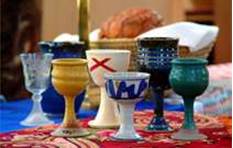
And we, ordinary water-filled vessels though we are, are no different.  God takes the created matter that is us and breathes Spirit into us, breathes life into us.  We, too, are water plus a miracle.  So as we lift the chalice today, let it be a reminder of Christ’s Spirit infused into us, living in us.  13thcentury German mystic Meister Eckhart said that “every creature is a word of God.”  It’s another way of reminding us that we are water plus a miracle.

So maybe this story of Jesus’ first miracle is not as odd as we thought.  Our lectionary places it immediately following the remembrance of Jesus’ baptism and the remembrance of our own.  It is the point where God’s Spirit, where the holy and sacred itself, was poured into each of us.  So, yes, we are a miracles, created matter, Spirit-breathed.  We are the good wine that God has saved for now.  We are water plus a miracle.

Go be the miracle you were created to be!

Grace and Peace,

Shelli

Open Table

Lectionary Passage:  Mark 7: 24-37
To read this passage online, go to http://bible.oremus.org/?ql=213945074.

I love being a United Methodist.  I probably take what could be considered an almost unhealthy sense of pride in the fact that we believe in an open table, that we believe that the Feast of Holy Communion, the Eucharist, is not “Methodist” but is instead an open table to which all are welcome.  It sounds good.  It makes us sound like a community in which one would want to be.

But this week’s Gospel reading begins to make us squirm a bit.  After all, we look to Jesus for this model of open invitation, for the depiction of compassion and mercy to which we all aspire.  And then we read this.  I mean, really, is he calling her a “dog”?  Now, with apologies to Maynard, my four-legged roommate, this was NOT a nice thing to say.  And yet, remember, Jesus understood his mission (in fact, EVERYONE understood his mission) as Messiah, the one promised to the chosen people.  Jesus’ mission was to the people of Israel.  There was nothing bad or closed-minded about that; that’s the way it was. So does that mean that this passage depicts a turning point, a veritable transformative moment for even Jesus?  Well, that’s bothersome.  After all, if Jesus needed transformation, where does that leave us?

Well, really, did we think that Jesus was just plunked down on this earth in ready-to-wear form?  After all, remember, he was human, “fully human” we are told.  Transformation is part of our humanity, being transformed is how we become fully human, fully made in the image of God.  It is how we become who we are supposed to be.  Maybe that was the point.  Maybe Jesus was not pushing us at all here, but leading us out of the box that we have built, leading us to who God calls us to be.  Maybe Jesus was showing us that even well-meaning and well-constructed boxes are meant to come crashing down when the time is right.  And the time was right.  This was not a diminishment of Jesus’ power; it was an expansion.  At this moment, the mission began to move and God’s Kingdom began to spread beyond the tight shores of the Galilean Lake and into the Decapolis region.  The Kingdom of God was at hand!

God cannot be contained.  Perhaps this story was Jesus’ realization and affirmation of that very notion.  After all, if Jesus experienced transformation, we are called to do the same.  Once again, Jesus takes a cultural norm (actually several of them!) and turns them on their ear.  It was his awakening to a new reality.  And it was the impetus that pushed the morality police known as his Disciples right out of the box with him.  The walls crash down, the table is set, and all are invited.  Come and feast with your Lord!

But it’s still a hard Scripture.  I mean, really, who did this foreign nameless immigrant think she was?  She was the voice, a voice for all foreign nameless immigrants that dare to claim their crumb at the table, that dare to go where God calls.  You see, the table is really open–not merely to us but by us.  We are the inviters, the ones transformed by relationships with “them”.  What do you bring to the table?  And who do you invite to sit down with you and share the bread and drink the cup?  Who belongs in the Kingdom of God? The Body of Christ given for you. The Blood of Christ poured out for you. And you and you and you and you and you and you and you…..Well, you get the idea.  Did we think this was about us?

Go therefore and make disciples of all nations, baptizing them in the name of the Father and of the Son and of the Holy Spirit, and teaching them to obey everything that I have commanded you.  And remember, I am with you always, to the end of the age. (Matthew 28: 19-20, NRSV)

Grace and Peace,

Shelli

LENT 1B: Driven

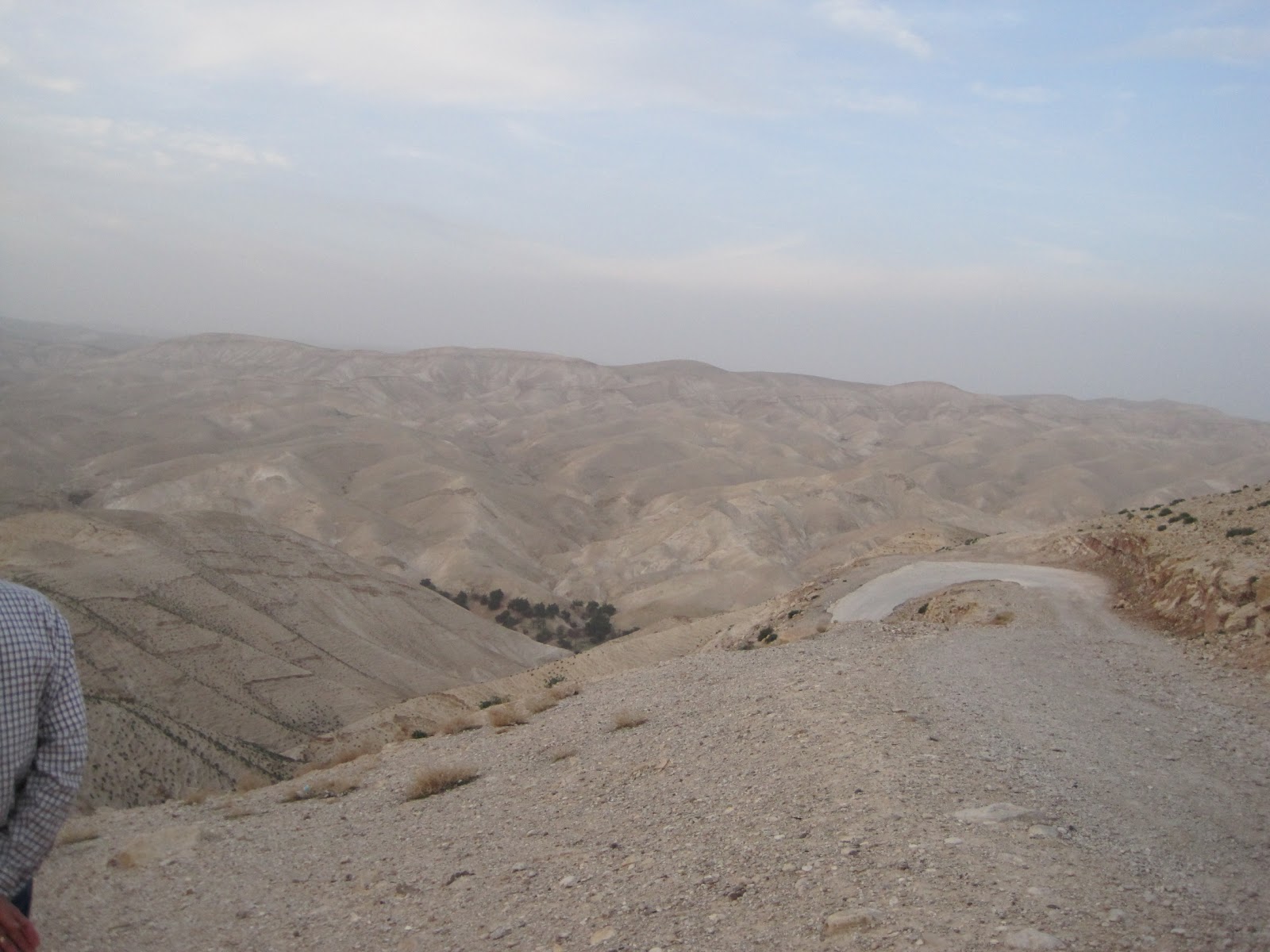
Judean Wilderness, near Jerusalem, Israel, 2010

Lectionary Passage: Mark 1: 9-12 (13-15)
In those days Jesus came from Nazareth of Galilee and was baptized by John in the Jordan. And just as he was coming up out of the water, he saw the heavens torn apart and the Spirit descending like a dove on him. And a voice came from heaven, “You are my Son, the Beloved; with you I am well pleased.” And the Spirit immediately drove him out into the wilderness.

Jesus was driven out into the wilderness.  First he gets baptized and the Spirit descends upon him.  He is claimed by the Spirit.  And then the same Spirit that claims him somehow compels him to go out into the wilderness alone–no supplies, no map, no compass, no cell phone with that neat little GPS app.  Driven out into the wilderness…You know, I used to think that I understood this wilderness thing.  I used to picture Jesus going out into the wilderness, into the trees, into nature, to pray and commune with God.  Perhaps my idea of a wilderness was somewhat skewed by visions of thick East Texas pine trees or perhaps the clammy sensation of the Costa Rican rainforest.  After all, nature is always a great place to become closer to God.

And then I saw the Judean wilderness, the same wilderness into which Jesus was driven by the Spirit.  I stood there on that mountain with a view of winds and sands and nothingness, the true depiction of forsakenness and despair.  And, standing there, I thought about this image of Jesus going out into the wilderness.  On purpose?  He went on purpose?  This is not a wilderness for the faint of heart and certainly not for one with such a faulty sense of direction as I seem to have.  This wilderness has no trees, no real markings of any kind.  The faint pathways change as the winds blow the sands wherever they want.  Even if one began this wilderness journey with some faint sense of where he or she was headed, the pathway would move in an instant and the traveler would be stranded, vulnerable, with no real sense of direction at all.

So into this vulnerable state, Jesus was driven.  If you read the passage, the Spirit claimed him at his baptism and then drove him into a journey that had no obvious pathway at all.  The mere thought of it terrifies us.  After all, don’t we do everything we can do to avoid the wilderness, to avoid a loss of control, a loss of our sense of direction, a loss of the knowledge of where we are and where we are going. But last I checked, the same Spirit supposedly descended on me as descended on Jesus.  So am I to assume that that Spirit is now driving me into the wilderness?  As one who was also baptized, who also had this same Spirit, am I being compelled to go beyond what I know?  But, I will tell you, I did not plan for the wilderness.  I do not have everything I need.  I need to pack.  I need to prepare.  (I probably need new shoes!)  And so I wait.  But that baptism thing keeps tugging at us.  You know, it’s not really meant to be a membership ritual.  It is meant, rather, to be the driving force in our lives.  It is the thing that drives us into the wilderness–if only we will go.

Contrary to the way most of us live our lives, faith is not certainty or knowledge.  It is not, I’m afraid, a sure and unquestioning sense of where one is going, even, for us seemingly progressive theologians (because we are ALL theologians!), in a “big picture” way.  It is not about being saved from something.  Faith is not about learning or being shown the way.  We are not given a map.  It’s just not that clear.  In fact, it’s downright murky, almost like sandy in the air.  No, I think that faith is about entering The Way, being driven into the wilderness, where one is vulnerable, unprepared, and usually scared to death.  And in that death, in that yielding, in that realization that we’re not really sure where it is we’re supposed to go, we encounter God.  And then in the next instant, the winds will blow the path away and, once again, we are in darkness until we realize that God is still there, not pointing to show us, but walking with us.

Every Lenten season we read of the wilderness into which Jesus was driven.  It is the affirmation that Jesus was not a superhero or a star of Survivor.  Rather, Jesus was driven into the deepest depths of human frailty and vulnerability and, unsure of where to go, found God.  Wandering the wilderness is not about finding your way but rather being open and vulnerable enough that The Way will find you.

So, continuing with our act of giving up so that we can take on, on this fourth day of Lent, think of those things that you work to control–time, space, people.  Let go of something that you control and be vulnerable, if only for a day.

Grace and Peace on this Lenten Journey,

Shelli

The promised land lies on the other side of a wilderness.{Havelock Ellis}

Grace and Peace on this Lenten Journey,

Shelli