Re-Creation

Easter Lily (DT 8087007)

Scripture Text:  John 20: 1-18

Early on the first day of the week, while it was still dark, Mary Magdalene came to the tomb and saw that the stone had been removed from the tomb. So she ran and went to Simon Peter and the other disciple, the one whom Jesus loved, and said to them, “They have taken the Lord out of the tomb, and we do not know where they have laid him.” Then Peter and the other disciple set out and went toward the tomb. The two were running together, but the other disciple outran Peter and reached the tomb first. He bent down to look in and saw the linen wrappings lying there, but he did not go in. Then Simon Peter came, following him, and went into the tomb. He saw the linen wrappings lying there, and the cloth that had been on Jesus’ head, not lying with the linen wrappings but rolled up in a place by itself. Then the other disciple, who reached the tomb first, also went in, and he saw and believed; for as yet they did not understand the scripture, that he must rise from the dead. Then the disciples returned to their homes.

But Mary stood weeping outside the tomb. As she wept, she bent over to look into the tomb; and she saw two angels in white, sitting where the body of Jesus had been lying, one at the head and the other at the feet. They said to her, “Woman, why are you weeping?” She said to them, “They have taken away my Lord, and I do not know where they have laid him.” When she had said this, she turned around and saw Jesus standing there, but she did not know that it was Jesus. Jesus said to her, “Woman, why are you weeping? Whom are you looking for?” Supposing him to be the gardener, she said to him, “Sir, if you have carried him away, tell me where you have laid him, and I will take him away.” Jesus said to her, “Mary!” She turned and said to him in Hebrew, “Rabbouni!” (which means Teacher). Jesus said to her, “Do not hold on to me, because I have not yet ascended to the Father. But go to my brothers and say to them, ‘I am ascending to my Father and your Father, to my God and your God.’” Mary Magdalene went and announced to the disciples, “I have seen the Lord”; and she told them that he had said these things to her.


THE LORD IS RISEN!

THE LORD IS RISEN INDEED!

Christ, the Lord, is risen today, Alleluia!   Sons of men and angels say, Alleluia!
Raise your joys and triumphs high, Alleluia!  Sing, ye heavens, and earth, reply, Alleluia!

Love’s redeeming work is done, Alleluia!  Fought the fight, the battle won, Alleluia!
Lo! the Sun’s eclipse is over, Alleluia!  Lo! He sets in blood no more, Alleluia!

Vain the stone, the watch, the seal, Alleluia!  Christ hath burst the gates of hell, Alleluia!
Death in vain forbids His rise, Alleluia!  Christ hath opened paradise, Alleluia!

Lives again our glorious King, Alleluia!  Where, O death, is now thy sting? Alleluia!
Once He died our souls to save, Alleluia!  Where thy victory, O grave? Alleluia!

Soar we now where Christ hath led, Alleluia!  Following our exalted Head, Alleluia!
Made like Him, like Him we rise, Alleluia!  Ours the cross, the grave, the skies, Alleluia!

Hail, the Lord of earth and Heaven, Alleluia!  Praise to Thee by both be given, Alleluia!
Thee we greet triumphant now, Alleluia!  Hail, the resurrection, thou, Alleluia!

King of glory, Soul of bliss, Alleluia!  Everlasting life is this, Alleluia!
Thee to know, Thy power to prove, Alleluia!  Thus to sing and thus to love, Alleluia!

(Charles Wesley, 1739)

The day has arrived!  After all this time of anunciation and birth, of baptism and ministry, of teaching and healing, of calling and response, of temptation and darkness, of dying and crucifixion, this Day of Resurrection has dawned.  After this long and difficult journey that we have taken, we come to this day with new eyes and as a new creation.  Christ has risen!  Christ has risen indeed!

But lest we lapse into thinking of this day as a commemoration of The Resurrection of Christ, as a mere remembrance of what happened on that third day so long ago, as some sort of shallow anniversary of Christ’s rising, we need to realize that this day is not just about Jesus’ Resurrection; it is also about our own.  We who carried our cross, we who died to self, we who journeyed through the wilderness and through those gates, are this day given new life.  God has recreated us into who God calls us to be.  And, in a way, that is almost more scary than the dying.  There is no going back.  The self that we knew before is no more.  We are a new creation.  We are a re-creation.

We have risen! 

We have risen indeed!

From the void, from the darkness, God created Light and Life.  Truthfully, if you look at it from a literal view, nothing has really changed.  Jesus, sadly, is still dead.  The human Jesus, the Jesus born into this world on that long ago night in Bethlehem, was gone.   But through eyes that have been resurrected, nothing will ever be the same again.

Maybe resurrection comes not in raising one above life, but in raising life to where it is supposed to be.  Jesus was the first to cross that threshold between–between death and life, between the world and the sacred, between seeing with the eyes of the world and seeing with the eyes of the Divine.  Hell has been vanquished.  Wesley wrote that “Christ hath burst the gates of hell”.  What that means is that everything, everything that God has created, everything above, below, within, around, everything we see, everything we know, everything we wonder about, everything we do not understand, has been made anew.  Resurrection is not about being transplanted to a new world but rather being called to live in this one as a new creation.  It means being recreated into the one that God envisions you to be.  It means being given a new way of seeing where love is stronger than death, where hope abides, and where life has no end.  It means being capable of glimpsing the Holy and the Sacred, the promise of Life, even in this life, even now.  This day of Easter is now only about Jesus’ Resurrection; it is about ours!  So, what do you plan to do with your new life?

The end of all our exploring…will be to arrive where we started…and know the place for the first time. (T.S. Eliot)


King of glory, Soul of bliss, Alleluia! Everlasting life is this, Alleluia!
Thee to know, Thy power to prove, Alleluia! Thus to sing and thus to love, Alleluia!

Everlasting life is truly this!

Grace and Peace,

Shelli


You, Resurrected


The Raising of Lazarus, Duccio de Buoninsegna, 1308-11

Scripture Text:  John 11: (1-16) 17-44 (45) (Lent 5A)

When Jesus arrived, he found that Lazarus had already been in the tomb four days. Now Bethany was near Jerusalem, some two miles away, and many of the Jews had come to Martha and Mary to console them about their brother. When Martha heard that Jesus was coming, she went and met him, while Mary stayed at home. Martha said to Jesus, “Lord, if you had been here, my brother would not have died. But even now I know that God will give you whatever you ask of him.” Jesus said to her, “Your brother will rise again.” Martha said to him, “I know that he will rise again in the resurrection on the last day.” Jesus said to her, “I am the resurrection and the life. Those who believe in me, even though they die, will live, and everyone who lives and believes in me will never die. Do you believe this?” She said to him, “Yes, Lord, I believe that you are the Messiah, the Son of God, the one coming into the world.” When she had said this, she went back and called her sister Mary, and told her privately, “The Teacher is here and is calling for you.” And when she heard it, she got up quickly and went to him. Now Jesus had not yet come to the village, but was still at the place where Martha had met him. The Jews who were with her in the house, consoling her, saw Mary get up quickly and go out. They followed her because they thought that she was going to the tomb to weep there. When Mary came where Jesus was and saw him, she knelt at his feet and said to him, “Lord, if you had been here, my brother would not have died.”

When Jesus saw her weeping, and the Jews who came with her also weeping, he was greatly disturbed in spirit and deeply moved. He said, “Where have you laid him?” They said to him, “Lord, come and see.” Jesus began to weep. So the Jews said, “See how he loved him!” But some of them said, “Could not he who opened the eyes of the blind man have kept this man from dying?” Then Jesus, again greatly disturbed, came to the tomb. It was a cave, and a stone was lying against it. Jesus said, “Take away the stone.” Martha, the sister of the dead man, said to him, “Lord, already there is a stench because he has been dead four days.” Jesus said to her, “Did I not tell you that if you believed, you would see the glory of God?” So they took away the stone. And Jesus looked upward and said, “Father, I thank you for having heard me. I knew that you always hear me, but I have said this for the sake of the crowd standing here, so that they may believe that you sent me.” When he had said this, he cried with a loud voice, “Lazarus, come out!” The dead man came out, his hands and feet bound with strips of cloth, and his face wrapped in a cloth. Jesus said to them, “Unbind him, and let him go.”

This has always been at the very least a strange story to me.  I think I once had some image of Lazarus walking out of the tomb, with tattered grave clothes dangling and an unbearable stench following him, and then dressing and sitting down for a nice fish dinner with Jesus and his sisters.  But the Scripture is not here to show us magic or to in some way depict a God that with the veritable snap of a finger can just put everything back like it was before. (Well, I don’t know, I supposed God CAN, but why?  That’s not really the way God works.  God has something much better in store.)  This story is taken as a precursor to Jesus’ own Resurrection.  It was Jesus’ way of promising life.  But, ironically, it is also the act that turns the tables toward Jesus’ demise.  Here, standing within two miles or so from Jerusalem, the journey as we know it begins to wind to an end.  Even now, the Sanhedrins are gathering their swords and the night is beginning to fall.

So, why would Jesus do that?  Surely he knew what might happen.  Surely he knew how many red flags his presence near Jerusalem had already raised.  And what about Lazarus?  Who was this mysterious man whose main part in the whole Biblical story is to die and be raised?  Why do this with someone as seemingly insignificant as this?  Maybe its because Lazarus is us–you and me.  Maybe the whole point of the passage is not to point to Jesus’ Resurrection but to our own.  Do you think of yourself as journeying toward resurrection?  Do you believe this?  Sure, we talk about journeying to God, about journeying to the Promised Land, whatever that might be, and about journeying to where God call us.  But do you think of it as resurrection?  Do you think of yourself dying and then raised?  Maybe each of us is Lazarus.  Maybe that’s what Jesus wanted us so badly to believe and live.

We talk a lot of this Lenten journey as our journey to the Cross, our journey with Christ.  So, does it stop there?  I think the story goes on.  Jesus is Resurrected.  Maybe that’s what Jesus was trying to show us–not that we would be somehow plucked from death in the nick of time and not that God really has need of putting our lives back together like some sort of Humpty-Dumpty character, but that we, too, are journeying toward resurrection, toward new life.  Lent is the journey that shows us that.  Lent shows us that the journey is sometimes hard, sometimes painful. Lent shows us not that death will not claim us but that death will not have the final word.  Lent shows us that our faith tells us that there is more.  Lent shows us what it means for Christ to unbind even us–even you and me–and let us go.  Through all of life’s transitions, through all of life’s sad endings, through all of life’s unbearable turns, there is always a beginning.  There is always resurrection–over and over and over again.

There was, indeed, something I had missed about Christianity, and now all of a sudden I could see what it was.  It was the Resurrection!  How could I have been a church historian and a person of prayer who loved God and still not known that the most fundamental Christian reality is not the suffering of the cross but the life it brings?…The foundation of the universe for which God made us, to which God draws us, and in which God keeps us is not death, but joy.  (Roberta Bondi)

As our Lenten Journey begins to turn toward Jerusalem, what does it mean to be a part of it?  And what does it mean to envision you, resurrected?

Grace and Peace,

Shelli


The Downside of Having Skin

Suffering and TearsScripture Passage:  Romans 5: 1-11 (Lent 3A)

Therefore, since we are justified by faith, we have peace with God through our Lord Jesus Christ, through whom we have obtained access to this grace in which we stand; and we boast in our hope of sharing the glory of God. And not only that, but we also boast in our sufferings, knowing that suffering produces endurance, and endurance produces character, and character produces hope, and hope does not disappoint us, because God’s love has been poured into our hearts through the Holy Spirit that has been given to us.  For while we were still weak, at the right time Christ died for the ungodly. Indeed, rarely will anyone die for a righteous person—though perhaps for a good person someone might actually dare to die. But God proves his love for us in that while we still were sinners Christ died for us. Much more surely then, now that we have been justified by his blood, will we be saved through him from the wrath of God. For if while we were enemies, we were reconciled to God through the death of his Son, much more surely, having been reconciled, will we be saved by his life. But more than that, we even boast in God through our Lord Jesus Christ, through whom we have now received reconciliation.

This is one of the hardest Scriptures for us (or at least the part of “us” that is “me”).  What do you mean suffering results in hope?  That can’t be right.  I mean, suffering=bad, hope=good.  Isn’t that how it works?  But suffering is a part of life.  It doesn’t mean that you did something wrong.  It certainly doesn’t mean that God is sitting off somewhere doling out suffering like it’s some sort of giant card game.  And, please, DO NOT tell me that God would never give me more than I can handle. (aaaggghhh!)  What are we all supposed to get some sort of ration of suffering?  No, that’s not the way it happens at all.  Suffering just happens.  It happens because it is part of life.  We do not live as mechanical robots.  Suffering is part of the richness and profundity of life.  Maybe it’s the downside of having skin, of being created, of being real.  We all have needs.  Sometimes life is just too much.  (And sometimes it’s not enough.)  But will all suffer.  And where is God?  There…there in the midst of the suffering.  Suffering reveals the heart of God.

More than a decade ago, I had the opportunity to visit Auschwitz, Poland.  I expected to be appalled; I expected to be moved; I expected to be saddened at what I would fine.  I did not expect to become so personally or spiritually involved.  As you walk through the concentration camp, you encounter those things that belonged to the prisoners and victims that were unearthed when the camp was captured–suitcases, eye glasses, books, clothes, artifical limbs, and shoes–lots and lots and lots and lots of shoes–mountains of humanity, all piled up in randomness and namelessness and despair.  This is the epitome of suffering.  This is humanity at its worst.  This is humanity making unthinkable decisions about one another based on the need to be in control, based on the need to be proved right or worthy or acceptable at the expense of others’ lives, based on the assumption that one human is better or more deserving than another.

And yet, God CHOSE to be human.  God CHOSE to put on skin, temporarily separating the Godself from the Holy Ground that is always a part of us, and enter our vulnerability.  God willingly CHOSE to become vulnerable and subject to humanity at its worst.  God CHOSE the downside of having skin.  But God did this because beneath us all is Holy Ground.  God came to this earth and put on skin and walked this earth that we might learn to let go, take off our shoes, and feel the Holy Ground beneath our feet.  God CHOSE to be human not so we would learn to be Divine (after all, that is God’s department) but so that we would learn what it means to take off our shoes and feel the earth, feel the sand, feel the rock, feel the Divine Creation that is always with us and know that part of being human is knowing the Divine.  Part of being human is being able to feel the earth move precariously beneath your feet, to be vulnerable, to be tangible, to be real, to take on flesh, to put on skin, to be incarnate.  Part of being human is making God come alive.

Suffering exists.  It always exists.  Right now, there is a plane somewhere in the Indian Ocean that appears to have just dropped out of the sky, leaving myriads of friends and relatives who do not dare to grieve or celebrate.  There are Ukranian families and children that are living in fear for their safety and for what their world will become.  There are people in Africa who do not know from where their next meal come.  Maybe we could stand a little reframing from Paul too.  For us, suffering is a failure; within the vision of God, suffering holds hope for newness.  Because in the midst of suffering, just like in the midst of everything else, we find God.  God walks with us through it, loving us and holding us, perhaps even revealing a way out of it, if we would only listen, and gives us a glimpse of what is to come.  The suffering of the world reveals the heart of God, reveals the holiness that is, if we will only look.  It doesn’t explain it; it doesn’t make it easier; it just reminds us that it is not the final chapter.  Maybe it’s the downside of having skin, which means that you are human, a child of God, made in the image of God, with so much more ahead.

In this season of Lent, we once again walk toward the Cross, with the drums of discord, still this moment far in the distance, growing louder with each step.  This season lasts for forty days.  But those forty days do not include the Sundays of Lent.  Known as “little Easters”, they are opportunities to glimpse and celebrate the Resurrection even in the midst of darkness.  They are reminders that even in this season of Christ’s Passion and Death, their is always a light on the horizon.  Resurrection always comes.  But it’s not a fix; it’s not a reward for the most powerful; it’s what happens when God’s love is poured into our hearts.

Look back from where we have come.  The path was at times an open road of joy.  At others a steep and bitter track of stones and pain.  How could we know the joy without the suffering?  And how could we endure the suffering but that we are warmed and carried on the breast of God? (Archbishop Desmond Tutu)

On this Lenten journey, do not avoid the hard times, but live them, embrace them, make them yours.  And find in them hope for the journey.

Grace and Peace,

Shelli

We Have Risen! We Have Risen Indeed!

To read today’s Gospel passage, click on
http://bible.oremus.org/?ql=200846939

THE LORD IS RISEN!

THE LORD IS RISEN INDEED!

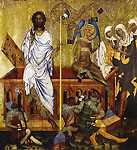
“The Resurrection of Christ”
Vyssi Brod Hohenfurth, c. 1350

Christ, the Lord, is risen today, Alleluia!
Sons of men and angels say, Alleluia!
Raise your joys and triumphs high, Alleluia!
Sing, ye heavens, and earth, reply, Alleluia!

Love’s redeeming work is done, Alleluia!
Fought the fight, the battle won, Alleluia!
Lo! the Sun’s eclipse is over, Alleluia!
Lo! He sets in blood no more, Alleluia!

Vain the stone, the watch, the seal, Alleluia!
Christ hath burst the gates of hell, Alleluia!
Death in vain forbids His rise, Alleluia!
Christ hath opened paradise, Alleluia!

Lives again our glorious King, Alleluia!
Where, O death, is now thy sting? Alleluia!
Once He died our souls to save, Alleluia!
Where thy victory, O grave? Alleluia!

Soar we now where Christ hath led, Alleluia!  Following our exalted Head, Alleluia!
Made like Him, like Him we rise, Alleluia!  Ours the cross, the grave, the skies, Alleluia!

Hail, the Lord of earth and Heaven, Alleluia!  Praise to Thee by both be given, Alleluia!
Thee we greet triumphant now, Alleluia!  Hail, the resurrection, thou, Alleluia!

King of glory, Soul of bliss, Alleluia!  Everlasting life is this, Alleluia!
Thee to know, Thy power to prove, Alleluia!  Thus to sing and thus to love, Alleluia!

(Charles Wesley, 1739)

The day has arrived!  After all this time of anunciation and birth, of baptism and ministry, of teaching and healing, of calling and response, of temptation and darkness, of dying and crucifixion, this Day of Resurrection has dawned.  Christ has risen!  Christ has risen indeed!

But lest we lapse into thinking of this day as a commemoration of The Resurrection of Christ, as a mere remembrance of what happened on that third day so long ago, we need to realize that this day is not just about Jesus’ Resurrection; it is also about our own.  We who carried our cross, we who died to self, are this day given new life.  God has recreated us into who God calls us to be.  And, in a way, that is almost more scary than the dying.  There is no going back.  The self that we knew before is no more.  We are a new creation.  We have risen!  We have risen indeed!

You see, Jesus did not die and magically come back to life.  God did not undo what had been done.  There was still a bloody cross standing on an unknown hill called Golgotha.  Rather, God created something new–a new way of seeing and a new way of being.  Do you remember the first time God did that?

In the beginning when God created the heavens and the earth,the earth was a formless void and darkness covered the face of the deep, while a wind from God swept over the face of the waters. Then God said, ‘Let there be light’; and there was light. And God saw that the light was good; and God separated the light from the darkness. God called the light Day, and the darkness he called Night. And there was evening and there was morning, the first day. (Genesis 1: 1-5)

From the void, from the darkness, God created Light and Life.  Truthfully, if you look at it from a literal view, nothing has really changed.  Jesus, sadly, is still dead.  But through eyes that have been resurrected, nothing will ever be the same again.  Maybe resurrection comes not in raising one above life, but in raising life to where it is supposed to be.  Jesus was the first to cross that threshold between–between death and life, between the world and the sacred, between seeing with the eyes of the world and seeing with the eyes of the Divine.  Resurrection is not about being transplanted to a new world but rather being called to live in this one with a new way of seeing.  It means being recreated into the one that God envisions you to be.  It means being given a new way of seeing where love is stronger than death, where hope abides, and where life has no end.  It means being capable of glimpsing the Holy and the Sacred, the promise of Life, even in this life, even now.  This day of Easter is now only about Jesus’ Resurrection; it is about ours!  So, what do you plan to do with your new life?

The end of all our exploring…will be to arrive where we started…and know the place for the first time. (T.S. Eliot)

King of glory, Soul of bliss, Alleluia! Everlasting life is this, Alleluia!
Thee to know, Thy power to prove, Alleluia! Thus to sing and thus to love, Alleluia!

Everlasting life is truly this!

Grace and Peace,

Shelli

Thank you for joining with me on this Lenten journey!  I have been so blessed by all the comments and the reflections that you have shared.  We will do this again.  In the meantime, I’m going to take a little “blogging sabbatical” and return on April 25th with posts two or three times a week.  I will do the “every day” thing again later!  Let me know if you or others that you know want to join the Google group and get emails each time I post.  And comment!  Let’s start a discussion!   You can email me at swilliams@stpaulshouston.org.  Let me hear from you! 

The Day Between

What do we do with this day, this Holy Saturday?  We are still grieving.  The reality of it all is beginning to sink in, beginning to be real.  Jesus is gone, dying alone on some hill that we don’t even know.  So, what do we do today?  How do we pick up the pieces in the midst of our pain and despair and just go on with our lives?  Oh, we 21st century believers know how the story ends.  We’ve already jumped ahead and read the next chapter many, many times.  (Don’t tell those that don’t read ahead, but it all works out in the end.)

And yet, we do ourselves no favors if we jump ahead to tomorrow.  After all, the Scriptures tell us that Jesus rose on the third day, the THIRD day, as in one-two-three.  The third day doesn’t happen without today.  It must be important, right?  But, oh, it’s just so painfully quiet.  The sanctuary is dark, awaiting to be redressed for its coronation.  The bells are quiet, hanging expectantly for tomorrow.  And we still sit here draped in black with our Easter brights hanging there ready for us to don.  What are we supposed to do today?

Tradition (and the older version of the Apostles’ Creed) holds that Jesus died, was buried, and descended into hell.  So is that what this day is?  Descent?  Good grief, wasn’t the Cross low enough?  The well-disputed claim is that Jesus descended into death, descended into hell, perhaps descended into Gehenna (Greek, Hebrew–Gehinnom, Rabbinical Hebrew–גהנום/גהנם), the State of ungodly souls.  Why?  Why after suffering the worst imaginable earthly death would Jesus descend into hell?  Well, the disputed part is that Jesus, before being raised himself, descended to the depths of suffering and despair and redeemed it, recreated it.  The sixth century hymnwriter, Venantius Fortunatus claimed that “hell today is vanquished, Heaven is won today.” Why is that so out of bounds of what God can do?  Don’t we believe that God is God of all?  Or does it give us some sense of comfort to know that we are not the worst of the bunch, that there are always Judas’ and Brutus’ that have messed up a whole lot worse than any of us and so are destined to spend eternity on the lowest rungs of hell?  But, oh, think about the power and grace and amazing love of a God who before the Divine Ascent into glory, descended into the depths of humanity and redeemed us all, perhaps wiped out the hell of each of our lives rung, by rung? 

And, yet, again, we cannot leave it all to Christ to do.  Just as we were called to pick up our cross yesterday, we are called to descend down into the depths, plunging into the unknown darkness, so that God can pick us up again, set us right, and show us a new journey.  And so this day, we stand between, between death and life, between hell and heaven, between a world that does not understand and a God who even in the silence of this day has begun the redeeming work.  In some ways, this is the holiest day of the week.  How often do we stand with a full and honest view of the world and a glimpse of the holy and the sacred that is always and forever part of our lives?  How often do we stand together and see ourselves as both betrayers and beloved children of God?  How often do we stand in the depths of our human state and yet know that God will raise us up.  This is a pure state of liminality, a state, as the Old English would say, “betwixt and between.”  It is where we are called to be.  It is the place of the fullness of humanity as it claims both human and divine.  In the silence of this day, we stand with God.  And we wait, we wait expectantly for resurrection, we wait for God to say us once again.  It is where we should always be.  We won’t though.  We won’t be there. (Remember, we’ve had this problem before.)  And maybe on some level, it’s too much for us to always be there, always be waiting expectantly for God.  But at least we can remember what this day feels like as we stand between who we were and what we will be. 

So, for today, keep expectant vigil.  Do not jump ahead.  We can only understand the glory of God when we see it behind the shadow of death.  But, remember, shadows only exist because of Light. 

“Welcome, happy morning!” age to age shall say:
“Hell today is vanquished, Heav’n is won today!”
Lo! the dead is living, God forevermore!
Him, their true Creator, all His works adore!

Refrain
“Welcome, happy morning!”
Age to age shall say.

Earth her joy confesses, clothing her for spring,
All fresh gifts returned with her returning King:
Bloom in every meadow, leaves on every bough,
Speak His sorrow ended, hail His triumph now.

Refrain

Months in due succession, days of lengthening light,
Hours and passing moments praise Thee in their flight.
Brightness of the morning, sky and fields and sea,
Vanquisher of darkness, bring their praise to Thee.

Refrain

Maker and Redeemer, life and health of all,
Thou from heaven beholding human nature’s fall,
Of the Father’s Godhead true and only Son,
Mankind to deliver, manhood didst put on.

Refrain

Thou, of life the Author, death didst undergo,
Tread the path of darkness, saving strength to show;
Come, then True and Faithful, now fulfill Thy Word;
’Tis Thine own third morning; rise, O buried Lord!

Refrain

Loose the souls long prisoned, bound with Satan’s chain;
All that now is fallen raise to life again;
Show Thy face in brightness, bid the nations see;
Bring again our daylight: day returns with Thee!

Refrain
Just wait…
Grace and Peace,
Shelli

Maybe It IS About Us

Scripture Text:  Matthew 28: 1-10
After the sabbath, as the first day of the week was dawning, Mary Magdalene and the other Mary went to see the tomb. And suddenly there was a great earthquake; for an angel of the Lord, descending from heaven, came and rolled back the stone and sat on it. His appearance was like lightning, and his clothing white as snow. For fear of him the guards shook and became like dead men. But the angel said to the women, “Do not be afraid; I know that you are looking for Jesus who was crucified. He is not here; for he has been raised, as he said. Come, see the place where he lay. Then go quickly and tell his disciples, ‘He has been raised from the dead, and indeed he is going ahead of you to Galilee; there you will see him.’ This is my message for you.” So they left the tomb quickly with fear and great joy, and ran to tell his disciples. Suddenly Jesus met them and said, “Greetings!” And they came to him, took hold of his feet, and worshiped him. Then Jesus said to them, “Do not be afraid; go and tell my brothers to go to Galilee; there they will see me.”

At last!  The day for which we’ve waited, for which we’ve prepared, for which we’ve hoped is here!  Alleluia!  Christ is Risen!…Christ is Risen indeed!

Last evening, we had an Easter Vigil at St. Paul’s.  I have grown to love that service.  I love entering the darkened, bare sanctuary and then being part of lighting it and filling it.  It is joyful to see it come alive!  As we were setting up, I got to do something that I had never done before.  Michael and I unwrapped the brand new Christ candle.  We opened the box and then worked together to unwrap it.  It was wonderful.  Both of us were grinning.  It was like bringing new life into the world.  You see, the Christ candle is the center of every worship service in that big Gothic sanctuary.  We light this brand new, tall Christ candle for the first time on Easter and then it burns down through the year until it is sadly snuffed out for the last time on Maundy Thursday.  This one had never been lit, never been a part of the service, never been viewed by any of us.  And there is lay on the sacristy table with both of us staring at it.  It was as if that acid-free tissue paper that we had peeled away was the rock itself that we rolled away.  Christ is risen!  Let the light of Christ illumine all!

And so this day, we light the brand new Christ candle and we joyously celebrate Christ’s Resurrection.  We finally get to sing “Alleluia” again after so many weeks of quiet and darkness. But what is it we’re celebrating?  Are we glad that Christ’s death was not permanent?  Well, of course we are.  But if Easter is only about Christ’s Resurrection, then the whole thing would have been for naught.  You know, it’s weird.  We struggle all through Lent to let go of ourselves, to surrender.  The reason we do that is because God has something else in store for us.  It’s called resurrection–no just Christ’s, but our own!  The whole purpose of Christ’s Resurrection was to unveil our eternity, to show us what was coming for us, to lay the groundwork for not Christ’s raising, but our own.  So, do you believe that?  You say you believe that Christ was raised.  Why would the Resurrection even happen if God was not trying to show us our own.  This is the Easter lesson.  Jesus came and walked this earth as God-With-Us, Emmanuel, to lead us into communion with God, to show us eternity.  Hmmm!  Maybe it IS about us!  But if it is, what do you plan to do with it?  What does it mean to celebrate not only Jesus’ Resurrection but our own?  What does it mean for God to love you so much that God would recreate your life?  So if your life is worth that much to God, what are you planning to do with it?  Go now, roll the stone away…and reveal what God has planned for you!  Alleluia!

And on the third day of this time
The tomb opened to the light
And there my Lord, who died before
Is risen in my sight.
Christ my Lord is Risen Today!
And gone is need to mourn,
For Creation lost has lived again
And life itself reborn.
I tell this story so that you’ll know
That death is not the end.
The journey turns and light returns
As each of us to life transcend.


So, on this day when we celebrate the Risen Christ, celebrate also the story of your own resurrection!

Christ is Risen!  Alleluia!  You are risen!  Alleluia!

Grace and Peace,

Shelli

NOTE:  The “whole” Holy Week poem is on a page on my blog under “Other Stuff”.