You Start at the Very Beginning…

Dawn in the wildernessScripture Text:  Mark 1: 1-8

The beginning of the good news of Jesus Christ, the Son of God.  As it is written in the prophet Isaiah, “See, I am sending my messenger ahead of you, who will prepare your way;
the voice of one crying out in the wilderness: ‘Prepare the way of the Lord, make his paths straight,’”

John the baptizer appeared in the wilderness, proclaiming a baptism of repentance for the forgiveness of sins. And people from the whole Judean countryside and all the people of Jerusalem were going out to him, and were baptized by him in the river Jordan, confessing their sins. Now John was clothed with camel’s hair, with a leather belt around his waist, and he ate locusts and wild honey. He proclaimed, “The one who is more powerful than I is coming after me; I am not worthy to stoop down and untie the thong of his sandals. I have baptized you with water; but he will baptize you with the Holy Spirit.”

Do you remember the song from “The Sound of Music”?  “You start at the very beginning.  A very good place to start.  When you read, you begin with A-B-C; when you sing you begin with Do-Re-Mi.  The first three notes just happen to be Do-Re-Mi. Do-Re-Mi-Fa-So-La-Ti…..oh let’s see if we can’t make it a little bit easier…”  (Yeah, I’m a Sound of Music dork.)  We’re used to that…starting at the beginning, learning our A-B-C’s before we jump headlong into reading Tolstoy or something.  But, the writer of the Gospel According to Mark seemed to just sort of want to get this show on the road.  We’ve become so accustomed to the beauty and poetry of the nativity that somehow that becomes the season for us.  But here…”The beginning of the good news of Jesus Christ, the Son of God.”  That’s it.  That’s all you get.  No announcement of Jesus’ birth, no birth story, no stable, no inn, no manger, no Mary and Joseph and the babe, no shepherds, no magi.  Just that.  It’s sort of like the Gospel writer is saying “refer to the previous volumes”.  But, of course, most Biblical scholars will tell you that there WERE no previous volumes of the Gospel but that this one was the first.  So, what is that beginning?


Then it goes on:  As it is written….Essentially, the beginning of the good news of Jesus Christ, the Son of God, is everything that came before–all the prophets, all the judges, all the Wisdom, all the kings, Elijah, Moses, Ruth, Jacob, Abraham, Sarai, all the exiles returning home, all the burning bushes and parting waters, all the covenants, all those generations upon generations of people who wandered in the wilderness.  And now…now appearing in the wilderness is this wild, somewhat unkempt, bear of a man who clothes himself in camel’s hair and eats what appears to be whatever crosses his path in the brush.  There were certainly those with “proper” upbringing and “acceptable” expression of their religious beliefs that probably would have been a bit embarrassed by the display.  I mean, maybe it would have gone down easier if it had been someone a tad bit more “traditional”.  (But then, really, was Jesus all that status quo?)  And yet, I’m fascinated with this character of John the Baptist.  He knew who he was.  He knew his place.  He was called to prepare the way.  He was called to BE the voice crying out in the wilderness.  He was called to prepare the way of the Lord.


The beginning of the good news of Jesus Christ, the Son of God.  Here we are, in the wilderness of our lives, wandering a little aimlessly at times, trying our best to connect to God, to feel God’s Presence in our lives.  And yet, we know that God did not plunk down in the middle of the bustling city of Jerusalem.  God did not come in the way that was planned or imagined.  The Son of God emerged into the wilderness that was already there, already so full of God that the very earth shook.  The truth is, God had been there all along.  The good news of Jesus Christ was always beginning.  The same is true for us today.  What we are living is not some sort of prelude of a life to come; it is the very beginning of the story.  Maybe that’s our shortcoming.  Maybe we live lives limited by the chapters surrounding us.  But God…God came and comes over and over and over again, beginning, recreating, starting us over.  Advent is the season of beginnings–the beginning of the church year, the beginning of us, the beginning of what comes next.  Advent is not a preface to the high holy day on which we celebrate the Savior’s birth.  Advent reminds us that we, even now, are the beginning of the good news of Jesus Christ, the Son of God.  “See, I am sending my messenger ahead of you, who will prepare your way; the voice of one crying out in the wilderness: ‘Prepare the way of the Lord, make his paths straight.”  The truth is, the story ALWAYS is at the beginning!


When you come to the end of all the light you know, and it’s time to step into the darkness of the unknown, faith is knowing that one of two things shall happen: Either you will be given something solid to stand on or you will be taught to fly. (Edward Teller)


FOR TODAY:  How are you called to prepare the way for Christ?  How are you called to begin again?


Grace and Peace,

Shelli


Holy Patience

PatienceScripture Text (Advent 2B): 2 Peter 3:8-9

But do not ignore this one fact, beloved, that with the Lord one day is like a thousand years, and a thousand years are like one day.  The Lord is not slow about his promise, as some think of slowness, but is patient with you, not wanting any to perish, but all to come to repentance.


I must admit that I am not the most patient person I know.  I think it’s safe to assume that, really, few of us are.  The world just moves too fast.  The patient ones, the ones who wait, tend to get left behind.  And yet, those of us of us who are always on the move don’t really get there any sooner.  What is that about?  And then we read this passage that describes God as patient.  Have you ever thought of the Divine, the Holy, the Creator, the One who is always and forever on the move, compelling us to go forward, to live into this glorious Vision that God has, as “patient.”  I suppose the impatient ones of us want God to get this show on the road, already.  After all, where IS peace?  Where IS righteousness?  Where IS this promise of no poverty, no hunger, no suffering?  But wait, it doesn’t say that God is sitting back on the holy laurels and being slow about things happening.  God is not slow to fill the world with glory; God is waiting for us, patiently waiting for us, to catch up.


So perhaps our impatience, our living life full-throttle, without stopping, just stopping to see what God is doing, to hear where God is calling, is what is slowing this whole thing down.  After all, God knows where God is going.  God is waiting for us, waiting for our response, waiting for us to perhaps wait to see, wait to hear.  Oh, shoot!  It’s back to that waiting thing.  We CAN’T hurry this along.  We CAN’T live for the next thing.  We CAN’T live as if we are in a season that is not quite yet.  God is waiting for us to stop, to wait on God, so that we can catch up to what God envisions us to be.  It’s back to the Sabbath ideal.  God created times for us to stop, to wait, to let ourselves sort of regroup so that we could move forward down the way we are called to go.


You’ve heard the story of the American traveler on safari in Kenya.  He was loaded down with maps, and timetables, and travel agendas.  Porters from a local tribe were carrying his cumbersome supplies, luggage, and “essential stuff.”  On the first morning, everyone awoke early and traveled fast and went far into the bush.  On the second morning, they all woke very early and traveled very fast and went very far into the bush.  On the third morning, they all woke very early and traveled very fast and went even farther into the bush.  The American seemed pleased.  But on the fourth morning, the porters refused to move.  They simply sat by a tree.  Their behavior incensed the impatient American.  “This is a waste of valuable time.  Can someone tell me what is going on here?”  The translator answered, “They are waiting for their souls to catch up with their bodies.”


This Advent time is a time of waiting for God.  But it is also a time when God waits on us–patiently and lovingly waits for us to awake to God’s Presence, awake to God’s beckoning, awake to finally see where we were meant to be all along.  We cannot do that if we are too busy impatiently moving through life, always reaching and grasping for the next thing and missing that God is waiting for us now.  If we would be a little more patient, if we could just for a moment stop and breathe in that Holy Patience of God, perhaps God would no longer have to wait another day or another thousand years for the promises to come to be.


Earth’s crammed with heaven, And every common bush afire with God; But only [they] who see, take off [their] shoes—The rest sit round it and pluck blueberries. (Elizabeth Barrett Browning, from “Aurora Leigh”)


FOR TODAY:  Stop moving so fast.  Be patient.  Look.  Listen.  Take off your shoes and be.  God is waiting.


Grace and Peace,

Shelli


Anticipation


The Top of the MountainScripture Text:  Mark 13: 32-37

But about that day or hour no one knows, neither the angels in heaven, nor the Son, but only the Father. 33Beware, keep alert; for you do not know when the time will come. 34It is like a man going on a journey, when he leaves home and puts his slaves in charge, each with his work, and commands the doorkeeper to be on the watch. 35Therefore, keep awake—for you do not know when the master of the house will come, in the evening, or at midnight, or at cockcrow, or at dawn, 36or else he may find you asleep when he comes suddenly. 37And what I say to you I say to all: Keep awake.”


You know that feeling when you’re driving up a really big mountain (or maybe climbing the tallest loop of the roller coaster)?  You can see behind you (although that’s probably not a good idea if you’re actually driving!) and you can see ahead–but only to the top.  You can see where the top begins to round out its shape and give way to the other side but in your view, there is no other side.  It almost looks like you’re just going to keep climbing and be propelled into the open sky, to lose control, to lose footing altogether.  At this point, there is no way to plan at all.  You just trust–trust that the mountain will gently curve its way to the other side and give way to another view, trust that the road on which you’re traveling actually DOES continue and that you will not fall into nothingness, and trust that, in just a moment, in just a moment…this climbing will end.


Advent reminds us that we’re sort of on that road.  We feel it under us.  We see it up ahead.  But it continues beyond what we can see, beyond where we can comprehend at this point.  And so we trust and we anticipate that what is up ahead and where we are called to go.  The Scripture text (which we Lectionary readers read this past Sunday) exhorts us to keep alert, to stay awake.  Maybe it could just as easily tell us to anticipate what is up ahead.  I mean, weren’t you told that by your driving instructor all those years ago?  Anticipate the road. I don’t think that means become a psychic or a mind-reader.  After all, the Scripture reminds us that we do not know, that, in fact, we CANNOT know, that we are not at this point in our being, capable of knowing what is up ahead.  Anticipating is not about knowing; it is about readying oneself, preparing oneself, maybe even feeling the road a little more deeply.  Perhaps living with anticipation is about being so awake and so aware that you can actually taste the Presence of the Divine and know that Presence so deeply that life changes.  If one begins to anticipate what is up ahead, one begins to live life as if the road is beginning to curve.  As if…what would it mean to live “as if”?  What would it mean to live as if peace were the norm?  What would it mean to live as if poverty ceased to exist?  What would it mean to live as if God’s Presence was so real that it literally permeated every thread of your being?


Advent is our calling to wake up, to anticipate and begin to live as if God has already come into our midst, because that’s EXACTLY what has happened.  The call to keep alert is not a threat; it’s God’s gift to us.  Stay awake, my child, for you do not want to miss it.  Life is coming, a Life that you cannot even fathom how incredible it is.  The road is beginning to round and another view is just up ahead.  Be alert.  You don’ want to miss it.


A dreamer is one who can find [his or her] way in the moonlight, and [whose] punishment is that [he or she] sees the dawn before the rest of the world. (Oscar Wilde)


FOR TODAY:  What does it mean to be alert?  What does it mean to allow yourself to be awakened to the presence of God in our midst?  What does it mean to anticipate life, to live as if?


Grace and Peace,

Shelli


The Last Time


"The Last Supper", Jesus Mafa
“The Last Supper”, Jesus Mafa

Scripture Text:  John 13: 1-17, 31b-35
Now before the festival of the Passover, Jesus knew that his hour had come to depart from this world and go to the Father. Having loved his own who were in the world, he loved them to the end. The devil had already put it into the heart of Judas son of Simon Iscariot to betray him. And during supper Jesus, knowing that the Father had given all things into his hands, and that he had come from God and was going to God, got up from the table, took off his outer robe, and tied a towel around himself. Then he poured water into a basin and began to wash the disciples’ feet and to wipe them with the towel that was tied around him. He came to Simon Peter, who said to him, “Lord, are you going to wash my feet?” 7Jesus answered, “You do not know now what I am doing, but later you will understand.” Peter said to him, “You will never wash my feet.” Jesus answered, “Unless I wash you, you have no share with me.” Simon Peter said to him, “Lord, not my feet only but also my hands and my head!” Jesus said to him, “One who has bathed does not need to wash, except for the feet, but is entirely clean. And you are clean, though not all of you.” For he knew who was to betray him; for this reason he said, “Not all of you are clean.” After he had washed their feet, had put on his robe, and had returned to the table, he said to them, “Do you know what I have done to you? You call me Teacher and Lord—and you are right, for that is what I am. So if I, your Lord and Teacher, have washed your feet, you also ought to wash one another’s feet. For I have set you an example, that you also should do as I have done to you. Very truly, I tell you, servants are not greater than their master, nor are messengers greater than the one who sent them. If you know these things, you are blessed if you do them.

“Now the Son of Man has been glorified, and God has been glorified in him. If God has been glorified in him, God will also glorify him in himself and will glorify him at once. Little children, I am with you only a little longer. You will look for me; and as I said to the Jews so now I say to you, ‘Where I am going, you cannot come.’ I give you a new commandment, that you love one another. Just as I have loved you, you also should love one another. By this everyone will know that you are my disciples, if you have love for one another.”

Sometimes life spins a little out of control. Sometimes things don’t go exactly like the carefully scripted plan we have in our own minds. Sometimes we have to let go or leave behind those in our lives before we’re actually ready to do so. Our lives are full of “last times”, those special, much-too-fleeting moments that we spend with those we love. It is those times when all we can do is trust that the groundwork has been laid for what must continue. That had to be a little of what Jesus was going through on this night. Think about it…he had spent his ministry gathering those around him, teaching them, loving them, and indeed shaping them into who they were. And now…here he was completely out of time…the end was approaching. Night had begun to fall. All he could do was trust that the seeds he had planted in his followers would continue to grow and flourish even in a new environment and a new time. So on this night, he invited all those who love him—this somewhat motley crew of misfits and ordinary ones to sit around the table and enjoy their time together. He knew what was about to happen. He knew that this would be the last.

That is where we enter the story…in the midst of this evening meal…this Passover meal…the last meal. The feast is prepared. The loved ones are gathered together. We have visions of a perfect meal and a perfect time together. But, as all of us know, that is not always the way that family meals come together. This was no exception. Nestled beneath this wonderful feeling of closeness and fellowship were chords of betrayal and distrust, signs of denial and misunderstandings, and an all-too-constant stream of arguing among the disciples. Does that sound familiar?

But in this Passover meal that we have come to call the Last Supper, Jesus chooses to share himself—his very body and blood with all of those that were gathered—this denying, betraying, bickering, and beloved lot. It was a way of giving them something to remember him so that they would not feel so alone without him. He gave them something to hold onto—to touch and to taste—something to do to keep Christ close in their hearts, to feel the very real Presence of Christ forever. On this night, Jesus gives the gift of himself and a way for all of us to remember who we are.

Our culture probably doesn’t do well with “lasts”.  We seem to be always rushing to the next thing, not wanting to hurt or grieve or even hold on to what may be somewhat painful moments in our lives.  We rush to get “over it”, to move on.  As many of you know, I am dealing with my own set of “lasts” right now.  As I prepare to close my chapter at St. Paul’s and begin a new chapter at FUMC, Cleveland, Tx, the “lasts” seem to be coming in a flurry right now.  I am such that I tear up and sometimes even blatantly bawl at the emptiness and, yet, I really want to savor it, to feel every moment of it, to remember it, to make it a part of me, and to leave a part of myself.  That is what Jesus was trying to do.  I don’t think he was trying to “get them through it” and he was definitely not wanting to rush for it to be over.  He was wanting them to experience it, to savor it, indeed, to remember it.  Do this in remembrance of me.  The beauty of this last meal was the intimacy and the relationship.  These were friends dining together–friends who had loved and argued, celebrated and cried, friends who had been called together one by one.  They were all different, coming from different lifestyles with different gifts to offer.  They were us.  We are them.  And this was the moment that they would remember when everything had changed.

I have known that I have been moving for nearly six months, carrying it with me with just a few trusted friends.  The “lasts” that I experienced alone were absolute torture.  Christmas Eve was a “last” I would like to forget.  But this, these holy days…I want to embrace and understand them in a whole new way.  For on this night of nights, Jesus drew them in, not to take care of them, but to help them remember. They had to remember enough to hand the memory on.  The Greek word for it is anamnesis.  We would translate it as remembering.  But it is more.  It is not merely remembering those things that happened to us; it is remembering what came before and what was passed on, remembering what was part of our tradition and our heart.  It is finding a memory of what came before that leads you on your journey beyond.  We often tout “institutional memory” as if it is a way of remembering what happened to whom and where and when.  But it is more.  It is a way of imparting what is important, what matters, what gives life to those that come next.  That is why this night was so important.  Jesus did not choose to shut himself off and grieve what was coming but instead immersed himself in a circle of friends so that he could live through them.  Experiencing a “last time” alone is painful; experiencing a “last time” with a gift of friends and a meal will remain forever.

This is the night we remember, the night that Jesus broke the bread and shared the cup, the night that Jesus knelt and washed the feet of the disciples, the night that Jesus forgave betrayal and welcomed life.  A few hours later the soldiers would come and the end would begin.  But the memory of that last time will last forever.  Do this in remembrance of me.

The glad hosannas are no longer heard.  The shouting is over, the palms are gathered; the shadows lengthen; the plotting begins in earnest. Knowing the outcome, we come with heavy hearts.  And what do we hear?  An unchanged and unchanging message of love; God’s love, a poet’s love, a woman’s love.  God’s love, foretold by Isaiah, in the shape of a servant.  (Moira B. Laidlaw)

On this night of nights, we remember.  But we also experience our own “lasts”.  What memories have been imparted to you?  What do you remember that makes you?  What can you impart to those that come after you?  Embrace your lasts, hold them, love them, and then pass them along.

Grace and Peace,

Shelli


When Things Began to Change

clouds-floating-over-a-mountainScripture Text:  Matthew 17: 1-9

Six days later, Jesus took with him Peter and James and his brother John and led them up a high mountain, by themselves. And he was transfigured before them, and his face shone like the sun, and his clothes became dazzling white. Suddenly there appeared to them Moses and Elijah, talking with him. Then Peter said to Jesus, “Lord, it is good for us to be here; if you wish, I will make three dwellings here, one for you, one for Moses, and one for Elijah.” While he was still speaking, suddenly a bright cloud overshadowed them, and from the cloud a voice said, “This is my Son, the Beloved; with him I am well pleased; listen to him!” When the disciples heard this, they fell to the ground and were overcome by fear. But Jesus came and touched them, saying, “Get up and do not be afraid.” And when they looked up, they saw no one except Jesus himself alone. As they were coming down the mountain, Jesus ordered them, “Tell no one about the vision until after the Son of Man has been raised from the dead.”

And then our journey brought us to the mountain.  We should have known.  Mountains have always been places of change even as far back as Moses and the Commandments.  But we followed.  Maybe we knew that things would change and maybe we were just being naive.  So we followed Jesus up the mountain that day not knowing what was about to happen.  And there was Jesus, his clothes having taken on a dazzling hue, blinding, whiter than anything we had ever seen before.  And he was not alone.  There was Moses.  There was Elijah.  It was the most amazing thing, surely not of this world, surely something miraculous.  Peter was funny, wanting to build a dwelling for the three.  But at least he spoke.  The rest of us just sort of stood there dumbfounded.  What would we do next?  What was about to happen to us?  And the voice!  Who’s voice was that?  I think it was God.  I know that sounds far-fetched, but I think it was God.  It was God telling us to listen, to listen to Jesus, to listen to our hearts, to listen to the journey.  It was obvious that things had begun to change.  We fell down trying to shield ourselves. 

And then in a moment, it was quiet.  We looked up.  The light was gone.  Elijah and Moses were gone.  And there was Jesus.  He looked the same and yet he was different.  Maybe we were different.  Maybe our eyes had been scarred by the bright lights.   Or maybe we had finally learned to look at things differently, to see the change we were being called to see, to traverse the journey ahead with new eyes.  We gathered our things together without speaking.  There were no words that belonged in the holy silence that embraced us.  We wanted to stay, stay there on that mountain with memories of the bright lights and that Presence.  But Jesus took our hands and beckoned us to follow.  We began to walk down the mountain.  There, there was Jerusalem in the distance.  Things were about to change.  We knew it.  But we descended from the mountain that day.  Jesus told us not to say anything.  We would understand it later.  But, for now, we had to return to the world.  The mountain was not ours.

Change is hard.  We try desperately to hold on to what we know, to what is safe and secure, to what feels comfortable.  But every once in awhile, we have a mountain we have to climb.  We ascend into the fog and something happens there.  Our world changes.  And for a little while, God stops talking, perhaps waiting for our silence so that we, too, can listen for what comes next.  On this day, we ascended the mountain as learners following a master.  And, looking back, the ones who walked down the other side together were different.  There was work to do and we were the ones that were called to do it. 

Jerusalem-First SightLent teaches us that the world is not ours to plan or control. It is ours to embrace and journey through.  Sometimes we will have things that shake us to our core.  And so we descend the mountain in silence listening for God.  There is more to do.  There is more holy work.  And what God has in store for us is nothing short of a miracle.  And so for now, things are beginning to change.  Jerusalem awaits.

I said to the man who stood at the gate of the year, Give me a light that I might go safely out into the darkness. And he replied, Go out into the darkness and put your hand into the hand of God. That shall be more to you than a light, and safer than a known way. (M.L. Haskins)

On this day before Holy Week begins, we know that things will change.  Embrace them.  Live them.  Change with them.  And walk.  The journey is yours alone.

Grace and Peace,

Shelli


At the Edge of the Rainbow

The Clifs of Moher, County Clare, Ireland

Scripture Passage:  Luke 3:21-22a

Now when all the people were baptized, and when Jesus also had been baptized and was praying, the heaven was opened, and the Holy Spirit descended upon him in bodily form like a dove.

What does it mean for the heavens to open, to somehow, whether literally or figuratively, come pouring into the earth?  When you read that, it’s a little hard to go back to the notion of the separation of the secular and the sacred.  No longer is God or whatever you think of heaven “out there”.  In some incredible, wonderful way, the Holy and the Sacred has poured into where we are.  All is sacred.

On this day when all who are Irish and all who become Irish for this day celebrate the feast day of St. Patrick, I thought we’d go back and visit his roots a little bit.  As his story goes, he was born Maewyn Succat in Roman Britain in the late 4th century.  Captured by Irish raiders when he was sixteen, he lived as a slave in Ireland for six years before escaping.  He would later return to Ireland as a missionary until his death in 460 or 461 and by the 8th century would become the land’s patron saint.  St. Patrick is, of course, associated with what we describe as Celtic Christianity.  This is a branch of Christianity that was unique to these Irish people during the Early Middle Ages.  The Celtic Christians unapologetically embraced their Celtic and Druid roots and articulated them through their new Christian lenses, even making some of their Druid gods and goddesses Christian saints.  We’re not completely sure how these Christians even got to Ireland but they were firmly established there by the 2nd century.  One view is that the Galatian Christians to whom Paul wrote (the Galts) were part of those who then migrated to what is now Wales, Ireland, and Scotland after the Roman invasion and occupation.

Celtic Christianity always has had a sense of pilgrimage, of journeying.  They were always, as Deborah Cronin describes it, “a bit on the edge”.  I think that would describe their physical location as well as their religious belief system.  But I also think it is where they are spiritually.  You see, the Celtic understanding is that all things are sacred.  Just as the Scripture implies, they had this strong sense that the spiritual world does indeed spill into the material world.  They embrace the image as a “thin place”, a place and time where time matters not and the spirit world is very close, a place where one can almost feel it, almost reach out and touch what is holy and sacred.  Rock bridgeThese thin places, thresholds between what is and what will be, are crossing places between the world and the Divine.  They are embraced as places of growth, as places through which we journey from one place to another, one way of seeing to another, one way of being to another.  So what we think of as ordinary places become sacred and holy as the sacred spills through them onto us.  Bridges, gateways, and causeways reconnect what is divided and make them accessible to each other.   Burial grounds mark the crossing place from life to death, from “this world” to an “other world”, from time and space to eternity and infinity.  And the rainbow?  If you remember, the ninth chapter of Genesis says that God set a bow in the clouds, a sign of the connection, the covenant, between God and the earth. 

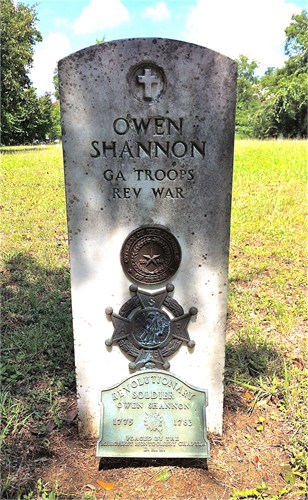
Burial site of Owen Shannon (1762-1839), Old Methodist Cemetery, Montgomery, TX (my great-great-great-great grandfather)

It is a symbol of the promise that the Sacred and the Holy is not inaccessible or removed from us but has spilled into the earth.  Never again can we become separated or isolated; never again can we close ourselves off and not move forward.

And for us?  We are always standing at the edge of the rainbow, the edge of the Sacred and the Holy.  God is in our midst and everything is Sacred.  The mundane and the ordinary is marked by God’s fingerprints and have become extraordinary.  This Lenten season is a journey of transformation.  We are moving from one way of being to another, from that mountaintop to Jerusalem, from life to death and life beyond.  And along the way are thresholds that we traverse.  We are always at the edge of the rainbow.  We just have to open ourselves to the sacredness that everything holds.  God is in our midst. Heaven has opened and has spilled into the earth.  Everywhere we walk is holy ground.

God rejoiced to see [God’s] Dream reborn.  [God] desired to mark this moment eternally, as a sign to all creation that hope is more real and permanent than despair.  [God] shone [this] perfect , invisible light–the light of joy–through all the tears that would ever flow out of human grief and suffering.  That invisible light was broken down, through our tears, into all the colours of the rainbow.  And God stretched the rainbow across the heavens, so that we might never forget the promise that holds all creation in being.  This is the promise that life and joy are the permanent reality, like the blue of the sky, and that all the roadblocks we encounter are like the clouds–black and threatening perhaps, but never the final word.  Because the final word is always “Yes”!  (Margaret Silf, in Sacred Spaces:  Stations on a Celtic Way)

On this Lenten journey, look around. What holiness do you see?  Where do you see God in your midst?

Rath De ‘ort (Gaelic, pronounced Rah Day urt, “The Grace of God on you.”)

Shelli


Psalm 121: A Season for Blessing

BlessingPsalter for Today:  Psalm 121

I lift up my eyes to the hills— from where will my help come?  My help comes from the Lord, who made heaven and earth.  He will not let your foot be moved; he who keeps you will not slumber.  He who keeps Israel will neither slumber nor sleep.  The Lord is your keeper; the Lord is your shade at your right hand.  The sun shall not strike you by day, nor the moon by night.  The Lord will keep you from all evil; he will keep your life.  The Lord will keep your going out and your coming in from this time on and forevermore.

Several months ago, I was about to leave a wedding rehearsal that I had just finished when the bride’s parents came up to me and asked if I could give them a blessing.  I have to admit that I was surprised.  We give blessings at baptisms and blessings at weddings.  We bless meals and houses and ships and new buildings.  We even bless our animal companions once a year or so.  But for some reason, blessings just for the sake of blessing, just for the sake of being, has become almost non-existent. Perhaps we’ve become almost distrustful of it, as if it’s some sort of implied expectation that God will shower good things upon us.  Our language has taken that concept of being “blessed” as some sort of reward, as if God has somehow built a bubble of good things and protection around us.  Well, truthfully, that’s just bad theology.  No where are we promised that God will shield us from bad things or continually shower us with good.  Faithful living does not guarantee that one will become healthy, wealthy, and wise.  The promise is that God will journey WITH us through all that life holds, even through the valley of the shadow of death.

This Psalm is known by some as one of the psalms of ascent, a traveler’s psalm.  It was often used as one began a journey and was a reminder to look to that place where God was, to know that God was there, a traveler with the traveler.  It is also a Psalm of blessing, a blessing for one who is about to begin a journey.  In our translation, the scripture begins with a question.  But since there’s no real punctuation in the original Hebrew in which it was written, this may or may not be intended this way.  Maybe, rather than a sojourner looking for help, it is one who acknowledges that he or she is not alone.  “I lift up mine eyes to the hills from where my help will come.”  This is the Lord who, no matter what happens, will keep your life–through all that life holds, darkness and life.  The Lord is always and forever present, never drifting away or slumbering. The chorus from Elijah (Mendelssohn) uses this theme.  “He, watching over Israel, slumbers not nor sleeps.”  God is always there.  This is the promise of faith.

The Hebrew call to be a blessing (Parshas Lech Lecha) is used eighty-eight times in the Book of Genesis.  A blessing is a gift.  It involves every sphere of our existence.  It is not, as our language and our culture seems to depict, payment for a life well-lived; it is not taking the bad things of life as God’s way of strengthening us or something; it is not somehow straining to proclaim the bad as good; and it is certainly not living some unreal existence where darkness does not seep in at all.  Being blessed means to be recreated.  It takes time.  To be a blessing is to enter the story.  God calls, God promises, and, as the Psalmist depicts, God walks with us, ever-present and ever-faithful.  That is how God is revealed.  When we enter the story, we are truly blessed.  We begin again.  We are blessed to be a blessing, one who journeys with God.

A Blessing is a beginning, a new beginning, an acknowledgment that, even now, recreation is happening.  Life is a blessing.  Even darkness and wilderness and desert spaces in our lives are blessings as they look ahead for the Light to come.  On Ash Wednesday, we were blessed with ashes as this Lenten journey began, as we were reminded who and whose we are.  We began again.  God walks with us on this journey.  We know that.  Intellectually, we know that.  But knowing it deep within our being is what being blessed is all about.

Blessing is one of the ways that God makes the presence of God known here and now. (Joan Chittister, in Listen with the Heart:  Sacred Moments in Everyday Life, p. 8)

On this second Sunday of our Lenten journey, know yourself blessed, know yourself recreated, know yourself as you begin again.

Grace and Peace,

Shelli