ADVENT 2B: Something Incredible is About to Happen

ADVENT 2B: Lectionary: Isaiah 40: 1-5 (6-11)
Comfort, O comfort my people, says your God. Speak tenderly to Jerusalem, and cry to her that she has served her term, that her penalty is paid, that she has received from the Lord’s hand double for all her sins.  A voice cries out: “In the wilderness prepare the way of the Lord, make straight in the desert a highway for our God. Every valley shall be lifted up, and every mountain and hill be made low; the uneven ground shall become level, and the rough places a plain. Then the glory of the Lord shall be revealed, and all people shall see it together, for the mouth of the Lord has spoken.”

First of all, with all due respect to Mr. Handel’s presentation, this passage was probably not originally written with us or our tradition in mind!  This really is talking about the people of Israel.  It really is talking about bringing comfort to a people who have wandered in the Judean wilderness.  Probably written toward the end of the Babylonian exile, this writing offers a vision where a highway (a REAL highway) through the wilderness will be made level and straight.  If, as most assume, this part of the book that we know as Isaiah was written after the exile, it would have been soon after 539 BCE when Cyrus of Persia conquered the Babylonians and, not really caring whether or not the Israelites stayed, allowed them to return to Jerusalem.  So imagine a highway that, typical of the ancient world, would have originally been built to accommodate royal processions.  And so God is depicting a highway made for a grand procession led by the Almighty.

The just-released exiles are returning.  But to what?  Their city and their way of life lay in ruins.  They can’t just go back and pick up where they left off.  They have to feel that God has deserted them.  They are looking for comfort.  They are looking for solace.  They are looking for God to put things back the way they were before.  But God has something different in mind.  Rather than repair, God promises recreation; rather than vindication, God promises redemption; and rather than solace, God promises transformation.  God is making something new–lifting valleys, lowering mountains, and ultimately, when all is said and done, revealing a glory that we’ve never seen before.

In this Advent season, we are given the same vision.  We are not promised solace.  We are not promised that Emmanuel, God With Us, is coming to put our lives back together.  In fact, can you feel it?  The world has begun to shake.  The valleys are rising; the mountains are leveling.  Something incredible is about to happen.  The light is just beginning to dawn.  Life as we know it will never be the same again.   Soon the fog will lift and we will see that the road does not lead back.  It instead leads us home.  But we’re going to have to be willing to leave what we know.

In this season of Advent, give yourself the gift of not going back so that God can show you the Glory that is about to be revealed.

Grace and Peace,

Shelli

Taking Care of Busyness (but not all!)

I just returned back to work today after a couple of days off.  It was wonderful!  It was what I guess they’re calling a “stay-cation”.  I just stayed at home and sort of “piddled”.  I got some (but not all) of the planting done, some (but not all) of the organizing done, some (but not all) of that “to do” list done,  In my “but not all” times, I wandered through shops that I kept saying I wanted to visit, sat on the porch, and walked the dog.  I bought an old concrete yard ornament that is a weather-beaten rabbit who has two (but not all!) of his ears.  The antique dealer sold him to me for $18.00 and he’s in my front flower bed in front of the porch.  His name is now Chester and he has a home (which is the reason that the dealer agreed to sell him so cheaply!).  And I went and bought fresh (I mean REALLY fresh) fruits and vegetables from a neighborhood market and then made up things that I could do with them.  And, to top it off, I lost weight!  Maybe “but not all” is a good thing on several levels!

We are a busy people!  To tell the truth, even my “stay-cation” was wrought with emails and calls that were “work related”.  But they were important–so important, in fact, that I need to check emails and messages while I’m doing my self-prescribed “piddling”!  So I was able set up some meetings and agreed to do another mentoring gig.  Really?  Am I THAT important?  No, not at all.  I think on some level I just don’t want to lag behind the world.  I’m letting the world and it’s busyness lead my life.  So what do you do?

I think you change the way you do things.  You alter the route of your life.  I was watching something on TV during my time off.  (Truthfully, I don’t know what because I just had it on in the midst of the “piddling”.  Again, I watched some (but not all)!)  Anyway, their was a test question asked as to whether one can improve his or her memory more by memorizing something or by changing one’s route to work or some other place.  Interestingly enough, the answer was by changing one’s route.  I think it’s because it makes us look at things differently.  It doesn’t mean that we don’t arrive at the place that we would have anyway; it just means that we got there a different way and probably paid more attention to what was along our path. Now don’t get me wrong.  I am a BIG ritual person.  That is not what gets us in trouble.  It’s not the ritual of it.  It’s the rote of it.  Look up “rote”.  One of the definitions is “from memory, without thought or meaning.”  “Without thought or meaning”?  That’s pretty scary.

You know, we’ve seen this theme before.  Think about it.  The Scriptures are big on wildernesses.  There are lots of accounts of people just wandering around until they found where they were supposed to be.  Maybe the point is not that they were lost but that they had found a different route!  I think ritual connects and points us to God.  But being open to changing the way that we walk may allow us to see the God who walks with us along the way. 

So, here’s what I think.  I don’t think iPhones are bad.  I don’t think ritual is bad.  I don’t think work and staying busy is bad.  I don’t even think that one’s inability to say “no” once in awhile (but not all) is really all that bad.  It’s the WAY we do it.  Each of our lives is a work of art-in-process.  Each step is a brushstroke filling the canvas with color and texture.  And eventually, that bright white light that you see is the blending of all of those colors.  White is the most brilliant color of all.  Without color, without contrast, the world is dark.

So, how do we take care of busyness?  Maybe it’s only a matter of loosening it up enough to follow a different route.  Maybe some (but not all) busyness isn’t all that bad.

Two roads diverged in a yellow wood,
And sorry I could not travel both
And be one traveller, long I stood
And looked down one as far as I could
To where it bent in the undergrowth;

Then took the other, as just as fair,
And having perhaps the better claim,
Because it was grassy and wanted wear;
Though as for that the passing there
Had worn them really about the same,

And both that morning equally lay
In leaves no step had trodden black.
Oh, I kept the first for another day!
Yet knowing how way leads on to way,
I doubted if I should ever come back.

I shall be telling this with a sigh
Somewhere ages and ages hence:
Two roads diverged in a wood, and I–
I took the one less traveled by,
And that has made all the difference

…Robert Frost

Have a wonderfully busy week…just drive around a different block once in awhile!
Grace and Peace,
Shelli


WALK TO JERUSALEM: The Announcement

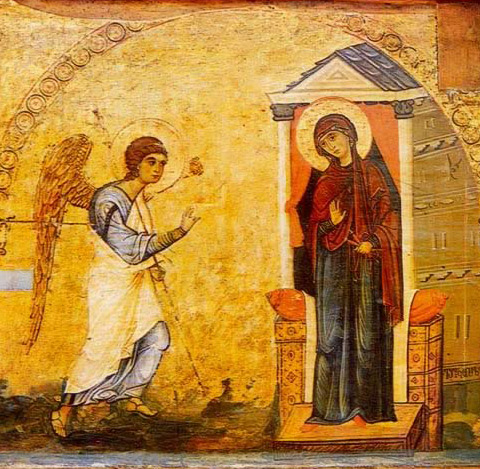
St. Catherine’s Monastery, Egypt, 12 century

Scripture Reading:  Luke 1: 26-38
In the sixth month the angel Gabriel was sent by God to a town in Galilee called Nazareth, to a virgin engaged to a man whose name was Joseph, of the house of David. The virgin’s name was Mary. And he came to her and said, “Greetings, favored one! The Lord is with you.” But she was much perplexed by his words and pondered what sort of greeting this might be. The angel said to her, “Do not be afraid, Mary, for you have found favor with God. And now, you will conceive in your womb and bear a son, and you will name him Jesus. He will be great, and will be called the Son of the Most High, and the Lord God will give to him the throne of his ancestor David. He will reign over the house of Jacob forever, and of his kingdom there will be no end.” Mary said to the angel, “How can this be, since I am a virgin?” The angel said to her, “The Holy Spirit will come upon you, and the power of the Most High will overshadow you; therefore the child to be born will be holy; he will be called Son of God. And now, your relative Elizabeth in her old age has also conceived a son; and this is the sixth month for her who was said to be barren. For nothing will be impossible with God.” Then Mary said, “Here am I, the servant of the Lord; let it be with me according to your word.” Then the angel departed from her.

Most of us good Protestants seldom talk about The Anunciation at all, let alone in the middle of the season of Lent.  The Anunciation literally means “announcement”.  The word itself probably holds no real mystery.  But it is the beginning of the central tenet of our entire Christian faith–Anunciation, Incarnation, Transfiguration, Resurrection, that cycle of holy mystery that with each turn draws us closer and closer to God as God reveals the very Godself more and more to us.  For us, it begins the mystery that is Jesus Christ, the mystery that will take us to Jerusalem.  For us, the fog lifts and there before us is the bridge between the human and the divine. 

In December, we usually speed past this reading, eager as we are to get to “In those days a decree went out from Emperor Augustus…”  We want to get to the beginning of it all.  But think back.  Jesus was human and just like all humans, something happened nine months before.  And whether or not you take the notion of a virgin birth literally, there was something remarkable that happened.  It is in this moment that God steps through the fog into humanity, that the great I AM reveals the Godself to all of Creation, and, just like every one of us must do, waits to be birthed into the world.  It is not just this young girl’s womb that is suddenly filled with child, swelling with expectant life; it is all of Creation that now waits for Light to be born.  The world is with child.

Can you imagine what Mary must have thought?  She was young, she had plans, she had her whole life ahead of her.  “How can this be?” we read.  In today’s vernacular, it would read, “Are you kidding me?”  And so as everything she knew and everything she planned toppled around her, she said “yes” and entered the mystery of God.  Now, I have to admit, I don’t get so wrapped up in needing Mary to be a literal virgin. (In fact, I don’t care enough about it to need to prove it or disprove it, so you can stay anywhere you are on the issue.) After all, would it really change what happened?  Would it really change who God was or what God has done?  Would it really change that this was the moment when the Light of God came into the world, when the Divine suddenly spilled into the womb of the world.  And that the one who held the birthing of God in her hands said yes.  Now, THAT, my friends, I think is important. 
 
Think about it.  What exactly does it mean to be “virgin”?  It means undefiled, pure, ready and open to receive.  Mary, the virgin, was open to receive God unto herself.  The most scandalous part of the whole story has nothing to do with whether or not the birth was “proper” in terms of our world; the scandal is that the great I AM, the holiest of holies, the One whose name could not be said, suddenly enters humanity with all of its violence and corruption and despair and the reordering of our existence begins.  All that we know and all that we plan is beginning to topple around us.  The Anunciation is the anouncement of hope for all of us.
 
If God’s incomprehensibility does not grip us in a word, if it does not draw us into [God’s] superluminous darkness, if it does not call us out of the little house of our homely, close-hugged truths…we have misunderstood the words of Christianity.  (Karl Rahner)
 
So, in this season of Lent, what does it mean for you to be open to receiving Jesus Christ into your life?  Because, you see, that is the way to Jerusalem…
 
Grace and Peace,
 
Shelli

Patiently Waiting

Today’s Lectionary Scriptures:
         Joshua 5: 9-12
         2 Corinthians 5: 15-21
         Luke 15: 1-3, 11b-32

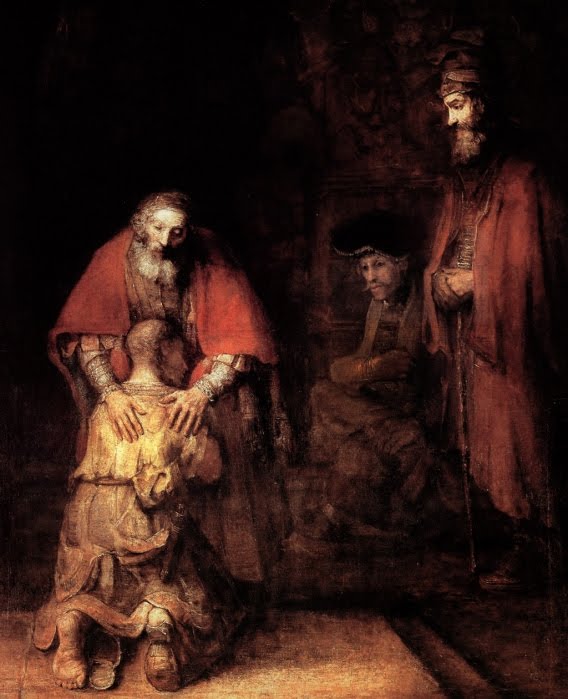
Today’s Gospel passage is a familiar one.  The story of the two sons and their father is one of our favorites.  It reminds us that no matter how prodigal we may be, God always welcomes us home.  We like this story.  It gives us an assurance to which we can cling even in the most distant countries of our lives.  We take comfort in its themes of forgiveness and reconciliation no matter what we do.

But I want to back up a minute.  Today’s prescribed lectionary starts at the beginning of the fifteenth chapter of Luke and then it skips several verses.  I think those verses are important for the context of our story.  First Jesus tells of a lost sheep and the rejoicing of the master at its finding.  Following that is the account of a woman who loses a coin.  And now this…a father loses his most precious thing–his son and then rejoices at his finding.  But notice that the father does not go in search of the son the way the other two did.  When a coin is lost, the owner searches for it to bring its home.  As important as it obviously is to the owner, it is still an inanimate object.  The coin cannot choose to come home.  And the sheep, while a living being, does not possess the gift of free will.  The sheep will follow when its master comes to find it.  But the son is different.  The father does not stop what he’s doing and leave the older son and his property and home behind to chase after him.  The son, as opposed to the coin and the sheep, must choose to come home.

 Perhaps the point of this familiar story is not simply that God forgives us; perhaps the point is that we must choose to come home.  After all, God’s forgiveness, grace, and unconditional love are always there for us whether or not we choose to claim them.  Our journey of faith is not about God finding us but, rather, about our return to God.  I don’t think these are three related stories of loss and finding.  I think that instead the first two point to the third.  God’s deepest desire is that we are indeed all found.  But God, filled with love and compassion, is patiently waiting for us to decide once and for our deepest desire is to return home.

Grace and Peace,

Shelli

Believing in Trust

“Trust” and “Belief” are interesting terms.  Are they the same?  If not, what is the difference?  We are told to “just believe”, as if that will make everything alright, as if that will somehow make us worthy or deserving of God’s attention.  What does that mean?  Believe in what???  Believing is an odd thing.  It moves us beyond where we are, beyond ourselves.  Believing in God means that we realize that God exists, that God is part of our lives, that we need God.  And yet, believing, in and of itself, means that on some level, we have systemitized our understanding of God (or, for that matter, whatever it is in which we claim that we believe).  Once we “believe”, we have in some way locked in our understanding of something.  So, for us God-believers, God has become our own doing, our own creation, our own imagining of how God works and who God is.  In some way, to say “I believe….” is to affirm, yes…to confess, yes…and to claim it as part of who we are, yes.  But saying those words also means that we have in that moment boxed God in to who we think God is.

Why can’t we just trust in God?  Why can’t I just trust in however and whoever God manifests Godself in my life?  God is God.  Why is that so hard to trust?  You see, when you get right down to it, God is not really something that can be defined, or systematized, or limited to my belief system.  Sure, God is comfortable and reliable and one on whom we can count to set our lives on track.  Thanks be to God!  But, God is also wild and unfathomable, unpredictable and imaginative and one on whom we can count on to throw our carefully-cultivated and perfectly-planned lives into a complete and unadulaterated tailspin.  Thanks be to God!

You see, there is a difference between believing in who you think God is and trusting in God who is.  God is beyond who we can imagine in our dreams.  God is beyond who we can claim as our belief.  And God is beyond what we have planned and cultivated and saved for the certainty in our lives.  God is God.  Nothing else.  Why is trusting in God so hard?  Because to trust in something, we have to surrender to the idea that it’s more than what we’re capable of conceiving.  Trust in God…and be surprised at what you find!  Trust in God…and find that in which you should have always believed.

Grace and Peace,

Shelli

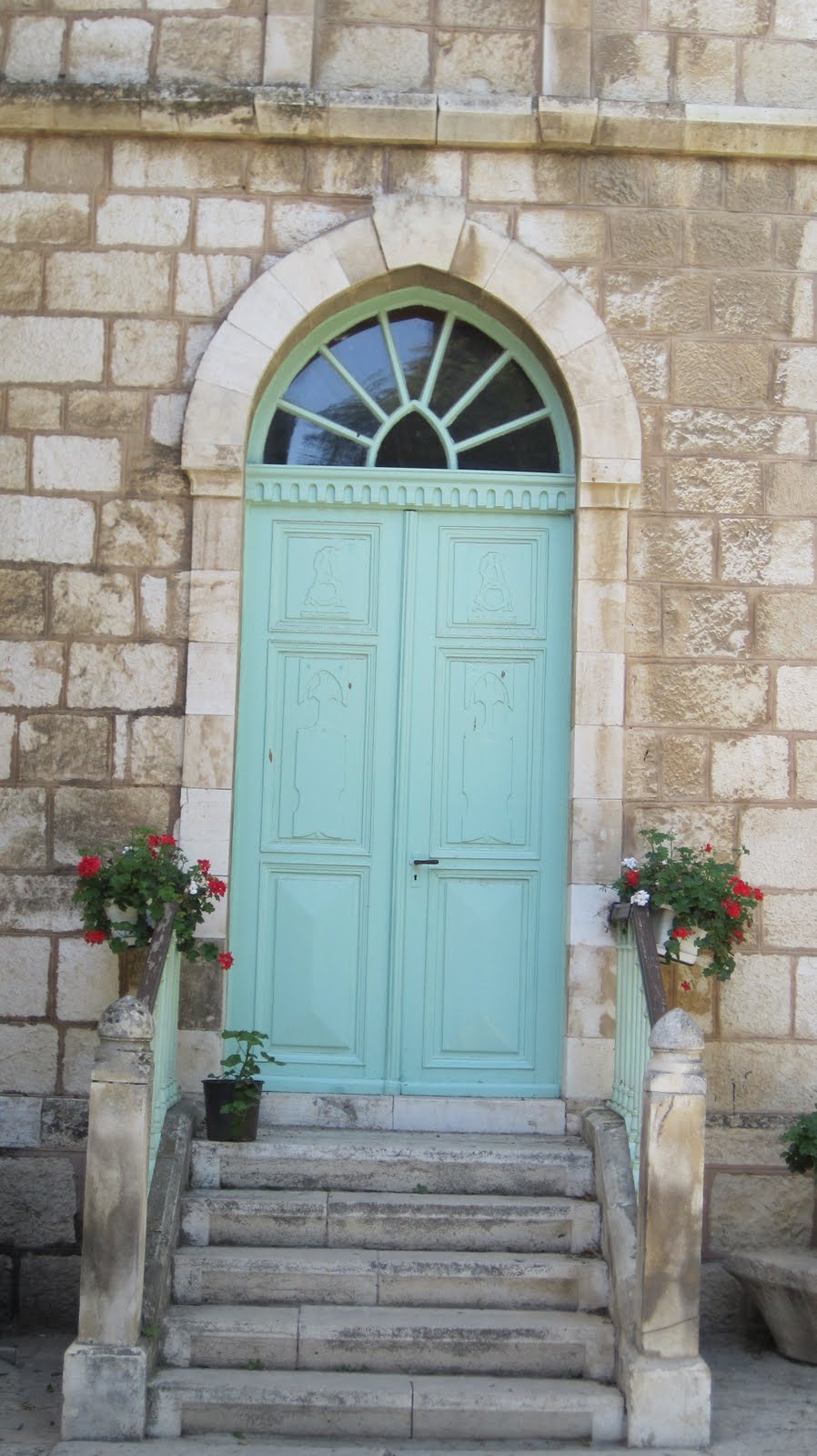
Picture:  Jerusalem, Israel, 2010

Expecting Surprise

This morning I was standing at the back of the sanctuary waiting to process for the last of the three services. The building was packed. Behind me in the Narthex amidst the sound of excited voices waiting for the service to start and some trying to set up chairs in the Narthex, was the rustling of the huge ribbon banners that are the first things in the Easter Festival Processional. There was a little girl standing on a chair in the very back. She turned around and saw the glorious white ribbons rustling in the breeze of the open doors and exclaimed, “Mommy, I think we’re having a party!”

Well, of course we’re having a party! Christ is Risen! The Lord is Risen indeed!

Expectations are good things. They make us pay attention; they keep us awake; they keep us excited about life. But when expectations get in the way of our noticing and welcoming the unexpected, we need to let go of what we expected. The women who first encountered the tomb were expecting a tomb. They were not expecting it to be open, not expecting it to be empty, not expecting Jesus to be gone. Mary broke down, weeping over her loss, until Jesus surprised her. Jesus was present after all. The unexpected had happened. Christ was indeed Risen! She had expected anything but a party, but here it was happening anyway!

Easter is about encountering the unexpected. Everything that was expected, that was planned, has gone by the wayside. The Season of Lent prepared us for this by emptying us, by making room for what was aobut to happen. Now is the Season to embrace the unexpected and let it fill your life.

Well, of course we’re having a party! Christ is Risen! The Lord is Risen indeed!

So go forth in this festival season and expect to be surprised!

Happy Easter!

Grace and Peace,

Shelli

Becoming Human

The time is almost here. In just a few hours, the door to the Divine will swing open and God and all of heaven will burst into the world. If you stop and listen, just for a moment, you can hear the eternal harps in the distance as they approach our lives. Oh, sure, it’s happened before. But can’t you feel it? Doors opening, light flooding in, the earth filled with a new vision of peace eternal. Maybe, just maybe, tonight will be different.

The child in the manger is, of course, no ordinary child, but God Incarnate, the Word made flesh. God took the form of a human–just an ordinary human–a human like you and me–and was born and dwelt with us–still Divine, but in every way human (because you see God in all of God’s wisdom and all of God’s mystery can do that!) This Holy Incarnation was not meant to show us how to be Divine but, rather, how to be human. We see ourselves as “only human”, as if that excuses us from being who God called us to be. But the point is that God calls us to be human, made in the image of God (not like God, but in the image–a reflection of God, Incarnate). Jesus the Christ was born human so that we would know what being human means. And when, like Jesus, we become fully human, our hearts are filled with compassion, connecting us to one another; our eyes are filled with a vision of what God made this world to be; and our lives become holy as they are shaped in the image of God Incarnate. And we, even as humans, can reach out and touch the Divine now that God has burst forth into this world.

On the eve of Christ’s birth, let us open our lives to receive this holy child and open our hearts and our eyes that we might finally know what we are called to become–human, made in the image of God, a reflection and an incarnation of God here on earth. This Christmas, let Christ be born in us. This Christmas, let us become fully human.

O holy Child of Bethlehem, descend to us, we pray;
Cast out our sin, and enter in, be born in us today.
We hear the Christmas angels the great glad tidings tell;
O come to us, abide with us, our Lord Emmanuel!
(Phillips Brooks)

The time is almost here. The door is opening and we see heaven beginning to pour in. Go forth and become human, become who God called you to be.

Grace and Peace on this Night of Nights,
Shelli