Open Season

“…who was conceived of the Holy Spirit, born of the Virgin Mary…”

We say those words every Sunday.  We stand and we look at the cross and we say with all our heart that we believe these words to be true.  Now, the “conceived” part we get–conceived, thought up, breathed into–Jesus was God’s way after eons of breathing Creation into being of finally breathing the very Godself into the world.  The Divine has come to walk with us.  But this Virgin Mary thing?  What is that?  Jesus, born, born as a human, born as a baby.  As unromantic and “un-Nativity-like” as it may be, Jesus was fussy and colicy.  The Son of God, in all likelihood, messed up his first-century diaper.  (I’ve never been accused of being overly-reverent!)  Mary and Joseph were probably sleep-deprived.  And as time went on, Jesus, like all of us, had to learn to walk and talk and be.   He had to grow into who he was. But when’s the last time you held a newborn baby?  When’s the last time you held a baby that was only hours old? It’s just like holding the entire hope of the world in your arms.  There are no preconceptions; there are no agendas; there is no one to impress or keep from disappointing.  There is only a pure and undefiled openness to what comes next, to what God holds.  There is only hope.  You can smell it.  Maybe it’s the smell of birth.  But maybe it’s the smell of the Divine.

So does it really matter?  We get so wrapped up in whether or not Mary’s virginity was literally intact when Jesus was born.  Again, does it really matter?  Does it really matter when you are holding the hope of the world?  Does it really matter when you are holding the world’s salvation in your arms?  Think about it.  Jesus was born, Son of God and Son of Humanity.  Jesus was born to Mary, the mother of the Salvation of the World.  Perhaps the translators of the writing by the writer known as Matthew had it right and Mary was a virgin in every sense of the word–pure, undefiled, and open to receive.  But, more importantly,  Mary was a virgin in the spiritual sense of the word–pure, undefiled, and open to receive what comes next, open to receive whatever God held for her life.  Mary opened her heart and her life that she might birth God into this world.

In this season of Advent, we are called to do the same.  14th century theologian, Meister Eckhart said that “we are all meant to be mothers of God, for God is always needing to be born.”  We are all called to be virgin–pure, undefiled, and open to receive.  We are all called to birth God into this world.  How open are you to what comes next?  How open are you to what God holds for your life?  This is the open season.  This is the season when we shed all the preconceptions of what we think God is.  This is the season when we let go of our need to explain God’s coming into the world and be open to what comes next.  So does it really matter?  You bet it does.  It is the Hope of the World that depends on it.
 
In this season of Advent, give yourself the gift of being open to whatever it is God holds for you and birthing God into your life.  Be virgin.  Be a womb for the hope of the world.

Grace and Peace,

Shelli
      

A Call to Revolution

Scripture Text:  Luke 1:45-55
And blessed is she who believed that there would be a fulfillment of what was spoken to her by the Lord.”And Mary said, “My soul magnifies the Lord,and my spirit rejoices in God my Savior,for he has looked with favor on the lowliness of his servant. Surely, from now on all generations will call me blessed; for the Mighty One has done great things for me, and holy is his name.His mercy is for those who fear him from generation to generation. He has shown strength with his arm; he has scattered the proud in the thoughts of their hearts. He has brought down the powerful from their thrones, and lifted up the lowly; he has filled the hungry with good things, and sent the rich away empty. He has helped his servant Israel, in remembrance of his mercy, according to the promise he made to our ancestors, to Abraham and to his descendants forever.”

It’s called The Magnificat or the Song of Mary.  It is a young girl’s realization that life will never be the same again, her affirmation that God has called her to be a part of something that will turn the world upside down.  Our Christian tradition has probably overly-domesticated the image of Mary a bit, giving her characteristics of one who is young and meek and downtrodden, a scared young girl that became the mother of Christ.  But these words are not meek; in fact, they are downright radical for the first century and for us today.  It is a call to take those who are on top–the rich, the haughty, the successful, the powerful and bring them down.  It is a call to elevate those who are poor, hungry, the very bottom of our society.  Who are we kidding?  In our burgeoning political climate, this is NOT the way to get elected.  This is NOT the way to gain support.  This is anything but politically correct.  In fact, this is a call to revolution.  I’m betting these words will not show up in any of the 584 presidential debates (doesn’t it seem like there are about that many?) between now and next November.

E. Stanley Jones calls The Magnificat, “the most revolutionary document in the world”.  It is said that this document terrorized the Russian Czars.  In fact, for a time during the 1980’s, the government of Guatemala banned its public recitation.  After all, if someone actually paid attention to this stuff, who knows what could happen?  Why, this might be downright dangerous to our acceptable of way life!You know, I think that’s the point.  We are called to DO something. We are called to pay attention. We are called to no longer accept society’s “acceptable” way of life.  The Christian movement did not begin as a comfortable and affirming religious tradition of the majority.  Just like we have domesticated and calmed our image of Mary, we have done the same with our tradition.  You see, Christianity began as a revolution, a revolution against the way the world rewards money and status and power, against the way the world leaves behind those that do not have the resources to care for themselves, and against the way the world sets up standards and rules for the way things should be.  It is a revolution against a world that has lost its sense of grace and compassion and justice.  It is a revolution that followed the Way of Christ.  After all, if someone actually paid attention to this stuff, who knows what could happen?

In this Season of Advent, we are becoming more and more aware of the mystery of God’s Presence and God’s Love that is even now breaking into our way of being.  God With Us, Emmanuel, was not born into our little world to tell us what a stupendous job we are doing!  God came, born as one of us, to show us the Way to something different, to call us into revolution.  Where are you now?  How full do you feel today?  How can you be ready to birth God into your life when you are so full of this world?
 
In this season of Advent, give yourself the gift of answering the call to revolution, of being hungry enough to be filled with God.

Grace and Peace,

Shelli


A Lingering Fragrance

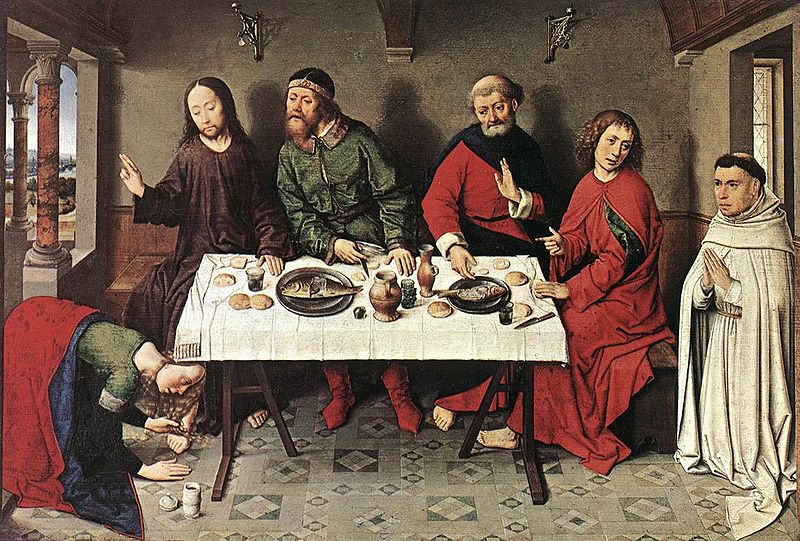
“Christ in the House of Simon”
Dieric Bouts, 1440’s
(Staatliche Museen, Berlin)

Lectionary Text:  John 12: 1-11
Six days before the Passover Jesus came to Bethany, the home of Lazarus, whom he had raised from the dead. There they gave a dinner for him. Martha served, and Lazarus was one of those at the table with him. Mary took a pound of costly perfume made of pure nard, anointed Jesus’ feet, and wiped them with her hair. The house was filled with the fragrance of the perfume. But Judas Iscariot, one of his disciples (the one who was about to betray him), said, “Why was this perfume not sold for three hundred denarii and the money given to the poor?” (He said this not because he cared about the poor, but because he was a thief; he kept the common purse and used to steal what was put into it.) Jesus said, “Leave her alone. She bought it so that she might keep it for the day of my burial. You always have the poor with you, but you do not always have me.” When the great crowd of the Jews learned that he was there, they came not only because of Jesus but also to see Lazarus, whom he had raised from the dead. So the chief priests planned to put Lazarus to death as well, since it was on account of him that many of the Jews were deserting and were believing in Jesus.

You can imagine these friends around this table filled with wonderful-smelling food, telling stories and laughing together.  And then Mary gets up and picks up this beautiful jar full of expensive perfume.  She pours it lavishly on Jesus’ feet not caring how much she used.  The smell of the perfume fills the room.  And Mary kneels all the way down and wipes Jesus’ feet with her hair as it spills onto the floor.  It is not the anointing itself that is all that unusual.  After all, it was normal to anoint kings at their coronation and priests at their ordination.  And, of course, anointing was a way to prepare a body after death.  Mary was anointing Jesus her Lord and King and preparing him for what would come next.  But those there missed that point.  They were much more worried about this expensive oil that was now soaking into the stone floor.

Now you have to understand that women were not supposed to put themselves in a position of being the center of attention. And they were not supposed to touch a man that was not their husband. And for a woman to let her hair down in public would have been considered a disgrace. So as those present saw her, Mary was making a total spectacle of herself. And then she wastes all this perfumed oil. Judas surmised that it could be sold for three hundred denairii. If that were true, that would have been close to one year’s wages for a laborer. But Albert Schweitzer said that “if you own something you cannot give away, then you don’t own it, it owns you.”

Massada, Israel
Taken February, 2010

As for Mary, none of that mattered anyway. The love that she felt for Jesus just made all those things meaningless. She was truly overcome with love for Christ. And she wanted him to know that she got it. And so this act of extravagant generosity, this act of deep, incredible love, the kind of love that Jesus gave, becomes a sort of living embalming, an act that showed Jesus that Mary was with him on his way to the cross.  Think about some of the language—Mary took, poured, and wiped. We will hear those same words this Thursday in the account of Jesus’ last meal: Jesus took the bread, poured out the wine, and wiped the feet of the disciples, and through these common gestures and such common touch, Jesus shows us what true love is. And as Mary takes, and pours, and wipes, she shows that same love toward Christ, and this small crowded house in Bethany becomes a cathedral and this simple meal becomes a Eucharist. Through her touch, through her love, the ordinary becomes sacred. Mary enters Jesus’ life and he becomes part of her. And God enters that very room and Mary feels the presence of the Divine.  Her life becomes a sacrament that shows Jesus’ love to the world. And the whole world is now forever filled with the fragrance of that perfume.

Where do we find ourselves in this story? Jesus has begun the walk to the cross. Are we standing on the sidelines watching the events unfold as if it is some sort of prepared video stream? Are we holding back those things we have because the cost is just too great? Or are we waiting to see what the person next to us will do? I’m afraid that I’m probably not standing in the right place on the stage of this story.  I’m afraid I probably AM too worried about the cost, about the loss, about what people will think.  But each of us is called to take, to pour, and to wipe. Each of us is called to become a living sacrament of Christ’s love. Each of us is called to walk with Christ to the cross. Each of us is called to embody that close a relationship with the living Christ that we will be positively overcome with our love for God. Each of us is called to see, to hear, to smell, to touch, to feel, to laugh, and to love with the depth and passion of Christ.  Oh, I want to be one that spills out all that I am and all that I have with utterly reckless abandon. Because, you see, that is the only way to experience that lingering fragrance that is still in the air.

So we follow our Lord hoping against hope
That soon the road might veer
And get us back to a place we know
A place we do not fear.
And then the fragrance of spilled perfume
Begins to cloud our head
The woman takes and pours and wipes our Lord
And we wonder what we would’ve said.


So, on this holiest of walks, ask yourself what it is that you’re being asked to pour out for Christ and then do it joyfully until it spills onto and covers the floor of the world…

Grace and Peace in this holiest of weeks,

Shelli