Lenten Threshold

Celtic Cross-2Scripture Passage: John 1: 1-14

In the beginning was the Word, and the Word was with God, and the Word was God.2He was in the beginning with God.3All things came into being through him, and without him not one thing came into being. What has come into being4in him was life, and the life was the light of all people.  5The light shines in the darkness, and the darkness did not overcome it.6There was a man sent from God, whose name was John.7He came as a witness to testify to the light, so that all might believe through him.8He himself was not the light, but he came to testify to the light.9The true light, which enlightens everyone, was coming into the world.10He was in the world, and the world came into being through him; yet the world did not know him.11He came to what was his own, and his own people did not accept him.12But to all who received him, who believed in his name, he gave power to become children of God,13who were born, not of blood or of the will of the flesh or of the will of man, but of God.14And the Word became flesh and lived among us, and we have seen his glory, the glory as of a father’s only son, full of grace and truth.

Happy St. Patrick’s Day!  Yes, even those of us who are in traditions where we honor few feast days of saints get in to this one and don our green.  Now, admittedly, most of us don’t even know much about Patrick or his tradition, save a few legends about snakes and stuff.  Patrick was said to have been born Maewyn Succat (Lat., Magonus Succetus) in Roman Britain in the late 4th century.  When he was sixteen, he was captured by Irish raiders and taken as a slave to Ireland, where he lived for six years before escaping and returning to his family.  He wrote that his faith grew in captivity and he prayed daily.  The story is told that one day Patrick heard a voice saying “your ship is ready” and took it to mean that it was time to return home.  Fleeing his master, he traveled to a port two hundred miles away, found a ship, and sailed home.  He entered the church and later returned to Ireland as a missionary.  By the eighth century, he had become one of the patron saints of Ireland.

Patrick’s life, like his Celtic tradition, is based on pilgrimage.  Life in this tradition is about growing and moving and not “pitching our tent” in one place too long.  It is about connecting to all of Creation, about honoring and revering all as sacred.  It is about treating all of life sacramentally, embracing it as a gift from God and a way to God.  Embracing the Celtic spirit means going on a journey, open to moving from one place to another, one thought to another, one way of seeing to another.  In the midst of this journey, Celtic spirituality recognizes the importance of crossing places, seeing them as thresholds of growth.  These places are truly looked upon as sacred spaces.  Bridges and gateways express a determined refusal to be stopped by what blocks our way; causeways open up pathways to places that have been inaccessible; and burial grounds mark the crossing place from life to death, from “this world” to an “other world”, from time and space to eternity and infinity.      These thresholds prevent us from becoming islands, closed off to change and moving forward.  The thresholds open up new worlds and new possibilities.  Thresholds are bridges between the now and the to be.

For us, this Celtic tradition holds a lot of things that can help us on our Lenten journey.  In fact, they are notions that we spend a good part of our Lenten season trying to grasp.  Lent itself is a threshold, a sacred doorway to growth and connection, to learning to embrace our own lives as gifts, as sacramental journeys toward a new oneness with God.  It is a journey to the ultimate threshold of all, the gateway between life and death, between the world that we know and the Way that we are called to go.  Lent keeps us from staying behind when God is moving just ahead.  There is an Old English word, “liminality”, that literally means “betwixt and between”.  It is a place of intersection, a threshold, between what is and what will be.  And we are called to that place, to the intersection of this world and the world to which God calls us.  We are called to be “betwixt and between”, with our feet firmly planted in this world and our heart, our soul, and our mind stretching beyond ourselves, stretching to God.

And the snakes?  Well the legend credits St. Patrick with banishing all the snakes from Ireland.  Evidence suggests, however, that post-glacial Ireland never had any snakes.  But some suggest that Patrick was instrumental in ridding the Celtic Christians of all the “serpents” that were so common in their pre-Christian Druid belief, of helping them get rid of those things that got in the way of their movement, of their threshold, of their journey toward God.  Hmm!  Sounds like Lent to me!

So, as we journey during this Lenten season, let us embrace our threshold, let us embrace all of time and all of space that has brought us to this place, and then let us journey toward the Way that God is calling us.

Rath De ‘ort (Gaelic, pronounced Rah Day urt, “The Grace of God on you.”)

Shelli
The Day Between

What do we do with this day, this Holy Saturday?  We are still grieving.  The reality of it all is beginning to sink in, beginning to be real.  Jesus is gone, dying alone on some hill that we don’t even know.  So, what do we do today?  How do we pick up the pieces in the midst of our pain and despair and just go on with our lives?  Oh, we 21st century believers know how the story ends.  We’ve already jumped ahead and read the next chapter many, many times.  (Don’t tell those that don’t read ahead, but it all works out in the end.)

And yet, we do ourselves no favors if we jump ahead to tomorrow.  After all, the Scriptures tell us that Jesus rose on the third day, the THIRD day, as in one-two-three.  The third day doesn’t happen without today.  It must be important, right?  But, oh, it’s just so painfully quiet.  The sanctuary is dark, awaiting to be redressed for its coronation.  The bells are quiet, hanging expectantly for tomorrow.  And we still sit here draped in black with our Easter brights hanging there ready for us to don.  What are we supposed to do today?

Tradition (and the older version of the Apostles’ Creed) holds that Jesus died, was buried, and descended into hell.  So is that what this day is?  Descent?  Good grief, wasn’t the Cross low enough?  The well-disputed claim is that Jesus descended into death, descended into hell, perhaps descended into Gehenna (Greek, Hebrew–Gehinnom, Rabbinical Hebrew–גהנום/גהנם), the State of ungodly souls.  Why?  Why after suffering the worst imaginable earthly death would Jesus descend into hell?  Well, the disputed part is that Jesus, before being raised himself, descended to the depths of suffering and despair and redeemed it, recreated it.  The sixth century hymnwriter, Venantius Fortunatus claimed that “hell today is vanquished, Heaven is won today.” Why is that so out of bounds of what God can do?  Don’t we believe that God is God of all?  Or does it give us some sense of comfort to know that we are not the worst of the bunch, that there are always Judas’ and Brutus’ that have messed up a whole lot worse than any of us and so are destined to spend eternity on the lowest rungs of hell?  But, oh, think about the power and grace and amazing love of a God who before the Divine Ascent into glory, descended into the depths of humanity and redeemed us all, perhaps wiped out the hell of each of our lives rung, by rung? 

And, yet, again, we cannot leave it all to Christ to do.  Just as we were called to pick up our cross yesterday, we are called to descend down into the depths, plunging into the unknown darkness, so that God can pick us up again, set us right, and show us a new journey.  And so this day, we stand between, between death and life, between hell and heaven, between a world that does not understand and a God who even in the silence of this day has begun the redeeming work.  In some ways, this is the holiest day of the week.  How often do we stand with a full and honest view of the world and a glimpse of the holy and the sacred that is always and forever part of our lives?  How often do we stand together and see ourselves as both betrayers and beloved children of God?  How often do we stand in the depths of our human state and yet know that God will raise us up.  This is a pure state of liminality, a state, as the Old English would say, “betwixt and between.”  It is where we are called to be.  It is the place of the fullness of humanity as it claims both human and divine.  In the silence of this day, we stand with God.  And we wait, we wait expectantly for resurrection, we wait for God to say us once again.  It is where we should always be.  We won’t though.  We won’t be there. (Remember, we’ve had this problem before.)  And maybe on some level, it’s too much for us to always be there, always be waiting expectantly for God.  But at least we can remember what this day feels like as we stand between who we were and what we will be. 

So, for today, keep expectant vigil.  Do not jump ahead.  We can only understand the glory of God when we see it behind the shadow of death.  But, remember, shadows only exist because of Light. 

“Welcome, happy morning!” age to age shall say:
“Hell today is vanquished, Heav’n is won today!”
Lo! the dead is living, God forevermore!
Him, their true Creator, all His works adore!

Refrain
“Welcome, happy morning!”
Age to age shall say.

Earth her joy confesses, clothing her for spring,
All fresh gifts returned with her returning King:
Bloom in every meadow, leaves on every bough,
Speak His sorrow ended, hail His triumph now.

Refrain

Months in due succession, days of lengthening light,
Hours and passing moments praise Thee in their flight.
Brightness of the morning, sky and fields and sea,
Vanquisher of darkness, bring their praise to Thee.

Refrain

Maker and Redeemer, life and health of all,
Thou from heaven beholding human nature’s fall,
Of the Father’s Godhead true and only Son,
Mankind to deliver, manhood didst put on.

Refrain

Thou, of life the Author, death didst undergo,
Tread the path of darkness, saving strength to show;
Come, then True and Faithful, now fulfill Thy Word;
’Tis Thine own third morning; rise, O buried Lord!

Refrain

Loose the souls long prisoned, bound with Satan’s chain;
All that now is fallen raise to life again;
Show Thy face in brightness, bid the nations see;
Bring again our daylight: day returns with Thee!

Refrain
Just wait…
Grace and Peace,
Shelli

WALK TO JERUSALEM: The Birth of God

The Traditional place of Jesus’ birth beneath
The Church of the Nativity, Bethlehem, Israel
Taken February, 2010

Scripture Text:  Luke 2:1-20:
In those days a decree went out from Emperor Augustus that all the world should be registered. This was the first registration and was taken while Quirinius was governor of Syria. All went to their own towns to be registered. Joseph also went from the town of Nazareth in Galilee to Judea, to the city of David called Bethlehem, because he was descended from the house and family of David. He went to be registered with Mary, to whom he was engaged and who was expecting a child. While they were there, the time came for her to deliver her child. And she gave birth to her firstborn son and wrapped him in bands of cloth, and laid him in a manger, because there was no place for them in the inn.  In that region there were shepherds living in the fields, keeping watch over their flock by night. Then an angel of the Lord stood before them, and the glory of the Lord shone around them, and they were terrified. But the angel said to them, “Do not be afraid; for see—I am bringing you good news of great joy for all the people: to you is born this day in the city of David a Savior, who is the Messiah, the Lord. This will be a sign for you: you will find a child wrapped in bands of cloth and lying in a manger.” And suddenly there was with the angel a multitude of the heavenly host, praising God and saying, “Glory to God in the highest heaven, and on earth peace among those whom he favors!” When the angels had left them and gone into heaven, the shepherds said to one another, “Let us go now to Bethlehem and see this thing that has taken place, which the Lord has made known to us.” So they went with haste and found Mary and Joseph, and the child lying in the manger. When they saw this, they made known what had been told them about this child; and all who heard it were amazed at what the shepherds told them. But Mary treasured all these words and pondered them in her heart. The shepherds returned, glorifying and praising God for all they had heard and seen, as it had been told them.

“In those days, a decree went out.”…There it is!  It is probably the best known story of all time and a great story it is–forced occupation, poor couple, long trip, impressive ancestry,  a last-minute birth, animals, humble beginnings, angels, assurance, surprise visitors, well-trained choir, and God.  (You know, in hindsight, if there had been a coach and a glass slipper, this would have been perfect!)  But, seriously, think about it.  This story has gripped the world for twenty centuries.  Jesus of Nazareth was born a human gift to this world, born the way we were all born.  No, the Scripture doesn’t speak of morning sickness and labor pains.  In fact, in our haste to welcome the Christ child into our lives each Christmas Eve, we forget the humanness of the birth.  We forget that he first appeared in the dim lights of that grotto drenched with the waters of Creation, with the smell of God still in his breath.  We forget that Mary was in tears most of the night as she tried to be strong, entering a realm she had never entered, questioning what the angel nine months before had really convinced her to do.  We forget that Jesus was human.

But this night, this silent night, is the night when the Word comes forth, Incarnate.  In its simplest form, the Incarnation is the mingling of God with humanity.  It is God becoming human and, in turn, giving humanity a part of the Divine.  It is the mystery of life that always was coming into all life yet to be.  There is a word that we do not use much. “Liminality”, from the Latin for threshold is used to describe in Old English, “betwixt and between”, a point of being suspended between two realms, two times.  Think of it as an airpline flying over the ocean.  For a few hours, you are suspended between and yet part of two cultures, two worlds.  It is as if you are nowhere and everywhere at the same time.  This is where we are.  Humanity and the Divine are this moment suspended.  Neither has moved forward yet.  Just for a moment, they will dance in this grotto while we look on. 

God has come, sought us out.  Eons of God inviting us and claiming us and drawing us in did not do it.  So God came, came to show us the sacredness that had been created for us, the holy in the ordinary that we kept missing.  God has traversed time and space and the barrier between us and the Divine and as God comes across the line, the line disappears.  God is now with us.  We just have to open our eyes.  And then, the walk begins, a walk that will pass through Galilee and Jerusalem and Golgotha.  And at each point, God asks us to dance again.  And we will never be the same again.  This notion of “Emmanuel”, God With Us, means that all of history has changed.  We have passed through to another time with our feet still firmly planted here.  It has changed us too.  God is not asking us to be Divine.  We are not called to be God.  God is asking us to be who God created us to be and came to walk with us to show us what it meant to be human, to be made, not God, but in the very image of the Divine.

This birth does not just stand alone as an historic high-point in world history.  You cannot look at it by itself.  The Incarnation, Emmanuel, God With Us, is not limited to this silent night.  God comes over and over and over again–in Jesus’ birth, life, ministry, death, and resurrection.  And this night in Bethlehem, this night of humanity, will end only a few miles away.  But it will travel far beyond.  It is part of a something bigger, a cycle of time and space, human and Divine, that has not ended yet and that, as I belief, will continue into eternity until all becomes one with God.  God came that we might have Life!

In this Season of Lent, God comes to show us how to be human, made in the image of the Divine.  What is it that stands in your way, that makes you inhumane?  What stands in the way of walking with God, Emmanuel?  Because, you see, that is the way to Jerusalem…

Grace and Peace,

Shelli

Getting to a Thin Place


The Celtic Spiral

Happy St. Patrick’s Day!  I do not know of any true Irish blood in my family but my hodge-podge geneaology includes enough of the British Isles to at leaast come close.  So I have donned my green and I’m set for the day!
St. Patrick was said to have been born Maewyn Succat (Lat. Magonus Succetus) in Roman Britain (Scotland) around the year 387.  As the story goes, when he was sixteen, he was captured by Irish raiders and taken as a slave to Ireland, where he lived for six years before escaping and returning to his family.  He wrote that his faith grew in captivity and he prayed daily. The story is told that one day Patrick heard a voice saying “your ship is ready” and took it to mean that it was time to return home.  Fleeing his master, he traveled to a port two hundred miles away, found a ship, and sailed home.  He entered the church and later returned to Ireland as a missionary.  By the eighth century, he had become the patron saint of Ireland.

In this season of Lent, we are called to do our own returning.  Part of Lent is about returning to your source, to that from whence you came.  It is our season of returning to God, letting go of all the baggage that we’ve stacked up along the way, and beginning again.  Lent is about relearning to travel light.  Celtic spirituality is based primarily on pilgrimage.  Life, in this understanding, is about growing and moving and not “pitching our tent” in one place too long.  It is about connecting with all of Creation.  It is about connecting with God.  It is about recognizing the transcendent, those places where one meets God in his or her life.  In Celtic Spirituality, they are called “thin places”, those places where the spiritual spills into the material, where time and space are one, those places where we feel so connected to God, to our source, that the eternal is there for the taking.  It is those places that are in this life and in this world where one has the sense that one hears the harps eternal just over the not-too-distant hill.  It carries an understanding that all in life is sacred, that all in life is of God; we just have to return with new eyes and new ears and a new heart to see it.  Lent calls us to find our own thin places.  They are not the places where God exists but rather the places where we can finally sense the Presence of the One who is everywhere.

Legend credits St. Patrick for banishing all of the snakes from Ireland.  It is interesting to note, though, that evidence suggests that post-glacial Ireland never really had any snakes.  Perhaps it was an account of Patrick’s influence in the doing away with the belief in serpents that were so common in Druid belief.  Or perhaps it is a reminder to us what a life of true faith, a life of singular devotion to God, can mean.  When one returns to his or her source, when one finds that place where one knows God and senses the God who is all things and everywhere, all those things that haunt us, all those things that perch around corners and strike unexpectedly, all those things in life that we try to avoid, try not to step on, finally do not matter.  It is said that Patrick feared nothing, not even death, so complete was his trust in God.

So, in this Lenten journey, may you find your thin place.

Christ with me, Christ before me, Christ behind me, Christ within me,
Christ beneath me, Christ above me, Christ at my right, Christ at my left,…
Christ in the heart of everyone who thinks of me,
Christ in the mouth of everyone who speaks to me,
Christ in every eye that sees me,
Christ in every ear that hears me.
I bind to myself today the strong virtue of an invocation of the Trinity,
I believe the Trinity in the Unity,
The Creator of the Universe.  
(From The Prayer of St. Patrick’s Breastplate, supposedly composed by him in preparation for victory over Paganism.)

Grace and Peace,

Shelli

Threshold

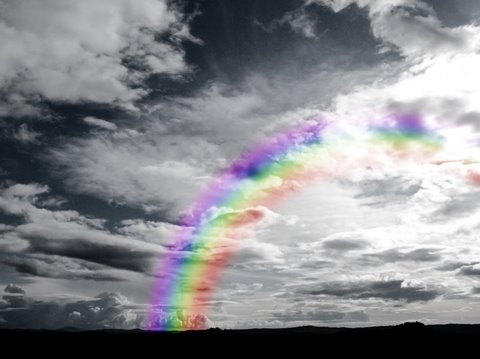
In this Sunday’s Lectionary readings, the passage from the Hebrew Scriptures is the end of the account of Noah and The Great Flood. Noah and his family have listened to God, built the ark, and have now been cooped up for months as the torrential waters pounded against the wood of their somewhat tenuous residence, drowning the very earth and all the foundations that they knew. Noah sends a bird out to “test the waters”. The bird returns. After several attempts, the bird finally does not return. The land is ready; the waters have receded and the earth has reappeared. And there–there in the sky is a splash of color, a bow in the clouds, the sign of God’s promise that Creation will never again be separated from its Creator.

The Celts understood the rainbow as a bridge, a threshold between what is and what will be. It is, in Celtic terms, a “thin place”, as the thin gaseous vapors form a sort of bridge in the clouds between one way of being and the next. This is the bridge to promise and discovery; this is the bridge to life. Hey….maybe there really is a pot of gold at the end!

This is a perfect passage for Lent. We are indeed in a threshold season, a season between one world and the next, between death and eternity, between who we are and what we will be. Lent is not a season where we withdraw, pulling ourselves away from our lives and the world. For some of us, we think we need to do that, giving up things that are part of our lives to remind us of our connection to God. Don’t get me wrong. Lent is a contemplative and retrospective season, a season when we take a good hard look at our lives, at their failings and misgivings, at the ways that we have been complicit in the continued crucifixion of goodness and grace and love. But the retrospection is not to fill us with remorse or regret; it is to propel us forward through the threshold. It is to open to our eyes to the thin places, where the colors come alive and the way is clear.

The rainbow, the promise of hope, is, in physical terms, a reflection. It is a mirror of what surrounds it. And in that mirror, in that threshold, we see ourselves–our life, our death, and, our glorious resurrection. Because, after all, that IS the pot of gold at the end of the rainbow!

So go forth this season and seek the threshold–do not be afraid–it is filled with hope and promise like nothing you’ve ever known!

Grace and Peace,

Shelli

Illumination (A Mid-Week Homily)

IlluminationLectionary Text: John 1: 6-8, 19-28
I love Christmas lights. When I was little, my family would pick at least one night right before or immediately after Christmas and drive around and look at the Christmas lights. Later, as a young adult, I several times drove my Grandmother around to look at them. My Grandmother Reue seemed to have as much of the childlike appreciation of the lights that I had always had. Many of us are like that. There’s something about Christmas lights—full of wonder and awe, a sort of call to the season for us. These lights are comfortable for us. They are reassuring. From a practical standpoint, they’re virtually useless. But you know as well as I do that they are a sign of the season.
The Gospel passage that we read for this week uses that image of light also. For the writer of The Gospel According to John, the Logos was the light of humanity, the true light. There are no announcements here of Jesus’ coming and there is no birth story. But this is essentially the equivalent: the coming of Jesus, the Incarnation, is the coming of the true light, which enlightens everyone and illumines everything. But where the writers of the Gospels of Matthew and Luke use an angel to proclaim Christ’s coming, this writer uses John the Baptist. Now whatever you have to say about this camel hair-wearing, locust-eating, wilderness wanderer, he took his job seriously. John understood himself as called by God to point to the light as well as to that which is illuminated by the light. He didn’t get lost, as many do, in the rhetoric about Christ as the light without realizing the purpose of the light itself. And sometimes John’s words were not very popular. He went around like some wild man in the wilderness preaching repentance, preaching that we needed to change, preaching about the one who was coming after him, preaching about the light that was just around the bend, a light such that we had not seen. “John,” we want to say, “Shhhh!…you’ll wake the baby.”
That’s where we want to be—at the manger, kneeling before our Lord, basking in the illumination of the star above, and yet we still want to hold onto those shadows in our life. For there is familiarity; there is safety; there is that which we can control, there is that place to which we can retreat when life is just too hard. And the light…We would rather the light be allowed to remain in our thinking depicted as a warm and comfortable place to be. Just let us sit here awhile with this sleeping baby, the Christ child, there in the manger while the North Star dances overhead. This is a sign of the season!
But John the Baptist was right. This light is not a twinkling, intermittent light like those that light our houses this season. This is not a warm, glowing, candle-lit light that makes us feel comfortable even as we sit in its shadows. And it’s closer to us than any star in the universe. This light is different. This light is so big and so bright and so powerful that sometimes it hurts to look at it. Sometimes it is just too painful. This light is so pervasive and so encompassing, that it casts no shadows. The light of Christ, this light to which John pointed, is not a warm glow but is rather a radical illumination of everything around it. Because you see, Christ did not come into the world just to be our personal guiding light so that we could see where to go on this journey. The Christ light is also a light that shows us what needs to be done while we’re on that journey. Christoph Frederick Blumhardt says that “a light has a purpose; a light ought to shine into our lives so that we can see what needs to be done and set our hand to it and clean it up.”[i] That is the Light of Christ.
Yes, it’s uncomfortable. Yes, it will show us things that we’d rather not see, things with which we’d rather not have to deal. I’ll make a confession here. You can tell when I get too busy in my life by looking at my house. Right now, my house is atrocious. If you walked into it, you would experience the worst housekeeping that you can possibly imagine. In my kitchen, I have these really bright overhead canister lights. I also have these wonderful, warm, under-cabinet lights that I absolutely love. I realized the other night that I like my kitchen better right now at night when I turn off the canister lights and turn on those under-cabinet lights. They are beautiful as they reflect off the granite and project a warm, delicate glow to the kitchen. But the real reason is because with them, the kitchen looks clean. How easy it is just to forget about those things we need to do when we can’t see them!
The Christ light is not a warm, delicate light. The Christ light is this incredibly bright, all-encompassing light that enables us to see the world differently. It is a light that illumines not only the present, but also the future. The Spiritual Masters would refer to this illumination as a type of liminality, a way of existing in two worlds, betwixt and between. We are standing in the world in which we live, but the light is illumining the world to come. And when we learn how to see with that light, the world in which we live will look different. We will finally see that some of this is just not right. We can then no longer close our eyes to what the light has shown us. It will be impossible. Because, for us, all the shadows will finally once and for all be exposed. We will no longer be able to live with hunger and homelessness, with destruction of people’s lives and waste of our planet, with violence and war, or with the exclusion of any of God’s children from the light. The light in our lives will find those things not just sad, but unacceptable, inexcusable, incapable of being.
How, then, do we prepare ourselves to look at this light. How do we turn our eyes, so shielded by all the shadows of this world and look at that bright illuminating light without it being uncomfortable for us? Well, you know as well as I do that the way to prepare yourself to look at light is to look at light. And as uncomfortable as that may be, there is no other way. In her book, Lighted Windows, Margaret Silf tells the story of when her daughter was born and how one of the first problems that they encountered was light. She said that “to make sure that [our daughter] would always experience the presence of a gentle, comforting light if she awoke during the night, we installed a little lamp close to the nursery door. It also meant that if she cried we could grope our way to her even in a half-asleep state.”[ii] But they soon realized that even the little nursery light burned their eyes, especially after the third or fourth time they went into the nursery during the night, groggy from sleep with eyes burning. “So,” she says, “we went to the local electrical shop to ask whether they had any bulbs lower than 15 watts!” “It’s strange,” she comments, “how light that is so needful for growth and life can also be so hurtful when we are unprepared for it.”[iii]
In this Advent season, the way that we prepare ourselves for the coming of the Light is by looking at that light. That is why God came and burst forth into our humanness—to show us what full illumination looks like and to call us into the light. Do you remember that bumper sticker a couple of years ago? I haven’t seen it in awhile. “God is coming…look busy.” It’s funny but it’s wrong. God is here…get busy. God has come. The baby IS awake and now it’s our turn to wake up, rub our sleep-filled, groggy eyes, and with every intentional part of our being, look into the light and see what we are called to do. And the Word became flesh and lived among us, and we have seen his glory…full of grace and truth. THAT is the sign of the season—all of Creation in full illumination so that we may get a glimpse of what is to come.
In the Name of the One who said “Let There Be Light” and then brought the light to earth that we might see the world the way it was created to be. Amen.
So, go and be light!
Grace and Peace,
Shelli
[i] Christoph Friederich Blumhardt, “Action in Waiting”, in Watch for the Light: Readings for Advent and Christmas, (Farmington, PA: Plough Publishing, 2001), 11/24.
[ii] Margaret Silf, Lighted Windows: Advent Reflections for a World in Waiting, (Nashville, TN: Upper Room Books, 2004.), 101.
[iii] Ibid