EASTER 2A: In the Shadow of a Doubt

Lectionary Text:  John 20: 19-31
When it was evening on that day, the first day of the week, and the doors of the house where the disciples had met were locked for fear of the Jews, Jesus came and stood among them and said, “Peace be with you.” After he said this, he showed them his hands and his side. Then the disciples rejoiced when they saw the Lord. Jesus said to them again, “Peace be with you. As the Father has sent me, so I send you.” When he had said this, he breathed on them and said to them, “Receive the Holy Spirit. If you forgive the sins of any, they are forgiven them; if you retain the sins of any, they are retained.” But Thomas (who was called the Twin), one of the twelve, was not with them when Jesus came. So the other disciples told him, “We have seen the Lord.” But he said to them, “Unless I see the mark of the nails in his hands, and put my finger in the mark of the nails and my hand in his side, I will not believe.” A week later his disciples were again in the house, and Thomas was with them. Although the doors were shut, Jesus came and stood among them and said, “Peace be with you.” Then he said to Thomas, “Put your finger here and see my hands. Reach out your hand and put it in my side. Do not doubt but believe.” Thomas answered him, “My Lord and my God!” Jesus said to him, “Have you believed because you have seen me? Blessed are those who have not seen and yet have come to believe.” Now Jesus did many other signs in the presence of his disciples, which are not written in this book. But these are written so that you may come to believe that Jesus is the Messiah, the Son of God, and that through believing you may have life in his name.

This Scripture probably scares all of us a bit.  Are we just supposed to believe unconditionally, take on a sort of blind faith without questioning, without trying to figure it all out?  I don’t really believe that (but maybe I have my doubts!).  No, really, the Scriptues tell us to believe but nowhere does it say that we’re not supposed to explore that belief.  The truth is, we fault Thomas here and, yet, the others HAD seen.  Of course they believed.  Thomas, though, alone, had the courage and, I would say, the faith, to question it all.  And Jesus gave him the gift of himself, the gift not of answers but of illumination.  Thomas probably still couldn’t explain to you how or why or even if it happened.  He just believed that it did.

Swiss-born theologian and writer Hans Kung said that “doubt is the shadow cast by faith. One does not always notice it, but it is always there, though concealed. At any moment it may come into action. There is no mystery of the faith which is immune to doubt.”  Isn’t that a wonderful thought? Doubt is the shadow cast by faith. Faith in the resurrection does not exclude doubt, but takes doubt into itself. Faith is a matter of worshipping and doubting, doubting and worshipping. It is a matter of being part of this wonderful community of disciples not because God told us to but because our doubts bring us together. Examining our faith involves doubts, it requires us to learn the questions to ask. And it is in the face of doubt that our faith is born. God does not call us to a blind, unexamined faith, accepting all that we see and all that we hear as unquestionable truth; God instead calls us to an illumined doubt, through which we search and journey toward a greater understanding of God.

At the risk of disappointing some of you, going to seminary did not give me all the answers to the faith.  It taught me how to ask the questions.  I think that’s what faith is about–not having the right answers all the time but having the courage and indeed the desire to continue asking those questions that lead us to a more illumined faith.  Who is God?  What is God to you?  Who is Christ?  What does it mean to be Christ in this world?  What does it truly mean to show your brothers and sisters in this world what the Risen Christ means to you?  The list is endless, far into the shadows up ahead.  Faith is not about memorizing doctrines or dismissing questions in light of what some choose to call “orthodox” belief.  And I don’t think we’re called to have the answers but rather to live a faith that becomes alive and illumined by our questions and our exploration and our continued search for what it all means in our life.  That is the way we connect with God.  That is the way we journey toward God.  That is the way to living a life of faith that is propelled by our doubts rather than pulled down by them.  Maybe our doubts are not supposed to live in the shadows of our lives but way out in front, pulling us into a greater understanding of this God that we so desire. Maybe a life of faith IS lived in the shadow of a doubt.  Hey, remember what creates shadows?  Light…  Isn’t that illuminating?

So in this season in which you see the Risen Christ, go ahead and doubt and then let it lead to faith, to the belief that it is so.

Grace and Peace,

Shelli

LENT 4A: Peering From the Darkness

Lectionary Text:  John 9: 1-14, (15-38) 39-41
As he walked along, he saw a man blind from birth. His disciples asked him, “Rabbi, who sinned, this man or his parents, that he was born blind?” Jesus answered, “Neither this man nor his parents sinned; he was born blind so that God’s works might be revealed in him. We must work the works of him who sent me while it is day; night is coming when no one can work. As long as I am in the world, I am the light of the world.” When he had said this, he spat on the ground and made mud with the saliva and spread the mud on the man’s eyes, saying to him, “Go, wash in the pool of Siloam” (which means Sent). Then he went and washed and came back able to see.  The neighbors and those who had seen him before as a beggar began to ask, “Is this not the man who used to sit and beg?” Some were saying, “It is he.” Others were saying, “No, but it is someone like him.” He kept saying, “I am the man.” But they kept asking him, “Then how were your eyes opened?” He answered, “The man called Jesus made mud, spread it on my eyes, and said to me, ‘Go to Siloam and wash.’ Then I went and washed and received my sight.” They said to him, “Where is he?” He said, “I do not know.”   They brought to the Pharisees the man who had formerly been blind. Now it was a sabbath day when Jesus made the mud and opened his eyes…Jesus said, “I came into this world for judgment so that those who do not see may see, and those who do see may become blind.” Some of the Pharisees near him heard this and said to him, “Surely we are not blind, are we?” Jesus said to them, “If you were blind, you would not have sin. But now that you say, ‘We see,’ your sin remains.

Our Gospel text for this the fourth Sunday of Lent is the account of the healing of the man blind from birth in the Pool of Siloam (or the Pool of Shelah or the waters of Shiloah). We tend to read this story as a great miracle or healing story where, once again, Jesus comes out as the glorious hero. But what would happen if you flipped the thinking a little bit? Did the man become able to see because Jesus healed him, pulling him out of his disability, his “sin”, and into “righteousness”? Or was the man able to see because he was in darkness and had nowhere else to look but toward the light? Maybe rather than a healing story, this is a story that calls us to look into our own blindness, our own way that we miss seeing God. 19th century artist Paul Gauguin once said that “I shut my eyes in order to see.” It is harder to see light on light. There is no definition, no contrast. It is harder to discern which light is the one that will allow us to see. Light cannot light light.  I mean, really, when was the last time you went outside and gazed at the stars at noon?  Do you think the stars disappear during the day?  Do you think that when the sun goes down, a myriad of stars begin to peek through the ozone layer for our enjoyment?  No, they are there all the time, just waiting for us to peer from the darkness and finally glimpse their light.  It is when we are in the darkness that the light is illuminating, seemingly consuming the darkness, if only for a time.
 
But read the first chapter of Genesis.  The light did not expel the darkness; it pushed it away, replacing it with light.  The darkness and the light were separated not because one was bad and one was good but because it is in the darkness that we see the light.  That is why the man born blind from birth in our story could so easily gain his sight.  Jesus knew that.  The man lived in darkness.  Light was all he could see.  But those who lived in the light of their own spiritual perfectionism–it was they that were blinded by the light, unable to see, unable to distinguish the light of the their own making from the light of God.

Lent is as much about looking into our own darkness as it is looking into the light.  Think about it…all that is created begins in darkness–the darkness of the great void that existed before we were, the darkness of the womb that held us for a time, and the darkness that encompassed that Friday afternoon when the world was once again plunged into darkness so that it could be created once again.  If the darkness was completely bad, not “of God”, so to speak, why in the world would God leave it in Creation at all?  There is nothing “evil” about darkness.  In fact, I would submit the real possibility that there is a lot more evil going on in broad daylight nowadays, out where we can see it, whether or not we choose to pay attention!

Darkness is a real part of life–the darkness of sin, the darkness of depression, the darkness of poverty and economic hardships, the darkness of substance abuse, the darkness of failure, the darkness of living a life that has not turned out the way we thought it would, the darkness of ______________ (just fill in the blank).  We all begin in darkness.  But it is from the darkness that we can peer into the light, groggy-eyed and body-bent, and see beyond the shadows, beyond the flickering lights of the world, to the illuminating Light of Christ that shows us the Way of Life, the Way of God, the way to see as God sees, the Way to Love, the Way of Grace.  It is from the darkness that we can see what we’ve never seen before.  Helen Keller said that “I believe that life is given us so we may grow in love, and I believe that God is in me as the sun is the colour and fragrance of a flower…I believe that in the life to come I shall have the senses I have not had here, and that my home there will be beautiful with colour, music, and speech of flowers and faces I love. Without this faith there would be little meaning in my life. I should be “a mere pillar of darkness in the dark.”

Amazing Grace, how sweet the sound,  That saved a wretch like me.
I once was lost but now am found, Was blind, but now I see.
T’was Grace that taught my heart to fear. And Grace, my fears relieved.
How precious did that Grace appear the hour I first believed.
When we’ve been here ten thousand years bright shining as the sun.
We’ve no less days to sing God’s praise than when we’ve first begun.
                                                                                       (John Newton)

So, in this Lenten season, close your eyes…and open them that you might finally see!

Grace and Peace,

Shelli

LENT 4A: Images of Light

Lectionary Text: Ephesians 5: 8-14
For once you were darkness, but now in the Lord you are light. Live as children of light— for the fruit of the light is found in all that is good and right and true. Try to find out what is pleasing to the Lord. Take no part in the unfruitful works of darkness, but instead expose them. For it is shameful even to mention what such people do secretly; but everything exposed by the light becomes visible, for everything that becomes visible is light. Therefore it says, “Sleeper, awake! Rise from the dead, and Christ will shine on you.”

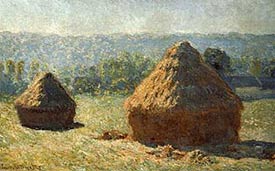
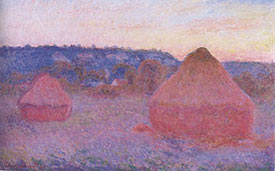
I’m sure most of you are familiar with the art of Claude Monet, the French Impressionist painter who is probably best known for his incredible landscapes and works of nature as well as for his paintings of those things that were a normal part of his own life. Probably the most fascinating part of Monet’s work are those paintings that he did as part of several series representing similar or even the same subjects—his own incredible gardens, poppy fields, a woman with a parasol, and those unusual haystacks.

The paintings in this series of haystacks were painted under different light conditions at different times of day. Monet would rise before dawn, paint the first canvas for half an hour, by which time the light had changed. Then he would switch to the second canvas, and so on. The next day and for days and months afterward, he would repeat the process. In each painting, the color of the haystack is different because the amount and quality of the light shining on the haystack is different. The subject is the same but the perspective from which it is viewed changes with the light. 

Up until this time, color was thought to be an intrinsic property of an object, such as weight or density. In other words, oranges were orange and lemons were yellow, with no variation as to the lens through which they were viewed. But with Monet’s studies in light and how it affects our view of life, that all changed. As Monet once said, “the subject is of secondary importance to me; what I want to reproduce is that which is in between the subject and me.” (I guess you could say he was painting hay while the sun shines! (sorry, couldn’t resist!))  But, seriously, Monet wasn’t merely painting images of haystacks; he was painting images of light.

I don’t really think of this light of Christ as a bright, blinding spotlight.  It’s really much more nuanced and subtle than that.  Think illuminating, rather than blinding.  And it doesn’t dispel the darkness but rather enlightens it.  It casts a different light, a light that illuminates all.  God, with infinite wisdom, gave us the power and the desire to see through the darkness and glimpse the light shining through, to see the Light that is Christ.  It is a light that is always present regardless of our view, that exposes all that is visible and makes that on which it shines light itself. 

There is a Maori proverb that says “turn your face to the [light] and the shadows will fall behind you.”  They are not consumed; they are still there, light streaming into their midst.  Shadows do not exist without light.  Light is what makes them visible.  We are like that.  Exposed by the Light of Christ, we become visible; and by becoming visible, we become light, children of light, images of the Light that is Christ, the Light that is God.  As I said before, what Monet painted was light.  He captured the visibility of a blank canvas and created a set of masterpieces.  Become visible; become light; become a blank canvas on which God can paint a masterpiece of light.

So, in this Lenten season, be visible, be light!

Grace and Peace,

Shelli


Receiving and Giving

During both of the “high” seasons of the church year, we talk a lot about change and growth.  Both of them point toward a “high point” and tell us that we have to prepare, that we have to get ready.  When you think about it, Advent points us toward a birth and Lent points us toward a re-birth.  During Advent, we are told over and over again that we have to open our lives and open our heart so that we can receive the Christ-child into our heart, so that we will know what it means for Jesus Christ to enter our life.  In essence, we have to be virgin, pure, open to receive and birth Christ in our own life.  Tis the season of receiving!

During this season of Lent, though, things change.  It is not just about receiving Christ or believing that Christ was resurrected or viewing Christ as the Messiah, or the Savior, or God Incarnate.  We have to do more than just believe the story.  We have to do more than just believe in Jesus Christ.  The only way to prepare oneself to walk this way of the Cross is through total and complete surrender of everything one thinks and everything one is.  We have to begin to become one with the Risen Christ.  We have to enter the Way of Christ. We have to give our lives and our hearts and everything we know over to God.  We become one with God.  You see, the point, I think, is that Jesus did not merely die on the cross to wipe my sin away or insure me everlasting life.  I think it was a bigger deal than that.  The cross is the point of recreation.  God took something so horrific, so unimagineable, so inhumane, and turned it into life.  All of Creation, all that we know, all that we thought changed at that moment.  The earth shook and gasped because nothing would ever be the same again.  The intention was not to just clean each of us and set us back on the same path.  We really are supposed to become something new.  And without death (as in “dying to self”), without handing over one’s life, without letting go of all those things to which you hold so tightly that really have meaning only to you, without giving all that you have and all that you are, God cannot make something new.  God cannot create life.  Tis the season of giving!

There are very few people who realize what God would make of them if they abandoned themselves into [God’s] hands and let themselves be formed by grace.  (St. Ignatius of Loyola, 16th century)

So, follow the one who came that you might have life!

Grace and Peace,

Shelli

Inseparable

Genesis 1: 14-19

And God said, “Let there be lights in the dome of the sky to separate the day from the night; and let them be for signs and for seasons and for days and years, 15and let them be lights in the dome of the sky to give light upon the earth.” And it was so. 16God made the two great lights—the greater light to rule the day and the lesser light to rule the night—and the stars. 17God set them in the dome of the sky to give light upon the earth, 18to rule over the day and over the night, and to separate the light from the darkness. And God saw that it was good. 19And there was evening and there was morning, the fourth day.

The Light has come into the World!  Actually, if you remember the first day of Creation, there was light.  You know…”Let there be light!”  And there was.  The first day God created light in the midst of the darkness. But here…here God creates more light, putting light even in the midst of the darkness.  Notice that the darkness was not extinguished.  Perhaps it is there to make us look Sunrisetoward the light.  God did not snuff out the darkness; God rather gave us a light to navigate through it.

And now…in this Easter season, we are told that Jesus is the light of the world.  Now, notice here that the claim is not that Jesus HAS the light; it is that Jesus IS the light. What does that mean to “be” light? Light means life. Light signifies life-giving power. Think, for a moment, of the everyday miracle we know as photosynthesis. In photosynthesis light means life. In the presence of light, green plants convert water, carbon dioxide, and minerals into carbohydrates and oxygen. If there would be no light, there would be no photosynthesis. If there would be no photosynthesis, there would be no life. Light means life.

So Jesus is not just saying that he has brought light. Jesus is saying that he, God, the great I AM, IS life. But light’s value is not just unto itself. In all honesty, light, alone, is rather useless. Its true worth comes to be in its effect on everything around it. Its true value is in the way that it illumines and clarifies the world in which we live. Jesus’ intention, too, was not to come into the world as a blinding, white light but, rather, as a warm, illuminating presence that shines toward God and enables us to see the world the way we are intended to see it—all the world—the darkness, the light, and the shadows in our lives that constantly play between those two poles.

Edith Wharton said that “there are two ways of spreading light—to be the candle or the mirror that reflects it.” God is the candle, the firstborn light of Creation, the light of the world. We are called to go into the world and be light by reflecting God’s light even into the deepest crevices of the earth. Do not fear the darkness. In all truth, the darkness would not be if the light were not so bright. The two are inseparable. Jesus said, “I am the Light of the world…”  With Jesus, God re-created Light not to rid the world of darkness but to show us how to walk through it.

So, go, in the Name of Christ, and be light!

Grace and Peace,

Shelli

Becoming Light

In these last days of Advent, we experience both excitement and panic as we prepare for Christmas Day. But, again, Advent is meant to be more than just a precursor to Christmas Day. This is the time of preparation for Jesus’ coming, of course. But that means that it is also our time to become–become the one who receives God into our lives. The Gospel According to John begins with images of Christ as light coming into the world, enlightening all of the darkness on the earth until it is no more. And we, as children of the light, receive that light.

But what does that mean to receive light? We know that looking directly at light is uncomfortable and, at times, downright dangerous. Our eyes are not meant to look directly at something so bright. The light, then, is not merely something at which we look. That is not light’s purpose; otherwise it would be nothing more than a pretty decoration. The purpose of light is to illumine the darkness. We are not called to look at it, but to enter it. And in entering it, we become it, we become a reflection of that light for the world. It doesn’t take much–after all, one tiny light can wipe out absolute darkness–one light–your light. But the lights of many of us is what makes the world so bright. Jesus came as the light and calls us to become that light.

So go forth and become light!

Grace and Peace,
Shelli

Illumination (A Mid-Week Homily)

IlluminationLectionary Text: John 1: 6-8, 19-28
I love Christmas lights. When I was little, my family would pick at least one night right before or immediately after Christmas and drive around and look at the Christmas lights. Later, as a young adult, I several times drove my Grandmother around to look at them. My Grandmother Reue seemed to have as much of the childlike appreciation of the lights that I had always had. Many of us are like that. There’s something about Christmas lights—full of wonder and awe, a sort of call to the season for us. These lights are comfortable for us. They are reassuring. From a practical standpoint, they’re virtually useless. But you know as well as I do that they are a sign of the season.
The Gospel passage that we read for this week uses that image of light also. For the writer of The Gospel According to John, the Logos was the light of humanity, the true light. There are no announcements here of Jesus’ coming and there is no birth story. But this is essentially the equivalent: the coming of Jesus, the Incarnation, is the coming of the true light, which enlightens everyone and illumines everything. But where the writers of the Gospels of Matthew and Luke use an angel to proclaim Christ’s coming, this writer uses John the Baptist. Now whatever you have to say about this camel hair-wearing, locust-eating, wilderness wanderer, he took his job seriously. John understood himself as called by God to point to the light as well as to that which is illuminated by the light. He didn’t get lost, as many do, in the rhetoric about Christ as the light without realizing the purpose of the light itself. And sometimes John’s words were not very popular. He went around like some wild man in the wilderness preaching repentance, preaching that we needed to change, preaching about the one who was coming after him, preaching about the light that was just around the bend, a light such that we had not seen. “John,” we want to say, “Shhhh!…you’ll wake the baby.”
That’s where we want to be—at the manger, kneeling before our Lord, basking in the illumination of the star above, and yet we still want to hold onto those shadows in our life. For there is familiarity; there is safety; there is that which we can control, there is that place to which we can retreat when life is just too hard. And the light…We would rather the light be allowed to remain in our thinking depicted as a warm and comfortable place to be. Just let us sit here awhile with this sleeping baby, the Christ child, there in the manger while the North Star dances overhead. This is a sign of the season!
But John the Baptist was right. This light is not a twinkling, intermittent light like those that light our houses this season. This is not a warm, glowing, candle-lit light that makes us feel comfortable even as we sit in its shadows. And it’s closer to us than any star in the universe. This light is different. This light is so big and so bright and so powerful that sometimes it hurts to look at it. Sometimes it is just too painful. This light is so pervasive and so encompassing, that it casts no shadows. The light of Christ, this light to which John pointed, is not a warm glow but is rather a radical illumination of everything around it. Because you see, Christ did not come into the world just to be our personal guiding light so that we could see where to go on this journey. The Christ light is also a light that shows us what needs to be done while we’re on that journey. Christoph Frederick Blumhardt says that “a light has a purpose; a light ought to shine into our lives so that we can see what needs to be done and set our hand to it and clean it up.”[i] That is the Light of Christ.
Yes, it’s uncomfortable. Yes, it will show us things that we’d rather not see, things with which we’d rather not have to deal. I’ll make a confession here. You can tell when I get too busy in my life by looking at my house. Right now, my house is atrocious. If you walked into it, you would experience the worst housekeeping that you can possibly imagine. In my kitchen, I have these really bright overhead canister lights. I also have these wonderful, warm, under-cabinet lights that I absolutely love. I realized the other night that I like my kitchen better right now at night when I turn off the canister lights and turn on those under-cabinet lights. They are beautiful as they reflect off the granite and project a warm, delicate glow to the kitchen. But the real reason is because with them, the kitchen looks clean. How easy it is just to forget about those things we need to do when we can’t see them!
The Christ light is not a warm, delicate light. The Christ light is this incredibly bright, all-encompassing light that enables us to see the world differently. It is a light that illumines not only the present, but also the future. The Spiritual Masters would refer to this illumination as a type of liminality, a way of existing in two worlds, betwixt and between. We are standing in the world in which we live, but the light is illumining the world to come. And when we learn how to see with that light, the world in which we live will look different. We will finally see that some of this is just not right. We can then no longer close our eyes to what the light has shown us. It will be impossible. Because, for us, all the shadows will finally once and for all be exposed. We will no longer be able to live with hunger and homelessness, with destruction of people’s lives and waste of our planet, with violence and war, or with the exclusion of any of God’s children from the light. The light in our lives will find those things not just sad, but unacceptable, inexcusable, incapable of being.
How, then, do we prepare ourselves to look at this light. How do we turn our eyes, so shielded by all the shadows of this world and look at that bright illuminating light without it being uncomfortable for us? Well, you know as well as I do that the way to prepare yourself to look at light is to look at light. And as uncomfortable as that may be, there is no other way. In her book, Lighted Windows, Margaret Silf tells the story of when her daughter was born and how one of the first problems that they encountered was light. She said that “to make sure that [our daughter] would always experience the presence of a gentle, comforting light if she awoke during the night, we installed a little lamp close to the nursery door. It also meant that if she cried we could grope our way to her even in a half-asleep state.”[ii] But they soon realized that even the little nursery light burned their eyes, especially after the third or fourth time they went into the nursery during the night, groggy from sleep with eyes burning. “So,” she says, “we went to the local electrical shop to ask whether they had any bulbs lower than 15 watts!” “It’s strange,” she comments, “how light that is so needful for growth and life can also be so hurtful when we are unprepared for it.”[iii]
In this Advent season, the way that we prepare ourselves for the coming of the Light is by looking at that light. That is why God came and burst forth into our humanness—to show us what full illumination looks like and to call us into the light. Do you remember that bumper sticker a couple of years ago? I haven’t seen it in awhile. “God is coming…look busy.” It’s funny but it’s wrong. God is here…get busy. God has come. The baby IS awake and now it’s our turn to wake up, rub our sleep-filled, groggy eyes, and with every intentional part of our being, look into the light and see what we are called to do. And the Word became flesh and lived among us, and we have seen his glory…full of grace and truth. THAT is the sign of the season—all of Creation in full illumination so that we may get a glimpse of what is to come.
In the Name of the One who said “Let There Be Light” and then brought the light to earth that we might see the world the way it was created to be. Amen.
So, go and be light!
Grace and Peace,
Shelli
[i] Christoph Friederich Blumhardt, “Action in Waiting”, in Watch for the Light: Readings for Advent and Christmas, (Farmington, PA: Plough Publishing, 2001), 11/24.
[ii] Margaret Silf, Lighted Windows: Advent Reflections for a World in Waiting, (Nashville, TN: Upper Room Books, 2004.), 101.
[iii] Ibid