Lighted Windows

Candle in the WindowScripture Passage for Reflection:  John 1:5

The light shines in the darkness, and the darkness did not overcome it.

There are bumps in every road–even the road to Bethlehem.  There are things that we plan, that we need, that somehow do not go the way we envisioned.  For me, one of my favorite services is the Service of the Longest Night, the service of light where we remember that even in the midst of those bumps in the road, even in the darkest darkness, is God, walking with us, bumping along just like we are.  And then Wednesday night, I got sick.  Now I don’t do sick well.  It’s hard to admit that I’m sick.  But Thursday was just not going to happen for me so I missed the Service of the Longest Night.  I missed the service that I probably needed to help me get through some bumps in the road because of a bump in the road.  Go figure!

I actually don’t think that original journey to Bethlehem was without its bumps.  Life is like that.  The little caravan with the pregnant couple whose world had been turned upside down probably encountered lots of things.  They probably couldn’t drive straight through.  There were places that they had to avoid, places that were filled with danger from thieves or wild animals or parts of the road that were all but impassable.  And the weather was totally unpredictable.  Who knew that it would be this cold at night?  But they knew that this was something that they had to walk and they knew that they were not alone.  But it was so incredibly dark!

We are told that this is the season of light.  We are usually made to believe that this season should be a joyous one of celebration.  We are made to feel that we should put aside our worries and our cares and enjoy ourselves; we are told to embrace the celebrations and be happy; we are told to look toward the light, the birth of the Christ child.  And yet, tonight, here we sit in darkness. This is the winter solstice, the longest night of the year–fourteen hours of darkness.  The word “solstice” is derived from the Latin “solstitium”, from two words meanings “sun” and “stand still”.  Technically, this comes from the fact that during the days surrounding the solstice, the sun appears at its lowest point in the sky and then seems to have the same noontime elevation for several days in a row.  To early astronomers, the sun appeared to hang in the sky, suspended, paralyzed, as if waiting for some word to move on.

So it seems that on this night of darkness, it is appropriate to acknowledge those parts of our lives that do not seem to “fit” with the joyous season—our frustrations, our fears and anxieties, our anger, our depression, our loneliness, our despair, our grief.  These are not things that we can just leave at the door to the season and then pick them up later.  They are part of us.  And just as we bear them, God takes them and holds them and in what can only be attributed to the mystery of God, somehow manages to put a light in the window in the midst of our darkest night.

That’s exactly what happened that first Christmas.  Think about it.  Things were far from completely right with the world.  The young couple Mary and Joseph were not wealthy, prominent citizens of the capital city of Jerusalem.  They were poor working class citizens of a no-name town in what was essentially a third-world country.  Remember the Scriptures:  nothing good comes from Nazareth.  There was nothing there.  And we tend to romanticize their trip to Bethlehem, making it into some sort of painting of a starlit camping trip with a lovely dark blue backdrop and a beaming star above.  That wasn’t exactly the way it was.  If they did indeed have to make that journey as the writer of the Gospel According to Luke claims, it’s about an 80 mile trip, a 4-day journey under the best of circumstances.  But, as we know, the teen-age Mary was pregnant and at that time, they would probably want to avoid Samaria (which was not the friendliest of territories to the Israelites), which means they probably would have circled through what is now modern-day Jordan, making it an even longer trip.  And, remember, the whole reason that they were traveling at all was for the tax census, imposed by a foreign government to pay for foreign rulers that ruled their lives.  These were not the best of times.  They traveled in darkness.  But that part of the story somehow falls away when it is illumined by the light in the window.  God came, Immanuel, God with us.  “The light shines in the darkness and the darkness did not overcome it.”

You know, since humanity began, light has been important.  But for those of us who live in the city, where profound physical darkness almost never comes, we may have lost that sense of what light really means.  It’s about more than just lighting our way or giving us a pathway so that we can see where we are going.  Think about those who lived before there was electricity and streetlights every 500 feet or so.  When the sun went down, they were plunged into darkness, save for a few strategically-placed stars.  Until, that is, they lit a candle.  And cultures all over the world and throughout history have had traditions of putting a candle in the window.

The Irish tradition of putting a candle in a window is a symbol of hospitality.  Reminiscent of the first Christmas, it was seen as a gesture to ancient travelers who could find no shelter that there was room for them.  During those times in Irish history when Catholicism was abolished, a candle in the window designated a safe place for Catholic members and clergy.  And we’ve all seen movies and depictions of people trudging through a dark and foreboding snowy night only to be saved by seeing a light in a window.  So, lighted windows are much, much more than something that provides us light to see.  They are places of hospitality, of welcome.  They signify shelter and protection.  A candle in the window draws us in from the darkness.  It brings us home.

So, maybe we who live always surrounded by light don’t really have an appreciation for what lighted windows really mean—until, that is, we find ourselves surrounded by darkness, until we find ourselves encountering a bump in the road.  And in those times, there is the light—a place of welcome, of shelter, of safety.  It draws us home.  The promise of the season is not that there will be no darkness but that it will not overcome the light, that it will not overcome us.

Reflection:  What bumps in the road have you encountered this Advent?  Where have the lights in the window been for you?

Grace and Peace,

Shelli
Light-Yielding

In this Lenten season, we tend to focus on wilderness and darkness.  We are told to look at our selves honestly, compelled to confront our wrongs and name our sins.  The season begins in dust, with the faint sign of the cross made of oil and ash.  And as we sit in the dark, forboding wilderness, wrought with the tempations around us, we strain to see the light that we are promised.  We try hard to see even a small glimmer of the light that our faith tells us is up ahead.  We are told to let go, to relinquish the thinngs that we hold.  But how can we?  This season is too hard, too dangerous, too foreboding.  And so we stay in the darkness for now, content to wallow in our guilt and be comforted by our despair, hiding our shame from the world.  And we go on.  Someday the Light will come.

I don’t think we get it.  Surely this God of light and life does not want us to wallow here.  I mean, anyone that even knows the definition of psychology knows that healing starts with diagnosing our ills, confronting our demons, and naming our sins. In fact, in her book Speaking of Sin, Barbara Brown Taylor contends that sin, that thing that we try to hide away from everyone, is our only hope, because the recognition that something is wrong is the first step toward setting it right again.  She says that “there is no help for those who admit no need of help.  There is no repair for those who insist that nothing is broken, and there is no hope of transformation for a world whose inhabitants accept that it is sadly but irreversibly wrecked.”  But most of us are not comfortable facing ourselves that honestly and so we become content with wallowing in the darkness.  We get stuck in cycles of guilt and self-denial and become well-versed in closing our eyes to our own shortcomings and those of our society.  We somehow convince ourselves and cherish the idea that we live in a classless, equal-opportunity society where everyone has the same chance.  We are taught to save face and tuck our blemishes and sins away so that no one will see.

I don’t think Lent is meant to be a season of wallowing.  No where is it written or implied that this is a season that shows us the way around the cross. (If that was the case, then why didn’t God somehow pluck Jesus off the cross in the nick of time?  But the story wouldn’t be the same.  It would be one of avoiding death, rather than recreating it into life.  It would be a fairy tale, rather than a vision of our eternity.) Rather, Lent is a season of journeying to the cross, of letting go of all those things that impede our vision of the Light, and laying them down and going beyond them as they, too, are recreated into Life.  In that way, it is a season not of wallowing in the darkness but one of yielding to the Light.  The Light is there, waiting.  But we have to yield to it.  We can no longer be content to sit here in the darkness, surrounded by those things we hide, and wait for the light to come.  That’s not the way it works.  We have to let go.  We have to let go of our sins, our despair, and our view that we are not ready yet or not “there” yet, of the notion that we have to somehow prepare ourselves a little bit more.  The Light is not going to magically move in and replace the darkness.  We have to yield to the Light that is already there.  We have to name what impedes our journey and let it go.  And when we let go of the hopelessness that we’ve created, we will finally see the Hope that is already there.  I don’t know about you, but I have some work to do!

On this sixteenth day of Lenten observance, name those sins that you have hidden.  Speak one out loud to someone.  Let it go.  Yield to the Light that is already there.

Grace and Peace on this Lenten Journey,

Shelli

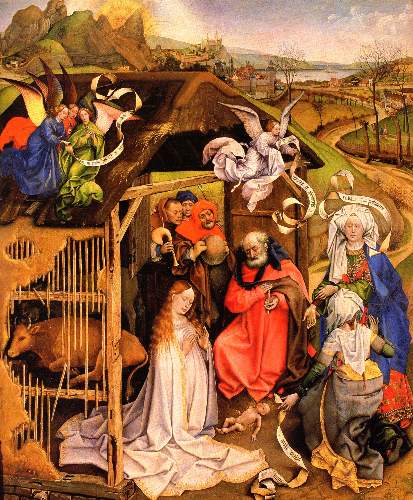
The Story of God

“Birth of Christ”, Robert Campin
ca. 1425-30

There is not one of us that does not love The Christmas Story.  It’s got it all–heartache, darkness, intrigue, danger, animals, innocence, an oppressive government, and a baby to boot.  It’s got all those things that make great tales.  No wonder it’s a bestseller!  No wonder there are so many songs written about it (that we at this moment cannot WAIT to sing!)  But for all the romantic notions of a baby born into a cold desert night in a small town on the other side of the world to poor, struggling parents, this story is not about a birth.  It’s not a story about Jesus.  This is the Story of God.

It began long before this.  It began in the beginning.  It began when God breathed a part of the Godself into being and created this little world.  And as the story unfolded, as God’s Creation grew into being, God remained with them, a mysterious, often unknown Presence, that yearned to be in relationship with what God had breathed into being.  And once in a while, God’s children would stop what they were doing long enough to know and acknowledge the incarnations of God.  Once in awhile, they would encounter a burning bush or a parting sea or an unfathomable cloud on the top of a mountain.  Once in awhile they would stop, take off their shoes, and feel the holiness beneath their feet.  But more often than not, they struggled in darkness, they struggled in war, they struggled in oppression and injustice because they didn’t see the Light that was with them.  God called them and God sent them and some were prophets and some were wise and some were yearning themselves to be with God.  Some wrote hymns and poetry telling of their yearning and others just bowed and hoped that God would notice.

This wasn’t enough.  It wasn’t enough for the people and it wasn’t enough for God.  God yearned to be with what God had created.  God desperately wanted humanity to be what they were made to be, to come home to the Divine.  And so God came once again, God Incarnate, into this little world.  But this time, God came as what God had created.  And so God was born into a cold, dark night.  But the earth was almost too full.  There was little room for God.  But, on that night, in a dark grotto on the outskirts of holiness, God was born.  The Divine somehow made room in a quiet, little corner of the world.  God came to show Creation what had been there all along.  And, yet, there was Newness; there was Light; there was finally Meaning; there was God Made Known.

The Incarnation (the “big I” one!) is God’s unveiling.  It is God coming out of the darkness and out of the shadows and showing us what we could not see before.  God became one of us to show us how to be like God in the world.  So, in this season, we again hear the story.  We hear the story of God.  But unless we realize that it is our story, it still won’t be enough.  God came as God Incarnate into this little world to tell the story that goes back to the beginning.  In the beginning was the Word, and the Word was with God, and the Word was God.  He was in the beginning with God.  All things came into being through him, and without him not one thing came into being.  What has come into being in him was life, and the life was the light of all people.  The light shines in the darkness, and the darkness did not overcome it.  (John 1: 1-5)  And the story continues… 

In this season of Advent, give yourself the gift of being a part of the story, of being Light, of being Life, of being who you were created to be in the beginning.  Give yourself the gift of making room for God.

Grace and Peace,

Shelli
    

THIRD SUNDAY IN ADVENT: Letting Go of Darkness

St. Paul’s United Methodist Church
Houston, TX
December 11, 2011

On this third Sunday in the Advent season, we continue to talk about light, about the Light of God as it comes into the world.  We talk about a light that illumines, a light that shows the way.  We talk about light-bending and light-bearing.  And we are reminded that this is the Light that pushes away the darkness.  And, yet, we still live in darkness.  We still live with injustice.  We still live with fear.  And we still live in a world that yearns for God and searches for Life.

So what is the problem?  If God created Light and then came into this world as Light Incarnate, the living Light, then why is there still so much darkness?  Perhaps it is we that are holding too tightly to the darkness.  Perhaps it is we who just don’t want to let go of that to which we are accustomed, of that which makes us comfortable.  Perhaps it is we who rather than adjusting our eyes to the Light, instead choose to shield our eyes and close our hearts until the Light is easier to handle.  Perhaps it is we that cannot let go of the darkness, of injustices that we allow to exist, of exclusions that we do not protest and hungers that we do not feed, and of those places where education, or medical resources, or the very basics of sustenance and life are not supplied because it is just too difficult.  And, so, there is still darkness.  Oh, we know that it’s there.  But what can we do? 

Don’t you think that if it were completely up to God, the Light would already be encompassing our world and the Kingdom of God would already be living into its fullest being?  I mean, really, what purpose does it serve God to hold back on us?  Why WOULDN’T God want Creation to be what it was created to be?  Why WOULDN’T God desire a world of justice and righteousness and sustenance for all.  Why WOULDN’T God want a world that offers life to all of God’s children?  If God is truly omnipotent, if God is all-powerful, why is our world the way it is?  It is because this omnipotent God chose long ago to give up a piece of the Godself.  It’s called free will.  God gave the greatest gift to humanity imagineable–a piece of the Divine, the ability to make a choice to let go of darkness and be the Light.  And then God came, Emmanuel, God-With-Us, to show us how to be that Light, to show us what it means to be a child of that Light.  God has never intended to remove us from the darkness of our lives but rather to show us how to transform it into Light, how to transform it into Life.  God is not holding back on us; God is waiting for us to let go of the darkness; God is waiting for us to be light.

Light looked down and beheld Darkness.
‘Thither will I go’, said Light.
Peace looked down and beheld War.
‘Thither will I go’, said Peace.
Love looked down and beheld Hatred.
‘Thither will I go’, said Love.
So came Light and shone.
So came Peace and gave rest.
So came Love and brought Life.
(“And the Word Was Made Flesh”, by Laurence Housman)
This morning we lit our third candle.  The Light has almost encircled the wreath.  It gives us the image of the Light encircling the world.  And when it is complete, when darkness is transformed, then the Light of Christ will be born to all.  We are the light-bearers.  We are the ones called to be children of the Light, bringing the Light to all.  So, let go of the darkness that it might be transformed into Life.  Be Light. Be Peace. Be Love.  Be the Image of God.

In this season of Advent, give yourself the gift of letting go of darkness; give yourself the gift of becoming the light that you were called to be, the light that points to the Light of God and brings life to a hurting world.

Grace and Peace,

Shelli


ADVENT 3B: Bending Light

Lectionary Text:  John 1: 6-8, (19-28)
There was a man sent from God, whose name was John. He came as a witness to testify to the light, so that all might believe through him. He himself was not the light, but he came to testify to the light.

Once again, we encounter John, who we now call John the Baptist.  But he’s really John the Witness.  Here, we are told that John is but a witness to something bigger.  He is there to point to the light of Christ that is coming.  But what makes John’s message uncomfortable is that he is always pointing to that which the light illumines.  For the writer of the Gospel According to John, the Logos was the true light bursting forth into humanity.  Rather than an angel announcing the birth of a baby, the writer is using John as a witness to point to that light as well as the purpose of that light.  We love the image of light but sometimes we are uncomfortable with full illumination.  I mean, here’s John, running around like a wild man in the wilderness preaching repentance, calling for us to change, and just being really loud.  Our reaction in this season is to respond with:  “John…shhhh!  You’ll wake the baby.”

After all, this is the Season when we celebrate the birth of Christ.  This is the Season when we want to give gifts to each other and spend time with our families enjoying a veritable plethora of high-sugar baked goods.  This is the Season when we want to decorate our houses with festive reminders of the joyous season and get dressed up and go to parties to celebrate the same.  This is the Season when we want everything to be joyous and beautiful and perfect.  But this John character just gets in the way, doesn’t he?  Doesn’t this come later in the Scriptures?  Doesn’t this come at the beginning of Jesus’ ministry?  Why do we have to think about this now in the middle of the birth stories?

The reason that we read about John is because it’s not about John.  He knew that.  Scary as he sometimes is, you can’t help but admire him.  He did not stand on convention and he really didn’t care at all what people thought.  He had one purpose.  He was to point to the Light.  In fact, when you think about it, he seemed to TRY to deflect attention away from himself.  Maybe that’s the point.  He was not the Light; he was the deflector.  It was his purpose to turn the attention aside and recast it toward the One who WAS the Light.  God created the Light for us so that we can see the Way, so that we can feel God’s Presence in our lives.  God created the Light that it might shine into our lives.  But God also created us in the image of the Godself that we might be able to also shine the Light away from ourselves, to deflect the Light back to God.  If we do nothing but bask in this incredible Light, we are surrounded in shadows.  But if we become a deflector of that Light, then the Light illumines even the darkness.

In this Advent season, we, too, are called to be witnesses of the Light.  It is not about us.  We, too, are called to turn God’s Light back toward God.  We are called to be Light-benders.  And you know what?  The baby’s already awake.  We just need to turn the Light toward the Christ that we might realize that.

In this season of Advent, give yourself the gift of turning the Light away from yourself that you might finally see the Glory of God.

Grace and Peace,

Shelli

(And if you’re interested in the full notes from the week’s lectionary passages, check out http://journeytopenuel.blogspot.com/ )

SECOND SUNDAY IN ADVENT: A Child of the Light

On this second Sunday in Advent, we sing the late 20th century hymn by Kathleen Thomerson entitled “I Want to Walk as a Child of the Light”. Most of us like this song.  We like the thought of a warm and illuminating light pervading our very lives.  We want to follow Christ.  We want to be a child of the Light.  But think about it.  Do we really know what we’re signing up to be?

The image of light is prevalent throughout the Scriptures and throughout our understanding of God.  It starts in the beginning with the Creator God pushing back the darkness with the light, filling what was essentially an empty formless void with Illuminating Light.  The Light is in essence the very Presence of God.  This is not to be taken as merely day filling night.  In fact, part of the Creation story is the setting into place that eternal cycle of day and night, work and rest.  They are both essential; they are both of God; they are both part of the Created order.  They are one.

No, this Light of God is different.  It is God’s Presence.  It is Illumination replacing emptiness, void, nothingness, absence.  To say that we want to walk in that Light, to be a part of that Light, is to say that we want to be with God, that we want to be part of God’s continuing Creation that illuminates all there is.  We are saying that we want to live within that Kingdom of God. But do not think that this means that we all of a sudden start basking in this warm, yellow-gold light.  (That’s the sun, not God.)  The Light of God is more pervasive than we can even fathom.  It is white-hot, burning with a tender fire, as it brings everyone and everything into its flame.  The writer of the book we know as Malachi compares it to a refiner’s fire that is so hot that it can change the form of anything it touches.  There is no shelter from this light because the shelter IS the light.  No longer can we cower in the shadows of political or social correctness while pain and injustices continue to exist around us.  No longer can we move freely from one social class to the next like we move from streetlight to streetlight on a dark winter night and nonchalantly leave others behind.  No longer can we exist in a world where only a portion of us stand bathed in artificial light and are accepted or promoted or fed or insured.  We are children of the light.  We are children of a different Way.  We are the ones that are called to expose the shadows of this world and bring the radiance and fullness of God’s Kingdom into being.  In this Season of Advent we are the ones that are called to birth God, the Hope and Joy and Light of all Creation, into the world. 

I want to walk as a child of the Light
I want to follow Jesus
God set the stars to give light to the world
The Star of my life is Jesus.

Refrain:In Him there is no darkness at all
The night and the day are both alike
The lamb is the Light of the city of God
Shine in my heart Lord Jesus.

I want to see the Brightness of God
I want to look at Jesus
Clear Son of righteousness shine on my path
And show me the way to the Father. (Refrain)

I’m looking for the coming of Christ
I want to be with Jesus
When we have run, with patience, the race
We shall know the joy of Jesus. (Refrain)


In this season of Advent, give yourself the gift of walking as a child of the light!  You will never be able to be the same again.

Grace and Peace,

Shelli


Announcing the Beginning

The Anunciation
Icon at St. Catherine’s Monastery

Christmas is coming!  We live this Season of Advent as if its purpose is to point to the beginning (or the “re-beginning”).   We prepare for the coming of God!  But think about it.  Something happened nine months before.  This human Jesus, like all of us, had to be grown and nurtured in the womb before the miracles started.  March 25th—The Feast of the Annunciation—is for some traditions the turning point of human history.  It is in this moment that God steps through the fog into humanity and, just like every human that came before, must wait to be fully birthed into this world.

We Protestants sort of skip over the Anunciation.  And then we start with Christmas and count back nine months.  After all, it’s just a bunch of waiting, right?  OK, that works.  Nine months before Christmas…But March 25th is traditionally regarded as the first day of Creation. (Now, really, I don’t even BEGIN to say that THAT is a real date!  But, it’s as good as any, right?)  So, let’s go with it.  March 25th is the beginning.  The Anunciation…the announcement of the coming of Christ, the coming of God, into our little world…IS the first day of Creation. (You know, “In the beginning was the Word and the Word was…”)  So, begin at the beginning and count forward…to the birth of God into the world. Like Creation, the coming of Christ was the Light pushing the darkness away.

But the world, like any expectant parent, had to wait.  Advent teaches us to wait.  Advent teaches us that birth does not appear in a flash.  Rather, birth, like all things that matter, is a process.  And, it is definitely worth the wait. 

God will come when God will come.  But we don’t want to miss the process of the birth.

In this season of Advent, give yourself the gift of being a part of the process of birthing the world into being.  But part of it means that you have to wait until it’s ready to be.

Grace and Peace,

Shelli