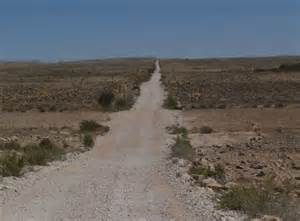
Under Construction in the Wilderness

Wilderness Road (Negev desert)Scripture Text: Isaiah 40: 3-5

3A voice cries out: “In the wilderness prepare the way of the Lord, make straight in the desert a highway for our God. 4Every valley shall be lifted up, and every mountain and hill be made low; the uneven ground shall become level, and the rough places a plain. 5Then the glory of the Lord shall be revealed, and all people shall see it together, for the mouth of the Lord has spoken.”


So, here we wander in the wilderness, hoping against hope that it will all be over soon, that things will finally, once and for all, get back to normal. So, what IS normal? Is it places that are not the wilderness? It is times that are not now? Is it ways of being that were before? Here, the exiles, just released from captivity, dripping with newfound freedom, are beginning to return. They are making their way through the wilderness, headed toward “getting back to normal”. But their city and their way of life lies in ruins. They can’t just go back and pick where they left off. They are looking for comfort, for solace, for a promise that God will put things back the way they were before.


But that is not the promise that has been made. Rather than repair, God promises re-creation; rather than vindication, God promises redemption, and rather than solace, God promises transformation. God is making something new—lifting valleys, lowering mountains, and, ultimately, when all is said and done, revealing a glory that we’ve never seen before. The truth is, there is no going back. So what is normal? Perhaps “normal” is newness, going forward, becoming re-created. What if THAT was normal?


I mean, have you ever really witnessed a highway being built? (If you haven’t, you don’t live where I do!) It’s not easy. It takes preparation and time and lots of heavy lifting. You have to recruit people to do it, you have to clear the way, you have to show people how to navigate through it. And once in a while (or every other week-end, as the case may be where I live), they have to close the road so that it can be made new. See, lifting valleys and lowering mountains is not an easy feat. God is not a magician. (Oh, sure, God could raise and flatten with the wave of a hand, I’m sure, but what fun is that?) In fact, I’m thinking the world, all of Creation, is even now groaning and shaking with all the movement that is happening, wanting at its very core to burst forth into being, to ignore God’s prodding to wait and be patient. And, no, it will never be like it was before. There is no going back. There is never any going back. In this life of faith, “normal” is newness, it is going forward through the wilderness toward a new normal.


At the end of the exile, the people realized that their former lives did not exist. And so, in this new normal, they had to rethink and recast their image of God. They had to find God again in the midst of a strange, new world. They had to discover that God was not in the repair business, that God was not there to clean up their mess and fix their woes, that God loves us too much to put things back the way they were before.


We are no different. This wilderness journey that we are on is not a “break” from our lives. Lent is not a season of denying ourselves and giving up sweets and talking about sin and suffering and repentance over and over and then sliding into to Easter morning with a “whew, glad THAT’S over…now we can go back.” If that were the case, there would be no point. If that’s what you think, there is a chocolate bunny that you can have right now! See, the deal is, the wilderness changes you; it changes your life; it changes the world. God is doing something new. There is a new normal. You can never, ever go back. But you CAN go home again. THAT’S what the wilderness teaches you.


If you always imagine God in the same way, no matter how true and beautiful it may be, you will not be able to receive the gift of the new ways he has ready for you. (Carlos Valles)


FOR TODAY: Think about your Lenten practices that you are doing. What new normal is coming to be?    


Grace and Peace,

Shelli

As If Everything Were Downside Up


upsidedownworldScripture Text: John 2: 13-17

The Passover of the Jews was near, and Jesus went up to Jerusalem. 14In the temple he found people selling cattle, sheep, and doves, and the money changers seated at their tables. 15Making a whip of cords, he drove all of them out of the temple, both the sheep and the cattle. He also poured out the coins of the money changers and overturned their tables. 16He told those who were selling the doves, “Take these things out of here! Stop making my Father’s house a marketplace!” 17His disciples remembered that it was written, “Zeal for your house will consume me.”


We don’t know what to make of this passage. Oh, we try to make sense of it, sort of clean it up so that it doesn’t look so bad. After all, what happened to that loving, mild-mannered Savior that we knew? What happened to the consummate storyteller that knew how to get everyone to listen to him? What happened to Jesus? Here he is, whip raised like some sort of drunken cowboy herding all the sheep and cattle out of the square outside the temple. And then grabbing all of the baskets of coins from the money changers and throwing them on the ground. So, when he walked away there were animals scattered into the town, tables turned over, coins strewn everywhere, and, I’m assuming, some pretty flabbergasted merchants standing around not knowing what to do.


Well, of course, we know why. After all, the temple is God’s house; the temple is a place of reverence and worship. Well, OK, BUT, remember that God dwells everywhere—in you, in me. Remember…God made flesh, Emmanuel, Dwelt among us,..all that stuff. So what exactly was wrong? After all, that was the way society ran. No one was breaking the law. No one was mistreating anyone (or at least not in any way that was not properly sanctioned by both the community and the religious tradition) So what was wrong? Why was Jesus so upset? Because, there they were…essentially selling worship, selling religious practice, selling God.


“Horrible!,” we sigh. But think about our own society.  Think about us. Our lives are reward-driven and because of it we live with the idea that we should get what is “due” to us. We believe that by working hard and doing the right things we will be rewarded. And often that carries into our spiritual lives. How many of us do the things we do because we think we should, because we think that it will in some way earn us points with God, or, even, because we think that we are the only ones that can do them? Oh, you know the stuff. If I pray really hard, God will answer. If I have faith, God will reward me. If I serve God, I will feel good. If I study and try my best to make sense of God, God will guide me and everything will turn out alright. It is our own way of merchandising. What do we do because we love God and what do we do because we think that will reap a reward (or at least insure us against future calamity)?


Meister Eckhart (13th-14th century German mystic) said that “as long as we strive to get something from God on some kind of exchange, we are like the merchants. If you want to be rid of the commercial spirit, then by all means do all you can in the way of good works, but do so solely for the praise of God.” Eckhart then exhorts us to “live as if you do not exist…then God alone dwells there.” So what would that mean, then, to live as if we do not exist? It means to live without an “if-then” statement. It means to live “as if”, as if God’s Kingdom is here in its fullness and glory, as if all of Creation echoes the song of God, as if God dwells in our midst and you are God’s holy temple (oh, yeah…that one IS supposed to be an already one). We live between the already and the not yet. This season of Lent makes that oh so much more real to us as we journey in the wilderness knowing that the Cross, and, indeed, the Resurrection, God’s ultimate act of bringing the downside up, is up ahead.  But that does not mean that the tables cannot be turned—even now. So, to live as if you do not exist, to live as if God dwells in you as a holy temple, what tables in your life does Jesus need to turn downside up to get your attention? (Or what do you need to do to at least live as if it were that way?)


The noblest prayer is when [one] who prays is inwardly transformed into what [one] kneels before. (Angelus Silesius, 17th century)


FOR TODAY:  Think about what tables Jesus need to turn downside up in your life so that you can live as if you do not exist.


Grace and Peace,

Shelli

Sometimes the Wilderness Blooms

Crocus in the desertScripture Text: Isaiah 35: 1-2

 The wilderness and the dry land shall be glad, the desert shall rejoice and blossom; like the crocus 2it shall blossom abundantly, and rejoice with joy and singing. The glory of Lebanon shall be given to it, the majesty of Carmel and Sharon. They shall see the glory of the Lord, the majesty of our God.


Our walk in the wilderness has grown tiresome already. As far as we can look, there is desolation, drought, and despair. When is this going to end already? (Sorry…not even a third of the way there!)  But this passage is almost an interruption. We thought had it in our minds what the wilderness was. For us, the wilderness is a place to get through, to complete, to endure, a pathway to somewhere else. But maybe we’re not giving the wilderness the credit that it is due. After all, would God have created a complete wasteland with no redeeming qualities, no chance for hope? That’s not really God’s style. Maybe we’ve missed something. Maybe we’re trying so hard to overcome the wilderness and run through it, we’ve missed its beauty.


God does not wait until everything in order and the time is right to spring beauty into action. Every inch of creation, every wasteland we endure, has God’s fingerprints all over it. Every single piece is awash in God’s grace, even those whose beauty we cannot yet see either because our eyes have not adjusted to the light or because we have been clouded over with the old way of seeing. Can you see it? Or are we too busy rushing through it hoping that it will end? God’s voice is often out of place with what we see and know about the world. And yet, the desert wasteland is rejoicing in bloom. The passage says that the crocuses (maybe it’s croci) are blossoming abundantly, rejoicing with joy and singing. They abound with the glory of the Lord. We just have to give the wilderness a chance.


Maybe our problem is that we don’t trust first appearances. We want something that is tried and true, that perhaps has been around awhile and weathered all the tests. We want something that makes sense.  But this crocus pops up first. It is a first creation. And we’re not sure what to do. Is it a weed? Is it a flower? What do I do with it? It is God’s newness that at first glance seems to look a little out of place until it begins to gather its flock. (You know, I think that happened before for us. And, again, the world did not know quite what to do with something so out of place, something that so interrupted the way we think and the way we live.) So before we crucify any notion of beauty in the wilderness, let us stop and breathe and see it in bloom. Let us open our eyes and begin, even now while we’re wandering in the darkness, to see our resurrection (that’s right, not only THE Resurrection, but OUR resurrection) that is beginning to be.  Because, SOMETIMES even the wilderness blooms.


Our God is the One who comes to us in a burning bush, in an angel’s song, in a newborn child. Our God is the One who cannot be found locked in the church, not even in the sanctuary. Our God will be where God will be with no constraints, no predictability. Our God lives where our God lives, and destruction has no power and even death cannot stop the living. Our God will be born where God will be born, but there is no place to look for the One who comes to us. When God is ready God will come even to a godforsaken place like a stable in Bethlehem. Watch…for you know not when God comes. Watch, that you might be found whenever, wherever God comes. (Ann Weems, Kneeling in Bethlehem)


FOR TODAY: Stop and look for the blooms in the wilderness. What beauty do you see?

Falling Down Laughing

Falling down laughingScripture Text:  Genesis 17: 4-8

4“As for me, this is my covenant with you: You shall be the ancestor of a multitude of nations. 5No longer shall your name be Abram, but your name shall be Abraham; for I have made you the ancestor of a multitude of nations. 6I will make you exceedingly fruitful; and I will make nations of you, and kings shall come from you.  7I will establish my covenant between me and you, and your offspring after you throughout their generations, for an everlasting covenant, to be God to you and to your offspring after you. 8And I will give to you, and to your offspring after you, the land where you are now an alien, all the land of Canaan, for a perpetual holding; and I will be their God.”

You know the story.  Abram and Sarai have longed for a child, an offspring, a descendent.  But it had never happened.  And now, with more years behind them than ahead, they have resolved that the longing will never come to be.  The first ones to hear this story were more than likely in the midst of exile, living in the wilderness of darkness and looking at the bare remains of a city and temple that once was.  The story comes as a reminder of who they are as the people of God.  It is a reminder that God does not always act within the limits that we have established and the plans that we have formulated in our small minds; rather, God continually jaunts out into the wilderness, into what cannot be, and creates.  It’s ludicrous; it’s incredulous; it’s enough to make you fall down laughing.  But God’s promise remains true.

First, God appears to Abram and announces God’s presence.  Abram falls on his face, downright shocked at who is actually speaking to him.  And with the covenant, Abram becomes Abraham and Sarai becomes Sarah.  The covenant signifies a shift in who they are.  God promises that Abram will have descendents.  And they laughed.  Well, of course they laughed.  It was ridiculous.  Abram and Sarai were old–really, really, really old.  All logic told them that their childbearing years were not just running out but were way behind them.  It just didn’t make sense.  But surprisingly, God often doesn’t make sense in this world that we have figured out.  God continually tends to sort of blow the boundaries and the limits that we have drawn out of the water.

Our lectionary (even the full passage that I didn’t put up at the front of this) doesn’t really include the part where Abram fell down laughing.  Perhaps those who put the lectionary together thought that a bit too irreverent of the mighty God.  After all, would you dare laugh at God?  Well, good grief, don’t you think God is laughing at us sometimes?  Perhaps laughter is what brings perspective.

Abraham laughed.  Sarah laughed.  And I’m betting God laughed.  (You can just imagine the inside joke between the three:  “This is going to be good.  No one will ever believe this could happen.  We’ll just shake them up a bit.”)  Maybe laughter is our grace-filled way of getting out of our self and realizing that, as ludicrous and unbelievable as it may be, God’s promise holds.  Maybe it’s our way of admitting once and for all that we don’t have it all figured out, that, in all honesty, we don’t even have ourselves figured out, that there’s a whole new identity just waiting for us to claim.  In this Season of Lent, we are called to get out of our self, to open ourselves to possibilities and ways of being that we cannot even fathom. Go ahead and laugh.  It is only the beginning.  The promise holds.

You know, I don’t think God really expects us to stay buttoned-up and well-behaved.  God doesn’t want anything that we are not.  God doesn’t want us on our best behavior; God wants us real; God wants us to just flat fall down laughing sometimes at the ludicrousness of it all.  If sometimes tells you not to cry, if someone tells you not to laugh, they are telling you not to be you.  God gave you those expressions of emotion as a wonderful, wonderful gift to get you through it all.  Don’t you think God enjoys a good joke once in a awhile?  After all, this is the God that promised offspring to someone not just past their prime, but downright looking at the tail end of life!  And THEN came through with the promise.  Pretty funny…pretty sneaky…pretty amazing.

I hope that at my funeral, there will be both tears and laughter because then I will know that I have lived the fullness of life.  And then I hope that everyone will leave the church and go dancing because then I will know that they have joy.  The wilderness is known for tears but sometimes you just have to laugh at the ludicrousness of it all.  I don’t know if we laugh our way through the wilderness or out of it, but Abram embraced it and became someone else.  Abraham and Sarah never got to the Promised Land.  It was enough to live with God’s Promise of what it held; it was enough for it to make one fall down laughing in praise to the God who chooses not to live within our rules, who chooses instead to love our laughter and feel our tears and offer grace through it all.

Humor is the beginning of faith and laughter is the beginning of prayer. (Reinhold Niebuhr)

FOR TODAY:  Laugh…laugh…laugh…laugh enough that you fall down in prayer.

Grace and Peace,

Shelli