Threshold

Journey to Bethlehem-colorScripture Passage for Reflection:  Luke 2: 1-5

In those days a decree went out from Emperor Augustus that all the world should be registered. This was the first registration and was taken while Quirinius was governor of Syria. All went to their own towns to be registered. Joseph also went from the town of Nazareth in Galilee to Judea, to the city of David called Bethlehem, because he was descended from the house and family of David. He went to be registered with Mary, to whom he was engaged and who was expecting a child. 

There is a word that we do not use much called “liminality”.  It is from the Latin word for threshold and is used to describe a state of being “betwixt and between”a point of being suspended between what has happened and what will be.  It is likened to being on an airplane flying over the ocean between two continents.  For a few hours, it is as if you are suspended between times, cultures, and nations.  It is as if you are nowhere and everywhere at the same time.  It is a place of enlarged vision, enlarged perspective and no real place to put down roots.  Liminality is a place that our souls crave, a place where our spiritual sense is somehow heightened, a place where se can see both who we are and who we will become.  On this eve of the Great Eve, we find ourselves a little “betwixt and between”.

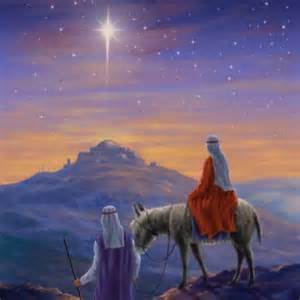
Think of this day so long ago.  Bethlehem was in reach for this scared young couple who were so unsure of exactly what the world held for them.  They were rounding the final peaks of their journey.  But this day they found themselves no longer a part of their old lives and yet they didn’t really know what tomorrow would hold. But now, now they were traveling through a foreign land.  It was the land of Joseph’s family.  He had been there often as a child.  But the place was different somehow, full of those who followed this emperor, nothing like he really remembered.  The road was packed with travelers returning to the place of their ancestors to make their presence known to the government.  Joseph felt like he should know these people and, yet, they were all strangers to him.  Mary and Joseph did not feel like they were part of this new world and yet their old world did not exist.  There didn’t seem to be any room for them at all.

We are indeed standing on the edge of a brave new world.  Oh sure, we do this once a year whether we’re ready or not. Once a year, the night of nights comes and we sing Silent Night and we light our candle and once again welcome the Christ Child into our lives.  Why is this year any different?  Because, in this moment, standing on this edge between who we are and who we will be has the possibility of changing everything.  This is the moment when we decide whether or not to turn toward Bethlehem or to turn and go back.  Standing in this place of “betwixt and between”, we see both, fully in our view.

We are not that different from that scared young couple.  We find ourselves pulled between the life we’ve so carefully created and the life we’ve been promised.  It is hard to not hold so tightly to those structures that give us power and prestige and security.  And yet, God doesn’t call us to leave our lives behind but to live all that we are and all that we have within that vision that God holds for us.  And it is in this moment, standing here between the two that allows us to see how to do that, that allows us to see our lives the way that God sees them and journey on.  It is in this moment that God gives us new eyes and asks us to follow the star.  And if we do that, this year WILL be different.  We are standing in the threshold between a waiting world and one in which the Divine has already poured into our midst.  We live in the already and the not yet.  But for those who see with new eyes, the road ahead is the only one that makes sense anymore.  Because that is the way to Bethlehem.  Let us go and see this thing that has happened.  There’s a world about to be born.

This text speaks of the birth of a child, not the revolutionary deed of a strong man, or the breath-taking discovery of a sage, or the pious deed of a saint.  It truly boggles the mind:  The birth of a child is to bring about the great transformation of all things, is to bring salvation and redemption to all of humanity.

As if to shame the most powerful human efforts and achievements, a child is placed in the center of world history.  A child born of humans, a son given by God.  This is the mystery of the redemption of the world; all that is past and all that is to come.

All who at the manger finally lay down all power and honor, all prestige, all vanity, all arrogance and self-will; all who take their place among the lowly and let God alone be high; all who see the glory of God in the lowliness of the child in the manger:  these are the ones who will truly celebrate Christmas. (From Christmas With Dietrich Bonhoeffer, ed. By Manfred Weber)

Reflection:  On this eve of Eve’s, name those things that are holding you back from THIS year being different.

Grace and Peace,

Shelli
What God is About to Do

HorizonPassage for Reflection:  Isaiah 65: 17-18

For I am about to create new heavens and a new earth; the former things shall not be remembered or come to mind. But be glad and rejoice forever in what I am creating; for I am about to create Jerusalem as a joy, and its people as a delight.

I know…more visioning.  I guess that’s where I am this year.  I’m sorry if you were tuning in hoping to feel good about where you are!  No really, I don’t think God is disappointed in us; God just wants the best for us.  Isn’t that just like God?  There is nothing wrong with where we are.  I love this earth.  I love this country.  I love this state and the fact that I’m generations into it.  I love this city.  I love St. Paul’s.  I love my house.  I love my life.  But in case you think I am nothing more than an annoying cheerleader, I also count on the fact that there is always something more, something just over the horizon.  I think that Advent does a good job of reminding us of that horizon, reminding us that what we have and what we hold is really not “it”.  No, regardless of where we think we’ve been headed, we have not “arrived”.

This passage for today is not some unrealistic pipe dream.  It is not something that slashes our view of the life that we’ve created.  It just shows us something more.  It is real.  It is what God is about to do–maybe not tomorrow, maybe not next week, maybe not even in the next ten centuries.  But we are people of faith.  We are people of what God, always, is about to do.  The question is do we live our lives holding on to what we have or do we live our lives looking for what God is about to do.

There is a Native American tale of a chief who had three sons.  He knew that he was nearing the end of his life and had not yet decided which of his sons would succeed him as chief.  So, he gathered them together and pointed to a mountain in the distance.  “I want you to journey to that mountain, climb to its summit, and bring back the thing you think will be most helpful in leading our people”.  After several days, the first son returned with a load of flint stones, used to make arrow tips and spear points.  He told his father, “Our people will never live in fear of their enemies.  I know where there is a mountain of flint.”  The second son climbed to the top of the mountain, and found forests rich with wood for making fires.  When he returned, he said to his father, “Our people will never be cold in winter.  I know where wood can be found in abundance to keep them warm and to cook their food.  The third son returned late and empty-handed.  He told his father, “When I got to the summit, I found nothing worth bringing back.  I searched and searched, but the top of the mountain was barren rock and useless.  Then I looked out towards the horizon, far into the distance.  I was astonished to see new land filled with forests and meadows, mountains and valleys, fish and animals—a land of great beauty and perfect peace.  I brought nothing back, for the land was still far off and I didn’t have time to travel there.  But I would love to go there someday; I delayed coming back because I found it very difficult to return after seeing the beauty of that land.”  The old chief’s eyes blazed.  He grasped his third son in his arms, proclaiming that he would succeed him as the new chief.  He thought to himself, “The other sons brought back worthy things, necessary things.  But my third son has a vision.  He has seen a better land, the promised land, and he burns with the desire to go there.”

As I said, this is not something that God is dangling out there like some sort of teaser knowing that we will never reach it.  God really means for us to glimpse what God is about to do, to move toward it, to love and desire it so much that we can do nothing else but go toward it.  I do not know what my future holds.  None of us do.  But I know that just over the horizon is something so incredible that I burn with desire to go there.  It is the place that God means for me to go.

Today is the twelfth day of Advent.  (Wait, wasn’t that supposed to be the twelfth day of Christmas?)  We are halfway through this waiting, halfway through this season that calls us to put a hold on our plans, to look to the horizon, to strain and squint for a glimpse, just a glimpse of what will be.  Today is the twelfth day of the twelfth month.  The symbolic meaning of twelve is completeness, whole.  That’s right.  The vision has not come to fruition, but that doesn’t mean that it is not complete.  It is there, just as it should be, just over the horizon.  And now…now we will start living into what we see.  Because, you see, it is about what God is about to do…

Reflection:  What does that place just over the horizon look like to you?  What would you give up to take the time to go toward it?  What do you see that God is about to do?

Grace and Peace,

Shelli

Advent 2A: Shoots and Stumps

Garden of Gethsemane 07 (New Shoots)Advent 2A Old Testament Passage: Isaiah 11: 1-10

A shoot shall come out from the stump of Jesse, and a branch shall grow out of his roots. 2The spirit of the Lord shall rest on him, the spirit of wisdom and understanding, the spirit of counsel and might, the spirit of knowledge and the fear of the Lord. 3His delight shall be in the fear of the Lord. He shall not judge by what his eyes see, or decide by what his ears hear; 4but with righteousness he shall judge the poor, and decide with equity for the meek of the earth; he shall strike the earth with the rod of his mouth, and with the breath of his lips he shall kill the wicked. 5Righteousness shall be the belt around his waist, and faithfulness the belt around his loins. 6The wolf shall live with the lamb, the leopard shall lie down with the kid, the calf and the lion and the fatling together, and a little child shall lead them. 7The cow and the bear shall graze, their young shall lie down together; and the lion shall eat straw like the ox. 8The nursing child shall play over the hole of the asp, and the weaned child shall put its hand on the adder’s den. 9They will not hurt or destroy on all my holy mountain; for the earth will be full of the knowledge of the Lord as the waters cover the sea.  10On that day the root of Jesse shall stand as a signal to the peoples; the nations shall inquire of him, and his dwelling shall be glorious.

We Christians tend to read this with our own Christ-centered lens.  The shoot–newness, replacing the old sad stump–and the branch–us, growing from the foundations that have been laid.  And yet, this Scripture is purely Old Testament, purely Hebrew Scripture.  It speaks of a vision, a vision when life will be what God calls it to be, when the earth and all that it holds will finally once and for all live together just as the Lord intended.  Jesse was the father of David, the pinnacle of the great dynasty of Israel.  But dynasties and kingdoms have life spans just as people do.  And what was once a thriving political powerhouse becomes a stump, seemingly useless for the world, a shadow of the past.  And yet, from what we thought was dead suddenly springs forth life, providing a foundation for a new shoot.  It creates a new order, a new way of seeing the world, a time of peace and unity for all the world.  The people of Israel expected this from their king.  This was what God intended–an order of justice and righteousness and peace.  They long for a dynasty such as this, one with all the solid foundations of the past but one that grows in righteousness.

So, back to the Christ-centered lens…new order, justice, righteousness, peace…isn’t that the thing for which we hope?  In this season of Advent, we once again remember and live that hope of the people of Israel for the Messiah, the Savior of the World.  And we prepare for this year’s coming that will once again push us just a little bit closer to who we are meant to me.  And at the same time we wait for our own Advent, our own coming of God in its fullness.  Advent is all these things.  We long for that new creation.  We long for the day when  warriors will sit down with those that they now attack, when predators will live in peace with their victims, and when those that consume more than they need just because they can finally come to the realization that the resources of this world belong to all.  We hope against hope for a world without poverty and homelessness, without the threat of annihilation from weapons of all kinds, a world where each and every child has enough nutrition and education and healthcare to grow and flourish into who God calls him or her to be.

So, are we the shoot or the stump?  Are we the newness bursting forth or are we the foundation from whence it comes?  The answer is yes.  The two are so inter-connected that they cannot be separated.  The shoot does not just drop out of the sky but is born into generations upon generations of waiting and hoping for the Light to come.

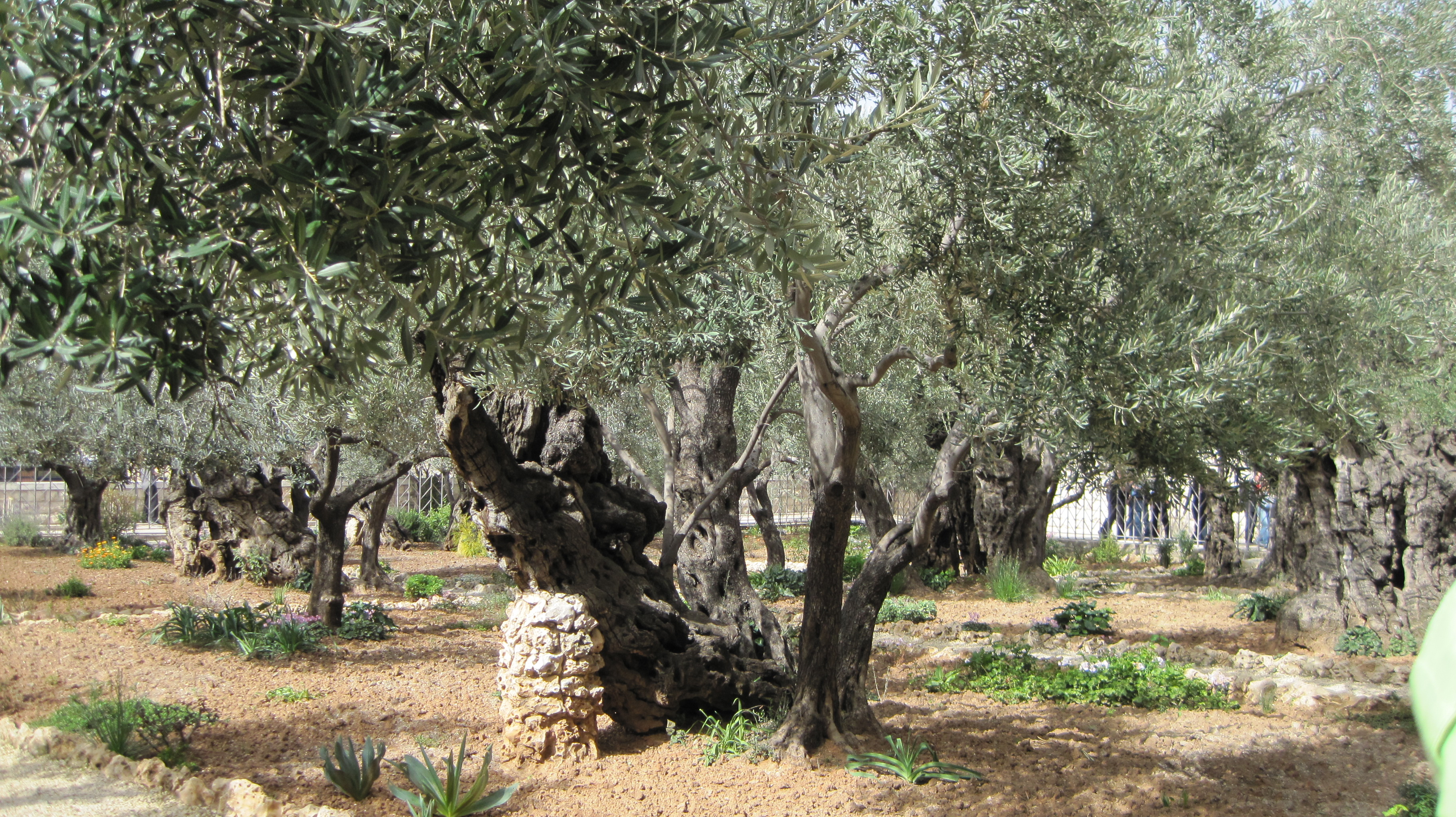
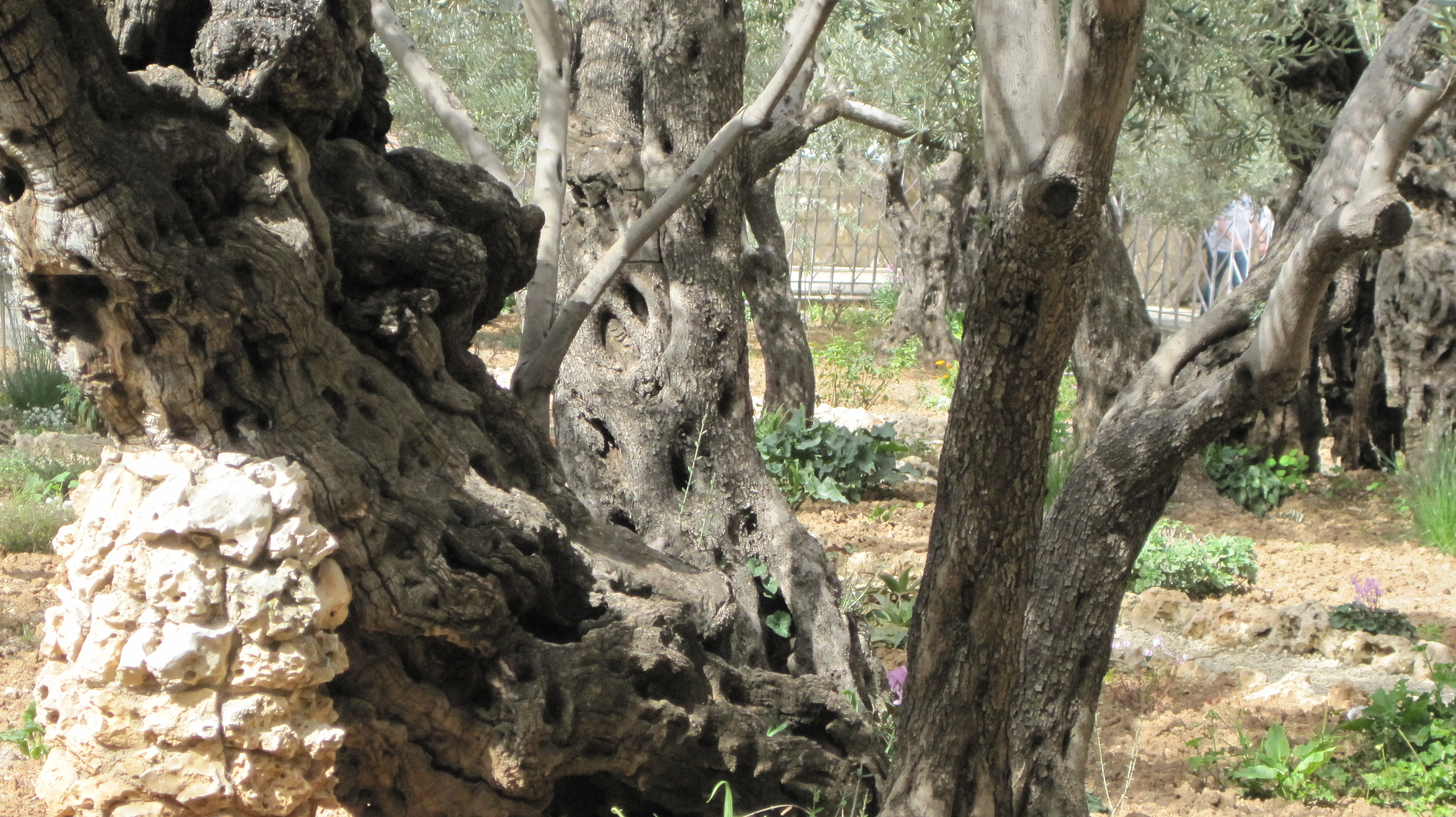
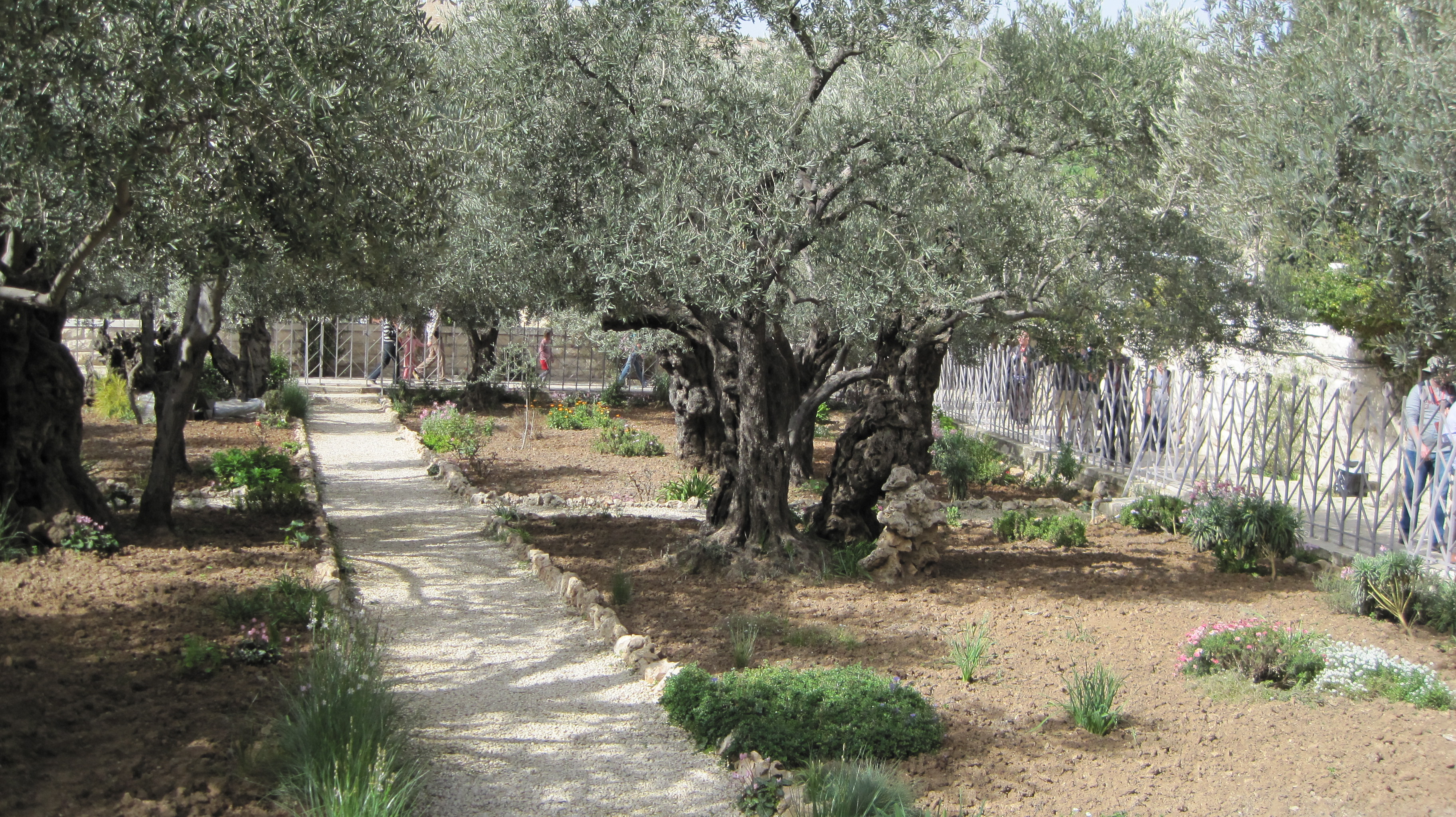
Garden of Gethsemane 08 (New Shoots)When I was in Israel a few years ago, I was fascinated with the olive trees.  You see, they live hundreds or perhaps even a thousand years.  And then they die, they leave what seems to be a mere stump.  But the root system gives way to something new.  So one of the oldest trees has a stump that is thousands of years old, almost petrified from the eons of weathering.  But shooting from its foundation is another tree that is hundreds of years old.  And shooting from it is another younger tree.  And shooting from it is yet another brand new shoot.  The tree is both a stump and a shoot, embracing the foundations of the past but leaving room for newness and recreation, leaving room for God’s work.  And they exist together there in the garden, the Garden of Gethsemane.

God did not create a disposable world, regardless of what we do with it.  God created an earth that would sustain itself not as individual lives making their way on others but as solid foundations giving way to new life.  Both shoots and stumps are part of God’s vision for what will be.  God is not replacing but recreating, redeeming, and resurrecting over and over again.

The fullness of joy is to behold God in everything. (Julian of Norwich)

Reflection:  Where are the stumps in your life?  Now look closer.  What shoots do you see emerging from them?  Are there parts of your life that you have discarded before God was finished working on them?

Grace and Peace,

Shelli

To see my full notes for this week’s Lectionary passages, go to http://journeytopenuel.com/.  If you’d like to get them each week, just follow the blog!

If I Could Turn Back Time

Judas BetrayalToday’s Lectionary Passage:  John 13: 21-32

21After saying this Jesus was troubled in spirit, and declared, “Very truly, I tell you, one of you will betray me.” 22The disciples looked at one another, uncertain of whom he was speaking. 23One of his disciples—the one whom Jesus loved—was reclining next to him; 24Simon Peter therefore motioned to him to ask Jesus of whom he was speaking. 25So while reclining next to Jesus, he asked him, “Lord, who is it?” 26Jesus answered, “It is the one to whom I give this piece of bread when I have dipped it in the dish.” So when he had dipped the piece of bread, he gave it to Judas son of Simon Iscariot. 27After he received the piece of bread, Satan entered into him. Jesus said to him, “Do quickly what you are going to do.” 28Now no one at the table knew why he said this to him. 29Some thought that, because Judas had the common purse, Jesus was telling him, “Buy what we need for the festival”; or, that he should give something to the poor. 30So, after receiving the piece of bread, he immediately went out. And it was night.  31When he had gone out, Jesus said, “Now the Son of Man has been glorified, and God has been glorified in him. 32If God has been glorified in him, God will also glorify him in himself and will glorify him at once.

Poor Judas!  We take this story so literally most of the time, pinning all the bad in all the world on the one that Biblical translations and exegetical interpretations have branded the betrayer, the bad seed, the evil one, the poster child for the worst sin imagineable.  In fact, Dante’ puts Judas in the fourth level of the ninth circle of hell, the lowest rung of the inferno, along with Brutus and Brutus’ co-hort Cassius.   Me?  I tend to err more on the side of mercy.  Because truth be known, don’t you think that Simon Peter was nervous when he was asking that question.  “Lord, who is it?”  In other words, “is it I”?  “Am I the one that will betray my Lord?”  After all, I’m not sure than any of the disciples really came to the forefront.  None of them stood out that night or the next day as glowing examples of who God calls us to be.  They were scared; they were unsure about their own well-being; and they were certainly unsure what life would hold next.  Maybe some had begun to figure out what was about to happen.  I think most of them were like us, living in some sort of state of denial thinking that we are doing the right thing and that everything will turn out alright.

And don’t you think that all of them, Judas included, looked back on the night the next morning and thought, “If only…if only I could turn back time.”?  (yeah, I know that’s a Cher song!) So why did Judas do it?  Oh, please, why do any of us do what we do?  We all have regrets; we’ve all made mistakes; we’ve all wished that somehow we could turn back time.  The truth is, there is a little Judas in all of us.  But in this same passage, there is another character introduced:  “the one whom Jesus loved”.   This is the epitome of light against the foil of Judas in his darkest hour as his actions usher in the time that brings Jesus’ presence as the light of this world to a close.  There is all kinds of speculation.  Was it someone that we don’t know?  Was it Mary Magdelene?  Or was it, perhaps, even Judas? 

Judas could not live with what he had done. The writer of Matthew’s Gospel says that Judas would end his own life that next morning.  (Matthew 27: 3-5)

When Judas, his betrayer, saw that Jesus was condemned, he repented and brought back the thirty pieces of silver to the chief priests and the elders. 4He said, “I have sinned by betraying innocent blood.” But they said, “What is that to us? See to it yourself.” 5Throwing down the pieces of silver in the temple, he departed; and he went and hanged himself. 

And yet, Jesus, knowing what was about to happen, welcomed Judas to the table; in fact, Jesus welcomed all of them, that motley crew of misfits that never really could get it together and were always in competition with each other, that lot of sinners and saints.  The truth is we are all both–the betrayer and the beloved, the sinner and the saint.   God does not love us in spite of who we are; God loves us because of who we are.  The question that we should ask ourselves is whether or not we believe that anyone is ever beyond God’s redemption, beyond God’s love, beyond God’s power to pick up and recreate.  This night of betrayal does not end that way.  This night ends with love and with life.  Because, you see, when it’s all said and done, God really does turn back time.

Madeleine L’Engle tells an old legend that after his death Judas found himself at the bottom of a deep and slimy pit.  For thousands of years he wept his repentance, and when the tears were finally spent he looked up and saw, way, way up, a tiny glimmer of light.  After he had contemplated it for another thousand years or so, he began to try to climb up towards it.  The walls of the pit were dank and slimy, and he kept slipping back down.  Finally, after great effort, he neared the top, and then he slipped and fell all the way back down.  It took him many years to recover, all the time weeping bitter tears of grief and repentance, and then he started to climb again.  After many more falls and efforts and failures he reached the top and dragged himself into an upper room with twelve people seated around a table.  “We’ve been waiting for you, Judas.  We couldn’t begin till you came. (From “Waiting for Judas”, by Madeleine L’Engle, in Bread and Wine:  Readings for Lent and Easter (Maryknoll, NY:  Orbis Books, 2003), 312.)

Garden of Gethsemane, Jerusalem, 2010

So, as you walk through this week, remember that we are all Judas but, more importantly, we are all beloved.  And, remember, that God really does turn back time, so to speak, gathering all of us to the table and recreating us into the fullness of God’s vision for all.  But God cannot begin until you come.

“If I Could Turn Back Time” (Cher)

Grace and Peace,

Shelli

Repurposed

Coal BucketThis Week’s Lectionary Passage:  Isaiah 43: 16-21
16Thus says the Lord, who makes a way in the sea, a path in the mighty waters,17who brings out chariot and horse, army and warrior; they lie down, they cannot rise, they are extinguished, quenched like a wick:18Do not remember the former things, or consider the things of old.19I am about to do a new thing; now it springs forth, do you not perceive it? I will make a way in the wilderness and rivers in the desert.20The wild animals will honor me, the jackals and the ostriches; for I give water in the wilderness, rivers in the desert, to give drink to my chosen people,21the people whom I formed for myself so that they might declare my praise.

I am about to do a new thing…Wake up! Pay attention!  This is going to be incredible!  Remember the context of this passage.  It is probably toward the end of the exile, the end of a time of great loss and despair.  They have lost everything–homes, land, their way of making a living, even their very sense of who they were.  And now this…a new thing.  Let it go…leave it behind…let us go forward toward something new.  Let us begin again.

God is a God of beginning again.  It happens over and over throughout our story.  God takes us from a garden that we threw away and places us in a world.  God takes us from a world that we let get away and placed us on an ark to sail to a new way of being.  God takes us from exile and sends us to freedom.  God takes us from death and heads us toward life.  God is a God of beginning again.  The thing is God is always and forever about to do a new thing.  It is the story of our faith.  Our problem is that we don’t pay attention.  We don’t trust enough to let go.  Our faith tells us that the new creation will be better, will be something that we can’t even fathom right now.  But we stay, attached to our old way of being, to being comfortable and predictable and seemingly in control.

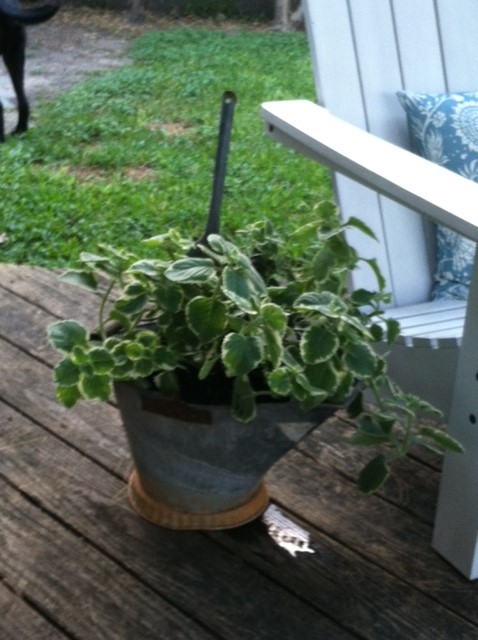
I love old things.  My house and my yard are filled with them.  In fact, I suppose that my house IS one of them.  But living and decorating with old things requires a few tricks.  You want them to look old.  (In fact, I have new things that I want to look old.)  You want them to look old but have a new purpose.  The trick is not to have old things but rather to repurpose them, to bring them in to a new way of being, to perhaps use them in a new way.  So I have an old rusty coal bucket with Cuban Oregano planted in it.  I have an old rusty metal lawn chair that sits out by the bird feeders.  I have old wire baskets that have become shelves.  And I have an old wooden ice chest that is a coffee table.  And my 1920 bungalow has central air, a modern kitchen, and a new bathroom.  Perhaps doing a new thing is not starting over but beginning again with what you have.  Perhaps doing a new thing is repurposing rather than replacing.   Maybe that’s hard for us to embrace.  We live in a disposable society in a temporary world.  The thing that we have is always in need of being replaced by the thing that we want.  So what would it mean to live a life of repurposing?

God created us and calls us into being.  But there is not some new me out there that God is waiting to slip into place.  God is a God of repurposing, of making new what is already here, of giving it new meaning and a new purpose, of giving it new life.  You just have to believe that God is about to do something new with who you are.  That is what faith is all about–believing in repurposing.

Grace and Peace,

Shelli

The Sacred “And”

The Creation of Adam [Humanity], Michelangelo, segment of The Sistine Chapel, c. 1512
This Week’s Lectionary Passage:  2 Corinthians 5: 16-21

16From now on, therefore, we regard no one from a human point of view; even though we once knew Christ from a human point of view, we know him no longer in that way. 17So if anyone is in Christ, there is a new creation: everything old has passed away; see, everything has become new! 18All this is from God, who reconciled us to himself through Christ, and has given us the ministry of reconciliation; 19that is, in Christ God was reconciling the world to himself, not counting their trespasses against them, and entrusting the message of reconciliation to us. 20So we are ambassadors for Christ, since God is making his appeal through us; we entreat you on behalf of Christ, be reconciled to God. 21For our sake he made him to be sin who knew no sin, so that in him we might become the righteousness of God.

Paul starts right off acknowledging Jesus as both divine and human.  That in and of itself is hard for us.  I mean, we like the idea of Jesus coming and walking around in our midst, giving us a much clearer way of understanding what it is we’re supposed to be about.  We like the idea of what sometimes seems to us to be a sort of “semi-human” leading us around and in some satisfactory way “proving” to us that God really does exist.  We like the idea of having someone to emulate.  But, see, Jesus is not a textbook or proof of God’s existence or even a super-hero that we can aspire to be like.  Jesus is fully human, that fully-developed image of the Godself in which we were all created.  Jesus came not to start a religion or even a belief system; Jesus came into our midst, Emmanuel, God With Us, that we might, finally, become human.

But in order to be fully human, in order to become this New Creation about which Paul writes, we have to let go, have to open ourselves to the Divine pouring into us, filling us.  The New Creation is not a denial of humanity.  The coming of God’s Kingdom into our being does not mean that we will become Divine; it means, rather that God’s Spirit, the essence of the Divine will pour into our lives and make us fully human.  St. Athanasius of Alexandria (4th century) supposedly claimed that “Christ became human that we might become divine.”  Now that used to bug me a bit.  It even bugs me when someone refers to another person (or themself!) as “godly”.  I don’t think of myself or anyone else as “like God”.  I actually believe that God pretty much has a monopoly on that way of being.  And yet, if Jesus had NOT come as human, as one of us, then God’s Spirit, the essence of the Divine, would have remained pretty removed and unapproachable for our limited capabilities.  Perhaps Jesus came as human to show us how to open ourselves to the Divine, how to leave room for this pouring in of the sacred and the holy into our lives, how to relate to a God that was never really removed and unapproachable at all. 

The statement says that Jesus came as fully human and fully divine.  The two cannot be separated; otherwise, humanity is removed from God and the Divine remains aloof and inaccessible.  But together, intertwined, eternally connected with a sacred “and”, we become fully human.  We become the one that God created us to be.  We become a new creation, reconciled to God.  We become righteousness, become sacredness, become the essence of God’s Spirit.

So in this Lenten season, be fully human.  Open yourselves to the Spirit of the Divine pouring into your life.  Embrace the sacred “and” of you and God together, Emmanuel, God With Us. 

Grace and Peace,

Shelli