Anointing Presence

mary-anoints-jesusThis Week’s Lectionary Passage: John 12: 1-8
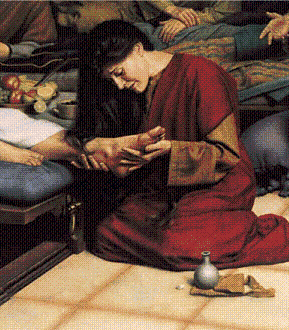
Six days before the Passover Jesus came to Bethany, the home of Lazarus, whom he had raised from the dead. 2There they gave a dinner for him. Martha served, and Lazarus was one of those at the table with him. 3Mary took a pound of costly perfume made of pure nard, anointed Jesus’ feet, and wiped them with her hair. The house was filled with the fragrance of the perfume. 4But Judas Iscariot, one of his disciples (the one who was about to betray him), said, 5“Why was this perfume not sold for three hundred denarii and the money given to the poor?” 6(He said this not because he cared about the poor, but because he was a thief; he kept the common purse and used to steal what was put into it.) 7Jesus said, “Leave her alone. She bought it so that she might keep it for the day of my burial. 8You always have the poor with you, but you do not always have me.”

Several years ago a friend of mine forwarded me one of those prepared video streams with the background music that everyone emails around.  I have to admit that many of them have very little substance and some are bordering on being downright hokey, but this one struck me.  It told of a teacher who asked her students to list the Seven Wonders of the World and write about them.  They began work and most of them came up with the same ones that most of us would:  Egypt’s Grand Pyramids, The Taj Mahal, The Grand Canyon, the Panama Canal, the Empire State Building, St. Peter’s Basilica, and the Great Wall of China (yeah, I know, it depends on what list you’re using, doesn’t it?).  But, to the point, one girl seemed to be having difficulty.  The teacher asked her to read hers aloud so that maybe the others could help.  Her answers to the question “What are the Seven Wonders of the World?” were these:  to see, to hear, to smell, to touch, to feel, to laugh, and to love. 

The story said that you could have heard a pin drop.  What a really incredible answer!  It’s more than just those biological senses that we have to make life enjoyable.  Rather, those are the things that connect us to each other.  Those are the gifts that give us a common humanity and draw us together.  The ability to see, to hear, to smell, to touch, to feel, to laugh, and to love—any of them enable us to reach out and connect to the world around us.  

This story is told in all four canonical Gospel accounts.  But it’s never told the same way twice, illustrating yet again that the Bible is not an historical narrative but rather a way to connect us to God and to each other.  The fact, though, that costly and seemingly extravagant perfumed oil is poured onto Jesus is always the same.  So what does that mean?  What could this costly nard mean in our relationship to God?  I think on some level, it represents presence.  It represents the way that we connect, the way that we relate.  It represents the way that we love.  After all, this story is all about presence and connecting with each other.  They have a dinner together; they are served; Mary touches Jesus’ feet; Mary wipes his feet with her hair.  (You will notice that in none of the accounts is Mary checking her email or texting her friend while she is doing this!)  She is present–fully and completely present.

Sometimes I think that our society (myself included!) sometimes forgets what that’s about.  What does it mean to be present, to fully and completely engage with another, to enter their world, to open yourself up to them, to who they are, to the God that you see in them?  If each of us indeed has a piece of the Godself in us, an image of God in our being, then engaging with each other in this very moment is the very crux of our spiritual journey.  It is the way that we journey to God, becoming aware of the moment and the experience that God has placed before us right now.  Alfred North Whitehead supposedly once said that “the present is holy ground.”  Maybe that’s what Jesus was trying to get across.  “Look, look at me now, be with me now.  Take this moment that God gives you now and feel it, for it is offering you each other–see, hear, smell, touch, feel, laugh, love.  In other words, live loving God and neighbor with all your heart and your soul and your might, with everything that you have.”

On this Lenten journey, we are coming closer and closer to the Cross.  Do not be afraid.  Take each step as it comes and extravagantly anoint it.  See, hear, smell, touch, feel, laugh, love.  The point is the journey itself and what you do while your on it.  Eternity is not “out there” somewhere.  It is here, it is now, beckoning you on this path.

Grace and Peace,

Shelli

Resume’

Resume'This Week’s Lectionary Text: Philippians 3: 4b-14

4even though I, too, have reason for confidence in the flesh. If anyone else has reason to be confident in the flesh, I have more: 5circumcised on the eighth day, a member of the people of Israel, of the tribe of Benjamin, a Hebrew born of Hebrews; as to the law, a Pharisee; 6as to zeal, a persecutor of the church; as to righteousness under the law, blameless. 7Yet whatever gains I had, these I have come to regard as loss because of Christ. 8More than that, I regard everything as loss because of the surpassing value of knowing Christ Jesus my Lord. For his sake I have suffered the loss of all things, and I regard them as rubbish, in order that I may gain Christ  9and be found in him, not having a righteousness of my own that comes from the law, but one that comes through faith in Christ, the righteousness from God based on faith. 10I want to know Christ and the power of his resurrection and the sharing of his sufferings by becoming like him in his death, 11if somehow I may attain the resurrection from the dead. 12Not that I have already obtained this or have already reached the goal; but I press on to make it my own, because Christ Jesus has made me his own. 13Beloved, I do not consider that I have made it my own; but this one thing I do: forgetting what lies behind and straining forward to what lies ahead, 14I press on toward the goal for the prize of the heavenly call of God in Christ Jesus.

This passage begins with Paul almost sounding a little arrogant, as if he is presenting his resume’ for being a church leader and quashing anyone else that might think themself better for the job than he.  But then his tone changes quickly.  It’s as if the resume’ is just not enough.  The resume’ is not going to get someone to the point in this faith journey where they need to be.  So Paul’s words become a treatise on faith itself, rather than on Paul.  In fact, Paul is almost disputing that claim that being better-versed or better-practiced in the faith brings one closer to God.  I think he might even say quite the opposite.  Paul would discount any blind following of the rules and order of religion and opt instead for a bare openness to what the faith journey itself holds.  In fact, my guess is that Paul would claim that any reliance on our resume’ will get us nowhere.

I saw a feature on one of the news shows this week that talked about the “new” look of resumes.  With the changing economy coupled with the changing needs of the job market, the traditional one or two page, neatly blocked listing of one’s accomplishments just doesn’t cut it anymore.  Oh, it’s not bad, per se, but it will probably not get one farther than the myriads of other one or two page, neatly blocked presentations that get tossed into the same pile.  It just doesn’t work anymore.  Instead, prospective employers want to get a sense of who the person is.  People are now posting on Facebook and tweeting their presentations.  They are providing PowerPoint and You Tube media releases that either augment or replace their resume’s.  One guy called the company that he was hoping would hire him and asked for his resume’ to be pulled because he had another offer.  They called and talked him into interviewing and then hired him.  The point is, a resume’ is now more than a list of accomplishments; it depicts who the person is.  (Gee, I thought I was being stupendously cutting edge by printing mine out on cream or ecru colored paper!)

But, face it, we are a list-driven people.  We want to neatly and systematically check off what headway we’ve made and our faith journey is no different.  It’s really sort of a “catch-22” when you think about it.  Our religion and our belief system provide the necessary grounding that we need for our journey.  They point us in the right direction.  They start us on our journey and they keep us with at least some modicum of framework of what that journey entails.  And yet, if we rely on them, if we turn them into some sort of spiritual resume’, we are lost.  In fact, they just downright get in the way.   Religion does not provide the answers; it provides the questions.  The “prize”, if you will, is not the attainment of the goal.  It is not being “in”; it is not finally and forever getting the position that we so desperately want.  The prize is the journey, the opening of our lives so that God can weave through and truly become for us the One in which we live and move and have our being.  And in order to do that, as Paul says, we have to leave ourselves (and our resume’s) behind and journey into who we are rather than what we’ve done.

So, on this Lenten journey, forget who you are and journey toward who you are called to be. (And don’t worry about your resume’…we’re all behind the times anyway!)

Grace and Peace,

Shelli

The Season of Shadows

Scripture Passage: Joel 2: 1-2, 12-17
Blow the trumpet in Zion; sound the alarm on my holy mountain! Let all the inhabitants of the land tremble, for the day of the Lord is coming, it is near—2a day of darkness and gloom, a day of clouds and thick darkness! Like blackness spread upon the mountains a great and powerful army comes; their like has never been from of old, nor will be again after them in ages to come…12Yet even now, says the Lord, return to me with all your heart, with fasting, with weeping, and with mourning;13rend your hearts and not your clothing. Return to the Lord, your God, for he is gracious and merciful, slow to anger, and abounding in steadfast love, and relents from punishing.14Who knows whether he will not turn and relent, and leave a blessing behind him, a grain offering and a drink offering for the Lord, your God?15Blow the trumpet in Zion; sanctify a fast; call a solemn assembly;16gather the people. Sanctify the congregation; assemble the aged; gather the children, even infants at the breast. Let the bridegroom leave his room, and the bride her canopy.17Between the vestibule and the altar let the priests, the ministers of the Lord, weep. Let them say, “Spare your people, O Lord, and do not make your heritage a mockery, a byword among the nations. Why should it be said among the peoples, ‘Where is their God?’”
 
In the shadow of the morning, we can see just a hint of light peeking through the clouds.  There is no brightness, no need to shield our eyes from the glare.  The season of shadows has begun.  We have been through this before.  We know what is to come.  And, yet, we cannot help but continue down the path.  It is where we are called to go.  The Light is at the end.  But to get to it, we must walk through the shadows.  We must walk through the ashes of last year’s palms and the smoky residue of plans we had.  It is the way that we return.  It is the way home.
 
We don’t do well with shadows.  There is something untrustworthy about these shadows, as if they’re hiding something that we cannot see.   But think about it.  A somewhat overcast day is a photographer’s dream.  After all, we need light; we crave light; we are children of the Light!  The darkness is not for us.  It is foreboding.  We do not know which way to go.  But light…full, glaring, heat-ridden light.  It is too much.  So we don our sunglasses and we pull down the shades.  Our eyes are not accustomed to the glare.  It is just too hard to see.  But filtered light, those overcast days, those gray, cloud-filled shadow days that seem to hide something behind it all–those are the ones that let us see.  The glare is gone.  And there is just enough light to illumine our way.  Shadows are disconcerting and, yet, they provide the place for the most clarity.  The filtered colors are brilliant as if all of them are refracted through one prism in brilliant technicolor.  The shadows are where we can truly see.

This is the Season of Shadows.  As hard as it is for us to admit to ourselves, we are not yet ready for the Light.  So God gives us just enough to show us the way without blinding our path.  We will walk for 40 days, stopping to rest every now and then as the Light become brighter, stopping to adjust our eyes.  This is the Season of Shadows, the season of clarity, the season that lights our way when we’re not really ready for the brightness of Home.  Let us now walk, slowly, basking in the shadows.  Even the Shadow is a part of God’s grace.

On this Day of Ashes, remember that even the Shadows were created by God.  And be thankful.

Grace and Peace,

Shelli


Protecting Our Identity

Who are you?  No, I mean really.  Who are you?  Most of us live lives that demand that we take on numerous roles.  For me, I am a pastor, a preacher, a friend, a confidante, a counselor, a teacher, a daughter, a sister, a cousin, a homeowner, a sometimes-writer, a reader, a cook, a lover of antiques, a lover of history, and, right now, a human companion and purveyor of food and treats to one dog that I adopted on purpose and another one that twelve days ago accidentally adopted me (does anyone want a really cute dog?).  And those roles are just the tip of the iceberg.  It gives new meaning to “meeting yourself coming and going”.

The articles and advertisements for protecting one’s identity seem endless nowadays.  It’s the new danger in our world, the chance that someone might steal who we are, that we might somehow lose ourselves.  And so we shred and we cut and we lock and we watch.  We do everything to keep who we are intact. And yet, we find ourselves searching for who we are.  Isn’t that interesting?

God created each one of us.  We are unique, full of gifts and graces, most of which we haven’t even tapped into yet.  Each of us is a child of God, with the ability to become fully human and the desire to connect with the Divine.  I think that God actually envisions something for each of us, that God somehow created us with an idea of what the best of each of us is.  But we’re not children of the Stepford clan.  We are not pre-programmed robots that God wound up at the start and then pushed us down the road with enough battery juice to get us to the end of the road.  No, God’s vision of Creation was much more nuanced and much more beautiful than that.  Somewhere along the way, God decided to instill the notion of free will in us, the wherewithal (if, sometimes, not the ability!) to choose–to choose right from wrong, to choose one road or another, to choose to be one role or to be something completely different.  God gave us life and  envisioned what that life could be, envisioned our identity.  But how we get there is completely up to us.

Maybe this life of faith is about protecting our identity, then–from the world, from all those voices that beg for our time or our money or our attention, and, most of all, from ourselves.  Maybe learning to walk this life of faith is about figuring out how to protect our identity, walking that journey of becoming, losing, recapturing, and becoming again that Being that God envisioned us to be from the very beginning. It’s hard.  So, in this Season of Lent, as we strip away all of those encumbrances that pull us away from ourselves, as we try to find the way back to who we are, maybe it’s not just about becoming someone else, but protecting who we are in the first place.  So who are you?  No, I mean, really.  Who are you?
 
On this eighteenth day of Lenten observance, make a list of all your roles in life.  Which ones drain your existence?  Which ones give you life?  It’s a good thing to think about once in awhile.

Grace and Peace on this Lenten Journey,

Shelli  

And I’m serious…anyone want to adopt a dog?

LENT 2B: Safe Travels

Lectionary Passage: Mark 8: 31-34 (35-38):
Then he began to teach them that the Son of Man must undergo great suffering, and be rejected by the elders, the chief priests, and the scribes, and be killed, and after three days rise again. He said all this quite openly. And Peter took him aside and began to rebuke him. But turning and looking at his disciples, he rebuked Peter and said, “Get behind me, Satan! For you are setting your mind not on divine things but on human things.”  He called the crowd with his disciples, and said to them, “If any want to become my followers, let them deny themselves and take up their cross and follow me.

We want to be safe.  We want everything to turn out alright.  We want some minimal guarantee of what is going to happen in our life.  We want safe travels on this journey.  But that was never part of the promise.

We’re just like Peter.  Sure, Peter got that Jesus was the Messiah.  He knew the words.  He had been taught the meaning probably from his childhood.  He knew that that was what they had been expecting all along—someone to be in control, someone to fix things, someone to make it all turn out like they wanted it to turn out.    And now Jesus was telling them that the way they had thought it would all turn out was not to be, that instead this Messiah, this one who was supposed to make everything right, was to be rejected and would endure great suffering.  “No, this can’t be,” yelled Peter.  This cannot happen.  We have things to accomplish.  We are not done.  This ministry is important. (To whom?)  It cannot go away.  You have to fix this. You have to fix this now! 

Now, contrary to the way our version of the Scriptures interprets it, I don’t think Jesus was accusing Peter of being evil or Satan or anything like that.  I doubt that Jesus would have employed our semi-modern notion of an anthropomorphic view of evil.  More than likely, this was Jesus’ way of reprimanding Peter for getting hung up on the values of this world, getting hung up on our very human desire to save ourselves and the way we envision our lives to be, to fix things.  But what God had in store was something more than playing it safe.  I think that Peter, like us, intellectually knew that.  We know that God is bigger and more incredible than anything that we can imagine.  And yet, that’s hard to take.  We still sort of want God to fix things.  We still sort of want God to lead us to victory, to lead us to being the winning team.  Face it, we sort of still want Super Jesus.  And, of course, Peter loved Jesus.  He didn’t even want to think about the possibility of Jesus suffering, of Jesus dying.

Safety can be a good thing.  I would advocate that we all wear seat belts.  I think having regulations for how children are to ride in vehicles is a prudent practice. (In fact, I’m not real impressed when I see an unrestrained dog in the back of a pick-up!)  And I lock my doors at night.  But our need to be safe can also paralyze us.  It can prevent us from moving forward on this journey as we settle for taking cover from the darkness rather than journeying toward the light.  And in our search for safety, for someone to save us, what do we do with a crucified Savior?  What do we do with the cross?  Well, let’s be honest, most of us clean it up, put it in the front of the sanctuary, and, sadly, go on with the security of our lives.  So, what does it mean “take up your cross and follow”?  I think it means that sometimes faith is hard; sometimes faith is risky; in fact, sometimes faith is downright dangerous. 

In all probability, none of us will be physically crucified for our faith.  But it doesn’t mean that we should clean it up and put it out for display either.  Sometimes our journey will take us through waters that are a little too deep and torrential; sometimes we will find ourselves bogged down by mud; and sometimes faith takes us to the edge of a cliff where we are forced to precariously balance ourselves until we find the way down.  The promise was not that it would be safe; the promise was that there was something more than we could ever imagine and that we would never journey alone.  And along the way, we encounter a Savior that will save us from ourselves.

So, continuing with our act of giving up so that we can take on, on this ninth day of Lent, give up that thing in your life that is keeping you safe and secure on this journey of faith.  Begin to move forward into what God has promised for you. 

Grace and Peace on this Lenten Journey,

Shelli

Beginning the Journey

Whew! It’s over–this season of running and shopping and baking and wrapping and giving and getting and dressing and partying and, oh yeah, worshipping the Christ who has come!  Now we can go back to normal.  Whew!  It’s over!  But what is the deal with all this light around?  Really?  So what was the point?  Truth be told,  as Christmas is the celebration of God’s coming, Epiphany is the manifestation of our going.  Epiphany is the beginning of the journey.  So, in other words, don’t get too comfortable!  There is work to do!

This season of Epiphany probably gets sort of glossed over.  I don’t know, maybe we’re tired.  Maybe we’ve eaten too much or run too much or just too much-ed.  Or maybe we just don’t understand what it’s about.  Epiphany is about making Jesus real, making the Christ child part of your life.  It is about doing beginning to travel down a road that you’ve never traveled before.

We know the story of the Wisemen, those learned ones who came to pay homage to the new king.  I suppose it was just a politically correct fulfillment of accepted etiquette.  There was a new king in town and they would greet him and give him the proper gifts and perhaps he would remember them in the future. (And in the meantime, perhaps the press would treat them kindly in this politically volatile season!) It was, after all, the proper and the smart thing to do. But instead, something happened.  Perhaps it was the star; perhaps it was the king; perhaps it was some sort of divine inspiration.  But, whatever it was, these wandering souls got it.  They saw a pathway that was different than the one that they were on, they saw where God was calling them to go.  And so they went home by another way.

Many of you have heard the Henry Van Dyke story of “The Other Wise Man”.  It is the story of a magi named Artaban, who waited impatiently for the star to shine so that he could travel with the other magi to see the new king. In fact, he had sold all of his possessions and bought three jewels—a sapphire, a ruby, and a pearl—to give to the new baby king.  And, then, he finally saw what he had been waiting for as the dark eastern sky was filled with light.  He hurried to join his friends so that he could meet the king.  But on the way, he came upon the form of a man lying on the side of the road, motionless and dying.  He knew that if he stayed to help the dying stranger, he would miss meeting the Messiah.  So, with a heavy heart, he stayed and cared for the man until his strength returned.  And in return, the man, a Jew, blessed his travel to Bethlehem, where he told him the king had actually been born.  So, left behind by the others, Artaban was forced to sell the sapphire, buy a train of camels, and provisions for the journey. 

But he arrived there three days after the others had departed.  He entered a cottage and found a young mother singing her baby to sleep.  And quietly, the woman told him that the new king and his family had fled secretly in the night.  Suddenly there was a noise outside as Herod’s soldiers came for the child.  Artaban went to the doorway and met the soldiers, telling them that he was alone in the house.  When the soldier did not believe him, he reached in his pocket and pulled out his ruby and gave it to him.  The soldiers went away.  The woman blessed him.

Artaban spent his life searching for the king.  In all this world of anguish, he found many to help, but no one to worship.  He fed the hungry, clothed the naked, healed the sick, and comforted those in despair.  Thirty-three years later, he came for the last time to Jerusalem and was met with a flurry of activity as the city prepared to crucify Jesus of Nazareth.  On hearing this, Artaban knew that this was what he was called to do.  The pearl, the last of his riches, could be offered as ransom for the king’s life.  It was then that a young slave girl was dragged through the streets and threw herself at Artaban’s feet.  Save me, she begged, they are going to kill me.  He sadly took the pearl from his pocket.  It gleamed with radiance as he handed it to the girl so that she could buy her life.  The earth began to shake around him; the sky darkened; and it was then that a heavy tile hit Artaban on the head.  As he lay there, the slave girl bent over him to try to hear what he was saying.  It was then that she heard a faint voice from above—“verily I say unto thee,  Inasmuch as thou hast done it unto one of the least of these my brethren, thou hast done it unto me.”  A calm radiance came over Artaban’s face and he breathed one last breath.  His journey had ended.  His treasures were accepted.  He had met the King many, many times.

Well, obviously, this is fiction.  There’s no basis to it.  It’s not Scriptural.  But the point is that we are the other wisemen.  We are the ones called to the work.  We are the ones that will meet the King.  Maybe we will see it to fruition; more than likely, we will not.  The point is that it’s not about the end-result.  It’s about the journey.  It’s about making the Christ-child real in your lives.  It’s about meeting the King. But more than that, it’s about getting it! It’s about making it real. It’s about letting the Light illumine your life.


God came and the Light shined into our midst.

We are called to follow, to walk in the way illumined by the Light.
Let us follow the Light as it guides us on our journey.
Let us follow the Light as it leads us to Life.
So, in this season of Epiphany, make the newborn Christ real in your life!  There is work to be done!

Grace and Peace,

Shelli     

There’s Always a Plan B

It is comfortable for us to think about the ideal life as one that moves in a straight line–no bumps, no turns, no dead-ends.  It is comfortable for us to think that God has some sort of grand plan for our lives and that God then leads us down this straight, narrow road to get to the glorious end.  Really?  Do you really think that’s it?  I mean, think about it, would you have traded some of the “bumps” and twists in your life’s pathway?  Would you give up who you are today for walking through those?  And what if your life HAD continued down one of the roads on which you started?  Where would you be today?

I’m not really convinced anymore that God lays out some road on which I am to walk.  (I suppose some of you would say that’s the reason I wander off of it as much as I do!)  After all, there’s that free will thing.  If there was one road for each of us and we then chose to wander from that road or just detour around part of it or if we ended up on someone else’s road altogether, would we then be a failure in God’s eyes?  Would we have messed up God’s perfect pre-ordained plan?  Nah…I don’t think that’s the way God works.

I think that God does have a plan, a plan that brings us to a place where we encounter God, to a place where all of who we are–our gifts, our talents, our minds, our hearts, those things we’ve learned and those things we made up on our own, those mistakes and those choices that we’ve made in our lives–comes together into who God calls us to be.  But I don’t think there is one pre-determined road down which we are required to travel to make that happen.  God is much more grace-filled than that!  When we wander from the road on which we’re traveling, when we cut our own path through life, and even when we follow others on a well-worn route, God, with infinite mercy and wisdom does not pull us back to the center of our road;  rather, God moves the path itself and continues journeying with us.  There’s always a Plan B.

God has done this before.  I have a hard time buying in to the idea of God sending Jesus to this earth specifically to die a painful and horrific death just so we slackers could have eternal life.  I hate the thought of Jesus’ sole mission on this earth being born to die.  Oh, don’t get me wrong–the eternal life thing was God’s purpose.  God had that in mind all along; in fact, God had that in mind from the very beginning of Creation.  We just didn’t get it.  So God came and walked this earth, Emmanuel, God with us, to show us the Way, to show us that at the end was the beginning.  I don’t think it went completely as planned.  (Oh, really now, does life EVER go completely as planned?)  Instead of embracing the Way, humanity put an end to it, hanging it on a cross and walking away.  But God, with infinite mercy and wisdom, did something different.  God took the end that we handed God and recreated it into a beginning.  There’s always a Plan B.

In this Lenten season, we’ve talked a lot about roads and pathways.  Maybe Lent is the time to realize that the end of the road is always the beginning, so the purpose of the journey is the journey.  Maybe that’s a good Plan B.

It may be that when we no longer known what to do, we have come to our real work.  And when we no longer know which way to go, we have begun our real journey.  (Wendell Berry)

Grace and Peace,

Shelli