Wishing to See Jesus


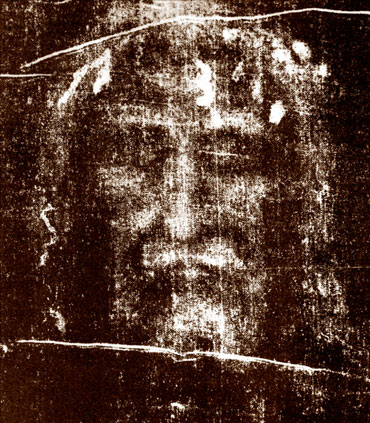
The Shroud of Turin

 Lectionary Passage From Today: John 12: 20-21 (22-36)
Now among those who went up to worship at the festival were some Greeks. They came to Philip, who was from Bethsaida in Galilee, and said to him, “Sir, we wish to see Jesus.”

“Sir, we wish to see Jesus.”  Hmm!  I supposed you and everyone else!  We ALL wish to see Jesus.  But somehow that often eludes us.  Oh, we know that Jesus existed.  We have the stories and all.  But what does it mean to see Jesus, REALLY see Jesus?  It’s got to mean seeing more thatn Jesus as a prophet, or a mighty king or a high priest.  It’s got to mean more than standing alongside Jesus the teacher, Jesus the healer, or even Jesus the friend (Although I would be careful with that one–careful that we do not somehow pull the very human Jesus down to our level.  Jesus was FULLY human.  Jesus was what we’re called to be.)  No, seeing Jesus means beoming a part of The Way that is Christ, entering the mystery, the awe, the very essence that is God.  It means being lifted up and gathered in.

So, when these Greeks came asking to see Jesus, what were they seeking?  Do you think they wanted someone to lead them?  Probably not…they had their own leaders.  They had their own teachers.  They had their own friends.  What they desired was what we all desire–for it all to mean something.  They wanted to understand.  They wanted some sort of proof.  They wanted to see Jesus.

There is a story that is told in Feasting on the Word (Year C, Volume 2) of Anthony the Great, the fourth-century leader of Egyptian monasticism:  A Wise older monk and a young novice would journey each year into the desert to seek the wisdom of Anthony.  Upon finding him, the monk would seek instruction on the life of prayer, devotion to Jesus, and his understanding of the Scriptures.  While the monk was asking all the questions the novice would simply stand quietly and take it all in.  The next year the well-worn monk and the young novice again went into the desert to find Anthony and seek his counsel.  Again the monk was full of questions, while the novice simply stood by withouot saying a word.  This pattern was repeated year after year.  Finally, Anthony said to the young novice, “Why do you come here?  You come here year after year, yet you never ask any questions, you never desire my counsel, and you never seek my wisdom.  Why do you come?  Can you not speak?”  The young novice spoke for the first time in the presence of the great saint.  “It is enough just to see you.  It is enough for me just to see you.”

We all wish to see Jesus.  But seeing Jesus is not about seeing with our eyes.  It is not about information-collecting.  It is not about understanding.  It is not about proof.  It is, rather abut Presence.  The vision is that all would see Jesus and finally have their thirst quenched by the Divine.  But you have to realize for what it is you thirst.  We thirst for the Divine; We thirst to see Jesus.  The Cross is the instrument through which we see Jesus.  It is ont the Cross that Jesus becomes transparent, fully revealed.  Seeing Jesus means that we see that vision of the world that God holds for us.  And seeing Jesus also means that we see this world with all of its beauty and all of its horror.  We see the way that God sees.  And we finally see who we are.  And, finally, we are whole.  Seeing Jesus makes us whole and being whole means that we can finally see Jesus and we see everything else that way that it was meant to be.

In The Naked Now:  Learning to See as the Mystics See, Fr. Richard Rohr talks of the experiences of three ment who stoop by the ocean, looking at the same sunset.  As he relays, one man saw the immense physical beauty and enjoyed the event itself.  This man…deals with what he can see, feel, touch, move, and fix.  This was enough reality for him…A second man saw the sunset.  He enjoyed all the beauty that the first man did.  Like all lovers of coherent though, technology, and science, he also enjoyed his power to make sense of the universe and explain what he discovered.  He thought about the cyclical rotations of planets and stars.  Through imagination, intuition, and reason,, he saw…even [more].  The third man saw the sunset, knowing and enjoying all that the first and the second men did.  But in his ability to profess from seeing to explaing to “tasting,” he also remained in awe before an underlying mystery, coherence, and spaciousness that connected him with everything else.  He [saw] the full goal of all seeing and all knowing.  This was the best.  It was seeing with full understanding.

In order to see Jesus, you have to lay yourself aside and breathe in the mystery of it all.  You have to open yourself to being recreated with the eyes of the Divine.

On this fifth Sunday of Lent, close your eyes and breathe in the mystery that surrounds you.  Close your eyes and feel the Presence of Christ that pervades your life.  Close your eyes that you might see.

Grace and Peace,

Shelli

For the Sake of the World

Mary and Joseph have been traveling for a couple of days.  It’s so hard.  The days are sweltering; the nights are cold.  The wind hasn’t stopped.  It’s just that time of year.  Why are we doing this?  Why are we trying so hard to do the right thing?

The truth is, “God With Us? ” is just sometimes a little uncomfortable.  How can we comfortably live our lives with Emmanuel hanging around?  I mean, really, what are we supposed to do?  I saw a bumper sticker several years ago that said, “God is coming; Look busy!” You laugh (because, granted, it’s funny!), but isn’t that what many of us think deep down? No matter what we say intellectually (that God is with us, that God is everywhere, that God is everything), the truth is that we STILL sort of think of God as some sort of far-away supervisor that is “up there” keeping score of our lives. 

Maybe that’s the point!  Maybe Emmanuel, God With Us, means that we ARE to get busy, that we ARE supposed to do something.  Maybe God just got tired of being relegated to scorekeeper and wanted to show us how to play the game!  The miracle of God’s coming is not about a manger, or a star, or a baby.  It’s not about whether or not Mary was a literal virgin or not! (Really, does it matter that much?) And it’s DEFINITELY not about making sure that we buy each person the same number of presents!  The miracle of God’s coming is that the Divine, conceived as removed and secure from the muck of the world, poured into our midst.  God came that the world might change and that we might change along with it.

So do I know Jesus Christ as my personal savior?  (OK, I’ll probably get in trouble here!)  God didn’t come in the form of Jesus to be my brother, or my friend, or even my personal savior.  God came for the sake of the world.  God came bursting into the struggles of this world so that people like me would wake up, recollect myself, and go forward to do what God calls me to do.  God came that we might be for the other.  In all truth, the meaning of Emmanuel, God With Us, is that God’s coming means that it is time for us to go to others, to the world, to wherever God is calling us to go. God’s coming is our call to going.  We hear it over and over in the Scriptures that will come after this story as the child grows and enters ministry–“rise, take up your bed and go home,” “you give them something to eat,” “love your enemies,” “let your light shine,” “love one another,” “take, eat,” “they know not what they do.”  These are as much a part of the Christmas story as “in those days, a decree went out…”, or “laid in a manger,” or “no room in the inn.”  In fact, this is the way that Emmanuel comes over and over and over again.  God came to us as “fully human” and yet still remains as “fully divine.”  Both are made in the image of God, the image of the God’s unfailing and unfathomable grace in the world.

So, is Jesus my personal savior?  For the sake of the world, I pray so.  It’s not about being on my best behavior; it’s about birthing the Savior of the world into the world for the world. 

Lift up your heads, ye mighty gate; behold the King of glory waits;
the King of kings is drawing near; the Savior of the world is here.

Fling wide the portals of your heart; make it a temple, set apart
from earthly use for heaven’s employ, adorned with prayer and love and joy.

Redeemer, come, with us abide; our hearts to thee we open wide;
let us thy inner presence feel; thy grace and love in us reveal.

Thy Holy Spirit lead us on until our glorious goal is won;
eternal praise, eternal fame be offered, Savior, to thy name.

(Georg Weissel, 1642, trans. by Catherine Winkworth,, 1855)
 
God is coming!  Give yourself the gift of being God With Us, of being God in the world!  Give yourself the gift of making Jesus your personal Savior by being Christ for the sake of the world. 

Grace and Peace,

Shelli


The Cenacle

The Cenacle As it Exists Today
Jerusalem, Israel

Lectionary Text:  John 13: 1-17, 31b-35
Now before the festival of the Passover, Jesus knew that his hour had come to depart from this world and go to the Father. Having loved his own who were in the world, he loved them to the end. The devil had already put it into the heart of Judas son of Simon Iscariot to betray him. And during supper Jesus, knowing that the Father had given all things into his hands, and that he had come from God and was going to God, got up from the table, took off his outer robe, and tied a towel around himself. Then he poured water into a basin and began to wash the disciples’ feet and to wipe them with the towel that was tied around him. He came to Simon Peter, who said to him, “Lord, are you going to wash my feet?” Jesus answered, “You do not know now what I am doing, but later you will understand.” Peter said to him, “You will never wash my feet.” Jesus answered, “Unless I wash you, you have no share with me.” Simon Peter said to him, “Lord, not my feet only but also my hands and my head!” Jesus said to him, “One who has bathed does not need to wash, except for the feet, but is entirely clean. And you are clean, though not all of you.” For he knew who was to betray him; for this reason he said, “Not all of you are clean.” After he had washed their feet, had put on his robe, and had returned to the table, he said to them, “Do you know what I have done to you? You call me Teacher and Lord—and you are right, for that is what I am. So if I, your Lord and Teacher, have washed your feet, you also ought to wash one another’s feet. For I have set you an example, that you also should do as I have done to you. Very truly, I tell you, servants are not greater than their master, nor are messengers greater than the one who sent them. If you know these things, you are blessed if you do them…”Now the Son of Man has been glorified, and God has been glorified in him. If God has been glorified in him, God will also glorify him in himself and will glorify him at once. Little children, I am with you only a little longer. You will look for me; and as I said to the Jews so now I say to you, ‘Where I am going, you cannot come.’ I give you a new commandment, that you love one another. Just as I have loved you, you also should love one another. By this everyone will know that you are my disciples, if you have love for one another.”

The Cenacle, from the Latin cenaculum, or “Upper Room”, is the place where this final gathering takes place.  We usually think of this night as the night of “The Last Supper”, when the Eucharist that we so dearly love came to be.  And yet, the writer of the version of the Gospel narrative that we call John barely mentions the dinner at all.  There seems to be much more focus on Jesus himself, on what he was feeling at this moment, and how he understood what was about to happen to him.  So, if only for a moment, let us forget about the meal…

I visited the site known as the “Upper Room” when I was in Israel last year.  Now understand that it’s more than likely not the REAL Upper Room.  No one really knows for sure where that was.  The traditional site may have been built by the Crusaders possibily into a building that was already there and had survived the destruction of Jerusalem in 70 A.D. under Titus.  But there was still something about going to this Upper Room.  When I entered, my first thought was, “no, this can’t be right!  It’s too big.”  I suppose all of the artistic renditions to which I’ve been exposed over the years had gotten the best of me.  I had somehow imagined this stuffy little room in someone’ attic.  This couldn’t be right.  Then I went back and read the Scripture text.  No where does it say that the disciples were alone with Jesus.  This was the Passover feast, which would have started with the traditional Seder meal including friends and extended family.  And THEN Jesus got up from the table and went to the disciples.

But rather than looking at it solely as an historical event, think about what it really meant.  Jesus knew that this was his final night.  Everything was coming down to this place and this time–his birth, his life, his ministry–and he knew that things were about to change forever.  And all he could think about in that moment was how much he loved those who had been with him.  Yes, they were a little bumbling sometimes, maybe a little too focused on what was in it for them.  And he knew that they really didn’t understand the whole thing.  But they had stuck with him.  How he loved them!  And so he gets up and kneels and washes their feet, taking each foot in both hands and caressing it like a parent caresses his or her child.  It did not matter what they thought. It did not matter that they did not understand.  And it certainly did not matter what anyone around them thought.  This was the moment.  This was the moment when he would teach them to love, would teach them to be vulnerable, would teach them to sit, to just sit there in the presence of their Lord. 

It is hard for us to understand because it is hard for us to just sit and be in the moment, to shut out the world if only for awhile.  But this moment is its own.  For in this moment, Jesus does not think about what is to come.  For just a moment, Jesus does not worry whether or not the disciples can do what needs to be done when he is gone.  And for just a moment, this moment, here in this Cenacle, nothing else in the world matters–not the betrayal, not the denial, not the time when he will die alone and despised by most of the world.  Having loved his own who were in the world, he loved them to the end.  And so in this moment, Jesus loves.

It would be his final teaching.  I think it probably is THE teaching.  Everything is swept into to this moment–this Announced, God-With-Us, Spirit-empowered, disciple-calling, teaching, healing, raising, anointing moment.  It all ends with Love.

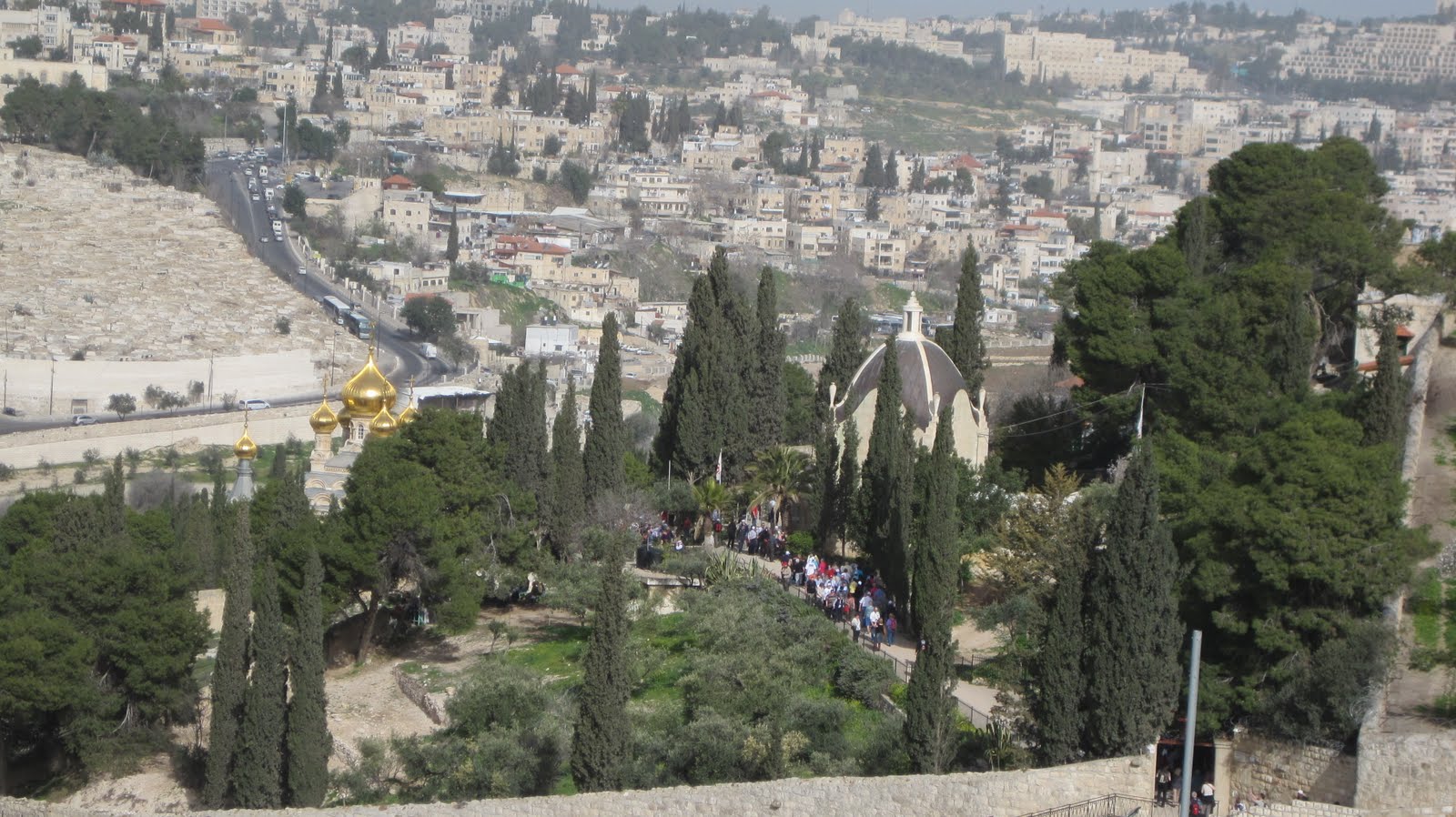
The Garden of Gethsemane
Jerusalem, Israel
February, 2010

After this, the Matthean version of the Gospel depicts Jesus going into the Garden of Gethsemane with his disciples and then going off to pray.  It was his final surrender.  As the night goes on, the events move faster, speeding through an almost surreal order–the betrayal, the handing over, the mock trial–until Jesus is supposedly imprisoned in a dark dungeon in the House of Caiaphas, the high priest.  There he would wait the dawn of Friday morning.

We enter now that Upper Room
And take the wine and bread
And sit as our Lord washes our feet
When we feel we should be washing instead
A late night walk down a winding path,
Into the garden we go
And in the cold of night, Jesus says
Something that we already know.
For on this night it all will end
With naught but a single kiss
Our friend, our teacher, and our Lord
Surely it can’t be ending like this.
Our Lord Jesus now is whisked away
In a flurry of chaotic swarm
And we are left with a helpless silence
As the clouds gather for the storm.
The sun has set in blackest night
And my Lord lies in chains
What has brought us to this place?
Which of us is full of blame?
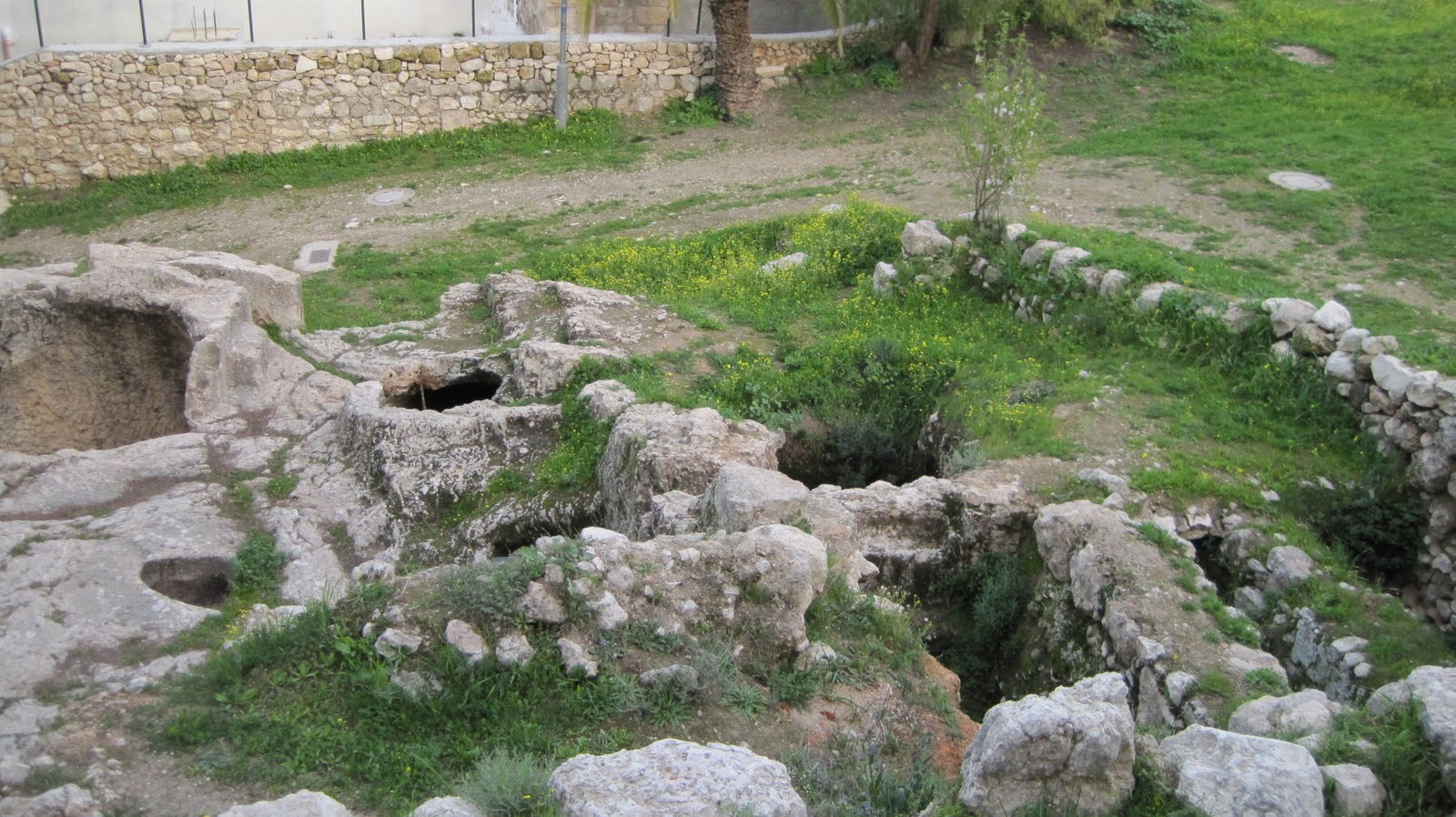
The Ruins of the House of Caiaphas
Jerusalem, Israel, February, 2010

As we come so near to the Cross, let us not grieve yet.  Let us, just for a moment, love as Jesus loves.

Grace and Peace in this holiest of weeks,

Shelli        

Et Tu, Judas

The Judas Tree

Lectionary Text:  John 13: 21-32
After saying this Jesus was troubled in spirit, and declared, “Very truly, I tell you, one of you will betray me.” The disciples looked at one another, uncertain of whom he was speaking. One of his disciples—the one whom Jesus loved—was reclining next to him; Simon Peter therefore motioned to him to ask Jesus of whom he was speaking. So while reclining next to Jesus, he asked him, “Lord, who is it?” Jesus answered, “It is the one to whom I give this piece of bread when I have dipped it in the dish.” So when he had dipped the piece of bread, he gave it to Judas son of Simon Iscariot. After he received the piece of bread, Satan entered into him. Jesus said to him, “Do quickly what you are going to do.” Now no one at the table knew why he said this to him. Some thought that, because Judas had the common purse, Jesus was telling him, “Buy what we need for the festival”; or, that he should give something to the poor. So, after receiving the piece of bread, he immediately went out. And it was night. When he had gone out, Jesus said, “Now the Son of Man has been glorified, and God has been glorified in him. If God has been glorified in him, God will also glorify him in himself and will glorify him at once.

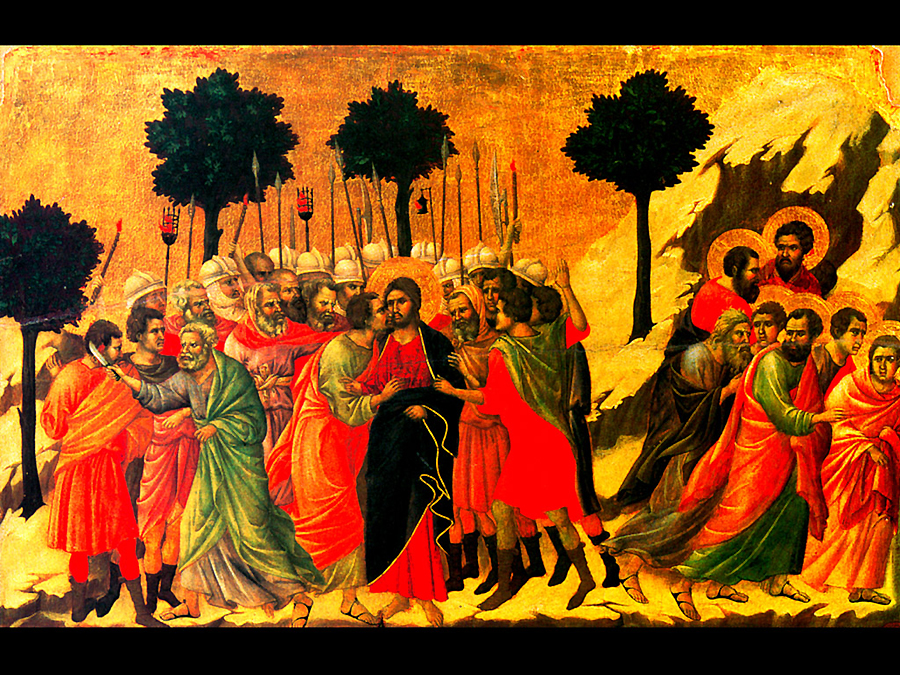
Jesus knew who would betray him.  It was his friend, the one that had accompanied him as he traveled around the lake teaching, the one who had met his family, the one who on those long nights after those just-as-long frustrating days had listened to him.  In fact, it would be the one he trusted.  The one who held the purse that bought them small but nourishing meals and paid their way, the one that had figured out how to budget the money so that they could get to Jerusalem.  It was the one that had it together.  It was the last one that he would have thought would do this.  But Jesus knew who would betray him.  It hurt, hurt more deeply than anyone would ever know.  Et Tu, Judas?  Even you, Judas?

“Kiss of Judas”
Duccio di Buoninsegna (1308)

The others will never figure it out.  They are too busy trying to figure out who it is (and trying to make sure that it’s not them!)  Isn’t that what we do?  In an odd sort of way, this Scripture holds some degree of comfort for us.  After all, Judas is bad, SO bad that whatever it is we mess up can’t possibly be as bad.  And so the world blames Judas for all of our wrongs.  Because, if we make Judas look bad, then maybe we won’t look as bad as we know we might be.  Dante would place him in the fourth level of the ninth rung of hell.  Now let me tell you, that is NOT good.  According to Dante’s Inferno, Judas shares this rung with Brutus and Cassius, who played a part in the murder of Julius Caesar.  (Et Tu, Brute?)  We are no better.  As long as there is a Judas, we
                                                                                        are not the worst.

But, really, do you think God desires our innocence?  If that was the case, we might as well all hang it up right now!  The truth is, none of us is innocent.  Innocence died a really long time ago.  And, interestingly enough, God didn’t have any need to resurrect that.  God does not desire our innocence; God desires us.  God desires repentance, reconciliation, and redemption.  God calls us to turn toward God, be with God, and accept that gift of forgiveness that God offers us.  That’s all it takes.  If God wanted perfect people, I’m thinking God would have made them.  God would have populated the world with a bunch of stepford pod-people and things probably would have gone a lot smoother.  I don’t know…maybe God wanted better dinner conversation.  Maybe God desired a good story.  Or maybe, just maybe, God wanted us to choose God rather than being compelled by something other than ourself.  And so God offers forgiveness for whatever we’ve pulled in the past.  Barbara Brown Taylor, in Speaking of Sin, contends that it is sin that is our only hope.  Because it is when we know that we have failed, when we know that we have moved farther away from God, when we name what it is that stands in our way, that the doors will swing open with a force we never knew and all of a sudden, we find ourselves sitting at the table in a place that we did not think we deserved.  Isn’t God incredible?  So, why do we need to blame Judas?  We are all looking for God.  Sometimes we just make bad choices.  But God always offers us another chance.  Forgiveness is the starting point for change, the beginning of the rest of our eternity.

Madeleine L’Engle tells an old legend that after his death Judas found himself at the bottom of a deep and slimy pit.  For thousands of years he wept his repentance, and when the tears were finally spent he looked up and saw, way, way up, a tiny glimmer of light.  After he had contemplated it for another thousand years or so, he began to try to climb up towards it.  The walls of the pit were dank and slimy, and he kept slipping back down.  Finally, after great effort, he neared the top, and then he slipped and fell all the way back down.  It took him many years to recover, all the time weeping bitter tears of grief and repentance, and then he started to climb again.  After many more falls and efforts and failures he reached the top and dragged himself into an upper room with twelve people seated around a table.  “We’ve been waiting for you, Judas.  We couldn’t begin till you came.”[i]

Et tu, Judas!  Even you, Judas!  Even you!

The path now seems to fly beneath us
And our doubts get carried away
We begin to question if we are more apt
To follow or betray
We hear the story of Judas’ deed
And quickly jump to blame,
But more than that we have to ask
If we might have done the same.

So, in this holiest of weeks, look first at yourself and find those places that separate you from God, and then look to God.  The table is waiting.  We can’t begin till you come!
Grace and Peace in this holiest of weeks,
Shelli

[i] From “Waiting for Judas”, by Madeleine L’Engle, in Bread and Wine:  Readings for Lent and Easter (Maryknoll, NY:  Orbis Books, 2003), 312.


A Lingering Fragrance

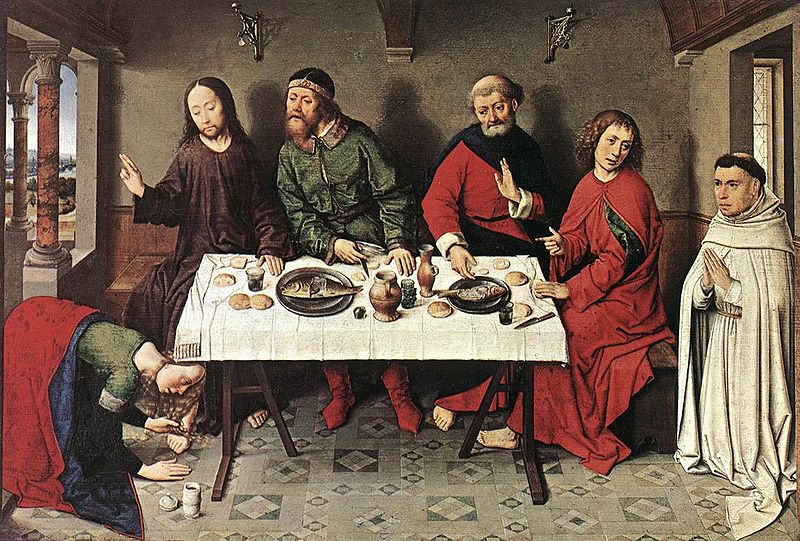
“Christ in the House of Simon”
Dieric Bouts, 1440’s
(Staatliche Museen, Berlin)

Lectionary Text:  John 12: 1-11
Six days before the Passover Jesus came to Bethany, the home of Lazarus, whom he had raised from the dead. There they gave a dinner for him. Martha served, and Lazarus was one of those at the table with him. Mary took a pound of costly perfume made of pure nard, anointed Jesus’ feet, and wiped them with her hair. The house was filled with the fragrance of the perfume. But Judas Iscariot, one of his disciples (the one who was about to betray him), said, “Why was this perfume not sold for three hundred denarii and the money given to the poor?” (He said this not because he cared about the poor, but because he was a thief; he kept the common purse and used to steal what was put into it.) Jesus said, “Leave her alone. She bought it so that she might keep it for the day of my burial. You always have the poor with you, but you do not always have me.” When the great crowd of the Jews learned that he was there, they came not only because of Jesus but also to see Lazarus, whom he had raised from the dead. So the chief priests planned to put Lazarus to death as well, since it was on account of him that many of the Jews were deserting and were believing in Jesus.

You can imagine these friends around this table filled with wonderful-smelling food, telling stories and laughing together.  And then Mary gets up and picks up this beautiful jar full of expensive perfume.  She pours it lavishly on Jesus’ feet not caring how much she used.  The smell of the perfume fills the room.  And Mary kneels all the way down and wipes Jesus’ feet with her hair as it spills onto the floor.  It is not the anointing itself that is all that unusual.  After all, it was normal to anoint kings at their coronation and priests at their ordination.  And, of course, anointing was a way to prepare a body after death.  Mary was anointing Jesus her Lord and King and preparing him for what would come next.  But those there missed that point.  They were much more worried about this expensive oil that was now soaking into the stone floor.

Now you have to understand that women were not supposed to put themselves in a position of being the center of attention. And they were not supposed to touch a man that was not their husband. And for a woman to let her hair down in public would have been considered a disgrace. So as those present saw her, Mary was making a total spectacle of herself. And then she wastes all this perfumed oil. Judas surmised that it could be sold for three hundred denairii. If that were true, that would have been close to one year’s wages for a laborer. But Albert Schweitzer said that “if you own something you cannot give away, then you don’t own it, it owns you.”

Massada, Israel
Taken February, 2010

As for Mary, none of that mattered anyway. The love that she felt for Jesus just made all those things meaningless. She was truly overcome with love for Christ. And she wanted him to know that she got it. And so this act of extravagant generosity, this act of deep, incredible love, the kind of love that Jesus gave, becomes a sort of living embalming, an act that showed Jesus that Mary was with him on his way to the cross.  Think about some of the language—Mary took, poured, and wiped. We will hear those same words this Thursday in the account of Jesus’ last meal: Jesus took the bread, poured out the wine, and wiped the feet of the disciples, and through these common gestures and such common touch, Jesus shows us what true love is. And as Mary takes, and pours, and wipes, she shows that same love toward Christ, and this small crowded house in Bethany becomes a cathedral and this simple meal becomes a Eucharist. Through her touch, through her love, the ordinary becomes sacred. Mary enters Jesus’ life and he becomes part of her. And God enters that very room and Mary feels the presence of the Divine.  Her life becomes a sacrament that shows Jesus’ love to the world. And the whole world is now forever filled with the fragrance of that perfume.

Where do we find ourselves in this story? Jesus has begun the walk to the cross. Are we standing on the sidelines watching the events unfold as if it is some sort of prepared video stream? Are we holding back those things we have because the cost is just too great? Or are we waiting to see what the person next to us will do? I’m afraid that I’m probably not standing in the right place on the stage of this story.  I’m afraid I probably AM too worried about the cost, about the loss, about what people will think.  But each of us is called to take, to pour, and to wipe. Each of us is called to become a living sacrament of Christ’s love. Each of us is called to walk with Christ to the cross. Each of us is called to embody that close a relationship with the living Christ that we will be positively overcome with our love for God. Each of us is called to see, to hear, to smell, to touch, to feel, to laugh, and to love with the depth and passion of Christ.  Oh, I want to be one that spills out all that I am and all that I have with utterly reckless abandon. Because, you see, that is the only way to experience that lingering fragrance that is still in the air.

So we follow our Lord hoping against hope
That soon the road might veer
And get us back to a place we know
A place we do not fear.
And then the fragrance of spilled perfume
Begins to cloud our head
The woman takes and pours and wipes our Lord
And we wonder what we would’ve said.


So, on this holiest of walks, ask yourself what it is that you’re being asked to pour out for Christ and then do it joyfully until it spills onto and covers the floor of the world…

Grace and Peace in this holiest of weeks,

Shelli

Intersection

Lectionary Text:  Matthew 21: 1-11
When they had come near Jerusalem and had reached Bethphage, at the Mount of Olives, Jesus sent two disciples, saying to them, “Go into the village ahead of you, and immediately you will find a donkey tied, and a colt with her; untie them and bring them to me. If anyone says anything to you, just say this, ‘The Lord needs them.’ And he will send them immediately.” This took place to fulfill what had been spoken through the prophet, saying, “Tell the daughter of Zion, Look, your king is coming to you, humble, and mounted on a donkey, and on a colt, the foal of a donkey.” The disciples went and did as Jesus had directed them; they brought the donkey and the colt, and put their cloaks on them, and he sat on them. A very large crowd spread their cloaks on the road, and others cut branches from the trees and spread them on the road. The crowds that went ahead of him and that followed were shouting, “Hosanna to the Son of David! Blessed is the one who comes in the name of the Lord! Hosanna in the highest heaven!” When he entered Jerusalem, the whole city was in turmoil, asking, “Who is this?” The crowds were saying, “This is the prophet Jesus from Nazareth in Galilee.”

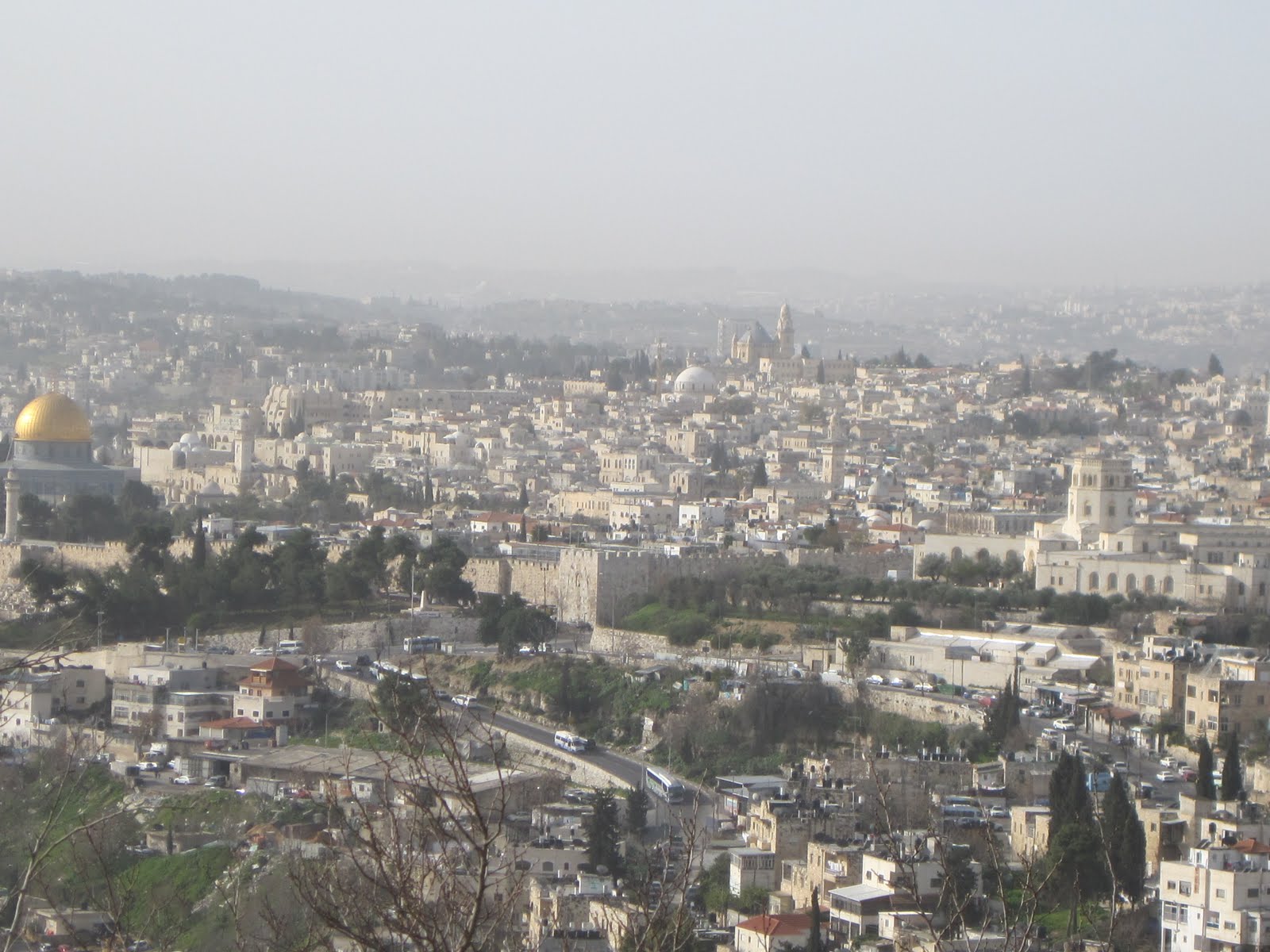
Last year when I had the opportunity to drive into Jerusalem for the first time, my senses told me that this was no ordinary place.  Most cities have a character, sort of a defining theme.  But this is a city of intersections.  Coming together right here in this small city as cities go (only 49 square miles) is the old city, seemingly untouched by time, and the new sparkling buildings surrounding it.  It is today, as it has always been, a place where the conflicts of both social politics and religious politics come together, not in unity but rather somehow choosing to live side by side with boundaries defined by centuries of distrust for each other and often heightened by physical expressions of that conflict.  And, the most powerful for me, was the intersection of my own life that I live often comfortably removed from this walk of Christ with this entrance into these gates that I had read and heard so much about.  It was almost surreal, as if I was being compelled to live the past and at the same time walk headlong into my future.  Because it is easy to say that one follows Christ.  But where are you when the crowd enters into this city where you don’t feel unsafe but you don’t feel at ease?  Intersections are indeed places of faith, places where God meets you, places where you have to choose to follow or not.

The Palm Sunday Road
Taken February, 2010

Most of us love the Palm Sunday passage.  We like waving our palms and processing into the sanctuary as we did this morning.  We like being a part of this Hosanna crowd.  But this is no ordinary parade.  Winding down the narrow Palm Sunday Road from Mt. Olivet through the Garden of Gethsemane, there is no room for bystanders, no room for those of us that want to just see it and then sneak off through the olive trees.  The road is steep and propels us forward toward the Eastern gate of the city.

In their book “The Last Week”, Marcus Borg and Dominic Crossan, contend that this was one of two parades.  The other was a grand and glorious Roman royal military parade coming into the Western gate.   The juxtaposition of these two processions would have set up quite a contrast.  Once came as an expression of empire and military occupation whose goal was to make sure oppressed people did not find deliverance.  It approached the city using horses, brandishing weapons, proclaiming the power of the empire.  The other procession, using a donkey and laying down cloaks and branches along the road, was coming quietly, profoundly proclaiming the peaceful reign of God.  Their contention is that our whole Palm Sunday “celebration”, as we call it, was a parody of the world as we know it, a satirical reminder that we are different.

Now whether you adhere to the notion of the two parades or not, I think it’s a powerful reminder to us what this processional of palms really meant.  Jesus had already made a name for himself from even as far away as Galilee.  But this was the city, the bustling intersection of Roman occupation and religious doctrine.  And when Jesus entered through the Eastern gate with his funny little entourage brandishing palms, even that was proclaiming blasphemous ideals (because remember that it had been prophesied that the Messiah would enter through the Eastern Gate, also known as the Messiah’s Gate and the Golden Gate).

Then he brought me back to the outer gate of the sanctuary, which faces east; and it was shut. The Lord said to me: This gate shall remain shut; it shall not be opened, and no one shall enter by it; for the Lord, the God of Israel, has entered by it; therefore it shall remain shut. Only the prince, because he is a prince, may sit in it to eat food before the Lord; he shall enter by way of the vestibule of the gate, and shall go out by the same way.  (Ezekiel 44: 1-3)

Street in Jerusalem
Taken February, 2010

So once they had entered this gate, this “parade” that we celebrate would have been on a clear collision course with power and might and the way things were in the world.  Once they had walked into the city, these two worlds, these two ways of being, would have collided.  It is easy for us to stand on the side and wave our palm branches but Palm Sunday thrusts us into something else.  It is an intersection of Galilee and Jerusalem, of Jesus’ ministry and Jesus’ Passion, of establishment and holy rebellion, of the ways of society and the Way of Christ.  This Palm Sunday processional, if we stay with it, thrusts us into Holy Week.  That is the reason that this is known as Palm / Passion Sunday.  You cannot disconnect the two notions.  This Way just keeps moving.  Where are you in the crowd?  The Way of Christ has turned toward the Cross.  Will you follow or go back to what you were doing?

On this day we joyously follow the crowd
Palms in hand and praises fair
Unaware that just inside the city gate
Worlds collide and tempers flare.
And we are faced with the choice
Between silent acquiescence and faith portrayed
For one will pacify the world we know
And one will take us farther along Christ’s Way.


As we enter this holiest of weeks, we must decide whether or not to follow.

Grace and Peace in Holiest of Weeks,

Shelli

WALK TO JERUSALEM: Metamorphosis

Scripture Text:  Matthew 17: 1-9
Six days later, Jesus took with him Peter and James and his brother John and led them up a high mountain, by themselves. And he was transfigured before them, and his face shone like the sun, and his clothes became dazzling white. Suddenly there appeared to them Moses and Elijah, talking with him. Then Peter said to Jesus, “Lord, it is good for us to be here; if you wish, I will make three dwellings here, one for you, one for Moses, and one for Elijah.” While he was still speaking, suddenly a bright cloud overshadowed them, and from the cloud a voice said, “This is my Son, the Beloved; with him I am well pleased; listen to him!” When the disciples heard this, they fell to the ground and were overcome by fear. But Jesus came and touched them, saying, “Get up and do not be afraid.” And when they looked up, they saw no one except Jesus himself alone. As they were coming down the mountain, Jesus ordered them, “Tell no one about the vision until after the Son of Man has been raised from the dead.”

So here we have the story of a child born into anonymous poverty and raised by no-name peasants.  He grows up, becomes a teacher, probably a rabbi, a healer, and sort of a community organizer.  He asks a handful of people to become his followers, to help him in his mission.  They leave everything they have, give up their possessions and their way of making a living, they sacrifice any shred of life security that they might have had, and begin to follow this  person around, probably often wondering what in the world they were doing. And then one day, Jesus takes them mountain climbing, away from the interruptions of the world, away from what was brewing below.  Don’t you think they were sort of wondering where they were going?  Oh, if they only knew what would come!  And there on the mountain, they see Jesus change, his clothes taking on a hue of dazzling, blinding white, whiter than anything they had ever seen before.  And on the mountain appear Moses and Elijah, standing there with Jesus—the law, the prophets, all of those things that came before, no longer separate, (and certainly not replacements one for the other) but suddenly swept into everything that Christ is, swept into the whole presence of God right there on that mountain. 

So Peter offers to build three dwellings to house them. I used to think that he had somehow missed the point, that he was in some way trying to manipulate or control or make sense of this wild and uncontrollable mystery that is God. I probably thought that because that’s what I may tend to do. But, again, Peter was speaking out of his Jewish understanding. He was offering lodging—a booth, a tent, a tabernacle—for the holy. For him, it was a way not of controlling the sacred but rather of honoring the awe and wonder that he sensed.  And then the voice…”This is my Son, the Beloved; with him I am well pleased; listen to him!” OK…what would you have done? First the mountain, then the cloud, then these spirits from the past, and now this voice…”We are going to die. We are surely going to die,” they must have thought. And then Jesus touches them and in that calm, collected manner, he says, “Get up and do not be afraid.”  And then, just as suddenly as they appeared, Moses and Elijah drop out of sight. In Old Testament Hebrew understanding, the tabernacle was the place where God was. Here, this changes. Jesus stays with them alone. Jesus IS the tabernacle, the reality of God’s presence in the world. And all that was and all that is has become part of that, swept into this Holy Presence of God.

And so the disciples start down the mountain. Jesus remains with them but he tells them not to say anything. The truth was that Jesus knew that this account would only make sense in light of what was to come. The disciples would know when to tell the story. They saw more than Jesus on the mountain. They also saw who and what he was. And long after Jesus is gone from this earth, they will continue to tell this strange story of what they saw. For now, he would just walk with them. God’s presence remains.

The Greek term for “transfiguration” is “metamorphosis”, deriving from the root meaning “transformation”. It is, literally, to change into something else. There is no going back. The truth is that the disciples probably got a little bit more of God’s presence than they wanted. Because there was more than just Jesus changed on that mountain. The disciples would never be the same again. We will never be the same again. The Hebrews understood that no one could see God and live. You know, I think they were right. No one can see God and remain unchanged. We die to ourselves and emerge in the cloud. The truth is, when we are really honest with ourselves, we probably are a little like the disciples. We’d rather not really have “all” of God. We’d rather control the way God enters and affects our lives. We’d rather be a little more in control of any metamorphosis that happens in our lives. We’d rather be able to pick and choose the way that our lives change. We’d rather God’s Presence come blowing in at just the right moment as a cool, gentle, springtime breeze. In fact, we’re downright uncomfortable with this devouring fire, bright lights, almost tornado-like God that really is God.

Remember the words of the Isaac Watts hymn: “Were the whole realm of nature mine, that were an offering far too small; love so amazing, so divine, demands my soul, my life, my all.” God’s power is God’s power. It does not just come to us; we enter it—taking with it all that we are. It is not a warm and fuzzy relationship; it is wild and risky, full of awe and wander. It is mystery. It is more than anything that we can possibly imagine. It is a complete and total metamorphosis. There is no going back.

This account of the Transfiguration of Jesus seems to us that it should be the climax of the Jesus story—the quintessential mountain-top experience. After all, how can you top it—Old Testament heroes appearing, God speaking from the cloud, and Jesus all lit up so brightly that it is hard for us to look at him. But there’s a reason that the lectionary places this reading immediately before we begin the journey to Jerusalem.  In some ways, it is perhaps the climax of Jesus’ earthly journey. Jesus tells the disciples to keep what happened to themselves, if only for now. And then the lights dim. Moses and Elijah are gone, and, if only for awhile, God stops talking.

Have you ever been mountain climbing? The way up is hard. You have to go slowly, methodically even. You have to be very careful and very intentional. You have to be in control. But coming down is oh, so much harder. Sometimes you can’t control it; sometimes the road is slick and seems to move faster than your feet. And sometimes, through no fault or talent of your own, you get to the bottom a little bit sooner than you had planned. Yes, it’s really harder to come down.  Jesus walked with the disciple in the silence. The air became thicker and heavier as they approached the bottom. As they descended the mountain, they knew they were walking toward Jerusalem.

The Transfiguration is only understood in light of what comes next. Yes, the way down is a whole lot harder. We have to go back down, to the real world, to Jerusalem. We have to walk through what will come. Jesus has started the journey to the cross. We must do the same.

Jerusalem, Israel
February, 2010
Just outside Jerusalem we came to a gate called Truth.  We called to the gatekeeper to let us in.  “The latch is not on,” he replied.  “Anyone who will can enter.”  We went closer, but seeing how great and how heavy was the gate, we looked for a way around.  There must be a way around…The pilgrims trudge toward the death of God.  Only with bowed heads and closed eyes will they be able to see the way to Jerusalem.  (from Kneeling in Jerusalem, by Ann Weems, 63-64)
Our Lenten journey is rounding the bend and we see the city up ahead.  The path has changed us.  So, go cut a palm branch and I will see you in Jerusalem!
Grace and Peace,
Shelli