Climax

clouds-floating-over-a-mountainScripture Passage:  Mark 9: 2-9

2Six days later, Jesus took with him Peter and James and John, and led them up a high mountain apart, by themselves. And he was transfigured before them, 3and his clothes became dazzling white, such as no one on earth could bleach them. 4And there appeared to them Elijah with Moses, who were talking with Jesus. 5Then Peter said to Jesus, “Rabbi, it is good for us to be here; let us make three dwellings, one for you, one for Moses, and one for Elijah.” 6He did not know what to say, for they were terrified. 7Then a cloud overshadowed them, and from the cloud there came a voice, “This is my Son, the Beloved; listen to him!” 8Suddenly when they looked around, they saw no one with them any more, but only Jesus.  9As they were coming down the mountain, he ordered them to tell no one about what they had seen, until after the Son of Man had risen from the dead.

How did we get here so fast?  Everything seemed to just fly by.  Wasn’t it just a few days ago that we were reading of the birth of a child?  Wasn’t it just awhile ago that Jesus was beginning his ministry and calling the disciples to journey with him? In the big scheme of things, we’ve gotten to this point pretty fast.  Here it is—a child born into anonymous poverty and raised by no-name peasants turns out to be the Son of God.  He grows up, becomes a teacher, a healer, and capable of hosting large groups of people with just a small amount of leftovers.  Then he asks a handful of people to become his followers, to help him in his mission.  They leave everything they have, give up their possessions and their way of making a living, they sacrifice any shred of life security that they might have had, and begin to follow this person around, probably often wondering what in the world they were doing.  And we’ve essentially read through all of this in a matter of a few months since early December.  And then one day, Jesus leads them up to a mountain, away from the interruptions of the world.

Now, this is sort of interesting.  There is no proof of an actual geographically-charted mountain.  It is presented as if it just rose up, uninterrupted, from the terrain, as if it is rather a part of the topography of God.  Even for people, such as myself, who cannot claim a single, stand alone, so-called “mountain-top experience” that brought them to Christ but rather came year by year and grew into the relationship…even for us…this IS the mountain-top experience.  And there, on that mountain, everything changes.  The clothes that Jesus was wearing change, taking on a hue of dazzling, blinding, white, whiter than anything that they had ever seen before.  And on the mountain appeared Elijah and Moses, representing the Law and the prophets, the forerunners of our faith, standing there with Jesus.  Peter wanted to build three dwellings to house them.  For me, that’s sort of an interesting part of the story.  Dwellings…I guess because that would keep them here, essentially bound to our way of living.  Dwellings…to control where they were.  Dwellings…to somehow put this incredible thing that had happened into something that made sense, to bring it into the light of the world where we could understand it.  But, instead, they are veiled by a cloud and from the cloud comes a voice, “This is my Son, the Beloved, listen to him!”  “Listen to him!”  And then they were gone and Jesus stood there alone.

The account of the Transfiguration of Jesus seems to us that it should be the climax of the Jesus story.  After all, how can you top it—Old Testament heroes appearing, God speaking from the cloud, and Jesus all lit up so brightly that it is hard for us to look at him.  But there’s a reason that we read this at this point.  In some ways, it is perhaps the climax of Jesus’ earthly journey.  Jesus tells the disciples to keep what happened to themselves, if only for now.  This is the ultimate in thin places, those places of liminality, “betwixt and between” what is and what will be, those places that if we dare to enter, we experience that glimpse of the sacred and the holy.  The light is so bright it is blinding.  God’s glory is so pervasive that we cannot help but encounter it.  And these Old Testament characters?  They show us that this is not a one-time “mountain-top” experience.  It is part of life; it is part of history; it is part of humanity.  Rather than everything of this world being left behind in this moment, it is all swept into being.  It all becomes part of the glory of God.

And then the lights dim.  There are no chariots, Moses and Elijah are gone, and, if only for awhile, God stops talking.  And in the silence, Jesus starts walking down the mountain toward Jerusalem.  From our vantage point, we know what happens there.  And he asks us to follow and gives us all the portions we need to do just that.  And we can.  Because now we see the way to go.  Let us now go to Jerusalem and see this thing that has happened.

The journey to Bethlehem was much more to my liking.  I am content kneeling here, where there’s an aura of angels and the ever-present procession of shepherds and of kings who’ve come to kneel to the Newborn to whom we are newborn.  I want to linger here in Bethlehem in joy and celebration, knowing once I set my feet toward Jerusalem, the Child will grow, and I will be asked to follow. The time of Light and Angels is drawing to a close.  Just when I’ve settled contentedly into the quiet wonder of Star and Child, He bids me leave and follow.  How can I be expected to go back into darkness after sitting mangerside, bathed in such Light?  It’s hard to get away this time of year; I don’t know how I’ll manage.  It’s not just the time…the conversation along the way turns from Birth to Death.  I’m not sure I can stand the stress and pain; I have enough of those already.  Besides, I’ve found the lighting on the road to Jerusalem is very poor.  This time around, there is no Star…

view-of-city-of-jerusalemThe shepherds have left; they’ve returned to hillside and to sheep.  The Magi, too, have gone, having been warned in a dream, as was Joseph, who packed up his family and fled.  If I stay in Bethlehem, I stay alone.  God has gone on toward Jerusalem. (“Looking Toward Jerusalem”, from Kneeling in Jerusalem, by Ann Weems, p. 14-15.)

“If any want to become my followers, let them deny themselves and take up their cross daily and follow me.” (Luke 9: 23b)

Grace and Peace,

Shelli
Encounter

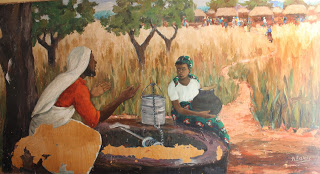
"Women at the Well", part of a mural by Emmanuel Nsama, Zambia
“Women at the Well”, part of a mural by Emmanuel Nsama, Zambia

Scripture Passage:  John 4: 5-26

5So he came to a Samaritan city called Sychar, near the plot of ground that Jacob had given to his son Joseph.6Jacob’s well was there, and Jesus, tired out by his journey, was sitting by the well. It was about noon.7A Samaritan woman came to draw water, and Jesus said to her, “Give me a drink.”8(His disciples had gone to the city to buy food.)9The Samaritan woman said to him, “How is it that you, a Jew, ask a drink of me, a woman of Samaria?” (Jews do not share things in common with Samaritans.)10Jesus answered her, “If you knew the gift of God, and who it is that is saying to you, ‘Give me a drink,’ you would have asked him, and he would have given you living water.”11The woman said to him, “Sir, you have no bucket, and the well is deep. Where do you get that living water?12Are you greater than our ancestor Jacob, who gave us the well, and with his sons and his flocks drank from it?”13Jesus said to her, “Everyone who drinks of this water will be thirsty again,14but those who drink of the water that I will give them will never be thirsty. The water that I will give will become in them a spring of water gushing up to eternal life.”15The woman said to him, “Sir, give me this water, so that I may never be thirsty or have to keep coming here to draw water.”16Jesus said to her, “Go, call your husband, and come back.”17The woman answered him, “I have no husband.” Jesus said to her, “You are right in saying, ‘I have no husband’;18for you have had five husbands, and the one you have now is not your husband. What you have said is true!”19The woman said to him, “Sir, I see that you are a prophet.20Our ancestors worshiped on this mountain, but you say that the place where people must worship is in Jerusalem.”21Jesus said to her, “Woman, believe me, the hour is coming when you will worship the Father neither on this mountain nor in Jerusalem.22You worship what you do not know; we worship what we know, for salvation is from the Jews.23But the hour is coming, and is now here, when the true worshipers will worship the Father in spirit and truth, for the Father seeks such as these to worship him.24God is spirit, and those who worship him must worship in spirit and truth.”25The woman said to him, “I know that Messiah is coming” (who is called Christ). “When he comes, he will proclaim all things to us.”26Jesus said to her, “I am he, the one who is speaking to you.”

The journey has shifted.  No longer are Jesus’ words limited to those in his immediate circle.  He leaves the confines of what he knows and begins to turn to outsiders, those who tradition and cultural and societal norms have rejected. First on the list are the Samaritans.  The less than civil relationship between the Jews and the Samaritans dated back at least 1,000 years before the birth of Christ.  Both believed in God.  Both had a monotheistic understanding of the one true God, the YHWH of their shared tradition of belief.  But where the temple of YHWH for the Jews existed on Mount Zion in Jerusalem, the Samaritans instead worshipped God on Mount Gerizim near the ancient city of Shechem.  And with that, a new line of religious understanding was formed.  The Samaritans believed that their line of priests was the legitimate one, rather than the line in Jerusalem and they accepted only the Law of Moses as divinely inspired, without recognizing the writings of the prophets or the books of wisdom.   What started as a simple religious division, a different understanding of how God relates to us and we relate to God, eventually grew into a cultural and political conflict that would not go away.  The tension escalated and the hatred for the other was handed down for centuries from parent to child over and over again.

So, here is Jesus breaking all of the boundaries of traditional religion.  He, unescorted, speaks to a woman.  He speaks to a woman of questionable repute.  And he speaks to the enemy. The truth is, there is nothing about this woman that is wrong or sinful or anything else that we try to tack on her reputation.  This woman was just different.  Her life had been difficult.  She lived in the shadows of humanity.  And the most astonishing thing is that this seemingly low-class woman who is a Samaritan becomes the witness to the Gospel of Jesus Christ.  Once again, the Gospel is found not in Jerusalem and not on Mt. Gerizim but in our shared existence as part of this “new humanity”.

Now, the woman does miss Jesus’ point.  She looks upon Jesus as some sort of miracle worker, rather than seeing that he offers a new way of being.  Even this story deals with suffering—the woman surely suffered.  Good grief, she was there by herself—couldn’t even face the crowd.  And Jesus—well Jesus was just thirsty.  “Give me a drink…I thirst.” We all have needs; we all have fears—that is the nature of our true humanity.  And maybe the story teaches us that from our need we will realize who God is.  Maybe, in fact, it is IN our very need that we find God, those times when we are unsure of ourselves and not quite so confident that we are heading the right direction in our lives.  So, this woman’s new life begins when she recognizes Jesus’ true identity.  Maybe that’s our problem.  We are still looking for the Jesus that will make our lives easier rather than the one who will give us new life.  We are still looking for a Jesus that will affirm where we are rather than leading us to this new thing that God is doing.  We are still looking for a Jesus that will become our own personal Savior, our own private Messiah, rather than the Salvation and Life of the world.

Our faith journey is not just ours.  Contrary to what some may tell you, you are not carrying the sole responsibility for “getting it right”.  The journey, rather is made up of encounters with those that God places in our path.  At each turn, we grow, we change, our pathway broadens.  The procession to the Cross has already begun.  We are walking together, gathering others into our midst as we walk.  This is what Jesus did.  The journey to the Cross began long before the gates of Jerusalem at the end of the Palm Sunday Road.  The journey began “in the beginning”.  The journey weaved through a garden, into the lessons learn from the stories of an ark, and was there as its followers were carried into exile.  The journey held deliverance and led us up to a mountaintop.  It has held prophets’ voices and the wisdom of sages.  On it were two women named Naomi and Ruth who held each other through their trials.  It was the road for kings and judges and those who were trying to figure out why a life had fallen apart.  The journey turned into a small town outside of Jerusalem where life and clarity and salvation were born.  It returned us to the place of exile, which this time held deliverance.  The journey is one of water and wine and welcome for all.  This journey has taught us how to love and how to thirst.  It has shown us what it means to have faith and not need certainty.  It has taught us that questions are part of it all.

We are still gathering in.  And now it turns…one more mountain to climb and then the procession will enter Jerusalem.  But that is not the end; there is always more up ahead.  But we do not travel alone.  God has already gone before us and still walks with us to show the Way.  So, as our Lenten journey nears Jerusalem, remember from where you’ve come and remember what you have received from those that you have encountered on the way.  Remember who and whose you are.  Remember that you do not walk alone.

Grace and Peace,

Shelli

Add Water and Stir

wedding-feast-cana-ic-4025Scripture Passage:  John 2: 1-11

On the third day there was a wedding in Cana of Galilee, and the mother of Jesus was there. 2Jesus and his disciples had also been invited to the wedding. 3When the wine gave out, the mother of Jesus said to him, “They have no wine.” 4And Jesus said to her, “Woman, what concern is that to you and to me? My hour has not yet come.” 5His mother said to the servants, “Do whatever he tells you.” 6Now standing there were six stone water jars for the Jewish rites of purification, each holding twenty or thirty gallons. 7Jesus said to them, “Fill the jars with water.” And they filled them up to the brim. 8He said to them, “Now draw some out, and take it to the chief steward.” So they took it. 9When the steward tasted the water that had become wine, and did not know where it came from (though the servants who had drawn the water knew), the steward called the bridegroom 10and said to him, “Everyone serves the good wine first, and then the inferior wine after the guests have become drunk. But you have kept the good wine until now.” 11Jesus did this, the first of his signs, in Cana of Galilee, and revealed his glory; and his disciples believed in him.

This was an embarrassing situation—the wine has run out, and there appears to be no solution.  Either no more wine is available, or there is no money to buy more wine. The guests seem unaware of what is happening. If something is not done, all will be embarrassed. Some commentators even inform us that litigation was possible in such cases. (Can you imagine being sued for not providing enough food and drink at a marriage ceremony?)  But, regardless, it is clear that Jesus mother expects Jesus to do something out of the ordinary.  She expects him to fix it.  Maybe it’s a message to us that Jesus didn’t just come for the “big”, splashy things.  Maybe it’s a reminder that God is in even the ordinary, those seemingly small things in life that we think we can handle, that we think don’t really even matter to God.

But this?  I mean, really, wine?  Why didn’t he turn the water into food for the hungry or clothing for the poor?  Why didn’t he end the suffering of one of those wedding guests who were forced to live their lives in pain?  Why didn’t he teach those that were there that God is more impressed by who we are than what we do?  Now THAT would have been a miracle.  But instead Jesus, in his first miraculous act, the first of his signs, creates a party, a feast.  Maybe it’s a reminder that we ought to just relax and trust God a little more.  Maybe it’s trying to tell us that God is indeed in every aspect of our life.  And maybe it’s telling us that life is indeed a feast to be celebrated.

And think about the wine itself.  It begins as ordinary grapes.  Well, not really.  If you go even farther back, you start with water.  Everything starts with water.  And then those ordinary grapes with just the right amount of water, the right amount of sunlight, and the right amount of nutrients fed to them from the rich, dark earth begin to seed.  And then we wait, we wait for them to grow and flourish and at just the right time, they are picked and processed and strained of impurities and all of those things that are not necessary.  And then they are bottled and tucked away while again, we wait.  They are placed in just the right temperature, with just the right amount of light, and just the right amount of air quality, and we wait.  We wait and until it becomes…well, a miracle.

And remember that when the wine ran out, Jesus did not conjure up fresh flagons of wine.  Rather, he took what was there, those ordinary, perhaps even abandoned vessels of ordinary, everyday water and turned it into a holy and sacred gift.  Water and a miracle…So this story of wine makes a little more sense.  Wine is water—plus a miracle.  But in case it is lost on us, remember that our bodies are roughly two-thirds water.  No wonder the ancient sages always used water as a symbol for matter itself.  Humans, they taught, are a miraculous combination of matter and Spirit—water and a miracle—and thus unique in all of creation.  No wonder that wine is such a powerful, sacramental, and universal symbol of the natural world—illumined and uplifted by the Divine.  Wine is water, plus spirit, a unique nectar of the Divine, a symbol of life.  And we, ordinary water-filled vessels though we are, are no different.  God takes the created matter that is us and breathes Spirit into us, breathes life into us.  We, too, are water plus a miracle.  13th century German mystic Meister Eckhart said that “every creature is a word of God.”  It’s another way of reminding us that we are water plus a miracle, God-breathed, holy and sacred.

So in this week “between”, that week when you don’t want to essentially jump into the Passion stories way too soon, we are moving–moving from Bethlehem through Galilee to Jerusalem, moving from birth through growth to maturity, moving from life to death to life again.  This is the week in which the Procession begins.  And here we remember, we remember this child born among us; we remember this child delivered to us; we remember our baptism.  And, now, we remember that that baptism calls us to be something, calls us to be water plus a miracle.  The water has been added.  Now start stirring.  Let your Lenten journey be one that moves your life into what it should be–a miracle.

Grace and Peace,

Shelli

A Place to Flee

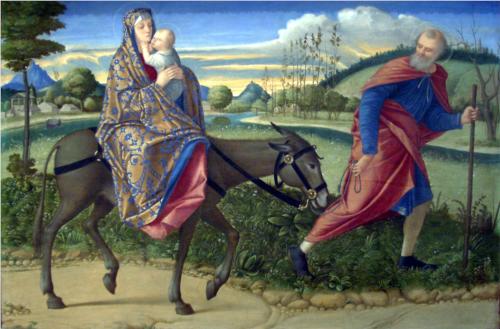
"The Flight Into Egypt", Vittore Carpaccio, c. 1500
“The Flight Into Egypt”, Vittore Carpaccio, c. 1500

Scripture Passage:  Matthew 2:13-2313Now after they had left, an angel of the Lord appeared to Joseph in a dream and said, “Get up, take the child and his mother, and flee to Egypt, and remain there until I tell you; for Herod is about to search for the child, to destroy him.”14Then Joseph got up, took the child and his mother by night, and went to Egypt,15and remained there until the death of Herod. This was to fulfill what had been spoken by the Lord through the prophet, “Out of Egypt I have called my son.”  16When Herod saw that he had been tricked by the wise men, he was infuriated, and he sent and killed all the children in and around Bethlehem who were two years old or under, according to the time that he had learned from the wise men.17Then was fulfilled what had been spoken through the prophet Jeremiah:18“A voice was heard in Ramah, wailing and loud lamentation, Rachel weeping for her children; she refused to be consoled, because they are no more.” 19When Herod died, an angel of the Lord suddenly appeared in a dream to Joseph in Egypt and said,20“Get up, take the child and his mother, and go to the land of Israel, for those who were seeking the child’s life are dead.”21Then Joseph got up, took the child and his mother, and went to the land of Israel.22But when he heard that Archelaus was ruling over Judea in place of his father Herod, he was afraid to go there. And after being warned in a dream, he went away to the district of Galilee.23There he made his home in a town called Nazareth, so that what had been spoken through the prophets might be fulfilled, “He will be called a Nazorean.”

(OK, see, I had something else in mind to write today, but my journey took me another way…Thanks, Mary! :))

We keep talking about our “journey” like it’s some neatly-mapped pathway from one point to another, like there is only one way to get to where we need to go.  But, really, our “journey” is a series of journeys, all connected, all with a beginning and an ending that pushes us into the next leg of our Way.  Rainer Maria Rilke speaks of living one’s life in “ever-widening circles”, all complete and yet inter-connected, each in its completion giving way to the beginning of another and all together creating an infinity of time and space and being.

We don’t deal with this particular Scripture a whole lot.  It appears in the Revised Common Lectionary once in Year A on the first Sunday following Christmas, so it is in competition with New Year’s, national Associate’s Sunday, and, depending on how the calendar falls, Epiphany Sunday.  So what does this mean?  Well, on one level, it is indicative of the unstable and almost chaotic way the world was put together then, with people vying for power and doing anything to make sure that their position stayed as it was (OK, maybe it’s not just about then!).  It is also a depiction of the great love that Mary and Joseph showed for the child Jesus, wanting to protect him, to rush him away, giving up themselves, giving up their own lives, leaving their families, probably Joseph’s carpentry business, leaving all that was familiar and all that was comfortable to make sure that the one that they loved was safe.

But Egypt?  If I remember, Egypt did not go well for Joseph and Mary’s ancestors.  In fact, Egypt represented oppression and slavery and forced labor and loss of home and way of living and way of being and overwhelming despair.  Well, apparently, God can redeem anything!  After all, Joseph is told to flee into the very place from which those before him fled.  This time around, Egypt means safety and freedom and redemption.  Oh, how our journeys turn, giving way to one another!  Perhaps this is a taste of what is to come.  Jesus will never be “safe”; Jesus will never be “comfortable”; Jesus will never be in a place of stability.  Jesus will always be journeying, fleeing from one circle to another–from a home that has no room for his birth to a place of exile that offers freedom and life.  Jesus will spend his life fleeing toward temptation and walking away from self-centeredness.  Jesus will spend his life with no place to lay his head and fleeing toward Jerusalem.  Jesus’ life of ever-widening circles will take him from rejection by his own to welcome to a place of exile over and over again.

Maybe each of our journeys prepares us for what’s to come, for not only the next, but to resolution down the road of a journey that we once thought had ended.  Perhaps this image of Egypt not as a captor but as redemption is a foretaste of what’s to come, that an instrument of death, an ending that logic tells us has no redemption, begins again.  And there, we will be called to the home where we have always belonged, where there was always room.

So on this Lenten journey, think of your journeys, think how they connect, how they redeem each, and how each is part of calling you home.  And imagine that the one that ends in despair could possibly be the one that begins your life.

Grace and Peace,

Shelli

Station X: Stripped Naked


"Station 10", Peter Adams, 2012
“Station 10”, Peter Adams, 2012

Scripture Passage:  John 19: 23-25a

23When the soldiers had crucified Jesus, they took his clothes and divided them into four parts, one for each soldier. They also took his tunic; now the tunic was seamless, woven in one piece from the top. 24So they said to one another, ‘Let us not tear it, but cast lots for it to see who will get it.’ This was to fulfil what the scripture says, ‘They divided my clothes among themselves, and for my clothing they cast lots.’ 25And that is what the soldiers did.

This tenth station of the Via Dolorosa recalls that the Roman soldiers stripped Jesus of his clothing and gambled for his robe near where Jesus was to be crucified.  Visitors can peer into a Latin chapel through a special window.  This station is disconcerting, to say the least.  Keep in mind that Jesus was Jewish and, as a Jew, had been taught that it was a disgrace to be seen naked.  This would have been the ultimate disgrace.  Jesus, stripped of his humanness and his very dignity, is being prepared for crucifixion.

Dignity is a strange thing.  We think of it as something that we humans can bestow or take away from each other at will.  And, yet, dignity by its very definition is described as innate.  It is a gift from God, a gift of our humanity, so removing it from another is essentially depriving them of something that has not only been given to them but is part of them.  So stripping Jesus of his garments was the way that his tormenters removed his dignity, the way that they made him something less than human, the way that they, in their minds, put him in some way beneath humanity, in some way less than themselves.

Sadly, there are ways that we continue to strip others of their dignity, ways that we over and over again strip humanity of the gifts that God has bestowed.  And it’s not limited to physical stripping, although we as a people are guilty of that over and over again as we allow that to happen to others.  Putting someone in a place of humiliation, a place where they can no longer be who they are called to be does the same thing.  Anytime that we become so convinced of our “rightness”, of our position of being above others, anytime that we misuse and abuse conceived power over others, anytime that we refuse to accept others because they are different than what we think they should be, we have again stripped the garments of Christ from our world.

And yet, Jesus was seemingly passive as the soldiers stripped away at his garments and bared his nakedness for all to see.  Maybe it was because he knew, he knew that he was being stripped of his humanness.  This is the turning point.  This is the way that one prepares oneself, by stripping away at the things that get in the way.  This is the final hour.  The cross is being prepared and Jesus along with it.

So on this Lenten journey, let us allow ourselves to be stripped of those things that get in the way, let us allow ourselves to be humbled that we might be open to receive the Divine into our lives.

Grace and Peace,

Shelli

Station III: Vulnerable

“Station III”, painting by Chris Gollon
Commissioned in 2000 by
St. John on Bethnal Green, London

Scripture Passage:  Matthew 7:25
The rain fell, the floods came, and the winds blew and beat on that house, but it did not fall, because it had been founded on rock.

The third station of this Way of the Cross is the image of Jesus falling under the weight of the cross.  It is one of the non-Canonical stations and yet we know that the sheer exhaustion alone would be enough to make this a reality for any human.  That’s right.  Lest we forget, Jesus was human.  God did not come to earth to live as a figure resembling one of our super heroes, above the fray, untouchable, undaunted by the difficulties of human life.  No, God came as one of us, struggling and vulnerable.  And as Jesus falls, we feel that vulnerability.  It is uncomfortable for us.  After all, if this one on whom we rely, in whom we place all of our hopes and our dreams, is vulnerable, what does that say about out own lives?

Maybe the crux of this Walk is that we ARE supposed to be vulnerable.  Living a life of faith does not place some sort of impermeable bubble around us.  Regardless of what many will tell you, walking this walk does not guarantee that you will be healthy, wealthy, and wise.  If anything, it points to our vulnerability in the most profound way.  As humans, we will at times experience sadness, despair, and the deepest grief imagineable.  We experience those not because we are weak but because we are real.  And Jesus experienced the same thing because he, too, was real.  And, when you think about it, what kind of God is it who will plunge the Divine Self into the deepest of despair and the vulnerability?  It is the kind of God that does more than pull us out of it but rather lays at the bottom of it all and cradles us until it subsides.  But we will only experience that when we allow ourselves to be vulnerable, when we allow ourselves to be real, when we finally allow ourselves to need others, to let them in to our darkness.

This depiction of Jesus falling under the weight of the Cross affirms that vulnerability is part of us.  It also compels us toward the vulnerable, the hurting, the outcast, for it is there that we will find in ourselves empathy and compassion, and, finally, a Love greater than we thought we could have.  If we allow ourselves to be vulnerable, we will be able to see the same in others.  We are not called to become a Super Hero; we are called to cross boundaries and be Christ for others when they need it the most and, perhaps with even greater faith than that, we are called to let others into our grief and pain.  We are the ones who both lift the fallen and allow ourselves to be lifted.  Sometimes we will fall.  Sometimes life will hurt.  But we are never there alone.  But it takes great faith to know that.

Jesus will fall two more times on this Walk.  Life goes on.

Grace and Peace,

Shelli  

Dancing in the Rain

Image from “Singing in the Rain” (1952)
(with Gene Kelly)

Lectionary Passage:  John 6: 1-21
To read this passage online, go to http://bible.oremus.org/?passage=John+6:1-21&vnum=yes&version=nrsv

We love this story.  (And they must have loved it in the first century because the writers of all four gospels chose to include it their unique account of the Good News of Jesus Christ.) Yes, we like the notion of Jesus providing everything we need, bursting in just when we are at the end of our ropes, just when we need help the most, and fixing the ails of our life (or at least feeding us lunch!).

But notice (don’t you hate that…yes, I’m about to ruin your image of super-hero Jesus pulling lunch out of a hat or whatever we thought he did!) that the story never says that the boy’s lunch was the ONLY food there.  Perhaps there were some people holding back what they had brought, afraid to offer it for community consumption because, after all, what if they ran out?  What if they needed it tomorrow or the next day or after they retire?  So, perhaps the miracle lies not in some sort of image of Jesus creating something from nothing but rather in the little boy himself.  He was first, freely offering what he had to Jesus and the Disciples to do whatever they needed to do with it.  Now, note what was in the little boy’s lunch–barley bread and fish.  Barley is a very inexpensive and somewhat “unglamourous” grain and fish were plentiful.  After all, they were right next to this huge lake.  (Just to get it in your head, the “Sea” of Galilee is actually a huge lake.)  In other words, this was the lunch of the poor.  The little boy was more than likely not from a family of means.  Perhaps his mom had lovingly packed all they had into his lunch so that her son could have this experience of seeing this great man Jesus of whom they had only heard.  But before that ever happened, the little boy stood and offered everything he had.

And, then, well you know how it goes.  The person next to him saw what he had done, thinking that no longer could he now with a clear conscience keep what he had brought tucked away.  And then the person next to that person saw him offer what he had.  It went on and on, a veritable Spirit moving through the crowd.  The message is right.  It WAS a miracle!  And when they had finished eating, they realized that it wasn’t that there was enough for all.  There was more!  There were leftovers that were then gathered into baskets.  Maybe they were for later.  Maybe they were for those who needed it.  Or maybe they were offered as holy doggie bags to remind us that God always gives us way more than we really need. 

So what about those of us who feel that we need to be prepared for the next storm that is coming around the bend?  Well, keep reading.  The passage goes on to say that the disciples started across the lake in the darkness.  And, sure enough, the storm began to rage–blowing winds, crashing waves, beating sheets of rain bearing down upon them.  Wouldn’t you know?  See, this is what we were afraid of!  But, there is Jesus.  “Do not be afraid.  Do not be afraid.”  What is interesting is that the account never says that Jesus calmed the storm.  Jesus calmed the disciples.  Jesus reminded the disciples that no matter what, no matter how hungry or unprepared they are, no matter what storms come up unexpectedly, they are not alone.  It is truly a story of extraordinary abundance.

I was going to write today on the David and Bathsheeba story but I got up early this morning to get a drink of water.  And standing at the window in my kitchen, I saw the words on a plaque I have on the window sill:  “Life isn’t about waiting for the storm to pass.  It’s about learning to dance in the rain.”  (I looked it up and the quote is attributed to Vivian Green.)  It’s a great thought.  Jesus is not a super hero that performs unexplainable miracles or plucks us out of the storms of life.  Jesus is much more.  When the storms come, when the winds rage, and when we just think we just don’t have enough for what’s coming, God invites us to dance, holding us until we find the rhythm that is deep within us and know the steps ourselves.

So, keep dancing!

Grace and Peace,

Shelli

For those of you who are reading this through the St. Paul’s ESPACE link, welcome!  And for those who get this as a “blog” email, yes, I’m finally back!  I’m going to try to maybe do this 2-3 times a week.  Keep on me!  🙂  Shelli