Encounter

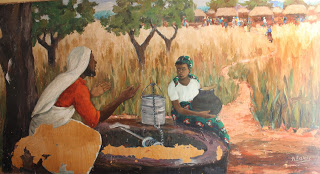
"Women at the Well", part of a mural by Emmanuel Nsama, Zambia
“Women at the Well”, part of a mural by Emmanuel Nsama, Zambia

Scripture Passage:  John 4: 5-26

5So he came to a Samaritan city called Sychar, near the plot of ground that Jacob had given to his son Joseph.6Jacob’s well was there, and Jesus, tired out by his journey, was sitting by the well. It was about noon.7A Samaritan woman came to draw water, and Jesus said to her, “Give me a drink.”8(His disciples had gone to the city to buy food.)9The Samaritan woman said to him, “How is it that you, a Jew, ask a drink of me, a woman of Samaria?” (Jews do not share things in common with Samaritans.)10Jesus answered her, “If you knew the gift of God, and who it is that is saying to you, ‘Give me a drink,’ you would have asked him, and he would have given you living water.”11The woman said to him, “Sir, you have no bucket, and the well is deep. Where do you get that living water?12Are you greater than our ancestor Jacob, who gave us the well, and with his sons and his flocks drank from it?”13Jesus said to her, “Everyone who drinks of this water will be thirsty again,14but those who drink of the water that I will give them will never be thirsty. The water that I will give will become in them a spring of water gushing up to eternal life.”15The woman said to him, “Sir, give me this water, so that I may never be thirsty or have to keep coming here to draw water.”16Jesus said to her, “Go, call your husband, and come back.”17The woman answered him, “I have no husband.” Jesus said to her, “You are right in saying, ‘I have no husband’;18for you have had five husbands, and the one you have now is not your husband. What you have said is true!”19The woman said to him, “Sir, I see that you are a prophet.20Our ancestors worshiped on this mountain, but you say that the place where people must worship is in Jerusalem.”21Jesus said to her, “Woman, believe me, the hour is coming when you will worship the Father neither on this mountain nor in Jerusalem.22You worship what you do not know; we worship what we know, for salvation is from the Jews.23But the hour is coming, and is now here, when the true worshipers will worship the Father in spirit and truth, for the Father seeks such as these to worship him.24God is spirit, and those who worship him must worship in spirit and truth.”25The woman said to him, “I know that Messiah is coming” (who is called Christ). “When he comes, he will proclaim all things to us.”26Jesus said to her, “I am he, the one who is speaking to you.”

The journey has shifted.  No longer are Jesus’ words limited to those in his immediate circle.  He leaves the confines of what he knows and begins to turn to outsiders, those who tradition and cultural and societal norms have rejected. First on the list are the Samaritans.  The less than civil relationship between the Jews and the Samaritans dated back at least 1,000 years before the birth of Christ.  Both believed in God.  Both had a monotheistic understanding of the one true God, the YHWH of their shared tradition of belief.  But where the temple of YHWH for the Jews existed on Mount Zion in Jerusalem, the Samaritans instead worshipped God on Mount Gerizim near the ancient city of Shechem.  And with that, a new line of religious understanding was formed.  The Samaritans believed that their line of priests was the legitimate one, rather than the line in Jerusalem and they accepted only the Law of Moses as divinely inspired, without recognizing the writings of the prophets or the books of wisdom.   What started as a simple religious division, a different understanding of how God relates to us and we relate to God, eventually grew into a cultural and political conflict that would not go away.  The tension escalated and the hatred for the other was handed down for centuries from parent to child over and over again.

So, here is Jesus breaking all of the boundaries of traditional religion.  He, unescorted, speaks to a woman.  He speaks to a woman of questionable repute.  And he speaks to the enemy. The truth is, there is nothing about this woman that is wrong or sinful or anything else that we try to tack on her reputation.  This woman was just different.  Her life had been difficult.  She lived in the shadows of humanity.  And the most astonishing thing is that this seemingly low-class woman who is a Samaritan becomes the witness to the Gospel of Jesus Christ.  Once again, the Gospel is found not in Jerusalem and not on Mt. Gerizim but in our shared existence as part of this “new humanity”.

Now, the woman does miss Jesus’ point.  She looks upon Jesus as some sort of miracle worker, rather than seeing that he offers a new way of being.  Even this story deals with suffering—the woman surely suffered.  Good grief, she was there by herself—couldn’t even face the crowd.  And Jesus—well Jesus was just thirsty.  “Give me a drink…I thirst.” We all have needs; we all have fears—that is the nature of our true humanity.  And maybe the story teaches us that from our need we will realize who God is.  Maybe, in fact, it is IN our very need that we find God, those times when we are unsure of ourselves and not quite so confident that we are heading the right direction in our lives.  So, this woman’s new life begins when she recognizes Jesus’ true identity.  Maybe that’s our problem.  We are still looking for the Jesus that will make our lives easier rather than the one who will give us new life.  We are still looking for a Jesus that will affirm where we are rather than leading us to this new thing that God is doing.  We are still looking for a Jesus that will become our own personal Savior, our own private Messiah, rather than the Salvation and Life of the world.

Our faith journey is not just ours.  Contrary to what some may tell you, you are not carrying the sole responsibility for “getting it right”.  The journey, rather is made up of encounters with those that God places in our path.  At each turn, we grow, we change, our pathway broadens.  The procession to the Cross has already begun.  We are walking together, gathering others into our midst as we walk.  This is what Jesus did.  The journey to the Cross began long before the gates of Jerusalem at the end of the Palm Sunday Road.  The journey began “in the beginning”.  The journey weaved through a garden, into the lessons learn from the stories of an ark, and was there as its followers were carried into exile.  The journey held deliverance and led us up to a mountaintop.  It has held prophets’ voices and the wisdom of sages.  On it were two women named Naomi and Ruth who held each other through their trials.  It was the road for kings and judges and those who were trying to figure out why a life had fallen apart.  The journey turned into a small town outside of Jerusalem where life and clarity and salvation were born.  It returned us to the place of exile, which this time held deliverance.  The journey is one of water and wine and welcome for all.  This journey has taught us how to love and how to thirst.  It has shown us what it means to have faith and not need certainty.  It has taught us that questions are part of it all.

We are still gathering in.  And now it turns…one more mountain to climb and then the procession will enter Jerusalem.  But that is not the end; there is always more up ahead.  But we do not travel alone.  God has already gone before us and still walks with us to show the Way.  So, as our Lenten journey nears Jerusalem, remember from where you’ve come and remember what you have received from those that you have encountered on the way.  Remember who and whose you are.  Remember that you do not walk alone.

Grace and Peace,

Shelli
The Road

This Week’s Lectionary Passage:  1 Corinthians 10: 1-13
I do not want you to be unaware, brothers and sisters, that our ancestors were all under the cloud, and all passed through the sea,2and all were baptized into Moses in the cloud and in the sea,3and all ate the same spiritual food,4and all drank the same spiritual drink. For they drank from the spiritual rock that followed them, and the rock was Christ.5Nevertheless, God was not pleased with most of them, and they were struck down in the wilderness.  6Now these things occurred as examples for us, so that we might not desire evil as they did.7Do not become idolaters as some of them did; as it is written, “The people sat down to eat and drink, and they rose up to play.”8We must not indulge in sexual immorality as some of them did, and twenty-three thousand fell in a single day.9We must not put Christ to the test, as some of them did, and were destroyed by serpents.10And do not complain as some of them did, and were destroyed by the destroyer.11These things happened to them to serve as an example, and they were written down to instruct us, on whom the ends of the ages have come.12So if you think you are standing, watch out that you do not fall.13No testing has overtaken you that is not common to everyone. God is faithful, and he will not let you be tested beyond your strength, but with the testing he will also provide the way out so that you may be able to endure it.

Well, it seems as if Paul is trying to shake up his Corinthian hearers a bit.  After all, they were pretty sure of themselves.  They were righteous and God-fearing and their faith was serving them well.  But Paul reminds them that it is not about them.  After all, a life of faith is not a life of checking off the boxes of all things good that one has done and counting one’s accolades; it is, rather, a life of an ongoing relationship with God.  And, as we all know, relationships do not move in a neat escalating line.  They have ups and downs and sometimes feel as if they are going to break completely apart.  Paul (as opposed to others in that day and, sadly, in ours) sees salvation here as a journey, an ongoing relationship, rather than securing a place in heaven or avoiding a place in hell. 

The truth is, relationships are hard.  This faith thing is hard.  It does not guarantee one a life of ease or plenty.  As Paul reminds us, look at the past. Faithful people lived in the shadows and had the waves crash over them.  Things were not easy.  Why would our life be different?  You see, faith is not something that removes us from life, that separates us from the world.  Faith is what calls us to live there, to be who we are called to be in this world, showing the world a different pathway.  Yeah, I know, it’s not easy.  But we have to persevere.

In our time, so much of religion is presented as a cure for all.  Well-meaning seekers are promised that faith, REAL faith, UNENDING faith, UNFALTERING faith, will bring them health and wealth and ease.  OK, excuse me here, but, really…no.  The Scriptures never depicted that.  This faith thing is hard.  Did you forget that it has to do with a cross, an instrument of death?  Did you forget that it acknowledges that pain and suffering is part of life?  Did you forget that we are told to deny ourselves and follow a pathway that we’ve never followed before?  But, more than anything else, did you forget that God has walked ahead?

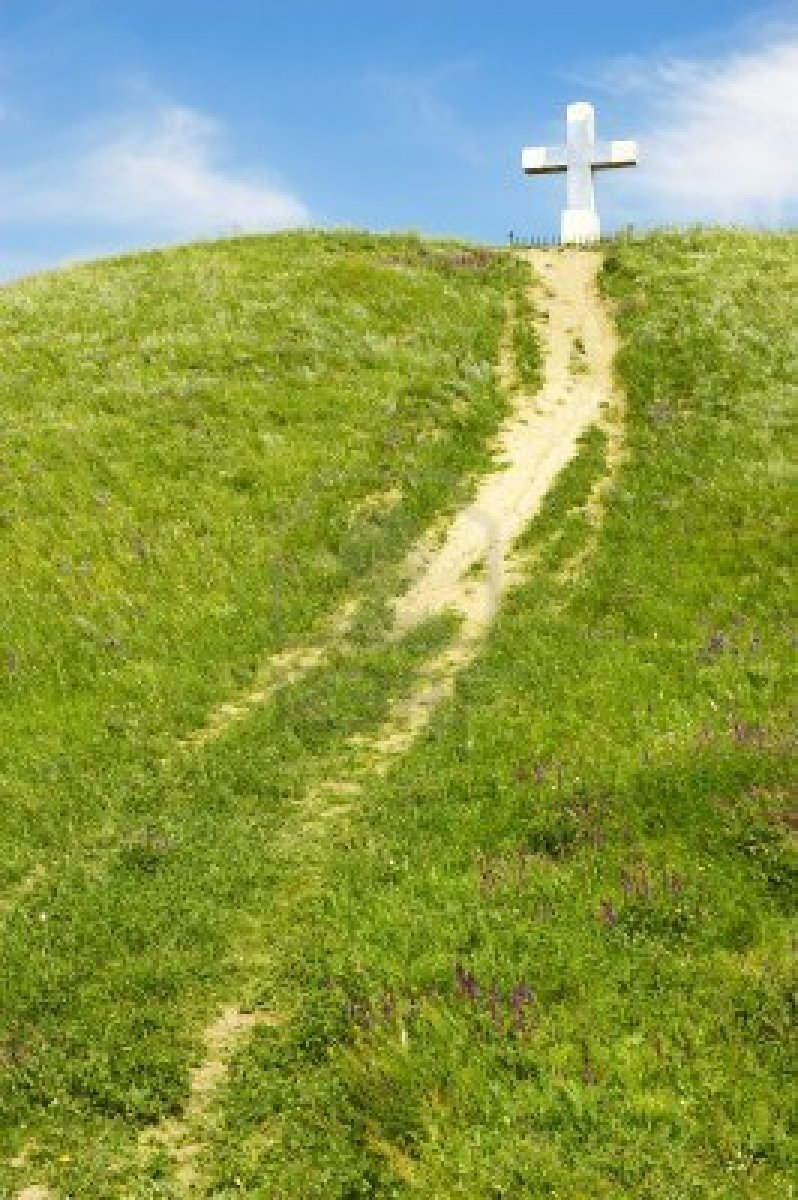
It may not be easy; it may destroy you; it may even end your life as you know it.  But God has walked this way before.  That’s the difference between shallow, empty pictures of fame and fortune dangled above a well-paved and perfectly landscaped path and following this bumpy, over-grown road with the marks of a cross drug through it and the, albeit faint, footsteps of faithful travelers who have gone before. 

Faith is not about finding the easiest way but following where God has gone before.

Grace and Peace,

Shelli

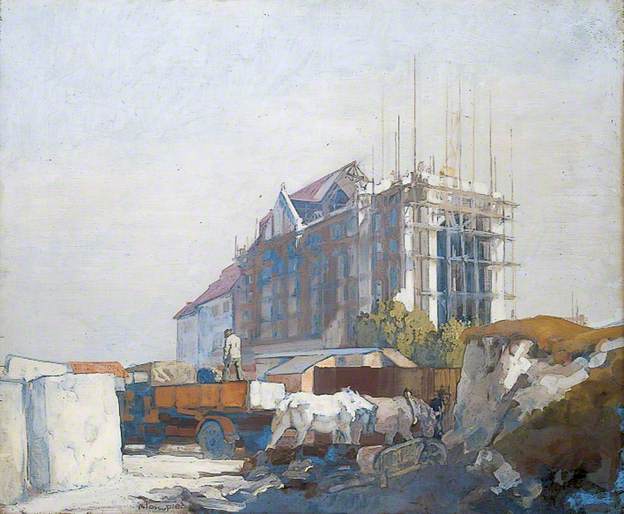
Brick by Brick

Building a Cathedral at Annecy, France
Edmund Blampied
Early 20th century

Lectionary Passage for This Week:  Genesis 15: 1-12, 17-18
After these things the word of the Lord came to Abram in a vision, “Do not be afraid, Abram, I am your shield; your reward shall be very great.”  2But Abram said, “O Lord God, what will you give me, for I continue childless, and the heir of my house is Eliezer of Damascus?”3And Abram said, “You have given me no offspring, and so a slave born in my house is to be my heir.”4But the word of the Lord came to him, “This man shall not be your heir; no one but your very own issue shall be your heir.”5He brought him outside and said, “Look toward heaven and count the stars, if you are able to count them.” Then he said to him, “So shall your descendants be.”6And he believed the Lord; and the Lord reckoned it to him as righteousness.  7Then he said to him, “I am the Lord who brought you from Ur of the Chaldeans, to give you this land to possess.”8But he said, “O Lord God, how am I to know that I shall possess it?”9He said to him, “Bring me a heifer three years old, a female goat three years old, a ram three years old, a turtledove, and a young pigeon.”10He brought him all these and cut them in two, laying each half over against the other; but he did not cut the birds in two.11And when birds of prey came down on the carcasses, Abram drove them away.  12As the sun was going down, a deep sleep fell upon Abram, and a deep and terrifying darkness descended upon him.

17When the sun had gone down and it was dark, a smoking fire pot and a flaming torch passed between these pieces.18On that day the Lord made a covenant with Abram, saying, “To your descendants I give this land, from the river of Egypt to the great river, the river Euphrates,

We often read this story with Abram as the hero, trusting and faithful to God, who follows God’s call and believes God’s promises.  After all, Abram would become the patriarch of three worldwide religions.  But even Abram was not perfect.  Yes, the truth is, Abram was more like us than we care to admit.  He told himself that he trusted God, that God had made a great promise of descendants to him.  And he had waited and waited and nothing had happened.  So, he took care of it.  After all, he was old, Sarai was old.  Time was slipping away.  Something had to be done.  But, in Abram’s defense, remember what “barrenness” meant in that time. An absence of children was not just a discontinuation of one’s line or one’s name. It was death. There would be no one to care for you, no one to work with you to provide. Barrenness or infertility was looked upon as failure. It meant that God had not blessed you or provided for you.

But, God clarifies the promise a little bit more. This is not the heir that God had been talking about. The heir shall be a biological child of Abraham and Sarah rather than a surrogate birth. Well, I’m sure you can see Abraham rolling his eyes a bit. Are you kidding me? Because, you see, I’m really, really old. My wife is really, really old.  This is just not normal. This is not even rational. This is nuts!

Well, we know how the story turns out.  God, once again, in spite of Abram, comes through.  The truth is, that’s pretty much what God does.  We can plan and prepare and even force things to happen but when it’s all said and done, things will happen in God’s time.  The truth is, hard as it may be for us to admit, the fruits of trust and faith do not come to harvest when we think they should.  Did you read the last line of the passage?  Abram did not get the promise of land.  The land was to go to his descendants.  He was not called to deliver the world; rather, he was called to be a small part of a long line of the faithful that God would call.  The realization of God’s promise was not immediate gratification. (I mean, did you think that you were the only one to which God was making promises?)

Maybe that’s our whole problem. Maybe we want to see the fruits of our faith now, in our lifetime. Maybe faith is about realizing that we are part of a deep and abiding relationship between God and humanity as the holy and the sacred sort of dribbles into our world little by little. Our part is important but it is, oh, so much bigger than us. In fact, it’s really not even rational the way we think it should be. Maybe that’s what makes it faith. Faith does not teach us to believe; it teaches us to wait with expectant hope that when the time comes, the clouds will part and the light will break through.  In the meantime, we are called to keep building cathedrals, brick by brick, knowing that it doesn’t matter whether or not we see them completed but only that we had faith enough to imagine it to be.

So, on this Lenten journey, let go of needing to see the result and instead do your part to make it be.

Grace and Peace,

Shelli 

On the Other Side of the Wilderness

“Christ in the Desert”
Ivan Kramskoi, 1872
Tretyakov Gallery, Moscow

This Week’s Lectionary Passage:  Luke 4: 1-13
Jesus, full of the Holy Spirit, returned from the Jordan and was led by the Spirit in the wilderness, 2where for forty days he was tempted by the devil. He ate nothing at all during those days, and when they were over, he was famished. 3The devil said to him, “If you are the Son of God, command this stone to become a loaf of bread.” 4Jesus answered him, “It is written, ‘One does not live by bread alone.’” 5Then the devil led him up and showed him in an instant all the kingdoms of the world. 6And the devil said to him, “To you I will give their glory and all this authority; for it has been given over to me, and I give it to anyone I please. 7If you, then, will worship me, it will all be yours.” 8Jesus answered him, “It is written, ‘Worship the Lord your God, and serve only him.’” 9Then the devil took him to Jerusalem, and placed him on the pinnacle of the temple, saying to him, “If you are the Son of God, throw yourself down from here, 10for it is written, ‘He will command his angels concerning you, to protect you,’ 11and ‘On their hands they will bear you up, so that you will not dash your foot against a stone.’” 12Jesus answered him, “It is said, ‘Do not put the Lord your God to the test.’” 13When the devil had finished every test, he departed from him until an opportune time.

Every year in this first week of Lent we read of Jesus, led or driven by the Spirit, intentionally going out into the wilderness.  On purpose?  Who does that?  Who chooses to relinquish control and put oneself at the mercy of the elements or whatever else might come along? Well, obviously Jesus.  So what is our take-away of that?  Are we really supposed to follow?  After all, our lives have been a veritable exercise in learning to maintain control–of our homes, our families, our finances, our health, our time, and even our spiritual life.  And then, this.  Jesus leaves all the comforts and control of home and goes out into the wilderness by himself.  I mean, really, anything could happen out there, right?  He is hungry.  He is vulnerable.  And he surely knows that he is in danger.  And sure enough, temptation looms.  Jesus, Son of God and Son of Man, the gift of the God’s unfailing grace, the ground of our hope, and the promise of our deliverance from sin and death, is driven not just into the wilderness but into the depths of his humanity.  And it is there that he is tempted to raise himself up, to fill his emptiness, to place himself above others, to guarantee his own being and his own protection. 

The truth is, though, no one, not even Jesus, can save oneself.  That’s just not the way it works.  Maybe that’s what the wilderness teaches us–that we cannot save ourselves, that we cannot guarantee what will or won’t happen to us, that we are not, much as we hate to admit it, in control.  Now there are those that will say that this whole account was some sort of divine plan by God.  I have a hard time with that.  I mean, really, what point wout that prove?  All that says is that God is some sort of divine game player and we are nothing but pawns on an earthly gameboard.  And after all, is Jesus human or isn’t he?  I’ve been told that he was.  You know–fully human.  He was not above it all.  He was not a super hero.  And he was certainly not a game piece.  He encountered the same human weaknesses that we do every day.  Real weaknesses, real happenings in one’s life, are part of being real, part of being human. 

The truth is that there are some things for which we just cannot prepare.  I mean, think about it, we go along living our lives the best we can and then, without warning, a meteor comes screaming across the sky.  Do you know why astronomers and cosmologists weren’t expecting it?  They didn’t know that it was coming because it was too small to see.  That, too, is what the wilderness teaches us.  Sometimes the small things that we dismiss in our lives are the things that can hurt us, can slowly, bit by bit, pull us away from who we are, from who God calls us to be.

God does not inflict the wilderness on us.  Jesus was not led into this dark and foreboding place to pass some sort of Divine test.  Because, remember, a test does not always possess a right or wrong answer.  Think about a chemical test.  You put two or more elements together not to see if they will pass but to compel them to change.  Jesus went into the wilderness to change, to be fully human, and to find deep within himself the piece of the Godself that calls him home.

So, in this Lenten season, let us intentionally enter the wilderness, not to prove something or because God is waiting to see whether or not we fail, but because the wilderness is the way home.

The Promised Land lies on the other side of a wilderness.  (Havelock Ellis)

Grace and Peace,

Shelli

Dancing in the Rain

Image from “Singing in the Rain” (1952)
(with Gene Kelly)

Lectionary Passage:  John 6: 1-21
To read this passage online, go to http://bible.oremus.org/?passage=John+6:1-21&vnum=yes&version=nrsv

We love this story.  (And they must have loved it in the first century because the writers of all four gospels chose to include it their unique account of the Good News of Jesus Christ.) Yes, we like the notion of Jesus providing everything we need, bursting in just when we are at the end of our ropes, just when we need help the most, and fixing the ails of our life (or at least feeding us lunch!).

But notice (don’t you hate that…yes, I’m about to ruin your image of super-hero Jesus pulling lunch out of a hat or whatever we thought he did!) that the story never says that the boy’s lunch was the ONLY food there.  Perhaps there were some people holding back what they had brought, afraid to offer it for community consumption because, after all, what if they ran out?  What if they needed it tomorrow or the next day or after they retire?  So, perhaps the miracle lies not in some sort of image of Jesus creating something from nothing but rather in the little boy himself.  He was first, freely offering what he had to Jesus and the Disciples to do whatever they needed to do with it.  Now, note what was in the little boy’s lunch–barley bread and fish.  Barley is a very inexpensive and somewhat “unglamourous” grain and fish were plentiful.  After all, they were right next to this huge lake.  (Just to get it in your head, the “Sea” of Galilee is actually a huge lake.)  In other words, this was the lunch of the poor.  The little boy was more than likely not from a family of means.  Perhaps his mom had lovingly packed all they had into his lunch so that her son could have this experience of seeing this great man Jesus of whom they had only heard.  But before that ever happened, the little boy stood and offered everything he had.

And, then, well you know how it goes.  The person next to him saw what he had done, thinking that no longer could he now with a clear conscience keep what he had brought tucked away.  And then the person next to that person saw him offer what he had.  It went on and on, a veritable Spirit moving through the crowd.  The message is right.  It WAS a miracle!  And when they had finished eating, they realized that it wasn’t that there was enough for all.  There was more!  There were leftovers that were then gathered into baskets.  Maybe they were for later.  Maybe they were for those who needed it.  Or maybe they were offered as holy doggie bags to remind us that God always gives us way more than we really need. 

So what about those of us who feel that we need to be prepared for the next storm that is coming around the bend?  Well, keep reading.  The passage goes on to say that the disciples started across the lake in the darkness.  And, sure enough, the storm began to rage–blowing winds, crashing waves, beating sheets of rain bearing down upon them.  Wouldn’t you know?  See, this is what we were afraid of!  But, there is Jesus.  “Do not be afraid.  Do not be afraid.”  What is interesting is that the account never says that Jesus calmed the storm.  Jesus calmed the disciples.  Jesus reminded the disciples that no matter what, no matter how hungry or unprepared they are, no matter what storms come up unexpectedly, they are not alone.  It is truly a story of extraordinary abundance.

I was going to write today on the David and Bathsheeba story but I got up early this morning to get a drink of water.  And standing at the window in my kitchen, I saw the words on a plaque I have on the window sill:  “Life isn’t about waiting for the storm to pass.  It’s about learning to dance in the rain.”  (I looked it up and the quote is attributed to Vivian Green.)  It’s a great thought.  Jesus is not a super hero that performs unexplainable miracles or plucks us out of the storms of life.  Jesus is much more.  When the storms come, when the winds rage, and when we just think we just don’t have enough for what’s coming, God invites us to dance, holding us until we find the rhythm that is deep within us and know the steps ourselves.

So, keep dancing!

Grace and Peace,

Shelli

For those of you who are reading this through the St. Paul’s ESPACE link, welcome!  And for those who get this as a “blog” email, yes, I’m finally back!  I’m going to try to maybe do this 2-3 times a week.  Keep on me!  🙂  Shelli

Impersonalization of Faith

“The Peaceable Kingdom”
John Swanson, 1994

This journey of faith is a personal one, right?  Isn’t that what we’re told?  We’re suppose to find some way to connect to God, some way to find our own path to God, some way to express our own faith.  We are told that we’re supposed to have a personal faith in Jesus Christ.  And so we spend our time to trying to find our way, trying to find that one thing or that one way that makes us feel the most connected to God, makes us feel like we’re finally once and for all getting this faith thing figured out.

But ARE we called to a personal faith?  ARE we called to “find our own way?  I thought we were called to make disciples, to love one another, and to put down our lives.  Those don’t really sound all that individual and personal, when you really think about it.  They sound like community.  They sound like connection.  They sound like Communion.  We are called to be the Body of Christ.  It’s hard to do that by yourself.  I really do think that God envisioned us together.  Perhaps God even envisioned this bantering and this arguing and even this war of words and wits that so many of our religious denominations (including my own United Methodist one) are experiencing.  Maybe it’s part of what we’re meant to do.  It’s painful; it’s hurtful; it sometimes pulls us apart. 

We all have our own vision of what God’s Kingdom looks like.  I know I do.  I envision a world where all of us are welcomed, all of us are fed, and all of us are valued for the gifts that God has placed in each of us.  But do I?  Do I welcome those with whom I disagree?  Do I feed those with whom I am uncomfortable?  And do I truly value those gifts that God has placed in those persons that have a vision that is different from mine?  I don’t think that unity is about sameness.  I’ve come to think that it’s not even about agreement.  Unity has more to do with recognizing that the Kingdom of God, the Body of Christ is bigger than any one group, or one view, or one way of experiencing God.  It has to do with leaving the door open, with sensing that there’s something more, something beyond what we think and what we believe.  And together in faith, we will have to discern when we are called to be patient and when we are called to be persistent, when we are called to be open to moving and when we are called to stand firm, and, finally, when we are called to go into the wilderness, into the unknown and face our demons and prepare ourself for what is to come, and when we are called to go as a people to Jerusalem.  Perhaps this Lenten journey is a call not to strengthen our faith but to impersonalize it and realize that we are called, together, to be the Body of Christ.

So on this twenty-fourth day of Lenten observance, get out of yourself.  Impersonalize your faith a bit and open yourself to someone else on this journey.

Grace and Peace on this Lenten Journey,

Shelli

LENT 4B: But…

Lectionary Passage:  Ephesians 2:1-10
You were dead through the trespasses and sins in which you once lived, following the course of this world, following the ruler of the power of the air, the spirit that is now at work among those who are disobedient. All of us once lived among them in the passions of our flesh, following the desires of flesh and senses, and we were by nature children of wrath, like everyone else. But God, who is rich in mercy, out of the great love with which he loved us even when we were dead through our trespasses, made us alive together with Christ—by grace you have been saved— and raised us up with him and seated us with him in the heavenly places in Christ Jesus, so that in the ages to come he might show the immeasurable riches of his grace in kindness toward us in Christ Jesus. For by grace you have been saved through faith, and this is not your own doing; it is the gift of God— not the result of works, so that no one may boast. For we are what he has made us, created in Christ Jesus for good works, which God prepared beforehand to be our way of life.

There’s actually two parts to this passage.  There’s a “before” and there’s an “after”.  BEFORE you were dead…and AFTER you weren’t.  That’s probably enough.  We can just stop there. 

BUT the writer of this letter (who is more than likely not the Apostle Paul but rather a later follower or disciple of Paul’s) seems to be really focused on continuing this separation between this world and God, between the “sinful” world and God’s promise of grace and life.  Paul had introduced the notion of being justified by grace through faith, the notion that God was a redemptive God, that it was a process by which we traversed the experience of this world and along the way encountered God.  BUT, here, that word “saved” appears, as if it’s past tense, as if it is some badge of honor that we earn and wear as we continue to be forced to live in this sin-filled world in which we live.  Somewhere along the way eschatology became realized, “already”, rather than something to which we look and live into.

Now keep in mind that this letter was probably written in the late first century.  Jesus had come, died on the cross, and the Resurrection on which everything that is “Christian” is based had happened.  And Jesus had promised to return.  That had been imminent for Paul.  BUT that hadn’t happened yet.  The first century Christian followers (it still wasn’t “Christianity”, per se, the way we think of it today) were wondering if perhaps they had misunderstood, perhaps they had gotten the whole thing wrong.  So the emphasis for the writer of Ephesians (as well as others), was a notion of echatology that had already happened, an emphasis on the crowned Jesus sitting at the right hand of God.  And for those of us who are still mired in the throes of worldly evil and worldly despairs, there became a separation, a dualism that was put into place that pretty much exists even today.  So many of us live in this world, burdened by sin, and hope against hope that God will swoop in and save us. 

Really?  Is that it?  What happened to “God did not send the Son into the world to condemn the world, BUT in order that the world might be saved through him.“?  (But…but…but) God’s vision of the Kingdom of God is not to shun the world or even to rid us of all things worldly.  God’s vision of the Kingdom of God is to recreate the world into what it is called to be–BUT the whole world, not the ones who follow the rules or the ones who are “good”, but everyone.  So in this life of faith, we do not magically crossover to being “saved” from being “unsaved” and then sit back and wait for God to pluck us out of our miserable existence.  Rather, we yield to new meanings and new circumstances as God recreates our lives into Life and brings about the fullness of the Kingdom of God throughout this wonderful created world in which we live.

That’s what Lent is about–new meanings and new circumstances.  Maybe it’s about dropping the “but” in life.  God created the life that each of us has.  Why would God call us to leave it behind?  Rather God is recreating it as we speak, bringing it into being, into the image that God envisions for it.  You know, if we look at things with the eyes of a world where God is not, a world that waits for God to return, there is always a “but”;  BUT if we look at all of Creation with the eyes of faith, with the eyes of those who believe in a God who came into our midst to show us how much we are loved, everything has an AND.

On this nineteenth day of Lenten observance, look around you.  Where are you being called to surrender to new meanings in this life that God has created?

Grace and Peace on this Lenten Journey,

Shelli