To Boldly Go Where No One Has Gone Before

Star TrekScripture Passage:  Genesis 12: 1-4a (Lent 2A)

Now the Lord said to Abram, “Go from your country and your kindred and your father’s house to the land that I will show you. I will make of you a great nation, and I will bless you, and make your name great, so that you will be a blessing. I will bless those who bless you, and the one who curses you I will curse; and in you all the families of the earth shall be blessed.”  So Abram went, as the Lord had told him; and Lot went with him.

We are familiar with this story that our lectionary brings for this second week of Lent.  We know it well.  Abram is called to go forth, called to leave what he knows and become someone new.  We know that it will end with him becoming Abraham.  It is the beginning of Israel, the beginning of Judaism, and, ultimately, the beginning of us and our own faith story.  The story quickly moves from a broad sweep of humanity to a focus on one family and one person.  Perhaps it was a way of reminding us that humanity is not just a glob of no-name people but is rather made up of individuals, each children of God in their own right.

We like this story of our hero Abraham.  What courage, what persistence, what faith it would take to leave one’s home, to leave everything that one knows and to follow God.  It is that to which we all aspire and to which most of us fall incredibly short.  We struggle with what leaving would mean for us.  After all, what would it mean to you to just lock your doors and walk away, never looking back at the comforts and certitudes of your existence?  And, yet, think about it.  Abram’s people were nomadic, wandering aliens.  Their sense of “home” was not the same as it is for us.  And family?  Well, Abram had more than likely outlived his parents and he had no children.  Who was he leaving behind?  What was he leaving?  Maybe God was calling him from hopelessness and loneliness and barrenness and finally showing him home.  Maybe God was not calling him away but toward.  Maybe that was the promise.  And yet, Abram still had to have the faith to go into the unknown, to trust in the promise that God was beginning to reveal.

Maybe that’s the point that we are supposed to learn–not that God calls us to leave behind what we know but that God calls us to journey into the unknown, to journey beyond what we know, to journey far past those things of which we are certain.  It is called faith.  We are not called to know, to be certain.  We are called to trust that the Promise is real.  Do you remember the Star Trek mission–“to boldly go where no man has gone before”?  (Well, it was the 1960’s so I’ve made it more inclusive for the title of this post.)  I’m not really that big a Star Trek fan but I remember watching it when I was little.  There was something that drew me in.  Perhaps it was that notion of going beyond, traveling to a place where no one had ever been, a place where parents and mentors and clergy, where books and Scriptures and songs could talk about but never really fully depict exactly what it was.

God does not call us to “figure it out”.  There are no “right” answers.  In fact, I have found that really good discussions of faith matters generally create more questions.  (Thanks be to God!)  God doesn’t expect us to blindly follow into certainty but rather to leave what we know behind and journey far into the unknown, into the wilds of our lives where the pathway is less paved and worn down by others.  Maybe that is why Lent begins not in the Temple but in the wilderness, where the winds blow the pathways into changing patterns rather than roads and the sands swirl and blind us at times.  Maybe it is when we leave behind what we know that we can finally hear the way Home.  That is the Promise in which we trust–that somewhere beyond what we have figured out and what we have planned and for which we have prepared is the way Home.

Today we are bombarded with a theology of certitude. I don’t find much biblical support for the stance of “God told me and I’m telling you, and if you don’t believe as I do, you’re doomed.” A sort of “My god can whip your god” posture. From Abraham, going out by faith not knowing where he was being sent, to Jesus on the cross, beseeching the Father for a better way, there was always more inquiring faith than conceited certainty. (Will D. Campbell)

As this second week of Lent begins, of what are you certain?  What would it mean for you to leave your certainty behind and journey into the unknown?

Grace and Peace,

Shelli
Behold, A Mystery!

Mystery ForestScripture Passage for Reflection: 1 Corinthians 15:51

Listen, I will tell you a mystery! We will not all die, but we will all be changed.

This Season of Advent is ripe with mystery.  I guess it’s conventional and comfortable to take all the stories as they are written, to make sure that Jesus was born the way we assume him to be born, to make sure that there was nothing that might be in question.  And so we spend the season praying over and over to God that God will somehow get our perspectives straight; in other words, that God will swoop in and finally clear it all up for us once and for all.  But mystery still remains!  There are oh so many questions.  Why this way?  Why Mary?  Why that time? (I mean the world wasn’t any more ready for it than it is now!)  Why NOT now?  Why THIS man?  Why THIS place?  Was it in a manger or a grotto or the back room attached to the house that was built for the animals in that century?  And why didn’t they have room?  I mean, really, if God was coming into the world, why didn’t God at least make reservations for the occasion?  So much of this doesn’t make sense at all.  Wouldn’t it have been more efficient of God’s coming into the world was better documented, perhaps well-explained so that we’d have something with which to work?  It would definitely be oh so much easier.

The truth is, surety and doubt, belief and questions are all a part of our faith.  They are all a part of the story.  They are the way the story unfolds. When I was in seminary, Perkins arranged for students to participate in a small question and answer type discussion with noted author and screenwriter, John Irving.  One of the questions that someone asked him was how he went about constructing his stories.  The question was, of course, not surprising.  The answer, though, might have been to some.  Irving said that when he sat down to write, he always wrote the ending first and then backed through the story, creating characters, plot, and theme.  The point of the story is, after all, that with which we are left.  Regardless of where it’s located in the work, the point is usually realized at the end.  I think that’s what God has done.  God wrote the ending first, the recreation of all there is, the Kingdom of God in its fullest, and then began to back through the story.  So this coming of the Godself into our midst becomes the turning point that leads us that Way.

Eternal life was already there for us written into the deepest part of our being, the very image of God within us.  But the way to that life is murky at best.  So God came not as one wielding weath and power and the things of this world but as one holding nothing, a tiny baby with nothing but the love of two people who had promised to show him the Way.  God never intended that this way would be one of certitude.  The journey is one of seeking, of questioning, of wrestling, until one finds his or her way to God.  Having all the answers would have shut us down long ago.  It is the mystery that invites us to journey.  Another noted author, Andrew Greeley, once wrote, “Life is prodigious,  overwhelming. In that there is mystery, hint, and perhaps sacrament…The excessiveness of life is the best sacrament we could ask for, a hint of how powerful, how determined, and how excessive You are.”  Maybe God’s plan was not to bring the Divine down to our understanding but to give us something to journey toward.  Mary’s part was a journey into the unknown.  So was Joseph’s.  So is ours.  But it is only unknown until we embrace it as Home.

God…leads us step by step, from event to event.  Only afterwards, as we look back over the way we have come and reconsider certain important moments in our lives in the light of all that has followed them, or when we survey the whole progress of our lives, do we experience the feeling of having been led without knowing it, the feeling that God has mysteriously guided us. (Paul Tournier)

Reflection:  What part of this mystery is the hardest for you?  Where do you need to journey?

Grace and Peace,

Shelli

Advent 4A: All of the Above

Winding PathLectionary Old Testament Passage for Reflection:  Isaiah 7: 10-16

Again the Lord spoke to Ahaz, saying, Ask a sign of the Lord your God; let it be deep as Sheol or high as heaven. But Ahaz said, I will not ask, and I will not put the Lord to the test. Then Isaiah said: “Hear then, O house of David! Is it too little for you to weary mortals, that you weary my God also? Therefore the Lord himself will give you a sign. Look, the young woman is with child and shall bear a son, and shall name him Immanuel. He shall eat curds and honey by the time he knows how to refuse the evil and choose the good. For before the child knows how to refuse the evil and choose the good, the land before whose two kings you are in dread will be deserted.

During this season of Advent this year, we have read texts that get louder and louder with prophetic messages of what is to come.  This is the thing of which Christmas’s are made.  And now we read of the signs and wonders that were shown to the House of David.  “Here, listen people, there is a young woman with child.  She shall bear a son and the world will change.”  That’s essentially what it says.  But wait a minute!  We always read this as a prophetic sign of what will come, a prophet’s vision of the coming of Christ, Immanuel.  But, read it again.  This is in the present tense.  The young woman IS with child.  (as in already)  So, which is it?  Is it a child born immediately after this writing or are we talking about the birth of Jesus?  After all, the writer known as Matthew depicted it differently.  Is it then or is it later?  Yes.  All of the above.

The sign is a child.  The child’s name, Immanuel (or “God with us”) reinforces the divine promise to deliver the people from sure demise.  The child is born of a young woman, the Hebrew “almah”, which means a young woman of marriageable age.  Many scholars think that the young woman may have been Ahaz’s wife and her son the future king Hezekiah.If the author had wanted to depict the woman as a virgin, the word “betulah” would have been used.  But in the Greek translation of the Old Testament, the word was translated as “parthenos” or “virgin”.  So the writer of The Gospel According to Matthew understood the verse as a prediction of the birth of Jesus.  And then all those translators that came after that capitalized on that notion, perhaps in an effort to explain the unexplainable, to rid the text of the ambiguities that were probably meant to be there in the first place.

So, which is it?  Is it a virgin or a young woman?  Is it talking about Hezekiah or Jesus?  Is it what the writer known as Isaiah probably wrote or what the writer known as Matthew assumed or what the later redactors translated?  Yes.  All of the above.  The text and, indeed, the whole Bible is ambiguous at best.  Who are we kidding?  Faith is ambiguous.  It encompasses surety and doubt, light and darkness, life and death.  I don’t really get wrapped up in what “really” happened.  It doesn’t bother me if this is actually talking about Hezekiah.  But it was part of the Matthean writer’s tradition.  It meant something to him.  Somewhere in the words, in the text of his faith, he saw God.  He felt God.  To him, it mean Immanuel.  And so what better way to depict the first century nativity story that we love?  The coming of God WAS foretold–over and over and over again–through sacred stories told and shared by a waiting people.  It continues to be told, the story of God who breathed Creation into being, who entered the very Creation that held the God-breath, and who comes into each of our lives toward the glorious fulfillment of all that was meant to be.

I don’t think that God ever intended to lay it all out for us like some sort of lesson for us to memorize.  God doesn’t call us to have it all figured out but rather to live it, to open our eyes to all the sign and wonders of the world, to all the ways that God walks with us, to all the ways that God calls us to follow, to become.  All of the above, the obvious and the ambiguous, are part of the Truth that God reveals (whether or not our human minds can fathom it as “true”).  We are about to begin our journey to Bethlehem.  It is a road that is filled with ambiguities–loss and finding, sorrow and joy, fear and assurance, doubts and fears, a manger and a cross.  But along the way are signs of the God who is always with us, Immanuel, who carries us from moment to moment and from eon to eon with the promise of new life.  Let us go and see this thing that the Lord has made known–you know, all of the above.  It is this for which we were made.

If God’s incomprehensibility does not grip us in a word, if it does not draw us into [God’s] superluminous darkness, if it does not call us out of the little house of our homely close-hugged truths…we have misunderstood the words of Christianity. (Karl Rahner)

On prisoners of darkness the sun begins to rise, the dawning of forgiveness upon the sinner’s eyes, to guide the feet of pilgrims along the paths of peace, O bless our God and Savior with songs that never cease. (Michael Perry)

Reflection:  What are the things that are ambiguous for you in the story?  How do they really change the story for you?

Grace and Peace,

Shelli

Advent 2A: Shoots and Stumps

Garden of Gethsemane 07 (New Shoots)Advent 2A Old Testament Passage: Isaiah 11: 1-10

A shoot shall come out from the stump of Jesse, and a branch shall grow out of his roots. 2The spirit of the Lord shall rest on him, the spirit of wisdom and understanding, the spirit of counsel and might, the spirit of knowledge and the fear of the Lord. 3His delight shall be in the fear of the Lord. He shall not judge by what his eyes see, or decide by what his ears hear; 4but with righteousness he shall judge the poor, and decide with equity for the meek of the earth; he shall strike the earth with the rod of his mouth, and with the breath of his lips he shall kill the wicked. 5Righteousness shall be the belt around his waist, and faithfulness the belt around his loins. 6The wolf shall live with the lamb, the leopard shall lie down with the kid, the calf and the lion and the fatling together, and a little child shall lead them. 7The cow and the bear shall graze, their young shall lie down together; and the lion shall eat straw like the ox. 8The nursing child shall play over the hole of the asp, and the weaned child shall put its hand on the adder’s den. 9They will not hurt or destroy on all my holy mountain; for the earth will be full of the knowledge of the Lord as the waters cover the sea.  10On that day the root of Jesse shall stand as a signal to the peoples; the nations shall inquire of him, and his dwelling shall be glorious.

We Christians tend to read this with our own Christ-centered lens.  The shoot–newness, replacing the old sad stump–and the branch–us, growing from the foundations that have been laid.  And yet, this Scripture is purely Old Testament, purely Hebrew Scripture.  It speaks of a vision, a vision when life will be what God calls it to be, when the earth and all that it holds will finally once and for all live together just as the Lord intended.  Jesse was the father of David, the pinnacle of the great dynasty of Israel.  But dynasties and kingdoms have life spans just as people do.  And what was once a thriving political powerhouse becomes a stump, seemingly useless for the world, a shadow of the past.  And yet, from what we thought was dead suddenly springs forth life, providing a foundation for a new shoot.  It creates a new order, a new way of seeing the world, a time of peace and unity for all the world.  The people of Israel expected this from their king.  This was what God intended–an order of justice and righteousness and peace.  They long for a dynasty such as this, one with all the solid foundations of the past but one that grows in righteousness.

So, back to the Christ-centered lens…new order, justice, righteousness, peace…isn’t that the thing for which we hope?  In this season of Advent, we once again remember and live that hope of the people of Israel for the Messiah, the Savior of the World.  And we prepare for this year’s coming that will once again push us just a little bit closer to who we are meant to me.  And at the same time we wait for our own Advent, our own coming of God in its fullness.  Advent is all these things.  We long for that new creation.  We long for the day when  warriors will sit down with those that they now attack, when predators will live in peace with their victims, and when those that consume more than they need just because they can finally come to the realization that the resources of this world belong to all.  We hope against hope for a world without poverty and homelessness, without the threat of annihilation from weapons of all kinds, a world where each and every child has enough nutrition and education and healthcare to grow and flourish into who God calls him or her to be.

So, are we the shoot or the stump?  Are we the newness bursting forth or are we the foundation from whence it comes?  The answer is yes.  The two are so inter-connected that they cannot be separated.  The shoot does not just drop out of the sky but is born into generations upon generations of waiting and hoping for the Light to come.

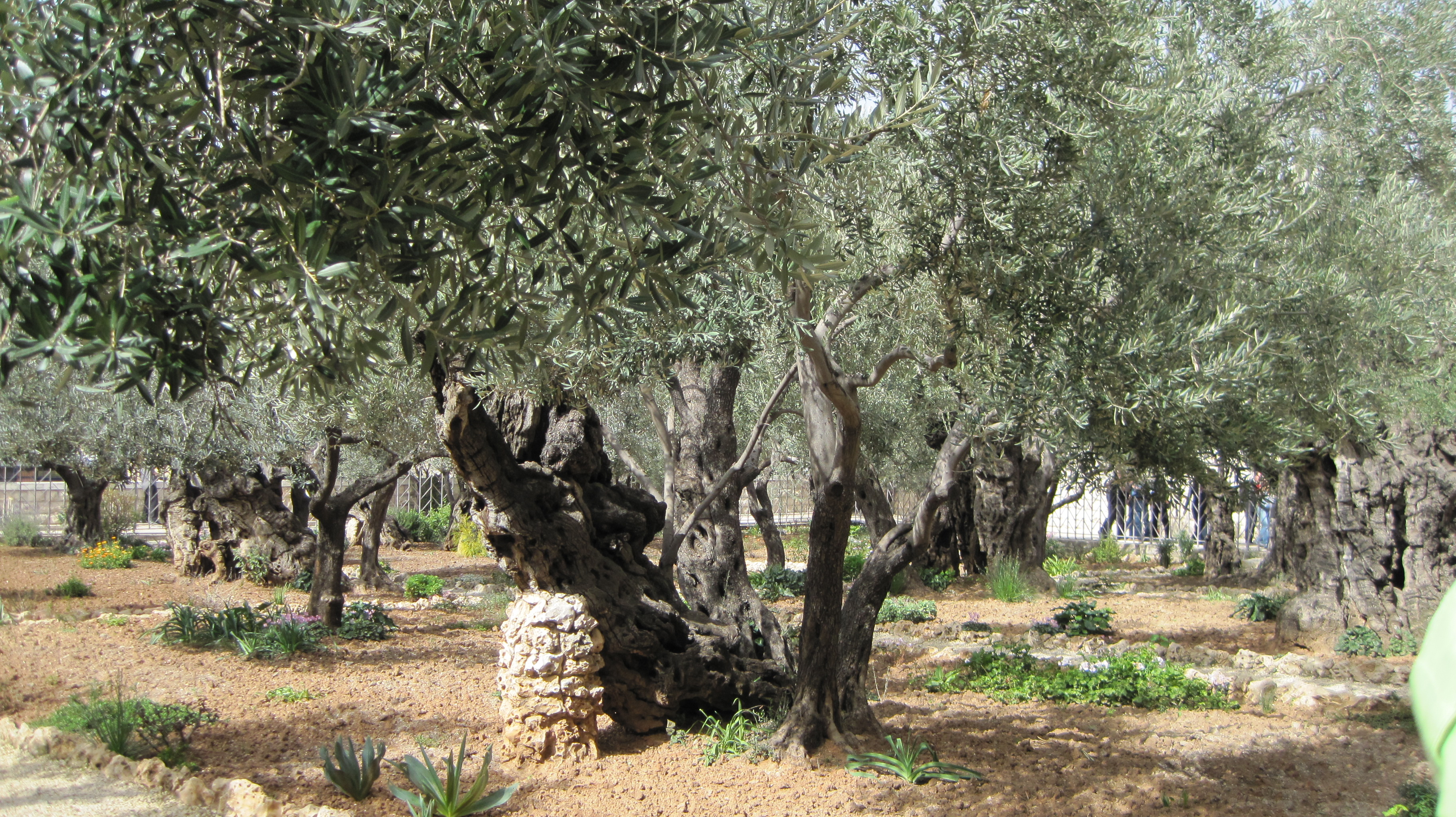
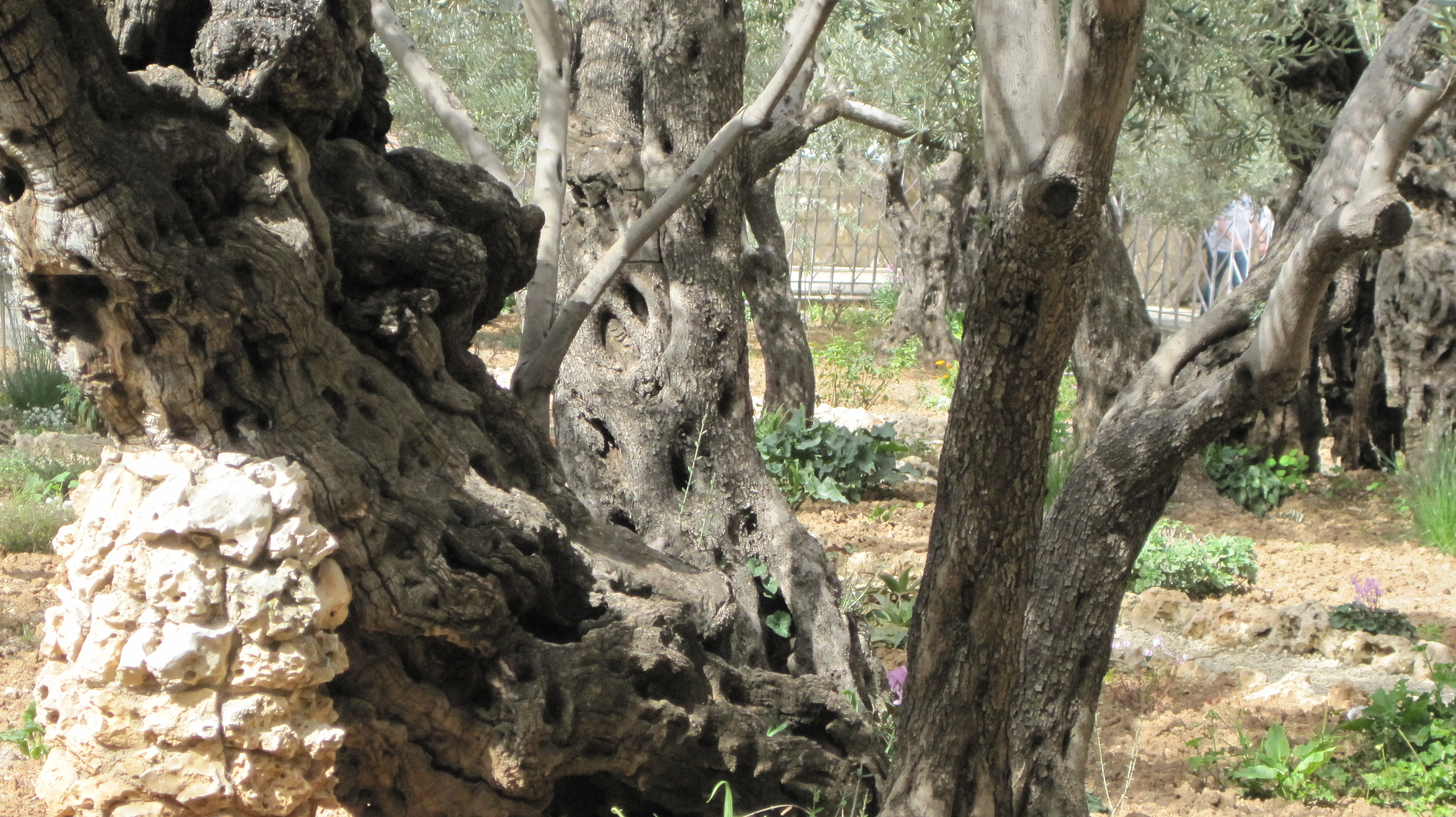
Garden of Gethsemane 08 (New Shoots)When I was in Israel a few years ago, I was fascinated with the olive trees.  You see, they live hundreds or perhaps even a thousand years.  And then they die, they leave what seems to be a mere stump.  But the root system gives way to something new.  So one of the oldest trees has a stump that is thousands of years old, almost petrified from the eons of weathering.  But shooting from its foundation is another tree that is hundreds of years old.  And shooting from it is another younger tree.  And shooting from it is yet another brand new shoot.  The tree is both a stump and a shoot, embracing the foundations of the past but leaving room for newness and recreation, leaving room for God’s work.  And they exist together there in the garden, the Garden of Gethsemane.

God did not create a disposable world, regardless of what we do with it.  God created an earth that would sustain itself not as individual lives making their way on others but as solid foundations giving way to new life.  Both shoots and stumps are part of God’s vision for what will be.  God is not replacing but recreating, redeeming, and resurrecting over and over again.

The fullness of joy is to behold God in everything. (Julian of Norwich)

Reflection:  Where are the stumps in your life?  Now look closer.  What shoots do you see emerging from them?  Are there parts of your life that you have discarded before God was finished working on them?

Grace and Peace,

Shelli

To see my full notes for this week’s Lectionary passages, go to http://journeytopenuel.com/.  If you’d like to get them each week, just follow the blog!

Beginning at the End

Closed CurtainAdvent 1A: Matthew 24: 36-44

36“But about that day and hour no one knows, neither the angels of heaven, nor the Son, but only the Father. 37For as the days of Noah were, so will be the coming of the Son of Man. 38For as in those days before the flood they were eating and drinking, marrying and giving in marriage, until the day Noah entered the ark, 39and they knew nothing until the flood came and swept them all away, so too will be the coming of the Son of Man. 40Then two will be in the field; one will be taken and one will be left. 41Two women will be grinding meal together; one will be taken and one will be left. 42Keep awake therefore, for you do not know on what day your Lord is coming. 43But understand this: if the owner of the house had known in what part of the night the thief was coming, he would have stayed awake and would not have let his house be broken into. 44Therefore you also must be ready, for the Son of Man is coming at an unexpected hour.

Oh, this can’t be right.  Our Gospel passage for the first reading in Advent is starting toward the end of the Gospel According to Matthew.  What happened to Mary?  Where are those angels announcing the coming birth?  After all, we need something joyful to think about it as we drag the boxes of Christmas decorations out of storage and begin to prepare for the season that most retailers have already proclaimed on the heels of the Jack-o-Lanterns!  I mean, really, first they tell us that we have to wait to sing Christmas carols and then they give us this perceived warning of a thief coming in the middle of the night.  Why in the world are we beginning at what feels like the end of the story?

There are those in our modern world who will pounce on this Scripture as a warning of what might happen if we do not act right or think right or live right.  There are those who will abuse it by holding over the heads of persons to scare them into religion.  I don’t think that’s what it’s about.  Faith is not about doing the right thing or living the right way or being scared into a place that does not feel welcoming and grace-filled.  Faith is about relationship.  And, as the Scripture says, it is about waking up so that God can gather us in.  God doesn’t want a bunch of zombies that have to be pulled kicking and screaming into faith.  God desires a relationship with those who desire a relationship with God.  And God has faith that in the deepest part of ourselves, there is faith enough for all.

Jesus is not standing at the edge of some far off place waiting for us to step over the line.  Jesus is here, ahead of time itself, calling and gathering and sanctifying each of us as we awake to the morning.  Remember last week’s Scripture that we read for Christ the King? We were again given the image of Jesus hanging on the Cross, minutes away from death.  It was the end.  And there, there beside him was the thief.  “But understand this: if the owner of the house had known in what part of the night the thief was coming, he would have stayed awake and would not have let his house be broken into. 44Therefore you also must be ready, for the Son of Man is coming at an unexpected hour.” The thief was not left behind but instead was gathered into the Reign of God.  Advent is not waiting to see whether or not you make the cut but rather waking up to the glorious Gathering that is happening all around us.

The curtain on the Advent season is about to rise.  Jesus is not waiting in the wings somewhere until the play is done; rather, Jesus is standing on the stage itself, inviting us in.  “Come, wait with me.  You do know when the Glory will come but this waiting is a holy place.  Come, all, wait with me.  Stay awake so that you won’t miss the inbreaking of Glory itself, the dawn of the fullness of the Kingdom of God.”  The reason that we begin at the end is because it is the same as the beginning.  God is the Alpha and the Omega.  Birth and death are all wrapped up together, needing each other to give life.  Awaken now that you do not miss one thing.  Open your eyes.  There is a baby coming!  The extraordinary miracle of what is about to happen is matched only by the moment before it does–this moment, this time.  The world awaits!  Awaken that you do not miss the story!

Awake! awake! and sing the blessed story; Awake! awake! and let your song of praise arise;                                                                       Awake! awake! the earth is full of glory, And light is beaming from the radiant skies;                                                                                  The rocks and rills, the vales and hills resound with gladness, All nature joins to sing the triumph song.

(Refrain)  The Lord Jehovah reigns and sin is backward hurled! Rejoice! rejoice! lift heart and voice, Jehovah reigns! Proclaim His sov’reign pow’r to all the world, And let His glorious banner be unfurled! Jehovah reigns! Rejoice! rejoice! rejoice! Jehovah reigns!

Ring out! ring out! O bells of joy and gladness; Repeat, repeat anew the story o’er again,                                                                             Till all the earth shall lose its weight of sadness, And shout anew the glorious refrain;                                                                                   Ye angels in the heights, sing of the great Redeemer, Who saves us from the pow’r of sin and death.

(Refrain)

“Awakening Chorus”, Charles H. Gabriel, 1905

Reflection:  Advent is our awakening season.  What do you need to do to no longer hit the “snooze button” of your faith?

Grace and Peace,

Shelli

Bending Rules

Bending tree2This Week’s Lectionary Text: Luke 7:36-8:3

I am for the most part a rule-follower (so I’m trying to get back to posting some blogs!).  Part of it is due to what could probably be considered my meticulous, “Type A” personality, but my guess is that most of it is due to my small-town, Protestant upbringing.  Rules are good.  They create boundaries; they can provide protection; they serve as a foundation on which to stand and from which to grow as we are guided by the remnants of the past.  Our society and our lives are built on rules.  So what happens when the rules are not followed?  Does it always result in chaotic anarchy?  Or are there some rules that it’s alright to stretch just a bit? Do you think that there are possibly some rules that need to be bent?

We all know enough about religion to know that it was based on rules from the very beginning.  My own denomination’s generally-accepted beliefs and consensual polity are encapsulated in The Book of Discipline of the United Methodist Church.  This is not a new publication.  It’s been around for about as long as Methodism has been in the United States.  I have a small collection of antique Disciplines and the oldest one that I have is dated 1828.  I also have one that I found in my great-grandfather’s attic.  It’s from 1900.  When you look through it, there are some similarities to our current one.  It has the Articles of Religion and the General Rules.  But it’s also got some rules that we would probably consider just downright odd.  They seemed to be very concerned with how people dressed and intent on insuring that people did not come to church wearing too much jewelry.  There are very few of us that would fit into that mold of what we’re supposed to look like when we come to church.  The point is that sometime rules change.  Sometimes they need to be edited or added to and I think sometimes they need to be thrown out altogether.       

In the Gospel passage that we read, we are given lots of rules.  It starts at the beginning when it tells us that Jesus “took his place at the table.”  He took his place as if there was a designated place where he was supposed to sit.  It was probably, you could surmise, toward the head of the table to the right of the host.  Isn’t that what the rules of etiquette usually tell us?  And then this woman enters—a woman already defined by the community and now by Scripture as a “sinner”.  Somewhere along the way she had apparently broken some rule of conduct and violated what would be considered an acceptable way of living and being. (People have often designated her a prostitute.  Go there if you want, but it never really tells us, so…maybe that’s not a great “rule of thumb”!)  And now she is apparently interrupting what is probably a perfectly-choreographed evening in the home of one of the most respected religious leaders.  She desires to anoint Jesus’ head with oil.  (Boy, I hope she doesn’t get that all over the imported tablecloth!) But standing nearer Jesus’ feet, she is suddenly overcome with emotion and begins to weep.  She begins to wash his feet with her tears, takes down her hair to dry them and then kisses them and pours the anointing oil on them.  What a spectacle that must have been!  And right here in the home of this respected Pharisee!

And so the Pharisee not only pronounces judgment on the woman, but also on Jesus.  After all, they had both broken the rules!  Woman of questionable reputation did not act like this, with weeping and flying hair and all, and if Jesus was really who he claimed to be, he would have known better.  But Jesus’ response is not the apology that the Pharisee and his “respectable” guests probably expected.  Instead Jesus challenges Simon’s pronouncement of both of them by launching into a parable about forgiveness.  And woven through the parable are reminders of what the woman did.  She openly and generously gave of herself, more than anyone else at the table had done.

Jesus is trying to make them realize that there is something more than rules, there is something more than religion, and there is something more than doing the “right thing”.  Ralph Waldo Emerson said that “the faith that stands on authority is not faith”.  I think that is what Jesus is trying to get across.  Faith is not about rules.  The woman’s intense act of love beyond all reasonable expectations and all acceptable actions becomes a means of grace.  It leads us to God.  It shakes us out of our comfort zones of what is normal and expected and even acceptable because, when you think about it, Jesus was very seldom normal and expected and even acceptable.  Instead he showed us how to step out of our boxes and live a life of faith—real faith that is untamed and uncontrolled and virtually undefined, a faith that rips open our carefully-sewn-together lives just enough to let God’s presence spill into them.     

 In a 2006 article in the “National Catholic Reporter”, editor Tom Roberts said that “we live in an age of expanding religion and a diminishing God.”  Those words probably make several of us squirm.  After all, have we become so sure of who we think God is and what we think God wants from us that we are willing to sacrifice the new and expanding ways that God interacts with our lives?  Religion and faith are not the same thing. Religion is about what we believe and why we believe.  It is about tradition, the institution, the system, and, yes, the rules.  When you think about it, our religion has been constructed over centuries.  It has given us creeds and liturgy and definitions of God.  It gathers us and grounds us and reminds us of a world to come.  It gives us commandments and rules that guide the way we live so that we can become what we seek, so that we can journey toward a oneness with God.  It is meant to lead us to God, not pave the way (as in make it easier) or drive us there. 

Somewhere in the midst of those rules we, like Jesus, have to do a little bending.  We have to at some point move beyond and transcend the rules and rituals.  We have to look beyond where we are to that place to which God calls us.  That is where faith comes in.  That is where God, greater than any religion, meets us.

In her book, Called to Question, Joan Chittister says that “in order to find the God of life in all of life, maybe we have to be willing to open ourselves to the part of it that lies outside the circles of our tiny little worlds.”  She goes on to tell a Sufi tale of disciples who, when the death of their master was clearly imminent, became totally bereft.  “If you leave us, Master,” they pleaded, “how will we know what to do?”  And the Master replied, “I am nothing but a finger pointing at the moon.  Perhaps when I am gone you will see the moon.”  The meaning is clear:  It is God that religion must be about, not itself.  When religion [or rules] makes itself God, it ceases to be religion.  But when religion becomes the bridge that leads to God, it stretches us to live to the limits of human possibility.”[i]  Chittister maintains that “religion ends where spirituality begins.”  From that standpoint, these rules, these dogmas, all of these things that make up our religion are not our faith journey, but they lead us through it.  They are, from that standpoint, a means of grace.

And as we change, as our journey changes, as our context changes, perhaps we are sometimes called to the act of bending rules.  It doesn’t mean that we’re dismissing them or ignoring them.  It means that we are allowing the conversation about God to continue.  But more important than that, it means that we are becoming part of the conversation.  We are becoming part of the journey.  And so, perhaps we really are called to a spiritual discipline of bending the rules sometimes.  It is part of the ongoing conversation, the ongoing faith journey of which we are a part.  Sometimes that bending means we just understand it better after we’ve questioned and explored.  Sometimes it means that we need to add something to make it clearer for us and for those who walk this journey with us.  And sometimes it means that we need to get rid of things that no longer augment or serve to depict our understanding of who God is and how God enters and is revealed in our lives.   Hugh E. Brown said that “Christianity is not being destroyed by the confusions and concussions of the time; it is being discovered.”  That is the point.  We don’t discover how God is revealed to us without continuing to think about it, continuing to look and re-address how we have understood God. 

That’s what Jesus was doing that day at the Pharisee’s house.  He wasn’t shunning the rules that had been a part of the faith tradition for as long as anyone could remember.  He was just bending them a bit, making them a bit more pliable, a bit more nimble, a little bit more transcendent, a little bit closer to what God had in mind.  The rules are meant to be foundations on which we can stand and through which God is revealed.  But when they become boundaries that control who is welcome and who is accepted, or who is invited to live out their own calling or who is not, that is not what God is about.  So, Jesus didn’t really follow the rules.  In fact, Jesus often got himself in trouble with those rule-followers.  Jesus just loved God and wanted to reveal that love for us and everyone else.  And here was this woman—a sinful woman, the Scriptures say—shunned by the rule-followers and welcomed by God.  Because you see this woman did what we are called to do—love generously and extravagantly, love the way that God loves.  G.K. Chesterton said that we should “let our religion be less of a theory and more of a love affair.”  There are really very few rules—except to love the way God loves and be open to doing perhaps a little bending.

So, go do a little rule-bending of your own!
 
Grace and Peace,
 
Shelli
 
(To see notes on all of the Lectionary texts for this week, go to http://journeytopenuel.wordpress.com/)


[i] Joan Chittister, Called to Question:  A Spiritual Memoir, (Lanham, MD:  Sheed & Ward, 2004), 19-20.

Climax

clouds-floating-over-a-mountainScripture Passage:  Mark 9: 2-9

2Six days later, Jesus took with him Peter and James and John, and led them up a high mountain apart, by themselves. And he was transfigured before them, 3and his clothes became dazzling white, such as no one on earth could bleach them. 4And there appeared to them Elijah with Moses, who were talking with Jesus. 5Then Peter said to Jesus, “Rabbi, it is good for us to be here; let us make three dwellings, one for you, one for Moses, and one for Elijah.” 6He did not know what to say, for they were terrified. 7Then a cloud overshadowed them, and from the cloud there came a voice, “This is my Son, the Beloved; listen to him!” 8Suddenly when they looked around, they saw no one with them any more, but only Jesus.  9As they were coming down the mountain, he ordered them to tell no one about what they had seen, until after the Son of Man had risen from the dead.

How did we get here so fast?  Everything seemed to just fly by.  Wasn’t it just a few days ago that we were reading of the birth of a child?  Wasn’t it just awhile ago that Jesus was beginning his ministry and calling the disciples to journey with him? In the big scheme of things, we’ve gotten to this point pretty fast.  Here it is—a child born into anonymous poverty and raised by no-name peasants turns out to be the Son of God.  He grows up, becomes a teacher, a healer, and capable of hosting large groups of people with just a small amount of leftovers.  Then he asks a handful of people to become his followers, to help him in his mission.  They leave everything they have, give up their possessions and their way of making a living, they sacrifice any shred of life security that they might have had, and begin to follow this person around, probably often wondering what in the world they were doing.  And we’ve essentially read through all of this in a matter of a few months since early December.  And then one day, Jesus leads them up to a mountain, away from the interruptions of the world.

Now, this is sort of interesting.  There is no proof of an actual geographically-charted mountain.  It is presented as if it just rose up, uninterrupted, from the terrain, as if it is rather a part of the topography of God.  Even for people, such as myself, who cannot claim a single, stand alone, so-called “mountain-top experience” that brought them to Christ but rather came year by year and grew into the relationship…even for us…this IS the mountain-top experience.  And there, on that mountain, everything changes.  The clothes that Jesus was wearing change, taking on a hue of dazzling, blinding, white, whiter than anything that they had ever seen before.  And on the mountain appeared Elijah and Moses, representing the Law and the prophets, the forerunners of our faith, standing there with Jesus.  Peter wanted to build three dwellings to house them.  For me, that’s sort of an interesting part of the story.  Dwellings…I guess because that would keep them here, essentially bound to our way of living.  Dwellings…to control where they were.  Dwellings…to somehow put this incredible thing that had happened into something that made sense, to bring it into the light of the world where we could understand it.  But, instead, they are veiled by a cloud and from the cloud comes a voice, “This is my Son, the Beloved, listen to him!”  “Listen to him!”  And then they were gone and Jesus stood there alone.

The account of the Transfiguration of Jesus seems to us that it should be the climax of the Jesus story.  After all, how can you top it—Old Testament heroes appearing, God speaking from the cloud, and Jesus all lit up so brightly that it is hard for us to look at him.  But there’s a reason that we read this at this point.  In some ways, it is perhaps the climax of Jesus’ earthly journey.  Jesus tells the disciples to keep what happened to themselves, if only for now.  This is the ultimate in thin places, those places of liminality, “betwixt and between” what is and what will be, those places that if we dare to enter, we experience that glimpse of the sacred and the holy.  The light is so bright it is blinding.  God’s glory is so pervasive that we cannot help but encounter it.  And these Old Testament characters?  They show us that this is not a one-time “mountain-top” experience.  It is part of life; it is part of history; it is part of humanity.  Rather than everything of this world being left behind in this moment, it is all swept into being.  It all becomes part of the glory of God.

And then the lights dim.  There are no chariots, Moses and Elijah are gone, and, if only for awhile, God stops talking.  And in the silence, Jesus starts walking down the mountain toward Jerusalem.  From our vantage point, we know what happens there.  And he asks us to follow and gives us all the portions we need to do just that.  And we can.  Because now we see the way to go.  Let us now go to Jerusalem and see this thing that has happened.

The journey to Bethlehem was much more to my liking.  I am content kneeling here, where there’s an aura of angels and the ever-present procession of shepherds and of kings who’ve come to kneel to the Newborn to whom we are newborn.  I want to linger here in Bethlehem in joy and celebration, knowing once I set my feet toward Jerusalem, the Child will grow, and I will be asked to follow. The time of Light and Angels is drawing to a close.  Just when I’ve settled contentedly into the quiet wonder of Star and Child, He bids me leave and follow.  How can I be expected to go back into darkness after sitting mangerside, bathed in such Light?  It’s hard to get away this time of year; I don’t know how I’ll manage.  It’s not just the time…the conversation along the way turns from Birth to Death.  I’m not sure I can stand the stress and pain; I have enough of those already.  Besides, I’ve found the lighting on the road to Jerusalem is very poor.  This time around, there is no Star…

view-of-city-of-jerusalemThe shepherds have left; they’ve returned to hillside and to sheep.  The Magi, too, have gone, having been warned in a dream, as was Joseph, who packed up his family and fled.  If I stay in Bethlehem, I stay alone.  God has gone on toward Jerusalem. (“Looking Toward Jerusalem”, from Kneeling in Jerusalem, by Ann Weems, p. 14-15.)

“If any want to become my followers, let them deny themselves and take up their cross daily and follow me.” (Luke 9: 23b)

Grace and Peace,

Shelli