
Re-Patterned

RoundaboutScripture Passage:  Romans 4: 1-5, 13-17 (Lent 2A)

What then are we to say was gained by Abraham, our ancestor according to the flesh? For if Abraham was justified by works, he has something to boast about, but not before God. For what does the scripture say? “Abraham believed God, and it was reckoned to him as righteousness.” Now to one who works, wages are not reckoned as a gift but as something due. But to one who without works trusts him who justifies the ungodly, such faith is reckoned as righteousness…For the promise that he would inherit the world did not come to Abraham or to his descendants through the law but through the righteousness of faith. If it is the adherents of the law who are to be the heirs, faith is null and the promise is void. For the law brings wrath; but where there is no law, neither is there violation. For this reason it depends on faith, in order that the promise may rest on grace and be guaranteed to all his descendants, not only to the adherents of the law but also to those who share the faith of Abraham (for he is the father of all of us, as it is written, “I have made you the father of many nations”) —in the presence of the God in whom he believed, who gives life to the dead and calls into existence the things that do not exist.

We are creatures of habit.  We cling to our patterns of life sometimes for our very identity.  And it is no different with our faith.  Our ways of believing, our ways of worship, our ways of practicing our faith are, for most of us, virtually untouchable.  (If any of you have ever tried to make any changes in a worship service, you know EXACTLY what I’m talking about!)  We are open to change as long as WE don’t have to be the ones that change.  We are open to doing things differently as long as it doesn’t affect us.  Does that sound a little bit uncomfortably familiar?

The audience to whom Paul was probably writing were really no different.  They had grown up with norms of what was “right” and “righteous”, what made them acceptable before God and as people of faith.  For them, their revered patriarch Abraham was blessed because he followed God and did the right things (which also happened to of course be the things that they were doing or at least thought they were doing).  And now here is Paul daring to write that that’s not what it meant at all, that it had nothing to do with what Abraham did or whether he lived and practiced his faith in the right way but that he had faith in a God that freely offered relationship, in a God that freely and maybe even a little haphazardly offered this relationship to everyone (whether or not it’s actually deserved–go figure!).  Faith is not something that you define or check of your list of “to do’s”; faith is something that you live.

In this Season of Lent, we talk a lot about giving up old ways and taking on new patterns in life.  Lent is a season of re-patterning who we are and how we live.  Maybe it’s a time to let go of the things that we assume, those habits that are so ingrained in us that we don’t even realize that they are there, things that have somehow become so much a part of our lives that they have by their nature changed who we are.  Think of Lent as the season that asks us to drive on the other side of the road.  I remember the first time I did that.  It was in New Zealand.  Now if you’ve been to New Zealand, you understand that the miles and miles of rolling hills patterned only by sheep farms is a good place to learn to drive on the other side.  There is lots of room for “correction”, shall we say.  That wasn’t the problem.  The problem was the more heavily populated areas where we had to deal with other people’s habits and ways of being.  (As in when you had to worry about other people on the road, all of whom were driving on the “wrong” side of the road!)  And in the middle of every town was what they call a “round-about”.  It was sort of fun to get on but getting off was a completely different story.  My brain did not work that way.  I couldn’t make myself turn the right way (or the wrong way) while I was driving on what was to me the “wrong” side of the road.  (So, needless to say, we would just drive around that circle several times until I just took a breath and sort of went for it!)  It was one of the scariest things I’ve ever done.

Paul was trying to get people to look at things differently, to think differently, perhaps even to drive on the other side of the road.  “Leave the old patterns and the old rules and the old ways of thinking behind,” he was saying, and get on.  It’s a little scary and you might have to drive around it a few times just to re-pattern your brain.  But just do it.  Open your eyes and look at things differently.  Open your lives to faith.  Oh, don’t get me wrong, our rules and our patterns can help us at times.  They give us foundations, sort of a tangible guide to support us on this journey.  They are necessary.  They are a means of grace.  But the passage reminds us that these rules and foundation are just that.  They are not an end unto themselves.  It takes faith to breathe life into them, to make them come alive.  It takes faith to give us the ability to back away from ourselves sometimes and figure out in what ways our life needs to be re-patterned.  (Otherwise, we just keep driving around in circles!)  Lent calls us to look at all of our life with a critical eye, to discern what is purely habit and what is truly a way of living out our faith.  Lent calls us to look at things differently, to really see rather than just assume.  Lent calls us to have enough faith to drive on the other side of the road.  So, just take a breath and go for it!

In faith there is enough light for those who want to believe and enough shadows to blind those who don’t. (Blaise Pascal)

As we continue on this Lenten journey, take a look at your habits, at those things that you just take for granted.  Which ones are life-giving?  Which ones hinder faith and openness?

Grace and Peace,

Shelli

The Dwelling Place

Open HouseScripture Passage: Psalm 27:4

One thing have I desired of the Lord, that will I seek after; that I may dwell in the house of the Lord all the days of my life, to behold the beauty of the Lord, and to enquire in his temple. (KJV)

The Psalmist gives us great comfort, this idea of dwelling with God forever.  It is our hope; it is our promise; it is what our faith is all about.  So what does it mean to “dwell”?  One definition is to “stay” or to “reside in permanent residence.”  That is usually the way we think of this notion–to live with God, to stay with God forever.  For us, a “dwelling” is something permanent, a structure that protects us and gives us shelter.  It is the place where we can go when life gets to be too much and when we need rest and sustenance.  It is the place where we can hide ourselves away and heal.  It is the place that feels like home.

IMG_0033[2]But dwellings also wall us off from the rest of the world, setting up boundaries of what is “mine” and what is “yours”.   They allow us to ignore the needs and the lives of those who are not within our walls.  I used to live in an older neighborhood in Houston.  Once filled with a few older Victorian homes and lots of small 1920’s bungalows (I had one of those), it eventually became a victim of the so-called “McMansion” syndrome as bungalow after bungalow was torn down so that a sprawling three-story (or even four-story) Victorian wannabe can take over the entire lot.  Sadly, when I sold my lovely historic bungalow this past September, it was immediately torn down to make room for “more” dwelling.  It still bothers me.  Is it appropriate to grieve for a house?  See, beyond mere protection and shelter, the dwelling has creeped beyond its own boundaries and taken on an identity all its own.


Is this how we read these words now, as if we have somehow taken up residence with God and God’s sprawling house?  Is that what it means to dwell with God, to stay, to hide, take move into a permanent structure (perhaps with other like-minded children of God)?  But there is another meaning of the word “dwell”.  It is also defined as “to linger over” or “ponder”. So what, then, would it mean to spend all the days of one’s life pondering God, lingering with God?  I don’t think God calls us to stay with God but rather to be with God.  The walls of dwellings sound to me far too limiting of a limitless God. (Which is the reason that the image of Christ becomes the new Temple, the new Dwelling.)  But this dwelling that we have somehow conjured up in our minds is not where God lives but rather where we want God to be, the place where we envision pulling God into our notion of who God is.  But to be, to be with God, means to go where God is, which means we have to open one’s mind and heart and soul to being the very image of God, to being the dwelling of God.

Once again, it requires us to make room, to clear our lives of the “stuff” that we have accumulated and to perhaps open the doors and windows and let the fresh air and light in.  God IS our sustenance, our shelter, even, at times, our protector.  But God does not wall us off from the rest of the world.  We are called to go forth, to be God’s image in the world.  We are called to ponder, to linger over, to become.  Doesn’t that sound a little familiar?  Mary treasured all these words and pondered them in her heart. (Luke 2: 19, NRSV)  And then, if you remember, she became the very dwelling of the Godself, the God-bearer, the one that birthed God into the world.  We are not called to stay with God; we are called to be with God, to be a dwelling place for God with God in God.  We are called to be the God-bearers.  It is home, the place where we can truly rest our souls.

My ego is like a fortress.  I have built its walls stone by stone to hold out the invasion of the love of God.  But I have stayed here long enough.  There is light over the barriers.  O my God…I let go of the past, I withdraw my grasping hand from the future, and in the great silence of this moment, I alertly rest my soul.  (Howard Thurman)

On this Lenten journey, what does it mean for you to dwell in God, to ponder?  What does it mean to become a dwelling place for God?

Grace and Peace,

Shelli

To Boldly Go Where No One Has Gone Before

Star TrekScripture Passage:  Genesis 12: 1-4a (Lent 2A)

Now the Lord said to Abram, “Go from your country and your kindred and your father’s house to the land that I will show you. I will make of you a great nation, and I will bless you, and make your name great, so that you will be a blessing. I will bless those who bless you, and the one who curses you I will curse; and in you all the families of the earth shall be blessed.”  So Abram went, as the Lord had told him; and Lot went with him.

We are familiar with this story that our lectionary brings for this second week of Lent.  We know it well.  Abram is called to go forth, called to leave what he knows and become someone new.  We know that it will end with him becoming Abraham.  It is the beginning of Israel, the beginning of Judaism, and, ultimately, the beginning of us and our own faith story.  The story quickly moves from a broad sweep of humanity to a focus on one family and one person.  Perhaps it was a way of reminding us that humanity is not just a glob of no-name people but is rather made up of individuals, each children of God in their own right.

We like this story of our hero Abraham.  What courage, what persistence, what faith it would take to leave one’s home, to leave everything that one knows and to follow God.  It is that to which we all aspire and to which most of us fall incredibly short.  We struggle with what leaving would mean for us.  After all, what would it mean to you to just lock your doors and walk away, never looking back at the comforts and certitudes of your existence, never look back at all the stuff you’ve gathered and stored, never look back at this life that you have so painstakingly created?  And, yet, think about it.  Abram’s people were nomadic, wandering aliens.  Their sense of “home” was not the same as it is for us.  And family?  Well, Abram had more than likely outlived his parents and he had no children.  Who was he leaving behind?  What was he leaving?  Maybe God was calling him from hopelessness and loneliness and barrenness and finally showing him home.  Maybe God was not calling him away but toward.  Maybe that was the promise.  And yet, Abram still had to have the faith to go into the unknown, to trust in the promise that God was beginning to reveal.

Maybe that’s the point that we are supposed to learn–not that God calls us to leave behind what we know but that God calls us to journey into the unknown, to journey beyond what we know, to journey far past those things of which we are certain.  It is called faith.  We are not called to know, to be certain.  We are called to trust that the Promise is real.  Do you remember the Star Trek mission–“to boldly go where no man has gone before”?  (Well, it was the 1960’s so I’ve made it more inclusive for the title of this post.)  I’m not really that big a Star Trek fan (more of a Princess Leia, Luke Skywalker, and Han Solo kind of gal!) but I remember watching it when I was little.  There was something that drew me in.  Perhaps it was that notion of going beyond, traveling to a place where no one had ever been, a place where parents and mentors and clergy, where books and Scriptures and songs could talk about but never really fully depict exactly what it was.

God does not call us to “figure it out”.  There are no “right” answers.  In fact, I have found that really good discussions of faith matters generally create more questions.  (Thanks be to God!)  God doesn’t expect us to blindly follow into certainty but rather to leave what we know behind and journey far into the unknown, into the wilds of our lives where the pathway is less paved and worn down by others.  Maybe that is why Lent begins not in the Temple but in the wilderness, where the winds blow the pathways into changing patterns rather than roads and the sands swirl and blind us at times.  Maybe it is when we leave behind what we know that we can finally hear the way Home.  That is the Promise in which we trust–that somewhere beyond what we have figured out and what we have planned and for which we have prepared is the way Home.

Today we are bombarded with a theology of certitude. I don’t find much biblical support for the stance of “God told me and I’m telling you, and if you don’t believe as I do, you’re doomed.” A sort of “My god can whip your god” posture. From Abraham, going out by faith not knowing where he was being sent, to Jesus on the cross, beseeching the Father for a better way, there was always more inquiring faith than conceited certainty. (Will D. Campbell)

As this second week of Lent begins, of what are you certain?  What would it mean for you to leave your certainty behind and journey into the unknown?

Grace and Peace,

Shelli

The Wilderness of Certainty

Tightrope walkerScripture Text:  Ephesians 2: 8-10


8For by grace you have been saved through faith, and this is not your own doing; it is the gift of God— 9not the result of works, so that no one may boast. 10For we are what he has made us, created in Christ Jesus for good works, which God prepared beforehand to be our way of life.


See, we’ve really figured this out. We think if we get good grades, we’ll pass the course. If we do a good job, we’ll get a promotion. If we pay our dues, we’ll be rewarded. If we’re good, we’ll end up in the good seats in God’s Kingdom. We have it figured out. But this…what do you mean it’s not our doing? We’ve been working so hard. After all, there are good people and bad people. There are believers and non-believers (and maybe a few unbelievers). But we have tried so hard. Oh, we’ve messed up a time or two. We’ve ignored poverty. We’ve allowed racism and prejudice to exist even today. We’ve gotten behind those who can get us further, can give us what we desire. We’ve been mean, no, really, really mean to some that did not deserve it. But, for the most part, we follow the “Big Ten” and we try our best to be on our best God-behavior and, after all, we’re not bad “them”. And so we wait and hope that it will all be enough for God to swoop in and save us.


Is that what that says? Is that what any of it means? And what do we do with “it’s not our doing”? Of course it’s our doing. If we’re good, God will save us; if we’re bad, well we just won’t think about that. And now we find out that it’s a gift. Whew! Gifts from God tend to be very unpredictable. Gifts from God are not always what we imagined, not always what we would have put on our wish list. Gifts from God are sometimes downright dangerous business. The truth is, we see now that what we do, how good we act, how much better we are than anyone else is not what God had in mind. We are saved, yes, but through faith. Grace saves us through faith.


Don’t you hate it when that happens? It kind of puts everyone on the same level. After all, grace is undeserved, unmerited, unmeasured, and undefined. Grace is God’s movement in our life. God has been known to just hand out grace at will! So, when do we get saved? When do we get the t-shirt? When does God finally, once and for all, check us off the big God list so that we know that we’re “in”? You know, wandering in this wilderness would be a whole lot better if we knew how it was all going to turn out.


The problem is that Grace is not a one-time shot. Grace happens over and over and over again in our lives. Doors are continually opening for us and some are closing this very moment so that we will turn toward the open one. Grace is not a place or a time or a particular window in our lives. Grace is God’s way of journeying with us, handing us God’s hand over and over as God pushes us or pulls us or propels us or welcomes us into being. Grace is a process. Salvation is a process. We are never saved; we are always being saved. Salvation is never past tense, nor is grace.


Perhaps this wilderness comes about because we are so certain of things. Certainty is a dangerous thing. Certainty closes us off. We check off our boxes and we go on to the next thing. Grace does not give us certainty; grace gives us assurance enough to keep walking. Perhaps certainty, itself, is a wilderness. Perhaps it is a wilderness that we didn’t even recognize, a way that shuts us off to God, that makes us turn to ourselves, that closes our minds and our hearts to the Grace that God continually sows into our lives. Perhaps this Lenten season is a wilderness that moves us out of the wilderness of certainty, that walks us through a wilderness that is actually going somewhere, that moves us to a place where we can touch and feel and know beyond a shadow of a doubt that we do not know and so must continue journeying on through the doors that Grace opens.


Certainty is missing the point entirely. (Ann Lamott in “Plan B:  Further Thoughts on Faith”)


FOR TODAY:  Let go of certainty.  Follow Grace.  Let the wilderness lead you where God is leading you.


Grace and Peace,

Shelli

Guided in the Wilderness

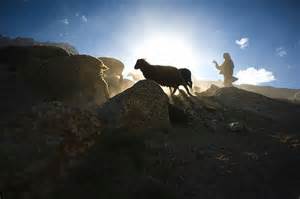
Shepherd with SheepScripture Text: Psalm 78: 52-54


52Then he led out his people like sheep, and guided them in the wilderness like a flock. 53He led them in safety, so that they were not afraid; but the sea overwhelmed their enemies. 54And he brought them to his holy hill, to the mountain that his right hand had won.


We tend to think of the wilderness as a place where we are sort of thrown out into virtually alone. We imagine wandering, looking for solace, looking for companionship, looking for someone to help us out of where we are. We search for God as if God is somehow parked at the exit of the wilderness holding a sign with our name on it as we disembark. And, yet, this psalm reminds us that even in the wilderness we are not alone, that God leads us and guides us through the treacherous terrain. Actually, there are times, when God, as it says, guides us IN, wandering, living the wilderness. It says that we are led to safety and brought to a place that is holy, that is of God. So, why then, here in the wilderness, do we feel so alone?


We are accustomed to pastoral images in the Bible, beautiful images of the flock being led or shepherds on the hillside. We know what it is supposed to connote. The shepherd guides the sheep to the place where they will be well-fed and cared for, the place where they will grow and flourish into maturity. There is soft, green grass, blue skies, and other sheep in the fold to keep them company as they grow together. But this is not what it looks like right now. Where is the green grass? Where are the blue skies? Where are my trusty companions? And so, searching for our image of where a shepherd is supposed to lead, we leave to look for greener pastures or easier pathways. But the grass isn’t really greener, the skies really aren’t any clearer, and in our confusion, we fall, tumbling down the gulley, bruised and tired.


As we said before, the wilderness is not just something to rush through. And God does not always lead us out of the desolation that surrounds us. As the passage says, God leads us through or in the wilderness, helping us navigate the rough paths and the difficult sightlines and, when the time is right, bringing us home. Our problem is that we don’t envision ourselves like sheep because we are trying so hard to be the shepherd of our own lives, to be in control, to be the guide. And so we often wander away and get lost. We may end up in a place that is not ours to be. But think about sheep. Sheep are seldom characterized as one of the smartest beings on the farm and yet, sheep know to whom they belong. Sheep know how to follow. Sheep know how to be part of a flock, holding each other up, helping each other see the shepherd. And when, as happens every now and then, a sheep gets lost, the sheep trusts that the shepherd will come and bring the sheep home.


Lent is a season that teaches us to be more like sheep, to follow God through the wilderness, learning the things that it teaches, accepting the things that it offers, and knowing, that, when it is time, God will guide us out of this lostness, out of despair, out of the loneliness.  You don’t have to fix it; you don’t have to hurry; you don’t have to make it something it is not.  Just follow.  Just live.  But by following God’s lead, we will see beauty we have never seen and companionship we have never known.  That’s what you get when you’re part of a flock.


Be patient toward all that is unsolved in your heart and try to love the questions themselves like locked rooms or books that are written in a foreign tongue. The point is to live everything. Live the questions now. Perhaps you will then gradually without noticing it, live your life some distant day into the answers. (Rainer Maria Rilke)


FOR TODAY:  Be sheep.  Follow.  Listen.  Be patient.

With My Mind Stayin’ on Jesus


Kneeling at the CrossScripture Text: Mark 8: 31-38

31Then he began to teach them that the Son of Man must undergo great suffering, and be rejected by the elders, the chief priests, and the scribes, and be killed, and after three days rise again. 32He said all this quite openly. And Peter took him aside and began to rebuke him. 33But turning and looking at his disciples, he rebuked Peter and said, “Get behind me, Satan! For you are setting your mind not on divine things but on human things.”  34He called the crowd with his disciples, and said to them, “If any want to become my followers, let them deny themselves and take up their cross and follow me. 35For those who want to save their life will lose it, and those who lose their life for my sake, and for the sake of the gospel, will save it. 36For what will it profit them to gain the whole world and forfeit their life? 37Indeed, what can they give in return for their life? 38Those who are ashamed of me and of my words in this adulterous and sinful generation, of them the Son of Man will also be ashamed when he comes in the glory of his Father with the holy angels.”

So many of us are like Peter. We want to “fix” things, to make sure that everything and everyone is safe and alright. We want things to be OK. We want to get this wilderness place cleaned up and ready for show. But that was never part of the promise. I think Peter actually DID understand that Jesus was the Messiah. He just didn’t fully grasp what that meant. For him, the Messiah was here to fix things, to make it all turn out like it was supposed to turn out. And now Jesus was telling them that the way they had thought it would all turn out was not to be, that instead this Messiah, this one who was supposed to make everything right, was to be rejected and would endure great suffering.  “No, this can’t be!” yelled Peter.  This cannot happen.  We have things to accomplish.  We are not done.  This ministry is important. It cannot go away.  You have to fix this. You have to fix this now! We are not ready to do it alone. We are not ready to be without you. 

Now, contrary to the way our version of the Scriptures interprets it, I don’t think Jesus was accusing Peter of being evil or Satan or anything like that.  More than likely, this was Jesus’ way of reprimanding Peter for getting hung up on the values of this world, getting hung up on our very human desire to save ourselves and the way we envision our lives to be, to fix things.  But what God had in store was something more than playing it safe.  I think that Peter, like us, intellectually knew that.  We know that God is bigger and more incredible than anything that we can imagine.  And yet, that’s hard to take.  We still sort of want God to fix things, to make things comfortable, or at least palatable.  We still sort of want God to lead us to victory, to lead us to being the winning team.  Face it, we sort of still want Super Jesus in the story.  And, of course, Peter loved Jesus.  He didn’t even want to think about the possibility of Jesus, his friend, his mentor, his confidante, suffering, of Jesus dying.

You know, there is a danger in our thinking that God is here to make life easier for us, to keep us safe and warm and free from harm. After all, there’s that whole Cross thing that gets in the way. If we think that God came into this world, Emmanuel, God-with-us to make life better or easier or grander for us, then what do we do with a crucified Savior? What do we do with the cross?  Well, let’s be honest, most of us clean it up, put it in the front of the sanctuary, and, sadly, go on with the security of our lives.  So, what does it mean to “take up your cross and follow”? What does it MEAN to follow God not just to the altar where that gleaming, cleaned-up cross sits, but to follow Christ to the hills of Golgotha, to walk with Jesus all the way to the Cross?  I think it means that sometimes faith is hard; sometimes faith is risky; in fact, sometimes faith is downright dangerous. And, to be honest, faith rarely makes sense in the context of the world in which we live. After all “denying ourselves”, “losing our life to save it”, and “letting go to gain” make absolutely no sense to us. They don’t make sense because we are setting our minds on the human rather than the Divine.

There’s a old Gospel song with these lyrics:  (Hear it at https://www.youtube.com/watch?v=Xit39G0lIk4)

Well, woke up this mo’nin with my mind, stayin’ on Jesus

Woke up this mo’nin with my mind, stayin’ on Jesus

Well, woke up this mo’nin with my mind, stayin’ on Jesus

Halleluh, halleleluh, halleleluh


In all probability, none of us will be physically crucified for our faith.  But it doesn’t mean that we should clean it up and put it out for display either.  Sometimes our journey will take us through waters that are a little too deep and torrential; sometimes we will find ourselves bogged down by mud; and sometimes faith takes us to the edge of a cliff where we are forced to precariously balance ourselves until we find the way down.  The promise was not that it would be safe; the promise was that there was something more than we could ever imagine and that we would never journey through the wilderness alone. The promise was that a Savior would come, not to save us from the world or to save us from evil, but to save us from ourselves.

On this Lenten journey, this journey that takes us through the wilderness all the way to that place beyond the wilderness, to the Cross, we are called to follow Christ. We are called to begin to wake up in the morning with our minds “stayin’ on Jesus”. It will not lead you to safety; it will lead you to Life.

He comes to us as One unknown, without a name, as of old, by the lakeside…He speaks to us the same word:  ‘Follow thou me!” and sets us to the tasks which He has to fulfill for our time…And to those who obey, whether they be wise or simple, [God] will reveal {Godself] in the toils, the conflicts, the sufferings which they shall pass through in this fellowship, and, as an ineffable mystery, they shall learn in their own experience Who [God] is.  (Albert Schweitzer)

FOR TODAY:  Put your plans aside.  Let go of the images of God that you have conjured up.  Let go of the notion of a Savior who will fix things.  Close your eyes.  Then wake up…wake up with minds stayin’ on Jesus…all the way through the wilderness of Golgotha to Life.

Grace and Peace,

Shelli

Finding Enough in the Wilderness

Shifting Sands on the PathwayScripture Text:  Romans 4: 13-22

13For the promise that he would inherit the world did not come to Abraham or to his descendants through the law but through the righteousness of faith. 14If it is the adherents of the law who are to be the heirs, faith is null and the promise is void. 15For the law brings wrath; but where there is no law, neither is there violation. 16For this reason it depends on faith, in order that the promise may rest on grace and be guaranteed to all his descendants, not only to the adherents of the law but also to those who share the faith of Abraham (for he is the father of all of us,  17as it is written, “I have made you the father of many nations”) —in the presence of the God in whom he believed, who gives life to the dead and calls into existence the things that do not exist. 18Hoping against hope, he believed that he would become “the father of many nations,” according to what was said, “So numerous shall your descendants be.” 19He did not weaken in faith when he considered his own body, which was already as good as dead (for he was about a hundred years old), or when he considered the barrenness of Sarah’s womb. 20No distrust made him waver concerning the promise of God, but he grew strong in his faith as he gave glory to God, 21being fully convinced that God was able to do what he had promised. 22Therefore his faith “was reckoned to him as righteousness.”

According to the passage, faith is and has always been the basis of a relationship with God.  (Well, duh!)  We know that.  We are told to believe, to have faith, no matter what.  And so we wander around in another wilderness perhaps beating ourselves up because it just doesn’t make sense to us.  Our pragmatic 21st century minds need proof.  We want to touch it or we want to somehow see it or AT LEAST be able to google it and get more information.  But, as Paul reminds us here, if our whole faith system depends on nothing more than adhering to some limited set of laws or hard and fast Scriptural interpretations that have been laid down by those that came before us, what good is faith?  It’s not bad, mind you, it’s just not enough.  Faith is about relationship; faith is about jumping off into the abyss of unknowing whether or not it makes sense; faith is about knowing only that what you know, what you understand, and what you’ve been told is just not enough.

Now I have to admit, I am a list maker of the highest magnitude.  There is a certain satisfaction, almost power-driven, in “checking things off” my list.  So, faith, for me, is definitely a walk in the wilderness where the winds blow the sands beneath my feet distorting my planned path, where the road winds and turns into unknown terrain, and where nothing, I mean NOTHING, is ever completed or “checked off” as “OK, I got that one”.  See, I don’t think Paul would have ever have meant to dismiss systematized religion or even the rules.  They help shape us; they give us a starting point.  But Paul is reminding us that they have their limitations.  They tend to make sense of something that, in our minds, in our limited human minds, does not and cannot fully make sense.  An authentic, growing, faith making its way through the wild terrain is one that weaves what doesn’t make sense into understanding, laughter into prayer, and grace into the everyday.  It is a mixture of sense-making and transcendence that, sometimes, on our very best days, opens us to an encounter with the Divine when we least expect it in our everyday, carefully planned, list-ridden life.  And in that moment, the path beneath us shifts just a bit as God gently moves us to face a new direction.

As the passage says, the promises of God do not come to us through our religion or through our laws or through even our reading of the Scriptures (shhhh!)  The promise of God comes to us through our faith.  The promise comes to be in the wilds of our lives when our lists cannot be completed and we can no longer control where our path leads.  The promise takes life when we encounter and know God as perfectly revealed and totally hidden.  The promise takes life when we finally know that what we know is never enough.

On this Lenten wilderness journey, we are taught to open our eyes to what we’re missing seeing and opening our hearts to the ways that we’re missing being and opening our minds beyond the boundaries that we have drawn to know that there is so much more, that what we know and what we see is never enough.  We are never called to tame the wilderness through which we journey or to try to redraw the shifting pathways but rather to believe that the Promise will be. The wilderness teaches us that faith fills the void where knowing is not enough.  And, for now, that is enough.

Let your religion be less of a theory and more of a love affair.  (G.K. Chesterton)

FOR TODAY: Put the list down. Stop checking things off.  Now let yourself travel into the wilderness where faith is enough.

Grace and Peace,

Shelli