If I Could Turn Back Time

Judas BetrayalToday’s Lectionary Passage:  John 13: 21-32

21After saying this Jesus was troubled in spirit, and declared, “Very truly, I tell you, one of you will betray me.” 22The disciples looked at one another, uncertain of whom he was speaking. 23One of his disciples—the one whom Jesus loved—was reclining next to him; 24Simon Peter therefore motioned to him to ask Jesus of whom he was speaking. 25So while reclining next to Jesus, he asked him, “Lord, who is it?” 26Jesus answered, “It is the one to whom I give this piece of bread when I have dipped it in the dish.” So when he had dipped the piece of bread, he gave it to Judas son of Simon Iscariot. 27After he received the piece of bread, Satan entered into him. Jesus said to him, “Do quickly what you are going to do.” 28Now no one at the table knew why he said this to him. 29Some thought that, because Judas had the common purse, Jesus was telling him, “Buy what we need for the festival”; or, that he should give something to the poor. 30So, after receiving the piece of bread, he immediately went out. And it was night.  31When he had gone out, Jesus said, “Now the Son of Man has been glorified, and God has been glorified in him. 32If God has been glorified in him, God will also glorify him in himself and will glorify him at once.

Poor Judas!  We take this story so literally most of the time, pinning all the bad in all the world on the one that Biblical translations and exegetical interpretations have branded the betrayer, the bad seed, the evil one, the poster child for the worst sin imagineable.  In fact, Dante’ puts Judas in the fourth level of the ninth circle of hell, the lowest rung of the inferno, along with Brutus and Brutus’ co-hort Cassius.   Me?  I tend to err more on the side of mercy.  Because truth be known, don’t you think that Simon Peter was nervous when he was asking that question.  “Lord, who is it?”  In other words, “is it I”?  “Am I the one that will betray my Lord?”  After all, I’m not sure than any of the disciples really came to the forefront.  None of them stood out that night or the next day as glowing examples of who God calls us to be.  They were scared; they were unsure about their own well-being; and they were certainly unsure what life would hold next.  Maybe some had begun to figure out what was about to happen.  I think most of them were like us, living in some sort of state of denial thinking that we are doing the right thing and that everything will turn out alright.

And don’t you think that all of them, Judas included, looked back on the night the next morning and thought, “If only…if only I could turn back time.”?  (yeah, I know that’s a Cher song!) So why did Judas do it?  Oh, please, why do any of us do what we do?  We all have regrets; we’ve all made mistakes; we’ve all wished that somehow we could turn back time.  The truth is, there is a little Judas in all of us.  But in this same passage, there is another character introduced:  “the one whom Jesus loved”.   This is the epitome of light against the foil of Judas in his darkest hour as his actions usher in the time that brings Jesus’ presence as the light of this world to a close.  There is all kinds of speculation.  Was it someone that we don’t know?  Was it Mary Magdelene?  Or was it, perhaps, even Judas? 

Judas could not live with what he had done. The writer of Matthew’s Gospel says that Judas would end his own life that next morning.  (Matthew 27: 3-5)

When Judas, his betrayer, saw that Jesus was condemned, he repented and brought back the thirty pieces of silver to the chief priests and the elders. 4He said, “I have sinned by betraying innocent blood.” But they said, “What is that to us? See to it yourself.” 5Throwing down the pieces of silver in the temple, he departed; and he went and hanged himself. 

And yet, Jesus, knowing what was about to happen, welcomed Judas to the table; in fact, Jesus welcomed all of them, that motley crew of misfits that never really could get it together and were always in competition with each other, that lot of sinners and saints.  The truth is we are all both–the betrayer and the beloved, the sinner and the saint.   God does not love us in spite of who we are; God loves us because of who we are.  The question that we should ask ourselves is whether or not we believe that anyone is ever beyond God’s redemption, beyond God’s love, beyond God’s power to pick up and recreate.  This night of betrayal does not end that way.  This night ends with love and with life.  Because, you see, when it’s all said and done, God really does turn back time.

Madeleine L’Engle tells an old legend that after his death Judas found himself at the bottom of a deep and slimy pit.  For thousands of years he wept his repentance, and when the tears were finally spent he looked up and saw, way, way up, a tiny glimmer of light.  After he had contemplated it for another thousand years or so, he began to try to climb up towards it.  The walls of the pit were dank and slimy, and he kept slipping back down.  Finally, after great effort, he neared the top, and then he slipped and fell all the way back down.  It took him many years to recover, all the time weeping bitter tears of grief and repentance, and then he started to climb again.  After many more falls and efforts and failures he reached the top and dragged himself into an upper room with twelve people seated around a table.  “We’ve been waiting for you, Judas.  We couldn’t begin till you came. (From “Waiting for Judas”, by Madeleine L’Engle, in Bread and Wine:  Readings for Lent and Easter (Maryknoll, NY:  Orbis Books, 2003), 312.)
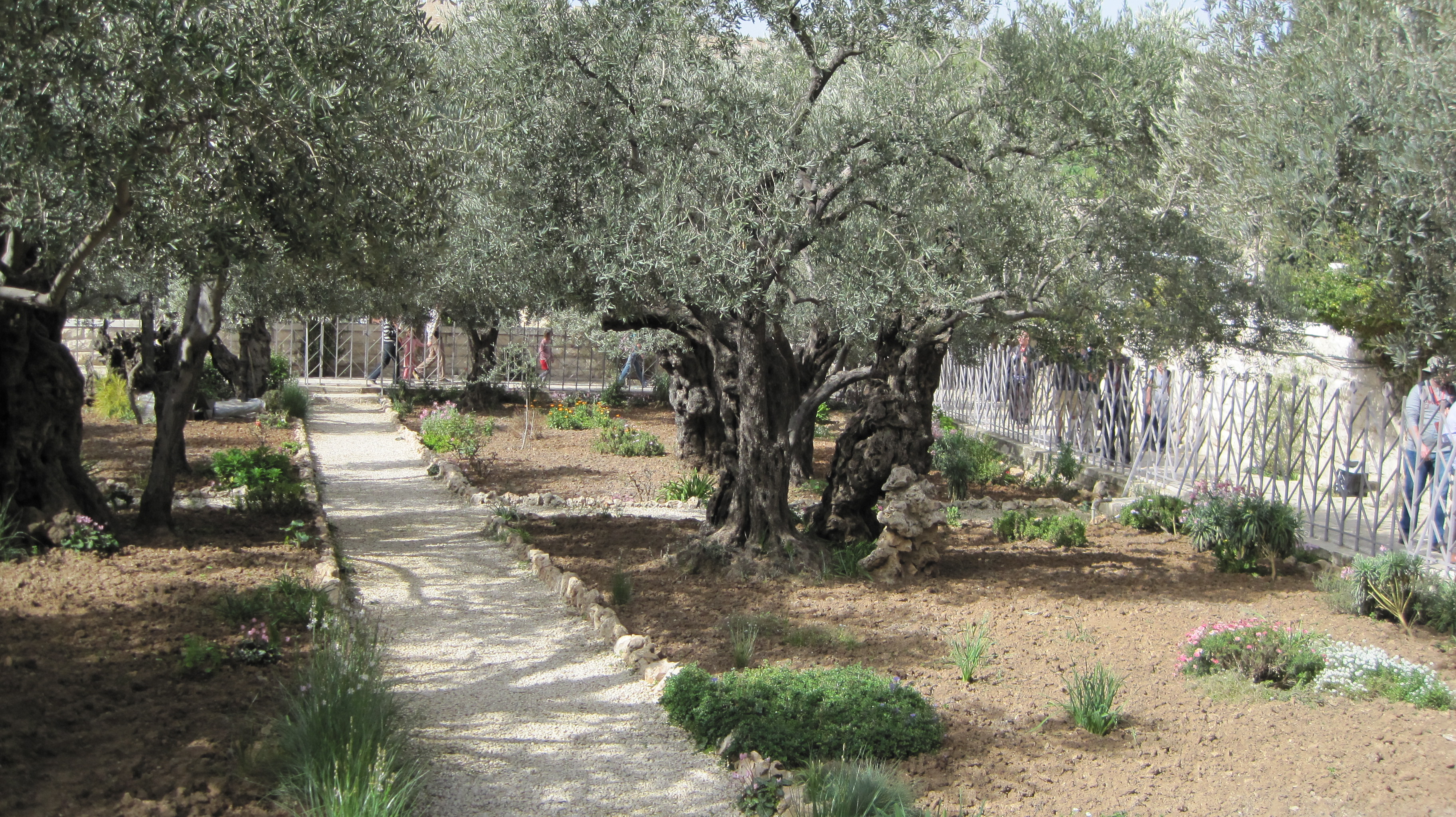
Garden of Gethsemane, Jerusalem, 2010

So, as you walk through this week, remember that we are all Judas but, more importantly, we are all beloved.  And, remember, that God really does turn back time, so to speak, gathering all of us to the table and recreating us into the fullness of God’s vision for all.  But God cannot begin until you come.

“If I Could Turn Back Time” (Cher)

Grace and Peace,

Shelli

Dancing in the Rain

Image from “Singing in the Rain” (1952)
(with Gene Kelly)

Lectionary Passage:  John 6: 1-21
To read this passage online, go to http://bible.oremus.org/?passage=John+6:1-21&vnum=yes&version=nrsv

We love this story.  (And they must have loved it in the first century because the writers of all four gospels chose to include it their unique account of the Good News of Jesus Christ.) Yes, we like the notion of Jesus providing everything we need, bursting in just when we are at the end of our ropes, just when we need help the most, and fixing the ails of our life (or at least feeding us lunch!).

But notice (don’t you hate that…yes, I’m about to ruin your image of super-hero Jesus pulling lunch out of a hat or whatever we thought he did!) that the story never says that the boy’s lunch was the ONLY food there.  Perhaps there were some people holding back what they had brought, afraid to offer it for community consumption because, after all, what if they ran out?  What if they needed it tomorrow or the next day or after they retire?  So, perhaps the miracle lies not in some sort of image of Jesus creating something from nothing but rather in the little boy himself.  He was first, freely offering what he had to Jesus and the Disciples to do whatever they needed to do with it.  Now, note what was in the little boy’s lunch–barley bread and fish.  Barley is a very inexpensive and somewhat “unglamourous” grain and fish were plentiful.  After all, they were right next to this huge lake.  (Just to get it in your head, the “Sea” of Galilee is actually a huge lake.)  In other words, this was the lunch of the poor.  The little boy was more than likely not from a family of means.  Perhaps his mom had lovingly packed all they had into his lunch so that her son could have this experience of seeing this great man Jesus of whom they had only heard.  But before that ever happened, the little boy stood and offered everything he had.

And, then, well you know how it goes.  The person next to him saw what he had done, thinking that no longer could he now with a clear conscience keep what he had brought tucked away.  And then the person next to that person saw him offer what he had.  It went on and on, a veritable Spirit moving through the crowd.  The message is right.  It WAS a miracle!  And when they had finished eating, they realized that it wasn’t that there was enough for all.  There was more!  There were leftovers that were then gathered into baskets.  Maybe they were for later.  Maybe they were for those who needed it.  Or maybe they were offered as holy doggie bags to remind us that God always gives us way more than we really need. 

So what about those of us who feel that we need to be prepared for the next storm that is coming around the bend?  Well, keep reading.  The passage goes on to say that the disciples started across the lake in the darkness.  And, sure enough, the storm began to rage–blowing winds, crashing waves, beating sheets of rain bearing down upon them.  Wouldn’t you know?  See, this is what we were afraid of!  But, there is Jesus.  “Do not be afraid.  Do not be afraid.”  What is interesting is that the account never says that Jesus calmed the storm.  Jesus calmed the disciples.  Jesus reminded the disciples that no matter what, no matter how hungry or unprepared they are, no matter what storms come up unexpectedly, they are not alone.  It is truly a story of extraordinary abundance.

I was going to write today on the David and Bathsheeba story but I got up early this morning to get a drink of water.  And standing at the window in my kitchen, I saw the words on a plaque I have on the window sill:  “Life isn’t about waiting for the storm to pass.  It’s about learning to dance in the rain.”  (I looked it up and the quote is attributed to Vivian Green.)  It’s a great thought.  Jesus is not a super hero that performs unexplainable miracles or plucks us out of the storms of life.  Jesus is much more.  When the storms come, when the winds rage, and when we just think we just don’t have enough for what’s coming, God invites us to dance, holding us until we find the rhythm that is deep within us and know the steps ourselves.

So, keep dancing!

Grace and Peace,

Shelli

For those of you who are reading this through the St. Paul’s ESPACE link, welcome!  And for those who get this as a “blog” email, yes, I’m finally back!  I’m going to try to maybe do this 2-3 times a week.  Keep on me!  🙂  Shelli

LENT 5B: This Talk of Death

Lectionary Passage:  John 12: 20-33:
Now among those who went up to worship at the festival were some Greeks. They came to Philip, who was from Bethsaida in Galilee, and said to him, “Sir, we wish to see Jesus.” Philip went and told Andrew; then Andrew and Philip went and told Jesus. Jesus answered them, “The hour has come for the Son of Man to be glorified. Very truly, I tell you, unless a grain of wheat falls into the earth and dies, it remains just a single grain; but if it dies, it bears much fruit. Those who love their life lose it, and those who hate their life in this world will keep it for eternal life. Whoever serves me must follow me, and where I am, there will my servant be also. Whoever serves me, the Father will honor.   “Now my soul is troubled. And what should I say—‘Father, save me from this hour’? No, it is for this reason that I have come to this hour. Father, glorify your name.” Then a voice came from heaven, “I have glorified it, and I will glorify it again.” The crowd standing there heard it and said that it was thunder. Others said, “An angel has spoken to him.”30Jesus answered, “This voice has come for your sake, not for mine. Now is the judgment of this world; now the ruler of this world will be driven out. And I, when I am lifted up from the earth, will draw all people to myself.” He said this to indicate the kind of death he was to die.

You can tell it’s getting closer.  As we move through these last weeks of Lent, the time seems to increase to warp speed.  It is almost more than we can take.  I mean, wasn’t it just a few months ago that we were talking about stars and the birth of a child?  Wasn’t it just a few weeks ago that we were following Jesus around Galilee as he built his ministry, as he spread the first real notion of hope that we had ever seen?  And now the talk turns to touble and death.  What are we to do with that?  And what is this thing about wheat again?

First, the wheat must die so that it can grow and bear more fruit.  This is sort of confusing if you do not know what wheat is.  Wheat is what is called a caryopsis, meaning that the outer seed and the inner fruit are connected.  The seed essentially has to die so that the fruit can emerge.  If you were to dig around and uproot a stalk of wheat , there is no seed.  It is dead and gone.  The grain must, in essence, allow itself to be changed.  What this tells us in that in order for something new to happen, in order for a “new” or “renewed” creation to come about, we must allow ourselves to be changed.

So what Jesus is trying to tell us here is that if we do everything in our power to protect our lives the way they are—if we successfully thwart change, avoid conflict, prevent pain—then at the end we will find that we have no life at all.  So why, then, is death so hard for us to talk about, so hard for us to deal with in our life?  In fact, we do everything that we can to postpone it or avoid it altogether.  So maybe that’s why the cross bothers us so much if we really think about it.  Oh, we Christians can focus on the Resurrection and just let the cross somehow disappear into the background, covered in Easter lilies.  But then we have forgotten part of the story.  We have forgotten that God does not leave us to our own devices, does not leave us until we have “figured it out”, does not wait in the wings until we have covered it all up with Easter lilies.  God is there, in the suffering, in the heartache and despair.  And God in Christ, there on the cross, bloodied and writhing in pain, is there not in our place but for us and with us.

Whether you believe that God sent Jesus to die, or that human fear and preoccupation with the self put Jesus to death, or whether you think the whole thing was some sort of colossal misunderstanding…the point of the cross is that God took the most horrific, the most violent, the worst that the world and humanity could offer and recreated it into life.  And through it, everything—even sin, evil, and suffering is redefined in the image of God.  By absorbing himself into the worst of the world and refusing to back away from it, Jesus made sure that it was all put to death with him.  By dying unto himself, he created life that will never be defeated.  And in the same way, we, too, are baptized into Jesus’ death and then rise to new life. 

Yes, in these weeks we turn to death.  It is the way that we turn to life.  And life is the whole reason we started talking about stars and the birth of a baby anyway, right?  After all, without the cross, I think the manger is just a feed trough. All of life makes sense in light of the end.  Brazilian Catholic Archbishop Dom Helder Camera once said “why fear the dark?  How can we help but love it when it is the darkness that brings the stars to us?  What’s more:  who does not know that it is on the darkest nights that the stars acquire their greatest splendor?”  


So, on this twenty-seventh day of Lenten observance, think about what the cross means to you.  What does the cross call you to do?  Who does the cross call you to be?

Grace and Peace,

Shelli  

Light-Yielding

In this Lenten season, we tend to focus on wilderness and darkness.  We are told to look at our selves honestly, compelled to confront our wrongs and name our sins.  The season begins in dust, with the faint sign of the cross made of oil and ash.  And as we sit in the dark, forboding wilderness, wrought with the tempations around us, we strain to see the light that we are promised.  We try hard to see even a small glimmer of the light that our faith tells us is up ahead.  We are told to let go, to relinquish the thinngs that we hold.  But how can we?  This season is too hard, too dangerous, too foreboding.  And so we stay in the darkness for now, content to wallow in our guilt and be comforted by our despair, hiding our shame from the world.  And we go on.  Someday the Light will come.

I don’t think we get it.  Surely this God of light and life does not want us to wallow here.  I mean, anyone that even knows the definition of psychology knows that healing starts with diagnosing our ills, confronting our demons, and naming our sins. In fact, in her book Speaking of Sin, Barbara Brown Taylor contends that sin, that thing that we try to hide away from everyone, is our only hope, because the recognition that something is wrong is the first step toward setting it right again.  She says that “there is no help for those who admit no need of help.  There is no repair for those who insist that nothing is broken, and there is no hope of transformation for a world whose inhabitants accept that it is sadly but irreversibly wrecked.”  But most of us are not comfortable facing ourselves that honestly and so we become content with wallowing in the darkness.  We get stuck in cycles of guilt and self-denial and become well-versed in closing our eyes to our own shortcomings and those of our society.  We somehow convince ourselves and cherish the idea that we live in a classless, equal-opportunity society where everyone has the same chance.  We are taught to save face and tuck our blemishes and sins away so that no one will see.

I don’t think Lent is meant to be a season of wallowing.  No where is it written or implied that this is a season that shows us the way around the cross. (If that was the case, then why didn’t God somehow pluck Jesus off the cross in the nick of time?  But the story wouldn’t be the same.  It would be one of avoiding death, rather than recreating it into life.  It would be a fairy tale, rather than a vision of our eternity.) Rather, Lent is a season of journeying to the cross, of letting go of all those things that impede our vision of the Light, and laying them down and going beyond them as they, too, are recreated into Life.  In that way, it is a season not of wallowing in the darkness but one of yielding to the Light.  The Light is there, waiting.  But we have to yield to it.  We can no longer be content to sit here in the darkness, surrounded by those things we hide, and wait for the light to come.  That’s not the way it works.  We have to let go.  We have to let go of our sins, our despair, and our view that we are not ready yet or not “there” yet, of the notion that we have to somehow prepare ourselves a little bit more.  The Light is not going to magically move in and replace the darkness.  We have to yield to the Light that is already there.  We have to name what impedes our journey and let it go.  And when we let go of the hopelessness that we’ve created, we will finally see the Hope that is already there.  I don’t know about you, but I have some work to do!

On this sixteenth day of Lenten observance, name those sins that you have hidden.  Speak one out loud to someone.  Let it go.  Yield to the Light that is already there.

Grace and Peace on this Lenten Journey,

Shelli

The Story of God

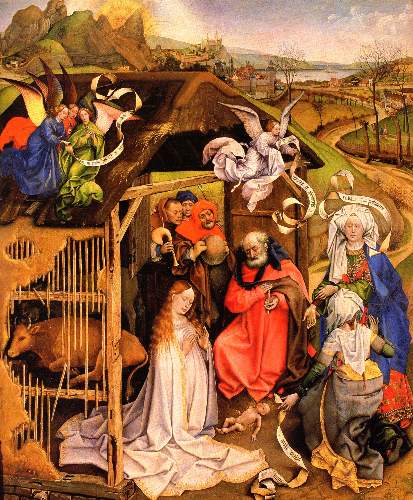
“Birth of Christ”, Robert Campin
ca. 1425-30

There is not one of us that does not love The Christmas Story.  It’s got it all–heartache, darkness, intrigue, danger, animals, innocence, an oppressive government, and a baby to boot.  It’s got all those things that make great tales.  No wonder it’s a bestseller!  No wonder there are so many songs written about it (that we at this moment cannot WAIT to sing!)  But for all the romantic notions of a baby born into a cold desert night in a small town on the other side of the world to poor, struggling parents, this story is not about a birth.  It’s not a story about Jesus.  This is the Story of God.

It began long before this.  It began in the beginning.  It began when God breathed a part of the Godself into being and created this little world.  And as the story unfolded, as God’s Creation grew into being, God remained with them, a mysterious, often unknown Presence, that yearned to be in relationship with what God had breathed into being.  And once in a while, God’s children would stop what they were doing long enough to know and acknowledge the incarnations of God.  Once in awhile, they would encounter a burning bush or a parting sea or an unfathomable cloud on the top of a mountain.  Once in awhile they would stop, take off their shoes, and feel the holiness beneath their feet.  But more often than not, they struggled in darkness, they struggled in war, they struggled in oppression and injustice because they didn’t see the Light that was with them.  God called them and God sent them and some were prophets and some were wise and some were yearning themselves to be with God.  Some wrote hymns and poetry telling of their yearning and others just bowed and hoped that God would notice.

This wasn’t enough.  It wasn’t enough for the people and it wasn’t enough for God.  God yearned to be with what God had created.  God desperately wanted humanity to be what they were made to be, to come home to the Divine.  And so God came once again, God Incarnate, into this little world.  But this time, God came as what God had created.  And so God was born into a cold, dark night.  But the earth was almost too full.  There was little room for God.  But, on that night, in a dark grotto on the outskirts of holiness, God was born.  The Divine somehow made room in a quiet, little corner of the world.  God came to show Creation what had been there all along.  And, yet, there was Newness; there was Light; there was finally Meaning; there was God Made Known.

The Incarnation (the “big I” one!) is God’s unveiling.  It is God coming out of the darkness and out of the shadows and showing us what we could not see before.  God became one of us to show us how to be like God in the world.  So, in this season, we again hear the story.  We hear the story of God.  But unless we realize that it is our story, it still won’t be enough.  God came as God Incarnate into this little world to tell the story that goes back to the beginning.  In the beginning was the Word, and the Word was with God, and the Word was God.  He was in the beginning with God.  All things came into being through him, and without him not one thing came into being.  What has come into being in him was life, and the life was the light of all people.  The light shines in the darkness, and the darkness did not overcome it.  (John 1: 1-5)  And the story continues… 

In this season of Advent, give yourself the gift of being a part of the story, of being Light, of being Life, of being who you were created to be in the beginning.  Give yourself the gift of making room for God.

Grace and Peace,

Shelli
    

THIRD SUNDAY IN ADVENT: Letting Go of Darkness

St. Paul’s United Methodist Church
Houston, TX
December 11, 2011

On this third Sunday in the Advent season, we continue to talk about light, about the Light of God as it comes into the world.  We talk about a light that illumines, a light that shows the way.  We talk about light-bending and light-bearing.  And we are reminded that this is the Light that pushes away the darkness.  And, yet, we still live in darkness.  We still live with injustice.  We still live with fear.  And we still live in a world that yearns for God and searches for Life.

So what is the problem?  If God created Light and then came into this world as Light Incarnate, the living Light, then why is there still so much darkness?  Perhaps it is we that are holding too tightly to the darkness.  Perhaps it is we who just don’t want to let go of that to which we are accustomed, of that which makes us comfortable.  Perhaps it is we who rather than adjusting our eyes to the Light, instead choose to shield our eyes and close our hearts until the Light is easier to handle.  Perhaps it is we that cannot let go of the darkness, of injustices that we allow to exist, of exclusions that we do not protest and hungers that we do not feed, and of those places where education, or medical resources, or the very basics of sustenance and life are not supplied because it is just too difficult.  And, so, there is still darkness.  Oh, we know that it’s there.  But what can we do? 

Don’t you think that if it were completely up to God, the Light would already be encompassing our world and the Kingdom of God would already be living into its fullest being?  I mean, really, what purpose does it serve God to hold back on us?  Why WOULDN’T God want Creation to be what it was created to be?  Why WOULDN’T God desire a world of justice and righteousness and sustenance for all.  Why WOULDN’T God want a world that offers life to all of God’s children?  If God is truly omnipotent, if God is all-powerful, why is our world the way it is?  It is because this omnipotent God chose long ago to give up a piece of the Godself.  It’s called free will.  God gave the greatest gift to humanity imagineable–a piece of the Divine, the ability to make a choice to let go of darkness and be the Light.  And then God came, Emmanuel, God-With-Us, to show us how to be that Light, to show us what it means to be a child of that Light.  God has never intended to remove us from the darkness of our lives but rather to show us how to transform it into Light, how to transform it into Life.  God is not holding back on us; God is waiting for us to let go of the darkness; God is waiting for us to be light.

Light looked down and beheld Darkness.
‘Thither will I go’, said Light.
Peace looked down and beheld War.
‘Thither will I go’, said Peace.
Love looked down and beheld Hatred.
‘Thither will I go’, said Love.
So came Light and shone.
So came Peace and gave rest.
So came Love and brought Life.
(“And the Word Was Made Flesh”, by Laurence Housman)
This morning we lit our third candle.  The Light has almost encircled the wreath.  It gives us the image of the Light encircling the world.  And when it is complete, when darkness is transformed, then the Light of Christ will be born to all.  We are the light-bearers.  We are the ones called to be children of the Light, bringing the Light to all.  So, let go of the darkness that it might be transformed into Life.  Be Light. Be Peace. Be Love.  Be the Image of God.

In this season of Advent, give yourself the gift of letting go of darkness; give yourself the gift of becoming the light that you were called to be, the light that points to the Light of God and brings life to a hurting world.

Grace and Peace,

Shelli


ADVENT 3B: Bending Light

Lectionary Text:  John 1: 6-8, (19-28)
There was a man sent from God, whose name was John. He came as a witness to testify to the light, so that all might believe through him. He himself was not the light, but he came to testify to the light.

Once again, we encounter John, who we now call John the Baptist.  But he’s really John the Witness.  Here, we are told that John is but a witness to something bigger.  He is there to point to the light of Christ that is coming.  But what makes John’s message uncomfortable is that he is always pointing to that which the light illumines.  For the writer of the Gospel According to John, the Logos was the true light bursting forth into humanity.  Rather than an angel announcing the birth of a baby, the writer is using John as a witness to point to that light as well as the purpose of that light.  We love the image of light but sometimes we are uncomfortable with full illumination.  I mean, here’s John, running around like a wild man in the wilderness preaching repentance, calling for us to change, and just being really loud.  Our reaction in this season is to respond with:  “John…shhhh!  You’ll wake the baby.”

After all, this is the Season when we celebrate the birth of Christ.  This is the Season when we want to give gifts to each other and spend time with our families enjoying a veritable plethora of high-sugar baked goods.  This is the Season when we want to decorate our houses with festive reminders of the joyous season and get dressed up and go to parties to celebrate the same.  This is the Season when we want everything to be joyous and beautiful and perfect.  But this John character just gets in the way, doesn’t he?  Doesn’t this come later in the Scriptures?  Doesn’t this come at the beginning of Jesus’ ministry?  Why do we have to think about this now in the middle of the birth stories?

The reason that we read about John is because it’s not about John.  He knew that.  Scary as he sometimes is, you can’t help but admire him.  He did not stand on convention and he really didn’t care at all what people thought.  He had one purpose.  He was to point to the Light.  In fact, when you think about it, he seemed to TRY to deflect attention away from himself.  Maybe that’s the point.  He was not the Light; he was the deflector.  It was his purpose to turn the attention aside and recast it toward the One who WAS the Light.  God created the Light for us so that we can see the Way, so that we can feel God’s Presence in our lives.  God created the Light that it might shine into our lives.  But God also created us in the image of the Godself that we might be able to also shine the Light away from ourselves, to deflect the Light back to God.  If we do nothing but bask in this incredible Light, we are surrounded in shadows.  But if we become a deflector of that Light, then the Light illumines even the darkness.

In this Advent season, we, too, are called to be witnesses of the Light.  It is not about us.  We, too, are called to turn God’s Light back toward God.  We are called to be Light-benders.  And you know what?  The baby’s already awake.  We just need to turn the Light toward the Christ that we might realize that.

In this season of Advent, give yourself the gift of turning the Light away from yourself that you might finally see the Glory of God.

Grace and Peace,

Shelli

(And if you’re interested in the full notes from the week’s lectionary passages, check out http://journeytopenuel.blogspot.com/ )