Station VI: No Longer Hidden

Station 06-HScripture Passage: Luke 8: 43-48:

43Now there was a woman who had been suffering from hemorrhages for twelve years; and though she had spent all she had on physicians, no one could cure her. 44She came up behind him and touched the fringe of his clothes, and immediately her hemorrhage stopped. 45Then Jesus asked, “Who touched me?” When all denied it, Peter said, “Master, the crowds surround you and press in on you.” 46But Jesus said, “Someone touched me; for I noticed that power had gone out from me.” 47When the woman saw that she could not remain hidden, she came trembling; and falling down before him, she declared in the presence of all the people why she had touched him, and how she had been immediately healed. 48He said to her, “Daughter, your faith has made you well; go in peace.”

The sixth station of the Stations of the Cross, named Veronica Wipes the Face of Jesus, does not come directly from Scripture but rather from the hearts and the traditions of the early European Christians. Tradition holds that Jesus healed a young woman named Veronica in his early ministry and as a sign of her deep and abiding gratitude for him, she accompanied him to the place of his execution. When she wiped his sweating face along this walk, the imprint of his face supposedly remained on the cloth. Eusebius, in his Historia Ecclesiastica, tells how at Caesarea Philippi lived the woman who Jesus healed of the blood disorder. In the West, she was identified as Martha of Bethany; in the East, she was called Berenike, or Beronike, the name appearing in the Acts of Pilate. The derivation of the name Veronica comes from the words “Vera Icon”, or “true image”.

This man had shown her great compassion when she thought there was none. The bleeding had started and had never stopped. And so, always, she was deemed unclean and, therefore, unacceptable, untouchable, shunned. This was a last effort to claim her life, to become a person of value and worth again in a society that so carefully laid out who was acceptable and who was not. She had, carefully, made her way through the crowds that day avoiding the stares and recoils that others held for her. And then she touched him. It was only a touch but she could feel something. She cowered back into the crowd trying to hide. But he saw her, compelling her forward and her life was never the same again.

And so on this day, she could not just hide out in the crowd. He needed someone–companionship, mercy, compassion. She didn’t care what she was risking. After all, this is the one who had given her her life. She could do this one thing. And when she wiped his face, she felt that same burst of power that she had felt before, a life-giving, life-awakening power. And she was left with the image of Christ.

Whether we take this literally or not, whether we believe that she was healed or that Christ’s imprint adhered to a cloth, is not the point. You see, each of us was made in the image of God. We are not destined to BE God but to be an image, a reflection of the Godself into the world and into the lives of each and every one that we meet. And when we show compassion, when we show mercy, when we step forward and show love to those who need it the most, the imprint of that image DOES stay with us. We become a reflection of the Christ, an image of the God who gave us life and calls us to show it to the world. And as Jesus walked toward death, the image of the Christ remained, no longer hidden, on the one who reached out to one in need. Reaching out to others does not mean that we are Christ; it means that we are human, fully human, the way Christ showed us to be.

So in this season of darkness and shadows, remain no longer hidden but step forward into this Walk of Christ and help someone in need. And the imprint of Christ, the image of the very Godself, will stay with you always.

Grace and Peace,

Shelli
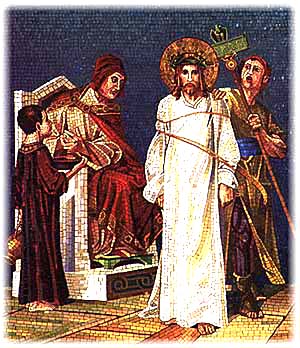
Station I: Condemned

Scripture Passage: Luke 23: 20-25
20Pilate, wanting to release Jesus, addressed them again; 21but they kept shouting, “Crucify, crucify him!” 22A third time he said to them, “Why, what evil has he done? I have found in him no ground for the sentence of death; I will therefore have him flogged and then release him.” 23But they kept urgently demanding with loud shouts that he should be crucified; and their voices prevailed. 24So Pilate gave his verdict that their demand should be granted. 25He released the man they asked for, the one who had been put in prison for insurrection and murder, and he handed Jesus over as they wished.

It has begun.  Our recognition of Christ’s Passion is not just relegated to those few heartwrenching hours on Good Friday or even to the few fast-moving days leading up to it.  Christ’s Passion actually began years ago in a small grotto or stable in Bethlehem.  Now do not think that I am one of those that thinks that God sent Christ to our little earth for the sole purpose of dying.  I just can’t see a God who is that cold and calculating.  Christ was not sent here to die but to live and to, at the same time, show us how to do the same. That was the point. 

And yet, even as early as the moment when Herod heard of the possibility of Jesus’ existence and ordered him (and all of the other male children of that age) killed, Jesus was condemned.  Actually, I think you can go back farther than that.  I mean, really, think about it–born in a barn or something to parents that really sort of appear to be illegal immigrants in sort of a no-name town just outside of the hustle and bustle of the holy city.  Jesus came into this world alien, poor, and condemned.  So this condemnation of Pilate’s, sparked on by those in majority rule, those who were trying desperately to maintain life as they knew it, is yet another step in this walk of a sadly condemned Christ.

This first Station of the Cross begins at the Praetorium, the court of law, located in the Fortress of Antonia, north of the Temple Mount.  Pilate is depicted as the accuser and, yet, if it had really been left up to him, Jesus would have been flogged and sent home.  But Pilate was swept into a whirlwind of political and personal agendas.  Jesus was essentially a victim of the conflicts of a society in chaos as its members postured to place themselves higher and stay ahead of the game.  After all, this man was expecting us to change!  So as the crowd became louder and louder as they tried to get the last word, Pilate had no choice but to hand down the sentence that would change the world.

We stand in awe of Jesus.  We are amazed at one who can hold so true to their convictions.  And we blame Pilate and the crowd and the disciples.  (I mean, really, where ARE they???)  And yet, where would we be?  Where would you be?  Would you have put your financial security, your reputation, perhaps even your life on the line to stand up for the condemnation of the innocent, to speak out in the way God calls you to speak?  DO you ever do that?  I have to confess that I fall embarrassingly short of that calling.  Jesus has been condemned to death and we stand not really knowing what to do next.  And so we sit quietly in the warmth of our comfortable lives while the world goes on.

On this Lenten journey, let us truly walk this Way of the Cross by speaking out for the condemned, by standing up for what is right, by being Christ in the world.  Let us finally kneel at the manger and worship Emmanuel, God With Us.  Let us find room this time.

Grace and Peace,

Shelli

Were You There at the End?

Today’s Scripture Passage: Mark 15: 34-47.
To read today’s portion of the account of the Passion, click on the below link:
http://bible.oremus.org/?ql=200678972

It’s 3:00.  The bells have begun to toll.  The sky is black and rumbling. After hanging there for hours, Jesus is nearing death.  He cries out from the depth of his forsakenness, the depth of his loneliness and abandonment.

Standing in the background, we want to help.  We want to bring comfort and a swift and painless death.  But we don’t.  Instead we stand by, not really knowing what to do, not really knowing if we should get involved, put our own selves at risk perhaps.  The truth is, we don’t really want to get our hands dirty.  Why do we think that because Jesus is our Savior, we should become nothing more than inert bystanders?  Well, we’ve never been told that.  No where in Scripture does it tell us to sit back while Jesus does all the hard stuff.  Oh, it would definitely be more palatable to just sort of walk way from this whole ugly mess and wait for it to pass, maybe show up Sunday morning for the grand processional with not even a bloodstain on us.

And then, it is over.  Jesus cries out and breathes his last breath on this earth.  The last piece of humanity that was at its fullest, the last shred that was what God envisioned, goes away in one last long and drawn out exhale.  God breathed us into being and is now exhaling and slipping away.  It is finished.  Jesus is gone.

Suddenly, the earth shakes and flashes of lightning cut across the darkened sky.  Torrential winds begin to blow across the earth and rain begins pouring onto the land.  The curtain of the temple, the veil that separates the Holy of Holies from us, that separates holiness from the earth, is torn in two and heaven and earth begin to spill together.  In some ways, they become almost undistinguishable from each other.  It is almost as if they somehow belong together, perhaps that they always belonged together. 

And then, from the shadows emerge the women.  They are those who are powerless, meaningless in society.  They are those whom Jesus loved.  And they were there even at the end.  Because the Sabbath was beginning, Joseph of Arimethea, an outsider in Jesus’ circle, asked for Jesus body.  And after anointing him, Joseph buried him in a borrowed tomb.  Even in death, Jesus had no home.  Even in death, the world did not make room.  And so the stone was rolled into place.  And those who loved him tried to go back to their lives.

So, were you there at the end?  Were you there when Jesus died, when the world changed, and when Jesus was buried in an unmarked grave?  The women knew where he was buried.  But no one else seemed to know.  They were not there.  So, what now?  We were always told to follow Jesus.  Where is he now?  Well you see, this would be the point at which we are compelled to pick up our cross and follow.  This would be the place where we die to self, where we leave our selves behind and go forward.  This would be the place where we experience the wholeness of who Jesus is.  This is the moment for which we’ve been preparing on this forty-day journey.  Just as the earth and heaven have spilled together, becoming undistinguishable, so have death and life.  No longer can we see where one ends and another begins because death has been recreated as life, death itself has had the breath of God breathed into it. The Protestant notion of the “empty cross” does not even make sense.  The cross is not empty; it is full of life–all of life. 

But we have to wait.  We have to enter the Cross on this day.  We have to follow Christ.  We have to die with Christ this day–die to self, die to greed and selfishness and putting ourselves ahead of others, die to prejudice and exclusion and a lack of compassion for our brothers and sisters in this holy earth.  Today we die.  And then we wait.  For God has gone on ahead.  God entered death first and asked us to do the same, asked us to follow, asked us to take up our cross.  So, take up your cross and follow.  For those who believe that God redeems, death is now part of life, earth is now part of heaven, and endings are now part of our beginning.  The birthing is not over.  It is never really finished.  On this night it all spills together and waits for God’s redeeming work.  On this night the earth once again waits with expectant hope for birth to happen.  But this time, it is ours!
 

Silent night! Holy night!
All is calm, all is bright,
Round yon Virgin Mother and Child!
Holy Infant, so tender and mild,
Sleep in heavenly peace!
Silent night!  Holy night!
Son of God, loves pure light
Radiant beams from Thy Holy Face
With the dawn of redeeming grace,
Jesus, Lord, at Thy Birth!

So, even as we wait in darkness, even as we grieve this night, God has only begun creating Life.  So, were you there at the end?  If we’re not there at the end, we’ll miss what comes next.  In the silence and holiness of this night, God is with us, walking us through to Life.
The point of Holy Week is to empty.  It is the completion of the process of Lent in which we have made room for our death…Resurrection is finding that place that is just for us.  In the beginning of Holy Week, we find ourselves spiritually homeless.  But when we are homeless, we are ready to be sheltered.  The shelter from death, in life, is on its way.  We don’t need to fear the emptiness.  (Donna E. Schaper, in Calmly Plotting the Resurrection, p. 80.)
Grace and Peace,
Shelli


Were You There When They Crucified My Lord?

Today’s Scripture Passage: Mark 15: 20-33
.
To read today’s portion of the account of the Passion, click on the below link:
http://bible.oremus.org/?ql=200598988

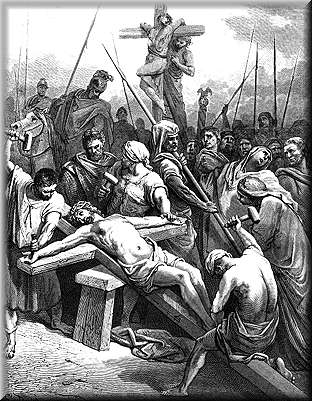
So they led him away and they hung him on the cross.  They chided him to save himself.  But Jesus was even too weak to carry his own cross.  They randomly pluck a man out of the crowd to help him carry it.  Now if we were doing the staging of this, we probably would have written in one of the disciples to do this, one of those who had traveled with Jesus these past years and received so much love and so much of life from Jesus.  It would have made more sense for one of those whom Jesus had stooped down below last night to wash his feet in a poetic depiction of incredible mutuality.  But that’s not what happened.  As it becomes more and more difficult for Jesus to carry his cross, it is a stranger who stoops to serve Jesus.  We really know very little about Simon—is he black, brown, white, olive-skinned?  Does it matter?  He was from Libya—a foreigner to the city of Jerusalem.  Anonymously plucked out of the crowd to help a bleeding dying man, he stooped and hoisted the cross that Jesus was carrying to his own shoulder.  Even at this late hour, God has orchestrated a Divine reversal in what the world expected.  Isn’t that just like God?  But, you have to wonder, where were the disciples?  Where were you?

The account says that they brought Jesus to Golgotha.  The name derives from the Aramaic golgolta, meaning “skull” or “place of the skull”.  Early tradition assumed that this was a site west of the city.  And when the Lukan Scripture was translated into Latin, it became known as “Calvary.”  But somewhere in history, the site was lost.  Perhaps it wasn’t even a specific site at all but a sort of general area away from the bustle of the city where these crucifixions would occur.  In 330, the Emperor Constantine tore down a Roman temple to Aphrodite and built the Church of the Holy Sepulcher, which tradition now recognizes as the last stations of Jesus’ journey to the cross, the site of the Crucifixion, and the site of the burial.  The present structure, built by the Crusaders, still houses the Constantine structure and the tradition.  Maybe it’s best that it’s like that.  Maybe it’s best that the actual site of Jesus’ final moments is not really known and even that Jesus’ final resting place is more of a tradition than a known place.  After all, would you have been there anyway? Maybe the anonymity is the whole point, sort of a depiction of our faith journey as we wander with no real knowledge of where it is we’re going–only that God is calling us there.

So, accompanied by an anonymous person to an anonymous place, Jesus is crucified.  The one who not so long ago had been surrounded by friends and followers, who a short time ago had preached to thousands on a hillside near the Galilean lake, and who only days ago had been showered with palm-branches in acclaim for who he was, was totally alone.  The one who had come into the world to save the world was now going to die in a shroud of anonymity.  It’s pointless to ask the question as to whether or not you were there.  You weren’t.  I wasn’t.  No one was. 

The life that began in the humble anonymity of a rough-hewn manger was ending the same way on a rough-hewn cross.  Maybe that was the whole point.  We bring nothing into this world and we take nothing out.  We are here for but a short time that, by the very Grace of God, is hopefully so filled with life and love that when our life here has ended, love still remains.  We do not know exactly where Jesus was born and we can’t pinpoint the location where he died.  What we do know is that while Jesus hung on the cross waiting those agonizing hours to die, God had plunged down to the very depths of humanity, to the places of loneliness and despair, to the places of abandonment and darkness, to the places where we are sometimes afraid to go.  And there, God began to say Creation into being once again.  The cross is God’s highest act of Creation yet. And when it was all said and done, it was Love that remained.

H.J. Iwand said that “our faith begins at the point where atheists suppose it must be at an end.  Our faith begins with the bleakness and power which is the night of the cross, abandonment, temptation, and doubt about everything that exists!  Our faith must be born where it is abandoned by all tangible reality; it must be born of nothingness, it must taste this nothingness, it must taste this nothingness and be given it to taste in a way that no philosophy of nihilism can imagine.”  So, in all probability, the explanation of the Cross is that there is no explanation.  At humanity’s lowest point, whether or not we bother to show up at all, it is only God who can save us.

Were you there when they crucified my Lord?
Oh, sometimes it causes me to tremble, tremble, tremble.
Where you there whey they crucified my Lord?

When it was noon, darkness came over the whole land until three in the afternoon…

Grace and Peace,

Shelli

Where Were You As Jesus Stood Accused?

“Christ Accused by the Pharisees”
Duccio de Buoninsegna, (1308-11)

Today’s Scripture Passage: Mark 14: 53-72
.
To read today’s portion of the account of the Passion, click on the below link:
http://bible.oremus.org/?ql=200505621

Most of us don’t read this portion of The Passion a whole lot.  We like the image of Jesus’ Anointing and we love the notion of The Garden of Gethsemane but this…this is not to our liking.  This is the story of Jesus as The Accused.  And we all know that doesn’t make sense.  What did Jesus ever do wrong?  And yet, here he is, before the court.  But this man who had spent his ministry welcoming others in was alone.  Oh, wait a minute…there’s Peter behind that sleeping elderly Scribe with the bad complexion.  Peter, his friend, his confidante, his disciple (Peter, as in Saint!) is there, but keeping a safe distance.  Well, I suppose he has too.  After all, the future of the Christian church rests with him, right?  He has to keep up appearances, do the right thing.  The important thing is that he is here, that Jesus knows he is here.  The important thing is that, deep down, Jesus knows how much he loves him and supports him.

Oh, we’re good at this, aren’t we?  We’re good at figuring out how to keep up appearances, at figuring out how to offer love and support while still maintaining our own place in life.  It’s difficult to associate ourselves with certain people or certain issues, even though we agree.  You see, we have to maintain our position so, please, understand, I support you, but I can’t speak out just now.  I know you understand how much I love you.

COCK A DOODLE DOOOOOOO!

What was that?  That was a lot of noise!  But, seriously, it’s hard to associate with certain people.  I love them; I support them; you know, I even think that they’re treated badly by both the society and, sadly, the church, but I just can’t.  What good would it do for me to forego my position just to make a statement on their behalf?

COCK A DOODLE DOOOOOOO!

Geez!  What IS that noise?  This man is my friend.  I love him.  But I can’t.  I can’t be seen with him right now.  I know he understands.

COCK A DOODLE DOOOOOOO!

And so Jesus stood alone. And Peter wept.  Peter wept for his friend but probably more than that he wept for what he was not.

I have to say that I am not a “rabble rouser”.  I tend to live my life with as little drama as I can muster.  In fact, I have to admit that I would be often standing in the back of the courtroom silently supporting the accused but not wanting to put my own self in jeopardy.  We’re all like that.  Isn’t that interesting that we talk so much, cannot put our cell phones or our emails aside and, yet, we are silent?  It is a dangerous and destructive silence.  It is like standing in the back of the courtroom and watching the innocent of all innocents accused and not speaking out.  Because you see, it is silence that crucified Jesus; it is silence that allowed the religious Crusades of the Middles Ages exist; it is silence that created slavery as the blotch on our nation’s history; it is silence that closed its eyes to Auschwitz hoping against hope that it would go away; it is silence that allowed segregation to exist in this country until late in the 20th century; and it is silence that continues to allow our church and our nation to limit who is part of us, who is part of the Kingdom of God.

And so Jesus stood accused.  Peter was in the background, safely hidden away.  Where were you? 

So, on this Wednesday of Holy Week, how would you answer? Were you there as Jesus stood accused?  Were you in the back of the courtroom?  What things do you know are wrong but about which you are silent?  Where do you voice your passions?  Where do you voice your Passion?

Grace and Peace,

Shelli

LENT 2B: Safe Travels

Lectionary Passage: Mark 8: 31-34 (35-38):
Then he began to teach them that the Son of Man must undergo great suffering, and be rejected by the elders, the chief priests, and the scribes, and be killed, and after three days rise again. He said all this quite openly. And Peter took him aside and began to rebuke him. But turning and looking at his disciples, he rebuked Peter and said, “Get behind me, Satan! For you are setting your mind not on divine things but on human things.”  He called the crowd with his disciples, and said to them, “If any want to become my followers, let them deny themselves and take up their cross and follow me.

We want to be safe.  We want everything to turn out alright.  We want some minimal guarantee of what is going to happen in our life.  We want safe travels on this journey.  But that was never part of the promise.

We’re just like Peter.  Sure, Peter got that Jesus was the Messiah.  He knew the words.  He had been taught the meaning probably from his childhood.  He knew that that was what they had been expecting all along—someone to be in control, someone to fix things, someone to make it all turn out like they wanted it to turn out.    And now Jesus was telling them that the way they had thought it would all turn out was not to be, that instead this Messiah, this one who was supposed to make everything right, was to be rejected and would endure great suffering.  “No, this can’t be,” yelled Peter.  This cannot happen.  We have things to accomplish.  We are not done.  This ministry is important. (To whom?)  It cannot go away.  You have to fix this. You have to fix this now! 

Now, contrary to the way our version of the Scriptures interprets it, I don’t think Jesus was accusing Peter of being evil or Satan or anything like that.  I doubt that Jesus would have employed our semi-modern notion of an anthropomorphic view of evil.  More than likely, this was Jesus’ way of reprimanding Peter for getting hung up on the values of this world, getting hung up on our very human desire to save ourselves and the way we envision our lives to be, to fix things.  But what God had in store was something more than playing it safe.  I think that Peter, like us, intellectually knew that.  We know that God is bigger and more incredible than anything that we can imagine.  And yet, that’s hard to take.  We still sort of want God to fix things.  We still sort of want God to lead us to victory, to lead us to being the winning team.  Face it, we sort of still want Super Jesus.  And, of course, Peter loved Jesus.  He didn’t even want to think about the possibility of Jesus suffering, of Jesus dying.

Safety can be a good thing.  I would advocate that we all wear seat belts.  I think having regulations for how children are to ride in vehicles is a prudent practice. (In fact, I’m not real impressed when I see an unrestrained dog in the back of a pick-up!)  And I lock my doors at night.  But our need to be safe can also paralyze us.  It can prevent us from moving forward on this journey as we settle for taking cover from the darkness rather than journeying toward the light.  And in our search for safety, for someone to save us, what do we do with a crucified Savior?  What do we do with the cross?  Well, let’s be honest, most of us clean it up, put it in the front of the sanctuary, and, sadly, go on with the security of our lives.  So, what does it mean “take up your cross and follow”?  I think it means that sometimes faith is hard; sometimes faith is risky; in fact, sometimes faith is downright dangerous. 

In all probability, none of us will be physically crucified for our faith.  But it doesn’t mean that we should clean it up and put it out for display either.  Sometimes our journey will take us through waters that are a little too deep and torrential; sometimes we will find ourselves bogged down by mud; and sometimes faith takes us to the edge of a cliff where we are forced to precariously balance ourselves until we find the way down.  The promise was not that it would be safe; the promise was that there was something more than we could ever imagine and that we would never journey alone.  And along the way, we encounter a Savior that will save us from ourselves.

So, continuing with our act of giving up so that we can take on, on this ninth day of Lent, give up that thing in your life that is keeping you safe and secure on this journey of faith.  Begin to move forward into what God has promised for you. 

Grace and Peace on this Lenten Journey,

Shelli