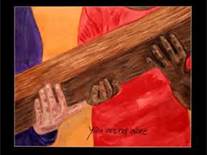
Station V: Anonymous Bystander

Scripture Passage:  Mark 15: 21-24
They compelled a passer-by, who was coming in from the country, to carry his cross; it was Simon of Cyrene, the father of Alexander and Rufus. 22Then they brought Jesus to the place called Golgotha (which means the place of a skull). 23And they offered him wine mixed with myrrh; but he did not take it. 24And they crucified him, and divided his clothes among them, casting lots to decide what each should take.

We know the town from where he came–Cyrene, an ancient Greek colony that became a Roman colony near modern-day Shahhat, Libya.  We know that he was a father of two sons.  Beyond that, this man Simon is essentially an anonymous bystander.  We don’t know why he was there at all.  Had he intended to come and bring his sons to this gory event or had they planned to visit Jerusalem, perhaps steep themselves in history and a little shopping, without realizing what this day would bring?  We don’t know what about him prompted the guards to literally pluck him out of the crowd.  All we know is that this man lives in history as the one, the only one, who helped Jesus carry his cross to Golgotha.

The Scriptures do not say that he responded in any way other than to do it.  It is interesting that in all those years upon years of God’s calls being met with “no, not me, please not me” that this anonymous man about whom we know little would be the one to do this.  So God calls a scared, young, no-name peasant girl to bring Jesus into the world and a foreign, probably dark-skinned, anonymous bystander to carry him out.  Isn’t that just like God?  Here, just before the end, God slips one more Divine reversal in.

You know, Simon had to be afraid.  Good grief.  Here he was in the middle of the processional to a crucifixion!  What if they killed him too?  What would happen to his sons?  His family was miles away.  How would they even know what had happened to him?  And, yet, he didn’t seem to question his role.  He put his hand on Jesus’ shoulder as if to say, “I’m here.”  Then he leaned down and picked up the heavy cross, being careful to place his hands rather than running them down the splintering wood.  And then they began to walk–Jesus and this man, this dark-skinned anonymous man who Jesus had never met, this child of God, this new disciple, this one who without hesitation carried the cross of his Savior.  He would go through the gates and up the hill, touching the edge between life and death. 

But, again, I have to ask, where were those disciples?  Where were those who Jesus had called, who Jesus had groomed, who had been part of Jesus’ ministry, who had been Jesus’ friends?  Why was it THIS man and not them?  Why was it Simon that when it was all said and done was the first to take the yoke of Christ unto himself?  After all, it seems, the disciples would have been in the best position.  It would have made a whole lot more sense.  But, then, where would we be?  Where would those of us who Jesus had called, who Jesus had groomed, who are part of Jesus’ ministry?  Why isn’t it us touching the edge between life and death?  Why do we hold back?

28 ‘Come to me, all you that are weary and are carrying heavy burdens, and I will give you rest. 29Take my yoke upon you, and learn from me; for I am gentle and humble in heart, and you will find rest for your souls. 30For my yoke is easy, and my burden is light.’  (Matthew 11: 28-30).  See, we read this with such comfort at what Jesus can do for us.  But what does it mean to “take my yoke”?  For, THAT is the way that our souls will rest.

So, on this Lenten journey, move from being an anonymous bystander to a disciple of Christ.

Grace and Peace,

Shelli


The Road

This Week’s Lectionary Passage:  1 Corinthians 10: 1-13
I do not want you to be unaware, brothers and sisters, that our ancestors were all under the cloud, and all passed through the sea,2and all were baptized into Moses in the cloud and in the sea,3and all ate the same spiritual food,4and all drank the same spiritual drink. For they drank from the spiritual rock that followed them, and the rock was Christ.5Nevertheless, God was not pleased with most of them, and they were struck down in the wilderness.  6Now these things occurred as examples for us, so that we might not desire evil as they did.7Do not become idolaters as some of them did; as it is written, “The people sat down to eat and drink, and they rose up to play.”8We must not indulge in sexual immorality as some of them did, and twenty-three thousand fell in a single day.9We must not put Christ to the test, as some of them did, and were destroyed by serpents.10And do not complain as some of them did, and were destroyed by the destroyer.11These things happened to them to serve as an example, and they were written down to instruct us, on whom the ends of the ages have come.12So if you think you are standing, watch out that you do not fall.13No testing has overtaken you that is not common to everyone. God is faithful, and he will not let you be tested beyond your strength, but with the testing he will also provide the way out so that you may be able to endure it.

Well, it seems as if Paul is trying to shake up his Corinthian hearers a bit.  After all, they were pretty sure of themselves.  They were righteous and God-fearing and their faith was serving them well.  But Paul reminds them that it is not about them.  After all, a life of faith is not a life of checking off the boxes of all things good that one has done and counting one’s accolades; it is, rather, a life of an ongoing relationship with God.  And, as we all know, relationships do not move in a neat escalating line.  They have ups and downs and sometimes feel as if they are going to break completely apart.  Paul (as opposed to others in that day and, sadly, in ours) sees salvation here as a journey, an ongoing relationship, rather than securing a place in heaven or avoiding a place in hell. 

The truth is, relationships are hard.  This faith thing is hard.  It does not guarantee one a life of ease or plenty.  As Paul reminds us, look at the past. Faithful people lived in the shadows and had the waves crash over them.  Things were not easy.  Why would our life be different?  You see, faith is not something that removes us from life, that separates us from the world.  Faith is what calls us to live there, to be who we are called to be in this world, showing the world a different pathway.  Yeah, I know, it’s not easy.  But we have to persevere.

In our time, so much of religion is presented as a cure for all.  Well-meaning seekers are promised that faith, REAL faith, UNENDING faith, UNFALTERING faith, will bring them health and wealth and ease.  OK, excuse me here, but, really…no.  The Scriptures never depicted that.  This faith thing is hard.  Did you forget that it has to do with a cross, an instrument of death?  Did you forget that it acknowledges that pain and suffering is part of life?  Did you forget that we are told to deny ourselves and follow a pathway that we’ve never followed before?  But, more than anything else, did you forget that God has walked ahead?

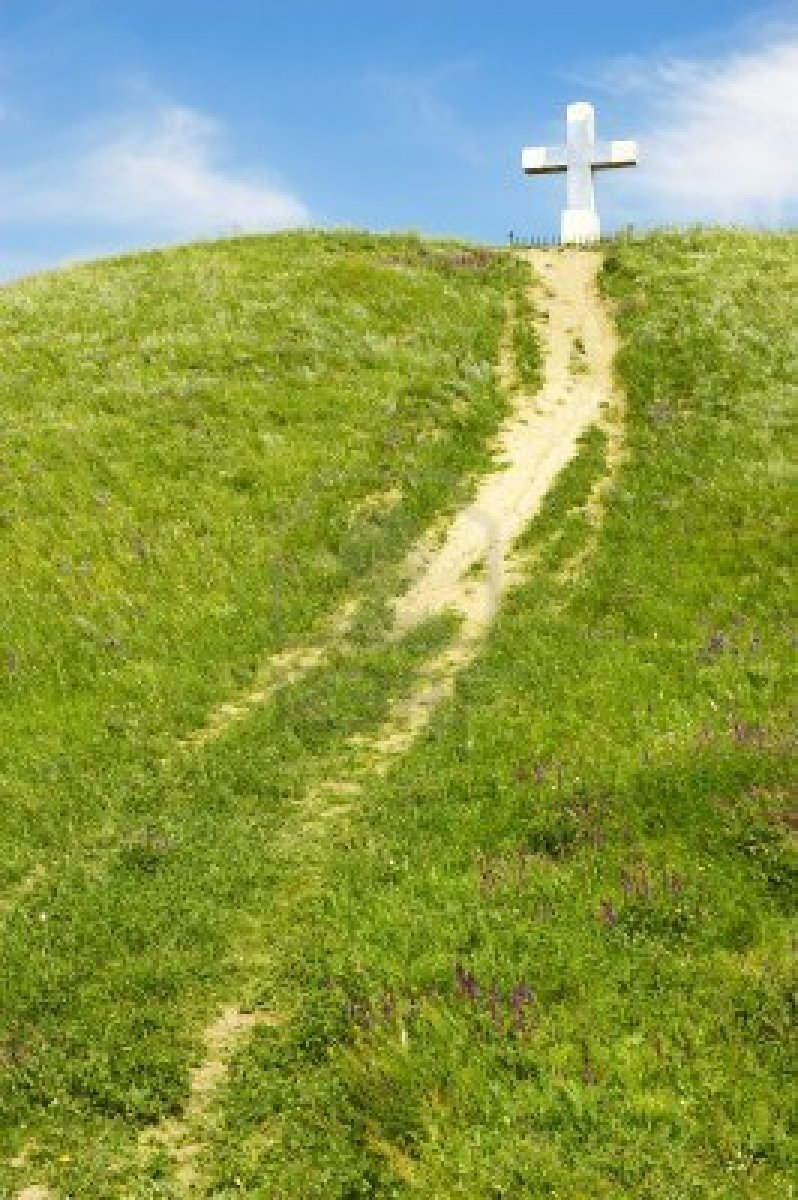
It may not be easy; it may destroy you; it may even end your life as you know it.  But God has walked this way before.  That’s the difference between shallow, empty pictures of fame and fortune dangled above a well-paved and perfectly landscaped path and following this bumpy, over-grown road with the marks of a cross drug through it and the, albeit faint, footsteps of faithful travelers who have gone before. 

Faith is not about finding the easiest way but following where God has gone before.

Grace and Peace,

Shelli

Station II: Take Up Your Cross

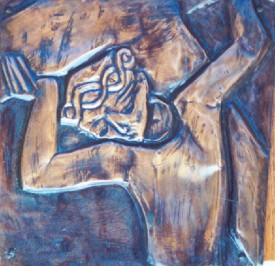
Copper Plate Depicting Station II
Samarpan Spiritual Leadership Center
Poway, CA

Scripture Passage:  Luke 9: 18-24
18Once when Jesus was praying alone, with only the disciples near him, he asked them, “Who do the crowds say that I am?”19They answered, “John the Baptist; but others, Elijah; and still others, that one of the ancient prophets has arisen.”20He said to them, “But who do you say that I am?” Peter answered, “The Messiah of God.”21He sternly ordered and commanded them not to tell anyone,22saying, “The Son of Man must undergo great suffering, and be rejected by the elders, chief priests, and scribes, and be killed, and on the third day be raised.”23Then he said to them all, “If any want to become my followers, let them deny themselves and take up their cross daily and follow me.24For those who want to save their life will lose it, and those who lose their life for my sake will save it.

The second station of the Via Dolorosa depicts Jesus taking up his cross.  Tried in a sham trial and condemned to death, Jesus is handed the heavy blocks of wood that have been hastily bound together.  What began as God’s creation pushed through from the soil has been taken and turned into an instrument of death.  So, Jesus takes up his cross.  The gates of the fortress open and Jesus is pulled to his feet and handed the heavy wood.  He begins to walk what would become known as the Way of the Cross, the Way of Sorrows, the Via Dolorosa.  He passes through the gate.  There is no turning back.

We are told to take up our cross and follow.  Surely that doesn’t mean this!  Surely the Gospel writers meant it metaphorically, meant that we shoul learn to be like Jesus, to follow his example.  It can’t mean this.  Surely we’re not supposed to take this literally!  So, what does that mean to take up our cross then?  If Jesus was nothing more than an example of how we’re supposed to live, we could have just as easily followed Mother Teresa or someone else that did a really good job of being a human.  And when you think about it, Jesus kept getting himself into trouble.  He continuously broke the rules and there are indications in the Gospel accounts that he may possibly have dealt with some anger management issues.  So, how do we follow THAT?  We deny ourselves, take up our cross, and follow.  Now?  Now, when things are not going well?  NOW we’re supposed to follow?

Jesus was not just an example of how to live; Jesus was the very embodiment of the Way to God.  And this Way of the Cross, this way of sorrows, this Via Dolorosa is part of that.  It is not rational to us; it doesn’t make sense.  But Jesus didn’t come to make sense; Jesus came to show us the Way to Life.  Being a disciple, a follower of Christ has little to do with behaving (Thanks be to God!).  Being a disciple means that we take all of this life that we hold dear, all of this life with which we’ve surrounded ourselves, all of these rules and all of these “right” way of doing things and lay them aside.  And we begin walking–through the gate, into the mystery of something that we don’t understand.  In essence, we walk into the unknown carrying nothing but our faith.   We deny ourselves and open our eyes to what God has placed before it.  That is our Way; that is our Cross.  And we walk this Way of the Cross.  It means more than following; it means becoming the very Way itself.  It means yielding ourself to the mystery that is beyond what we know and becoming who we were always meant to be.  It will take us through every aspect of life–through darkness and light, through suffering and joy, through doubt and faith.

It is not an easy way.  The cross is heavy.  The rough-hewn wood is splintering into my skin. Those along the pathway that are yelling and jeering make it even more painful.  This was not what I had planned.  I never thought that it would turn out like this.  I mean, I had so much more to do.  But I will go because I know that I do not walk this way alone.  Life as we know it is not all bathed in light.  Perhaps the darkness ensues at times to show us that God is there, even there, in the darkness, walking with us.  And I also know that somewhere down this road, there is more Light and more Love and more Life than anything that I could have conjured up.  And somewhere it will all make sense.  But, for now, I will take up my cross and walk this Way.

http://www.youtube.com/watch?v=IUFJJ-5K_LY&feature=player_detailpage

Grace and Peace,

Shelli

Were You There at the End?

Today’s Scripture Passage: Mark 15: 34-47.
To read today’s portion of the account of the Passion, click on the below link:
http://bible.oremus.org/?ql=200678972

It’s 3:00.  The bells have begun to toll.  The sky is black and rumbling. After hanging there for hours, Jesus is nearing death.  He cries out from the depth of his forsakenness, the depth of his loneliness and abandonment.

Standing in the background, we want to help.  We want to bring comfort and a swift and painless death.  But we don’t.  Instead we stand by, not really knowing what to do, not really knowing if we should get involved, put our own selves at risk perhaps.  The truth is, we don’t really want to get our hands dirty.  Why do we think that because Jesus is our Savior, we should become nothing more than inert bystanders?  Well, we’ve never been told that.  No where in Scripture does it tell us to sit back while Jesus does all the hard stuff.  Oh, it would definitely be more palatable to just sort of walk way from this whole ugly mess and wait for it to pass, maybe show up Sunday morning for the grand processional with not even a bloodstain on us.

And then, it is over.  Jesus cries out and breathes his last breath on this earth.  The last piece of humanity that was at its fullest, the last shred that was what God envisioned, goes away in one last long and drawn out exhale.  God breathed us into being and is now exhaling and slipping away.  It is finished.  Jesus is gone.

Suddenly, the earth shakes and flashes of lightning cut across the darkened sky.  Torrential winds begin to blow across the earth and rain begins pouring onto the land.  The curtain of the temple, the veil that separates the Holy of Holies from us, that separates holiness from the earth, is torn in two and heaven and earth begin to spill together.  In some ways, they become almost undistinguishable from each other.  It is almost as if they somehow belong together, perhaps that they always belonged together. 

And then, from the shadows emerge the women.  They are those who are powerless, meaningless in society.  They are those whom Jesus loved.  And they were there even at the end.  Because the Sabbath was beginning, Joseph of Arimethea, an outsider in Jesus’ circle, asked for Jesus body.  And after anointing him, Joseph buried him in a borrowed tomb.  Even in death, Jesus had no home.  Even in death, the world did not make room.  And so the stone was rolled into place.  And those who loved him tried to go back to their lives.

So, were you there at the end?  Were you there when Jesus died, when the world changed, and when Jesus was buried in an unmarked grave?  The women knew where he was buried.  But no one else seemed to know.  They were not there.  So, what now?  We were always told to follow Jesus.  Where is he now?  Well you see, this would be the point at which we are compelled to pick up our cross and follow.  This would be the place where we die to self, where we leave our selves behind and go forward.  This would be the place where we experience the wholeness of who Jesus is.  This is the moment for which we’ve been preparing on this forty-day journey.  Just as the earth and heaven have spilled together, becoming undistinguishable, so have death and life.  No longer can we see where one ends and another begins because death has been recreated as life, death itself has had the breath of God breathed into it. The Protestant notion of the “empty cross” does not even make sense.  The cross is not empty; it is full of life–all of life. 

But we have to wait.  We have to enter the Cross on this day.  We have to follow Christ.  We have to die with Christ this day–die to self, die to greed and selfishness and putting ourselves ahead of others, die to prejudice and exclusion and a lack of compassion for our brothers and sisters in this holy earth.  Today we die.  And then we wait.  For God has gone on ahead.  God entered death first and asked us to do the same, asked us to follow, asked us to take up our cross.  So, take up your cross and follow.  For those who believe that God redeems, death is now part of life, earth is now part of heaven, and endings are now part of our beginning.  The birthing is not over.  It is never really finished.  On this night it all spills together and waits for God’s redeeming work.  On this night the earth once again waits with expectant hope for birth to happen.  But this time, it is ours!
 

Silent night! Holy night!
All is calm, all is bright,
Round yon Virgin Mother and Child!
Holy Infant, so tender and mild,
Sleep in heavenly peace!
Silent night!  Holy night!
Son of God, loves pure light
Radiant beams from Thy Holy Face
With the dawn of redeeming grace,
Jesus, Lord, at Thy Birth!

So, even as we wait in darkness, even as we grieve this night, God has only begun creating Life.  So, were you there at the end?  If we’re not there at the end, we’ll miss what comes next.  In the silence and holiness of this night, God is with us, walking us through to Life.
The point of Holy Week is to empty.  It is the completion of the process of Lent in which we have made room for our death…Resurrection is finding that place that is just for us.  In the beginning of Holy Week, we find ourselves spiritually homeless.  But when we are homeless, we are ready to be sheltered.  The shelter from death, in life, is on its way.  We don’t need to fear the emptiness.  (Donna E. Schaper, in Calmly Plotting the Resurrection, p. 80.)
Grace and Peace,
Shelli


LENT 5B: This Talk of Death

Lectionary Passage:  John 12: 20-33:
Now among those who went up to worship at the festival were some Greeks. They came to Philip, who was from Bethsaida in Galilee, and said to him, “Sir, we wish to see Jesus.” Philip went and told Andrew; then Andrew and Philip went and told Jesus. Jesus answered them, “The hour has come for the Son of Man to be glorified. Very truly, I tell you, unless a grain of wheat falls into the earth and dies, it remains just a single grain; but if it dies, it bears much fruit. Those who love their life lose it, and those who hate their life in this world will keep it for eternal life. Whoever serves me must follow me, and where I am, there will my servant be also. Whoever serves me, the Father will honor.   “Now my soul is troubled. And what should I say—‘Father, save me from this hour’? No, it is for this reason that I have come to this hour. Father, glorify your name.” Then a voice came from heaven, “I have glorified it, and I will glorify it again.” The crowd standing there heard it and said that it was thunder. Others said, “An angel has spoken to him.”30Jesus answered, “This voice has come for your sake, not for mine. Now is the judgment of this world; now the ruler of this world will be driven out. And I, when I am lifted up from the earth, will draw all people to myself.” He said this to indicate the kind of death he was to die.

You can tell it’s getting closer.  As we move through these last weeks of Lent, the time seems to increase to warp speed.  It is almost more than we can take.  I mean, wasn’t it just a few months ago that we were talking about stars and the birth of a child?  Wasn’t it just a few weeks ago that we were following Jesus around Galilee as he built his ministry, as he spread the first real notion of hope that we had ever seen?  And now the talk turns to touble and death.  What are we to do with that?  And what is this thing about wheat again?

First, the wheat must die so that it can grow and bear more fruit.  This is sort of confusing if you do not know what wheat is.  Wheat is what is called a caryopsis, meaning that the outer seed and the inner fruit are connected.  The seed essentially has to die so that the fruit can emerge.  If you were to dig around and uproot a stalk of wheat , there is no seed.  It is dead and gone.  The grain must, in essence, allow itself to be changed.  What this tells us in that in order for something new to happen, in order for a “new” or “renewed” creation to come about, we must allow ourselves to be changed.

So what Jesus is trying to tell us here is that if we do everything in our power to protect our lives the way they are—if we successfully thwart change, avoid conflict, prevent pain—then at the end we will find that we have no life at all.  So why, then, is death so hard for us to talk about, so hard for us to deal with in our life?  In fact, we do everything that we can to postpone it or avoid it altogether.  So maybe that’s why the cross bothers us so much if we really think about it.  Oh, we Christians can focus on the Resurrection and just let the cross somehow disappear into the background, covered in Easter lilies.  But then we have forgotten part of the story.  We have forgotten that God does not leave us to our own devices, does not leave us until we have “figured it out”, does not wait in the wings until we have covered it all up with Easter lilies.  God is there, in the suffering, in the heartache and despair.  And God in Christ, there on the cross, bloodied and writhing in pain, is there not in our place but for us and with us.

Whether you believe that God sent Jesus to die, or that human fear and preoccupation with the self put Jesus to death, or whether you think the whole thing was some sort of colossal misunderstanding…the point of the cross is that God took the most horrific, the most violent, the worst that the world and humanity could offer and recreated it into life.  And through it, everything—even sin, evil, and suffering is redefined in the image of God.  By absorbing himself into the worst of the world and refusing to back away from it, Jesus made sure that it was all put to death with him.  By dying unto himself, he created life that will never be defeated.  And in the same way, we, too, are baptized into Jesus’ death and then rise to new life. 

Yes, in these weeks we turn to death.  It is the way that we turn to life.  And life is the whole reason we started talking about stars and the birth of a baby anyway, right?  After all, without the cross, I think the manger is just a feed trough. All of life makes sense in light of the end.  Brazilian Catholic Archbishop Dom Helder Camera once said “why fear the dark?  How can we help but love it when it is the darkness that brings the stars to us?  What’s more:  who does not know that it is on the darkest nights that the stars acquire their greatest splendor?”  


So, on this twenty-seventh day of Lenten observance, think about what the cross means to you.  What does the cross call you to do?  Who does the cross call you to be?

Grace and Peace,

Shelli  

LENT 4B: A Lesson in Snake-Handling

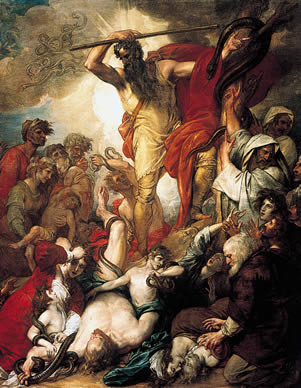
“The Brazen Serpent”
Benjamin West (1738-1820)
BJU Museum & Gallery, Greenville, SC

Lectionary Passage:  Numbers 21: 4-9
From Mount Hor they set out by the way to the Red Sea, to go around the land of Edom; but the people became impatient on the way. The people spoke against God and against Moses, “Why have you brought us up out of Egypt to die in the wilderness? For there is no food and no water, and we detest this miserable food.” Then the Lord sent poisonous serpents among the people, and they bit the people, so that many Israelites died. The people came to Moses and said, “We have sinned by speaking against the Lord and against you; pray to the Lord to take away the serpents from us.” So Moses prayed for the people. And the Lord said to Moses, “Make a poisonous serpent, and set it on a pole; and everyone who is bitten shall look at it and live.” So Moses made a serpent of bronze, and put it upon a pole; and whenever a serpent bit someone, that person would look at the serpent of bronze and live.

OK, this is just odd!  It’s one of those passages that probably wouldn’t have made it into the lectionary except that the Gospel writer that we know as John included it.  (We’ll read that this week too!)  Personally, I think it’s a little over the top–sending poisonous snakes.  I mean, it seems that the people were only asking for a little variety in their menu.  Isn’t this a little out of proportion?  I mean, really:  complaining…bad; poisononous snakes all over the place…REALLY bad.

But from the very beginning of Creation, as one of the Aramaic translations of the Hebrew Bible explains, the snake has slithered on its belly and eaten only dust and yet it has done so without a word of complaint.  So, then, what better character to rule over the people who have murmured over a choice of food?  Essentially, the snake comes to teach humility and patience.  But we as humans cannot resist being more than a little squeamish at the character.  There is something about a snake that demands our full attention.  When someone mentions that a snake is nearby, we don’t ask what lessons can be learned.  Instead, we climb on the furniture or over one another to get out of the way.

Our full attention…to how many things do we give that?  And how many things would we rather climb on the furniture or run to get out of the way rather than dealing with them?  And it is interesting that in order to save the people from the plague of snakes, God gave them a snake.  So, when someone is bitten by a snake, he or she is to look at a snake.  What sense does that make?  Think about it…we are to look at our fear; we are to look at those things that tempt us; we are to look at those things that distract us and pull us away from God.  (Goodness…that sounds a lot like this season of Lent!)  And God, in God’s infinite wisdom puts them on a pole so that we cannot avoid seeing them.

But only in the wisdom of God do we counter something that we fear with that which we fear.  Here, God’s antidote for the snakes is a snake.  Isn’t that sort of paradoxical?   We have to look beyond that with which we are uncomfortable.  We have to look into a sight that brings such fear, such loathing, that it is hard for us to find God’s presence in it.  And, deep within it, is the sight of humility and patience, a creature that, according to Creation mythology, had resigned itself to surrendering to that which ruled its life.  And by looking into one’s fear, by looking into one’s death, one is freed—the ultimate paradox. 

It is notable, too, that nothing is said to imply that God destroys the snakes.  Essentially, God does not destroy the enemy—God recreates it.  Isn’t that an incredible thing?  You see, we need to recognize that the traditional Jewish reading of the “Garden of Eden” story differs from the classical Christian version.  While the snake has often been identified in both faiths as Satan (or satan), the Jewish understanding is not that of something or someone outside of God’s command or a rebel against divine authority.  Rather, it’s sort of a prosecuting attorney, entrusted with testing, entrapping, and testifying against us before the heavenly court.  It’s part of God’s way of maintaining order.  It’s part of God’s way of showing us a mirror to look at ourselves.  So, from that standpoint, these snakes or serpents are not enemies but, rather, part of our ourselves.  (On some level, maybe that’s more uncomfortable even than enemies!)

So, the simple equation is this:  the cure for snakes is a snake…the cure for something is to stare it straight in the face.  Where have we heard that before?  Centuries later, God did it again.  The cure for our death is death—death of those things that stand in the way of our relationship with God, death of those things that make us less than human, death of those things that are not part of who we are as images of God.  And, if you remember, the cure for a life of pain and suffering and temptation is life eternal.  Snakes for snakes; death for death; life for life.

Those whose eyes are fixed on the Son of Man as he is lifted up ultimately see God’s healing of the world.  The Cross is that thing at which we are forced to look, forced to see a part of us that we do not want to see, forced to see the way we murmur and complain about our lives when they’re really not that bad.  In an odd way, the cross is that snake on a pole.  So as hard as it may be, stand still.  It doesn’t make sense in this world.  It’s gruesome and loathsome and filled with danger.  But God, in God’s infinite wisdom, takes it and turns it into life.  We don’t need to become snake-handlers; we just need to be aware of that to which we should be looking.  So, walk now, toward the cross—the instrument of death that gives you life.  

On this seventeenth day of Lenten observance, go commune with a snake…no, just kidding!  Instead, give someone today your full attention.  Do not get pulled away by your cell phone or your watch or your calendar.  
Grace and Peace on this Lenten Journey,

Shelli  

Lent 3B: Everybody Plays the Fool

Lectionary Text:  1 Corinthians 1: 18-20 (21-24) 25
For the message about the cross is foolishness to those who are perishing, but to us who are being saved it is the power of God. For it is written, “I will destroy the wisdom of the wise, and the discernment of the discerning I will thwart.” Where is the one who is wise? Where is the scribe? Where is the debater of this age? Has not God made foolish the wisdom of the world?..For God’s foolishness is wiser than human wisdom, and God’s weakness is stronger than human strength.

In this Season of Lent, as we come closer and closer to the cross, we get a better and better sense of its meaning.  You know, Paul’s really the only one that really ever dared to speak of the foolishness of the Cross, of the foolishness of God.  And he’s right, because in terms of the world, the Cross is utter foolishness.  The world says “mind your own business”; Jesus says “there is no such thing as your own business”.  The world says “buy low, sell high”; Jesus says “give it all away”.  The world says “take care of your health”; Jesus says “surrender your life to me”.  The world says “Drive carefully—the life you save may be your own”; Jesus says “whoever would save his life will lose it, and whoever loses his life for my sake will find it.”  The world says “get what you are due”; Jesus says, “love your neighbor as yourself”.

In his book, The Faces of Jesus, Frederick Buechner says that “if the world is sane, then Jesus is mad as a hatter and the Last Supper is the Mad Tea Party…In terms of the world’s sanity, Jesus is crazy as a coot, and anybody who thinks he can follow him without being a little crazy too is laboring less under a cross than under delusion.” (Buechner, The Faces of Jesus, p. 61)  Think about it.  It is really pretty ludicrous.  In fact, it’s probably downright absurd.  Here in this season, we are called to enter Christ’s suffering, called to follow Christ to the Cross.  Are we nuts?  That could kill someone!

And yet, there…there up on the altar every single Sunday is that beautiful gleaming cross.  Yeah, we all have them.  We polish them, we wear them, and we hang them on our walls.  (Have you SEEN my cross collection in my office?)  In fact, I think I remember seeing one on top of a cupcake the other day. (You know, I guess you can put anything on top of a cupcake!)  But maybe sometimes we clean it (the cross, not the cupcake) up too much.  Maybe we have forgotten the stench of death emanating from it or the sight of a mangled body hanging from it.  Maybe we have forgotten the foolishness of it all.  Maybe it is just too much for us.  After all, we’re good Methodists, people of the “empty cross”.  But it’s NOT empty; it’s full of life–life born from death, life recreated from despair and hopelessness and the end of all we knew.  But this promise of life did not just pop out of a cupcake.  It did not just appear in the midst of an array of carefully-placed lilies one Easter morning.  God took something so horrific, so dirty, so unacceptable and recreated it into Hope Everlasting.  Daniel Migliore calls it God’s greatest act of Creation yet.  But in terms of what we know, what we expect, even what we deserve, it is an act of utter foolishness.  Who writes this stuff?  In terms of this world, it is fool’s gold; but in terms of God’s Kingdom coming into being, it is the Gold of Fools because it takes us and turns us into the wise.  But perhaps wisdom is not about worshipping a gleaming, pristine cross but rather looking at an instrument of death and seeing the life it holds.  I know…none of it makes sense.  If it all made sense, we wouldn’t need it at all.

And, truth be told, the Scriptures are full of accounts of the wise and powerful ones mocking and getting mocked, never really understanding this lowly carpenter’s son from a no-name town.  But notice that it is the ones who are considered fools–the outsiders, the shunned, the ones who do not measure up to society’s standards–that get it.  So, maybe you have to be a fool. Go ahead.

Everybody plays the fool, sometime,
There’s no exception to the rule, listen baby,
It may be factual, it may be cruel, I ain’t lying,
Everybody plays the fool.
How can you help it, when the music starts to play
And your ability to reason is swept away
Oh, heaven on earth is all you see, you’re out of touch with reality
And now you cry, but when you do, next time around someone cries for you.
Everybody plays the fool, sometimes,
There’s no exception to the rule, listen baby,
It may be factual, it may be cruel, I ain’t lying,
Everybody plays the fool.
(K. Williams, R. Clark, J.R. Bailey, songwriters

http://www.youtube.com/watch?v=8Ni6iB3thsg

So, continuing with our act of giving up so that we can take on, on this thirteenth day of Lenten observance, do something blatantly foolish.  Give up needing to have a life that makes sense.  Feel the freedom of being recreated.   

Grace and Peace on this Lenten Journey,

Shelli