Keeping Silence

I read the other day that scientists have determined that noise has a definite effect on work efficiency.  Noise quickens the pulse, increases the blood pressure, and upsets the normal rhythms of the heart.  That’s actually pretty scary.  Because every single one of us live and exist in noise.  And if noise affects our work that way, what, exactly, does it do to our spiritual life?  We need silence sometimes.  It is part of the rhythm of life.  Mother Teresa of Calcutta once said that “we need to find God, and [God] cannot be found in noise and restlessness.  God is the friend of silence.  See how nature–trees, flowers, grass–grows in silence; see the stars, the moon, and the sun, how they move in silence…we need silence to be able to touch souls.”

So, why is silence so hard to find?  And why, then, is it so hard to take?  We’re not really programmed that way.  Our world is not programmed that way.  Most of us are used to at the very least a little “background” noise.  In fact, we now employ the use of benign “white noise” to drown out other noise, to bring us closer to silence.   For some of us, that is as close as we get to silence.  What is wrong with us?  Are we so unsure of ourselves and our faith that we cannot just be silent?  Is the honing of our communications skills of higher importance than the contemplation of our faith?

Now, to be honest, I’m not sure that “pure” silence really exists.  There’s always something making noise.  Perhaps “keeping silence” is more about returning to a natural level of noise than it is stopping all noise itself.  In her book, When God is Silent, Barbara Brown Taylor talks about an experience by composer John Cage’s time in an anechoic chamber (a room without echoes).  With his perfect hearing, he picked up two distinct sounds–one high and one low.  When he described them to the engineer in charge, he was told that the high sound was his nervous sytem in operation, and the low one was his blood in circulation.  Noise is part of life.  Keeping silence is not about existing in pure silence; it is about living in pure life, in Creation.  And yet, most of us live most of our lives in noise–artificial noise, the noise of the world, rather than the noise of Creation.

If you go back and read the story of Creation, it began in silence.  I think it probably began in “pure” silence, in a void.  And then God spoke us into being.  In her book, Taylor says, “in his poetic eulogy “The World of Silence”, the French philosopher Max Picard says that silence is the central place of faith, where we give the Word back to the God from whom we first received it.  Surrendering the Word, we surrender the medium of our creation.  We unsay ourselves, voluntarily returning to the source of our being, where we must trust God to say us once again.”

In this Lenten journey, we talk about giving up, we talk about re-aligning our lives with what God envisions for us, and we talk about change.  But maybe the part we’re missing is where we don’t talk.  Shhhhh!  Let God say you into being again.

On this third Sunday of Lenten, just be quiet.  What do you hear?  What does the silence teach you?
Grace and Peace on this Lenten Journey,

Shelli

Holding Fast

Lent is the season for fasting.  But, to be honest, most of us sort of shrug that off or snicker at the sheer absurdity of it all.  After all, fasting is not in our nature.  It doesn’t fit with our culture or our understanding.  We want to believe in a God of abundance rather than a God that expects us to go without anything.

And yet, fasting is one of the most frequently mentioned ascetic practices in the Bible.  The ancient Hebrews (and those of the Jewish tradition today) observe a special period of fasting as a sign of repentance on the Day of Atonement, or Yom Kippur.  Fasting was a sign of mourning or act of reparation for sins.  It was both a way to express repentance as well as prepare oneself inwardly for receiving the necessary strength and grace to complete a mission of faithful service in God’s name.  This was the reason that Jesus fasted for 40 days in the wilderness–not to prove something but to prepare himself for a life of ministry.  Fasting is neither abstinence from nor avoidance of, but a journey into a place that’s empty enough to fill with what God offers.  Essentially, it is allowing oneself to die to self and rise again in Christ.

So, why is it so hard?  Maybe it is not merely because we have a hard time going without (although I think that is a large part of it.)  Maybe it is because we are expecting it to produce results that it is not meant to produce. Fasting is not meant to be manipulated in that way. It is meant to clear rather than produce.  Think of fasting as response–a response to grief or sin, a response to graciousness or thankfulness, a response to a God who calls us out ourselves.  But perhaps fasting is also about return, a return to our own self before we developed all these needs, before we stored everything away, a return to the self that God created–with proper perspective and an awareness of what basic needs actually are. If you look up the physiology of fasting, you will find that a body can survive for 40 days or more without eating (40 days?  Hmmm! Isn’t THAT interesting?)  In that time, depriving a body of food is not starvation but rather a burning of stored energy.

But I have to say that fasting has never been a huge part of my spiritual discipline.  Being the good Methodist that I am, I have always maintained that I can “add” to my Lenten practice and do the same thing as fasting.  I’m not real sure, though, that that is the case.  Maybe, even metaphorically, I am only storing in excess, building and building for the future, trying to take as much of God’s abundance as I can and stash it away.  Maybe in this 40 days of fasting, we are indeed called to let something go, to return to who we are before we stored it all away–the “leaner”, fuller, more focused self who knew that our basic daily needs would be met and that the abundance of God was really about allowing God to fill our needs and fill our lives and show us the way.  And once our bodies and our minds and our souls (and our houses!) are cleared of all the stored excess, we will be open to what we need–the very breath of God who breathed life into us in the beginning and each and every day–if there’s room.

OK…you saw this one coming:  On this fourteenth day of Lenten observance, give something up that you think you cannot do without–food, sodas, coffee (ohhhh!), shopping, your cell phone, complaining, driving over the speed limit, the need to control, or whatever you come up with.  Give it up this evening and fast until this time tomorrow.  In a small way, you may just come closer to the one that God created before you began to add all those things in!   

Grace and Peace on this Lenten Journey,

Shelli

LENT 1B: The Harrowing of Hell

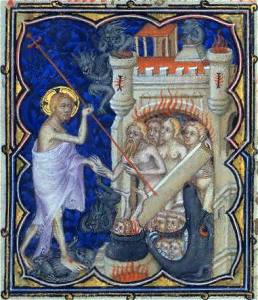
The Harrowing of Hell, depicted in the Petites Heures
de Jean de Berry, 14th c.  illuminated
manuscript commissioned by
John, Duke of Berry.

LECTIONARY PASSAGE:  1 Peter 3: 18-22
For Christ also suffered for sins once for all, the righteous for the unrighteous, in order to bring you to God. He was put to death in the flesh, but made alive in the spirit, in which also he went and made a proclamation to the spirits in prison, who in former times did not obey, when God waited patiently in the days of Noah, during the building of the ark, in which a few, that is, eight persons, were saved through water.  And baptism, which this prefigured, now saves you—not as a removal of dirt from the body, but as an appeal to God for a good conscience, through the resurrection of Jesus Christ, who has gone into heaven and is at the right hand of God, with angels, authorities, and powers made subject to him.

The faith communities to which this was written did not have it easy.  They were the outsiders–shunned, unaccepted, separated from the only society that they knew.  To put it bluntly, they were living in hell.  So this comes as a reminder that what they are experiencing now is not permanent.  It is not the final word.  New life is just over the horizon.  For the writer of this epistle, this is a sure promise, made real through our baptism.  Baptism here is depicted a recreation, as resurrection.  The whole point is that believers do not need to fear the difficulties and sufferings that are present now.  God has indeed promised something new.  In all honesty, I don’t think this writer necessarily saw baptism as merely a cleansing.  Rather, baptism is a claiming.  We are claimed by God.  We are empowered by the Spirit of Christ.  We are made new.  So no matter what hell we might find ourselves in, there is more up ahead.  God has claimed us.  Each of us is a beloved child of God.  Our baptism acknowledges that and, like the waters that flooded the earth, sweeps us into new life.

In fact, even the powers of hell cannot impede the recreation that is happening all around us.  Now our church chooses to recite the more sanitized version of the Apostles’ Creed but there is an older version that dates back to the 5th century that goes like this:  “I believe in God the Father almighty, maker of heaven and earth; and in Jesus Christ, his only Son our Lord, who was conceived by the Holy Ghost, born of the Virgin Mary, suffered under Pontius Pilate, was crucified, dead, and buried. He descended into hell.”  That last sentence is believed to have been loosely taken from this passage.  We read that Jesus proclaimed even to the “spirits in prison”.  In other words, Jesus descended into hell, into the bowels and depths of life.  And, there, he blew the gates open and the eternally forsaken escaped, crossing the threshold to new life.  In the Middles Ages, it was referred to as the “Harrowing of Hell”.  Now, admittedly, there is little basis for this theology but if death hath no sting, why would hell win?  (And to be honest, there’s really little basis for the notion of “hell” as we 21st century folks think of it.  I think Dante did us no favors. ) If God’s promise extends to all of Creation, then perhaps hell really hath no fury.    

Now this is in no way a lessening of the impact or importance of sin.  We all know that.  We sin.  We try not to.  But we sin.  In fact, most of us are pretty good at creating our own hell.  We plunge ourselves into darkness, into separation from God, through fear, or guilt, or shame, and we struggle to claw our way out.  But even the powers of sin are no match for the promise before us.  That is the whole point of our faith.  So, if we believe that, why is it such a stretch to believe that the God of all, the God who loves us, and who has claimed us, could vanquish all the powers that afflict us, that God has vanquished all the powers of hell?

Perhaps this Lenten season of penitence is not so much a call to grovel at the feet of a forgiving God but rather to faithfully follow this God who beckons us home again to begin again.  Maybe it truly is the harrowing of whatever hell we find ourselves in.  But in order to do that, we have to name our sin and release its power.  It’s part of our story.  It’s part of what we must tell.  And with that, the waters subside and the green earth rises again.  Now, I don’t profess to know the whole truth about this hell thing.  It’s not an issue for me.  But I struggle to reconcile the notion of a place called hell with this God who offers eternal mercy and grace and forgiveness, with this God that wants the Creation to return so badly to where they belong, to enter into a relationship with the Godself–so badly, in fact, that this God would come and walk this earth just to show us the way home.  Oh, don’t get me wrong.  Hell definitely exists.  But perhaps it is our creation, rather than God’s.  Perhaps our faith will show us that the gates of hell have already been removed and that all we have to do is walk the way toward life.  Let this Lenten Journey be your Journey toward Life.

So, continuing with our act of giving up so that we can take on, on this third day of Lent, think about those things that create your hell.  Is it fear?  or shame?  or guilt?  Is it the need for everyone to approve of you and like you?  Whatever it is, let it go.  Make room for that which gives you Life.

Grace and Peace on this Lenten Journey,

Shelli

At the center of the Christian faith is the history of Christ’s passion.  At the center of this passion is the experience of God endured by the godforsaken, God-cursed Christ.  Is this the end of all human and religious hope?  Or is it the beginning of the true hope, which has been born again and can no longer be shaken?  For me it is the beginning of true hope, because it is the beginning of a life which has death behind it and for which hell is no longer to be feared…Beneath the cross of Christ hope is born again out of the depths.  (Jurgen Moltmann)

Grace and Peace on Your Lenten Journey,

Shelli    


LENT 1B: Reordering Chaos

Lectionary Passage:  Genesis 9: 8-13 (14-17)
Then God said to Noah and to his sons with him,“As for me, I am establishing my covenant with you and your descendants after you,and with every living creature that is with you, the birds, the domestic animals, and every animal of the earth with you, as many as came out of the ark. I establish my covenant with you, that never again shall all flesh be cut off by the waters of a flood, and never again shall there be a flood to destroy the earth.”  God said, “This is the sign of the covenant that I make between me and you and every living creature that is with you, for all future generations:  I have set my bow in the clouds, and it shall be a sign of the covenant between me and the earth.

OK, so I’ve dusted off my little greenish translucent marble thing and it’s sitting here beside me.  According to what I told the world in yesterday’s blog, this is supposed to remind me how much I’m cherished by God.  So why do I feel like I’m drowning?  Why do I feel mired in chaos?  Why do I sometimes wish, just for a moment, the world would stop?  Enter…the ark.  I wonder how I would fare on an ark.  I used to like sailing–the wind in my hair, the sun on my face, the coolness of Galveston Bay when the sun on my face got to be too much, and the smell of fried shrimp and hushpuppies as we sailed back into Kemah.  But, somehow, I’m thinking it looked different.  Personally, it sounds pretty chaotic to me–howling elephants, uncontrollable zebras (I hear they’re not that well-behaved), and a vast array of odd amphibious creatures that I don’t even know.  Good grief, I can barely handle one 85-lb. black lab that eats Bibles, puts the throw pillows underneath the cushions on the loveseat, and turns down the covers on the bed and burrows underneath them before I can get in.  Chaos seems to abound whether or not you own an ark…

This passage is actually the end of a really long story that most of us know.  You know…Noah gets wind (pun intended!) of one of those severe weather warnings and is told to pack up the ark with all the earth’s animals and then he and this holy menagerie sail around until the rain stops and the water subsides.  And then they begin to load off the ark.  Who knows what they would find?  And, finally, God speaks.  God makes a promise.  This will not happen again.  In fact, the earth will be made anew.  All of creation will be made anew, recreated.  Chaos has not been wiped out.  It has been reordered.  It has been recreated into life.  It’s not a new Creation as in a DIFFERENT one .  God doesn’t erase the chalkboard and begin rewriting history.  Rather, God takes what is there and makes it new, gives it life.

So why does chaos abound?  Why is life still sometimes filled with darkness and despair that almost chokes it away?  Why does my greenish translucent marble thing even get dusty at all?  Maybe it’s because if life were easy, we’d never look at the rainbow.  You see, this story is not about the ark. It’s not about the flood.  I don’t even think it’s about human sinfulness or chaos.  It’s about the promise.  God stretched a bow across the darkness to remind us that it is hope and life, rather than sin and darkness, that are the permanent reality.

In this Lenten season, we will often find ourselves surrounded by darkness.  We may find ourselves mired in despair.  We might somehow turn up on a road that we never intended to travel.  In fact, sometimes we find ourselves in hell.  But these are never the final word.  Even when tales of a place called Golgotha begin to swirl around us, there is always something more.  When we come to the end, God will be there to beckon us into the arms of grace that we might begin again.  God has promised recreation.  But, you see, we have to let go of the chaos.  And maybe THAT’S the point of this Lenten journey.

So, continuing with our act of giving up so that we can take on, on this second day of Lent, let go of chaos.  Spend 15 minutes (just 15 minutes!) and sit down and listen to the sounds of Creation being recreated.

Grace and Peace on this Lenten Journey,

Shelli
Not only is another world possible, she is on her way.  On a quiet day, I can hear her breathing. (Arundhati Roy)

Grace and Peace on Your Lenten Journey,

Shelli    

The Days That Come After

In the beginning when God created the heavens and the earth,the earth was a formless void and darkness covered the face of the deep, while a wind from God swept over the face of the waters.  Then God said, “Let there be light”; and there was light.And God saw that the light was good; and God separated the light from the darkness.God called the light Day, and the darkness he called Night. And there was evening and there was morning, the first day. (Genesis 1: 1-5)

In those days Jesus came from Nazareth of Galilee and was baptized by John in the Jordan.And just as he was coming up out of the water, he saw the heavens torn apart and the Spirit descending like a dove on him.And a voice came from heaven, “You are my Son, the Beloved; with you I am well pleased. (Mark 1: 9-11)

I saw a movie trailer for a new movie called “Extremely Loud and Incredibly Close,” which is apparently a story of a young boy’s life after his father is killed in the 9/11 terrorist attacks.  The trailer ends with these words written on the screen:  “This is not a story about 9/11; it is a story about the days that come after.”  I thought that was a very profound statement.  After all, do we sometimes focus so much on specific times and specific days that we lose what it means to live the rest of them?  In some way, living a life of faith means getting beyond endings.  Maybe it even means getting beyond beginnings.  It means doing something with all of them as part of the totality of life.

Yesterday we remembered the Baptism of Jesus and through that also remembered our own.  And our lectionary readings for the day included the first five verses of Genesis.  We all know that it is the beginning of the story of Creation, the beginning of life, the beginning of our own beginnings.  But, truth be told, it wasn’t the beginning of EVERYTHING.  After all, it says that before it all, the earth did exist.  It’s just that it was a formless, shapeless void.  Perhaps it was a chaotic mass of swirling, meaningless matter.  And then God Said.  Those are the most powerful words imaginable.  With one simple statement, God creates order, shape, life.   As God’s Spirit sweeps over the waters, meaningless matter becomes earth.  It is not perfect; it is not the way it will be; it is the way it should be.  It is good.

But we know it doesn’t stop there.  The days go one and God creates sky, and land, and seas.  Then, rather than directly creating (we sometimes gloss over this), God appoints the earth to start creating, to bring forth vegetation.  God calls Creation to create.  Then God creates suns, and moons, and animals, and us.  And then, as the pinnacle of Creation, God creates Sabbath rest, completion, a taste of eternity.  You see, it doesn’t stop at “in the beginning”. The days that come after are what makes Creation the way it was intended to be.

And in those days that Creation continued,  once again God’s Spirit moved over the waters.  And this time, the heavens were torn apart (not opened, but violently ripped apart in a way that they could never go back together in the same way), and God’s Spirit decended.  And once again, God spoke:  “You are my Son, the Beloved, with whom I am well pleased.”  Once again, God Said. It is good.

The days that come after are the days.  Beginnings and endings are only markers, turning points, crosswalks.  We are told to “remember our baptism and be thankful.”  Truth be told, I don’t remember mine.  I was just a baby.  But remembering is not about the beginning; it is about the days afterward.  So, as people of faith, what will we do with those days afterward?  Faith is not about baptism; it is about the days that come after.

What will you do with your days that come after?

Grace and Peace,

Shelli

P.S.  As a programming note, I’m going to try to post a blog entry twice a week or so during this Season of Epiphany and then return to daily posts during our Lenten journey.  Thanks for staying with me!  Shelli

The Story of God

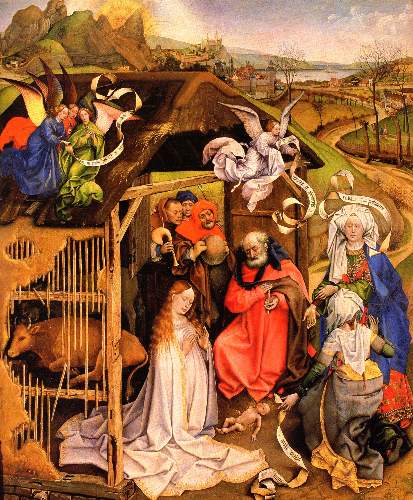
“Birth of Christ”, Robert Campin
ca. 1425-30

There is not one of us that does not love The Christmas Story.  It’s got it all–heartache, darkness, intrigue, danger, animals, innocence, an oppressive government, and a baby to boot.  It’s got all those things that make great tales.  No wonder it’s a bestseller!  No wonder there are so many songs written about it (that we at this moment cannot WAIT to sing!)  But for all the romantic notions of a baby born into a cold desert night in a small town on the other side of the world to poor, struggling parents, this story is not about a birth.  It’s not a story about Jesus.  This is the Story of God.

It began long before this.  It began in the beginning.  It began when God breathed a part of the Godself into being and created this little world.  And as the story unfolded, as God’s Creation grew into being, God remained with them, a mysterious, often unknown Presence, that yearned to be in relationship with what God had breathed into being.  And once in a while, God’s children would stop what they were doing long enough to know and acknowledge the incarnations of God.  Once in awhile, they would encounter a burning bush or a parting sea or an unfathomable cloud on the top of a mountain.  Once in awhile they would stop, take off their shoes, and feel the holiness beneath their feet.  But more often than not, they struggled in darkness, they struggled in war, they struggled in oppression and injustice because they didn’t see the Light that was with them.  God called them and God sent them and some were prophets and some were wise and some were yearning themselves to be with God.  Some wrote hymns and poetry telling of their yearning and others just bowed and hoped that God would notice.

This wasn’t enough.  It wasn’t enough for the people and it wasn’t enough for God.  God yearned to be with what God had created.  God desperately wanted humanity to be what they were made to be, to come home to the Divine.  And so God came once again, God Incarnate, into this little world.  But this time, God came as what God had created.  And so God was born into a cold, dark night.  But the earth was almost too full.  There was little room for God.  But, on that night, in a dark grotto on the outskirts of holiness, God was born.  The Divine somehow made room in a quiet, little corner of the world.  God came to show Creation what had been there all along.  And, yet, there was Newness; there was Light; there was finally Meaning; there was God Made Known.

The Incarnation (the “big I” one!) is God’s unveiling.  It is God coming out of the darkness and out of the shadows and showing us what we could not see before.  God became one of us to show us how to be like God in the world.  So, in this season, we again hear the story.  We hear the story of God.  But unless we realize that it is our story, it still won’t be enough.  God came as God Incarnate into this little world to tell the story that goes back to the beginning.  In the beginning was the Word, and the Word was with God, and the Word was God.  He was in the beginning with God.  All things came into being through him, and without him not one thing came into being.  What has come into being in him was life, and the life was the light of all people.  The light shines in the darkness, and the darkness did not overcome it.  (John 1: 1-5)  And the story continues… 

In this season of Advent, give yourself the gift of being a part of the story, of being Light, of being Life, of being who you were created to be in the beginning.  Give yourself the gift of making room for God.

Grace and Peace,

Shelli
    

WALK TO JERUSALEM: From the Water

The Jordan River,
Yardenit Baptism site, near the Lake of Galilee, Israel
Taken February, 2010

Scripture Text:  Matthew 3: 13-17
Then Jesus came from Galilee to John at the Jordan, to be baptized by him. John would have prevented him, saying, “I need to be baptized by you, and do you come to me?” But Jesus answered him, “Let it be so now; for it is proper for us in this way to fulfill all righteousness.” Then he consented. And when Jesus had been baptized, just as he came up from the water, suddenly the heavens were opened to him and he saw the Spirit of God descending like a dove and alighting on him. And a voice from heaven said, “This is my Son, the Beloved, with whom I am well pleased.”

The reading begins simply: “Then…” It is such a common connector, that we probably sort of gloss over it. But look a little more closely. It wasn’t just the thirty years that Jesus had waited to commit to public ministry. It was the centuries upon centuries and ages upon ages that all of Creation had waited for the dawn to break. In essence, from that very moment when we are told in the first chapter of Genesis that God’s Spirit swept over the face of the waters, Creation has been groaning and straining for this very moment, the very moment when life would emerge from the water.

Thirty years was, in fact, the traditional time that a rabbi waited to be committed to God. In those thirty years, Jesus would have been caring for his mother, and making a living, and preparing himself for ministry. I don’t really think that, contrary to what some may say, Jesus was confused about these roles. He was always serving God. But now…then…the time had come. And as eternity dawns, Jesus is ready to begin. And so he goes to John at the Jordan to be baptized and for a very short amount of time was then actually a disciple, a follower, of John’s.  And, from the water, the work has begun.  From the water, the heavens are opened and the Spirit emerges. And we hear what all the world has always been straining to hear: “This is my Son, the Beloved, with whom I am well pleased.” Even though the writer of the Gospel has presented Jesus as the Son of God in the birth story, it is not until this moment that the title is actually conferred. From the water, comes Jesus Christ as Savior and Redeemer of all of Creation.  From the water, comes a new Spirit. From the water, comes life.

What is it about the water in the River Jordan that so fascinates us? It’s wet and its cold—it’s just like any other water—and yet for more than 2,000 years, we have been captivated by it. When I had the opportunity to go to Israel last February, I, like most Holy Land tourists, could not wait to touch the water in the Jordan River. When that day that had the Jordan River on our itinerary arrived, I was so looking forward to it. This would be the place…this would be the place where I would connect with Jesus Christ.  Well, at the risk of bursting your idyllic Jordan River bubble, I was really disappointed. I imagined a calm and contemplative place on a quiet and peaceful river where I could have a high spiritual moment. Instead, I got Disneyland. The truth is, they have recently moved the place commemorating where Jesus was baptized (yes…I thought that was a little odd too!  The truth is, there are many views of where Jesus’ baptism took place and this one is probably the safest!) and have built a large, modern complex with a huge gift shop where busloads of people buy white robes tastefully monogrammed with the Jordan River Corporation logo so that they can get into the water and be baptized (again and again and again…). But we paid our money and went through the turnstiles and made our way to a place on the river. I hated the noise; I hated the crowds; but the river was beautiful. Somewhere in its depths, there WAS a peace, a calm, a contemplative, spiritual moment of peace. We found a place and had a short service renewing our Baptism. (And in the process had some people get upset with us because we were apparently taking prime real estate and never intending to be “really” baptized. Those [already-baptized] Methodists just always get in the way, don’t they?) And then, one by one, we walked down to the river, placed our hand in the water, and touched our forehead, reminding ourselves that we are Beloved, a son or daughter of God with whom God is well pleased. And in some way from the water, I did have a moment. In the midst of the yelling and the crowds, and the cold, modern structures, I felt the water and I felt Christ.  From the water comes life.

The truth is, there is nothing special about the water in the Jordan. There is nothing special about our own baptismal water.The truth is, when I fill the baptismal font, I usually get the water out of the second floor ladies bathroom.  (At any point in time, Creation lends water both to the Jordan and the sink in the ladies restroom at St. Paul’s!  It’s all the same!)  It’s just ordinary water. But something happens. From the water, comes life. As in the beginning of Creation, God’s Spirit once again sweeps over the waters. And from the water, our life comes. But it is up to us to do something with it. The waters are not made holy because Jesus was baptized in them; they are not made sacred because we clergy stand up there and bless them; the thing that makes them so incredible, so of God, so filled with life, is that from the water emerges the one that we are called to be, the son or daughter of God with whom God is well pleased.

In this Lenten journey, we are once again called to remember our baptism, to remember what gives us life.  Because, you see, that is the way to Jerusalem…

Grace and Peace,

Shelli